

Manse Yeoljeon
 |
Description
Book Introduction
[Commemorating the 100th Anniversary of the March 1st Movement]
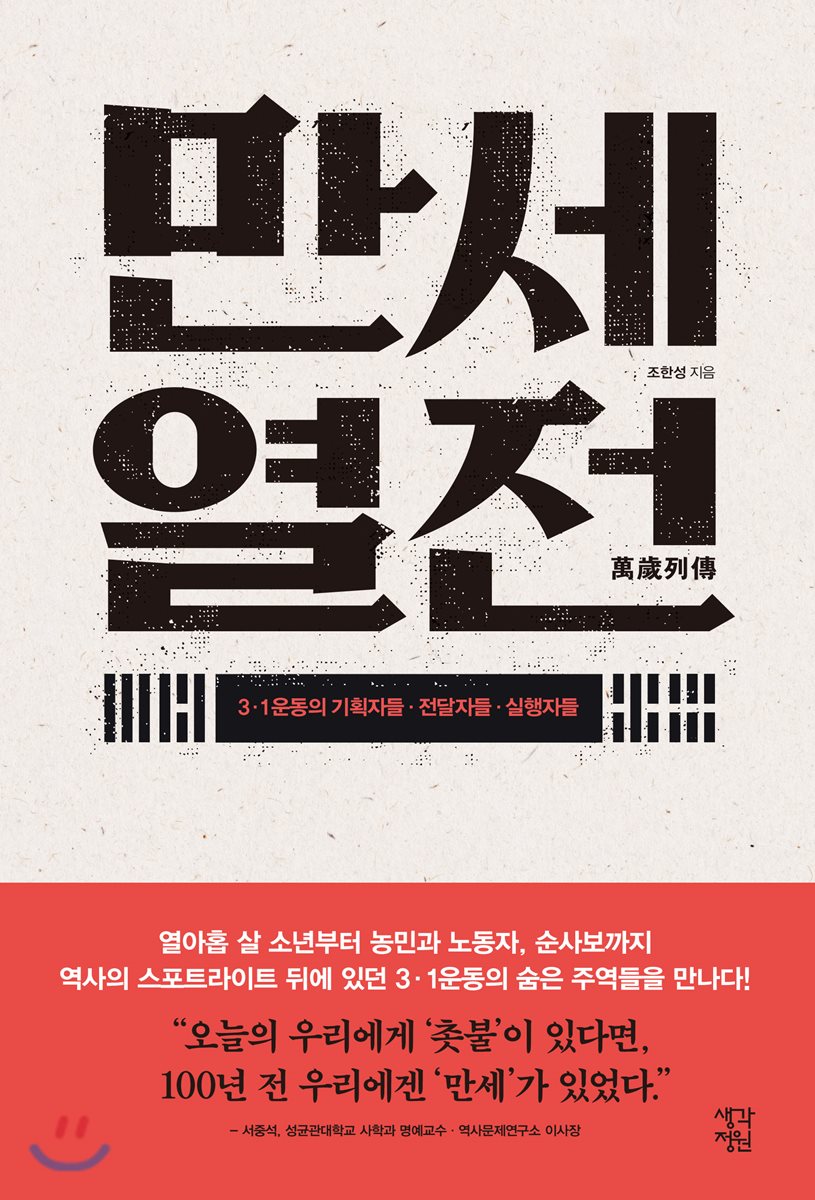
From a nineteen-year-old boy to a farmer, a worker, and a police officer
Meet the hidden heroes of the March 1st Movement who stood behind the spotlight of history!
“If we had a ‘candlelight’ today,
“100 years ago, we had ‘Manse.’”
Seo Jung-seok, Professor Emeritus of History, Sungkyunkwan University, and Director of the Institute for Historical Problems
On March 1, 1919, the land of Joseon was filled with cheers of independence... Among those who planned, communicated, and carried out the March 1st Movement, there were some prominent independence activists, but most were ordinary, unknown people.
It is no exaggeration to say that the March 1st Movement was the result of their sweat and tears, worries and conflicts, hopes and expectations, hesitation and action, from the nineteen-year-old boy who was in charge of delivering the Declaration of Independence, to the ten-year-old children who marched with flags and shouted “hurrah” following their father, to students and teachers, farmers and workers, independence activists and police officers.
But they don't appear in a single line of history books.
The hidden heroes of the March 1st Movement who stood behind the spotlight of history, 『Manse Yeoljeon』 is the story of those people.
But this book is not simply a list of historical facts, highlighting hidden protagonists.
The situations and concerns of each character, their activities, and the interrogation process by the police, prosecutors, and judges after they are caught are vividly portrayed, and the vividness and immersion, as if watching a drama, create the illusion that the reader has turned back the clock 100 years and is there 'that day' and 'that place.'
This is the moment when ‘their tears’ become ‘our tears’ and ‘their cries’ become ‘our cries’.
From a nineteen-year-old boy to a farmer, a worker, and a police officer
Meet the hidden heroes of the March 1st Movement who stood behind the spotlight of history!
“If we had a ‘candlelight’ today,
“100 years ago, we had ‘Manse.’”
Seo Jung-seok, Professor Emeritus of History, Sungkyunkwan University, and Director of the Institute for Historical Problems
On March 1, 1919, the land of Joseon was filled with cheers of independence... Among those who planned, communicated, and carried out the March 1st Movement, there were some prominent independence activists, but most were ordinary, unknown people.
It is no exaggeration to say that the March 1st Movement was the result of their sweat and tears, worries and conflicts, hopes and expectations, hesitation and action, from the nineteen-year-old boy who was in charge of delivering the Declaration of Independence, to the ten-year-old children who marched with flags and shouted “hurrah” following their father, to students and teachers, farmers and workers, independence activists and police officers.
But they don't appear in a single line of history books.
The hidden heroes of the March 1st Movement who stood behind the spotlight of history, 『Manse Yeoljeon』 is the story of those people.
But this book is not simply a list of historical facts, highlighting hidden protagonists.
The situations and concerns of each character, their activities, and the interrogation process by the police, prosecutors, and judges after they are caught are vividly portrayed, and the vividness and immersion, as if watching a drama, create the illusion that the reader has turned back the clock 100 years and is there 'that day' and 'that place.'
This is the moment when ‘their tears’ become ‘our tears’ and ‘their cries’ become ‘our cries’.
- You can preview some of the book's contents.
Preview
index
Prologue | Before Manse
Chapter 1.
When everyone despaired of darkness, there were those who resolutely lit candles: the planners.
Those Who Sowed the Seeds of Independence and Freedom: Yeo Un-hyeong and the Shinhan Youth Party
The Declaration of Independence heralds the beginning of the independence movement: Son Byeong-hui and the Cheondoists.
Beyond Doctrine, to a Cause, and to One Path: Lee Seung-hoon and Christians
Then, we will fight 'our fight': Student Leadership
Extra 1.
When did the Japanese military and police authorities and Korean intellectuals learn about the March 1st Movement?
Extra 2.
Why Sixteen-Year-Old Chae Sun-byeong Distributed Leaflets
Chapter 2.
Until the light of hope shines everywhere, risking your life to carry the torch: Messengers
The Way for Everyone to Die and Save a Million: Injongik, a Boseongsa Temple employee
A nineteen-year-old boy who simply did the usual things: Kim Dong-hyuk, a second-year student at Baejae High School.
A burning heart cannot be extinguished by guns or swords: Those who created underground newspapers and proclamations
Extra 1.
How far did the Declaration of Integrity reach?
Extra 2.
Fact Check: Truth and Fiction in Underground Newspapers
Chapter 3.
That day, cheers of "Manse" spread like wildfire across Joseon.
From ten-year-olds to students, teachers, and police officers, they all shouted "Manse" because: The Manse Demonstrators
'Mobs' or 'Righteous People'? Residents Armed with Rocks and Clubs: The Truth Behind the Police Officer's Murder
From Empire to Republic: Jang Cai-keuk and the Car Demonstration
Extra 1.
Why Did Korean High-Level Detective Shin Seung-hee Die?
Extra 2.
How the March 1st Movement Became a Massive Wave
Epilogue.
After cheering
Chapter 1.
When everyone despaired of darkness, there were those who resolutely lit candles: the planners.
Those Who Sowed the Seeds of Independence and Freedom: Yeo Un-hyeong and the Shinhan Youth Party
The Declaration of Independence heralds the beginning of the independence movement: Son Byeong-hui and the Cheondoists.
Beyond Doctrine, to a Cause, and to One Path: Lee Seung-hoon and Christians
Then, we will fight 'our fight': Student Leadership
Extra 1.
When did the Japanese military and police authorities and Korean intellectuals learn about the March 1st Movement?
Extra 2.
Why Sixteen-Year-Old Chae Sun-byeong Distributed Leaflets
Chapter 2.
Until the light of hope shines everywhere, risking your life to carry the torch: Messengers
The Way for Everyone to Die and Save a Million: Injongik, a Boseongsa Temple employee
A nineteen-year-old boy who simply did the usual things: Kim Dong-hyuk, a second-year student at Baejae High School.
A burning heart cannot be extinguished by guns or swords: Those who created underground newspapers and proclamations
Extra 1.
How far did the Declaration of Integrity reach?
Extra 2.
Fact Check: Truth and Fiction in Underground Newspapers
Chapter 3.
That day, cheers of "Manse" spread like wildfire across Joseon.
From ten-year-olds to students, teachers, and police officers, they all shouted "Manse" because: The Manse Demonstrators
'Mobs' or 'Righteous People'? Residents Armed with Rocks and Clubs: The Truth Behind the Police Officer's Murder
From Empire to Republic: Jang Cai-keuk and the Car Demonstration
Extra 1.
Why Did Korean High-Level Detective Shin Seung-hee Die?
Extra 2.
How the March 1st Movement Became a Massive Wave
Epilogue.
After cheering
Detailed image
Into the book
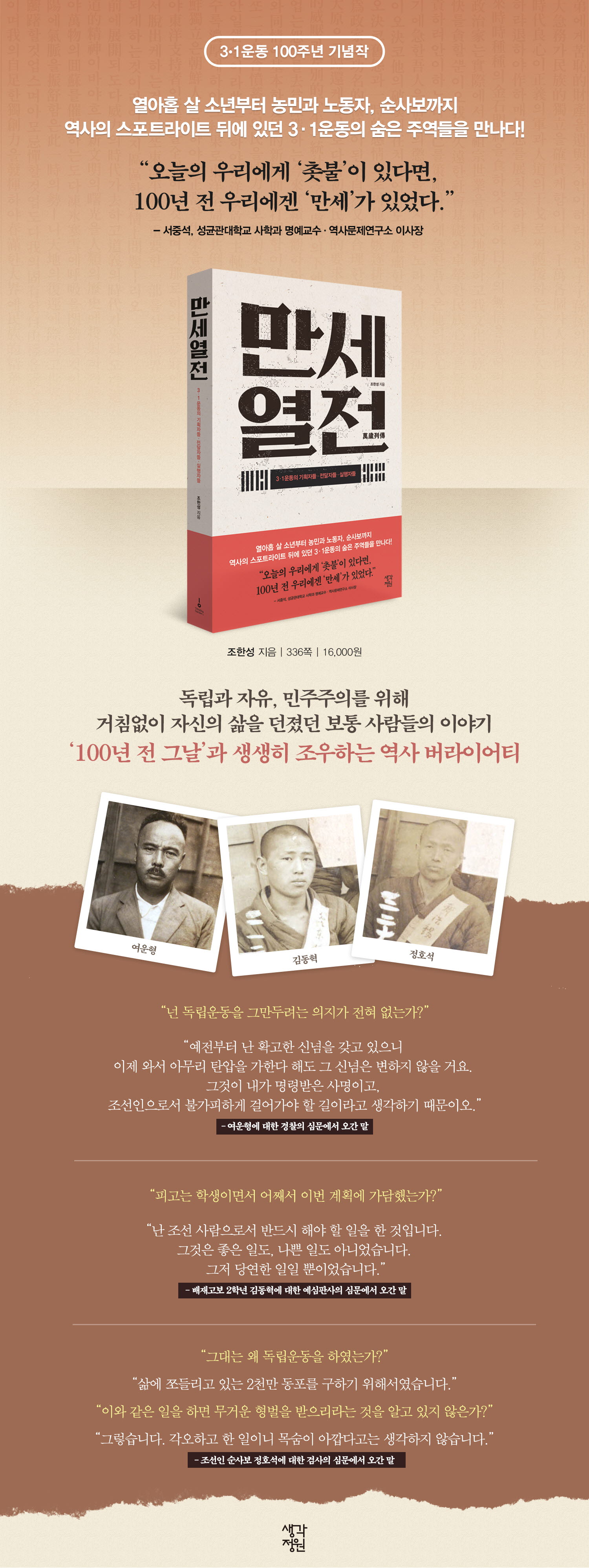
The Gyeonggi Provincial Police Agency's interrogation was conducted six times in total from July 18th to 27th.
The aim was to examine in detail most of Yeo Un-hyeong's life from his exile to China in 1914 until his arrest in 1929.
One day, during a boring question-and-answer session, the police officer suddenly asked.
“What were your impressions after arriving in Joseon?”
“When I crossed over to Shanghai, the world war had just broken out, and I dreamed that in 10 or 15 years, the world’s trends would change significantly, and that I would one day be able to make a glorious and shining return to my homeland.
But now, it has become a complete dream, and I cannot help but shed tears of sorrow as I come across this mountain while being caught by the police.
This is my first impression.
Next is… … ”
“What next?”
“I got off in Busan and saw the mountains along the coast.
I was surprised to see that the mountain I had seen before had completely changed into a green mountain.
However, I was quite disappointed to see no signs of change or progress in the villages of my compatriots on the coast.
“The governor-general’s politics may be able to turn a barren mountain into a green mountain, but what can’t they do about the people’s lives?”
“Do you have absolutely no intention of giving up the independence movement?”
“I have always had firm convictions, so no matter how much oppression is applied now, those convictions will not change.
“Because I believe that this is the mission I have been given and the path I must inevitably walk as a Korean.” --- From “People Who Sowed the Seeds of Independence and Freedom: Yeo Un-hyeong and the New Korea Youth Party”
A little after nine o'clock, two rickshaws appeared from the crowd.
The young men riding the rickshaw held flags with the words “Korean Independence” written on them, as if they had made a prior agreement.
It was Kang Ki-deok and Kim Won-byeok.
The crowd began to march, led by rickshaws.
Shouts of "Manse" shook the entire city.
Koreans became one with 'Manse'.
They fought for independence, democracy and freedom.
At some point, they began to dream of a new world.
It was a world where no one was oppressed, no one was discriminated against, and no one was exploited.
Kang Ki-deok was arrested by the police just 10 minutes after the protest began.
Kim Won-byeok lasted a little longer, but not for very long either.
Because they lack experience in protests, they are not familiar with how to protect leaders.
But it was still okay.
Because you can learn that stuff quickly.
And then someone else will pick up the flag they dropped and wave it.
It was not spring yet.
But the hearts of the Korean people were already in the spring.
---From "Then, We Will Fight 'Our Fight': Student Leadership"
“What more can I hide now?
I will tell you everything.”
Injongik opened his mouth.
He was brought into the interrogation room half-dead from the continuous interrogation.
It was such a gruesome sight that anyone who knew him would turn their head away, unable to bear to look at it.
He wiped the corner of his mouth, which was stained with blood, and tried to open his eyes, which were not very good, and looked ahead.
Comrades from the year of Gap-o once again appeared before my eyes.
Judging by his excited expression, it must have been around the time he took over Daeheung Government Office that fall.
Injongik belonged to the peasant army led by Park Deok-chil, the commander of the Yepo Peasant Army, and the capture of the Daeheung government office was the most brilliant achievement of the Yepo Peasant Army.
(…)
“If there were a way for everyone to die and save a million people, I would be willing to die.
If you kill ten thousand people, the blood of ten thousand people will stain millions. If you kill one million people, the blood of one million people will stain ten million.
Then, wouldn’t we be able to get good results in the end?”
“What will happen to your family if you go to prison?”
"Are you worried about my family right now? My family will find its own way to self-sufficiency." --- From "The Way Ten Thousands Die to Save a Million: Injongik, a Boseongsa Temple employee."
What was Dong-hyeok's mindset when he distributed the Declaration of Independence, distributed the [Joseon Independence Newspaper], and shouted "Manse" at the young age of 19?
Perhaps what he said at the preliminary hearing was closest to the truth.
Donghyuk stood before the preliminary examination judge.
The examining judge asks.
“Why did the defendant, a student, participate in this plan?”
Donghyuk answered.
“I did what I had to do as a Korean.
It was neither a good thing nor a bad thing.
“It was just a normal thing.” --- From “A Nineteen-Year-Old Boy Who Did Just a Normal Thing: Kim Dong-hyuk, a Sophomore at Baejae High School”
The independence demonstrations also moved the hearts of the police officers.
At 9:30 a.m. on March 5, Jeong Ho-seok (34 years old), a police officer working at Deoksugung Police Station, took a leave of absence on the pretext that his child was sick.
He took off his police uniform and changed into plain clothes, bought a piece of wood from a general store at Seodaemun intersection, and returned home.
After asking his wife to bring him a plate, Jeong Ho-seok pulled out a knife and tried to cut off her fourth finger.
When his wife and mother tried to stop him, he bit off the second joint of his fourth finger with his mouth instead of the knife.
After putting his own blood in a plate, he drew the Taegeukgi on a wooden board with his blood.
On another piece of wood that was in the house, he wrote 'Long live the independence of Korea' along with the Emperor of Heaven.
He tied the sticks to a cigarette butt and headed to Heungyeong Girls' School near his house.
Jeong Ho-seok entered the school, cheered for the first time, and then asked if they wanted to cheer for the first time together.
Then a young female student came out and shouted "Manse!"
She was Jeong Ho-seok's ten-year-old daughter.
As she stepped out, her friends followed.
Jeong Ho-seok headed to Gongdeok-ri, waving the flag and shouting “Manse!”
It was the road to Gyeongseong.
Dozens of girls followed behind him, shouting "Manse!"
The two teachers who had been hesitating also followed the children, shouting "Manse!"
This is how the youngest protest group in the history of the March 1st Movement was created.
The aim was to examine in detail most of Yeo Un-hyeong's life from his exile to China in 1914 until his arrest in 1929.
One day, during a boring question-and-answer session, the police officer suddenly asked.
“What were your impressions after arriving in Joseon?”
“When I crossed over to Shanghai, the world war had just broken out, and I dreamed that in 10 or 15 years, the world’s trends would change significantly, and that I would one day be able to make a glorious and shining return to my homeland.
But now, it has become a complete dream, and I cannot help but shed tears of sorrow as I come across this mountain while being caught by the police.
This is my first impression.
Next is… … ”
“What next?”
“I got off in Busan and saw the mountains along the coast.
I was surprised to see that the mountain I had seen before had completely changed into a green mountain.
However, I was quite disappointed to see no signs of change or progress in the villages of my compatriots on the coast.
“The governor-general’s politics may be able to turn a barren mountain into a green mountain, but what can’t they do about the people’s lives?”
“Do you have absolutely no intention of giving up the independence movement?”
“I have always had firm convictions, so no matter how much oppression is applied now, those convictions will not change.
“Because I believe that this is the mission I have been given and the path I must inevitably walk as a Korean.” --- From “People Who Sowed the Seeds of Independence and Freedom: Yeo Un-hyeong and the New Korea Youth Party”
A little after nine o'clock, two rickshaws appeared from the crowd.
The young men riding the rickshaw held flags with the words “Korean Independence” written on them, as if they had made a prior agreement.
It was Kang Ki-deok and Kim Won-byeok.
The crowd began to march, led by rickshaws.
Shouts of "Manse" shook the entire city.
Koreans became one with 'Manse'.
They fought for independence, democracy and freedom.
At some point, they began to dream of a new world.
It was a world where no one was oppressed, no one was discriminated against, and no one was exploited.
Kang Ki-deok was arrested by the police just 10 minutes after the protest began.
Kim Won-byeok lasted a little longer, but not for very long either.
Because they lack experience in protests, they are not familiar with how to protect leaders.
But it was still okay.
Because you can learn that stuff quickly.
And then someone else will pick up the flag they dropped and wave it.
It was not spring yet.
But the hearts of the Korean people were already in the spring.
---From "Then, We Will Fight 'Our Fight': Student Leadership"
“What more can I hide now?
I will tell you everything.”
Injongik opened his mouth.
He was brought into the interrogation room half-dead from the continuous interrogation.
It was such a gruesome sight that anyone who knew him would turn their head away, unable to bear to look at it.
He wiped the corner of his mouth, which was stained with blood, and tried to open his eyes, which were not very good, and looked ahead.
Comrades from the year of Gap-o once again appeared before my eyes.
Judging by his excited expression, it must have been around the time he took over Daeheung Government Office that fall.
Injongik belonged to the peasant army led by Park Deok-chil, the commander of the Yepo Peasant Army, and the capture of the Daeheung government office was the most brilliant achievement of the Yepo Peasant Army.
(…)
“If there were a way for everyone to die and save a million people, I would be willing to die.
If you kill ten thousand people, the blood of ten thousand people will stain millions. If you kill one million people, the blood of one million people will stain ten million.
Then, wouldn’t we be able to get good results in the end?”
“What will happen to your family if you go to prison?”
"Are you worried about my family right now? My family will find its own way to self-sufficiency." --- From "The Way Ten Thousands Die to Save a Million: Injongik, a Boseongsa Temple employee."
What was Dong-hyeok's mindset when he distributed the Declaration of Independence, distributed the [Joseon Independence Newspaper], and shouted "Manse" at the young age of 19?
Perhaps what he said at the preliminary hearing was closest to the truth.
Donghyuk stood before the preliminary examination judge.
The examining judge asks.
“Why did the defendant, a student, participate in this plan?”
Donghyuk answered.
“I did what I had to do as a Korean.
It was neither a good thing nor a bad thing.
“It was just a normal thing.” --- From “A Nineteen-Year-Old Boy Who Did Just a Normal Thing: Kim Dong-hyuk, a Sophomore at Baejae High School”
The independence demonstrations also moved the hearts of the police officers.
At 9:30 a.m. on March 5, Jeong Ho-seok (34 years old), a police officer working at Deoksugung Police Station, took a leave of absence on the pretext that his child was sick.
He took off his police uniform and changed into plain clothes, bought a piece of wood from a general store at Seodaemun intersection, and returned home.
After asking his wife to bring him a plate, Jeong Ho-seok pulled out a knife and tried to cut off her fourth finger.
When his wife and mother tried to stop him, he bit off the second joint of his fourth finger with his mouth instead of the knife.
After putting his own blood in a plate, he drew the Taegeukgi on a wooden board with his blood.
On another piece of wood that was in the house, he wrote 'Long live the independence of Korea' along with the Emperor of Heaven.
He tied the sticks to a cigarette butt and headed to Heungyeong Girls' School near his house.
Jeong Ho-seok entered the school, cheered for the first time, and then asked if they wanted to cheer for the first time together.
Then a young female student came out and shouted "Manse!"
She was Jeong Ho-seok's ten-year-old daughter.
As she stepped out, her friends followed.
Jeong Ho-seok headed to Gongdeok-ri, waving the flag and shouting “Manse!”
It was the road to Gyeongseong.
Dozens of girls followed behind him, shouting "Manse!"
The two teachers who had been hesitating also followed the children, shouting "Manse!"
This is how the youngest protest group in the history of the March 1st Movement was created.
---From "From a ten-year-old child to students, teachers, and police officers, why they shouted Manse: Manse Demonstrators"
Publisher's Review
Commemorative work for the 100th anniversary of the March 1st Movement
From a nineteen-year-old boy to a farmer, a worker, and a police officer
Meet the hidden heroes of the March 1st Movement who stood behind the spotlight of history!
On March 1, 1919, until the land of Joseon was filled with cheers of independence… … From ten-year-old children who marched with flags and cheers of independence, following their fathers, to students and teachers, farmers and workers, independence activists and police officers, there were countless ‘people.’
It is no exaggeration to say that the March 1st Movement was the result of their sweat and tears, worries and conflicts, hopes and expectations, hesitation and action.
The hidden heroes of the March 1st Movement who stood behind the spotlight of history, 『Manse Yeoljeon』 is the story of those people.
“This book is the story of those who bravely sacrificed their lives for independence and freedom during the March 1st Movement.
Among them are some prominent independence activists, but most are ordinary, unknown people.
In fact, those who fought to bring democracy to this land and to establish democracy were mostly unknown, ordinary people.
They sacrificed their precious lives for democracy, yet they are not mentioned even once in history books.
The first goal of this book is to restore their lives to history.
(…) This was a task to find the truth about ordinary people hidden within the grand narrative of the March 1st Movement.” - From the prologue
For independence, freedom and democracy
Stories of ordinary people who threw their lives away without hesitation.
A historical variety show that vividly recounts the events of 100 years ago.
Every change has a 'planner' who draws a picture of the change, a 'communicator' who spreads it widely, and countless 'executors' who put it into action.
The March 1st Movement was the same.
From Yeo Un-hyeong and the Shinhan Youth Party, who sowed the seeds of independence and freedom in Joseon, to those who spread Joseon's independence movement throughout the world through underground newspapers and proclamations, to the farmers, workers, and high school students who cried out for independence, this book contains the stories of all those who planned, delivered, and carried out the March 1st Movement—indeed, everyone.
Here are just a few of them:
· People who sowed the seeds of independence and freedom | Yeo Un-hyeong and the Shinhan Youth Party |
· Beyond doctrine, toward a greater cause, toward only one path | Son Byeong-hui and the Cheondoists, Lee Seung-hoon and Christians |
· Then, we will fight 'our fight' | Student Leadership |
· The way for everyone to die and save a million people | Injongik, an office worker at Boseongsa Temple |
· A nineteen-year-old boy who just did the normal things | Kim Dong-hyuk, a second-year student at Baejae High School |
· A burning heart cannot be extinguished even with a gun or a sword | Those who created underground newspapers and proclamations |
· From ten-year-olds to students, teachers, and police officers, why they shouted “Manse” | Manse Demonstrators |
But this book is not simply a list of historical facts, highlighting hidden protagonists.
The situations and concerns of each character, their activities, and the interrogation process by the police, prosecutors, and judges after they are caught are vividly portrayed, and the vividness and immersion, as if watching a drama, create the illusion that the reader has turned back the clock 100 years and is there 'that day' and 'that place.'
This is the moment when ‘their tears’ become ‘our tears’ and ‘their cries’ become ‘our cries’.
“If we had a ‘candlelight’ today,
“100 years ago, we had ‘Manse.’”
Seo Jung-seok, Professor Emeritus of History, Sungkyunkwan University, and Director of the Institute for Historical Problems
Author Cho Han-seong, a researcher at the Institute for Research in Collaborationist Activities, argues that the March 1st Movement was not an elite movement consisting of simple declarations, but rather an organized movement carried out by various groups, including overseas groups, domestic religious groups, and student groups. He also argues that it was not a single demonstration, but a candlelight vigil held by Korean men, women, and children from all corners of the country.
Looking at court testimony, there are many records of people answering "I did what I had to do" when asked by a Japanese judge why they participated in the independence movement, which represents the sentiments of the Korean people at the time.
They are not moved by anyone.
I just did it myself because it was something I had to do.
The author meticulously examined newspaper articles, historical documents, police interrogation records, preliminary interrogation records, and trial statements from the time, attempting to vividly document the people who planned, delivered, and carried out the March 1st Movement.
As recommended by Seo Jung-seok, director of the Institute for Historical Problems, “The story of the hidden protagonists of the March 1st Movement could be seen as a process of retracing the history of candlelight vigils in the Republic of Korea.”
From a nineteen-year-old boy to a farmer, a worker, and a police officer
Meet the hidden heroes of the March 1st Movement who stood behind the spotlight of history!
On March 1, 1919, until the land of Joseon was filled with cheers of independence… … From ten-year-old children who marched with flags and cheers of independence, following their fathers, to students and teachers, farmers and workers, independence activists and police officers, there were countless ‘people.’
It is no exaggeration to say that the March 1st Movement was the result of their sweat and tears, worries and conflicts, hopes and expectations, hesitation and action.
The hidden heroes of the March 1st Movement who stood behind the spotlight of history, 『Manse Yeoljeon』 is the story of those people.
“This book is the story of those who bravely sacrificed their lives for independence and freedom during the March 1st Movement.
Among them are some prominent independence activists, but most are ordinary, unknown people.
In fact, those who fought to bring democracy to this land and to establish democracy were mostly unknown, ordinary people.
They sacrificed their precious lives for democracy, yet they are not mentioned even once in history books.
The first goal of this book is to restore their lives to history.
(…) This was a task to find the truth about ordinary people hidden within the grand narrative of the March 1st Movement.” - From the prologue
For independence, freedom and democracy
Stories of ordinary people who threw their lives away without hesitation.
A historical variety show that vividly recounts the events of 100 years ago.
Every change has a 'planner' who draws a picture of the change, a 'communicator' who spreads it widely, and countless 'executors' who put it into action.
The March 1st Movement was the same.
From Yeo Un-hyeong and the Shinhan Youth Party, who sowed the seeds of independence and freedom in Joseon, to those who spread Joseon's independence movement throughout the world through underground newspapers and proclamations, to the farmers, workers, and high school students who cried out for independence, this book contains the stories of all those who planned, delivered, and carried out the March 1st Movement—indeed, everyone.
Here are just a few of them:
· People who sowed the seeds of independence and freedom | Yeo Un-hyeong and the Shinhan Youth Party |
· Beyond doctrine, toward a greater cause, toward only one path | Son Byeong-hui and the Cheondoists, Lee Seung-hoon and Christians |
· Then, we will fight 'our fight' | Student Leadership |
· The way for everyone to die and save a million people | Injongik, an office worker at Boseongsa Temple |
· A nineteen-year-old boy who just did the normal things | Kim Dong-hyuk, a second-year student at Baejae High School |
· A burning heart cannot be extinguished even with a gun or a sword | Those who created underground newspapers and proclamations |
· From ten-year-olds to students, teachers, and police officers, why they shouted “Manse” | Manse Demonstrators |
But this book is not simply a list of historical facts, highlighting hidden protagonists.
The situations and concerns of each character, their activities, and the interrogation process by the police, prosecutors, and judges after they are caught are vividly portrayed, and the vividness and immersion, as if watching a drama, create the illusion that the reader has turned back the clock 100 years and is there 'that day' and 'that place.'
This is the moment when ‘their tears’ become ‘our tears’ and ‘their cries’ become ‘our cries’.
“If we had a ‘candlelight’ today,
“100 years ago, we had ‘Manse.’”
Seo Jung-seok, Professor Emeritus of History, Sungkyunkwan University, and Director of the Institute for Historical Problems
Author Cho Han-seong, a researcher at the Institute for Research in Collaborationist Activities, argues that the March 1st Movement was not an elite movement consisting of simple declarations, but rather an organized movement carried out by various groups, including overseas groups, domestic religious groups, and student groups. He also argues that it was not a single demonstration, but a candlelight vigil held by Korean men, women, and children from all corners of the country.
Looking at court testimony, there are many records of people answering "I did what I had to do" when asked by a Japanese judge why they participated in the independence movement, which represents the sentiments of the Korean people at the time.
They are not moved by anyone.
I just did it myself because it was something I had to do.
The author meticulously examined newspaper articles, historical documents, police interrogation records, preliminary interrogation records, and trial statements from the time, attempting to vividly document the people who planned, delivered, and carried out the March 1st Movement.
As recommended by Seo Jung-seok, director of the Institute for Historical Problems, “The story of the hidden protagonists of the March 1st Movement could be seen as a process of retracing the history of candlelight vigils in the Republic of Korea.”
GOODS SPECIFICS
- Date of issue: January 29, 2019
- Page count, weight, size: 336 pages | 594g | 153*224*30mm
- ISBN13: 9791188388752
- ISBN10: 1188388754
You may also like
카테고리
korean


korean

![GQ KOREA Mark (Monthly): December [2025]](http://librairie.coreenne.fr/cdn/shop/files/8ef265dbbfbf186523ed75ba7319009d.jpg?v=1765340328&width=3840)


