

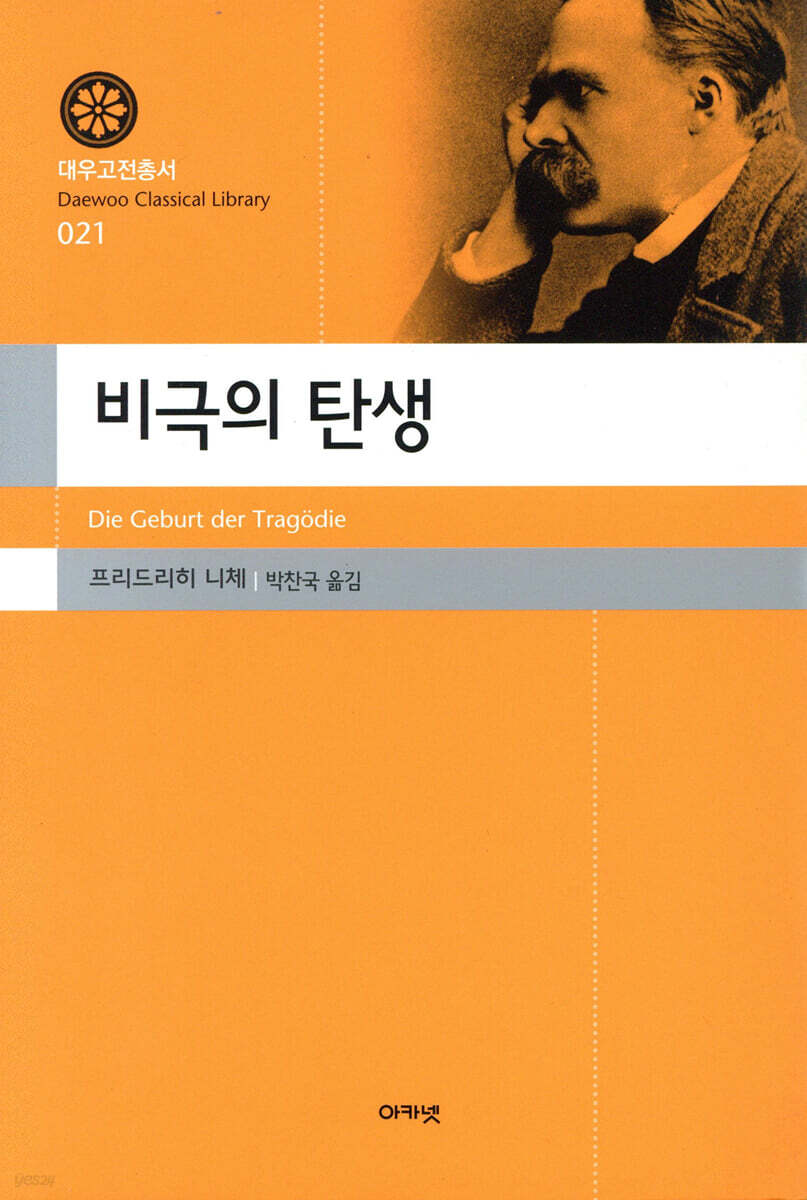
The Birth of Tragedy
 |
Description
Book Introduction
We are introducing Friedrich Nietzsche's book, The Birth of Tragedy, with the translation by Professor Park Chan-guk of the Department of Philosophy at Seoul National University, a leading scholar in the field of Nietzsche studies in Korea, who corrected errors in eight translated versions published in Korea.
The Birth of Tragedy is widely known to the world as 'Apollonian' and 'Dionysian'.
This is Nietzsche's first work, written when he was only 28 years old, and it represents the philosophy of his youth. In this book, Nietzsche deals with the birth (chapters 1-11), death (chapters 11-16), and rebirth (chapters 17 and following) of Greek tragedy. The main content is that 'Greek tragedy was born through the reconciliation of the opposing Apollonian and Dionysian elements, and tragedy met its death when the Apollonian element degenerated into Socratic logical intellectualism and the Dionysian element into the expression of everyday rough emotions, and is being resurrected through Wagner's music.'
At first glance, this book appears to be a classical philological study of the historical origins of Greek tragedy and the events that led to its downfall. However, in fact, because it challenged the classical philology of the time, its significance in the history of philosophy was even greater.
Since Socrates and Plato, Western metaphysics and Western history based on it have promoted learning based on logical intellect as the only path to truth, while belittling tragic music and myth. This book can be seen as a confrontation with that trend.
Nietzsche's ideas have continued to the present day in the Western metaphysics and Western historical critiques of Adorno, Heidegger, and postmodernism and poststructuralism.
This book also addresses the philosophical questions of art, such as what music and tragedy are and what true beauty is, the metaphysical question of what the ultimate basis of the world is, and the questions of what kind of beings humans are and how they should live.
Because of this multidimensional nature, the book has had an impact on many areas.
Above all, it has become an indispensable classic in the theory of tragedy and the philosophy of art, and the idea of 'Dionysus' developed by Nietzsche in this book is similar to that of W.
B. Yeats), Mallarmé (S.
Mallarm), Rilke (R.
It has also been an inexhaustible source of inspiration for artists such as M. Rilke and Thomas Mann.
Meanwhile, from the perspective of Nietzsche's own ideological development, this book contains the beginnings of his later developments in the ideas of eternal recurrence, the will to power, and perspectivism.
The Birth of Tragedy is widely known to the world as 'Apollonian' and 'Dionysian'.
This is Nietzsche's first work, written when he was only 28 years old, and it represents the philosophy of his youth. In this book, Nietzsche deals with the birth (chapters 1-11), death (chapters 11-16), and rebirth (chapters 17 and following) of Greek tragedy. The main content is that 'Greek tragedy was born through the reconciliation of the opposing Apollonian and Dionysian elements, and tragedy met its death when the Apollonian element degenerated into Socratic logical intellectualism and the Dionysian element into the expression of everyday rough emotions, and is being resurrected through Wagner's music.'
At first glance, this book appears to be a classical philological study of the historical origins of Greek tragedy and the events that led to its downfall. However, in fact, because it challenged the classical philology of the time, its significance in the history of philosophy was even greater.
Since Socrates and Plato, Western metaphysics and Western history based on it have promoted learning based on logical intellect as the only path to truth, while belittling tragic music and myth. This book can be seen as a confrontation with that trend.
Nietzsche's ideas have continued to the present day in the Western metaphysics and Western historical critiques of Adorno, Heidegger, and postmodernism and poststructuralism.
This book also addresses the philosophical questions of art, such as what music and tragedy are and what true beauty is, the metaphysical question of what the ultimate basis of the world is, and the questions of what kind of beings humans are and how they should live.
Because of this multidimensional nature, the book has had an impact on many areas.
Above all, it has become an indispensable classic in the theory of tragedy and the philosophy of art, and the idea of 'Dionysus' developed by Nietzsche in this book is similar to that of W.
B. Yeats), Mallarmé (S.
Mallarm), Rilke (R.
It has also been an inexhaustible source of inspiration for artists such as M. Rilke and Thomas Mann.
Meanwhile, from the perspective of Nietzsche's own ideological development, this book contains the beginnings of his later developments in the ideas of eternal recurrence, the will to power, and perspectivism.
- You can preview some of the book's contents.
Preview
index
Translator's Preface
Attempt at self-criticism
The Birth of Tragedy from the Spirit of Music
Translator's Note
Search
Attempt at self-criticism
The Birth of Tragedy from the Spirit of Music
Translator's Note
Search
Publisher's Review
Accurate and professional translation with friendly commentary and annotations
In Korea, “The Birth of Tragedy” has been translated eight times over the past 50 years.
These are the translations by Lee Wi-beom (Yangmunsa 1960), Kim Yeong-cheol (Whimoon Publishing Co., Nietzsche Complete Works Vol. 1, Modern World Thought Liberal Arts Collection Vol. 16, 1969), Lee Il-cheol (Jeong-eumsa 1976, Un-amsa 1983), Kim Byeong-ok (Daeyang Books, World Great Thought Complete Works Vol. 10, 1978, Beomjosa 1980), Park Jun-taek (Parkyoungsa 1976), Kwak Bok-rok (Dongseo Culture 1978, Beomwoo 1984, Hakwon Publishing Corporation 1993), Kim Dae-gyeong (Cheongha 1982), Seong Dong-ho (Hongsin Culture 1989), and Lee Jin-woo (Chaeksesang, 2005).
Among these, the Park Jun-taek translation was published as a paperback edition by Park Young-sa and was widely read in the 1970s, but although it was a major Japanese translation, it had many mistranslations that the Japanese translation did not make.
Meanwhile, Kim Dae-kyung's translation was the most widely read translation in the 1980s and 1990s, going through 16 editions from its publication in 1982 to 1997.
This translation has the advantage of being generally readable, but it contains several mistranslations and sometimes omits several lines from the original text.
On the other hand, the recently published translation by Lee Jin-woo corrects many of the mistranslations in the translation by Kim Dae-kyung and does not omit any parts.
However, this translation contains many mistranslations and is difficult to read due to unnatural expressions.
Meanwhile, the translations by Kwak Bok-rok (German literature) and Lee Il-cheol (English literature) are not translated by specialists in philosophy and thus lack some expertise.
In many of these translations, it is not difficult to find mistranslations and unnatural translations.
The translation of 『The Birth of Tragedy』 (Daewoo Classics Series 021), published by Akanet this time, was done by Professor Park Chan-guk of the Department of Philosophy at Seoul National University.
Professor Park Chan-guk is a leading scholar in the field of Nietzsche studies in Korea, and in this translation, he sought to correct errors in existing translations and ensure professionalism and accuracy.
In addition, detailed notes, annotations, and an index were added to help readers, including researchers, understand Nietzsche's thoughts more easily.
It is expected that the publication of this translated version will once again provide a new impetus for the study of Nietzsche's philosophy, which has been increasingly active in recent years.
In Korea, “The Birth of Tragedy” has been translated eight times over the past 50 years.
These are the translations by Lee Wi-beom (Yangmunsa 1960), Kim Yeong-cheol (Whimoon Publishing Co., Nietzsche Complete Works Vol. 1, Modern World Thought Liberal Arts Collection Vol. 16, 1969), Lee Il-cheol (Jeong-eumsa 1976, Un-amsa 1983), Kim Byeong-ok (Daeyang Books, World Great Thought Complete Works Vol. 10, 1978, Beomjosa 1980), Park Jun-taek (Parkyoungsa 1976), Kwak Bok-rok (Dongseo Culture 1978, Beomwoo 1984, Hakwon Publishing Corporation 1993), Kim Dae-gyeong (Cheongha 1982), Seong Dong-ho (Hongsin Culture 1989), and Lee Jin-woo (Chaeksesang, 2005).
Among these, the Park Jun-taek translation was published as a paperback edition by Park Young-sa and was widely read in the 1970s, but although it was a major Japanese translation, it had many mistranslations that the Japanese translation did not make.
Meanwhile, Kim Dae-kyung's translation was the most widely read translation in the 1980s and 1990s, going through 16 editions from its publication in 1982 to 1997.
This translation has the advantage of being generally readable, but it contains several mistranslations and sometimes omits several lines from the original text.
On the other hand, the recently published translation by Lee Jin-woo corrects many of the mistranslations in the translation by Kim Dae-kyung and does not omit any parts.
However, this translation contains many mistranslations and is difficult to read due to unnatural expressions.
Meanwhile, the translations by Kwak Bok-rok (German literature) and Lee Il-cheol (English literature) are not translated by specialists in philosophy and thus lack some expertise.
In many of these translations, it is not difficult to find mistranslations and unnatural translations.
The translation of 『The Birth of Tragedy』 (Daewoo Classics Series 021), published by Akanet this time, was done by Professor Park Chan-guk of the Department of Philosophy at Seoul National University.
Professor Park Chan-guk is a leading scholar in the field of Nietzsche studies in Korea, and in this translation, he sought to correct errors in existing translations and ensure professionalism and accuracy.
In addition, detailed notes, annotations, and an index were added to help readers, including researchers, understand Nietzsche's thoughts more easily.
It is expected that the publication of this translated version will once again provide a new impetus for the study of Nietzsche's philosophy, which has been increasingly active in recent years.
GOODS SPECIFICS
- Date of issue: September 10, 2007
- Format: Hardcover book binding method guide
- Page count, weight, size: 356 pages | 482g | Checking size
- ISBN13: 9788957331071
- ISBN10: 8957331077
You may also like
카테고리
korean


korean

![GQ KOREA Mark (Monthly): December [2025]](http://librairie.coreenne.fr/cdn/shop/files/8ef265dbbfbf186523ed75ba7319009d.jpg?v=1765340328&width=3840)


