

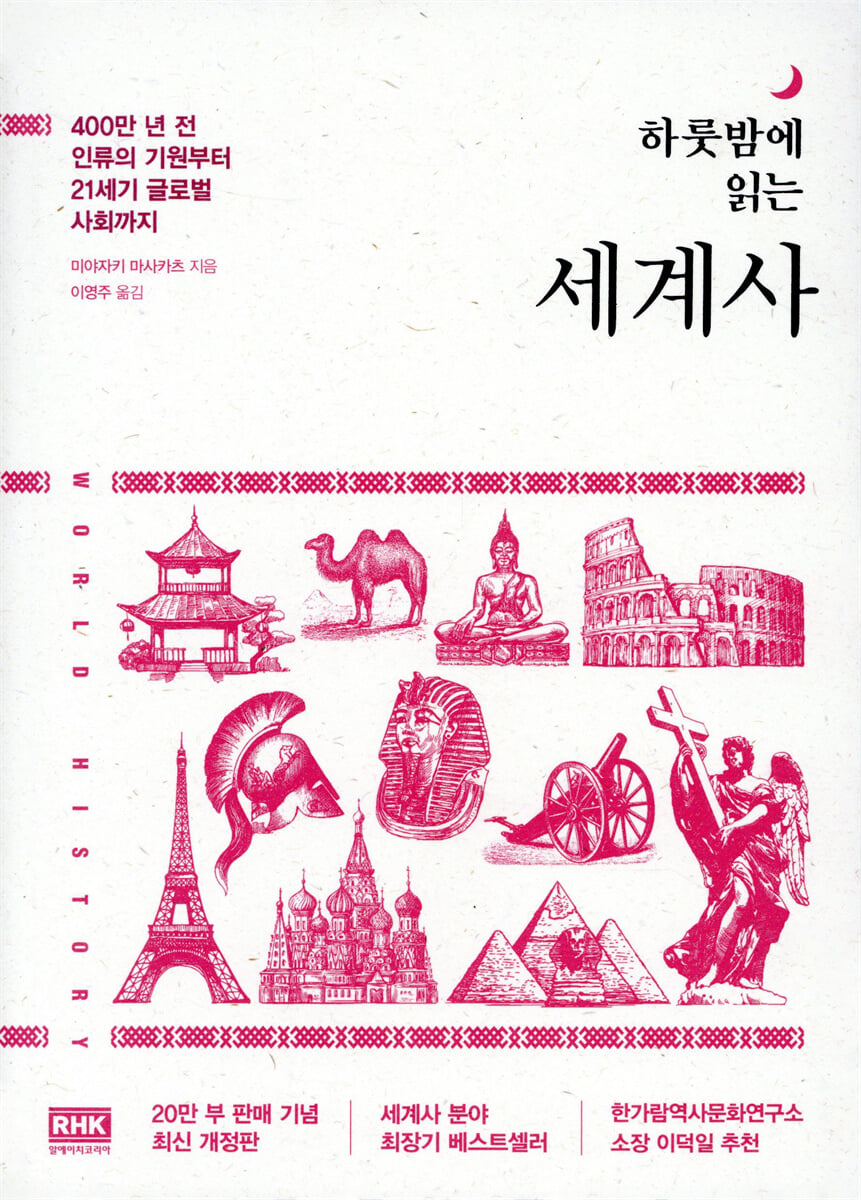
World History in One Night
 |
Description
Book Introduction
History is a conversation with the future.
A record of the world's reorganization through birth, connection, and re-expansion.
Meet the latest revised edition
For nearly 20 years since its first publication, "A World History in One Night" has received an unprecedented explosive response in the humanities field, becoming an immediate bestseller.
The One Night series, which covers the breadth and depth of history by organizing important events and topics by period and by subject, and provides a wealth of visual material to clearly convey vast knowledge, is without a doubt the bible of humanities books.
The author, who was a full-time lecturer for a popular subject on NHK Lectures, Japan's beloved "national educational broadcast," has written a high school world history textbook, making full use of his 30 years of experience as a high school teacher and professor at a teacher's college.
In the mid-1990s, he received a proposal to publish a general education book with the concept of “a history of the world that can be read in one night.”
Rather than focusing solely on Europe and China, as was the case with past history books, the book breaks down the major flow of history into five keywords: the era of conflict between various worlds, the era of Eurasian integration, the era of the formation of capitalism in the Atlantic world, the era of conquest in 19th-century Europe, and the era of global revolution ahead of the 21st century. The book describes the content in a way that makes it easy to understand at a glance.
Since its first publication in Japan in 1998, this book has been the most beloved history book among Japanese readers for 20 years, setting a precedent for how the greatest number of readers can effectively understand and utilize world history.
In this latest revised edition, we have comprehensively reviewed and corrected errors in the content of the revised edition from 10 years ago, which laid the foundation for the publication intention and understanding of world history in the first edition. We have also highlighted keywords of world history to ensure that current readers have no difficulty understanding them, and organized it so that major events in world history can be easily remembered just by looking at the title.
If we follow the great moments of human choice over the course of 'one night', we will see that the agony and efforts of humanity from prehistoric times to the present are in no way different from the present.
A record of the world's reorganization through birth, connection, and re-expansion.
Meet the latest revised edition
For nearly 20 years since its first publication, "A World History in One Night" has received an unprecedented explosive response in the humanities field, becoming an immediate bestseller.
The One Night series, which covers the breadth and depth of history by organizing important events and topics by period and by subject, and provides a wealth of visual material to clearly convey vast knowledge, is without a doubt the bible of humanities books.
The author, who was a full-time lecturer for a popular subject on NHK Lectures, Japan's beloved "national educational broadcast," has written a high school world history textbook, making full use of his 30 years of experience as a high school teacher and professor at a teacher's college.
In the mid-1990s, he received a proposal to publish a general education book with the concept of “a history of the world that can be read in one night.”
Rather than focusing solely on Europe and China, as was the case with past history books, the book breaks down the major flow of history into five keywords: the era of conflict between various worlds, the era of Eurasian integration, the era of the formation of capitalism in the Atlantic world, the era of conquest in 19th-century Europe, and the era of global revolution ahead of the 21st century. The book describes the content in a way that makes it easy to understand at a glance.
Since its first publication in Japan in 1998, this book has been the most beloved history book among Japanese readers for 20 years, setting a precedent for how the greatest number of readers can effectively understand and utilize world history.
In this latest revised edition, we have comprehensively reviewed and corrected errors in the content of the revised edition from 10 years ago, which laid the foundation for the publication intention and understanding of world history in the first edition. We have also highlighted keywords of world history to ensure that current readers have no difficulty understanding them, and organized it so that major events in world history can be easily remembered just by looking at the title.
If we follow the great moments of human choice over the course of 'one night', we will see that the agony and efforts of humanity from prehistoric times to the present are in no way different from the present.
- You can preview some of the book's contents.
Preview
index
Recommendation
Preface to the Revised and Expanded Edition
Preface to the first edition
Grasping the flow of world history
Part 1: The Beginning of World History
Chapter 1: Agricultural Revolution and Urban Revolution
Origin of Humanity: Humanity Spreading from Africa to the World
The Agricultural Revolution: Agriculture, the Revolution That Changed Human History
Civilization formed by the urban revolution
COLUMN 01 A perfect road network symbolizes the king's power!
The first four worlds created in Part 2
Chapter 2: The Birth of the West Asian World
The 'Genesis' civilization built from clay in Mesopotamia
Babylonian Kingdom Babylonian Kingdom's Code of Hammurabi
Ancient Egyptian civilization: a civilization that developed on fertile land created by rain and floods
The origin of the expanded alphabet of the Oriental world is the Phoenician alphabet.
The Birth of Judaism: Judaism Developed by the Suffering of the Hebrews
The Achaemenid Dynasty (Persian Empire), the fall of Assyria, and the reunification of the Orient by Persia
Persian culture spread east and west through the Parthians and Sassanids
COLUMN 02 Are the Roman gods and Maitreya Buddha the same thing?
Chapter 3: The Birth of the Mediterranean World
Athens and Sparta, over 1,000 poleis gathered in the Aegean Sea
The Persian Wars and the Peloponnesian War: The collapse of the polis hastened by victory in the Persian Wars.
The great empire founded by Alexander the Great during the Hellenistic period
Rome, the city-state that dominated the Mediterranean, the Republic of Rome
Roman Empire ① From the Triumvirate to the Empire
Roman Empire ② Rome divided into East and West after the Five Good Emperors
Christianity became the state religion of Rome after overcoming the era of persecution.
COLUMN 03 Cleopatra, the Beauty Who Led the Hellenistic World
Chapter 4: The Indian World and Southeast Asia
Indus Civilization From the Indus River Civilization to the Ganges River Civilization
The establishment of Buddhism Buddhism originated in India and spread throughout Asia.
India, which entered a period of chaos and the founding of Hinduism under the various dynasties of ancient India.
A culture that left behind massive structures influenced by India in Southeast Asia
Chapter 5: The Birth of the East Asian World
The Golden Civilization Born from the Yellow River: From the Yellow River Civilization to the Yin and Zhou Dynasties
The 550 years of chaos during which the feudal lords of the Spring and Autumn Period fought fiercely
The origins of Chinese thought that emerged in the late Spring and Autumn Period
The great empire of Qin, China's first unified dynasty, disappeared after 15 years.
The Han Empire, which laid the foundation for the prosperity of Chinese civilization
The prosperity of the Later Han Dynasty The Han Dynasty interacted with the Roman Empire through the Silk Road and sea routes.
The culture flowing from the Korean Peninsula to Japan, China → Korean Peninsula → Japan
A nomadic military power that declined with the advent of firearms during the nomadic era
The city-states that supported the Silk Road
The Age of Exploration also existed in the sea world and port-states of Eurasia.
COLUMN 04 Were there 10 suns in ancient times?
The Eurasian World Connected as One Part 3
Chapter 6: Changing East Asia
From the Three Kingdoms period to the Five and Sixteen Kingdoms period, the miserable Three Kingdoms period and the hundred-year-long Five and Sixteen Kingdoms period
Sinicization of nomadic incursions from the Northern and Southern Dynasties to the unification of Sui
Buddhism and Taoism in China Buddhism and Taoism take root throughout China
The Sui Dynasty was destroyed after 38 years due to large-scale civil engineering projects and frequent expeditions.
The Rise and Decline of the Tang Dynasty ① Empress Wu Zetian, the Only Empress in Chinese History
The Rise and Fall of the Tang Dynasty ② The Tang Dynasty Collapses Due to the Rebellion of Yang Guifei and An Si
The Song Dynasty adopted civil service, but was marred by corruption.
Song had the financial resources to develop the economy, but it was powerless.
The Rise of the Northern Peoples The Chinese Empire Subdued by the Northern Peoples
COLUMN 05 Jang'an, the international city where peonies bloom in profusion
Chapter 7: The Birth of Western Europe
The Roman Empire splits due to the Great Migration of the Germanic Peoples
The Transformation of the Frankish Kingdom and the Birth of Western Europe with the Coronation of Charlemagne
The Vikings and the Vikings who developed the 'river trade route' from the Baltic Sea to the Black Sea in Eastern and Western Europe
A millennium-long empire that lasted even as the Byzantine (Eastern Roman) Empire declined
The Humiliation of Canossa, which strengthened the papacy and the conflict between the emperor and the pope
The Crusades strengthened the power of the Crusader kings and enriched merchants.
The revival of medieval European cities and the urban network created by the Crusades
France revived by Joan of Arc during the Hundred Years' War
A new culture born from the economic development of Renaissance Italy
COLUMN 06 Brightening Europe and the Pied Piper of Hamelin
Chapter 8: The Age of Nomads
From the Founding of Islam to the Large-Scale Conquests of the Arab Empire
Understanding Islam Islam based on the norms of the Quran
From the Umayyad Dynasty to the Abbasid Dynasty, from the Arab Empire to the Islamic Empire
The Arabian Nights era, when international trade in the Islamic commercial sphere took place
Islamic civilization Europe learned from Islamic civilization
The Turks who conquered the Islamic world during the Turkic era
The Secret of Genghis Khan's Mighty Army
The Mongol Empire, which connected the Eastern and Western worlds
A world-class network built by the Mongolians: a ring network of sea and land
Chapter 9: The Reorganizing Eurasian World
The decline of the Mongol Empire The rapid decline of the Mongol Empire, which influenced the development of the world economy.
The Ming Dynasty, a Chinese empire revived by a poor peasant from Mongolia
The fall of the Ming Dynasty, the fate of the Ming Dynasty shaken by massive spending
The Qing Dynasty, a country with a queue that lasted for 300 years
Southeast Asia Islamized through commercial development
Another Mongol Empire rebuilt in Mughal India
The Ottoman Empire and the Mediterranean world are once again engulfed in Islamization.
COLUMN 07 This is how Constantinople disappeared
Part 4: The Age of Exploration and the Expansion of Europe
Chapter 10: A Changing Europe
The protagonists of the Age of Exploration, a time of swirling ideas.
The Inca Empire and the Aztec Empire, which were fresh civilizations in the Americas.
The Transformation of the American Continent: America Reformed by the Spanish
The New World and Commerce: The Declining Americas and the Rising Europe
The Reformation began with the issuance of indulgences during the Religious Revolution.
The era of religious wars and the horrific witch hunts that arose from religious conflict.
The hegemony of the merchant nation of the Netherlands, which monopolized trade with Japan
From the Puritan Revolution in England to the cabinet system
The European state system has changed over time as European sovereign states have emerged.
Prussia, Russia, and Poland: The Rise of Prussia and Russia, and the Fall of Poland
The war between Britain and France to dominate the world of colonial activities of Western European countries.
COLUMN 08 The Netherlands, a Merchant Nation Made of Herring
Part 5: The Age of European Conquest
Chapter 11: The Emergence of the Nation-State
The Industrial Revolution in England, which began in Calico
French Revolution ① Storming the Bastille by Men in Long Trousers
French Revolution ② The 'Nation-State' Born from the French Revolution
The Rise of Napoleon: Was Napoleon a Hero or a Fool?
Napoleon's Glory and Frustration: Napoleon's Strategy of Demonstrating His Power through Conscription
International order maintained under the Vienna Convention
The July and February Revolutions in France, which occurred because of the right to vote.
The Chartist Movement and the Reform of the Electoral Act The Chartist Movement of Workers Disenfranchised from Elections
The World's Fair, a display of Victorian economic power, and the start of the Great Depression
The collapse of the Second French Empire and Russia's southward expansion policy in Europe
Unification of Italy and Germany, War of Unification with Austria
Chapter 12: American Independence
The United States of America, 13 colonies in North America during the colonial era
The American Revolutionary War, the Boston Tea Party, and the Publication of "Common Sense"
The formation of the United States of America, the expansion of the United States' territory, and the prelude to the American Civil War
The Civil War and the New America Surrounding Slavery
Independence of Latin America Incomplete independence of Latin America
COLUMN 09 Jefferson, the Man Who Created the United States of America
Chapter 13: Expanding Europe
The Eastern Question: Great powers seeking to gain advantage by taking advantage of the decline of the Ottoman Empire
The formation of colonial India and the prosperity of Britain based on India
The Opium War, the War Caused by Black Tea, and the Treaty of Nanking
Britain and France, who seized the Qing's weaknesses in the Taiping Rebellion and the Arrow Rebellion
The Self-War Movement and the Meiji Restoration, China's development of Western and Chinese cultures, and Japan's enlightenment
The Sino-Japanese War brought great powers together in Qing.
The Birth of Imperialism: The Great Depression, Imperialism, and Foreign Expansion
The strategy of partitioning Africa, which began in the Congo
The United States laid the foundation for its Pacific expansion through a magnificent small war.
The Russo-Japanese War: Japan's Reckless Challenge and Difficult Victory
The Fall of the Qing Dynasty and the Unfinished Revolution
Part 6: Western Europe's Decline After Two World Wars
Chapter 14: World War I and Europe
World War I ① The European powder keg that exploded with the Sarajevo Incident
World War I ② The outcome of World War I determined by the United States
The Russian Revolution, the world's first socialist revolution and the Bolshevik dictatorship
The Soviet Union was formed by the union of four republics.
Versailles System ① Paris Peace Conference and the Treaty of Versailles
Versailles System ② Inflation in Germany and the Rise of Fascism in Italy
The Washington System: A New World with the United States as the Leading Force
The nationalist movement of Turks and Indians, the establishment of the Republic of Turkey, and Gandhi's Salt March
The Chinese Revolution, which began with a single East Asian nationalist magazine
COLUMN 10 The sudden collapse of the world
Chapter 15: World War II and the Transformation of the World
The Great Depression and the New Deal, which spread across the world
The collapse of the Versailles system and the Nazis' popular support
The Second Sino-Japanese War, with the Kuomintang-Communist alliance and Japan's apparent defeat
World War II ① The second great war that began with the unification of Germany
World War II ② 1942, the turning point
World peace protected by the United Nations' "Five Police Officers"
The establishment of the IMF system and the world economy under the dominance of the dollar
The Cold War unfolds, and the conflict between liberalism and socialism intensifies.
North Korea invaded South Korea during the Korean War
The Palestinian issue caused by Britain's secret agreement during the Middle East war
World history thereafter
Preface to the Revised and Expanded Edition
Preface to the first edition
Grasping the flow of world history
Part 1: The Beginning of World History
Chapter 1: Agricultural Revolution and Urban Revolution
Origin of Humanity: Humanity Spreading from Africa to the World
The Agricultural Revolution: Agriculture, the Revolution That Changed Human History
Civilization formed by the urban revolution
COLUMN 01 A perfect road network symbolizes the king's power!
The first four worlds created in Part 2
Chapter 2: The Birth of the West Asian World
The 'Genesis' civilization built from clay in Mesopotamia
Babylonian Kingdom Babylonian Kingdom's Code of Hammurabi
Ancient Egyptian civilization: a civilization that developed on fertile land created by rain and floods
The origin of the expanded alphabet of the Oriental world is the Phoenician alphabet.
The Birth of Judaism: Judaism Developed by the Suffering of the Hebrews
The Achaemenid Dynasty (Persian Empire), the fall of Assyria, and the reunification of the Orient by Persia
Persian culture spread east and west through the Parthians and Sassanids
COLUMN 02 Are the Roman gods and Maitreya Buddha the same thing?
Chapter 3: The Birth of the Mediterranean World
Athens and Sparta, over 1,000 poleis gathered in the Aegean Sea
The Persian Wars and the Peloponnesian War: The collapse of the polis hastened by victory in the Persian Wars.
The great empire founded by Alexander the Great during the Hellenistic period
Rome, the city-state that dominated the Mediterranean, the Republic of Rome
Roman Empire ① From the Triumvirate to the Empire
Roman Empire ② Rome divided into East and West after the Five Good Emperors
Christianity became the state religion of Rome after overcoming the era of persecution.
COLUMN 03 Cleopatra, the Beauty Who Led the Hellenistic World
Chapter 4: The Indian World and Southeast Asia
Indus Civilization From the Indus River Civilization to the Ganges River Civilization
The establishment of Buddhism Buddhism originated in India and spread throughout Asia.
India, which entered a period of chaos and the founding of Hinduism under the various dynasties of ancient India.
A culture that left behind massive structures influenced by India in Southeast Asia
Chapter 5: The Birth of the East Asian World
The Golden Civilization Born from the Yellow River: From the Yellow River Civilization to the Yin and Zhou Dynasties
The 550 years of chaos during which the feudal lords of the Spring and Autumn Period fought fiercely
The origins of Chinese thought that emerged in the late Spring and Autumn Period
The great empire of Qin, China's first unified dynasty, disappeared after 15 years.
The Han Empire, which laid the foundation for the prosperity of Chinese civilization
The prosperity of the Later Han Dynasty The Han Dynasty interacted with the Roman Empire through the Silk Road and sea routes.
The culture flowing from the Korean Peninsula to Japan, China → Korean Peninsula → Japan
A nomadic military power that declined with the advent of firearms during the nomadic era
The city-states that supported the Silk Road
The Age of Exploration also existed in the sea world and port-states of Eurasia.
COLUMN 04 Were there 10 suns in ancient times?
The Eurasian World Connected as One Part 3
Chapter 6: Changing East Asia
From the Three Kingdoms period to the Five and Sixteen Kingdoms period, the miserable Three Kingdoms period and the hundred-year-long Five and Sixteen Kingdoms period
Sinicization of nomadic incursions from the Northern and Southern Dynasties to the unification of Sui
Buddhism and Taoism in China Buddhism and Taoism take root throughout China
The Sui Dynasty was destroyed after 38 years due to large-scale civil engineering projects and frequent expeditions.
The Rise and Decline of the Tang Dynasty ① Empress Wu Zetian, the Only Empress in Chinese History
The Rise and Fall of the Tang Dynasty ② The Tang Dynasty Collapses Due to the Rebellion of Yang Guifei and An Si
The Song Dynasty adopted civil service, but was marred by corruption.
Song had the financial resources to develop the economy, but it was powerless.
The Rise of the Northern Peoples The Chinese Empire Subdued by the Northern Peoples
COLUMN 05 Jang'an, the international city where peonies bloom in profusion
Chapter 7: The Birth of Western Europe
The Roman Empire splits due to the Great Migration of the Germanic Peoples
The Transformation of the Frankish Kingdom and the Birth of Western Europe with the Coronation of Charlemagne
The Vikings and the Vikings who developed the 'river trade route' from the Baltic Sea to the Black Sea in Eastern and Western Europe
A millennium-long empire that lasted even as the Byzantine (Eastern Roman) Empire declined
The Humiliation of Canossa, which strengthened the papacy and the conflict between the emperor and the pope
The Crusades strengthened the power of the Crusader kings and enriched merchants.
The revival of medieval European cities and the urban network created by the Crusades
France revived by Joan of Arc during the Hundred Years' War
A new culture born from the economic development of Renaissance Italy
COLUMN 06 Brightening Europe and the Pied Piper of Hamelin
Chapter 8: The Age of Nomads
From the Founding of Islam to the Large-Scale Conquests of the Arab Empire
Understanding Islam Islam based on the norms of the Quran
From the Umayyad Dynasty to the Abbasid Dynasty, from the Arab Empire to the Islamic Empire
The Arabian Nights era, when international trade in the Islamic commercial sphere took place
Islamic civilization Europe learned from Islamic civilization
The Turks who conquered the Islamic world during the Turkic era
The Secret of Genghis Khan's Mighty Army
The Mongol Empire, which connected the Eastern and Western worlds
A world-class network built by the Mongolians: a ring network of sea and land
Chapter 9: The Reorganizing Eurasian World
The decline of the Mongol Empire The rapid decline of the Mongol Empire, which influenced the development of the world economy.
The Ming Dynasty, a Chinese empire revived by a poor peasant from Mongolia
The fall of the Ming Dynasty, the fate of the Ming Dynasty shaken by massive spending
The Qing Dynasty, a country with a queue that lasted for 300 years
Southeast Asia Islamized through commercial development
Another Mongol Empire rebuilt in Mughal India
The Ottoman Empire and the Mediterranean world are once again engulfed in Islamization.
COLUMN 07 This is how Constantinople disappeared
Part 4: The Age of Exploration and the Expansion of Europe
Chapter 10: A Changing Europe
The protagonists of the Age of Exploration, a time of swirling ideas.
The Inca Empire and the Aztec Empire, which were fresh civilizations in the Americas.
The Transformation of the American Continent: America Reformed by the Spanish
The New World and Commerce: The Declining Americas and the Rising Europe
The Reformation began with the issuance of indulgences during the Religious Revolution.
The era of religious wars and the horrific witch hunts that arose from religious conflict.
The hegemony of the merchant nation of the Netherlands, which monopolized trade with Japan
From the Puritan Revolution in England to the cabinet system
The European state system has changed over time as European sovereign states have emerged.
Prussia, Russia, and Poland: The Rise of Prussia and Russia, and the Fall of Poland
The war between Britain and France to dominate the world of colonial activities of Western European countries.
COLUMN 08 The Netherlands, a Merchant Nation Made of Herring
Part 5: The Age of European Conquest
Chapter 11: The Emergence of the Nation-State
The Industrial Revolution in England, which began in Calico
French Revolution ① Storming the Bastille by Men in Long Trousers
French Revolution ② The 'Nation-State' Born from the French Revolution
The Rise of Napoleon: Was Napoleon a Hero or a Fool?
Napoleon's Glory and Frustration: Napoleon's Strategy of Demonstrating His Power through Conscription
International order maintained under the Vienna Convention
The July and February Revolutions in France, which occurred because of the right to vote.
The Chartist Movement and the Reform of the Electoral Act The Chartist Movement of Workers Disenfranchised from Elections
The World's Fair, a display of Victorian economic power, and the start of the Great Depression
The collapse of the Second French Empire and Russia's southward expansion policy in Europe
Unification of Italy and Germany, War of Unification with Austria
Chapter 12: American Independence
The United States of America, 13 colonies in North America during the colonial era
The American Revolutionary War, the Boston Tea Party, and the Publication of "Common Sense"
The formation of the United States of America, the expansion of the United States' territory, and the prelude to the American Civil War
The Civil War and the New America Surrounding Slavery
Independence of Latin America Incomplete independence of Latin America
COLUMN 09 Jefferson, the Man Who Created the United States of America
Chapter 13: Expanding Europe
The Eastern Question: Great powers seeking to gain advantage by taking advantage of the decline of the Ottoman Empire
The formation of colonial India and the prosperity of Britain based on India
The Opium War, the War Caused by Black Tea, and the Treaty of Nanking
Britain and France, who seized the Qing's weaknesses in the Taiping Rebellion and the Arrow Rebellion
The Self-War Movement and the Meiji Restoration, China's development of Western and Chinese cultures, and Japan's enlightenment
The Sino-Japanese War brought great powers together in Qing.
The Birth of Imperialism: The Great Depression, Imperialism, and Foreign Expansion
The strategy of partitioning Africa, which began in the Congo
The United States laid the foundation for its Pacific expansion through a magnificent small war.
The Russo-Japanese War: Japan's Reckless Challenge and Difficult Victory
The Fall of the Qing Dynasty and the Unfinished Revolution
Part 6: Western Europe's Decline After Two World Wars
Chapter 14: World War I and Europe
World War I ① The European powder keg that exploded with the Sarajevo Incident
World War I ② The outcome of World War I determined by the United States
The Russian Revolution, the world's first socialist revolution and the Bolshevik dictatorship
The Soviet Union was formed by the union of four republics.
Versailles System ① Paris Peace Conference and the Treaty of Versailles
Versailles System ② Inflation in Germany and the Rise of Fascism in Italy
The Washington System: A New World with the United States as the Leading Force
The nationalist movement of Turks and Indians, the establishment of the Republic of Turkey, and Gandhi's Salt March
The Chinese Revolution, which began with a single East Asian nationalist magazine
COLUMN 10 The sudden collapse of the world
Chapter 15: World War II and the Transformation of the World
The Great Depression and the New Deal, which spread across the world
The collapse of the Versailles system and the Nazis' popular support
The Second Sino-Japanese War, with the Kuomintang-Communist alliance and Japan's apparent defeat
World War II ① The second great war that began with the unification of Germany
World War II ② 1942, the turning point
World peace protected by the United Nations' "Five Police Officers"
The establishment of the IMF system and the world economy under the dominance of the dollar
The Cold War unfolds, and the conflict between liberalism and socialism intensifies.
North Korea invaded South Korea during the Korean War
The Palestinian issue caused by Britain's secret agreement during the Middle East war
World history thereafter
Publisher's Review
A reinterpretation of records that mirror the essence of humanity.
Millions of years of footsteps are reborn as a journey to find the starting point for future growth.
Understanding the grand framework of world history requires a long-term effort.
Many scholars and writers, both at home and abroad, have dedicated their lives to writing world history.
This journey, in which their hard work shines, always presents readers with a new and fascinating work, no matter what narrative style it takes.
Yet, many readers still consider 'history' a difficult subject to read.
Understanding history requires a significant amount of effort, and history remains in the memory of the college entrance exam as a subject to be memorized.
“'Dante wrote the Divine Comedy in the Tuscan dialect, his intellect still steeped in medieval piety, yet its contents reveal a profound understanding of humanity.' For some students, this description was simply a historical formula to be memorized: Dante was the last medieval man.”
- From the recommended articles
The author, who was a full-time lecturer for a popular subject on NHK Lectures, Japan's beloved "national educational broadcast," has written a high school world history textbook, making full use of his 30 years of experience as a high school teacher and professor at a teacher's college.
In the mid-1990s, he received a proposal to publish a general education book with the concept of “a history of the world that can be read in one night.”
Rather than focusing solely on Europe and China, as was the case with past history books, the book breaks down the major flow of history into five keywords: the era of conflict between various worlds, the era of Eurasian integration, the era of the formation of capitalism in the Atlantic world, the era of conquest in 19th-century Europe, and the era of global revolution ahead of the 21st century. The book describes the content in a way that makes it easy to understand at a glance.
Since its first publication in Japan in 1998, this book has been the most beloved history book among Japanese readers for 20 years, setting a precedent for how the greatest number of readers can effectively understand and utilize world history.
In this latest revised edition, we have comprehensively reviewed and corrected errors in the content of the revised edition from 10 years ago, which laid the foundation for the publication intention and understanding of world history in the first edition. We have also highlighted keywords of world history to ensure that current readers have no difficulty understanding them, and organized it so that major events in world history can be easily remembered just by looking at the title.
If we follow the great moments of human choice over the course of 'one night', we will see that the agony and efforts of humanity from prehistoric times to the present are in no way different from the present.
Millions of years of footsteps are reborn as a journey to find the starting point for future growth.
Understanding the grand framework of world history requires a long-term effort.
Many scholars and writers, both at home and abroad, have dedicated their lives to writing world history.
This journey, in which their hard work shines, always presents readers with a new and fascinating work, no matter what narrative style it takes.
Yet, many readers still consider 'history' a difficult subject to read.
Understanding history requires a significant amount of effort, and history remains in the memory of the college entrance exam as a subject to be memorized.
“'Dante wrote the Divine Comedy in the Tuscan dialect, his intellect still steeped in medieval piety, yet its contents reveal a profound understanding of humanity.' For some students, this description was simply a historical formula to be memorized: Dante was the last medieval man.”
- From the recommended articles
The author, who was a full-time lecturer for a popular subject on NHK Lectures, Japan's beloved "national educational broadcast," has written a high school world history textbook, making full use of his 30 years of experience as a high school teacher and professor at a teacher's college.
In the mid-1990s, he received a proposal to publish a general education book with the concept of “a history of the world that can be read in one night.”
Rather than focusing solely on Europe and China, as was the case with past history books, the book breaks down the major flow of history into five keywords: the era of conflict between various worlds, the era of Eurasian integration, the era of the formation of capitalism in the Atlantic world, the era of conquest in 19th-century Europe, and the era of global revolution ahead of the 21st century. The book describes the content in a way that makes it easy to understand at a glance.
Since its first publication in Japan in 1998, this book has been the most beloved history book among Japanese readers for 20 years, setting a precedent for how the greatest number of readers can effectively understand and utilize world history.
In this latest revised edition, we have comprehensively reviewed and corrected errors in the content of the revised edition from 10 years ago, which laid the foundation for the publication intention and understanding of world history in the first edition. We have also highlighted keywords of world history to ensure that current readers have no difficulty understanding them, and organized it so that major events in world history can be easily remembered just by looking at the title.
If we follow the great moments of human choice over the course of 'one night', we will see that the agony and efforts of humanity from prehistoric times to the present are in no way different from the present.
GOODS SPECIFICS
- Publication date: November 23, 2017
- Page count, weight, size: 392 pages | 628g | 153*215*25mm
- ISBN13: 9788925562438
- ISBN10: 892556243X
You may also like
카테고리
korean


korean

![GQ KOREA Mark (Monthly): December [2025]](http://librairie.coreenne.fr/cdn/shop/files/8ef265dbbfbf186523ed75ba7319009d.jpg?v=1765340328&width=3840)


