

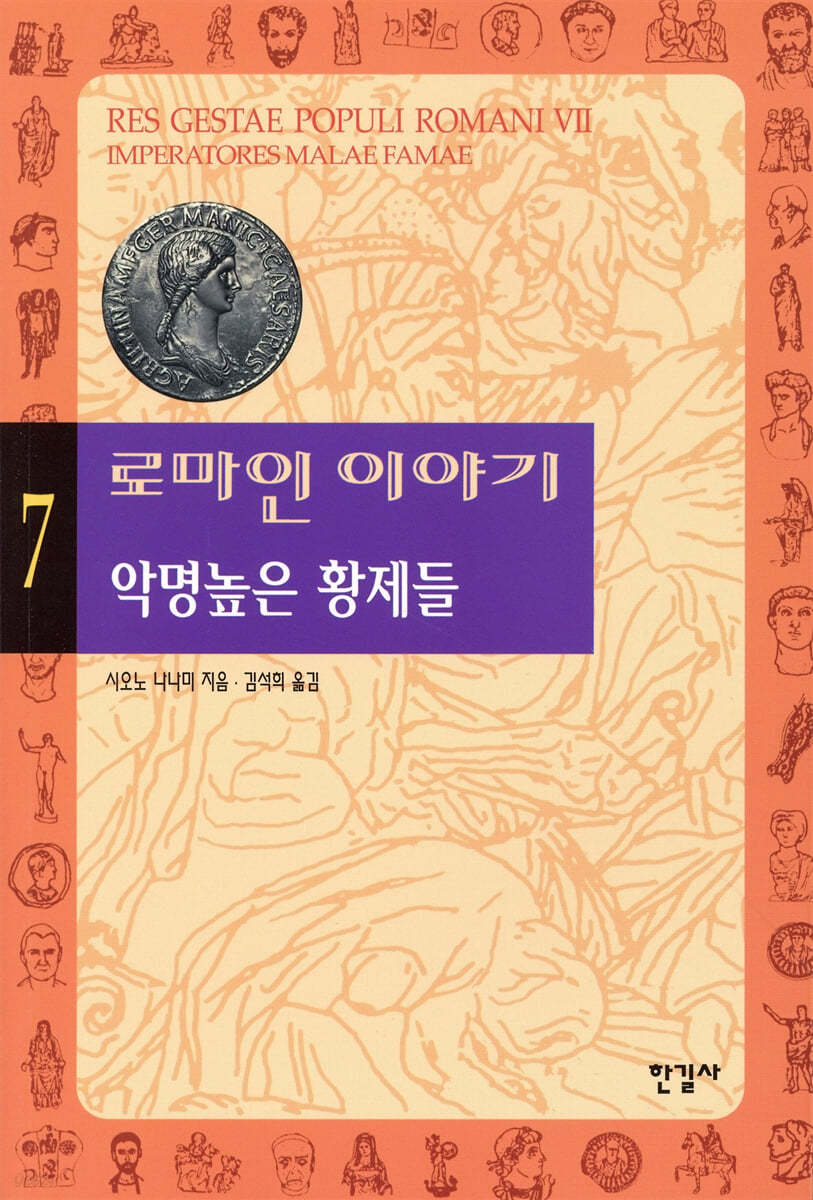
Roman Tales 7
 |
Description
Book Introduction
Roman Stories, Book 7.
Starting with Romulus, the founder of Rome, the 7th volume of the "Roman Stories" series, published in 1993, "Infamous Emperors."
It deals with the achievements and corruption of the four brothers Tiberius, Caligula, Claudius, and Nero during a time of crisis in the Roman Empire, which was suffering from disasters and food shortages due to a lack of leadership.
Starting with Romulus, the founder of Rome, the 7th volume of the "Roman Stories" series, published in 1993, "Infamous Emperors."
It deals with the achievements and corruption of the four brothers Tiberius, Caligula, Claudius, and Nero during a time of crisis in the Roman Empire, which was suffering from disasters and food shortages due to a lack of leadership.
- You can preview some of the book's contents.
Preview
index
1.
Emperor Tiberius
2.
Emperor Caligula
3.
Emperor Claudius
4.
Emperor Nero
5.
annual report
6.
References
Emperor Tiberius
2.
Emperor Caligula
3.
Emperor Claudius
4.
Emperor Nero
5.
annual report
6.
References
Into the book
The four emperors who inherited the legacy of Augustus: Tiberius, Caligula, Claudius, and Nero.
Many historians have branded them as infamous emperors, but the days of their empire were marked by glory.
A financial crisis of great chaos, a major disaster, and a food shortage.
A rebellion that could even swallow the fate of the empire.
The emperor's shoulders are heavy.
Their sins and their brilliant achievements, cast into the pages of Roman history, are merely two sides of the same coin, engraved on the bust of the emperor.
Whether it was ruined or ruined, the fate of the great empire was theirs.
Many historians have branded them as infamous emperors, but the days of their empire were marked by glory.
A financial crisis of great chaos, a major disaster, and a food shortage.
A rebellion that could even swallow the fate of the empire.
The emperor's shoulders are heavy.
Their sins and their brilliant achievements, cast into the pages of Roman history, are merely two sides of the same coin, engraved on the bust of the emperor.
Whether it was ruined or ruined, the fate of the great empire was theirs.
--- In the introduction
Nero had a tendency to only come up with extreme solutions when a problem needed to be solved urgently.
I think it might be because his own personality was inherently weak. p.491
Machiavelli also said that if you must do something bad, you should do it in one fell swoop. Idealism is excluded here.
If this is the reality of humanity, there is room for human wisdom to be applied in reducing the harm caused by evil deeds.
p.503
I think a competent leader is someone who is good at saving lives, effort, and time. p540 Nero had a tendency to only come up with extreme solutions when a problem needed to be solved urgently.
I think it might be because his own personality was inherently weak. p.491
Machiavelli also said that if you must do something bad, you should do it in one fell swoop. Idealism is excluded here.
If this is the reality of humanity, there is room for human wisdom to be applied in reducing the harm caused by evil deeds.
p.503
I think a competent leader is someone who is good at saving lives, effort, and time. p540
I think it might be because his own personality was inherently weak. p.491
Machiavelli also said that if you must do something bad, you should do it in one fell swoop. Idealism is excluded here.
If this is the reality of humanity, there is room for human wisdom to be applied in reducing the harm caused by evil deeds.
p.503
I think a competent leader is someone who is good at saving lives, effort, and time. p540 Nero had a tendency to only come up with extreme solutions when a problem needed to be solved urgently.
I think it might be because his own personality was inherently weak. p.491
Machiavelli also said that if you must do something bad, you should do it in one fell swoop. Idealism is excluded here.
If this is the reality of humanity, there is room for human wisdom to be applied in reducing the harm caused by evil deeds.
p.503
I think a competent leader is someone who is good at saving lives, effort, and time. p540
--- p.
The tendency of modern and contemporary historians to rehabilitate Tiberius is not due to a change in human thinking after 1,800 years, but rather to advances in archaeology.
Whereas previously we had to rely on the writings of ancient historians, we now have access to the vast number of inscriptions and other historical materials unearthed throughout the former Roman Empire.
The person who thoroughly implemented this in a German way was the 19th century historian Mommsen.
Mommsen is a person who received the Nobel Prize in Literature for his historical writing.
This assessment of Tiberius by Mommsen was that he was 'one of the greatest emperors Rome ever had.'
The tendency of modern and contemporary historians to rehabilitate Tiberius is not due to a change in human thinking after 1,800 years, but rather to advances in archaeology.
Whereas previously we had to rely on the writings of ancient historians, we now have access to the vast number of inscriptions and other historical materials unearthed throughout the former Roman Empire.
The person who thoroughly implemented this in a German way was the 19th century historian Mommsen.
Mommsen is a person who received the Nobel Prize in Literature for his historical writing.
This assessment of Tiberius by Mommsen was that he was 'one of the greatest emperors Rome ever had.'
Whereas previously we had to rely on the writings of ancient historians, we now have access to the vast number of inscriptions and other historical materials unearthed throughout the former Roman Empire.
The person who thoroughly implemented this in a German way was the 19th century historian Mommsen.
Mommsen is a person who received the Nobel Prize in Literature for his historical writing.
This assessment of Tiberius by Mommsen was that he was 'one of the greatest emperors Rome ever had.'
The tendency of modern and contemporary historians to rehabilitate Tiberius is not due to a change in human thinking after 1,800 years, but rather to advances in archaeology.
Whereas previously we had to rely on the writings of ancient historians, we now have access to the vast number of inscriptions and other historical materials unearthed throughout the former Roman Empire.
The person who thoroughly implemented this in a German way was the 19th century historian Mommsen.
Mommsen is a person who received the Nobel Prize in Literature for his historical writing.
This assessment of Tiberius by Mommsen was that he was 'one of the greatest emperors Rome ever had.'
--- p.223
Publisher's Review
There is no doubt that Shiono Nanami is a sincere and diligent writer.
He has kept his promise to write a comprehensive history of the Roman Empire, one volume per year, totaling 15 volumes, by the year 2006.
Moreover, when we consider that this was not a promise made in a half-hearted manner, but rather a promise made through meticulous preparation and tenacious persistence, we realize anew that we cannot dismiss that slender Japanese woman as a writer.
Countless readers awaited the publication of "The Roman Story," and Shiono did not disappoint.
He has prepared a story that is perfect for today, when we are closing the millennium and opening the new one.
"A serious crisis befell the Roman Empire, which lasted five hundred years! How did the Romans overcome it?" This is the theme Shiono explores in Volume 8, "Crisis and Overcoming."
What Shiono possesses as a writer is, above all, his exquisite ability to capture the timeliness of his writing.
Shiono never neglects to read the present and look to the future using the meticulously revealed history of the Romans as a mirror.
He has kept his promise to write a comprehensive history of the Roman Empire, one volume per year, totaling 15 volumes, by the year 2006.
Moreover, when we consider that this was not a promise made in a half-hearted manner, but rather a promise made through meticulous preparation and tenacious persistence, we realize anew that we cannot dismiss that slender Japanese woman as a writer.
Countless readers awaited the publication of "The Roman Story," and Shiono did not disappoint.
He has prepared a story that is perfect for today, when we are closing the millennium and opening the new one.
"A serious crisis befell the Roman Empire, which lasted five hundred years! How did the Romans overcome it?" This is the theme Shiono explores in Volume 8, "Crisis and Overcoming."
What Shiono possesses as a writer is, above all, his exquisite ability to capture the timeliness of his writing.
Shiono never neglects to read the present and look to the future using the meticulously revealed history of the Romans as a mirror.
GOODS SPECIFICS
- Date of issue: November 20, 1998
- Page count, weight, size: 617 pages | 710g | 148*210*35mm
- ISBN13: 9788935610891
- ISBN10: 8935610895
You may also like
카테고리
korean


korean

![ELLE 엘르 스페셜 에디션 A형 : 12월 [2025]](http://librairie.coreenne.fr/cdn/shop/files/b8e27a3de6c9538896439686c6b0e8fb.jpg?v=1766436872&width=3840)


