

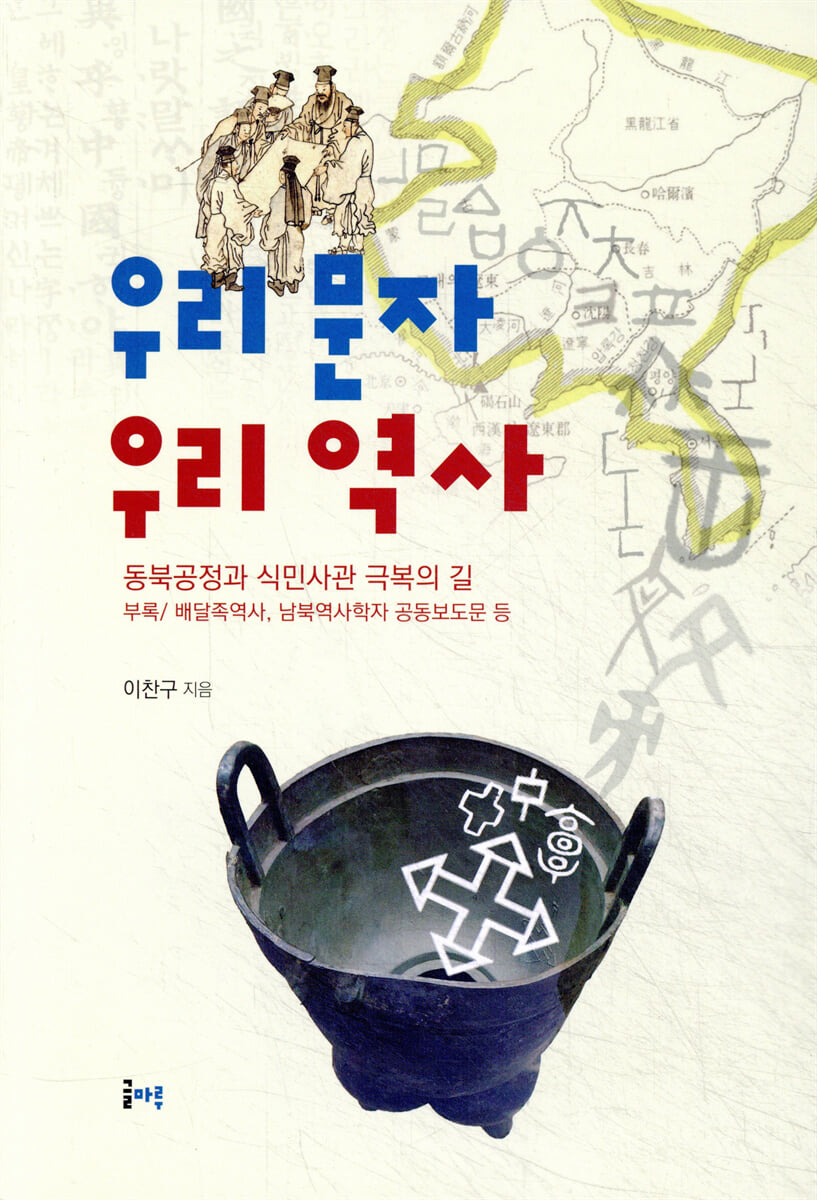
Our letters, our history
 |
Description
Book Introduction
"Dangun Joseon had a written language!" A collection of essays and critiques that lay the foundation for the study of national independence history.
- Dr. Lee Chan-gu, in "Our Letters, Our History," theorizes the Northeast Project and overcoming colonial historiography.
“Dangun Joseon was a federal state with a written language.”
This volume contains academic papers and historical criticism by historian Dr. Lee Chan-gu that prove this.
Part 1 contains academic papers that newly discover and interpret Korean characters used before Hangul, such as oracle bone script inscribed on a bronze steamer at the Jeokbong site, phonetic characters (don, nom, etc.) inscribed on money knives such as Cheomsudo and Chimsoodo, and Hangul-type characters on the 'Hanyobu Tass and Ms ...
Part 2 contains academic papers that provide new interpretations of important topics for a correct view of our history, such as the relationship between the Hongsan culture and the Joy people, the Dangun Joseon's Gujeongje (=Jeongjeonje), and the distinction between the Nakrang Commandery and the Choi clan's Nakrang country.
Part 3 clearly organizes various historical critiques and materials that criticize colonial history and present national independence history.
This is a humanities book that broadens your perspective on our language and history.
- Dr. Lee Chan-gu, in "Our Letters, Our History," theorizes the Northeast Project and overcoming colonial historiography.
“Dangun Joseon was a federal state with a written language.”
This volume contains academic papers and historical criticism by historian Dr. Lee Chan-gu that prove this.
Part 1 contains academic papers that newly discover and interpret Korean characters used before Hangul, such as oracle bone script inscribed on a bronze steamer at the Jeokbong site, phonetic characters (don, nom, etc.) inscribed on money knives such as Cheomsudo and Chimsoodo, and Hangul-type characters on the 'Hanyobu Tass and Ms ...
Part 2 contains academic papers that provide new interpretations of important topics for a correct view of our history, such as the relationship between the Hongsan culture and the Joy people, the Dangun Joseon's Gujeongje (=Jeongjeonje), and the distinction between the Nakrang Commandery and the Choi clan's Nakrang country.
Part 3 clearly organizes various historical critiques and materials that criticize colonial history and present national independence history.
This is a humanities book that broadens your perspective on our language and history.
- You can preview some of the book's contents.
Preview
index
Part 1: Our Characters (Thesis)
- Examination of the ancient characters and dragons excavated from the lower layer of the Ha-ga-jeom culture in the Jeokbong region
- Understanding the 'primitive form of Hangul' that appears in ancient currency inscriptions
- Discovery of the "Hanyobu Tass and Mss Misunderstanding" and Consideration of 'Gohangeul'
Part 2: Our History (Essay)
- The relationship between the Hongsan Culture of Yoseo and the Hwanung Joy tribe
- The origin of the ancient Jeongjeonje and the Dangun Joseon Dynasty
- The Reality of the Choi Clan's Nakrang Kingdom as Seen Through Literature Comparison
Part 3: Our Society (Criticism)
- Introduction to Colonial Criticism
- Current status and reflections of Korean historical academia
- The actual situation of colonial history
- Focus on the conflict between academic and non-academic history, Kimundara's opposition to UNESCO, the struggle for a millennium of history in Jeolla Province, and the Chuncheon Jungdo incident.
Attachment 1: Overview of the Special Act on the Establishment of Historical and Cultural Zones
Attachment 2: Proposed Bill on the "Gojoseon Historical and Cultural Sphere"
Attachment 3: "Baedaljok History" (Korean Provisional Government Textbook, 1922)
Attachment 4: Joint Press Release by South and North Korean Historians (2002)
- Examination of the ancient characters and dragons excavated from the lower layer of the Ha-ga-jeom culture in the Jeokbong region
- Understanding the 'primitive form of Hangul' that appears in ancient currency inscriptions
- Discovery of the "Hanyobu Tass and Mss Misunderstanding" and Consideration of 'Gohangeul'
Part 2: Our History (Essay)
- The relationship between the Hongsan Culture of Yoseo and the Hwanung Joy tribe
- The origin of the ancient Jeongjeonje and the Dangun Joseon Dynasty
- The Reality of the Choi Clan's Nakrang Kingdom as Seen Through Literature Comparison
Part 3: Our Society (Criticism)
- Introduction to Colonial Criticism
- Current status and reflections of Korean historical academia
- The actual situation of colonial history
- Focus on the conflict between academic and non-academic history, Kimundara's opposition to UNESCO, the struggle for a millennium of history in Jeolla Province, and the Chuncheon Jungdo incident.
Attachment 1: Overview of the Special Act on the Establishment of Historical and Cultural Zones
Attachment 2: Proposed Bill on the "Gojoseon Historical and Cultural Sphere"
Attachment 3: "Baedaljok History" (Korean Provisional Government Textbook, 1922)
Attachment 4: Joint Press Release by South and North Korean Historians (2002)
Into the book
After studying the Cheonbugyeong and the Book of Changes, I wanted to study philosophy in earnest.
While studying philosophy and reading about the history of Korean thought, I began to question why the Dangun idea was being treated as a fictional myth.
So I became interested in Korean history, and among them, I was particularly drawn to ancient history and ancient writing.
The first task was to study the currency characters of Cheomsudo and Myeongdojeon.
The mystery of the 'money' shaped tip has not yet been fully solved.
There is a saying that history must be learned at the site of the historical site.
I was able to explore the Hongsan Culture Uharyang Historic Site and gain a new understanding of Dangun Joseon (Gojoseon).
The book being published this time is a collection of papers and columns that organize these thoughts.
Part 1 is about our characters, and Part 2 is about our history.
Part 3 is about our society.
Parts 1 and 2 are papers published in academic journals such as 『History and Convergence』, and Part 3 is contributed columns.
The columns are articles written at the scene of the incident.
These are articles written from a historical perspective, based on direct observations of the civil movement in the wake of the Kimun-Dara UNESCO incident and the Jeolla-do Millennium History incident. Although some of the expressions are somewhat harsh, these are written to convey the feeling of the scene as it is.
While studying philosophy and reading about the history of Korean thought, I began to question why the Dangun idea was being treated as a fictional myth.
So I became interested in Korean history, and among them, I was particularly drawn to ancient history and ancient writing.
The first task was to study the currency characters of Cheomsudo and Myeongdojeon.
The mystery of the 'money' shaped tip has not yet been fully solved.
There is a saying that history must be learned at the site of the historical site.
I was able to explore the Hongsan Culture Uharyang Historic Site and gain a new understanding of Dangun Joseon (Gojoseon).
The book being published this time is a collection of papers and columns that organize these thoughts.
Part 1 is about our characters, and Part 2 is about our history.
Part 3 is about our society.
Parts 1 and 2 are papers published in academic journals such as 『History and Convergence』, and Part 3 is contributed columns.
The columns are articles written at the scene of the incident.
These are articles written from a historical perspective, based on direct observations of the civil movement in the wake of the Kimun-Dara UNESCO incident and the Jeolla-do Millennium History incident. Although some of the expressions are somewhat harsh, these are written to convey the feeling of the scene as it is.
--- From the "Author's Preface"
GOODS SPECIFICS
- Date of issue: August 15, 2025
- Page count, weight, size: 648 pages | 964g | 153*223*31mm
- ISBN13: 9791199341708
- ISBN10: 1199341703
You may also like
카테고리
korean


korean

![GQ KOREA Mark (Monthly): December [2025]](http://librairie.coreenne.fr/cdn/shop/files/8ef265dbbfbf186523ed75ba7319009d.jpg?v=1765340328&width=3840)


