

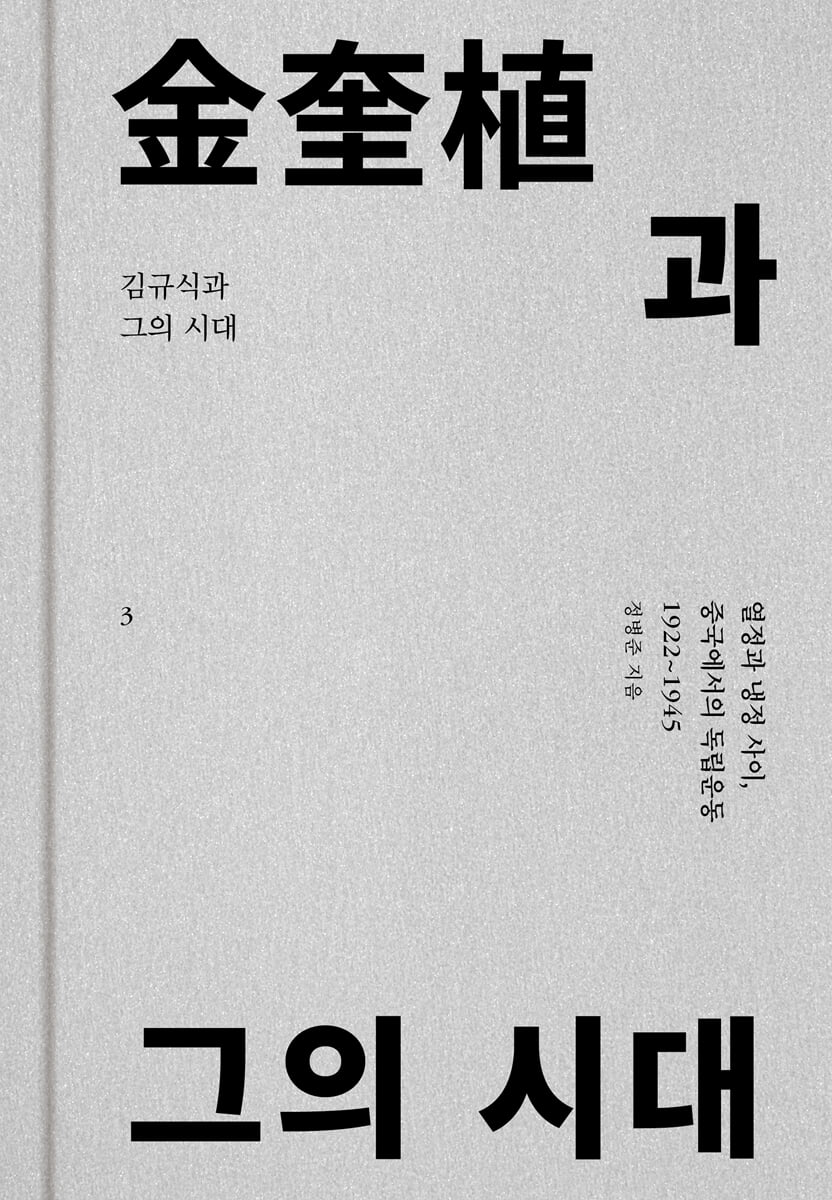
Kim Kyu-sik and His Era 3
 |
Description
Book Introduction
Kim Kyu-sik's 20-year anti-Japanese struggle that spanned the Soviet Union, the United States, and China.
And the turbulent history of the Korean independence movement
80 Years After Liberation: A Look into the Future Through the Unheard Voices of History
Finally, Professor Jeong Byeong-jun of Ewha Womans University, a historian and researcher of modern Korean history who has twice won the Korean Publication Culture Award in the academic writing category (for “The Korean War” in 2006 and “Hyun Alice and His Times” in 2015), is publishing “Kim Kyu-sik and His Times” (3 volumes) to commemorate the 80th anniversary of liberation.
Kim Kyu-sik, an outstanding independence activist who established the Korean Communications Bureau at the Paris Peace Conference in 1919 through short-term one-man diplomacy and proclaimed independence to the world, becoming the spark for the March 1st Movement and serving as Vice President of the Provisional Government before liberation.
However, his true nature remained buried and not accurately discovered even now, 80 years after liberation, except for a few colorful anecdotes that have been passed down in fragments.
This book, along with the tragic narrative of a man that clearly emerges throughout Kim Kyu-sik's life, seeks to fully capture the moments of sincerity and fiery passion of a man who, although politically unsuccessful, lived his life with the utmost devotion to his people, history, independence, and self-reliance in his heart.
This biography and non-fiction work on the history of the independence movement aims to bring out the previously unseen scenes and unheard voices of the era in which Kim Kyu-sik lived, thereby turning our eyes and ears to the "true lessons of history."
In this book, historian Jeong Byeong-jun, who himself described it as his “life’s work,” comprehensively summarizes the research results and data he has unearthed on modern Korean history and the history of the independence movement.
Volume 3 covers Kim Kyu-sik's activities over a period of 20 years, from 1922 (late 1921) to 1945.
Kim Kyu-sik earned the reputation of a national leader through special choices at special occasions, but sometimes he ended up joining extreme forces that he should not have joined.
His life was a complex mixture of rational choices and contradictory actions.
It encompasses the light and shadow that permeated Kim Kyu-sik and his era, along with various activities, organizations, and people over a long period of time.
In effect, it is a rewriting of the history of the Korean independence movement in China.
Through this, I hope to reveal the stories of previously unseen scenes and unheard voices.
And the turbulent history of the Korean independence movement
80 Years After Liberation: A Look into the Future Through the Unheard Voices of History
Finally, Professor Jeong Byeong-jun of Ewha Womans University, a historian and researcher of modern Korean history who has twice won the Korean Publication Culture Award in the academic writing category (for “The Korean War” in 2006 and “Hyun Alice and His Times” in 2015), is publishing “Kim Kyu-sik and His Times” (3 volumes) to commemorate the 80th anniversary of liberation.
Kim Kyu-sik, an outstanding independence activist who established the Korean Communications Bureau at the Paris Peace Conference in 1919 through short-term one-man diplomacy and proclaimed independence to the world, becoming the spark for the March 1st Movement and serving as Vice President of the Provisional Government before liberation.
However, his true nature remained buried and not accurately discovered even now, 80 years after liberation, except for a few colorful anecdotes that have been passed down in fragments.
This book, along with the tragic narrative of a man that clearly emerges throughout Kim Kyu-sik's life, seeks to fully capture the moments of sincerity and fiery passion of a man who, although politically unsuccessful, lived his life with the utmost devotion to his people, history, independence, and self-reliance in his heart.
This biography and non-fiction work on the history of the independence movement aims to bring out the previously unseen scenes and unheard voices of the era in which Kim Kyu-sik lived, thereby turning our eyes and ears to the "true lessons of history."
In this book, historian Jeong Byeong-jun, who himself described it as his “life’s work,” comprehensively summarizes the research results and data he has unearthed on modern Korean history and the history of the independence movement.
Volume 3 covers Kim Kyu-sik's activities over a period of 20 years, from 1922 (late 1921) to 1945.
Kim Kyu-sik earned the reputation of a national leader through special choices at special occasions, but sometimes he ended up joining extreme forces that he should not have joined.
His life was a complex mixture of rational choices and contradictory actions.
It encompasses the light and shadow that permeated Kim Kyu-sik and his era, along with various activities, organizations, and people over a long period of time.
In effect, it is a rewriting of the history of the Korean independence movement in China.
Through this, I hope to reveal the stories of previously unseen scenes and unheard voices.
- You can preview some of the book's contents.
Preview
index
Author's Note
Chapter 1 Participation in the Moscow Far Eastern Peoples' Congress and Moscow Diplomacy (1921–1922)
1. A Journey from Shanghai to Moscow
(1) Itinerary of Shanghai, Tianjin, Beijing, Zhangjiakou, Gobi Desert, Guolun, Kyakhta, Verkhneudinsk, Irkutsk, and Moscow
(2) The death of Lee Tae-jun and his cousin Kim Eun-sik encountered in Goryun
2 Moscow Conference and Korean Delegation Leader Kim Kyu-sik
(1) From Irkutsk to Moscow
(2) Kim Kyu-sik and Yeo Un-hyeong, members of the Korean delegation who attended the Moscow Convention
(3) Speech by Kim Kyu-sik, head of the Korean delegation, and report on Korean issues
(4) The Legacy of the Far Eastern People's Congress: The Kim Kyu-sik-Russia Secret Agreement Theory
3. The Split in Moscow: The Triangular Diplomatic Warfare Between the Diplomatic Negotiation Group, the Shanghai Faction of the Korean Communist Party, and the Provisional Government
(1) Kim Kyu-sik, head of the diplomatic negotiation team of the Korean delegation to the Far East National Congress
(2) The three-way diplomatic battle between the Shanghai faction, the Irkutsk faction, and the Provisional Government in Moscow
(3) The extreme confrontation between the Shanghai and Irkutsk factions over Lenin's funds
(4) The participation of the Provisional Government's special envoy in the Moscow diplomatic campaign and the negative publicity surrounding Kim Kyu-sik.
(5) Decision to discontinue funding for the Comintern
Chapter 2: National Representatives' Conference and Vladivostok's National Committee Member Kim Kyu-sik (1923)
1. The driving force behind the National Assembly: Han Hyung-kwon's 200,000 rubles
(1) The confrontation between Washington and Moscow
(2) Use of Lenin's funds of 200,000 rubles
(3) Kim Kyu-sik, the head of the Sino-Korean relations and education project
2. The National Assembly's Progress: Conclusion: The Establishment of a Creative Government
(1) Opening of the National Assembly and participants
(2) The conflict between the creative and reformist factions, the Shanghai faction and the Irkutsk faction
(3) The establishment of the Korean government and the National Committee of the Creative Party
3 A few months in Vladivostok: National Committee Member Kim Kyu-sik
(1) The National Committee, a revolutionary party rather than a government
(2) Draft revolutionary party platform of the National Committee
(3) Opposition attacks on the National Committee
(4) National Committee General Assembly and Closing Ceremony
(5) Park Yong-man's expulsion mystery
Chapter 3: Returning to Work and Caring for Daily Life (1923–1932)
1 Educator at Shanghai Nanhua Academy, Higher Conservative Academy, and Samil Engineering (1923-1925)
2 Professor at Shanghai Huiling English School and Fudan University, participated in the May 30th Movement and Northern Expedition (1922-1928)
(1) Professor at Hye-ryeong English Language School and Bokdan University
(2) Attempts at arrest by Japanese and British police
(3) Participation in the Northern Expedition by the Kuomintang (1927)
3. Daily Life in Tianjin (1928–1933)
Chapter 4: Another Attempt at Diplomacy with the US (1933)
1 Reorganization of the Shanghai independence movement camp after Yun Bong-gil's assassination (1932)
2. Formation of the Korea Anti-Japanese Front Unification Alliance and the China-Korea People's Alliance (1932)
(1) Establishment of the Korean Anti-Japanese Front Unification Alliance, a Korean united front (1932).
11)
(2) Formation of the Sino-Korean People's Alliance for Sino-Korean Solidarity (1932).
11)
3. Kim Kyu-sik's visit to the United States and the current state of the Korean community in the United States (1933)
(1) The political outlook of 『Wondongjeongse』
(2) The current state of the Korean community in the United States during the Great Depression
4 Kim Kyu-sik's Journey to the Americas and Major Activities: Unification Embraced by Division
(1) Schedule in California: Failure to form a branch of the Sino-Korean Alliance and organization of the Korean Independence Party (1933.
3. 10~1933.
5. 16)
(2) Schedule in the Central and Eastern Regions: Formation of the New York branch of the Sino-Korean People's Alliance and the Korea Anti-Japanese Front Unification Alliance (1933).
5. 17~1933.
7. 7)
(3) Activities in Hawaii: Connection with Lee Yong-jik and Han Gil-su
Chapter 5: Ten Years of Disappointment and Warmth (1933–1942): Joining and Leaving the Provisional Government and the National Revolutionary Party, and His Time as a Professor at Sichuan University
1. Kim Kyu-sik's rejoining of the Provisional Government (1933-1935)
2. Support from the Chinese Nationalist government in the 1930s and the coexistence of the Provisional Government and the National Revolutionary Party
3. Formation of the National Revolutionary Party, Kim Kyu-sik's participation and resignation (1935)
(1) Dissolution of the Anti-Japanese Front Unification Alliance and formation of the National Revolutionary Party
(2) Kim Kyu-sik's National Revolutionary Party "resigned"
4. Onchuk's time as a professor at Sacheon University (1935-1942)
(1) Life and writings of an English literature professor
(2) Kim Woo-sa of Hwasangma Tea House and Jukgeuntan Tangerine Garden
Chapter 6: The Confrontation between the Korean Independence Party and the National Revolutionary Party (1937–1942)
1 The Second Sino-Japanese War and the Division of the Liberation Front and the National Front (1937)
(1) Separation of the Liberation Front and the National Front
(2) Failure of the 7th Discipline Party Conference and the 5th Party Conference
2. Separation of the Korean Volunteer Corps and the Korean Liberation Army
(1) The establishment of the Korean Volunteer Corps and its advance northward
(2) Establishment of the Korean Liberation Army
3. Failure of the merger of the Korean Independence Party and the People's Revolutionary Party and the unification of the military, parliament, and government (1942)
(1) The Chinese Nationalist government's decision to integrate the Liberation Army and the Volunteer Corps
(2) Attempt to unify the Korean Independence Party and the People's Revolutionary Party
(3) Expansion and reorganization of the Provisional Legislative Assembly and the Provisional Government
Chapter 7: Kim Kyu-sik of the Provisional Government in Chongqing (1943-1945)
1. The Connection between Kim Won-bong and the National Revolutionary Party and Han Gil-su and the Korean Community in the US (1941-1942)
(1) The relationship between Kim Kyu-sik and the problematic figure Han Gil-su
(2) Connection between Kim Won-bong, Han Gil-su, and the American branch of the National Revolutionary Party
2. The emergence of the trusteeship issue and the conflict between the Korean Independence Party and the People's Revolutionary Party (1943)
(1) The rise of the trusteeship theory of the Korean Peninsula and the theories of international missions, international cooperation, and international supervision (1942-1943)
(2) The dual meaning of the 1943 Cairo Conference and Cairo Declaration
(3) Linking the 9 Articles of the Korean Liberation Army's Code of Conduct with Chinese Government Support
(4) Conflict over Chinese aid: The "Assassination Squad Incident" and the "Embezzlement of Public Funds"
(5) Inside and outside the conflict: livelihood issues, political conflict, and the lack of unification of Chinese aid channels.
3. Kim Kyu-sik, Vice President of the Provisional Government (1944)
4. Connections, conflicts, and divisions between China and the Americas (1941–1945)
(1) Conflicts within the Legislative Assembly: Constitutional amendments, the division of the Korean Independence Party, and the appointment of State Council members (1944)
(2) Kim Kyu-sik, Vice Chairman of the “National Unification Front Government”
5 Diplomacy, Military, Unification, and Solidarity of the Provisional Government (1945)
(1) Diplomacy: Kim Kyu-sik's attempt to participate in the 1945 San Francisco Conference and the controversy surrounding Syngman Rhee's 'Yalta Secret Agreement'
(2) Military: Abolition of the Nine Articles of Conduct and Joint Operations by the Korean Liberation Army and the OSS
(3) Attempts at unifying political parties in Chongqing: Five-Party Unification Conference and Independence Movement Representative Conference
(4) Solidarity with independence movement forces: Attempts to establish contact and solidarity with the Independence Alliance and Manchurian partisans.
Chapter 8: Liberation and the Path to Return
1 Liberation Day in Chongqing
2 Returning home after 33 years
Remaining Words: Kim Kyu-sik Data Tracker
1 Family, Childhood, Studying Abroad in the US
(1) A journey starting from modern history materials in the U.S. National Archives
(2) Testimony of Hongcheon descendants, family tree, father Kim Yong-won
(3) Underwood Orphanage School
(4) Photos of Kim Kyu-sik at the Smithsonian Museum
(5) Kim Kyu-sik's status and status consciousness
(6) Studying abroad in the US and the relationship with the Uihwa Army
(7) Kim Kyu-sik's college days as told through the records of Ronok University
(8) He received a passport and fled to China, saying he was going to Australia to sell ginseng.
2 March 1st Movement, Paris Peace Conference, Washington Western Commission, Moscow Far Eastern Peoples' Congress, National Representatives' Conference
(1) Research in England: A letter written by Kim Kyu-sik from Colombo in the Indian Ocean
(2) Research in the United States: Records from the failed attempt to smuggle the Thomas
(3) Finding the petition letter written by Yeo Woon-hyung to President Wilson
(4) Kim Kyu-sik at the Paris Peace Conference: From an unknown youth to a symbol of the independence movement
(5) Brain surgery of public bond salesman Kim Kyu-sik
(6) The relationship between Kim Kyu-sik and Yeo Un-hyeong
(7) Kim Kyu-sik, Shin Gyu-sik, and the relationship between the two brothers
(8) Research on materials in Japan: Choi Jeong-ik's mystery, Park Yong-man's mystery
(9) The first breakup between the Provisional Government and Kim Kyu-sik: The Far Eastern National Congress
(10) The National Assembly pushed to the limit
3 China in the 1930s and 1940s
(1) 1932 Sino-Korean People's Alliance, 1933 diplomatic mission to the United States, meeting with Han Gil-su
(2) Joining and Leaving the National Revolutionary Party in 1935: Reading Between the Lines
(3) During his time as a professor at Sacheon University
(4) Restoration of the Provisional Government in 1943
(5) Relations between the Provisional Government and the Americas
(6) Cairo Declaration, International Relations Theory, and Anti-Trusteeship Movement
(7) Liberation and return to the country
4. Kim Kyu-sik after liberation
Appendix: The process of establishing the "Korean Independence Party's Platform and Program," the National Committee's operating regulations, and the Korean Independence Party's organizational plan.
Appendix: Kim Kyu-sik's Political Activities in 1946-1947 as Seen Through the Birch Documents
References│Tables and Figures│Index
Chapter 1 Participation in the Moscow Far Eastern Peoples' Congress and Moscow Diplomacy (1921–1922)
1. A Journey from Shanghai to Moscow
(1) Itinerary of Shanghai, Tianjin, Beijing, Zhangjiakou, Gobi Desert, Guolun, Kyakhta, Verkhneudinsk, Irkutsk, and Moscow
(2) The death of Lee Tae-jun and his cousin Kim Eun-sik encountered in Goryun
2 Moscow Conference and Korean Delegation Leader Kim Kyu-sik
(1) From Irkutsk to Moscow
(2) Kim Kyu-sik and Yeo Un-hyeong, members of the Korean delegation who attended the Moscow Convention
(3) Speech by Kim Kyu-sik, head of the Korean delegation, and report on Korean issues
(4) The Legacy of the Far Eastern People's Congress: The Kim Kyu-sik-Russia Secret Agreement Theory
3. The Split in Moscow: The Triangular Diplomatic Warfare Between the Diplomatic Negotiation Group, the Shanghai Faction of the Korean Communist Party, and the Provisional Government
(1) Kim Kyu-sik, head of the diplomatic negotiation team of the Korean delegation to the Far East National Congress
(2) The three-way diplomatic battle between the Shanghai faction, the Irkutsk faction, and the Provisional Government in Moscow
(3) The extreme confrontation between the Shanghai and Irkutsk factions over Lenin's funds
(4) The participation of the Provisional Government's special envoy in the Moscow diplomatic campaign and the negative publicity surrounding Kim Kyu-sik.
(5) Decision to discontinue funding for the Comintern
Chapter 2: National Representatives' Conference and Vladivostok's National Committee Member Kim Kyu-sik (1923)
1. The driving force behind the National Assembly: Han Hyung-kwon's 200,000 rubles
(1) The confrontation between Washington and Moscow
(2) Use of Lenin's funds of 200,000 rubles
(3) Kim Kyu-sik, the head of the Sino-Korean relations and education project
2. The National Assembly's Progress: Conclusion: The Establishment of a Creative Government
(1) Opening of the National Assembly and participants
(2) The conflict between the creative and reformist factions, the Shanghai faction and the Irkutsk faction
(3) The establishment of the Korean government and the National Committee of the Creative Party
3 A few months in Vladivostok: National Committee Member Kim Kyu-sik
(1) The National Committee, a revolutionary party rather than a government
(2) Draft revolutionary party platform of the National Committee
(3) Opposition attacks on the National Committee
(4) National Committee General Assembly and Closing Ceremony
(5) Park Yong-man's expulsion mystery
Chapter 3: Returning to Work and Caring for Daily Life (1923–1932)
1 Educator at Shanghai Nanhua Academy, Higher Conservative Academy, and Samil Engineering (1923-1925)
2 Professor at Shanghai Huiling English School and Fudan University, participated in the May 30th Movement and Northern Expedition (1922-1928)
(1) Professor at Hye-ryeong English Language School and Bokdan University
(2) Attempts at arrest by Japanese and British police
(3) Participation in the Northern Expedition by the Kuomintang (1927)
3. Daily Life in Tianjin (1928–1933)
Chapter 4: Another Attempt at Diplomacy with the US (1933)
1 Reorganization of the Shanghai independence movement camp after Yun Bong-gil's assassination (1932)
2. Formation of the Korea Anti-Japanese Front Unification Alliance and the China-Korea People's Alliance (1932)
(1) Establishment of the Korean Anti-Japanese Front Unification Alliance, a Korean united front (1932).
11)
(2) Formation of the Sino-Korean People's Alliance for Sino-Korean Solidarity (1932).
11)
3. Kim Kyu-sik's visit to the United States and the current state of the Korean community in the United States (1933)
(1) The political outlook of 『Wondongjeongse』
(2) The current state of the Korean community in the United States during the Great Depression
4 Kim Kyu-sik's Journey to the Americas and Major Activities: Unification Embraced by Division
(1) Schedule in California: Failure to form a branch of the Sino-Korean Alliance and organization of the Korean Independence Party (1933.
3. 10~1933.
5. 16)
(2) Schedule in the Central and Eastern Regions: Formation of the New York branch of the Sino-Korean People's Alliance and the Korea Anti-Japanese Front Unification Alliance (1933).
5. 17~1933.
7. 7)
(3) Activities in Hawaii: Connection with Lee Yong-jik and Han Gil-su
Chapter 5: Ten Years of Disappointment and Warmth (1933–1942): Joining and Leaving the Provisional Government and the National Revolutionary Party, and His Time as a Professor at Sichuan University
1. Kim Kyu-sik's rejoining of the Provisional Government (1933-1935)
2. Support from the Chinese Nationalist government in the 1930s and the coexistence of the Provisional Government and the National Revolutionary Party
3. Formation of the National Revolutionary Party, Kim Kyu-sik's participation and resignation (1935)
(1) Dissolution of the Anti-Japanese Front Unification Alliance and formation of the National Revolutionary Party
(2) Kim Kyu-sik's National Revolutionary Party "resigned"
4. Onchuk's time as a professor at Sacheon University (1935-1942)
(1) Life and writings of an English literature professor
(2) Kim Woo-sa of Hwasangma Tea House and Jukgeuntan Tangerine Garden
Chapter 6: The Confrontation between the Korean Independence Party and the National Revolutionary Party (1937–1942)
1 The Second Sino-Japanese War and the Division of the Liberation Front and the National Front (1937)
(1) Separation of the Liberation Front and the National Front
(2) Failure of the 7th Discipline Party Conference and the 5th Party Conference
2. Separation of the Korean Volunteer Corps and the Korean Liberation Army
(1) The establishment of the Korean Volunteer Corps and its advance northward
(2) Establishment of the Korean Liberation Army
3. Failure of the merger of the Korean Independence Party and the People's Revolutionary Party and the unification of the military, parliament, and government (1942)
(1) The Chinese Nationalist government's decision to integrate the Liberation Army and the Volunteer Corps
(2) Attempt to unify the Korean Independence Party and the People's Revolutionary Party
(3) Expansion and reorganization of the Provisional Legislative Assembly and the Provisional Government
Chapter 7: Kim Kyu-sik of the Provisional Government in Chongqing (1943-1945)
1. The Connection between Kim Won-bong and the National Revolutionary Party and Han Gil-su and the Korean Community in the US (1941-1942)
(1) The relationship between Kim Kyu-sik and the problematic figure Han Gil-su
(2) Connection between Kim Won-bong, Han Gil-su, and the American branch of the National Revolutionary Party
2. The emergence of the trusteeship issue and the conflict between the Korean Independence Party and the People's Revolutionary Party (1943)
(1) The rise of the trusteeship theory of the Korean Peninsula and the theories of international missions, international cooperation, and international supervision (1942-1943)
(2) The dual meaning of the 1943 Cairo Conference and Cairo Declaration
(3) Linking the 9 Articles of the Korean Liberation Army's Code of Conduct with Chinese Government Support
(4) Conflict over Chinese aid: The "Assassination Squad Incident" and the "Embezzlement of Public Funds"
(5) Inside and outside the conflict: livelihood issues, political conflict, and the lack of unification of Chinese aid channels.
3. Kim Kyu-sik, Vice President of the Provisional Government (1944)
4. Connections, conflicts, and divisions between China and the Americas (1941–1945)
(1) Conflicts within the Legislative Assembly: Constitutional amendments, the division of the Korean Independence Party, and the appointment of State Council members (1944)
(2) Kim Kyu-sik, Vice Chairman of the “National Unification Front Government”
5 Diplomacy, Military, Unification, and Solidarity of the Provisional Government (1945)
(1) Diplomacy: Kim Kyu-sik's attempt to participate in the 1945 San Francisco Conference and the controversy surrounding Syngman Rhee's 'Yalta Secret Agreement'
(2) Military: Abolition of the Nine Articles of Conduct and Joint Operations by the Korean Liberation Army and the OSS
(3) Attempts at unifying political parties in Chongqing: Five-Party Unification Conference and Independence Movement Representative Conference
(4) Solidarity with independence movement forces: Attempts to establish contact and solidarity with the Independence Alliance and Manchurian partisans.
Chapter 8: Liberation and the Path to Return
1 Liberation Day in Chongqing
2 Returning home after 33 years
Remaining Words: Kim Kyu-sik Data Tracker
1 Family, Childhood, Studying Abroad in the US
(1) A journey starting from modern history materials in the U.S. National Archives
(2) Testimony of Hongcheon descendants, family tree, father Kim Yong-won
(3) Underwood Orphanage School
(4) Photos of Kim Kyu-sik at the Smithsonian Museum
(5) Kim Kyu-sik's status and status consciousness
(6) Studying abroad in the US and the relationship with the Uihwa Army
(7) Kim Kyu-sik's college days as told through the records of Ronok University
(8) He received a passport and fled to China, saying he was going to Australia to sell ginseng.
2 March 1st Movement, Paris Peace Conference, Washington Western Commission, Moscow Far Eastern Peoples' Congress, National Representatives' Conference
(1) Research in England: A letter written by Kim Kyu-sik from Colombo in the Indian Ocean
(2) Research in the United States: Records from the failed attempt to smuggle the Thomas
(3) Finding the petition letter written by Yeo Woon-hyung to President Wilson
(4) Kim Kyu-sik at the Paris Peace Conference: From an unknown youth to a symbol of the independence movement
(5) Brain surgery of public bond salesman Kim Kyu-sik
(6) The relationship between Kim Kyu-sik and Yeo Un-hyeong
(7) Kim Kyu-sik, Shin Gyu-sik, and the relationship between the two brothers
(8) Research on materials in Japan: Choi Jeong-ik's mystery, Park Yong-man's mystery
(9) The first breakup between the Provisional Government and Kim Kyu-sik: The Far Eastern National Congress
(10) The National Assembly pushed to the limit
3 China in the 1930s and 1940s
(1) 1932 Sino-Korean People's Alliance, 1933 diplomatic mission to the United States, meeting with Han Gil-su
(2) Joining and Leaving the National Revolutionary Party in 1935: Reading Between the Lines
(3) During his time as a professor at Sacheon University
(4) Restoration of the Provisional Government in 1943
(5) Relations between the Provisional Government and the Americas
(6) Cairo Declaration, International Relations Theory, and Anti-Trusteeship Movement
(7) Liberation and return to the country
4. Kim Kyu-sik after liberation
Appendix: The process of establishing the "Korean Independence Party's Platform and Program," the National Committee's operating regulations, and the Korean Independence Party's organizational plan.
Appendix: Kim Kyu-sik's Political Activities in 1946-1947 as Seen Through the Birch Documents
References│Tables and Figures│Index
Detailed image
Publisher's Review
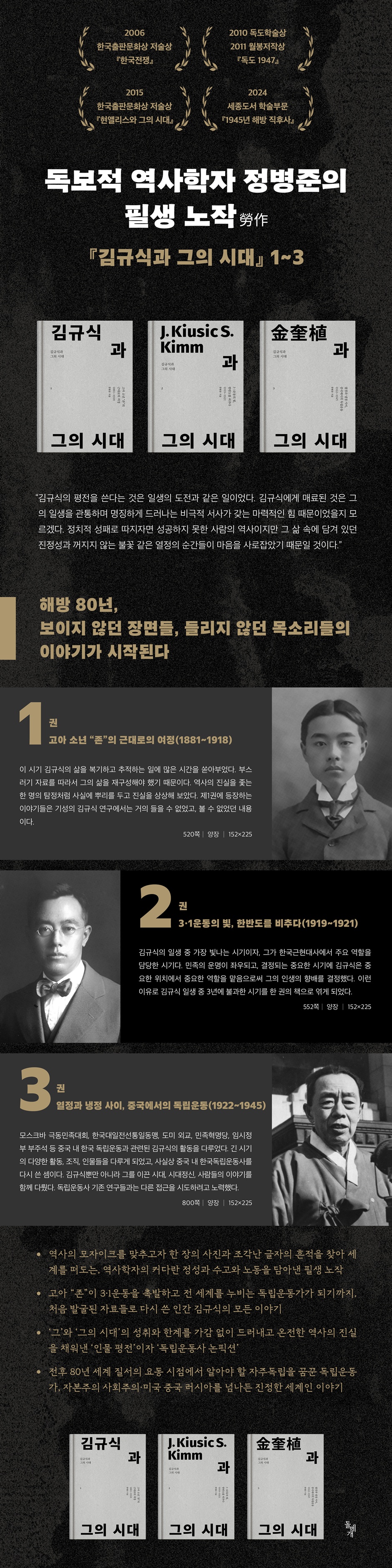
The life's work of Jeong Byeong-jun, a peerless researcher of modern Korean history.
“Dealing with Kim Kyu-sik’s life was like dealing with the major issues and activities of modern and contemporary Korean history and the Korean independence movement.
In short, it is a summary of everything I have studied throughout my life.
Writing a biography of Kim Kyu-sik was a lifelong challenge.
“Because that much research and study was required.” (From the author’s note)
And finally, Professor Jeong Byeong-jun, who won the Korean Publication Culture Award in the academic writing category twice (for “The Korean War” in 2006 and “Hyun Alice and His Era” in 2015), published “Kim Kyu-sik and His Era” (3 volumes) to commemorate the 80th anniversary of liberation.
This is a lifelong work that embodies the great sincerity, hard work, and labor of a historian who “wanders the world in search of traces of a single photograph and fragmented letters, and spends all day taking pictures, copying, scanning, meeting people, and reading books to piece together fragments and mosaics of history.”
The sheer volume of 1,872 pages, the dense and tightly structured text, and the appendices, references, tables, figures, and index that are packed into each volume clearly demonstrate the breadth and depth of the author's sweat and effort in creating this book. (In the final section of Volume 3, "Remaining Remarks: Tracking Down Kim Kyu-sik's Materials," the author, like a "historical detective," summarizes the core contents of Volumes 1-3 along with the process of doggedly collecting materials and the emotions he felt after encountering them.)
Orphan boy “John” sparks the March 1st Movement
Until he became an independence activist who traveled the world,
The entire story of Kim Kyu-sik, the human being, rewritten with materials unearthed for the first time.
The main contents of each volume are as follows.
Volume 1: Childhood in an American missionary orphanage, one of the first American university students and scholarship recipients in Joseon history, missionary work at the YMCA and other institutions after returning to Joseon, and all-round academic activities, exile in China, and participation in the independence movement
Volume 2: Attending the Paris Peace Conference (pro-American diplomacy), which became a catalyst for the March 1st Movement; the one-man diplomatic struggle of the Korea Communications Commission; the meeting and major conflict with Syngman Rhee at the European-American Committee; and brain tumor surgery.
Volume 3: Activities and frustrations of the Far Eastern National Congress in Russia (pro-Soviet diplomacy), withdrawal from the Provisional Government, solidarity with the Chinese and anti-Japanese movements, life as a professor at a Chinese university, fundraising for the independence movement in the United States, joining the National Revolutionary Party, returning to the Provisional Government, and serving as Vice Chairman
A boy from an underprivileged family background, called “John” or “Bon-gap” at an American missionary orphanage school, went to study abroad in the United States with his outstanding language skills, graduated with excellent grades, returned to Korea, and established himself as a mid-level leader in society. However, with great ambitions, he went into exile in China and began his independence movement in earnest.
Despite Japan's interference, he went around the world to call for and persuade Korean independence.
In particular, his actions, which became a catalyst for the March 1st Movement by establishing and operating the Korea Communications Agency through short-term, one-man diplomacy at the Paris Peace Conference in 1919, were a shining moment of 'diplomacy' in modern and contemporary Korean history.
We will also carry out anti-Japanese movements in solidarity with the Chinese people, respond flexibly to ideologies, political parties, and continue united front activities centered on the cause of the independence movement.
Because he did not go to extremes (the only exception would be the 'Far Eastern National Congress' in the early 1920s), he was sometimes excluded from the 'center' and his activities were restricted (for example, despite his fancy title, his position as 'Vice Chairman of the Provisional Government' in the 1940s did not come with much real power), but he never strayed from the path of struggle.
Due to these unique characteristics, many aspects of his true nature and activities have not been properly discovered compared to his fame.
Although his activities during the five years after liberation are somewhat well known, much of the story of his birth, upbringing, and arduous life as an independence activist is not well known.
"Kim Kyu-sik and His Era" goes far beyond simple analysis of existing literature to the point where it can be said to contain "everything about the human Kim Kyu-sik," by unearthing and revealing a variety of new materials. By comprehensively organizing "his era," it fully reveals the achievements and limitations, the light and dark sides of "him" and "his era," filling in the complete truth of history and generating numerous future research topics.
It is literally a biography of the human Kim Kyu-sik, a historical non-fiction work on the independence movement during the Japanese colonial period, and a weighty academic work that directly addresses and presents various issues and research topics in modern and contemporary Korean history.
Kim Kyu-sik's anti-Japanese movement that traveled between Moscow, New York, and Chongqing
And the light and shadow of the turbulent history of the Korean independence movement
Volume 3 covers Kim Kyu-sik's activities in China from late 1921 to 1945.
This book covers Kim Kyu-sik's activities related to the Korean independence movement in China, including the failure of the Far Eastern Peoples' Congress in Moscow in 1921-1922 and the National Representatives' Conference in 1923, the formation of the Korea Anti-Japanese Front Unification Alliance after the period of warming and rectification, diplomatic trip to the United States in 1933, participation in the National Revolutionary Party in 1935, life as a university professor in China, and his tenure as Vice Chairman of the Provisional Government in 1943-1945.
Although Kim Kyu-sik was not the type of person to lead an organization (around 1919, he was linked with Shin Gyu-sik and Dongjesa, Yeo Un-hyeong and the New Korea Youth Party), he was linked with the Soviet Union and socialist movements (especially the Irkutsk faction of the Korean Communist Party) in the early 1920s, and through twists and turns in the 1930s and 1940s, he was linked with the Provisional Government (Korean Independence Party (Kim Gu) and the National Revolutionary Party (Kim Won-bong), and at this time, Kim Kyu-sik was a member of the People's Revolutionary Party) and (since the Sino-Korean Friendship Association in the previous period) he has maintained a steady relationship with Chinese anti-Japanese forces through the Sino-Korean People's Alliance.
So, I ended up covering a long period of diverse activities, organizations, and people, and in effect, I ended up writing a history of the Korean independence movement in China.
In particular, Volume 3 covers not only Kim Kyu-sik, but also the era, zeitgeist, and people that led him.
In dealing with this period, I tried to take a different approach from existing studies that have a parallel structure of explanations centered on Kim Gu, the Korean Independence Party, and the Provisional Government, Kim Won-bong, the People's Revolutionary Party, and the Korean Volunteer Corps, and the Yan'an Independence Alliance and the Korean Volunteer Corps.
This paper aims to portray a comprehensive and true picture of the provisional government, encompassing both its "light" and "shadow," including its alliances and conflicts, its connections with the Chinese Nationalist Party, and its links with the world situation.
We also looked into some lesser-known but noteworthy facts, such as Kim Kyu-sik's turning the steering wheel of his diplomatic independence line toward the Soviet Union (Russia) in the early 1920s and his activities in the Moscow Far Eastern Peoples' Congress and the Vladivostok People's Committee, as well as the power of attorney he gave to the "problematic figure" Han Gil-su (Lee Han) in the early 1930s and his relationship with him.
Also included in Volume 3 is the historian's struggle to summarize Volumes 1-3 of "Kim Kyu-sik and His Times," "Remaining Words: Tracking Kim Kyu-sik's Materials," and a paper preparing for Volume 4 ("Kim Kyu-sik's Political Activities in 1946-1947 as Seen Through the Birch Documents").
80 Years After Liberation: A Look into the Future Through the Unheard Voices of History
"It's the story of a man who failed in terms of political success or failure, but the moments of sincerity and fiery passion contained in his life captivated my heart." (From the Author's Note)
This year marks the 80th anniversary of liberation.
Our nation's independence was also positioned in the context of World War II, where imperialism, fascism, capitalism, socialism, democracy, and national liberation movements intersected.
But as the civil war and foreign exchange coup of just a few months ago showed, the unfinished liberation has long been oppressed by war, subservience, and dictatorship.
And in 2025, the end of the American unipolar system and the shift in the post-war order of the past 80 years toward multipolarity are once again putting us to a huge test.
80 years have passed, but we still talk about 'unfinished liberation.'
The more so, if we want to confirm our current position and learn from history, we must listen even more closely to the 'unheard voices'.
At a time when the prospect of a "new world" is more urgent than ever, the dedicated yet rational actions of Kim Kyu-sik, who had been excluded or ignored, not fully understood, within the realities of Korean politics and history until now, and who sought open cooperation with all camps at home and abroad under the banner of independence, and who pondered the position of the independence movement within the flow of the world situation, have great implications for us.
When we listen to the lessons of history, which hold diverse potential for expression, unheard voices finally resonate deeply, becoming a starting point for new imagination as a map for envisioning the future.
This is why we are now focusing on Kim Kyu-sik, a true global man who dreamed of independence and liberation through left-right cooperation and national unity, while also straddling the East and the West, capitalism and socialism, the United States, China, and the Soviet Union (Russia).
Author's Note
“I think what fascinated me about Kim Kyu-sik was the magical power of the tragic narrative that clearly runs through his life.
Although it is the history of a man who failed in terms of political success or failure, it may be because the moments of sincerity and undying passion contained in his life captured our hearts.
For this reason, writing a biography of Kim Kyu-sik was a lifelong challenge.
This is because it was necessary to cover not only the modern history before and after liberation, but also the period of port opening at the end of the Joseon Dynasty and the Japanese colonial period, and to organize domestic and international activities.
When I decided to write a full-fledged biography of Kim Kyu-sik, I assumed it would be possible only after I was in my mid-50s.
Because that much research and study was required.
Since this is a biography about Kim Kyu-sik, it cannot be denied that it is based on interest and affection for him.
However, I did not try to portray Kim Kyu-sik as a special hero or great man who deviated from the path of history and made great decisions.
Biographies of great men or heroes are not the focus of this book.
The author's perspective that runs through this book is unique.
It deals with Kim Kyu-sik, a human being, not a hero or a great man.
Through this book, I hope to reveal previously unseen scenes and unheard voices from the history of the era in which Kim Kyu-sik lived.
Because of the dramatic transformations and twists and turns that modern and contemporary Korean history has undergone, there is a widespread tendency to understand this period's history as a simple dichotomy of success and failure, victory and defeat, good and evil.
But if we perceive history as a record of the victorious, the mysterious deeds of heroes, the providence of God or the decisions of powerful external forces, we will be blind to the true lessons of history.
This book seeks to listen to the resonance of the lessons of history, which have various potential manifestations.
And I hope to turn my eyes there.”
“Dealing with Kim Kyu-sik’s life was like dealing with the major issues and activities of modern and contemporary Korean history and the Korean independence movement.
In short, it is a summary of everything I have studied throughout my life.
Writing a biography of Kim Kyu-sik was a lifelong challenge.
“Because that much research and study was required.” (From the author’s note)
And finally, Professor Jeong Byeong-jun, who won the Korean Publication Culture Award in the academic writing category twice (for “The Korean War” in 2006 and “Hyun Alice and His Era” in 2015), published “Kim Kyu-sik and His Era” (3 volumes) to commemorate the 80th anniversary of liberation.
This is a lifelong work that embodies the great sincerity, hard work, and labor of a historian who “wanders the world in search of traces of a single photograph and fragmented letters, and spends all day taking pictures, copying, scanning, meeting people, and reading books to piece together fragments and mosaics of history.”
The sheer volume of 1,872 pages, the dense and tightly structured text, and the appendices, references, tables, figures, and index that are packed into each volume clearly demonstrate the breadth and depth of the author's sweat and effort in creating this book. (In the final section of Volume 3, "Remaining Remarks: Tracking Down Kim Kyu-sik's Materials," the author, like a "historical detective," summarizes the core contents of Volumes 1-3 along with the process of doggedly collecting materials and the emotions he felt after encountering them.)
Orphan boy “John” sparks the March 1st Movement
Until he became an independence activist who traveled the world,
The entire story of Kim Kyu-sik, the human being, rewritten with materials unearthed for the first time.
The main contents of each volume are as follows.
Volume 1: Childhood in an American missionary orphanage, one of the first American university students and scholarship recipients in Joseon history, missionary work at the YMCA and other institutions after returning to Joseon, and all-round academic activities, exile in China, and participation in the independence movement
Volume 2: Attending the Paris Peace Conference (pro-American diplomacy), which became a catalyst for the March 1st Movement; the one-man diplomatic struggle of the Korea Communications Commission; the meeting and major conflict with Syngman Rhee at the European-American Committee; and brain tumor surgery.
Volume 3: Activities and frustrations of the Far Eastern National Congress in Russia (pro-Soviet diplomacy), withdrawal from the Provisional Government, solidarity with the Chinese and anti-Japanese movements, life as a professor at a Chinese university, fundraising for the independence movement in the United States, joining the National Revolutionary Party, returning to the Provisional Government, and serving as Vice Chairman
A boy from an underprivileged family background, called “John” or “Bon-gap” at an American missionary orphanage school, went to study abroad in the United States with his outstanding language skills, graduated with excellent grades, returned to Korea, and established himself as a mid-level leader in society. However, with great ambitions, he went into exile in China and began his independence movement in earnest.
Despite Japan's interference, he went around the world to call for and persuade Korean independence.
In particular, his actions, which became a catalyst for the March 1st Movement by establishing and operating the Korea Communications Agency through short-term, one-man diplomacy at the Paris Peace Conference in 1919, were a shining moment of 'diplomacy' in modern and contemporary Korean history.
We will also carry out anti-Japanese movements in solidarity with the Chinese people, respond flexibly to ideologies, political parties, and continue united front activities centered on the cause of the independence movement.
Because he did not go to extremes (the only exception would be the 'Far Eastern National Congress' in the early 1920s), he was sometimes excluded from the 'center' and his activities were restricted (for example, despite his fancy title, his position as 'Vice Chairman of the Provisional Government' in the 1940s did not come with much real power), but he never strayed from the path of struggle.
Due to these unique characteristics, many aspects of his true nature and activities have not been properly discovered compared to his fame.
Although his activities during the five years after liberation are somewhat well known, much of the story of his birth, upbringing, and arduous life as an independence activist is not well known.
"Kim Kyu-sik and His Era" goes far beyond simple analysis of existing literature to the point where it can be said to contain "everything about the human Kim Kyu-sik," by unearthing and revealing a variety of new materials. By comprehensively organizing "his era," it fully reveals the achievements and limitations, the light and dark sides of "him" and "his era," filling in the complete truth of history and generating numerous future research topics.
It is literally a biography of the human Kim Kyu-sik, a historical non-fiction work on the independence movement during the Japanese colonial period, and a weighty academic work that directly addresses and presents various issues and research topics in modern and contemporary Korean history.
Kim Kyu-sik's anti-Japanese movement that traveled between Moscow, New York, and Chongqing
And the light and shadow of the turbulent history of the Korean independence movement
Volume 3 covers Kim Kyu-sik's activities in China from late 1921 to 1945.
This book covers Kim Kyu-sik's activities related to the Korean independence movement in China, including the failure of the Far Eastern Peoples' Congress in Moscow in 1921-1922 and the National Representatives' Conference in 1923, the formation of the Korea Anti-Japanese Front Unification Alliance after the period of warming and rectification, diplomatic trip to the United States in 1933, participation in the National Revolutionary Party in 1935, life as a university professor in China, and his tenure as Vice Chairman of the Provisional Government in 1943-1945.
Although Kim Kyu-sik was not the type of person to lead an organization (around 1919, he was linked with Shin Gyu-sik and Dongjesa, Yeo Un-hyeong and the New Korea Youth Party), he was linked with the Soviet Union and socialist movements (especially the Irkutsk faction of the Korean Communist Party) in the early 1920s, and through twists and turns in the 1930s and 1940s, he was linked with the Provisional Government (Korean Independence Party (Kim Gu) and the National Revolutionary Party (Kim Won-bong), and at this time, Kim Kyu-sik was a member of the People's Revolutionary Party) and (since the Sino-Korean Friendship Association in the previous period) he has maintained a steady relationship with Chinese anti-Japanese forces through the Sino-Korean People's Alliance.
So, I ended up covering a long period of diverse activities, organizations, and people, and in effect, I ended up writing a history of the Korean independence movement in China.
In particular, Volume 3 covers not only Kim Kyu-sik, but also the era, zeitgeist, and people that led him.
In dealing with this period, I tried to take a different approach from existing studies that have a parallel structure of explanations centered on Kim Gu, the Korean Independence Party, and the Provisional Government, Kim Won-bong, the People's Revolutionary Party, and the Korean Volunteer Corps, and the Yan'an Independence Alliance and the Korean Volunteer Corps.
This paper aims to portray a comprehensive and true picture of the provisional government, encompassing both its "light" and "shadow," including its alliances and conflicts, its connections with the Chinese Nationalist Party, and its links with the world situation.
We also looked into some lesser-known but noteworthy facts, such as Kim Kyu-sik's turning the steering wheel of his diplomatic independence line toward the Soviet Union (Russia) in the early 1920s and his activities in the Moscow Far Eastern Peoples' Congress and the Vladivostok People's Committee, as well as the power of attorney he gave to the "problematic figure" Han Gil-su (Lee Han) in the early 1930s and his relationship with him.
Also included in Volume 3 is the historian's struggle to summarize Volumes 1-3 of "Kim Kyu-sik and His Times," "Remaining Words: Tracking Kim Kyu-sik's Materials," and a paper preparing for Volume 4 ("Kim Kyu-sik's Political Activities in 1946-1947 as Seen Through the Birch Documents").
80 Years After Liberation: A Look into the Future Through the Unheard Voices of History
"It's the story of a man who failed in terms of political success or failure, but the moments of sincerity and fiery passion contained in his life captivated my heart." (From the Author's Note)
This year marks the 80th anniversary of liberation.
Our nation's independence was also positioned in the context of World War II, where imperialism, fascism, capitalism, socialism, democracy, and national liberation movements intersected.
But as the civil war and foreign exchange coup of just a few months ago showed, the unfinished liberation has long been oppressed by war, subservience, and dictatorship.
And in 2025, the end of the American unipolar system and the shift in the post-war order of the past 80 years toward multipolarity are once again putting us to a huge test.
80 years have passed, but we still talk about 'unfinished liberation.'
The more so, if we want to confirm our current position and learn from history, we must listen even more closely to the 'unheard voices'.
At a time when the prospect of a "new world" is more urgent than ever, the dedicated yet rational actions of Kim Kyu-sik, who had been excluded or ignored, not fully understood, within the realities of Korean politics and history until now, and who sought open cooperation with all camps at home and abroad under the banner of independence, and who pondered the position of the independence movement within the flow of the world situation, have great implications for us.
When we listen to the lessons of history, which hold diverse potential for expression, unheard voices finally resonate deeply, becoming a starting point for new imagination as a map for envisioning the future.
This is why we are now focusing on Kim Kyu-sik, a true global man who dreamed of independence and liberation through left-right cooperation and national unity, while also straddling the East and the West, capitalism and socialism, the United States, China, and the Soviet Union (Russia).
Author's Note
“I think what fascinated me about Kim Kyu-sik was the magical power of the tragic narrative that clearly runs through his life.
Although it is the history of a man who failed in terms of political success or failure, it may be because the moments of sincerity and undying passion contained in his life captured our hearts.
For this reason, writing a biography of Kim Kyu-sik was a lifelong challenge.
This is because it was necessary to cover not only the modern history before and after liberation, but also the period of port opening at the end of the Joseon Dynasty and the Japanese colonial period, and to organize domestic and international activities.
When I decided to write a full-fledged biography of Kim Kyu-sik, I assumed it would be possible only after I was in my mid-50s.
Because that much research and study was required.
Since this is a biography about Kim Kyu-sik, it cannot be denied that it is based on interest and affection for him.
However, I did not try to portray Kim Kyu-sik as a special hero or great man who deviated from the path of history and made great decisions.
Biographies of great men or heroes are not the focus of this book.
The author's perspective that runs through this book is unique.
It deals with Kim Kyu-sik, a human being, not a hero or a great man.
Through this book, I hope to reveal previously unseen scenes and unheard voices from the history of the era in which Kim Kyu-sik lived.
Because of the dramatic transformations and twists and turns that modern and contemporary Korean history has undergone, there is a widespread tendency to understand this period's history as a simple dichotomy of success and failure, victory and defeat, good and evil.
But if we perceive history as a record of the victorious, the mysterious deeds of heroes, the providence of God or the decisions of powerful external forces, we will be blind to the true lessons of history.
This book seeks to listen to the resonance of the lessons of history, which have various potential manifestations.
And I hope to turn my eyes there.”
GOODS SPECIFICS
- Date of issue: August 15, 2025
- Page count, weight, size: 800 pages | 1,248g | 152*225*42mm
- ISBN13: 9791194442394
- ISBN10: 1194442390
You may also like
카테고리
korean


korean

![GQ KOREA Mark (Monthly): December [2025]](http://librairie.coreenne.fr/cdn/shop/files/8ef265dbbfbf186523ed75ba7319009d.jpg?v=1765340328&width=3840)


