

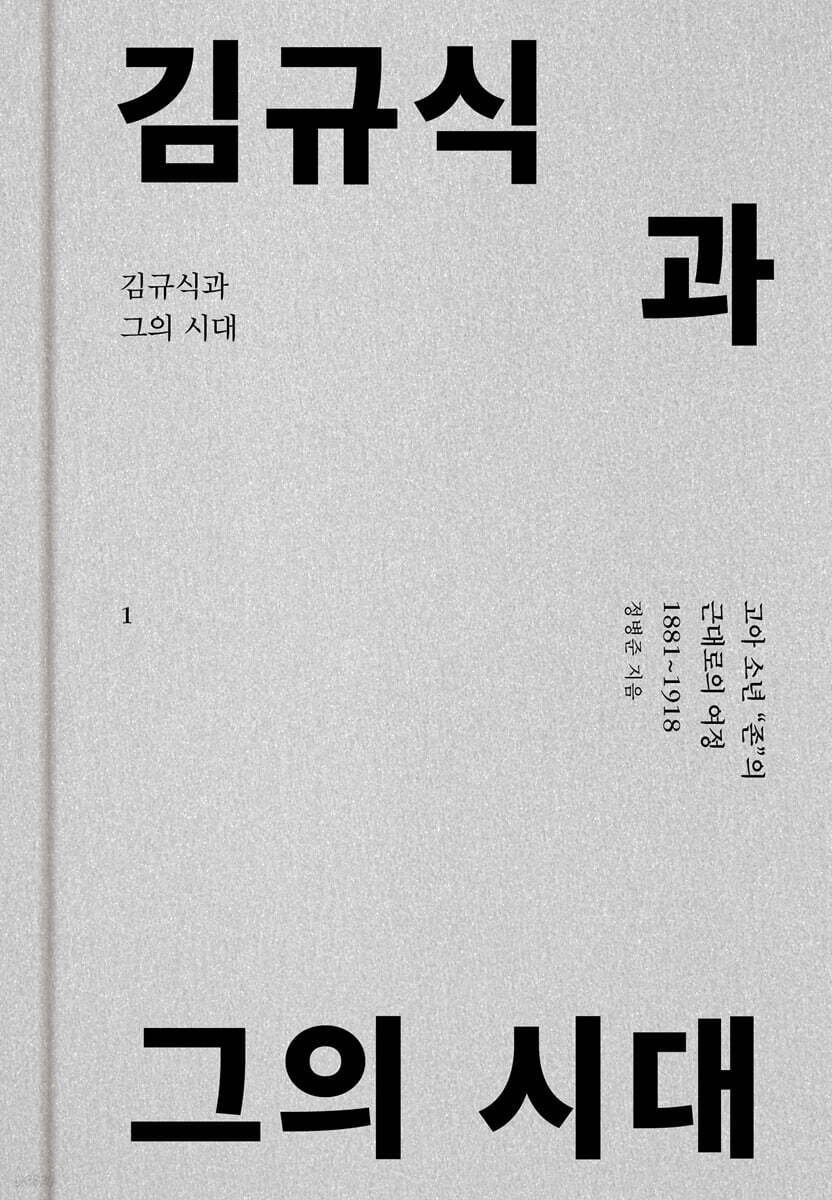
Kim Kyu-sik and His Era 1
 |
Description
Book Introduction
From the orphan boy “John”
To the modern intellectual Kim Kyu-sik
The entire story of Kim Kyu-sik, the man, rewritten using newly excavated materials.
Finally, Professor Jeong Byeong-jun of Ewha Womans University, a historian and researcher of modern Korean history who has twice won the Korean Publication Culture Award in the academic writing category (for “The Korean War” in 2006 and “Hyun Alice and His Times” in 2015), is publishing “Kim Kyu-sik and His Times” (3 volumes) to commemorate the 80th anniversary of liberation.
Kim Kyu-sik, an outstanding independence activist who established the Korean Communications Bureau at the Paris Peace Conference in 1919 through short-term one-man diplomacy and proclaimed independence to the world, becoming the spark for the March 1st Movement and serving as Vice President of the Provisional Government before liberation.
However, his true nature remained buried and not accurately discovered even now, 80 years after liberation, except for a few colorful anecdotes that have been passed down in fragments.
This book, along with the tragic narrative of a man that clearly emerges throughout Kim Kyu-sik's life, seeks to fully capture the moments of sincerity and fiery passion of a man who, although politically unsuccessful, lived his life with the utmost devotion to his people, history, independence, and self-reliance in his heart.
This biography and non-fiction work on the history of the independence movement aims to bring out the previously unseen scenes and unheard voices of the era in which Kim Kyu-sik lived, thereby turning our eyes and ears to the "true lessons of history."
In this book, historian Jeong Byeong-jun, who himself described it as his “life’s work,” comprehensively summarizes the research results and data he has unearthed on modern Korean history and the history of the independence movement.
Volume 1 covers Kim Kyu-sik's birth, family history, family relationships, Underwood Orphanage, his studies in the United States, his social activities after returning to Korea, his marriage, and his activities after his exile in China in 1913.
It took a lot of time and effort to reconstruct and trace Kim Kyu-sik's life during this period.
Because I had to gather scraps of information and reconstruct his life.
The stories in Volume 1 are comprised of content that is rarely seen or heard in existing studies of Kim Kyu-sik.
To the modern intellectual Kim Kyu-sik
The entire story of Kim Kyu-sik, the man, rewritten using newly excavated materials.
Finally, Professor Jeong Byeong-jun of Ewha Womans University, a historian and researcher of modern Korean history who has twice won the Korean Publication Culture Award in the academic writing category (for “The Korean War” in 2006 and “Hyun Alice and His Times” in 2015), is publishing “Kim Kyu-sik and His Times” (3 volumes) to commemorate the 80th anniversary of liberation.
Kim Kyu-sik, an outstanding independence activist who established the Korean Communications Bureau at the Paris Peace Conference in 1919 through short-term one-man diplomacy and proclaimed independence to the world, becoming the spark for the March 1st Movement and serving as Vice President of the Provisional Government before liberation.
However, his true nature remained buried and not accurately discovered even now, 80 years after liberation, except for a few colorful anecdotes that have been passed down in fragments.
This book, along with the tragic narrative of a man that clearly emerges throughout Kim Kyu-sik's life, seeks to fully capture the moments of sincerity and fiery passion of a man who, although politically unsuccessful, lived his life with the utmost devotion to his people, history, independence, and self-reliance in his heart.
This biography and non-fiction work on the history of the independence movement aims to bring out the previously unseen scenes and unheard voices of the era in which Kim Kyu-sik lived, thereby turning our eyes and ears to the "true lessons of history."
In this book, historian Jeong Byeong-jun, who himself described it as his “life’s work,” comprehensively summarizes the research results and data he has unearthed on modern Korean history and the history of the independence movement.
Volume 1 covers Kim Kyu-sik's birth, family history, family relationships, Underwood Orphanage, his studies in the United States, his social activities after returning to Korea, his marriage, and his activities after his exile in China in 1913.
It took a lot of time and effort to reconstruct and trace Kim Kyu-sik's life during this period.
Because I had to gather scraps of information and reconstruct his life.
The stories in Volume 1 are comprised of content that is rarely seen or heard in existing studies of Kim Kyu-sik.
- You can preview some of the book's contents.
Preview
index
Author's Note
The story of Kim Kyu-sik from 140 years ago, told through photographs from the Smithsonian Museum.
1. The young master of a noble family, Pastor Underwood's "John"
2 Korean Boy in the Missionary Pamphlet
3. Boy on a Japanese postcard
4. Smithsonian Archives' Hulbert Collection
Chapter 1: The Life of Kim Kyu-sik's Father, Kim Yong-won, and Kim Kyu-sik's Years at the Underwood Orphanage
1. “Bon-gap-i,” an abandoned, sickly child
2 Kim Yong-won or Kim Ji-seong's family
3. Accompanying the Japanese envoy to Dohwaseo painter Kim Yong-won
4. "Strategic General" Kim Yong-won's Study Abroad in Japan
(1) Establishment of the Uhu Glass Factory in Gyeongsang Province (1880)
(2) Investigation and observation team and study abroad in Japan (1881-1883)
The End of Kim Yong-won, the 5th Russian Diplomatic Envoy
(1) Activities after returning home: Establishment of the Filming Department and the Culture Department (1883)
(2) Diplomatic envoy to Russia (1884-1885)
Kim Kyu-sik, who learned survival and English at the Underwood Orphanage
Chapter 2: Studying in the US at Age 16: Relations with the Uihwa Army
1. The Uihwa Army's stay in Japan and study abroad in the United States
2 Kim Kyu-sik, Underwood, and Park Yun-gyu arrive in Yokohama
3. The Righteous Army and Kim Kyu-sik's Study Abroad in the United States
Chapter 3: The Years at Roanoke College: A New World, Lifelong Friends (1897–1903)
1 Korean students at Ronok College
2 Kim Kyu-sik's School Days (1): Academics
3 Kim Kyu-sik's School Days (2): Relations with the U.S. Embassy and the Uihwa Army
4 Kim Kyu-sik's School Days (3): Writing and Debating, Graduation
Chapter 4: Kim Kyu-sik in Korea (1904–1913)
1 YMCA Director, Secretary
2 Heunghwa School and Gyeongsin School teachers
3 Mysterious Attempts at Dominican Republic Diplomacy (1905)
4 Married Jo Eun-ae (1906)
5 Young Leaders of the Korean Christian Church
6 Leaders of enlightenment and cultural organizations, Korean language scholars
Chapter 5: Years of Exile (1): Kim Kyu-sik in Exile in China (1913)
1 Departed for Australia on April 2, 1913
2. Participation in the Nanjing and Shanghai Dongjesa Temples
3 Participation in the Second Chinese Revolution (1913.
7)
4th dispatch of students to the US (1913)
5. Network between Shanghai, Seoul, and San Francisco
Chapter 6: Years of Exile (2): Kim Kyu-sik in China (1914–1918)
1 The outbreak of World War I and the journey to Beijing, Uiju, and Goryeon (1914)
(1) A letter sent to Ahn Chang-ho from Beijing
(2) The plan to establish a military academy with Outer Mongolia's Goryunhaeng, Yoo Dongyeol, Lee Taejun, and Seo Walbo
(3) Kim Man-ho, 394, of the Anti-Japanese Secret Service
2. The New Korean Revolutionary Party and the Plan to Establish a Government in Exile (1915)
3. The Declaration of Great Unity and the Establishment of a Republican and Provisional Government (1917)
(1) The Declaration of Great Unity and the Establishment of a Provisional Government
(2) Kim Kyu-sik's participation and its significance
Life in Janggagu and Goryun (1916–1918)
(1) Life as a foreign trader in Janggagu and Goryun
(2) A brief reunion with his first wife and a permanent separation
Epilogue
Appendix: Kim Kyu-sik's handwritten resume (1950.
3. 5)
References│Tables and Figures│Search
The story of Kim Kyu-sik from 140 years ago, told through photographs from the Smithsonian Museum.
1. The young master of a noble family, Pastor Underwood's "John"
2 Korean Boy in the Missionary Pamphlet
3. Boy on a Japanese postcard
4. Smithsonian Archives' Hulbert Collection
Chapter 1: The Life of Kim Kyu-sik's Father, Kim Yong-won, and Kim Kyu-sik's Years at the Underwood Orphanage
1. “Bon-gap-i,” an abandoned, sickly child
2 Kim Yong-won or Kim Ji-seong's family
3. Accompanying the Japanese envoy to Dohwaseo painter Kim Yong-won
4. "Strategic General" Kim Yong-won's Study Abroad in Japan
(1) Establishment of the Uhu Glass Factory in Gyeongsang Province (1880)
(2) Investigation and observation team and study abroad in Japan (1881-1883)
The End of Kim Yong-won, the 5th Russian Diplomatic Envoy
(1) Activities after returning home: Establishment of the Filming Department and the Culture Department (1883)
(2) Diplomatic envoy to Russia (1884-1885)
Kim Kyu-sik, who learned survival and English at the Underwood Orphanage
Chapter 2: Studying in the US at Age 16: Relations with the Uihwa Army
1. The Uihwa Army's stay in Japan and study abroad in the United States
2 Kim Kyu-sik, Underwood, and Park Yun-gyu arrive in Yokohama
3. The Righteous Army and Kim Kyu-sik's Study Abroad in the United States
Chapter 3: The Years at Roanoke College: A New World, Lifelong Friends (1897–1903)
1 Korean students at Ronok College
2 Kim Kyu-sik's School Days (1): Academics
3 Kim Kyu-sik's School Days (2): Relations with the U.S. Embassy and the Uihwa Army
4 Kim Kyu-sik's School Days (3): Writing and Debating, Graduation
Chapter 4: Kim Kyu-sik in Korea (1904–1913)
1 YMCA Director, Secretary
2 Heunghwa School and Gyeongsin School teachers
3 Mysterious Attempts at Dominican Republic Diplomacy (1905)
4 Married Jo Eun-ae (1906)
5 Young Leaders of the Korean Christian Church
6 Leaders of enlightenment and cultural organizations, Korean language scholars
Chapter 5: Years of Exile (1): Kim Kyu-sik in Exile in China (1913)
1 Departed for Australia on April 2, 1913
2. Participation in the Nanjing and Shanghai Dongjesa Temples
3 Participation in the Second Chinese Revolution (1913.
7)
4th dispatch of students to the US (1913)
5. Network between Shanghai, Seoul, and San Francisco
Chapter 6: Years of Exile (2): Kim Kyu-sik in China (1914–1918)
1 The outbreak of World War I and the journey to Beijing, Uiju, and Goryeon (1914)
(1) A letter sent to Ahn Chang-ho from Beijing
(2) The plan to establish a military academy with Outer Mongolia's Goryunhaeng, Yoo Dongyeol, Lee Taejun, and Seo Walbo
(3) Kim Man-ho, 394, of the Anti-Japanese Secret Service
2. The New Korean Revolutionary Party and the Plan to Establish a Government in Exile (1915)
3. The Declaration of Great Unity and the Establishment of a Republican and Provisional Government (1917)
(1) The Declaration of Great Unity and the Establishment of a Provisional Government
(2) Kim Kyu-sik's participation and its significance
Life in Janggagu and Goryun (1916–1918)
(1) Life as a foreign trader in Janggagu and Goryun
(2) A brief reunion with his first wife and a permanent separation
Epilogue
Appendix: Kim Kyu-sik's handwritten resume (1950.
3. 5)
References│Tables and Figures│Search
Detailed image
Publisher's Review
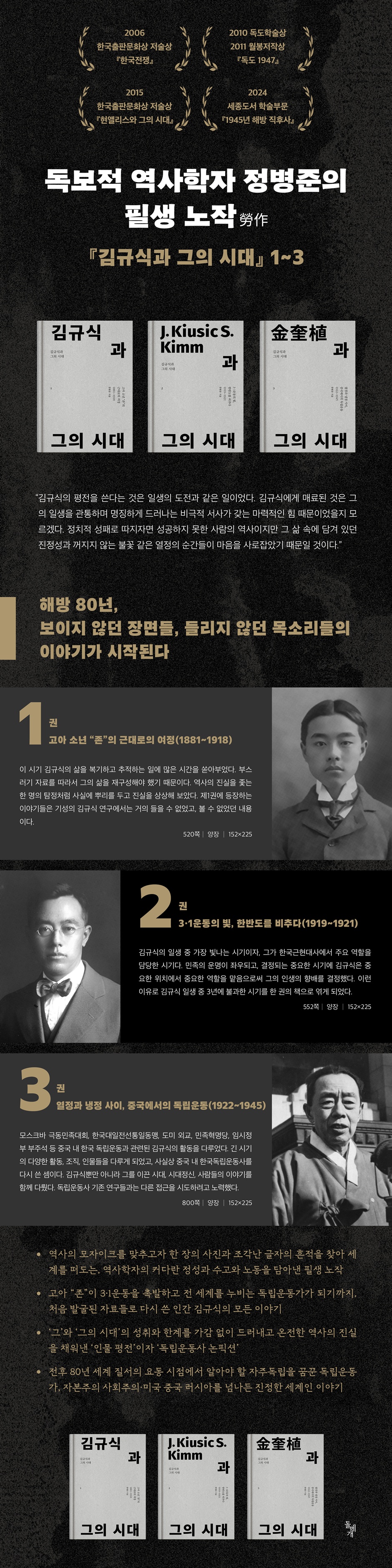
The life's work of Jeong Byeong-jun, a peerless researcher of modern Korean history.
“Dealing with Kim Kyu-sik’s life was like dealing with the major issues and activities of modern and contemporary Korean history and the Korean independence movement.
In short, it is a summary of everything I have studied throughout my life.
Writing a biography of Kim Kyu-sik was a lifelong challenge.
“Because that much research and study was required.” (From the author’s note)
And finally, Professor Jeong Byeong-jun, who won the Korean Publication Culture Award in the academic writing category twice (for “The Korean War” in 2006 and “Hyun Alice and His Era” in 2015), published “Kim Kyu-sik and His Era” (3 volumes) to commemorate the 80th anniversary of liberation.
This is a lifelong work that embodies the great sincerity, hard work, and labor of a historian who “wanders the world in search of traces of a single photograph and fragmented letters, and spends all day taking pictures, copying, scanning, meeting people, and reading books to piece together fragments and mosaics of history.”
The sheer volume of 1,872 pages, the dense and tightly structured text, and the appendices, references, tables, figures, and index that are packed into each volume clearly demonstrate the breadth and depth of the author's sweat and effort in creating this book. (In the final section of Volume 3, "Remaining Remarks: Tracking Down Kim Kyu-sik's Materials," the author, like a "historical detective," summarizes the core contents of Volumes 1-3 along with the process of doggedly collecting materials and the emotions he felt after encountering them.)
Orphan boy “John” sparks the March 1st Movement
Until he became an independence activist who traveled the world,
The entire story of Kim Kyu-sik, the human being, rewritten with materials unearthed for the first time.
The main contents of each volume are as follows.
Volume 1: Childhood in an American missionary orphanage, one of the first American university students and scholarship recipients in Joseon history, missionary work at the YMCA and other institutions after returning to Joseon, and all-round academic activities, exile in China, and participation in the independence movement
Volume 2: Attending the Paris Peace Conference (pro-American diplomacy), which became a catalyst for the March 1st Movement; the one-man diplomatic struggle of the Korea Communications Commission; the meeting and major conflict with Syngman Rhee at the European-American Committee; and brain tumor surgery.
Volume 3: Activities and frustrations of the Far Eastern National Congress in Russia (pro-Soviet diplomacy), withdrawal from the Provisional Government, solidarity with the Chinese and anti-Japanese movements, life as a professor at a Chinese university, fundraising for the independence movement in the United States, joining the National Revolutionary Party, returning to the Provisional Government, and serving as Vice Chairman
A boy from an underprivileged family background, called “John” or “Bon-gap” at an American missionary orphanage school, went to study abroad in the United States with his outstanding language skills, graduated with excellent grades, returned to Korea, and established himself as a mid-level leader in society. However, with great ambitions, he went into exile in China and began his independence movement in earnest.
Despite Japan's obstruction, he went around the world to call for and persuade Korean independence.
In particular, his actions, which became a catalyst for the March 1st Movement by establishing and operating the Korea Communications Agency through short-term, one-man diplomacy at the Paris Peace Conference in 1919, were a shining moment of 'diplomacy' in modern and contemporary Korean history.
We will also carry out anti-Japanese movements in solidarity with the Chinese people, respond flexibly to ideologies, political parties, and continue united front activities centered on the cause of the independence movement.
Because he did not go to extremes (the only exception would be the 'Far Eastern National Congress' in the early 1920s), he was sometimes excluded from the 'center' and his activities were restricted (for example, despite his fancy title, his position as 'Vice Chairman of the Provisional Government' in the 1940s did not come with much real power), but he never strayed from the path of struggle.
Due to these unique characteristics, many aspects of his true nature and activities have not been properly discovered compared to his fame.
Although his activities during the five years after liberation are somewhat well known, much of the story of his birth, upbringing, and arduous life as an independence activist is not well known.
"Kim Kyu-sik and His Era" goes far beyond simple analysis of existing literature to the point where it can be said to contain "everything about the human Kim Kyu-sik," by unearthing and revealing a variety of new materials. By also comprehensively organizing "his era," it fully reveals the achievements and limitations, the light and dark sides of "him" and "his era," filling in the complete truth of history and generating numerous future research topics.
It is literally a biography of the human Kim Kyu-sik, a historical non-fiction work on the independence movement during the Japanese colonial period, and a weighty academic work that directly addresses and presents various issues and research topics in modern and contemporary Korean history.
In the research on Kim Kyu-sik so far,
Stories you couldn't hear, photos you couldn't see
Volume 1 covers the period from his birth and family history in 1881 to 1918, just before the outbreak of the March 1st Movement after his exile in China.
It covers his family history, family relationships, Underwood Orphanage School, his studies in the United States, his social activities after returning to Korea, his marriage, and his activities after his exile in China in 1913.
It took a lot of time and effort to reconstruct and trace Kim Kyu-sik's life during this period.
Because I had to reconstruct his life based on scraps of information.
The stories that appear in Volume 1 are contents that could hardly be heard or seen in existing studies of Kim Kyu-sik [the life of Kim Kyu-sik's biological father, General Kim Yong-won (Kim Ji-seong), the origin of the name of Kim Kyu-sik's Underwood orphanage, 'John' or 'Bon-gap-i', the actual relationship between Kim Kyu-sik and Underwood, details of Kim Kyu-sik's activities and grades during his time at Ronok College, his reputation, his relationship with the Uihwa Army while studying abroad in the United States, Kim Kyu-sik's appearance as a comprehensive modern intellectual, from a YMCA leader to a Korean language scholar after returning to Korea, Kim Kyu-sik's early independence movement in exile in China, etc.].
Kim Kyu-sik is often understood as a modern figure with a personality and character distinct from that of colonial Koreans (Joseon people) of the time (and he certainly possessed such aspects), but at the same time, as a citizen of a weakened nation at the end of the Joseon Dynasty, he was a multifaceted figure influenced by the Joseon Dynasty, with which he had maintained a direct relationship since his father's time.
The numerous events that occurred in the 38 years before Kim Kyu-sik emerged onto the forefront of history prepared the Kim Kyu-sik that followed.
His exile in China.
This is the reason why events such as the preparation of the “Declaration of Great Unity” and participation in the organization of the Dongjesa, which were in preparation for the independence movement even before the March 1st Movement, were not sudden events in his life.
After completing the main text, the author finally located Kim Kyu-sik's childhood photos and documents from missionary Hulbert, who sold them to the Smithsonian Museum in the United States, and wrote the introduction to Volume 1 in early 2025.
The Smithsonian Museum's photo story (produced by missionaries) virtually symbolizes Kim Kyu-sik's life.
80 Years After Liberation: A Look into the Future Through the Unheard Voices of History
"It's the story of a man who failed in terms of political success or failure, but the moments of sincerity and fiery passion contained in his life captivated my heart." (From the Author's Note)
This year marks the 80th anniversary of liberation.
Our nation's independence was also positioned in the context of World War II, where imperialism, fascism, capitalism, socialism, democracy, and national liberation movements intersected.
But as the civil war and foreign exchange coup of just a few months ago showed, the unfinished liberation has long been oppressed by war, subservience, and dictatorship.
And in 2025, the end of the American unipolar system and the shift in the post-war order of the past 80 years toward multipolarity are once again putting us to a huge test.
80 years have passed, but we still talk about 'unfinished liberation.'
The more so, if we want to confirm our current position and learn from history, we must listen even more closely to the 'unheard voices'.
At a time when the prospect of a "new world" is more urgent than ever, the dedicated yet rational actions of Kim Kyu-sik, who had been excluded or ignored, not fully understood, within the realities of Korean politics and history, and who sought open cooperation with all camps at home and abroad under the banner of independence, and who pondered the position of the independence movement within the flow of the world situation, have great implications for us.
When we listen to the lessons of history, which hold diverse potential for expression, unheard voices finally resonate deeply, becoming a starting point for new imagination as a map for envisioning the future.
This is why we are now focusing on Kim Kyu-sik, a true global man who dreamed of independence and liberation through left-right cooperation and national unity, while also straddling the East and the West, capitalism and socialism, the United States, China, and the Soviet Union (Russia).
Author's Note
“I think what fascinated me about Kim Kyu-sik was the magical power of the tragic narrative that clearly runs through his life.
Although it is the history of a man who failed in terms of political success or failure, it may be because the moments of sincerity and undying passion contained in his life captured our hearts.
For this reason, writing a biography of Kim Kyu-sik was a lifelong challenge.
This is because it had to cover not only the modern history before and after liberation, but also the period of opening ports at the end of the Joseon Dynasty and the Japanese colonial period, and organize domestic and international activities.
When I decided to write a full-fledged biography of Kim Kyu-sik, I assumed it would be possible only after I was in my mid-50s.
Because that much research and study was required.
Since this is a biography about Kim Kyu-sik, it cannot be denied that it is based on interest and affection for him.
However, I did not try to portray Kim Kyu-sik as a special hero or great man who deviated from the path of history and made great decisions.
Biographies of great men or heroes are not the focus of this book.
The author's perspective that runs through this book is unique.
It deals with Kim Kyu-sik, a human being, not a hero or a great man.
Through this book, I hope to reveal previously unseen scenes and unheard voices from the history of the era in which Kim Kyu-sik lived.
Because of the dramatic transformations and twists and turns that modern and contemporary Korean history has undergone, there is a widespread tendency to understand this period's history as a simple dichotomy of success and failure, victory and defeat, good and evil.
But if we perceive history as a record of the victorious, the mysterious deeds of heroes, the providence of God or the decisions of powerful external forces, we will be blind to the true lessons of history.
This book seeks to listen to the resonance of the lessons of history, which have various potential manifestations.
And I hope to turn my eyes there.”
“Dealing with Kim Kyu-sik’s life was like dealing with the major issues and activities of modern and contemporary Korean history and the Korean independence movement.
In short, it is a summary of everything I have studied throughout my life.
Writing a biography of Kim Kyu-sik was a lifelong challenge.
“Because that much research and study was required.” (From the author’s note)
And finally, Professor Jeong Byeong-jun, who won the Korean Publication Culture Award in the academic writing category twice (for “The Korean War” in 2006 and “Hyun Alice and His Era” in 2015), published “Kim Kyu-sik and His Era” (3 volumes) to commemorate the 80th anniversary of liberation.
This is a lifelong work that embodies the great sincerity, hard work, and labor of a historian who “wanders the world in search of traces of a single photograph and fragmented letters, and spends all day taking pictures, copying, scanning, meeting people, and reading books to piece together fragments and mosaics of history.”
The sheer volume of 1,872 pages, the dense and tightly structured text, and the appendices, references, tables, figures, and index that are packed into each volume clearly demonstrate the breadth and depth of the author's sweat and effort in creating this book. (In the final section of Volume 3, "Remaining Remarks: Tracking Down Kim Kyu-sik's Materials," the author, like a "historical detective," summarizes the core contents of Volumes 1-3 along with the process of doggedly collecting materials and the emotions he felt after encountering them.)
Orphan boy “John” sparks the March 1st Movement
Until he became an independence activist who traveled the world,
The entire story of Kim Kyu-sik, the human being, rewritten with materials unearthed for the first time.
The main contents of each volume are as follows.
Volume 1: Childhood in an American missionary orphanage, one of the first American university students and scholarship recipients in Joseon history, missionary work at the YMCA and other institutions after returning to Joseon, and all-round academic activities, exile in China, and participation in the independence movement
Volume 2: Attending the Paris Peace Conference (pro-American diplomacy), which became a catalyst for the March 1st Movement; the one-man diplomatic struggle of the Korea Communications Commission; the meeting and major conflict with Syngman Rhee at the European-American Committee; and brain tumor surgery.
Volume 3: Activities and frustrations of the Far Eastern National Congress in Russia (pro-Soviet diplomacy), withdrawal from the Provisional Government, solidarity with the Chinese and anti-Japanese movements, life as a professor at a Chinese university, fundraising for the independence movement in the United States, joining the National Revolutionary Party, returning to the Provisional Government, and serving as Vice Chairman
A boy from an underprivileged family background, called “John” or “Bon-gap” at an American missionary orphanage school, went to study abroad in the United States with his outstanding language skills, graduated with excellent grades, returned to Korea, and established himself as a mid-level leader in society. However, with great ambitions, he went into exile in China and began his independence movement in earnest.
Despite Japan's obstruction, he went around the world to call for and persuade Korean independence.
In particular, his actions, which became a catalyst for the March 1st Movement by establishing and operating the Korea Communications Agency through short-term, one-man diplomacy at the Paris Peace Conference in 1919, were a shining moment of 'diplomacy' in modern and contemporary Korean history.
We will also carry out anti-Japanese movements in solidarity with the Chinese people, respond flexibly to ideologies, political parties, and continue united front activities centered on the cause of the independence movement.
Because he did not go to extremes (the only exception would be the 'Far Eastern National Congress' in the early 1920s), he was sometimes excluded from the 'center' and his activities were restricted (for example, despite his fancy title, his position as 'Vice Chairman of the Provisional Government' in the 1940s did not come with much real power), but he never strayed from the path of struggle.
Due to these unique characteristics, many aspects of his true nature and activities have not been properly discovered compared to his fame.
Although his activities during the five years after liberation are somewhat well known, much of the story of his birth, upbringing, and arduous life as an independence activist is not well known.
"Kim Kyu-sik and His Era" goes far beyond simple analysis of existing literature to the point where it can be said to contain "everything about the human Kim Kyu-sik," by unearthing and revealing a variety of new materials. By also comprehensively organizing "his era," it fully reveals the achievements and limitations, the light and dark sides of "him" and "his era," filling in the complete truth of history and generating numerous future research topics.
It is literally a biography of the human Kim Kyu-sik, a historical non-fiction work on the independence movement during the Japanese colonial period, and a weighty academic work that directly addresses and presents various issues and research topics in modern and contemporary Korean history.
In the research on Kim Kyu-sik so far,
Stories you couldn't hear, photos you couldn't see
Volume 1 covers the period from his birth and family history in 1881 to 1918, just before the outbreak of the March 1st Movement after his exile in China.
It covers his family history, family relationships, Underwood Orphanage School, his studies in the United States, his social activities after returning to Korea, his marriage, and his activities after his exile in China in 1913.
It took a lot of time and effort to reconstruct and trace Kim Kyu-sik's life during this period.
Because I had to reconstruct his life based on scraps of information.
The stories that appear in Volume 1 are contents that could hardly be heard or seen in existing studies of Kim Kyu-sik [the life of Kim Kyu-sik's biological father, General Kim Yong-won (Kim Ji-seong), the origin of the name of Kim Kyu-sik's Underwood orphanage, 'John' or 'Bon-gap-i', the actual relationship between Kim Kyu-sik and Underwood, details of Kim Kyu-sik's activities and grades during his time at Ronok College, his reputation, his relationship with the Uihwa Army while studying abroad in the United States, Kim Kyu-sik's appearance as a comprehensive modern intellectual, from a YMCA leader to a Korean language scholar after returning to Korea, Kim Kyu-sik's early independence movement in exile in China, etc.].
Kim Kyu-sik is often understood as a modern figure with a personality and character distinct from that of colonial Koreans (Joseon people) of the time (and he certainly possessed such aspects), but at the same time, as a citizen of a weakened nation at the end of the Joseon Dynasty, he was a multifaceted figure influenced by the Joseon Dynasty, with which he had maintained a direct relationship since his father's time.
The numerous events that occurred in the 38 years before Kim Kyu-sik emerged onto the forefront of history prepared the Kim Kyu-sik that followed.
His exile in China.
This is the reason why events such as the preparation of the “Declaration of Great Unity” and participation in the organization of the Dongjesa, which were in preparation for the independence movement even before the March 1st Movement, were not sudden events in his life.
After completing the main text, the author finally located Kim Kyu-sik's childhood photos and documents from missionary Hulbert, who sold them to the Smithsonian Museum in the United States, and wrote the introduction to Volume 1 in early 2025.
The Smithsonian Museum's photo story (produced by missionaries) virtually symbolizes Kim Kyu-sik's life.
80 Years After Liberation: A Look into the Future Through the Unheard Voices of History
"It's the story of a man who failed in terms of political success or failure, but the moments of sincerity and fiery passion contained in his life captivated my heart." (From the Author's Note)
This year marks the 80th anniversary of liberation.
Our nation's independence was also positioned in the context of World War II, where imperialism, fascism, capitalism, socialism, democracy, and national liberation movements intersected.
But as the civil war and foreign exchange coup of just a few months ago showed, the unfinished liberation has long been oppressed by war, subservience, and dictatorship.
And in 2025, the end of the American unipolar system and the shift in the post-war order of the past 80 years toward multipolarity are once again putting us to a huge test.
80 years have passed, but we still talk about 'unfinished liberation.'
The more so, if we want to confirm our current position and learn from history, we must listen even more closely to the 'unheard voices'.
At a time when the prospect of a "new world" is more urgent than ever, the dedicated yet rational actions of Kim Kyu-sik, who had been excluded or ignored, not fully understood, within the realities of Korean politics and history, and who sought open cooperation with all camps at home and abroad under the banner of independence, and who pondered the position of the independence movement within the flow of the world situation, have great implications for us.
When we listen to the lessons of history, which hold diverse potential for expression, unheard voices finally resonate deeply, becoming a starting point for new imagination as a map for envisioning the future.
This is why we are now focusing on Kim Kyu-sik, a true global man who dreamed of independence and liberation through left-right cooperation and national unity, while also straddling the East and the West, capitalism and socialism, the United States, China, and the Soviet Union (Russia).
Author's Note
“I think what fascinated me about Kim Kyu-sik was the magical power of the tragic narrative that clearly runs through his life.
Although it is the history of a man who failed in terms of political success or failure, it may be because the moments of sincerity and undying passion contained in his life captured our hearts.
For this reason, writing a biography of Kim Kyu-sik was a lifelong challenge.
This is because it had to cover not only the modern history before and after liberation, but also the period of opening ports at the end of the Joseon Dynasty and the Japanese colonial period, and organize domestic and international activities.
When I decided to write a full-fledged biography of Kim Kyu-sik, I assumed it would be possible only after I was in my mid-50s.
Because that much research and study was required.
Since this is a biography about Kim Kyu-sik, it cannot be denied that it is based on interest and affection for him.
However, I did not try to portray Kim Kyu-sik as a special hero or great man who deviated from the path of history and made great decisions.
Biographies of great men or heroes are not the focus of this book.
The author's perspective that runs through this book is unique.
It deals with Kim Kyu-sik, a human being, not a hero or a great man.
Through this book, I hope to reveal previously unseen scenes and unheard voices from the history of the era in which Kim Kyu-sik lived.
Because of the dramatic transformations and twists and turns that modern and contemporary Korean history has undergone, there is a widespread tendency to understand this period's history as a simple dichotomy of success and failure, victory and defeat, good and evil.
But if we perceive history as a record of the victorious, the mysterious deeds of heroes, the providence of God or the decisions of powerful external forces, we will be blind to the true lessons of history.
This book seeks to listen to the resonance of the lessons of history, which have various potential manifestations.
And I hope to turn my eyes there.”
GOODS SPECIFICS
- Date of issue: August 15, 2025
- Page count, weight, size: 520 pages | 858g | 160*230*29mm
- ISBN13: 9791194442370
- ISBN10: 1194442374
You may also like
카테고리
korean


korean

![ELLE 엘르 스페셜 에디션 A형 : 12월 [2025]](http://librairie.coreenne.fr/cdn/shop/files/b8e27a3de6c9538896439686c6b0e8fb.jpg?v=1766436872&width=3840)


