

Turkic
 |
Description
Book Introduction
Dr. Lee Ju-yeop, a prominent researcher in the international field of Central Eurasian history
A comprehensive and critical history of the Turkic people
The Turkic peoples have had a profound influence on world history, including China, Central Asia, the Middle East, South Asia, and Europe.
From the Turkic Empire, which emerged in the mid-6th century, to the Ottoman Empire, which exerted great influence for over 600 years, the Turkic peoples conquered vast territories across the Eurasian continent and established numerous empires and states for over a millennium.
They also participated in the construction and operation of the Mongol Empire, and Turkified a significant part of the Mongol Empire.
In his book “Turkic History,” Dr. Lee Ju-yeop of the University of Toronto presents critical insights into the Turkic peoples by treating their history not as the long history of a single ethnic group, but as a complex history of individual peoples with their own origins and identities, and as a history that includes the Turkification process of various Indo-European, Uralic, and Mongolian language groups.
It is a truly comprehensive history that begins with the early Turkic peoples active in the Mongolian steppes, passes through the medieval Turkic peoples such as the Khazars, Bulgars, Kipchaks, and Oghuz who emerged in central and western Eurasia, and covers all the way to the modern Turkic peoples such as the Chagatai, Uzbeks, Kazakhs, and Tatars who formed in the 14th to 16th centuries.
It also makes extensive use of recent research findings presented by experts in various fields, and particularly actively incorporates the latest advances in genetics (genetics provides clues to many previously unanswered questions related to the origins and formation of Turkic peoples).
In addition, dozens of boxed articles are included to provide detailed knowledge, including various primary sources that were difficult to access in existing domestic literature, the origins of various ethnic names, and the colorful cultural history that flourished under many dynasties.
In short, this book can be said to be a rigorous and concise encyclopedia of the history of the Turkic people.
A comprehensive and critical history of the Turkic people
The Turkic peoples have had a profound influence on world history, including China, Central Asia, the Middle East, South Asia, and Europe.
From the Turkic Empire, which emerged in the mid-6th century, to the Ottoman Empire, which exerted great influence for over 600 years, the Turkic peoples conquered vast territories across the Eurasian continent and established numerous empires and states for over a millennium.
They also participated in the construction and operation of the Mongol Empire, and Turkified a significant part of the Mongol Empire.
In his book “Turkic History,” Dr. Lee Ju-yeop of the University of Toronto presents critical insights into the Turkic peoples by treating their history not as the long history of a single ethnic group, but as a complex history of individual peoples with their own origins and identities, and as a history that includes the Turkification process of various Indo-European, Uralic, and Mongolian language groups.
It is a truly comprehensive history that begins with the early Turkic peoples active in the Mongolian steppes, passes through the medieval Turkic peoples such as the Khazars, Bulgars, Kipchaks, and Oghuz who emerged in central and western Eurasia, and covers all the way to the modern Turkic peoples such as the Chagatai, Uzbeks, Kazakhs, and Tatars who formed in the 14th to 16th centuries.
It also makes extensive use of recent research findings presented by experts in various fields, and particularly actively incorporates the latest advances in genetics (genetics provides clues to many previously unanswered questions related to the origins and formation of Turkic peoples).
In addition, dozens of boxed articles are included to provide detailed knowledge, including various primary sources that were difficult to access in existing domestic literature, the origins of various ethnic names, and the colorful cultural history that flourished under many dynasties.
In short, this book can be said to be a rigorous and concise encyclopedia of the history of the Turkic people.
- You can preview some of the book's contents.
Preview
index
Preface to the Korean edition
introduction
Why Turkic history?
Who are the Turks?
Geographic and historical background of the Turkic world
Chapter 1: Early Turkic Nomadic Peoples: Tielek, Turkic, and Uyghur
1.
Tiele: The first Turkic nomadic group
2.
Gokturks: A nomadic people who founded the first Turkic empire
3.
Uyghurs: A nomadic people who founded the Tielek Empire
Chapter 2: Turkic Peoples of Southern Siberia, Central Asia, and the Kipchak Steppe: Kyrgyz, Khazars, Bulgars, Karakhanids, and Kipchaks
1.
Kyrgyz: Turkic or Turkicized people of southern Siberia
2.
Khazars: Descendants of the Turks who converted to Judaism
3.
Bulgar: Ogurd Turkic people
4.
Karakhan Turks: The first Muslim Turks of Central Asia
5.
Kipchak nomads: a nomadic group that ruled the Kipchak steppe
Chapter 3: Oghuz Turkic Peoples of West Asia and the Middle East: Oghuz, Seljuk, Ottoman, and Turkmen
1.
Oghuz: A Turkic people in the Persian-Islamic world
2.
Seljuk: Oghuz group that established a Sunni Islamic empire
3.
Ottomans: The Turkmen People Who Built a World Empire
4.
Turkmen: The ruling people of early modern Iran
Chapter 4: The Kipchak Steppe and the Mongol Turkic Peoples of Central Asia ('Turkic-Mongols'): Jochi Ulus and Chagatai Ulus
1.
Chagatai: Mongol Turks of Central Asia ('Turko-Mongols')
2.
Uzbek: Mongol Turks of the Jochi Ulus ('Turkic-Mongols')
3.
Kazakh: Mongol Turks of the Jochi Ulus ('Turkic-Mongols')
4.
Crimean Tatars: Mongol Turks of the western Jochi Ulus ('Turkic-Mongols')
Conclusion
Appendix 1 Turkic Language Family
Appendix 2 Genealogy of the Turkic Peoples
Appendix 3 Timeline
Acknowledgements
main
References
Search
introduction
Why Turkic history?
Who are the Turks?
Geographic and historical background of the Turkic world
Chapter 1: Early Turkic Nomadic Peoples: Tielek, Turkic, and Uyghur
1.
Tiele: The first Turkic nomadic group
2.
Gokturks: A nomadic people who founded the first Turkic empire
3.
Uyghurs: A nomadic people who founded the Tielek Empire
Chapter 2: Turkic Peoples of Southern Siberia, Central Asia, and the Kipchak Steppe: Kyrgyz, Khazars, Bulgars, Karakhanids, and Kipchaks
1.
Kyrgyz: Turkic or Turkicized people of southern Siberia
2.
Khazars: Descendants of the Turks who converted to Judaism
3.
Bulgar: Ogurd Turkic people
4.
Karakhan Turks: The first Muslim Turks of Central Asia
5.
Kipchak nomads: a nomadic group that ruled the Kipchak steppe
Chapter 3: Oghuz Turkic Peoples of West Asia and the Middle East: Oghuz, Seljuk, Ottoman, and Turkmen
1.
Oghuz: A Turkic people in the Persian-Islamic world
2.
Seljuk: Oghuz group that established a Sunni Islamic empire
3.
Ottomans: The Turkmen People Who Built a World Empire
4.
Turkmen: The ruling people of early modern Iran
Chapter 4: The Kipchak Steppe and the Mongol Turkic Peoples of Central Asia ('Turkic-Mongols'): Jochi Ulus and Chagatai Ulus
1.
Chagatai: Mongol Turks of Central Asia ('Turko-Mongols')
2.
Uzbek: Mongol Turks of the Jochi Ulus ('Turkic-Mongols')
3.
Kazakh: Mongol Turks of the Jochi Ulus ('Turkic-Mongols')
4.
Crimean Tatars: Mongol Turks of the western Jochi Ulus ('Turkic-Mongols')
Conclusion
Appendix 1 Turkic Language Family
Appendix 2 Genealogy of the Turkic Peoples
Appendix 3 Timeline
Acknowledgements
main
References
Search
Into the book
How does "Turkic History" differ from existing books on Turkic history published both domestically and internationally? Above all, I would like to emphasize that this book is a comprehensive and critical study of Turkic history.
… It is a truly comprehensive history, starting with the early Turkic peoples active in the Mongolian steppes, through the medieval Turkic peoples such as the Khazars, Bulgars, Kipchaks, and Oghuz who emerged in central and western Eurasia, and up to the modern Turkic peoples such as the Chagatai, Uzbeks, Kazakhs, and Tatars who formed in the 14th to 16th centuries.
Furthermore, 『Turkic History』 critically examines the formation and development of each Turkic people, illuminating them as groups with diverse origins and identities.
Therefore, through this book, readers will be able to recognize, for example, the historical discontinuity between the Turkic Empire, known domestically as "Goguryeo's ally," and the Ottoman Empire, which claimed to be the successor to the Roman Empire, or the ethnic differences between the Mediterranean nation of Turkiye and the Central Asian oasis nation of Uzbekistan.
『Turkish History』 is also noteworthy in the following respects:
First, this book makes extensive use of the latest research findings from international academic circles.
We have referenced recent research findings published by experts in various fields, and have actively incorporated the latest advances in genetics in particular (genetics provides clues to many difficult questions related to the origins and formation of Turkic peoples that have not been clearly elucidated until now).
Additionally, 『Turkic History』 introduces a variety of primary sources that were difficult to access in existing domestic literature.
For example, it includes excerpts from key primary sources, such as the 'Epistle of Joseph' summarizing the history of the Khazar Empire; Ibn Fadlan's travelogue describing the customs of the Bulgar, Khazar, and Oghuz nomads; and Rui Gonzalez de Clavijo's account of his visit to the Timurid Empire on the origins of the Chagatai people. These will be useful resources for both general readers and history majors.
--- From the "Preface to the Korean Edition"
The various Turkic language groups that emerged after the Turkic Empire were not a single ethnic or linguistic group originating from a single ancestral group.
Accordingly, this book presents the history of the Turkic peoples not as the unbroken history of a single patrilineal group, but as a process of fusion and integration that took place over a long period of time.
Furthermore, the Turkic peoples are categorized not simply by historical or geographical criteria, but by focusing on their unique origins and individual identities.
This approach aims to provide an overview of the history of the Turkic peoples while also providing a critical understanding of Turkic identity.
--- From the "Introduction"
The Gokturks were the first 'Turkic' nomadic people to establish an empire.
They were a distinct nomadic people from the Tiele, and their royal family, the Ashina clan, may have been of Indo-European or mixed ancestry rather than Turkic.
The Turkic Empire they founded was the first pan-Eurasian empire in history, ruling over vast areas of Inner Asia from the mid-6th century to the mid-8th century.
The Turkic Empire split into the Eastern and Western Turkic dynasties in the late 6th century and was later conquered by the Tang Dynasty.
However, the Eastern Turks established a resurgent state that historians call the Second Turkic Empire (682–745) and ruled the Mongolian steppe region until the mid-8th century.
The Western Turks established a series of successor states, such as the Türgesh Khaganate, the Khazar Empire, and the Karakhanid dynasty.
The Turkic Empire and its successor states promoted the spread of Turkic languages and had a significant impact on Eurasian history.
--- 「1.2.
From "Gokturks: The Nomadic People Who Built the First Turkic Empire"
The Bulgars were a nomadic people who spoke Ogurd Turkic and first appeared in the Black Sea and Caspian Sea steppes in the late 5th century.
In the 7th century, a state called Great Bulgaria (Latin name: Magna Bulgaria) was established on the Black Sea steppe, but it was destroyed by an attack by the Khazar Empire.
Afterwards, some of the Bulgars migrated west and established Danube Bulgaria in the Balkan Peninsula, but were assimilated by the indigenous Slavic population.
The national name 'Bulgaria' is their heritage.
Another group of Bulgars migrated north and founded Volga Bulgaria in the Volga-Kama region.
Volga Bulgaria, which adopted Islam as its state religion in the early 10th century, was annexed by the Mongol Empire in the mid-13th century.
The Volga Tatars and Chuvash people of modern Russia are their descendants.
--- From "2.3 Bulgars: Ogurd Turkic People"
The Seljuks were a Turkic people who broke away from the Oghuz tribal confederation in the late 10th century, following a man named Seljuk.
In the mid-11th century, Toghril Beg and Chaghri Beg, grandsons of the Seljuks, led them to establish a new Sunni Islamic empire that ruled over Iran and Khorasan.
The Seljuk Empire reached its peak during the reign of Malik Shah, and expanded its sphere of influence into Central Asia by making the Karakhanid dynasty a vassal state.
The Seljuk Empire contributed to the revival of Sunni Islam by liberating the caliph, the symbolic leader of the Sunni Islamic world, from the rule of the Shiite Buyid dynasty, and by establishing Islamic institutions of higher learning throughout the empire to spread Sunni Islamic thought and law.
A branch of the Seljuk dynasty established the Seljuk Sultanate of Rum in Anatolia in 1077, thus beginning the Turkification of the region.
--- 「3.2.
Among the Seljuks
'Chagatai' was the name given to the Turkic-Mongol nomadic ruling class of the Chagatai Khanate, a Mongol state in Central Asia.
After the Chagatai Khanate split into eastern and western parts in the mid-14th century, the western Chagatai nomads living in Transoxiana called themselves 'Chagatais', while the eastern Chagatai nomads living a nomadic life in Moghulistan called themselves 'Moguls', or Mongols.
However, both of these Chagatai Ulus (nomadic peoples) had a 'Chagatai Mongol' identity.
The Chagatai founded two empires of world historical significance: the Timurid Empire in Central Asia and the Mughal Empire in South Asia.
The eastern Chagatai (Moghuls) ruled the southern part of modern-day China's Xinjiang region ('East Turkestan') until the late 17th century, contributing to the formation of the modern Uyghur people.
… It is a truly comprehensive history, starting with the early Turkic peoples active in the Mongolian steppes, through the medieval Turkic peoples such as the Khazars, Bulgars, Kipchaks, and Oghuz who emerged in central and western Eurasia, and up to the modern Turkic peoples such as the Chagatai, Uzbeks, Kazakhs, and Tatars who formed in the 14th to 16th centuries.
Furthermore, 『Turkic History』 critically examines the formation and development of each Turkic people, illuminating them as groups with diverse origins and identities.
Therefore, through this book, readers will be able to recognize, for example, the historical discontinuity between the Turkic Empire, known domestically as "Goguryeo's ally," and the Ottoman Empire, which claimed to be the successor to the Roman Empire, or the ethnic differences between the Mediterranean nation of Turkiye and the Central Asian oasis nation of Uzbekistan.
『Turkish History』 is also noteworthy in the following respects:
First, this book makes extensive use of the latest research findings from international academic circles.
We have referenced recent research findings published by experts in various fields, and have actively incorporated the latest advances in genetics in particular (genetics provides clues to many difficult questions related to the origins and formation of Turkic peoples that have not been clearly elucidated until now).
Additionally, 『Turkic History』 introduces a variety of primary sources that were difficult to access in existing domestic literature.
For example, it includes excerpts from key primary sources, such as the 'Epistle of Joseph' summarizing the history of the Khazar Empire; Ibn Fadlan's travelogue describing the customs of the Bulgar, Khazar, and Oghuz nomads; and Rui Gonzalez de Clavijo's account of his visit to the Timurid Empire on the origins of the Chagatai people. These will be useful resources for both general readers and history majors.
--- From the "Preface to the Korean Edition"
The various Turkic language groups that emerged after the Turkic Empire were not a single ethnic or linguistic group originating from a single ancestral group.
Accordingly, this book presents the history of the Turkic peoples not as the unbroken history of a single patrilineal group, but as a process of fusion and integration that took place over a long period of time.
Furthermore, the Turkic peoples are categorized not simply by historical or geographical criteria, but by focusing on their unique origins and individual identities.
This approach aims to provide an overview of the history of the Turkic peoples while also providing a critical understanding of Turkic identity.
--- From the "Introduction"
The Gokturks were the first 'Turkic' nomadic people to establish an empire.
They were a distinct nomadic people from the Tiele, and their royal family, the Ashina clan, may have been of Indo-European or mixed ancestry rather than Turkic.
The Turkic Empire they founded was the first pan-Eurasian empire in history, ruling over vast areas of Inner Asia from the mid-6th century to the mid-8th century.
The Turkic Empire split into the Eastern and Western Turkic dynasties in the late 6th century and was later conquered by the Tang Dynasty.
However, the Eastern Turks established a resurgent state that historians call the Second Turkic Empire (682–745) and ruled the Mongolian steppe region until the mid-8th century.
The Western Turks established a series of successor states, such as the Türgesh Khaganate, the Khazar Empire, and the Karakhanid dynasty.
The Turkic Empire and its successor states promoted the spread of Turkic languages and had a significant impact on Eurasian history.
--- 「1.2.
From "Gokturks: The Nomadic People Who Built the First Turkic Empire"
The Bulgars were a nomadic people who spoke Ogurd Turkic and first appeared in the Black Sea and Caspian Sea steppes in the late 5th century.
In the 7th century, a state called Great Bulgaria (Latin name: Magna Bulgaria) was established on the Black Sea steppe, but it was destroyed by an attack by the Khazar Empire.
Afterwards, some of the Bulgars migrated west and established Danube Bulgaria in the Balkan Peninsula, but were assimilated by the indigenous Slavic population.
The national name 'Bulgaria' is their heritage.
Another group of Bulgars migrated north and founded Volga Bulgaria in the Volga-Kama region.
Volga Bulgaria, which adopted Islam as its state religion in the early 10th century, was annexed by the Mongol Empire in the mid-13th century.
The Volga Tatars and Chuvash people of modern Russia are their descendants.
--- From "2.3 Bulgars: Ogurd Turkic People"
The Seljuks were a Turkic people who broke away from the Oghuz tribal confederation in the late 10th century, following a man named Seljuk.
In the mid-11th century, Toghril Beg and Chaghri Beg, grandsons of the Seljuks, led them to establish a new Sunni Islamic empire that ruled over Iran and Khorasan.
The Seljuk Empire reached its peak during the reign of Malik Shah, and expanded its sphere of influence into Central Asia by making the Karakhanid dynasty a vassal state.
The Seljuk Empire contributed to the revival of Sunni Islam by liberating the caliph, the symbolic leader of the Sunni Islamic world, from the rule of the Shiite Buyid dynasty, and by establishing Islamic institutions of higher learning throughout the empire to spread Sunni Islamic thought and law.
A branch of the Seljuk dynasty established the Seljuk Sultanate of Rum in Anatolia in 1077, thus beginning the Turkification of the region.
--- 「3.2.
Among the Seljuks
'Chagatai' was the name given to the Turkic-Mongol nomadic ruling class of the Chagatai Khanate, a Mongol state in Central Asia.
After the Chagatai Khanate split into eastern and western parts in the mid-14th century, the western Chagatai nomads living in Transoxiana called themselves 'Chagatais', while the eastern Chagatai nomads living a nomadic life in Moghulistan called themselves 'Moguls', or Mongols.
However, both of these Chagatai Ulus (nomadic peoples) had a 'Chagatai Mongol' identity.
The Chagatai founded two empires of world historical significance: the Timurid Empire in Central Asia and the Mughal Empire in South Asia.
The eastern Chagatai (Moghuls) ruled the southern part of modern-day China's Xinjiang region ('East Turkestan') until the late 17th century, contributing to the formation of the modern Uyghur people.
--- 「4.1.
From "Chagatai"
From "Chagatai"
Publisher's Review
Dr. Lee Ju-yeop, a prominent researcher in the international field of Central Eurasian history
A comprehensive and critical history of the Turkic people
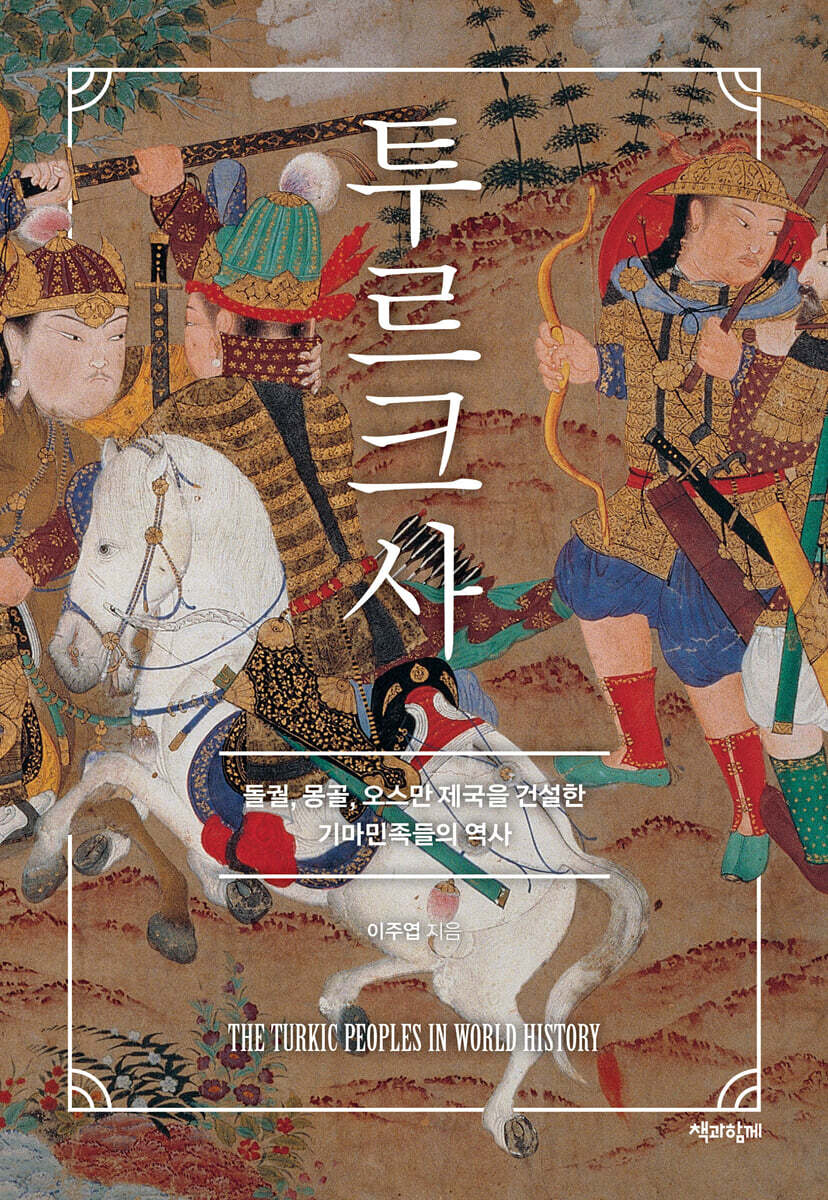
Dr. Lee Ju-yeop, a renowned researcher in the international field of Central Eurasian history, who is also well-known in Korea for his book “Descendants of the Mongol Empire” (2020), has published “Turkic History: The History of the Horsemen Who Built the Turkic, Mongol, and Ottoman Empires,” which is a compilation of the results of his research over the past decade.
The original version of this book was published in 2024 by the academic publisher Routledge under the title “The Turkic Peoples in World History.” The author, Dr. Lee Ju-yeop, personally translated it into Korean, adding and supplementing many parts.
In other words, this book, 『Turkish History』, is in fact a revised and expanded edition written in Korean.
Turkic peoples have had a profound influence on the history of China, Central Asia, the Middle East, South Asia, and Europe.
Therefore, without a comprehensive knowledge of the history of the Turkic peoples, it is difficult to gain a macroscopic understanding of the flow of world history, let alone insight into the modern world.
Dr. Lee Ju-yeop sought to provide critical insight into the Turkic peoples by treating their history not as the long history of a single ethnic group, but as a complex history of individual peoples with their own origins and identities, and as a history that includes the Turkification process of various Indo-European, Uralic, and Mongolian language groups.
Why should we know the history of the Turkic people?
Since the emergence of the first Turkic nomadic empire, the Gokturk Empire, on the Mongolian steppe in the mid-6th century, Turkic peoples have conquered vast territories across the Eurasian continent and established numerous empires and states for over a thousand years.
They also participated in the construction and operation of the Mongol Empire, and Turkified a significant part of the Mongol Empire.
Empires established by Mongol nomads, along with Turkic ones, had a significant impact on the history of pre-modern China, the Middle East, and Europe.
Representative examples include powerful empires such as the Uyghur Empire (744–840), the Khazar Empire (mid-7th century–968/969), the Seljuk Empire (1037–1194), and the Ottoman Empire (1299–1922).
Additionally, regional powers such as the Delhi Sultanate (1206–1526) in India and the Mamluk Sultanate (1250–1517) that ruled over Egypt and Syria were also states established by Turkic groups.
The Mongol Empire can also be included in the category of 'Turkic empires', and Turkic nomads were active in the Islamic world as 'slave soldiers' known as Mamluks or Ghulams.
It is difficult to find a single language group that has conquered as vast a territory, founded as many empires and states, and contributed as much to world cultural history as the Turkic peoples.
For thousands of years before the rise of the European powers as the world's dominant powers, the history of the Turkic peoples played a significant role in world history.
Major events that took place in the Turkic world had a profound impact on the history of China, Central Asia, the Middle East, South Asia, and Europe.
Therefore, without a comprehensive knowledge of the history of the Turkic peoples, it would be difficult to gain a macroscopic understanding of the flow of world history, let alone insight into the modern world.
Complex and comprehensive Turkic syntax
Existing books on Turkic history usually focus on the history of early Turkic peoples such as the Gokturks and Uyghurs, or empires well-known in world history such as the Seljuks and Ottomans, and relatively briefly or omit the history of the medieval Turkic peoples that developed in central and western Central Eurasia after the fall of the Uyghur Empire in the mid-9th century.
And the history of the Turkic-Mongol peoples who emerged in the post-Mongol period is barely covered.
On the other hand, 『Turkic History』 is a truly comprehensive history that begins with the early Turkic peoples active in the Mongolian steppe, passes through medieval Turkic peoples such as the Khazars, Bulgars, Kipchaks, and Oghuz who appeared in the central and western parts of Central Eurasia, and covers all the way to the early modern Turkic peoples such as the Chagatai, Uzbeks, Kazakhs, and Tatars who formed in the 14th to 16th centuries.
Moreover, existing books on Turkic history treat the history of the numerous Turkic peoples that appeared in history as a single ethnic group.
On the other hand, 『Turkic History』 critically examines the formation and development of each Turkic people, illuminating them as groups with diverse origins and identities.
Therefore, through this book, readers will be able to recognize, for example, the historical discontinuity between the Turkic Empire, known domestically as "Goguryeo's ally," and the Ottoman Empire, which claimed to be the successor to the Roman Empire, or the ethnic differences between the Mediterranean nation of Turkiye and the Central Asian oasis nation of Uzbekistan.
It broadly reflects the latest research results, including genetics.
Includes 67 supplementary information articles, including various primary sources.
『Turkic History』 makes extensive use of the latest research findings from international academic circles.
We have referenced recent research findings published by experts in various fields, and have actively incorporated the latest advances in genetics in particular (genetics provides clues to many difficult questions related to the origins and formation of Turkic peoples that have not been clearly elucidated until now).
Additionally, it introduces various primary sources that were difficult to access in existing domestic literature.
It includes excerpts from key primary sources, such as the 'Letter of Joseph' summarizing the history of the Khazar Empire; Ibn Fadlan's travelogue describing the customs of the Bulgar, Khazar, and Oghuz nomads; and Rui Gonzalez de Clavijo's account of his visit to the Timurid Empire on the origins of the Chagatai people. These will be a useful resource for both general readers and history majors.
In addition, dozens of boxed articles are included here and there to provide detailed knowledge that could not be covered in the main text, which covers major historical trends, such as 'DNA of the Turkic peoples', 'Turkic-Persian dual society in the Islamic world', and 'Comparison of 17th-century Tatar composite bows and early firearms'.
It also contains the origins of various ethnic names and the colorful cultural history that flourished under many dynasties.
In short, this book can be said to be a concise encyclopedia of Turkic national history.
Contents of the book
Chapter 1: Early Turkic Nomadic Peoples:
Tiele, Turks, Uyghurs
Chapter 1 deals with the origins and history of the Tieleks, Turks, and Uyghurs, early Turkic peoples who lived as pastoral nomads in the Mongolian and Dzungar steppes until the mid-9th century.
Various Turkic groups living in the Mongolian and Dzungarian steppes migrated in various directions, including westward, as refugees or conquered peoples at least from around the 4th century AD.
As a result, the Turkic world expanded significantly as non-Turkic groups living in southern Siberia, the central and western Eurasian steppes, the oasis regions of Central Asia, and the Volga-Kama region became Turkicized.
Chapter 2: Turkic Peoples of Southern Siberia, Central Asia, and the Kipchak Steppe:
Kyrgyz, Khazar, Bulgar, Karakhan, Kipchak
In the second half of the first millennium AD, the Turkification of non-Turkic groups also took place in the forested areas north of the Eurasian steppe.
During this period, the migration of Turkic nomads led to the Turkification of southern Siberia, the central and western steppes, the Central Asian oasis regions, and the Volga-Kama region, giving rise to new Turkic-speaking peoples such as the Khazars, Bulgars, Karakhan Turks, and Kipchaks.
Their origins and history are discussed in Chapter 2.
Chapter 3: Oghuz Turkic Peoples of West Asia and the Middle East:
Oghuz, Seljuk, Ottoman, Turkmen
Among the new Turkic peoples that emerged in the central and western Eurasian steppes were the Oghuz.
They lived a nomadic life in the Aral Sea and Caspian Sea steppe region around the 9th and 10th centuries.
Oghuz nomads began migrating to Iran and Anatolia via Khorasan around the 11th century.
The Oghuz nomads, also known as Turkmen in the Islamic world, built powerful empires in western Eurasia, including the Seljuk, Ottoman, and Safavid empires.
They Turkified various non-Turkic peoples, including the Persian-speaking inhabitants of Iran and Azerbaijan, the Greeks of Anatolia, and the Armenians.
Chapter 4: The Kipchak Steppe and the Mongol Turkic Peoples of Central Asia ('Turko-Mongols'):
Jochi Ulus, Chagatai Ulus
In the 13th century, all of Central Eurasia was united under the Mongol Empire.
The Mongols also conquered settled areas in outer Eurasia, including China, Kyivan Rus, Iran, and Anatolia.
Although the Mongol Empire began to disintegrate after the mid-14th century, Turkicized descendants of the Mongol Empire, such as the Chagatai/Moghuls, Uzbeks, Kazakhs, and Crimean Tatars, continued to rule over significant areas of Central Eurasia.
They remained politically active throughout the 17th and 18th centuries in a wide area, including the Crimean Peninsula, the East Kipchak steppe, Transoxiana, and the Tarim Basin.
Chapter 4 covers their origins and history.
A comprehensive and critical history of the Turkic people
Dr. Lee Ju-yeop, a renowned researcher in the international field of Central Eurasian history, who is also well-known in Korea for his book “Descendants of the Mongol Empire” (2020), has published “Turkic History: The History of the Horsemen Who Built the Turkic, Mongol, and Ottoman Empires,” which is a compilation of the results of his research over the past decade.
The original version of this book was published in 2024 by the academic publisher Routledge under the title “The Turkic Peoples in World History.” The author, Dr. Lee Ju-yeop, personally translated it into Korean, adding and supplementing many parts.
In other words, this book, 『Turkish History』, is in fact a revised and expanded edition written in Korean.
Turkic peoples have had a profound influence on the history of China, Central Asia, the Middle East, South Asia, and Europe.
Therefore, without a comprehensive knowledge of the history of the Turkic peoples, it is difficult to gain a macroscopic understanding of the flow of world history, let alone insight into the modern world.
Dr. Lee Ju-yeop sought to provide critical insight into the Turkic peoples by treating their history not as the long history of a single ethnic group, but as a complex history of individual peoples with their own origins and identities, and as a history that includes the Turkification process of various Indo-European, Uralic, and Mongolian language groups.
Why should we know the history of the Turkic people?
Since the emergence of the first Turkic nomadic empire, the Gokturk Empire, on the Mongolian steppe in the mid-6th century, Turkic peoples have conquered vast territories across the Eurasian continent and established numerous empires and states for over a thousand years.
They also participated in the construction and operation of the Mongol Empire, and Turkified a significant part of the Mongol Empire.
Empires established by Mongol nomads, along with Turkic ones, had a significant impact on the history of pre-modern China, the Middle East, and Europe.
Representative examples include powerful empires such as the Uyghur Empire (744–840), the Khazar Empire (mid-7th century–968/969), the Seljuk Empire (1037–1194), and the Ottoman Empire (1299–1922).
Additionally, regional powers such as the Delhi Sultanate (1206–1526) in India and the Mamluk Sultanate (1250–1517) that ruled over Egypt and Syria were also states established by Turkic groups.
The Mongol Empire can also be included in the category of 'Turkic empires', and Turkic nomads were active in the Islamic world as 'slave soldiers' known as Mamluks or Ghulams.
It is difficult to find a single language group that has conquered as vast a territory, founded as many empires and states, and contributed as much to world cultural history as the Turkic peoples.
For thousands of years before the rise of the European powers as the world's dominant powers, the history of the Turkic peoples played a significant role in world history.
Major events that took place in the Turkic world had a profound impact on the history of China, Central Asia, the Middle East, South Asia, and Europe.
Therefore, without a comprehensive knowledge of the history of the Turkic peoples, it would be difficult to gain a macroscopic understanding of the flow of world history, let alone insight into the modern world.
Complex and comprehensive Turkic syntax
Existing books on Turkic history usually focus on the history of early Turkic peoples such as the Gokturks and Uyghurs, or empires well-known in world history such as the Seljuks and Ottomans, and relatively briefly or omit the history of the medieval Turkic peoples that developed in central and western Central Eurasia after the fall of the Uyghur Empire in the mid-9th century.
And the history of the Turkic-Mongol peoples who emerged in the post-Mongol period is barely covered.
On the other hand, 『Turkic History』 is a truly comprehensive history that begins with the early Turkic peoples active in the Mongolian steppe, passes through medieval Turkic peoples such as the Khazars, Bulgars, Kipchaks, and Oghuz who appeared in the central and western parts of Central Eurasia, and covers all the way to the early modern Turkic peoples such as the Chagatai, Uzbeks, Kazakhs, and Tatars who formed in the 14th to 16th centuries.
Moreover, existing books on Turkic history treat the history of the numerous Turkic peoples that appeared in history as a single ethnic group.
On the other hand, 『Turkic History』 critically examines the formation and development of each Turkic people, illuminating them as groups with diverse origins and identities.
Therefore, through this book, readers will be able to recognize, for example, the historical discontinuity between the Turkic Empire, known domestically as "Goguryeo's ally," and the Ottoman Empire, which claimed to be the successor to the Roman Empire, or the ethnic differences between the Mediterranean nation of Turkiye and the Central Asian oasis nation of Uzbekistan.
It broadly reflects the latest research results, including genetics.
Includes 67 supplementary information articles, including various primary sources.
『Turkic History』 makes extensive use of the latest research findings from international academic circles.
We have referenced recent research findings published by experts in various fields, and have actively incorporated the latest advances in genetics in particular (genetics provides clues to many difficult questions related to the origins and formation of Turkic peoples that have not been clearly elucidated until now).
Additionally, it introduces various primary sources that were difficult to access in existing domestic literature.
It includes excerpts from key primary sources, such as the 'Letter of Joseph' summarizing the history of the Khazar Empire; Ibn Fadlan's travelogue describing the customs of the Bulgar, Khazar, and Oghuz nomads; and Rui Gonzalez de Clavijo's account of his visit to the Timurid Empire on the origins of the Chagatai people. These will be a useful resource for both general readers and history majors.
In addition, dozens of boxed articles are included here and there to provide detailed knowledge that could not be covered in the main text, which covers major historical trends, such as 'DNA of the Turkic peoples', 'Turkic-Persian dual society in the Islamic world', and 'Comparison of 17th-century Tatar composite bows and early firearms'.
It also contains the origins of various ethnic names and the colorful cultural history that flourished under many dynasties.
In short, this book can be said to be a concise encyclopedia of Turkic national history.
Contents of the book
Chapter 1: Early Turkic Nomadic Peoples:
Tiele, Turks, Uyghurs
Chapter 1 deals with the origins and history of the Tieleks, Turks, and Uyghurs, early Turkic peoples who lived as pastoral nomads in the Mongolian and Dzungar steppes until the mid-9th century.
Various Turkic groups living in the Mongolian and Dzungarian steppes migrated in various directions, including westward, as refugees or conquered peoples at least from around the 4th century AD.
As a result, the Turkic world expanded significantly as non-Turkic groups living in southern Siberia, the central and western Eurasian steppes, the oasis regions of Central Asia, and the Volga-Kama region became Turkicized.
Chapter 2: Turkic Peoples of Southern Siberia, Central Asia, and the Kipchak Steppe:
Kyrgyz, Khazar, Bulgar, Karakhan, Kipchak
In the second half of the first millennium AD, the Turkification of non-Turkic groups also took place in the forested areas north of the Eurasian steppe.
During this period, the migration of Turkic nomads led to the Turkification of southern Siberia, the central and western steppes, the Central Asian oasis regions, and the Volga-Kama region, giving rise to new Turkic-speaking peoples such as the Khazars, Bulgars, Karakhan Turks, and Kipchaks.
Their origins and history are discussed in Chapter 2.
Chapter 3: Oghuz Turkic Peoples of West Asia and the Middle East:
Oghuz, Seljuk, Ottoman, Turkmen
Among the new Turkic peoples that emerged in the central and western Eurasian steppes were the Oghuz.
They lived a nomadic life in the Aral Sea and Caspian Sea steppe region around the 9th and 10th centuries.
Oghuz nomads began migrating to Iran and Anatolia via Khorasan around the 11th century.
The Oghuz nomads, also known as Turkmen in the Islamic world, built powerful empires in western Eurasia, including the Seljuk, Ottoman, and Safavid empires.
They Turkified various non-Turkic peoples, including the Persian-speaking inhabitants of Iran and Azerbaijan, the Greeks of Anatolia, and the Armenians.
Chapter 4: The Kipchak Steppe and the Mongol Turkic Peoples of Central Asia ('Turko-Mongols'):
Jochi Ulus, Chagatai Ulus
In the 13th century, all of Central Eurasia was united under the Mongol Empire.
The Mongols also conquered settled areas in outer Eurasia, including China, Kyivan Rus, Iran, and Anatolia.
Although the Mongol Empire began to disintegrate after the mid-14th century, Turkicized descendants of the Mongol Empire, such as the Chagatai/Moghuls, Uzbeks, Kazakhs, and Crimean Tatars, continued to rule over significant areas of Central Eurasia.
They remained politically active throughout the 17th and 18th centuries in a wide area, including the Crimean Peninsula, the East Kipchak steppe, Transoxiana, and the Tarim Basin.
Chapter 4 covers their origins and history.
GOODS SPECIFICS
- Date of issue: August 14, 2025
- Page count, weight, size: 392 pages | 528g | 146*210*23mm
- ISBN13: 9791194263524
- ISBN10: 1194263526
You may also like
카테고리
korean


korean

![ELLE 엘르 스페셜 에디션 A형 : 12월 [2025]](http://librairie.coreenne.fr/cdn/shop/files/b8e27a3de6c9538896439686c6b0e8fb.jpg?v=1766436872&width=3840)


