

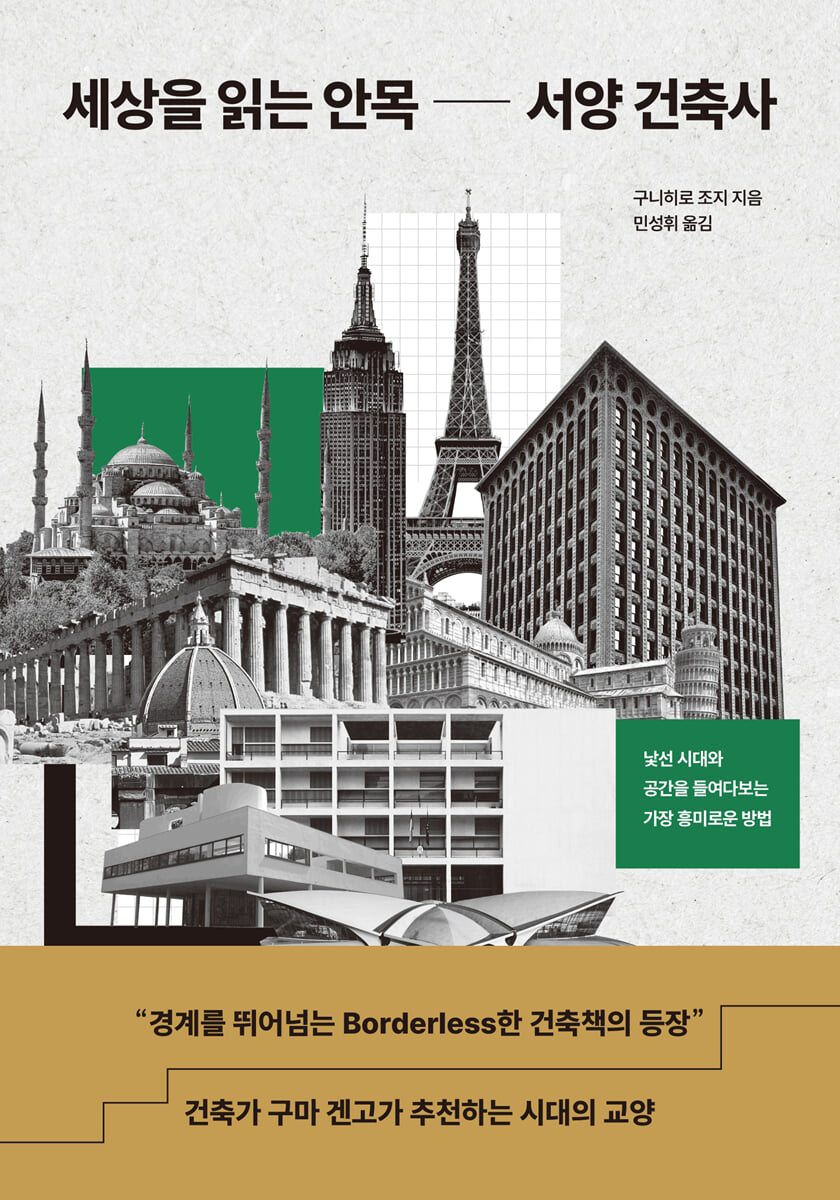
Western Architectural History: A Perspective on the World
 |
Description
Book Introduction
Architecture is not a product of technology built on blueprints,
It is a trace of the life and times that humanity has accumulated.
When we look beyond the appearance and into people's lives
Architecture becomes your eye and culture.
Everyone lives in architecture every day.
We spend all day in and around buildings, whether it be home, school, work, cafes, or restaurants, but few people actually know much about architecture.
Joji Kunihiro, author of "A Perspective on Western Architecture," has been an architect and professor for over 30 years, working to bring architecture out of the realm of experts and make it accessible to the general public.
Rather than listing famous landmarks, this book offers an honest chronological guide to the flow of Western architecture from the Stone Age to the present day.
That is, it emphasizes ‘architectural history.’
Because architecture is a 'stage of life' that embodies the lifestyles and values of the people of the time, knowing the history of architecture is a way to understand the history of mankind.
For example, when the power of the monarchy was weakened by the civil revolution, public buildings for the citizens increased, and the Industrial Revolution changed lifestyles by advancing technology and making skyscrapers possible.
The war-torn area became a testing ground for new urban planning.
If you are curious about the lives of people hidden beyond the exterior of a building, you can learn about the history of architecture in a fun way.
After reading the book, you will feel that the architecture is not just a beautiful sight to see, but an interesting narrative built by humanity.
Furthermore, the everyday scenery will become even more colorful.
It is a trace of the life and times that humanity has accumulated.
When we look beyond the appearance and into people's lives
Architecture becomes your eye and culture.
Everyone lives in architecture every day.
We spend all day in and around buildings, whether it be home, school, work, cafes, or restaurants, but few people actually know much about architecture.
Joji Kunihiro, author of "A Perspective on Western Architecture," has been an architect and professor for over 30 years, working to bring architecture out of the realm of experts and make it accessible to the general public.
Rather than listing famous landmarks, this book offers an honest chronological guide to the flow of Western architecture from the Stone Age to the present day.
That is, it emphasizes ‘architectural history.’
Because architecture is a 'stage of life' that embodies the lifestyles and values of the people of the time, knowing the history of architecture is a way to understand the history of mankind.
For example, when the power of the monarchy was weakened by the civil revolution, public buildings for the citizens increased, and the Industrial Revolution changed lifestyles by advancing technology and making skyscrapers possible.
The war-torn area became a testing ground for new urban planning.
If you are curious about the lives of people hidden beyond the exterior of a building, you can learn about the history of architecture in a fun way.
After reading the book, you will feel that the architecture is not just a beautiful sight to see, but an interesting narrative built by humanity.
Furthermore, the everyday scenery will become even more colorful.
- You can preview some of the book's contents.
Preview
index
preface.
Reading the Times and Life Through Architecture
Architectural styles by era at a glance
introduction.
Western architecture, which constantly pursues aesthetics
Why should we study Western architectural history?
The world's first architectural book, 『Ten Books on Architecture』, which had an influence for 2,000 years
Classicism and Modernism
The ill-fated architect and the frustrations of modernism
Stagnant Modernism: Looking Back to the Past for the Future
Chapter 1.
From the Stone Age to the Middle Ages_ The Beginning of Architecture and Symbols of Religious Power
Architecture is about creating spaces for people to use.
The Culture of Wood and the Culture of Stone: Two Ways Architecture Relates to Nature
Egypt's Luxor Temple: More than just a structure, it's a space.
Three types of capital designs passed from Egypt to Greece and Rome
From a space for the gods to a city for citizens: the Parthenon
Emperor Hadrian, a man of power who discovered aesthetics and commercial value in architecture
The Two Faces of Roman Architecture: The Pantheon and the Colosseum
Medieval European architecture centered around the Christian church
Hagia Sophia, an architectural legacy passed from Christianity to Islam
A space open to light beyond thick walls, from Romanesque to Gothic
Chapter 2: The Early Modern Age: The Revival of Antiquity and the Aesthetics of Display
Brunelleschi, a pioneer of Renaissance architecture
The first Renaissance building for humans, not gods, was an orphanage.
Renaissance architects who inherited ancient wisdom
Renovation of St. Peter's Basilica with participation of famous architects
Raphael's Death and the Reformation: St. Peter's Basilica Halted
Michelangelo, who brought the stagnant Renaissance back into motion
St. Peter's Basilica is finally completed
The Farnese Palace boasts perfect balance
The Succession of Classicism and a New Challenge: Palladio's Mannerism
The Baroque masterpiece, "Church of San Carlo alle Quattro Fontane," completed with curves
Rococo style born from the French upper class
The Rococo fashion that ended with the French Revolution
Chapter 3.
The beginning of modern times brought about by the Industrial Revolution_ Architecture created by technological and social changes
The Enlightenment and the bourgeois revolution, the forces that ushered in the era of modern architecture
Boullay, the visionary architect who breathed fresh air into neoclassical architecture
Ledoux, a neoclassical architect who dreamed of an industrial city
Piranesi, a printmaker and archaeologist who designed interesting spaces with prints
Fourier and Godin, who aimed for a socialist utopia
Schinkel, a German neoclassical architect who maintained rationality and classical beauty
The Crystal Palace, a symbol of the Industrial Revolution that illuminated the first London World's Fair
The classical style of the French National Library and Milan shopping arcade, expressed in iron and glass
The Arts and Crafts Movement, which sought to restore the value of craftsmanship in the age of mechanization
Chapter 4.
Late 19th century_ American skyscrapers and European Art Nouveau
The technological innovation that made the 300-meter Eiffel Tower possible
San Francisco, a new city created by the gold rush
Pullman Industrial City: An Urban Experiment Where Companies Co-Design Workplaces and Housing
The Chicago School, a group of architects who ushered in the era of high-rise office buildings
Louis Sullivan, the architect who added a new aesthetic to high-rise buildings
Art Nouveau, a style resembling natural curves, a new art that colored Europe.
Gaudi, the architect who perfected curves as structure rather than decoration
Mackintosh, a versatile artist who led British Art Nouveau, a member of the Glasgow School
A turning point from the conservative decorative arts of the 19th century to the functional architecture of the 20th century.
"Ornament is a crime." Adolf Loos, who opened the door to modernism.
Richardson, the architect who perfected the unique Romanesque style in America
America, which favored classics even in the 20th century
Chapter 5.
Modernism era_ An architectural style that prioritized function over decoration
From Art Nouveau to Modernism, Behrens, the architect who bridged the ages
The four great masters who pioneered modern architecture
Le Corbusier's Domino System: An Invention for Free Space
Houses as Machines for Living: Le Corbusier's New Housing Philosophy
The "Savoye Villa," which embodies the five principles of modern architecture.
Gropius's "Fagus Factory," a modernist factory that created a new space
The birth of the Bauhaus, a school dedicated to progressive art education
Bauhaus closed due to Nazi oppression
The Essence of Minimalism: Mies's "Barcelona Pavilion"
The masterpiece "Farnsworth House," embroiled in a lover's trial
Wright's Prairie Style: A House Resembling the Landscape of the American Plains
Japan reached out to Light, who was mired in a swamp due to a series of trials.
The footsteps of Shimoda Kikutaro, who had a great influence on Japanese architecture.
The Imperial Hotel Light Building, completed after many twists and turns
Wright ushered in a second golden age, creating masterpieces in harmony with nature.
Chapter 6.
From the Great Depression to World War II, an era in which power and ideology dictated the direction of architecture.
The Chicago Tribune Headquarters Building Competition: A Competitive Competition Between Modernism and Neoclassicism
Art Deco style, which pursues both possibility and decorativeness
Rockefeller Center: Art in the Great Depression, Massive Job Creation
The Chrysler Building, the world's tallest building, has achieved a height competition.
A New Perspective on Three-Dimensional Stereoscopy: Russian Constructivism
The Soviet Pavilion, a Russian constructivist building that captured the world's attention
Russia's Unfulfilled Imagination Becomes Reality in Japan
The pinnacle of structural beauty, the beauty of the skeleton itself: the "Shukhov Tower"
A huge palace planned as a symbol of power but left unfinished
The emergence of Futurism, which attempted to thoroughly destroy the art of the past
Rivera, an architect active in the fascist regime
Casa del Facio: Dense Proportions Hidden in Simple Forms
Chapter 7.
Postwar America: Internationalism and the Birth of the Modern City
The UN Headquarters Building, a symbol of post-war international cooperation and democracy
A generational shift within modernism, Team X dismantling CIAM
From 'Less is more' to 'Less is bore'
The Birth of the Shopping Mall: A Space That Became the Center of Suburban Life
High-rise buildings that speak to the city: the emergence of international style
The architectural imagination of Fuller, the inventor who dreamed of a sustainable world
The architectural philosophy of Louis Kahn, the last great architect of the 20th century
Curved Skyward: Eero Saarinen's Airport Architecture
The New York World's Fair, steeped in commercialism
Arcosanti, Soleri's experimental city of ecology, harmonizing the city with nature.
Chapter 8.
Japanese Modernism: An Experiment in Modern Architecture, Similar Yet Different from Western Modernism
Modernism that resisted the "Japanese taste" stipulated in the competition
Kunio Maekawa, who reinterpreted Western modernism for Japan
"Architecture is an art form." Young artists who pioneered modern Japanese architecture.
Tsuchiura's house, which angered his teacher Light
Japanese Modernism Recognized at the Paris World's Fair
The Watanabe Ou Memorial Hall, a temple-like building influenced by militarism
The debut work of Kenzo Tange, a rising star of Japanese modernism.
Hiroshima Peace Memorial Park and Memorial Hall: A Space of Peace Built on the Ruins of War
The Tokyo Plan 1960, which envisioned a future maritime city
Osaka World Expo: Bringing Metabolism to Life
Young architects, known as "Nobushi," showcase their talents in private homes rather than public buildings.
Chapter 9.
Postmodernism and Deconstructionism: The Freedom of Architecture Beyond All Rules and Order
Venturi's work rebelled against the rules of modernism.
A genius of modernism, a leader of postmodernism
Philip Johnson, the man who changed the course of 20th-century American architecture
Arata Isozaki, a pioneer of Japanese postmodernism
A turning point in the era: from postmodernism to deconstructionism
Deconstructivist architects with their distorted structures and destructive aesthetics
The fate of architects is to express themselves even under pressure.
Why Architecture is Necessary as a Liberal Arts Subject
Author's Note: I hope that anyone can easily enter the world of architecture.
Translator's Note: With the intention of building a foundation
References and Illustration Sources
Reading the Times and Life Through Architecture
Architectural styles by era at a glance
introduction.
Western architecture, which constantly pursues aesthetics
Why should we study Western architectural history?
The world's first architectural book, 『Ten Books on Architecture』, which had an influence for 2,000 years
Classicism and Modernism
The ill-fated architect and the frustrations of modernism
Stagnant Modernism: Looking Back to the Past for the Future
Chapter 1.
From the Stone Age to the Middle Ages_ The Beginning of Architecture and Symbols of Religious Power
Architecture is about creating spaces for people to use.
The Culture of Wood and the Culture of Stone: Two Ways Architecture Relates to Nature
Egypt's Luxor Temple: More than just a structure, it's a space.
Three types of capital designs passed from Egypt to Greece and Rome
From a space for the gods to a city for citizens: the Parthenon
Emperor Hadrian, a man of power who discovered aesthetics and commercial value in architecture
The Two Faces of Roman Architecture: The Pantheon and the Colosseum
Medieval European architecture centered around the Christian church
Hagia Sophia, an architectural legacy passed from Christianity to Islam
A space open to light beyond thick walls, from Romanesque to Gothic
Chapter 2: The Early Modern Age: The Revival of Antiquity and the Aesthetics of Display
Brunelleschi, a pioneer of Renaissance architecture
The first Renaissance building for humans, not gods, was an orphanage.
Renaissance architects who inherited ancient wisdom
Renovation of St. Peter's Basilica with participation of famous architects
Raphael's Death and the Reformation: St. Peter's Basilica Halted
Michelangelo, who brought the stagnant Renaissance back into motion
St. Peter's Basilica is finally completed
The Farnese Palace boasts perfect balance
The Succession of Classicism and a New Challenge: Palladio's Mannerism
The Baroque masterpiece, "Church of San Carlo alle Quattro Fontane," completed with curves
Rococo style born from the French upper class
The Rococo fashion that ended with the French Revolution
Chapter 3.
The beginning of modern times brought about by the Industrial Revolution_ Architecture created by technological and social changes
The Enlightenment and the bourgeois revolution, the forces that ushered in the era of modern architecture
Boullay, the visionary architect who breathed fresh air into neoclassical architecture
Ledoux, a neoclassical architect who dreamed of an industrial city
Piranesi, a printmaker and archaeologist who designed interesting spaces with prints
Fourier and Godin, who aimed for a socialist utopia
Schinkel, a German neoclassical architect who maintained rationality and classical beauty
The Crystal Palace, a symbol of the Industrial Revolution that illuminated the first London World's Fair
The classical style of the French National Library and Milan shopping arcade, expressed in iron and glass
The Arts and Crafts Movement, which sought to restore the value of craftsmanship in the age of mechanization
Chapter 4.
Late 19th century_ American skyscrapers and European Art Nouveau
The technological innovation that made the 300-meter Eiffel Tower possible
San Francisco, a new city created by the gold rush
Pullman Industrial City: An Urban Experiment Where Companies Co-Design Workplaces and Housing
The Chicago School, a group of architects who ushered in the era of high-rise office buildings
Louis Sullivan, the architect who added a new aesthetic to high-rise buildings
Art Nouveau, a style resembling natural curves, a new art that colored Europe.
Gaudi, the architect who perfected curves as structure rather than decoration
Mackintosh, a versatile artist who led British Art Nouveau, a member of the Glasgow School
A turning point from the conservative decorative arts of the 19th century to the functional architecture of the 20th century.
"Ornament is a crime." Adolf Loos, who opened the door to modernism.
Richardson, the architect who perfected the unique Romanesque style in America
America, which favored classics even in the 20th century
Chapter 5.
Modernism era_ An architectural style that prioritized function over decoration
From Art Nouveau to Modernism, Behrens, the architect who bridged the ages
The four great masters who pioneered modern architecture
Le Corbusier's Domino System: An Invention for Free Space
Houses as Machines for Living: Le Corbusier's New Housing Philosophy
The "Savoye Villa," which embodies the five principles of modern architecture.
Gropius's "Fagus Factory," a modernist factory that created a new space
The birth of the Bauhaus, a school dedicated to progressive art education
Bauhaus closed due to Nazi oppression
The Essence of Minimalism: Mies's "Barcelona Pavilion"
The masterpiece "Farnsworth House," embroiled in a lover's trial
Wright's Prairie Style: A House Resembling the Landscape of the American Plains
Japan reached out to Light, who was mired in a swamp due to a series of trials.
The footsteps of Shimoda Kikutaro, who had a great influence on Japanese architecture.
The Imperial Hotel Light Building, completed after many twists and turns
Wright ushered in a second golden age, creating masterpieces in harmony with nature.
Chapter 6.
From the Great Depression to World War II, an era in which power and ideology dictated the direction of architecture.
The Chicago Tribune Headquarters Building Competition: A Competitive Competition Between Modernism and Neoclassicism
Art Deco style, which pursues both possibility and decorativeness
Rockefeller Center: Art in the Great Depression, Massive Job Creation
The Chrysler Building, the world's tallest building, has achieved a height competition.
A New Perspective on Three-Dimensional Stereoscopy: Russian Constructivism
The Soviet Pavilion, a Russian constructivist building that captured the world's attention
Russia's Unfulfilled Imagination Becomes Reality in Japan
The pinnacle of structural beauty, the beauty of the skeleton itself: the "Shukhov Tower"
A huge palace planned as a symbol of power but left unfinished
The emergence of Futurism, which attempted to thoroughly destroy the art of the past
Rivera, an architect active in the fascist regime
Casa del Facio: Dense Proportions Hidden in Simple Forms
Chapter 7.
Postwar America: Internationalism and the Birth of the Modern City
The UN Headquarters Building, a symbol of post-war international cooperation and democracy
A generational shift within modernism, Team X dismantling CIAM
From 'Less is more' to 'Less is bore'
The Birth of the Shopping Mall: A Space That Became the Center of Suburban Life
High-rise buildings that speak to the city: the emergence of international style
The architectural imagination of Fuller, the inventor who dreamed of a sustainable world
The architectural philosophy of Louis Kahn, the last great architect of the 20th century
Curved Skyward: Eero Saarinen's Airport Architecture
The New York World's Fair, steeped in commercialism
Arcosanti, Soleri's experimental city of ecology, harmonizing the city with nature.
Chapter 8.
Japanese Modernism: An Experiment in Modern Architecture, Similar Yet Different from Western Modernism
Modernism that resisted the "Japanese taste" stipulated in the competition
Kunio Maekawa, who reinterpreted Western modernism for Japan
"Architecture is an art form." Young artists who pioneered modern Japanese architecture.
Tsuchiura's house, which angered his teacher Light
Japanese Modernism Recognized at the Paris World's Fair
The Watanabe Ou Memorial Hall, a temple-like building influenced by militarism
The debut work of Kenzo Tange, a rising star of Japanese modernism.
Hiroshima Peace Memorial Park and Memorial Hall: A Space of Peace Built on the Ruins of War
The Tokyo Plan 1960, which envisioned a future maritime city
Osaka World Expo: Bringing Metabolism to Life
Young architects, known as "Nobushi," showcase their talents in private homes rather than public buildings.
Chapter 9.
Postmodernism and Deconstructionism: The Freedom of Architecture Beyond All Rules and Order
Venturi's work rebelled against the rules of modernism.
A genius of modernism, a leader of postmodernism
Philip Johnson, the man who changed the course of 20th-century American architecture
Arata Isozaki, a pioneer of Japanese postmodernism
A turning point in the era: from postmodernism to deconstructionism
Deconstructivist architects with their distorted structures and destructive aesthetics
The fate of architects is to express themselves even under pressure.
Why Architecture is Necessary as a Liberal Arts Subject
Author's Note: I hope that anyone can easily enter the world of architecture.
Translator's Note: With the intention of building a foundation
References and Illustration Sources
Detailed image

Into the book
Buildings remain in society for a long time and have a lasting impact on people.
To fulfill our responsibility for the future, we must consider not simply cost or public opinion, but deeply consider what it could mean for human society.
And in order to understand the meaning and influence of architecture, we must know ‘history’.
It is important.
--- From the "Preface"
It is not only the grand structures built by a nation that have historical significance.
The origins of buildings that many people consider simply a part of their daily lives, such as apartments built by large construction companies, can be found in the history of architecture.
If you understand how architecture is positioned within history, you'll realize that you're living within the vast flow of architectural history, even without having to visit tourist attractions.
I think that the scenery that felt dry and dull until now will come across as completely different and fresh.
--- From the "Preface"
Architects, like artists, do not simply give form to the ideas that come to their minds.
However, this does not mean that I am a technician who simply embodies someone else's idea.
The role of an architect is to deeply consider the meaning and purpose required of architecture and create relationships with space.
(Omitted) When visiting an old building, if you don't simply exclaim, "It's big," but look at it while imagining the logic and message emanating from the space within, it will remain in your heart more deeply.
--- "From the Luxor Temple in Egypt, which became a space beyond a simple structure"
The holes in the ceiling of the Pantheon create a striking visual effect.
Those who saw the sunlight streaming down from the very top of the dark hall must have felt an indescribable sense of sacredness. The sun god Sol (from which the English word solar derives) in Roman mythology is said to have been fervently worshipped alongside other sun gods, including Apollo, during the Roman Empire.
(Omitted) When I am in an architectural space like this, emotions completely different from usual swirl deep within my heart.
In that respect, I think the Pantheon is a space that creates deep communication between architecture and humans.
--- From "The Two Faces of Roman Architecture: The Pantheon and the Colosseum"
Architects do not work solely on their own desires for expression.
As with other arts and cultures, there is always a background of social values that change within the great historical waves.
For example, the Renaissance was the era that ushered in modern science, starting with Nicolaus Copernicus' heliocentric theory.
The authority of the medieval Catholic Church was shaken, Greek natural philosophy was once again in the spotlight, and the ancient trend of 'rebirth' was formed.
The civil revolutions that occurred throughout the 17th and 18th centuries also brought about significant changes in the values of Western society.
This marks the beginning of ‘modern times’.
Without understanding these social changes, one cannot fully understand the history of Western architecture.
And if you don't understand history, you can't think deeply about modern architecture.
--- From "Enlightenment and Bourgeois Revolution, the Forces that Opened the Era of Modern Architecture"
You may have noticed that architecture is by no means an independent culture, but is closely connected to the politics, economy, and society of the time.
Modernist architecture, which took its first steps before and after World War I (1914-1918), created diverse changes by combining with Art Deco, avant-garde art movements, and neoclassicism.
However, dark shadows such as Nazism in Germany, Stalinism in the Soviet Union, fascism in Italy, and the Great Depression always followed behind.
And the world once again entered a great war that brought terrible disaster.
After the war, the world began anew based on reflection.
(Omitted) Western architectural history can also be seen as having a new start at this point.
--- From "The UN Headquarters Building, a Symbol of Postwar International Cooperation and Democracy"
Humans are easily bored creatures, so no matter how widely supported an architectural style is, it cannot last forever.
It is no exaggeration to say that Western architecture has changed because people easily got bored.
In the 1960s, people emerged who directly criticized modernist architecture.
A representative figure is Robert Venturi, mentioned earlier.
The expression “Less is bore,” which he asserted in his 1966 book “Complexity and Opposition in Architecture,” seems to say, “I am now tired of modernism.”
As can be seen in Le Corbusier's claim of a 'machine for living in', modernism is a style that values rationality and functionality.
Modernism not only rejected decoration as a “crime,” but also, in its pursuit of universality, excluded regionality and historicity.
'Postmodern architecture' was born when people who were tired of modernism reevaluated these elements.
--- From "Venturi's Works that Revolted Against the Rules of Modernism"
I don't think the reason modernist architecture became established as a 'style' and had such a strong persuasive power that it made us feel like 'this is how it should be' was simply because it pursued interesting ideas.
As discussed in this book, the social change of the Industrial Revolution was at the root of modernism.
The modern society brought about by the Industrial Revolution was a capitalist society of mass production and mass consumption, which required efficiency and speed.
In such a society, modernist architecture that prioritized rationality and functionality was needed.
It was widely accepted not only because it was 'cool' or 'fun', but also because it met the needs of society, and furthermore, it was able to develop into a style that the times demanded.
--- From "The Fate of Architects Who Must Express Themselves Even Under Pressure"
If the knowledge of architecture becomes widespread, those with great power or financial resources will not be able to make low-level decisions.
If you build something strange, you will be criticized by the world or ignored as an 'uncultured leader'.
To build public buildings or office buildings that everyone can understand, decision-makers must also increase their understanding of architecture.
I would be so happy if, after reading this book, more people would take a broader interest in everything from their own homes to public architecture, and would also pay attention to the architectural policies of society as a whole.
Then, I am confident that the future of architecture and the future of this society will be bright.
--- From "Why Architecture is Necessary as a Liberal Arts"
If we develop our own architectural vision, we will be able to read the social meaning that exists beyond the form of architecture.
Sometimes, even in buildings that don't look great, you can find a certain beauty, such as a convincing economic logic or social implications.
If that happens, wouldn't we be reborn as generous and easygoing people who appreciate diverse beauty? From aesthetic pleasure to social insight, and even a generous and leisurely sense of life, architecture may seem rigid at first, but once you hold it in your hands, it's surprisingly comfortable and a useful tool for life.
To fulfill our responsibility for the future, we must consider not simply cost or public opinion, but deeply consider what it could mean for human society.
And in order to understand the meaning and influence of architecture, we must know ‘history’.
It is important.
--- From the "Preface"
It is not only the grand structures built by a nation that have historical significance.
The origins of buildings that many people consider simply a part of their daily lives, such as apartments built by large construction companies, can be found in the history of architecture.
If you understand how architecture is positioned within history, you'll realize that you're living within the vast flow of architectural history, even without having to visit tourist attractions.
I think that the scenery that felt dry and dull until now will come across as completely different and fresh.
--- From the "Preface"
Architects, like artists, do not simply give form to the ideas that come to their minds.
However, this does not mean that I am a technician who simply embodies someone else's idea.
The role of an architect is to deeply consider the meaning and purpose required of architecture and create relationships with space.
(Omitted) When visiting an old building, if you don't simply exclaim, "It's big," but look at it while imagining the logic and message emanating from the space within, it will remain in your heart more deeply.
--- "From the Luxor Temple in Egypt, which became a space beyond a simple structure"
The holes in the ceiling of the Pantheon create a striking visual effect.
Those who saw the sunlight streaming down from the very top of the dark hall must have felt an indescribable sense of sacredness. The sun god Sol (from which the English word solar derives) in Roman mythology is said to have been fervently worshipped alongside other sun gods, including Apollo, during the Roman Empire.
(Omitted) When I am in an architectural space like this, emotions completely different from usual swirl deep within my heart.
In that respect, I think the Pantheon is a space that creates deep communication between architecture and humans.
--- From "The Two Faces of Roman Architecture: The Pantheon and the Colosseum"
Architects do not work solely on their own desires for expression.
As with other arts and cultures, there is always a background of social values that change within the great historical waves.
For example, the Renaissance was the era that ushered in modern science, starting with Nicolaus Copernicus' heliocentric theory.
The authority of the medieval Catholic Church was shaken, Greek natural philosophy was once again in the spotlight, and the ancient trend of 'rebirth' was formed.
The civil revolutions that occurred throughout the 17th and 18th centuries also brought about significant changes in the values of Western society.
This marks the beginning of ‘modern times’.
Without understanding these social changes, one cannot fully understand the history of Western architecture.
And if you don't understand history, you can't think deeply about modern architecture.
--- From "Enlightenment and Bourgeois Revolution, the Forces that Opened the Era of Modern Architecture"
You may have noticed that architecture is by no means an independent culture, but is closely connected to the politics, economy, and society of the time.
Modernist architecture, which took its first steps before and after World War I (1914-1918), created diverse changes by combining with Art Deco, avant-garde art movements, and neoclassicism.
However, dark shadows such as Nazism in Germany, Stalinism in the Soviet Union, fascism in Italy, and the Great Depression always followed behind.
And the world once again entered a great war that brought terrible disaster.
After the war, the world began anew based on reflection.
(Omitted) Western architectural history can also be seen as having a new start at this point.
--- From "The UN Headquarters Building, a Symbol of Postwar International Cooperation and Democracy"
Humans are easily bored creatures, so no matter how widely supported an architectural style is, it cannot last forever.
It is no exaggeration to say that Western architecture has changed because people easily got bored.
In the 1960s, people emerged who directly criticized modernist architecture.
A representative figure is Robert Venturi, mentioned earlier.
The expression “Less is bore,” which he asserted in his 1966 book “Complexity and Opposition in Architecture,” seems to say, “I am now tired of modernism.”
As can be seen in Le Corbusier's claim of a 'machine for living in', modernism is a style that values rationality and functionality.
Modernism not only rejected decoration as a “crime,” but also, in its pursuit of universality, excluded regionality and historicity.
'Postmodern architecture' was born when people who were tired of modernism reevaluated these elements.
--- From "Venturi's Works that Revolted Against the Rules of Modernism"
I don't think the reason modernist architecture became established as a 'style' and had such a strong persuasive power that it made us feel like 'this is how it should be' was simply because it pursued interesting ideas.
As discussed in this book, the social change of the Industrial Revolution was at the root of modernism.
The modern society brought about by the Industrial Revolution was a capitalist society of mass production and mass consumption, which required efficiency and speed.
In such a society, modernist architecture that prioritized rationality and functionality was needed.
It was widely accepted not only because it was 'cool' or 'fun', but also because it met the needs of society, and furthermore, it was able to develop into a style that the times demanded.
--- From "The Fate of Architects Who Must Express Themselves Even Under Pressure"
If the knowledge of architecture becomes widespread, those with great power or financial resources will not be able to make low-level decisions.
If you build something strange, you will be criticized by the world or ignored as an 'uncultured leader'.
To build public buildings or office buildings that everyone can understand, decision-makers must also increase their understanding of architecture.
I would be so happy if, after reading this book, more people would take a broader interest in everything from their own homes to public architecture, and would also pay attention to the architectural policies of society as a whole.
Then, I am confident that the future of architecture and the future of this society will be bright.
--- From "Why Architecture is Necessary as a Liberal Arts"
If we develop our own architectural vision, we will be able to read the social meaning that exists beyond the form of architecture.
Sometimes, even in buildings that don't look great, you can find a certain beauty, such as a convincing economic logic or social implications.
If that happens, wouldn't we be reborn as generous and easygoing people who appreciate diverse beauty? From aesthetic pleasure to social insight, and even a generous and leisurely sense of life, architecture may seem rigid at first, but once you hold it in your hands, it's surprisingly comfortable and a useful tool for life.
--- From the "Translator's Note"
Publisher's Review
Knowing the history of architecture is about developing an eye for reading the world.
“I wonder how great it would be if I could have an observatory from which I could look out over the world from my own height.
I hope this book will serve as a tool for creating such an observatory.” _From the translator’s note
Architecture requires enormous capital and sharp decision-making, and is created by the convergence of the values of the times and the wishes of many people.
It can be said to be a microcosm of society.
Looking back at the history of architecture, in ancient times, huge temples and palaces were developed to show off power, and in the Middle Ages, religion dominated society and cathedrals that expressed the authority of God were the main buildings.
During the Renaissance, human-centered thinking, free from God, was reflected in architecture, and in modern times, the Industrial Revolution advanced technology, giving rise to large structures and high-rise buildings.
In modern times, architecture is evolving to embrace sustainability in response to environmental issues.
As you can guess from this, ‘architectural insight’ is not just the ability to immediately see the beauty of a building.
It is a perspective that knows how to read the flow of society and organically interpret the concerns of the times.
As the number of discerning citizens increases, our lives can move forward on a more solid foundation.
Why the History of Architecture Remains Relevant Now and in the Future
The author defines architecture as ‘the work of creating spaces for people to use.’
In his study of architectural history, he prioritized the 'spaces where people live and give meaning' over monuments or sculptures.
For example, the pyramids, while technically marvelous, are not architectural structures by his standards, as they are merely places to house coffins and not living spaces.
Conversely, even if it is a naturally formed cave, if people live in it and find meaning and use in it, it is considered closer to architecture.
The first building covered in the book is the Temple of Luxor in ancient Egypt.
It is characterized by the meticulous planning of the arrangement and roles of the surrounding buildings, focusing on the religious purpose pursued by the Pharaoh, and clearly shows the process by which architecture goes beyond a simple structure and becomes a space with meaning.
The various buildings introduced below each contain interpretations of their meanings and uses, so reading the book following these messages will leave you with a deeper sense of inspiration.
Architects who continue to confront the questions of the times and dream of a better world.
This book contains as many stories about architects as it does about buildings.
You can get a glimpse into the process by which numerous architects have struggled to find their own solutions in the face of changing times, technological advancements, and social demands.
Some tried to stick to the existing format, while others boldly broke it and sought new paths.
In opposition to classicism, which emphasized aesthetics, modernism, which prioritized functionality, emerged, and then the era of postmodernism, which criticized uniformity, began.
As buildings were mass-produced under capitalism, the Arts and Crafts movement, which emphasized the beauty of handcraftsmanship, Art Nouveau, which revived decorative beauty, and designs that took regional characteristics into account emerged.
In this way, architecture has evolved through various conflicts rather than always trying to find a single solution to the questions posed by the times.
Behind it lies the philosophy of architects who have pondered over a better world.
There is no clear answer as to the direction in which architecture should move forward.
So more questions are needed.
The possibilities of architecture expand as the number of questions increases.
“I wonder how great it would be if I could have an observatory from which I could look out over the world from my own height.
I hope this book will serve as a tool for creating such an observatory.” _From the translator’s note
Architecture requires enormous capital and sharp decision-making, and is created by the convergence of the values of the times and the wishes of many people.
It can be said to be a microcosm of society.
Looking back at the history of architecture, in ancient times, huge temples and palaces were developed to show off power, and in the Middle Ages, religion dominated society and cathedrals that expressed the authority of God were the main buildings.
During the Renaissance, human-centered thinking, free from God, was reflected in architecture, and in modern times, the Industrial Revolution advanced technology, giving rise to large structures and high-rise buildings.
In modern times, architecture is evolving to embrace sustainability in response to environmental issues.
As you can guess from this, ‘architectural insight’ is not just the ability to immediately see the beauty of a building.
It is a perspective that knows how to read the flow of society and organically interpret the concerns of the times.
As the number of discerning citizens increases, our lives can move forward on a more solid foundation.
Why the History of Architecture Remains Relevant Now and in the Future
The author defines architecture as ‘the work of creating spaces for people to use.’
In his study of architectural history, he prioritized the 'spaces where people live and give meaning' over monuments or sculptures.
For example, the pyramids, while technically marvelous, are not architectural structures by his standards, as they are merely places to house coffins and not living spaces.
Conversely, even if it is a naturally formed cave, if people live in it and find meaning and use in it, it is considered closer to architecture.
The first building covered in the book is the Temple of Luxor in ancient Egypt.
It is characterized by the meticulous planning of the arrangement and roles of the surrounding buildings, focusing on the religious purpose pursued by the Pharaoh, and clearly shows the process by which architecture goes beyond a simple structure and becomes a space with meaning.
The various buildings introduced below each contain interpretations of their meanings and uses, so reading the book following these messages will leave you with a deeper sense of inspiration.
Architects who continue to confront the questions of the times and dream of a better world.
This book contains as many stories about architects as it does about buildings.
You can get a glimpse into the process by which numerous architects have struggled to find their own solutions in the face of changing times, technological advancements, and social demands.
Some tried to stick to the existing format, while others boldly broke it and sought new paths.
In opposition to classicism, which emphasized aesthetics, modernism, which prioritized functionality, emerged, and then the era of postmodernism, which criticized uniformity, began.
As buildings were mass-produced under capitalism, the Arts and Crafts movement, which emphasized the beauty of handcraftsmanship, Art Nouveau, which revived decorative beauty, and designs that took regional characteristics into account emerged.
In this way, architecture has evolved through various conflicts rather than always trying to find a single solution to the questions posed by the times.
Behind it lies the philosophy of architects who have pondered over a better world.
There is no clear answer as to the direction in which architecture should move forward.
So more questions are needed.
The possibilities of architecture expand as the number of questions increases.
GOODS SPECIFICS
- Date of issue: September 1, 2025
- Page count, weight, size: 392 pages | 492g | 140*200*28mm
- ISBN13: 9791175230033
- ISBN10: 1175230030
You may also like
카테고리
korean


korean

![GQ KOREA Mark (Monthly): December [2025]](http://librairie.coreenne.fr/cdn/shop/files/8ef265dbbfbf186523ed75ba7319009d.jpg?v=1765340328&width=3840)


