

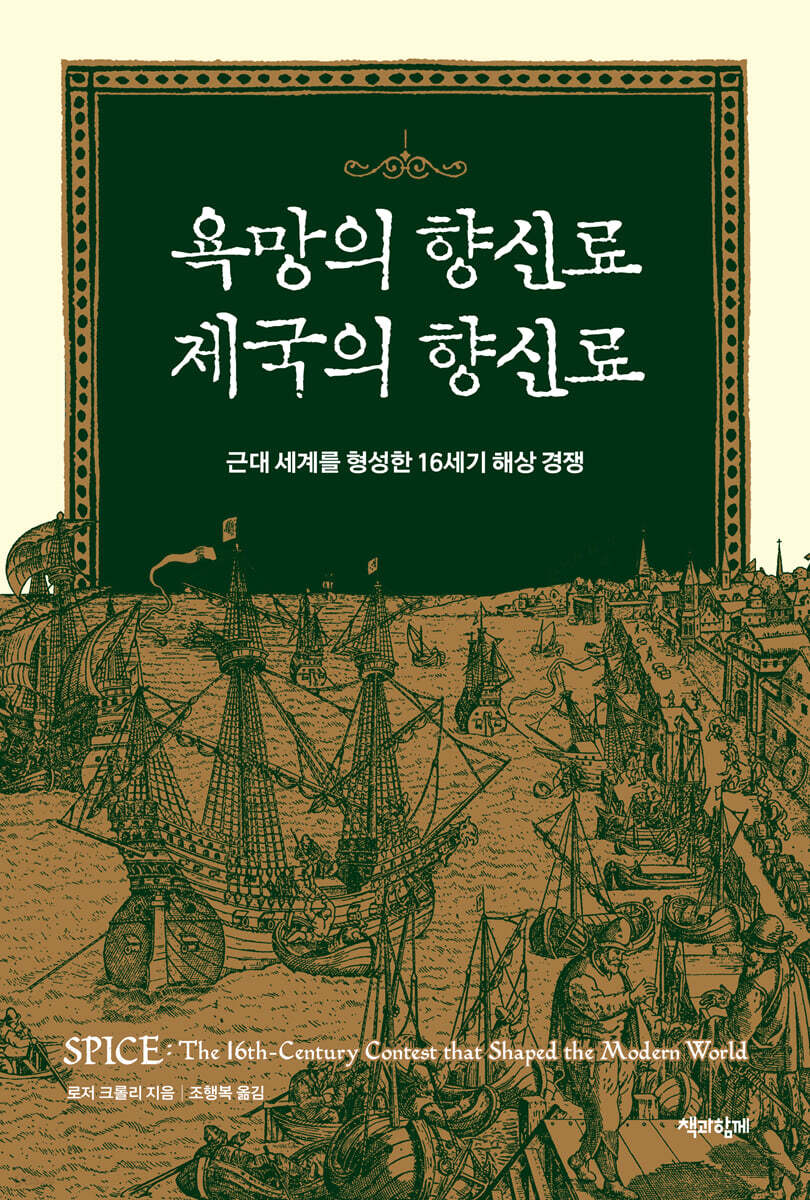
The Spice of Desire, The Spice of the Empire
 |
Description
Book Introduction
'The first truly global traded commodity'
The maritime race to control the spice supply chain and its aftermath
Columbus didn't try to discover America.
Magellan had no intention of circumnavigating the world.
Their real goal was the East Indies.
The goal was to trace the precious spice back to its mysterious origins.
Europeans' insatiable appetite for cloves and nutmeg drove the world economy in the early modern period.
When the Portuguese finally arrived in the Maluku Islands, the spice islands, in 1511, a fierce competition to control them began.
In the 16th century, European powers connected the oceans, established vast maritime empires, and gave birth to global trade.
Thus, the construction of Manila by Spain in 1571 and the galleon trade brought the global trade network to its peak.
All of them originated from the same purpose of dominating the spice supply chain.
Roger Crowley, a masterful historical storyteller, reveals with his characteristically vivid writing how this 60-year rivalry shaped the modern world.
From the shipyards of Seville, across the vast Pacific, through the volcanic Spice Islands of Indonesia, the Arctic Circle, and the coast of China, the adventures, shipwrecks, and sieges that shaped the global economy for centuries are brought to life through vivid testimonies from those involved.
By creating a mosaic of fragments of events through contemporary records, such as the expedition members' logs, the big picture is vividly depicted.
Visual aids such as numerous maps, photographs, and illustrations add vividness to the story.
The maritime race to control the spice supply chain and its aftermath
Columbus didn't try to discover America.
Magellan had no intention of circumnavigating the world.
Their real goal was the East Indies.
The goal was to trace the precious spice back to its mysterious origins.
Europeans' insatiable appetite for cloves and nutmeg drove the world economy in the early modern period.
When the Portuguese finally arrived in the Maluku Islands, the spice islands, in 1511, a fierce competition to control them began.
In the 16th century, European powers connected the oceans, established vast maritime empires, and gave birth to global trade.
Thus, the construction of Manila by Spain in 1571 and the galleon trade brought the global trade network to its peak.
All of them originated from the same purpose of dominating the spice supply chain.
Roger Crowley, a masterful historical storyteller, reveals with his characteristically vivid writing how this 60-year rivalry shaped the modern world.
From the shipyards of Seville, across the vast Pacific, through the volcanic Spice Islands of Indonesia, the Arctic Circle, and the coast of China, the adventures, shipwrecks, and sieges that shaped the global economy for centuries are brought to life through vivid testimonies from those involved.
By creating a mosaic of fragments of events through contemporary records, such as the expedition members' logs, the big picture is vividly depicted.
Visual aids such as numerous maps, photographs, and illustrations add vividness to the story.
- You can preview some of the book's contents.
Preview
index
map
Prologue | Conflict
Part 1: The Discovery of Land: The Race to Conquer the East
1 | Francisco Serão's Paradise 1511-1519
2 | Maps and Conjectures 1513-1519
3 | Maluku Fleet 1519-1520
4 | Towards the Spice Islands, 1520-1521
5 | Around the World Navigators 1521-1522
6 | The Saturation of the Main Lecture 1514-1524
Part 2: The Contenders: The Battle for the Maluku Islands
7 | Spain's Response 1522–1526
8 | Very Small Wars 1526-1528
9 | Voyages of the Florida, 1526–1536
10 | "Let's End Suffering" 1542-1546
11 | 'The Labyrinth of Hell' 1536-1540
Part 3: Connecting the World
12 | Death's Refuge 1553-1556
13 | “Revere our greatness, respect our power” 1530-1555
14 | Solving the Problem 1557-1571
15 | Galleons of Desire 1545-1571
16 | Globalization
Epilogue | Damage
Author's Note
Acknowledgements
Translator's Note
main
References
Source of the illustration
Search
Prologue | Conflict
Part 1: The Discovery of Land: The Race to Conquer the East
1 | Francisco Serão's Paradise 1511-1519
2 | Maps and Conjectures 1513-1519
3 | Maluku Fleet 1519-1520
4 | Towards the Spice Islands, 1520-1521
5 | Around the World Navigators 1521-1522
6 | The Saturation of the Main Lecture 1514-1524
Part 2: The Contenders: The Battle for the Maluku Islands
7 | Spain's Response 1522–1526
8 | Very Small Wars 1526-1528
9 | Voyages of the Florida, 1526–1536
10 | "Let's End Suffering" 1542-1546
11 | 'The Labyrinth of Hell' 1536-1540
Part 3: Connecting the World
12 | Death's Refuge 1553-1556
13 | “Revere our greatness, respect our power” 1530-1555
14 | Solving the Problem 1557-1571
15 | Galleons of Desire 1545-1571
16 | Globalization
Epilogue | Damage
Author's Note
Acknowledgements
Translator's Note
main
References
Source of the illustration
Search
Into the book
Spices contributed to the development of long-distance trade routes over land and sea, the growth of cities, and the spread of religions by the merchants who carried them.
Because they were light and durable, spices were the first truly global commodities.
Spices passed through many hands, so their price soared (up to 1,000 percent by the time they reached Europe) that they could cost more than their weight in gold.
Sometimes it was used as currency itself.
---From "Prologue 〈Conflict〉"
During these crucial six decades, Europeans proved that the Earth was round, began to fill the empty space in the Pacific Ocean, created the first global cities, and connected the oceans.
European maritime empires dominated the Earth's oceans for nearly 500 years.
Epic voyages and clashes of peoples and cultures have produced remarkable stories of perseverance, courage, and hardship, as well as horrifying atrocities and genocides committed against indigenous peoples.
Europeans ushered in a new era of information through the development of printing technology and established a global trade network.
In that structure, silver circulates globally as a universal medium of exchange, and the allure of spices serves as a springboard for this.
All of this constitutes the political, commercial, cultural and ecological character of the modern world.
---From "Prologue 〈Conflict〉"
This patently absurd attempt to neatly divide the world is summed up in the story of the conference held in Badajoz.
Several members of the Portuguese delegation attending the committee were walking along the Guadiana River when they came across a woman doing laundry and a little boy guarding his mother.
“The boy asked them if they were the ones who divided the world with the emperor.
When they answered 'yes', he lifted his shirt, thrust his bare buttocks at them and said:
“Draw a dividing line down the middle here.” The citizens of Badajoz laughed about this for months.
---From Chapter 7, “Spain’s Response”
The contemporary Portuguese historian João de Barros wrote about the corrupting effects of spices:
“These islands are a breeding ground for all evil.
There is nothing good about it except cloves.
Cloves are good because they were created by God.
But as long as the clove is the material reason why our compatriots go there, it is the seed of all discord.
“He deserves a curse worse than gold.”
---From Chapter 11, “The Labyrinth of Hell”
It was the temptation of spices that triggered this whole process.
Spices were the first globally traded commodity and an ideal commodity.
Dried spices were light, high value-added products that did not spoil easily even when stored in the holds of ships during long voyages.
The profits were enormous.
---From Chapter 16, “Globalization”
Early European navigators viewed the Pacific with fear and awe.
The Pacific Ocean was an ocean “so vast that the human mind could not imagine.”
It took hundreds of years to figure out its size.
The islands that sailors accidentally entered in the 16th century and that drifted after shipwrecks were divided into territories of 'ownership' and occupied by world powers in the 19th century.
In the 20th century, the Pacific again became a huge battlefield.
Because they were light and durable, spices were the first truly global commodities.
Spices passed through many hands, so their price soared (up to 1,000 percent by the time they reached Europe) that they could cost more than their weight in gold.
Sometimes it was used as currency itself.
---From "Prologue 〈Conflict〉"
During these crucial six decades, Europeans proved that the Earth was round, began to fill the empty space in the Pacific Ocean, created the first global cities, and connected the oceans.
European maritime empires dominated the Earth's oceans for nearly 500 years.
Epic voyages and clashes of peoples and cultures have produced remarkable stories of perseverance, courage, and hardship, as well as horrifying atrocities and genocides committed against indigenous peoples.
Europeans ushered in a new era of information through the development of printing technology and established a global trade network.
In that structure, silver circulates globally as a universal medium of exchange, and the allure of spices serves as a springboard for this.
All of this constitutes the political, commercial, cultural and ecological character of the modern world.
---From "Prologue 〈Conflict〉"
This patently absurd attempt to neatly divide the world is summed up in the story of the conference held in Badajoz.
Several members of the Portuguese delegation attending the committee were walking along the Guadiana River when they came across a woman doing laundry and a little boy guarding his mother.
“The boy asked them if they were the ones who divided the world with the emperor.
When they answered 'yes', he lifted his shirt, thrust his bare buttocks at them and said:
“Draw a dividing line down the middle here.” The citizens of Badajoz laughed about this for months.
---From Chapter 7, “Spain’s Response”
The contemporary Portuguese historian João de Barros wrote about the corrupting effects of spices:
“These islands are a breeding ground for all evil.
There is nothing good about it except cloves.
Cloves are good because they were created by God.
But as long as the clove is the material reason why our compatriots go there, it is the seed of all discord.
“He deserves a curse worse than gold.”
---From Chapter 11, “The Labyrinth of Hell”
It was the temptation of spices that triggered this whole process.
Spices were the first globally traded commodity and an ideal commodity.
Dried spices were light, high value-added products that did not spoil easily even when stored in the holds of ships during long voyages.
The profits were enormous.
---From Chapter 16, “Globalization”
Early European navigators viewed the Pacific with fear and awe.
The Pacific Ocean was an ocean “so vast that the human mind could not imagine.”
It took hundreds of years to figure out its size.
The islands that sailors accidentally entered in the 16th century and that drifted after shipwrecks were divided into territories of 'ownership' and occupied by world powers in the 19th century.
In the 20th century, the Pacific again became a huge battlefield.
---From "Epilogue 〈Damage〉"
Publisher's Review
'The first truly global traded commodity'
The maritime race to control the spice supply chain and its aftermath
Columbus didn't try to discover America.
Magellan had no intention of circumnavigating the world.
Their real goal was the East Indies.
The goal was to trace the precious spice back to its mysterious origins.
Europeans' insatiable appetite for cloves and nutmeg drove the world economy in the early modern period.
When the Portuguese finally arrived in the Maluku Islands, the spice islands, in 1511, a fierce competition to control them began.
In the 16th century, European powers connected the oceans, established vast maritime empires, and gave birth to global trade.
Thus, the construction of Manila by Spain in 1571 and the galleon trade brought the global trade network to its peak.
All of them originated from the same purpose of dominating the spice supply chain.
Roger Crowley, a masterful historical storyteller, reveals with his characteristically vivid writing how this 60-year rivalry shaped the modern world.
From the shipyards of Seville, across the vast Pacific, through the volcanic Spice Islands of Indonesia, the Arctic Circle, and the coast of China, the adventures, shipwrecks, and sieges that shaped the global economy for centuries are brought to life through vivid testimonies from those involved.
“It was the temptation of spices that triggered this whole process.”
The starting point of establishing a modern world order
While modern interest and discussion of East-West trade or the movement of goods often focuses on the Silk Road, it was actually spices, not silk, that led Europeans to find their way to Asia.
To Europeans, cloves and nutmeg symbolized unprecedented wealth.
As spices passed through many hands, their price soared (up to 1,000 percent by the time they reached Europe), sometimes becoming more valuable than gold, and the spices themselves were even used as currency.
The place where this highly valued spice could be obtained was the Maluku Islands, its native habitat.
This place was destined to be the epicenter of the great 16th century battle that literally shaped the 'world'.
The bitter rivalry between Portugal and Spain escalates into a global rivalry.
This competition involved people from all walks of life, from kings to explorers, conquistadors ('conquerors'), navigators, cartographers, sailors, and bankers, and also led to contact with China and Japan.
The struggle of those who sought to secure new future resources and colonies for their own wealth, sooner, in greater numbers, and for longer, transformed Europe from the periphery of the world to the center.
“The Spice of Desire, the Spice of Empire”
The 16th-century globalization achieved by the spice trade and its repercussions
The 60 years of profound change triggered by the spice trade marked the dawn of modernization and the global economy.
As Europeans embarked on a quest for discovery and conquest, they proved that the world was a sphere through the creation of more accurate maps and subsequent navigation.
This empowered them to fill the empty spaces of the newly discovered Pacific Ocean, build the first global cities, and connect the 'world' to each other.
In addition, the development of printing technology opened an unprecedented era of information (expansion of knowledge and technology) and established a global trade network (global movement of goods).
This map of trade, entangled like a spider's web, expanded further and further with silver.
By the end of the 16th century, a global economy was emerging, and within that structure, silver circulated as the universal medium of exchange (the American dollar is its descendant).
All of this constitutes the political, commercial, cultural and ecological character of the modern world.
The book goes beyond describing the beginnings of globalization in the 16th century and its subsequent achievements, such as the increase in global trade and the movement of goods, to examine the destructive underbelly of the clashes between peoples, cultures, and worldviews it brought about.
In the hundreds of years since the “Great Acceleration” of globalization in the 16th century, the habitats of great egrets have been destroyed, islands where European explorers mistakenly entered or drifted ashore in the 16th century were carved up and seized by world powers in the 19th century, and in the 20th century, the Pacific became a huge battleground twice again.
Spanish Pacific voyages for de facto control of the Maluku Islands
Spain and Portugal, who signed the Treaty of Tordesillas in 1494, established their spheres of influence not only in the Americas but also in Asia, but they could not reach an agreement because each claimed that the Maluku Islands were within their territory. From then on, both countries poured their efforts into establishing actual control over the Maluku Islands.
As a result of the Treaty of Tordesillas, the only way for Spain to compete in the spice trade was to sail west, and to do so, it needed a passage through the barrier known as the Americas.
Spain, which had found hope in 1513 when the conquistador Vasco Núñez de Balboa crossed the Isthmus of Panama connecting South and North America, was able to solve the difficult problem of a return voyage that had been repeatedly failed by the exploration of Andrés de Urdaneta and turn the Pacific Ocean into a Spanish lake.
The Spanish then founded Manila, and almost overnight it became a major shipping center.
Manila was already connected to traditional regional trade networks, but now it was connected to the 'world'.
The Spanish construction of Manila was the culmination of Europe's explosive expansion beyond Europe.
Portuguese voyages to the Pacific to establish contact with China and Japan
The Pacific was the golden key to China as well as the Spice Islands.
Portugal, which occupied Malacca in 1511, first took control of the spice trade with Ternate Island in the Maluku Islands as an ally, and focused its efforts on repelling challenges from Spain while simultaneously "discovering" China and opening the door to Japan.
In China and Japan, the 'Bulanggi (佛?機, Europeans)' were 'Pangui (犯規, barbarian devils)' and 'Nanbanjin (南蠻人, southern barbarians)', but both countries showed interest in their ideas and products.
Portugal's contacts with China began in 1517.
Portugal subsequently sent fleets several times to attempt to open formal trade, but each time they clashed with China and failed.
However, the Portuguese and local Chinese merchants solved the problem by conducting irregular trade outside the tribute system.
Macau was born in that process.
Macau was a city run by Portuguese merchants for themselves, and could be called the Venice of the East.
Portugal also began contact with Japan in 1543.
It all started when a ship carrying Portuguese merchants was driven by a storm and ended up on Tanegashima Island in western Japan.
The matchlock gun, Christianity, and Western learning that Portugal introduced to Japan had a profound influence on its history.
Japan would later prove to be one of the most remote and yet most profitable points of Portuguese exploration.
Main text
Chapter 1: Francisco Serão's Paradise, 1511-1519
It follows the Portuguese expedition's conquest of Malacca, the native habitat of cloves and nutmeg, in 1511 and the events that followed.
Francisco Serão, a Portuguese nobleman who participated in the conquest of Malacca, wanted to live not as a subject of the king in the clove-scented Malacca, but as a monarch in the exotic world of the Orient that he imagined.
In 1519, King Manuel I of Portugal commissioned the production of a rare atlas known today as the Miller Atlas.
Chapter 2: Maps and Conjectures 1513–1519
This is the story of Fernán de Magalhaes (Magellan), a Portuguese man who was wounded in the Battle of Morocco in 1513 and chose Spain as his new homeland due to his dissatisfaction with the royal family's non-payment of salary, until the Spanish expedition of Magellan completed preparations for sailing to the Maluku Islands in 1519.
Spain's attempt to overtake Portugal in the spice trade started with Magellan's map, but in reality it was Magellan's speculation as an explorer and his own will to become a great lord.
Chapter 3: The Maluku Fleet, 1519–1520
This account examines the journey of Magellan's five ships of the Maluku fleet from their departure in August 1519 on a mission to "plus ultra" ("further") to their "sucking" into the Pacific Ocean in November 1520, as recorded by Antonio de Pigafetta, an Italian nobleman and scholar who served as an assistant.
Magellan imagined a small ocean, but the Pacific was like a vast vacuum that was easy to enter but nearly impossible to escape.
None of the sailors who set out on their journey in joy knew this fact.
Chapter 4: Towards the Spice Islands, 1520-1521
This is the logbook of the Maluku fleet's voyage from December 1520, when it entered the middle of the Pacific Ocean, through which it had to pass to reach the Spice Islands, until November 1521, when the Maluku Islands began to appear.
Dreaming of establishing his own kingdom in a complex world of tribal rivalries and power structures, Magellan landed in Cebu and attempted to establish private sovereignty over the nearby islands.
However, he fought with one of the two kings of Mactan Island who refused to do so, and died along with several sailors on April 27, 1521.
Chapter 5: The World Navigators 1521-1522
This is the story of the Maluku Fleet landing on Tidore Island in the Maluku Islands in 1521, until the Victoria, the only ship in the fleet, returned to Spain on September 8, 1522, successfully completing the first circumnavigation of the world.
The circumnavigators experienced hunger, cold, scurvy, shipwrecks, battles with natives, the death of their commander, Magellan, and oceans of unimaginable magnitude.
The spices the ship brought were of considerable value, but barely enough to cover the costs of the expedition.
Chapter 6: Saturation of the Main Lecture 1514-1524
This is a record of what they experienced in China, which implemented a maritime ban policy, from 1514, when Portugal dispatched a delegation with the mission of 'discovering China', until 1524.
Portugal also focused its efforts on contact with China, which had great potential, while also engaging in the spice trade.
After fierce naval battles, the Portuguese established a fort on Tunmen Island at the mouth of the Pearl River and, although several were executed for smuggling and illegal activities, they continued to see the conquest of southern China as a possibility throughout the 16th century.
Chapter 7: Spain's Response, 1522–1526
The fruitless negotiations to determine the dividing line of exploration between Spain and Portugal, and the subsequent ordeals faced by the Spanish expedition to Loaísa in July 1525, are recounted by a seventeen-year-old Basque youth named Andrés de Urdaneta.
Only actual occupation, rather than absurd attempts to neatly divide the world, could resolve the futile squabbling over the map.
Chapter 8: The Small Wars 1526-1528
Describes the conflict between the Portuguese island of Ternate and the Spanish island of Tidore from 1526 to 1528.
Although Urdaneta claimed victory for Spain, in reality it was a stalemate with neither side able to win.
Chapter 9: The Voyage of the Florida, 1526–1536
It tells the story of how the Florida, part of another fleet sent by Hernán Cortés, the Spanish conqueror of Mexico, under the orders of Charles I of Spain, arrived in the Maluku Islands in March 1526 while sailing across the Pacific Ocean, and how the balance of power in the Maluku Islands unexpectedly shifted in favor of the Portuguese, and how the Spanish from the Maluku Islands, including Urdaneta, had to board Portuguese ships and be repatriated to their homeland.
Chapter 10: "Let Us End Suffering" (1542-1546)
This is the logbook of the Spanish Villalobos expedition, dating from 1542 to 1546, which was tasked with establishing a base for ship repairs and food supplies in the "Western Islands" (Philippines) north of the Maluku Islands, and solving the painful problem of returning to the Pacific Ocean, which had been repeatedly unsuccessful.
The Pacific Ocean, which remained the greatest gap in European cartography, was still the key to Spain's acquisition of the wealth of the East, and the key to seizing the Pacific Ocean lay in finding a clever way to return from there.
Chapter 11: The Labyrinth of Hell, 1536-1540
This is what António Galvão saw, experienced, and recorded while staying in the Maluku Islands from 1536 to 1540 as the 7th Portuguese Commander-in-Chief of the Maluku Islands.
To Galbang, the deep tropical Maluku Islands were a 'labyrinth of hell' that corrupted the Portuguese and a hotbed of all the world's evils.
Once the Portuguese had smelled the alluring scent of cloves, even Galvão, “the only man who had restored a little peace to the islands,” could no longer control them.
Chapter 12: The Refuge of Death, 1553-1556
He accompanied the English expedition on its voyage from 1553 to 1556.
They set sail hoping to find markets in China for their woolen exports and a northern route to purchase spices from the Maluku Islands.
The Edward discovered the entrance to the White Sea and established trade relations with Russia, but the Bona Esperanza could not withstand the harsh winter of the passage and, while using bituminous coal as fuel at a refuge, all of the crew died from carbon monoxide poisoning.
England's attempt to open the Northern Sea Route was a failure.
Chapter 13: "Revere Our Greatness, Respect Our Power" (1530-1555)
This is a record of the early contacts between the Portuguese and China, and the establishment of a Portuguese trading post in Macau between 1530 and 1555, amidst the clash of two worldviews: European and Oriental.
It also describes the process of contact between Portugal and Japan.
In China and Japan, the 'Bulanggi (佛?機, Europeans)' were 'Pangui (犯規, barbarian devils)' and 'Nanbanjin (南蠻人, southern barbarians)', but both countries showed interest in their ideas and products.
Chapter 14: Solving the Problem 1557-1571
He boarded the expedition sent by the viceroys of New Spain, who could not give up their dream of expansion into the Pacific and trade with China, on a voyage from 1557 to 1571.
The goal was to finally solve the still-controversial problem of returning from the 'Western Islands' via the Pacific Ocean.
Urdaneta finally solved the last riddle left to European navigation in the 16th century, and Legazpi laid the foundations of the Spanish city of Manila.
Now people, goods, and trade can flow in all directions.
Chapter 15: The Galleon of Desire, 1545-1571
It traces the silver mining boom in Potosi in the Andes in 1545 to the Portuguese merchants' acquisition of the right to use the port of Nagasaki in 1571.
Spain was connected to the Orient via Mexico and South America through the Urdaneta route, and galleons became the mythical vehicles carrying the wealth and desires of Europeans.
The commodity that connected these events, separated in time and space, was silver, used for trade, currency exchange, and war.
Chapter 16 Globalization
It guides us through the 16th-century globalization brought about by the Pacific maritime competition, the prosperity it brought, and the destructive underbelly of the clashes between peoples, cultures, and worldviews.
Now the map of trade, tangled like a spider's web, expanded further and further with silver.
By the end of the 16th century, a world economy was emerging, and its currency was silver.
And what triggered this whole process was the temptation of spices.
Spices were the first globally traded commodity and an ideal commodity.
Epilogue: Damage
It highlights the ongoing damage caused by the "Great Acceleration" of globalization in the 16th century.
Cerro Rico, the man-eating mountain of Potosi, still remains today.
The islands that 16th-century European explorers accidentally entered or drifted to were divided and occupied by world powers as territories of 'ownership' in the 19th century.
In the 20th century, the Pacific again became a huge battlefield.
The maritime race to control the spice supply chain and its aftermath
Columbus didn't try to discover America.
Magellan had no intention of circumnavigating the world.
Their real goal was the East Indies.
The goal was to trace the precious spice back to its mysterious origins.
Europeans' insatiable appetite for cloves and nutmeg drove the world economy in the early modern period.
When the Portuguese finally arrived in the Maluku Islands, the spice islands, in 1511, a fierce competition to control them began.
In the 16th century, European powers connected the oceans, established vast maritime empires, and gave birth to global trade.
Thus, the construction of Manila by Spain in 1571 and the galleon trade brought the global trade network to its peak.
All of them originated from the same purpose of dominating the spice supply chain.
Roger Crowley, a masterful historical storyteller, reveals with his characteristically vivid writing how this 60-year rivalry shaped the modern world.
From the shipyards of Seville, across the vast Pacific, through the volcanic Spice Islands of Indonesia, the Arctic Circle, and the coast of China, the adventures, shipwrecks, and sieges that shaped the global economy for centuries are brought to life through vivid testimonies from those involved.
“It was the temptation of spices that triggered this whole process.”
The starting point of establishing a modern world order
While modern interest and discussion of East-West trade or the movement of goods often focuses on the Silk Road, it was actually spices, not silk, that led Europeans to find their way to Asia.
To Europeans, cloves and nutmeg symbolized unprecedented wealth.
As spices passed through many hands, their price soared (up to 1,000 percent by the time they reached Europe), sometimes becoming more valuable than gold, and the spices themselves were even used as currency.
The place where this highly valued spice could be obtained was the Maluku Islands, its native habitat.
This place was destined to be the epicenter of the great 16th century battle that literally shaped the 'world'.
The bitter rivalry between Portugal and Spain escalates into a global rivalry.
This competition involved people from all walks of life, from kings to explorers, conquistadors ('conquerors'), navigators, cartographers, sailors, and bankers, and also led to contact with China and Japan.
The struggle of those who sought to secure new future resources and colonies for their own wealth, sooner, in greater numbers, and for longer, transformed Europe from the periphery of the world to the center.
“The Spice of Desire, the Spice of Empire”
The 16th-century globalization achieved by the spice trade and its repercussions
The 60 years of profound change triggered by the spice trade marked the dawn of modernization and the global economy.
As Europeans embarked on a quest for discovery and conquest, they proved that the world was a sphere through the creation of more accurate maps and subsequent navigation.
This empowered them to fill the empty spaces of the newly discovered Pacific Ocean, build the first global cities, and connect the 'world' to each other.
In addition, the development of printing technology opened an unprecedented era of information (expansion of knowledge and technology) and established a global trade network (global movement of goods).
This map of trade, entangled like a spider's web, expanded further and further with silver.
By the end of the 16th century, a global economy was emerging, and within that structure, silver circulated as the universal medium of exchange (the American dollar is its descendant).
All of this constitutes the political, commercial, cultural and ecological character of the modern world.
The book goes beyond describing the beginnings of globalization in the 16th century and its subsequent achievements, such as the increase in global trade and the movement of goods, to examine the destructive underbelly of the clashes between peoples, cultures, and worldviews it brought about.
In the hundreds of years since the “Great Acceleration” of globalization in the 16th century, the habitats of great egrets have been destroyed, islands where European explorers mistakenly entered or drifted ashore in the 16th century were carved up and seized by world powers in the 19th century, and in the 20th century, the Pacific became a huge battleground twice again.
Spanish Pacific voyages for de facto control of the Maluku Islands
Spain and Portugal, who signed the Treaty of Tordesillas in 1494, established their spheres of influence not only in the Americas but also in Asia, but they could not reach an agreement because each claimed that the Maluku Islands were within their territory. From then on, both countries poured their efforts into establishing actual control over the Maluku Islands.
As a result of the Treaty of Tordesillas, the only way for Spain to compete in the spice trade was to sail west, and to do so, it needed a passage through the barrier known as the Americas.
Spain, which had found hope in 1513 when the conquistador Vasco Núñez de Balboa crossed the Isthmus of Panama connecting South and North America, was able to solve the difficult problem of a return voyage that had been repeatedly failed by the exploration of Andrés de Urdaneta and turn the Pacific Ocean into a Spanish lake.
The Spanish then founded Manila, and almost overnight it became a major shipping center.
Manila was already connected to traditional regional trade networks, but now it was connected to the 'world'.
The Spanish construction of Manila was the culmination of Europe's explosive expansion beyond Europe.
Portuguese voyages to the Pacific to establish contact with China and Japan
The Pacific was the golden key to China as well as the Spice Islands.
Portugal, which occupied Malacca in 1511, first took control of the spice trade with Ternate Island in the Maluku Islands as an ally, and focused its efforts on repelling challenges from Spain while simultaneously "discovering" China and opening the door to Japan.
In China and Japan, the 'Bulanggi (佛?機, Europeans)' were 'Pangui (犯規, barbarian devils)' and 'Nanbanjin (南蠻人, southern barbarians)', but both countries showed interest in their ideas and products.
Portugal's contacts with China began in 1517.
Portugal subsequently sent fleets several times to attempt to open formal trade, but each time they clashed with China and failed.
However, the Portuguese and local Chinese merchants solved the problem by conducting irregular trade outside the tribute system.
Macau was born in that process.
Macau was a city run by Portuguese merchants for themselves, and could be called the Venice of the East.
Portugal also began contact with Japan in 1543.
It all started when a ship carrying Portuguese merchants was driven by a storm and ended up on Tanegashima Island in western Japan.
The matchlock gun, Christianity, and Western learning that Portugal introduced to Japan had a profound influence on its history.
Japan would later prove to be one of the most remote and yet most profitable points of Portuguese exploration.
Main text
Chapter 1: Francisco Serão's Paradise, 1511-1519
It follows the Portuguese expedition's conquest of Malacca, the native habitat of cloves and nutmeg, in 1511 and the events that followed.
Francisco Serão, a Portuguese nobleman who participated in the conquest of Malacca, wanted to live not as a subject of the king in the clove-scented Malacca, but as a monarch in the exotic world of the Orient that he imagined.
In 1519, King Manuel I of Portugal commissioned the production of a rare atlas known today as the Miller Atlas.
Chapter 2: Maps and Conjectures 1513–1519
This is the story of Fernán de Magalhaes (Magellan), a Portuguese man who was wounded in the Battle of Morocco in 1513 and chose Spain as his new homeland due to his dissatisfaction with the royal family's non-payment of salary, until the Spanish expedition of Magellan completed preparations for sailing to the Maluku Islands in 1519.
Spain's attempt to overtake Portugal in the spice trade started with Magellan's map, but in reality it was Magellan's speculation as an explorer and his own will to become a great lord.
Chapter 3: The Maluku Fleet, 1519–1520
This account examines the journey of Magellan's five ships of the Maluku fleet from their departure in August 1519 on a mission to "plus ultra" ("further") to their "sucking" into the Pacific Ocean in November 1520, as recorded by Antonio de Pigafetta, an Italian nobleman and scholar who served as an assistant.
Magellan imagined a small ocean, but the Pacific was like a vast vacuum that was easy to enter but nearly impossible to escape.
None of the sailors who set out on their journey in joy knew this fact.
Chapter 4: Towards the Spice Islands, 1520-1521
This is the logbook of the Maluku fleet's voyage from December 1520, when it entered the middle of the Pacific Ocean, through which it had to pass to reach the Spice Islands, until November 1521, when the Maluku Islands began to appear.
Dreaming of establishing his own kingdom in a complex world of tribal rivalries and power structures, Magellan landed in Cebu and attempted to establish private sovereignty over the nearby islands.
However, he fought with one of the two kings of Mactan Island who refused to do so, and died along with several sailors on April 27, 1521.
Chapter 5: The World Navigators 1521-1522
This is the story of the Maluku Fleet landing on Tidore Island in the Maluku Islands in 1521, until the Victoria, the only ship in the fleet, returned to Spain on September 8, 1522, successfully completing the first circumnavigation of the world.
The circumnavigators experienced hunger, cold, scurvy, shipwrecks, battles with natives, the death of their commander, Magellan, and oceans of unimaginable magnitude.
The spices the ship brought were of considerable value, but barely enough to cover the costs of the expedition.
Chapter 6: Saturation of the Main Lecture 1514-1524
This is a record of what they experienced in China, which implemented a maritime ban policy, from 1514, when Portugal dispatched a delegation with the mission of 'discovering China', until 1524.
Portugal also focused its efforts on contact with China, which had great potential, while also engaging in the spice trade.
After fierce naval battles, the Portuguese established a fort on Tunmen Island at the mouth of the Pearl River and, although several were executed for smuggling and illegal activities, they continued to see the conquest of southern China as a possibility throughout the 16th century.
Chapter 7: Spain's Response, 1522–1526
The fruitless negotiations to determine the dividing line of exploration between Spain and Portugal, and the subsequent ordeals faced by the Spanish expedition to Loaísa in July 1525, are recounted by a seventeen-year-old Basque youth named Andrés de Urdaneta.
Only actual occupation, rather than absurd attempts to neatly divide the world, could resolve the futile squabbling over the map.
Chapter 8: The Small Wars 1526-1528
Describes the conflict between the Portuguese island of Ternate and the Spanish island of Tidore from 1526 to 1528.
Although Urdaneta claimed victory for Spain, in reality it was a stalemate with neither side able to win.
Chapter 9: The Voyage of the Florida, 1526–1536
It tells the story of how the Florida, part of another fleet sent by Hernán Cortés, the Spanish conqueror of Mexico, under the orders of Charles I of Spain, arrived in the Maluku Islands in March 1526 while sailing across the Pacific Ocean, and how the balance of power in the Maluku Islands unexpectedly shifted in favor of the Portuguese, and how the Spanish from the Maluku Islands, including Urdaneta, had to board Portuguese ships and be repatriated to their homeland.
Chapter 10: "Let Us End Suffering" (1542-1546)
This is the logbook of the Spanish Villalobos expedition, dating from 1542 to 1546, which was tasked with establishing a base for ship repairs and food supplies in the "Western Islands" (Philippines) north of the Maluku Islands, and solving the painful problem of returning to the Pacific Ocean, which had been repeatedly unsuccessful.
The Pacific Ocean, which remained the greatest gap in European cartography, was still the key to Spain's acquisition of the wealth of the East, and the key to seizing the Pacific Ocean lay in finding a clever way to return from there.
Chapter 11: The Labyrinth of Hell, 1536-1540
This is what António Galvão saw, experienced, and recorded while staying in the Maluku Islands from 1536 to 1540 as the 7th Portuguese Commander-in-Chief of the Maluku Islands.
To Galbang, the deep tropical Maluku Islands were a 'labyrinth of hell' that corrupted the Portuguese and a hotbed of all the world's evils.
Once the Portuguese had smelled the alluring scent of cloves, even Galvão, “the only man who had restored a little peace to the islands,” could no longer control them.
Chapter 12: The Refuge of Death, 1553-1556
He accompanied the English expedition on its voyage from 1553 to 1556.
They set sail hoping to find markets in China for their woolen exports and a northern route to purchase spices from the Maluku Islands.
The Edward discovered the entrance to the White Sea and established trade relations with Russia, but the Bona Esperanza could not withstand the harsh winter of the passage and, while using bituminous coal as fuel at a refuge, all of the crew died from carbon monoxide poisoning.
England's attempt to open the Northern Sea Route was a failure.
Chapter 13: "Revere Our Greatness, Respect Our Power" (1530-1555)
This is a record of the early contacts between the Portuguese and China, and the establishment of a Portuguese trading post in Macau between 1530 and 1555, amidst the clash of two worldviews: European and Oriental.
It also describes the process of contact between Portugal and Japan.
In China and Japan, the 'Bulanggi (佛?機, Europeans)' were 'Pangui (犯規, barbarian devils)' and 'Nanbanjin (南蠻人, southern barbarians)', but both countries showed interest in their ideas and products.
Chapter 14: Solving the Problem 1557-1571
He boarded the expedition sent by the viceroys of New Spain, who could not give up their dream of expansion into the Pacific and trade with China, on a voyage from 1557 to 1571.
The goal was to finally solve the still-controversial problem of returning from the 'Western Islands' via the Pacific Ocean.
Urdaneta finally solved the last riddle left to European navigation in the 16th century, and Legazpi laid the foundations of the Spanish city of Manila.
Now people, goods, and trade can flow in all directions.
Chapter 15: The Galleon of Desire, 1545-1571
It traces the silver mining boom in Potosi in the Andes in 1545 to the Portuguese merchants' acquisition of the right to use the port of Nagasaki in 1571.
Spain was connected to the Orient via Mexico and South America through the Urdaneta route, and galleons became the mythical vehicles carrying the wealth and desires of Europeans.
The commodity that connected these events, separated in time and space, was silver, used for trade, currency exchange, and war.
Chapter 16 Globalization
It guides us through the 16th-century globalization brought about by the Pacific maritime competition, the prosperity it brought, and the destructive underbelly of the clashes between peoples, cultures, and worldviews.
Now the map of trade, tangled like a spider's web, expanded further and further with silver.
By the end of the 16th century, a world economy was emerging, and its currency was silver.
And what triggered this whole process was the temptation of spices.
Spices were the first globally traded commodity and an ideal commodity.
Epilogue: Damage
It highlights the ongoing damage caused by the "Great Acceleration" of globalization in the 16th century.
Cerro Rico, the man-eating mountain of Potosi, still remains today.
The islands that 16th-century European explorers accidentally entered or drifted to were divided and occupied by world powers as territories of 'ownership' in the 19th century.
In the 20th century, the Pacific again became a huge battlefield.
GOODS SPECIFICS
- Date of issue: April 10, 2025
- Page count, weight, size: 448 pages | 648g | 152*225*23mm
- ISBN13: 9791194263364
- ISBN10: 1194263364
You may also like
카테고리
korean


korean

![GQ KOREA Mark (Monthly): December [2025]](http://librairie.coreenne.fr/cdn/shop/files/8ef265dbbfbf186523ed75ba7319009d.jpg?v=1765340328&width=3840)


