

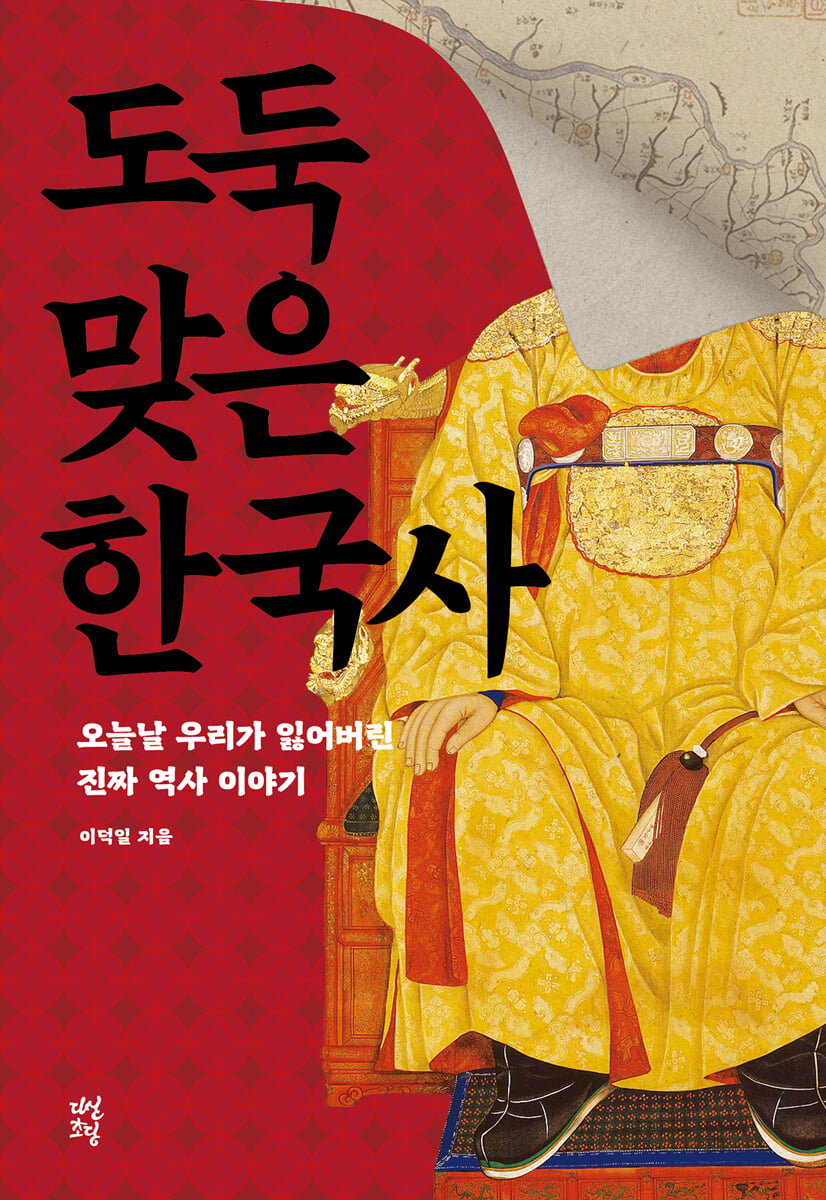
Stolen Korean History
 |
Description
Book Introduction
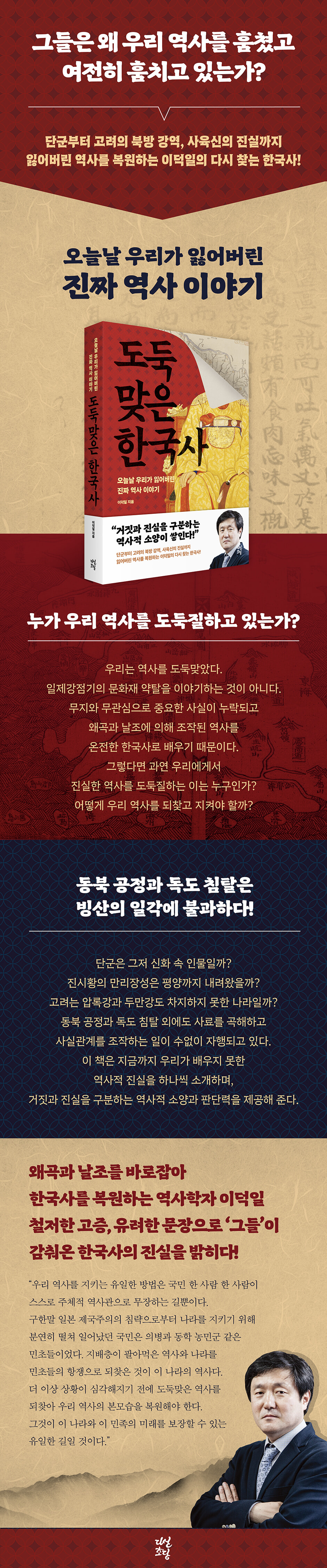
“Why did they steal our history and why are they still stealing it?”
From Dangun to the northern territory of Goryeo and the truth about the Six Martyred Ministers
Lee Deok-il's Rediscovering Korean History: Restoring Lost History
We have had our history stolen.
This is because important facts were omitted due to ignorance and indifference, and history was manipulated through distortion and fabrication, disguised as complete Korean history.
What exactly is our stolen history, and how can we reclaim and protect it? Director Lee Deok-il of the Hangaram Institute of History and Culture, who has pioneered new horizons in historical understanding through accurate historical interpretation, sets out in this book to uncover the most secret parts of our history, stolen and hidden.
Was Dangun merely a mythical figure? Did Qin Shi Huang's Great Wall extend all the way to Pyongyang? Was Goryeo a nation that couldn't even control the Yalu and Duman Rivers? Who are those who claim the Six Martyred Ministers were seven? In this way, this book introduces historical truths we've never learned before, one by one, providing historical literacy and the ability to discern truth from falsehood.
From Dangun to the northern territory of Goryeo and the truth about the Six Martyred Ministers
Lee Deok-il's Rediscovering Korean History: Restoring Lost History
We have had our history stolen.
This is because important facts were omitted due to ignorance and indifference, and history was manipulated through distortion and fabrication, disguised as complete Korean history.
What exactly is our stolen history, and how can we reclaim and protect it? Director Lee Deok-il of the Hangaram Institute of History and Culture, who has pioneered new horizons in historical understanding through accurate historical interpretation, sets out in this book to uncover the most secret parts of our history, stolen and hidden.
Was Dangun merely a mythical figure? Did Qin Shi Huang's Great Wall extend all the way to Pyongyang? Was Goryeo a nation that couldn't even control the Yalu and Duman Rivers? Who are those who claim the Six Martyred Ministers were seven? In this way, this book introduces historical truths we've never learned before, one by one, providing historical literacy and the ability to discern truth from falsehood.
- You can preview some of the book's contents.
Preview
index
Introduction
Chapter 1: Who Erased Dangun?
Chapter 2: China's Attempt to Steal Even the History of the Dongyi People
Chapter 3: Was Confucius a member of the Dongyi tribe?
Chapter 4: Did Qin Shi Huang's Great Wall Reach Pyongyang?
Chapter 5: Where Did the 4,000 Li of Samhan Land Go?
Chapter 6: A Korean History Textbook That Cut Off 2,000 Li of Goryeo Land
Chapter 7: The area south of Shenyang was part of Goryeo and Joseon.
Chapter 8: How Are There Seven Martyrs?
Chapter 9: The Prodigy Who Abandoned the World, Kim Si-seup
Chapter 10: Was the Crown Prince Mentally Ill?
Outgoing post
Chapter 1: Who Erased Dangun?
Chapter 2: China's Attempt to Steal Even the History of the Dongyi People
Chapter 3: Was Confucius a member of the Dongyi tribe?
Chapter 4: Did Qin Shi Huang's Great Wall Reach Pyongyang?
Chapter 5: Where Did the 4,000 Li of Samhan Land Go?
Chapter 6: A Korean History Textbook That Cut Off 2,000 Li of Goryeo Land
Chapter 7: The area south of Shenyang was part of Goryeo and Joseon.
Chapter 8: How Are There Seven Martyrs?
Chapter 9: The Prodigy Who Abandoned the World, Kim Si-seup
Chapter 10: Was the Crown Prince Mentally Ill?
Outgoing post
Detailed image
Into the book
Studying history is, in other words, studying primary sources.
Feed is broadly divided into primary feed and secondary feed, with primary feed referring to feed used at the time.
Secondary sources refer to papers or books written based on primary sources.
To take the above discussion as an example, the primary sources for the northern territories of Goryeo and Joseon are our 『History of Goryeo』, 『Annals of King Taejong and King Sejong』, 『Geography of the Annals of King Sejong』, and China's 『Myeongsa』.
These historical materials state that the northern territory of Goryeo and Joseon was from the south of present-day Shenyang in Liaoning Province to 700 li north of the Tumen River.
Any normal historian would naturally study the northern territories of Goryeo and Joseon based on these primary sources.
However, Korean historians have been writing textbooks that elevate secondary sources fabricated by Japanese colonial historians such as Ikeuchi Hiroshi, Imanishi Ryu, and Tsuda Sokichi as if they were primary sources.
It is not only the northern territory of Goryeo and Joseon.
As criticized in this book, Dangun, the founder of the nation, was erased, the Dongi people were erased, and Crown Prince Sado was manipulated into being a mentally ill person.
Moreover, the country's leading historians, who had served as Minister of Education and presidents of prestigious universities, were mobilized to replace Yu Eung-bu, one of the six loyal ministers, with Kim Mun-gi.
---From the "Introductory Note"
The country was liberated on August 15, 1945, with the Emperor's unconditional surrender declaration.
The pro-Japanese traitors who had been oppressing their fellow countrymen under Japanese rule were at a loss.
However, at the same time as liberation, the land was divided by foreign powers as the United States and the Soviet Union divided and occupied it.
The US military government committed a major policy error by continuing to employ pro-Japanese forces rather than punishing them.
This was the biggest cause of the chaos that occurred from 1945 to 1948, the so-called liberation period.
It can be said that it is okay to re-employ low-level administrative officials who were doing things like organizing family registers at local administrative agencies.
However, the two types of pro-Japanese traitorous forces should not be re-elected.
First, there were pro-Japanese forces who worked in the judiciary.
Judges, prosecutors, and police officers of the Government-General had to be excluded.
Those who became agents of the Japanese Empire and were involved in arresting, torturing, prosecuting, and sentencing independence activists to death or other guilty verdicts should not be rehired, but should be punished for their anti-national activities.
The Korean Independence Party, which was the ruling party of the Provisional Government of the Republic of Korea, held its 5th Representatives' Convention in Chongqing, China on August 28, 1945, and declared its party policy, or action plan, to be implemented after returning to Korea, stating, "We will punish traitors and those who obstructed the independence movement (pro-Japanese collaborators)."
However, the US military government re-appointed pro-Japanese collaborators.
---From "Chapter 1 - Who Erased Dangun"
When studying the history of a country, the most fundamental things are time and space.
The space that tells the time and extent of a country's existence and what its territory was like is the basis of historical research.
Numerous stories unfold within these two elements: time and space.
But if this time or space setting is wrong, then the historical research is flawed from the beginning.
The time of the 'Goryeo-Khitan War' is correct.
But space is not like that.
The map presented in the first episode of the 'Goryeo-Khitan War' depicted Goryeo as a small country that did not even occupy the entire Korean Peninsula.
If people around the world see this, they will think that Korea was a small country that had a territory of about 2/3 of the Korean Peninsula.
If that was the case in the actual Goryeo territory, it should be accepted as fact.
However, if it is drawn in a reduced form compared to reality, it will inevitably face criticism for ‘distortion of history.’
---From "Chapter 6 - A Korean History Textbook That Cut Off 2,000 Li of Goryeo Land"
The lesson that 『Hanjungnok』 gives us goes beyond the category of the banality of evil.
Many people feel ashamed and reflect on their small mistakes, but some people never reflect on their mistakes.
The fact is that, rather than reflecting, he kills the victim twice to rationalize his evil.
In our society, there is too much intentionality in evil, beyond the banality of evil.
This is because the forces of evil have never been properly disciplined.
The last leader of the Noron faction, who killed the crown prince, was Yi Wan-yong, who sold out the country.
Is it really that serious to sell out the country to a faction that killed the monarch who ruled as regent? These pro-Japanese traitors, even after liberation, remained impunity, seizing power and wealth, and continue to dominate our society to this day.
The fact that the power of academics is monopolized by the forces that turn the victim, Prince Sado, into the perpetrator speaks volumes about the reality of our society.
The Sado Crown Prince incident tells us that unless we fundamentally change this social and academic landscape, our society will not be able to move forward.
---From "Chapter 10 - Was the Crown Prince a Mentally Ill"
China has recently been showing signs of trying to uproot our history.
They are trying to systematically incorporate the history of the Dongyi people into Chinese history.
The history of the Neolithic Dongi people is the history before Dangun Joseon.
If the history of the Dongyi people is taken away, the rest of the history naturally becomes part of Chinese history.
In a country where politicians and high-ranking officials are largely ignorant of their country's history and historians systematically sell it out, the only way to preserve our history is for each and every citizen to arm themselves with their own subjective view of history.
The territorial invasion of the Japanese Empire at the end of the Joseon Dynasty began with the historical invasion that “Dangun is fake” and “Gaya is the Imna Japanese government.”
At that time, the people who rose up to protect the country were the common people, such as the Righteous Army and the Donghak Peasant Army.
The history of this country is the history of the people reclaiming the country and history sold out by the ruling class through their struggles.
Before the situation becomes any more serious, we must reclaim our stolen history and restore the true face of our history.
That may be the only way to secure the future of this country and this people.
Feed is broadly divided into primary feed and secondary feed, with primary feed referring to feed used at the time.
Secondary sources refer to papers or books written based on primary sources.
To take the above discussion as an example, the primary sources for the northern territories of Goryeo and Joseon are our 『History of Goryeo』, 『Annals of King Taejong and King Sejong』, 『Geography of the Annals of King Sejong』, and China's 『Myeongsa』.
These historical materials state that the northern territory of Goryeo and Joseon was from the south of present-day Shenyang in Liaoning Province to 700 li north of the Tumen River.
Any normal historian would naturally study the northern territories of Goryeo and Joseon based on these primary sources.
However, Korean historians have been writing textbooks that elevate secondary sources fabricated by Japanese colonial historians such as Ikeuchi Hiroshi, Imanishi Ryu, and Tsuda Sokichi as if they were primary sources.
It is not only the northern territory of Goryeo and Joseon.
As criticized in this book, Dangun, the founder of the nation, was erased, the Dongi people were erased, and Crown Prince Sado was manipulated into being a mentally ill person.
Moreover, the country's leading historians, who had served as Minister of Education and presidents of prestigious universities, were mobilized to replace Yu Eung-bu, one of the six loyal ministers, with Kim Mun-gi.
---From the "Introductory Note"
The country was liberated on August 15, 1945, with the Emperor's unconditional surrender declaration.
The pro-Japanese traitors who had been oppressing their fellow countrymen under Japanese rule were at a loss.
However, at the same time as liberation, the land was divided by foreign powers as the United States and the Soviet Union divided and occupied it.
The US military government committed a major policy error by continuing to employ pro-Japanese forces rather than punishing them.
This was the biggest cause of the chaos that occurred from 1945 to 1948, the so-called liberation period.
It can be said that it is okay to re-employ low-level administrative officials who were doing things like organizing family registers at local administrative agencies.
However, the two types of pro-Japanese traitorous forces should not be re-elected.
First, there were pro-Japanese forces who worked in the judiciary.
Judges, prosecutors, and police officers of the Government-General had to be excluded.
Those who became agents of the Japanese Empire and were involved in arresting, torturing, prosecuting, and sentencing independence activists to death or other guilty verdicts should not be rehired, but should be punished for their anti-national activities.
The Korean Independence Party, which was the ruling party of the Provisional Government of the Republic of Korea, held its 5th Representatives' Convention in Chongqing, China on August 28, 1945, and declared its party policy, or action plan, to be implemented after returning to Korea, stating, "We will punish traitors and those who obstructed the independence movement (pro-Japanese collaborators)."
However, the US military government re-appointed pro-Japanese collaborators.
---From "Chapter 1 - Who Erased Dangun"
When studying the history of a country, the most fundamental things are time and space.
The space that tells the time and extent of a country's existence and what its territory was like is the basis of historical research.
Numerous stories unfold within these two elements: time and space.
But if this time or space setting is wrong, then the historical research is flawed from the beginning.
The time of the 'Goryeo-Khitan War' is correct.
But space is not like that.
The map presented in the first episode of the 'Goryeo-Khitan War' depicted Goryeo as a small country that did not even occupy the entire Korean Peninsula.
If people around the world see this, they will think that Korea was a small country that had a territory of about 2/3 of the Korean Peninsula.
If that was the case in the actual Goryeo territory, it should be accepted as fact.
However, if it is drawn in a reduced form compared to reality, it will inevitably face criticism for ‘distortion of history.’
---From "Chapter 6 - A Korean History Textbook That Cut Off 2,000 Li of Goryeo Land"
The lesson that 『Hanjungnok』 gives us goes beyond the category of the banality of evil.
Many people feel ashamed and reflect on their small mistakes, but some people never reflect on their mistakes.
The fact is that, rather than reflecting, he kills the victim twice to rationalize his evil.
In our society, there is too much intentionality in evil, beyond the banality of evil.
This is because the forces of evil have never been properly disciplined.
The last leader of the Noron faction, who killed the crown prince, was Yi Wan-yong, who sold out the country.
Is it really that serious to sell out the country to a faction that killed the monarch who ruled as regent? These pro-Japanese traitors, even after liberation, remained impunity, seizing power and wealth, and continue to dominate our society to this day.
The fact that the power of academics is monopolized by the forces that turn the victim, Prince Sado, into the perpetrator speaks volumes about the reality of our society.
The Sado Crown Prince incident tells us that unless we fundamentally change this social and academic landscape, our society will not be able to move forward.
---From "Chapter 10 - Was the Crown Prince a Mentally Ill"
China has recently been showing signs of trying to uproot our history.
They are trying to systematically incorporate the history of the Dongyi people into Chinese history.
The history of the Neolithic Dongi people is the history before Dangun Joseon.
If the history of the Dongyi people is taken away, the rest of the history naturally becomes part of Chinese history.
In a country where politicians and high-ranking officials are largely ignorant of their country's history and historians systematically sell it out, the only way to preserve our history is for each and every citizen to arm themselves with their own subjective view of history.
The territorial invasion of the Japanese Empire at the end of the Joseon Dynasty began with the historical invasion that “Dangun is fake” and “Gaya is the Imna Japanese government.”
At that time, the people who rose up to protect the country were the common people, such as the Righteous Army and the Donghak Peasant Army.
The history of this country is the history of the people reclaiming the country and history sold out by the ruling class through their struggles.
Before the situation becomes any more serious, we must reclaim our stolen history and restore the true face of our history.
That may be the only way to secure the future of this country and this people.
---From "Outgoing Writing"
Publisher's Review
* A new book by Lee Deok-il, a true historian of our time!
* Includes various historical materials that refute Chinese and Japanese historical distortions.
* Easy-to-understand Korean history with over 100 photos and diagrams
Is the time and space of Korean history properly established?
: The Northern Territory Issue of the 'Goryeo-Khitan War'
In March 2024, the KBS drama 'Goryeo-Khitan War' ended with a high viewership rating of 13.8%.
The drama's homepage 'Planning Intention' states, "Now is the time to show KOREA to the world.
“The world will come to know what kind of people we are through this drama,” he says.
But what kind of Korea is this drama showing the world? When studying a country's history, the most fundamental considerations are time and space.
The timing is right for the 'Goryeo-Khitan War'.
But space is not like that.
The map presented in the first episode of the 'Goryeo-Khitan War' depicted Goryeo as a small country that did not even occupy the entire Korean Peninsula.
If people around the world saw this, they would think that Goryeo was a small country that had a territory of about two-thirds of the Korean Peninsula.
If that was the case in the actual Goryeo territory, it should be accepted as fact.
However, if it is drawn in a reduced form compared to reality, it will inevitably face criticism for ‘distortion of history.’
The production crew of 'Goryeo-Khitan War' may feel wronged.
Because it was drawn just as it appears in Korean history textbooks.
All Korean history textbooks used during the Japanese colonial period and after liberation have drawn the northern border of Goryeo diagonally from the Yalu River to Wonsan Bay.
The current large area of North Pyongan Province, the entire North Hamgyong Province, and a large part of South Hamgyong Province are excluded as not being Goryeo territory, and Goryeo is considered an 'incompetent country' that could not even occupy the Amnok and Tuman Rivers.
The northernmost regions of Goryeo are Bukgye and Donggye.
And the most important source for Goryeo Donggye is the 『Goryeosa』 「Geography Donggye」.
In the ‘History’ of ‘Donggye’, the ‘History of Goryeo’ begins with “Donggye was originally the old land of Goguryeo.”
According to the Geography Donggye section of the Goryeosa, in the second year of King Yejong's reign, the military commander Yun Gwan drove out the Jurchen people in 1107 and erected a stone monument inscribed with the words "Goryeo Border" at Seonchunryeong in Gongheumjin. This is the northern part of Donggye.
Where was the Gongheumjin where Yun Gwan erected the monument inscribed "Goryeo Border"? There are many historical sources that reveal the exact number of ri.
There is a “Geography” section in the Annals of King Sejong, which clearly states how many li north of the Duman River Gongheumjin was located.
The "Geography" section of the "Annals of King Sejong" accurately states that the four-sided boundaries of the "Gyeongwon Dohobu" on the banks of the Duman River are 700 li north of the Duman River to Gongheumjin, where Yun Gwan erected a monument, and 700 li northeast of the Duman River to Seonchunryeong.
King Sejong of Joseon was well aware that the northern territory of Goryeo and Joseon was Gongheumjin, 700 li north of the Duman River.
A good example of this is the policy question from April of the 8th year of King Sejong's reign (1426).
The essay section is an exam that asks about the meaning of scriptures or current political issues, and the essay section that answers these questions is called the countermeasure section.
Sejong asked where to station the soldiers and people.
The northernmost is Gongheumjin, the second is Gyeongwon on the Tuman River, and the third is Gyeongseong below that.
How do we know about Goryeo's northern territory, which can be confirmed through various historical sources? Today, our society speaks of history without even properly understanding the location of Gongheumjin, the foundation of Goryeo's northern territory.
Those who manipulate history and do not know how to reflect
: The Amazing Story of the Seven Martyred Ministers
There is a 'Sa-yuk-shin Park' in Noryangjin, Dongjak-gu, Seoul.
The Seoul Metropolitan Government's 'Seoul Park' website has a description of the 'Sayukshin Park', which states that "the graves of seven people, Ha Wi-ji, Seong Sam-mun, Yu Seong-won, Yi Gae, Yu Eung-bu, Park Paeng-nyeon, and Kim Mun-gi" are enshrined in this park.
That's a really strange description.
Couldn't the people who built this tomb have distinguished between six and seven characters? Why was the inscription written this way?
The term 'Sakyuksin' refers to the six people who were executed in the third year of King Sejo's reign (1457) while attempting to restore King Danjong to the throne: Seong Sam-mun, Park Pang-nyeon, Ha Wi-ji, Lee Gae, Yu Seong-won, and Yu Eung-bu.
The person who named these six people as the 'Saryuksin' is Nam Hyo-on, one of the six living gods.
In his 『Biographies of the Six Ministers』, he named these six people as the Six Martyred Ministers.
However, the argument that Yu Eung-bu should be excluded and Kim Moon-ki should be included emerged at the end of the Yushin era under President Park Chung-hee.
Broadcast writer Gu Seok-bong argued in the July 27, 1977 edition of the Chosun Ilbo that “since Yu Eung-bu in the ‘Biography of Yuksin’ written by Nam Hyo-on of Chugang is a misrepresentation of Kim Mun-gi, the Six Martyred Ministers should be Kim Mun-gi, not Yu Eung-bu.”
At this time, the National Institute of Korean History took the initiative to resolve this issue.
At that time, Choi Young-hee, the chairman of the National Institute of Korean History, immediately organized a special committee and volunteered to be the problem solver.
It would be no exaggeration to say that the list of members of this special committee was a veritable list of Korea's leading historians.
The special committee consisted of 15 members: Lee Byeong-do, Shin Seok-ho, Lee Seon-geun, Go Byeong-ik, Baek Nak-jun, Choi Yeong-hee, Yoo Hong-ryeol, Jo Gi-jun, Han Woo-geun, Jeon Hae-jong, Kim Cheol-jun, Kim Do-yeon, Lee Gi-baek, Lee Gwang-rin, and Kim Won-ryong.
The special committee surprisingly followed Gu Seok-bong's argument and unanimously resolved that "it is appropriate to honor Kim Mun-gi as one of the six martyred ministers."
At that time, it took considerable courage to raise an objection to the unanimous conclusion of the Special Committee of the National Institute of Korean History, namely, that the Six Martyred Ministers were not Yu Eung-bu but Kim Mun-gi.
It was not simply a question of academic right and wrong, but also because there was a powerful background.
The background of that power was Kim Jae-gyu, the director of the Central Intelligence Agency at the time.
Kim Jae-gyu, a descendant of Kim Mun-gi, attempted to change the title of the Six Martyred Minister from Yu Eung-bu to Kim Mun-gi based on a short historical perspective.
But even if the Chief of the Central Intelligence Agency was behind the scenes, how could the Six Martyred Ministers be suddenly replaced? This was due to the active involvement of Lee Byeong-do, the so-called leading figure in the field of national history.
Lee Byeong-do, who received Kim Jae-gyu's request, moved forward with the confidence that 'if I do it, I can make a difference.'
And indeed, it went as planned.
Fifteen prominent historians, some of whom are ministers or university presidents, unanimously announced that “the Four Martyrs was not Yu Ung-bu but Kim Mun-gi.”
This incident clearly showed the reality that those who are considered giants in Korean history are manipulating history without any hesitation.
In 1977, the Korean historical community was practically officially declared bankrupt.
Uncovering the current state of colonial history that has continued for decades!
: For historical literacy to recover our true history
As more and more citizens become aware of the anti-historical behavior of historians, Korea has become the only country in the world where a nation that loves its history is at odds with the historians who dominate universities and government institutions related to history.
Since the Japanese colonial period, for over 110 years, and even after liberation, for over 80 years, people have manipulated history without being punished, and instead, they have prospered to the point where government agencies are now selling history to international organizations.
When applying to UNESCO to register the Gaya Tumuli as a World Cultural Heritage site, they applied by fabricating Namwon in North Jeolla Province as the Gimun State in the Nihon Shoki, as fabricated by Imanishi Ryu, and by fabricating Hapcheon in South Gyeongsang Province as the Tara State in the Nihon Shoki.
Then, some scholars and historical civic activists across the country stepped forward and were able to register the Gaya Tombs on UNESCO's list, removing the theory that they were part of the Japanese Empire of Imna, including the "Kimun Kingdom" and the "Dara Kingdom."
In addition, 『Jeolla-do Millennium History』, which was compiled with 2.4 billion won of local funds from Jeollabuk-do, Gwangju, and Jeollanam-do, described Jeolla-do as a colony of Yamato-wa since ancient times, but its publication was halted after the arduous efforts of historical civic activists in the Honam region.
Now, led by historical civic activists, more and more citizens are breaking free from the gaslighting of colonial history and looking at history through their own eyes.
"Stolen Korean History" aims to restore the original form of Korean history before it was damaged by various external factors, and maintains the principle of writing based on primary sources.
I sincerely hope that this book will spark active discussion among citizens and contribute, even if only slightly, to reclaiming our true history.
* Includes various historical materials that refute Chinese and Japanese historical distortions.
* Easy-to-understand Korean history with over 100 photos and diagrams
Is the time and space of Korean history properly established?
: The Northern Territory Issue of the 'Goryeo-Khitan War'
In March 2024, the KBS drama 'Goryeo-Khitan War' ended with a high viewership rating of 13.8%.
The drama's homepage 'Planning Intention' states, "Now is the time to show KOREA to the world.
“The world will come to know what kind of people we are through this drama,” he says.
But what kind of Korea is this drama showing the world? When studying a country's history, the most fundamental considerations are time and space.
The timing is right for the 'Goryeo-Khitan War'.
But space is not like that.
The map presented in the first episode of the 'Goryeo-Khitan War' depicted Goryeo as a small country that did not even occupy the entire Korean Peninsula.
If people around the world saw this, they would think that Goryeo was a small country that had a territory of about two-thirds of the Korean Peninsula.
If that was the case in the actual Goryeo territory, it should be accepted as fact.
However, if it is drawn in a reduced form compared to reality, it will inevitably face criticism for ‘distortion of history.’
The production crew of 'Goryeo-Khitan War' may feel wronged.
Because it was drawn just as it appears in Korean history textbooks.
All Korean history textbooks used during the Japanese colonial period and after liberation have drawn the northern border of Goryeo diagonally from the Yalu River to Wonsan Bay.
The current large area of North Pyongan Province, the entire North Hamgyong Province, and a large part of South Hamgyong Province are excluded as not being Goryeo territory, and Goryeo is considered an 'incompetent country' that could not even occupy the Amnok and Tuman Rivers.
The northernmost regions of Goryeo are Bukgye and Donggye.
And the most important source for Goryeo Donggye is the 『Goryeosa』 「Geography Donggye」.
In the ‘History’ of ‘Donggye’, the ‘History of Goryeo’ begins with “Donggye was originally the old land of Goguryeo.”
According to the Geography Donggye section of the Goryeosa, in the second year of King Yejong's reign, the military commander Yun Gwan drove out the Jurchen people in 1107 and erected a stone monument inscribed with the words "Goryeo Border" at Seonchunryeong in Gongheumjin. This is the northern part of Donggye.
Where was the Gongheumjin where Yun Gwan erected the monument inscribed "Goryeo Border"? There are many historical sources that reveal the exact number of ri.
There is a “Geography” section in the Annals of King Sejong, which clearly states how many li north of the Duman River Gongheumjin was located.
The "Geography" section of the "Annals of King Sejong" accurately states that the four-sided boundaries of the "Gyeongwon Dohobu" on the banks of the Duman River are 700 li north of the Duman River to Gongheumjin, where Yun Gwan erected a monument, and 700 li northeast of the Duman River to Seonchunryeong.
King Sejong of Joseon was well aware that the northern territory of Goryeo and Joseon was Gongheumjin, 700 li north of the Duman River.
A good example of this is the policy question from April of the 8th year of King Sejong's reign (1426).
The essay section is an exam that asks about the meaning of scriptures or current political issues, and the essay section that answers these questions is called the countermeasure section.
Sejong asked where to station the soldiers and people.
The northernmost is Gongheumjin, the second is Gyeongwon on the Tuman River, and the third is Gyeongseong below that.
How do we know about Goryeo's northern territory, which can be confirmed through various historical sources? Today, our society speaks of history without even properly understanding the location of Gongheumjin, the foundation of Goryeo's northern territory.
Those who manipulate history and do not know how to reflect
: The Amazing Story of the Seven Martyred Ministers
There is a 'Sa-yuk-shin Park' in Noryangjin, Dongjak-gu, Seoul.
The Seoul Metropolitan Government's 'Seoul Park' website has a description of the 'Sayukshin Park', which states that "the graves of seven people, Ha Wi-ji, Seong Sam-mun, Yu Seong-won, Yi Gae, Yu Eung-bu, Park Paeng-nyeon, and Kim Mun-gi" are enshrined in this park.
That's a really strange description.
Couldn't the people who built this tomb have distinguished between six and seven characters? Why was the inscription written this way?
The term 'Sakyuksin' refers to the six people who were executed in the third year of King Sejo's reign (1457) while attempting to restore King Danjong to the throne: Seong Sam-mun, Park Pang-nyeon, Ha Wi-ji, Lee Gae, Yu Seong-won, and Yu Eung-bu.
The person who named these six people as the 'Saryuksin' is Nam Hyo-on, one of the six living gods.
In his 『Biographies of the Six Ministers』, he named these six people as the Six Martyred Ministers.
However, the argument that Yu Eung-bu should be excluded and Kim Moon-ki should be included emerged at the end of the Yushin era under President Park Chung-hee.
Broadcast writer Gu Seok-bong argued in the July 27, 1977 edition of the Chosun Ilbo that “since Yu Eung-bu in the ‘Biography of Yuksin’ written by Nam Hyo-on of Chugang is a misrepresentation of Kim Mun-gi, the Six Martyred Ministers should be Kim Mun-gi, not Yu Eung-bu.”
At this time, the National Institute of Korean History took the initiative to resolve this issue.
At that time, Choi Young-hee, the chairman of the National Institute of Korean History, immediately organized a special committee and volunteered to be the problem solver.
It would be no exaggeration to say that the list of members of this special committee was a veritable list of Korea's leading historians.
The special committee consisted of 15 members: Lee Byeong-do, Shin Seok-ho, Lee Seon-geun, Go Byeong-ik, Baek Nak-jun, Choi Yeong-hee, Yoo Hong-ryeol, Jo Gi-jun, Han Woo-geun, Jeon Hae-jong, Kim Cheol-jun, Kim Do-yeon, Lee Gi-baek, Lee Gwang-rin, and Kim Won-ryong.
The special committee surprisingly followed Gu Seok-bong's argument and unanimously resolved that "it is appropriate to honor Kim Mun-gi as one of the six martyred ministers."
At that time, it took considerable courage to raise an objection to the unanimous conclusion of the Special Committee of the National Institute of Korean History, namely, that the Six Martyred Ministers were not Yu Eung-bu but Kim Mun-gi.
It was not simply a question of academic right and wrong, but also because there was a powerful background.
The background of that power was Kim Jae-gyu, the director of the Central Intelligence Agency at the time.
Kim Jae-gyu, a descendant of Kim Mun-gi, attempted to change the title of the Six Martyred Minister from Yu Eung-bu to Kim Mun-gi based on a short historical perspective.
But even if the Chief of the Central Intelligence Agency was behind the scenes, how could the Six Martyred Ministers be suddenly replaced? This was due to the active involvement of Lee Byeong-do, the so-called leading figure in the field of national history.
Lee Byeong-do, who received Kim Jae-gyu's request, moved forward with the confidence that 'if I do it, I can make a difference.'
And indeed, it went as planned.
Fifteen prominent historians, some of whom are ministers or university presidents, unanimously announced that “the Four Martyrs was not Yu Ung-bu but Kim Mun-gi.”
This incident clearly showed the reality that those who are considered giants in Korean history are manipulating history without any hesitation.
In 1977, the Korean historical community was practically officially declared bankrupt.
Uncovering the current state of colonial history that has continued for decades!
: For historical literacy to recover our true history
As more and more citizens become aware of the anti-historical behavior of historians, Korea has become the only country in the world where a nation that loves its history is at odds with the historians who dominate universities and government institutions related to history.
Since the Japanese colonial period, for over 110 years, and even after liberation, for over 80 years, people have manipulated history without being punished, and instead, they have prospered to the point where government agencies are now selling history to international organizations.
When applying to UNESCO to register the Gaya Tumuli as a World Cultural Heritage site, they applied by fabricating Namwon in North Jeolla Province as the Gimun State in the Nihon Shoki, as fabricated by Imanishi Ryu, and by fabricating Hapcheon in South Gyeongsang Province as the Tara State in the Nihon Shoki.
Then, some scholars and historical civic activists across the country stepped forward and were able to register the Gaya Tombs on UNESCO's list, removing the theory that they were part of the Japanese Empire of Imna, including the "Kimun Kingdom" and the "Dara Kingdom."
In addition, 『Jeolla-do Millennium History』, which was compiled with 2.4 billion won of local funds from Jeollabuk-do, Gwangju, and Jeollanam-do, described Jeolla-do as a colony of Yamato-wa since ancient times, but its publication was halted after the arduous efforts of historical civic activists in the Honam region.
Now, led by historical civic activists, more and more citizens are breaking free from the gaslighting of colonial history and looking at history through their own eyes.
"Stolen Korean History" aims to restore the original form of Korean history before it was damaged by various external factors, and maintains the principle of writing based on primary sources.
I sincerely hope that this book will spark active discussion among citizens and contribute, even if only slightly, to reclaiming our true history.
GOODS SPECIFICS
- Date of issue: March 4, 2025
- Page count, weight, size: 352 pages | 604g | 148*215*23mm
- ISBN13: 9791130663012
- ISBN10: 1130663019
You may also like
카테고리
korean


korean

![ELLE 엘르 스페셜 에디션 A형 : 12월 [2025]](http://librairie.coreenne.fr/cdn/shop/files/b8e27a3de6c9538896439686c6b0e8fb.jpg?v=1766436872&width=3840)


