

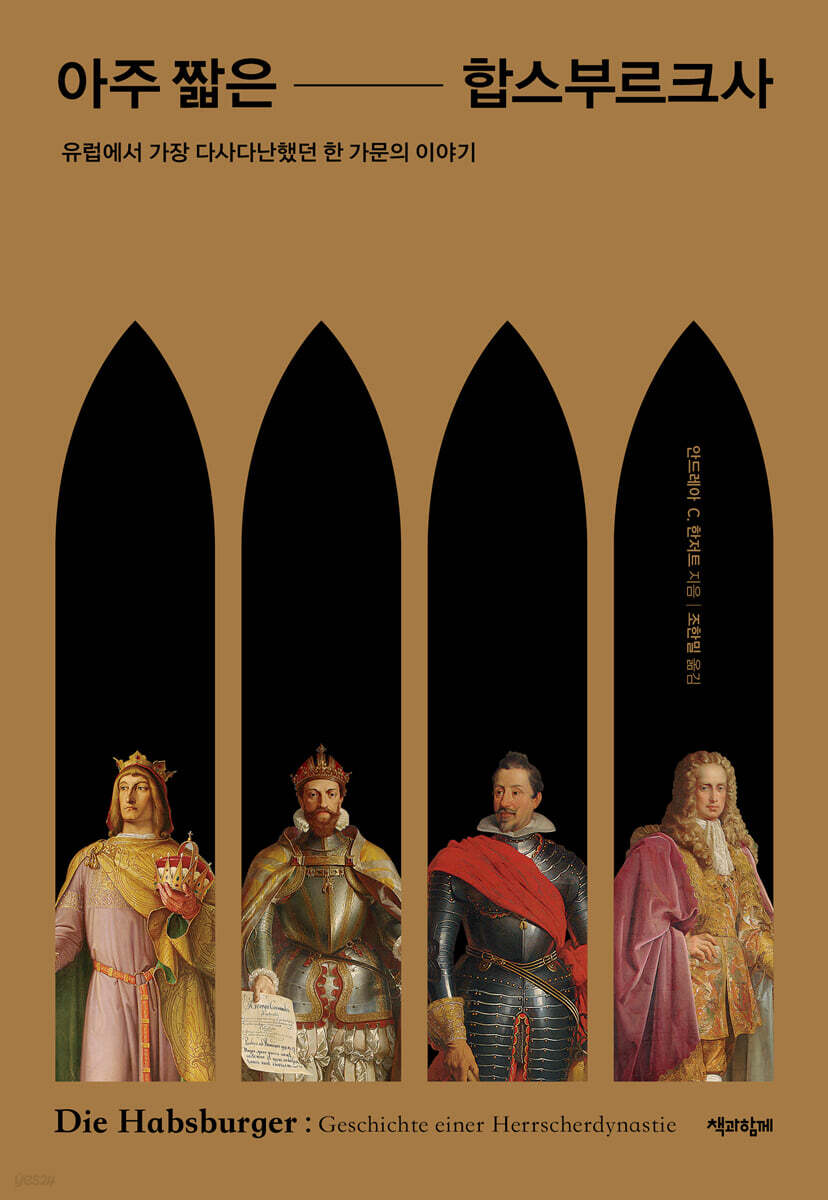
A very brief history of the Habsburgs
 |
Description
Book Introduction
A repository of memories that captures Europe's grand history
A concise, condensed history of the Habsburg family over a thousand years
Can European history be discussed without mentioning the Habsburgs? As the imperial house of the Holy Roman Empire for 400 years, and as the imperial house of the Austrian Empire for another 100 years, they held power in Europe longer than anyone else, swaying the course of world history.
Their history is filled with glorious moments, including building a great empire that spanned not only Europe but also South America and Africa, and ruling over countless nations and peoples.
However, after the 18th century, it faced repeated crises due to wars of succession, modernization, and nationalist conflicts, and finally fell into decline after its defeat in World War I in 1918.
This book condenses the turbulent journey of the Habsburgs, from their rise as a minor noble family in the 10th century to their dominance of Europe and eventual collapse in the 20th century, focusing on key figures and events.
Family trees, maps, and additional information placed throughout help readers more easily understand the complex personal relationships, European power structure, and unfamiliar concepts of the time.
Their history is intense and dynamic, having been at the center of every event that shook the world, including the Reformation, the Napoleonic Wars, and World War I.
Following these winding paths of time will not only give you a glimpse into European history, but also help you understand the complexities of today's Europe.
A concise, condensed history of the Habsburg family over a thousand years
Can European history be discussed without mentioning the Habsburgs? As the imperial house of the Holy Roman Empire for 400 years, and as the imperial house of the Austrian Empire for another 100 years, they held power in Europe longer than anyone else, swaying the course of world history.
Their history is filled with glorious moments, including building a great empire that spanned not only Europe but also South America and Africa, and ruling over countless nations and peoples.
However, after the 18th century, it faced repeated crises due to wars of succession, modernization, and nationalist conflicts, and finally fell into decline after its defeat in World War I in 1918.
This book condenses the turbulent journey of the Habsburgs, from their rise as a minor noble family in the 10th century to their dominance of Europe and eventual collapse in the 20th century, focusing on key figures and events.
Family trees, maps, and additional information placed throughout help readers more easily understand the complex personal relationships, European power structure, and unfamiliar concepts of the time.
Their history is intense and dynamic, having been at the center of every event that shook the world, including the Reformation, the Napoleonic Wars, and World War I.
Following these winding paths of time will not only give you a glimpse into European history, but also help you understand the complexities of today's Europe.
- You can preview some of the book's contents.
Preview
index
Family tree of the Habsburg family
prolog
Chapter 1: The Origins of the House of Habsburg
Chapter 2: The First Kings of the House of Habsburg and the Beginning of Austrian Rule in 1282
Chapter 3: The Habsburgs ascend to the throne
Chapter 4: Emperor Maximilian I and the Habsburgs' European Expansion
Chapter 5: Charles V and Ferdinand I, brothers who exchanged the throne
Chapter 6 Spain Seizes Hegemony
Chapter 7: Emperor Rudolf II and Matthias
Chapter 8: The Thirty Years' War and the House of Habsburg
Chapter 9: The Habsburgs Under the Sword of Damocles
Chapter 10: Maria Theresa and Joseph II
Chapter 11: Stagnation and Transition
Chapter 12: The Austrian Reign of Franz Joseph I
Chapter 13 World War I
Epilogue
Translator's Note
Search
prolog
Chapter 1: The Origins of the House of Habsburg
Chapter 2: The First Kings of the House of Habsburg and the Beginning of Austrian Rule in 1282
Chapter 3: The Habsburgs ascend to the throne
Chapter 4: Emperor Maximilian I and the Habsburgs' European Expansion
Chapter 5: Charles V and Ferdinand I, brothers who exchanged the throne
Chapter 6 Spain Seizes Hegemony
Chapter 7: Emperor Rudolf II and Matthias
Chapter 8: The Thirty Years' War and the House of Habsburg
Chapter 9: The Habsburgs Under the Sword of Damocles
Chapter 10: Maria Theresa and Joseph II
Chapter 11: Stagnation and Transition
Chapter 12: The Austrian Reign of Franz Joseph I
Chapter 13 World War I
Epilogue
Translator's Note
Search
Into the book
Above all, what made the Habsburgs unique was the vast territory they ruled.
…they ruled vast territories, from Austria and Bohemia to Hungary, the Netherlands, Spain, Portugal, the kingdoms of southern Italy, the colonies and numerous minor provinces of Central and South America, as well as the family's remaining homeland in southwestern Germany and strongholds on the north coast of Africa.
He literally built an empire on which the sun never sets.
---From the "Prologue"
The opportunity finally came in 1250, when Frederick II, Holy Roman Emperor, passed away.
With the death of Frederick II, the Staufen dynasty collapsed in an instant, and the Holy Roman Empire was plunged into a period of great interregnum that lasted for about 20 years, which resulted in the complete collapse of the royal authority.
The turbulent situation of the empire, paralyzed by this, was finally put in order when Rudolf I of the House of Habsburg was elected King of Germany in 1273.
Eventually, starting with Rudolf I, individual counts from the House of Habsburg ascended to the throne.
Of course, it took nearly 200 more years for the Habsburgs to take the imperial crown.
However, it was undeniable that the Habsburgs had risen to the top of the nobility in 1273 and had from then on entered the ranks of the ruling family representing the Holy Roman Empire.
---From "Chapter 1: The Origins of the Habsburg Family"
In 1452, Frederick IV celebrated two of the most important events of his life in Rome.
It was the wedding and the coronation of the emperor.
Upon arriving in Rome, Frederick IV immediately married Eleanor of Portugal, whom he had first seen there.
Three days later, the king and queen were crowned by the Pope, and Frederick IV was crowned Emperor Frederick III.
It was the moment when the first emperor of the Habsburg family was born.
---From "Chapter 3: The Habsburgs Who Came to the Emperor"
Frederick III was also a man who dealt with conflicts with perseverance and patience and who seized opportunities within his sphere of action.
He was particularly obsessed with the idea that God had chosen the Habsburgs and sent them into the world.
Even the secretive letter arrangement 'AEIOU' that Frederick III often used gives us a glimpse into his grand dream, and later generations have interpreted this motto to mean various things, such as 'Austria Erit In Orbe Ultima' (Austria will be the last in the world) and 'Austriae Est Imperare Orbi Universo' (All empires on earth obey Austria).
---From "Chapter 3: The Habsburgs Who Came to the Emperor"
Meanwhile, Maximilian I pursued a wide-ranging marriage policy, and the political marriages he pursued against France were one of his greatest creations.
In order to isolate France politically, he married his son Philip the Handsome and his daughter Margaret to children of the Houses of Castile and Aragon in 1496 and 1497, respectively.
However, when Margaret's husband and heir to the Spanish throne, Juan, died shortly after their wedding, the Spanish throne passed to Philip and his wife, Princess Juana of Spain.
---From "Chapter 4 Emperor Maximilian I and the Habsburgs' European Expansion"
It is believed that the high infant mortality rate was due to the Habsburg family repeatedly marrying close relatives for four generations to protect their family interests.
As can be seen from the table, the number of ancestors in the Habsburg family's children's generation was significantly smaller.
A child born to ordinary parents would have 64 ancestors six generations further back, but the children born to Leopold I and his first wife would have only 12 ancestors.
In other words, in the case of the Habsburg family, the number of ancestors is less than 20 percent of the general case.
As a result of repeated incestuous marriages for political and power reasons, many members of the Habsburg family developed weak bodies and physical defects, and it can be said that this marriage policy ultimately led to the demise of the Habsburg family.
---From "Chapter 9: The Habsburgs Under the Sword of Damocles"
Maria Theresa succeeded in preserving the Habsburg hereditary lands, except Silesia.
All the electors, including his son Maximilian III Joseph, who succeeded Charles VII as Duke of Bavaria, agreed to elect Maria Theresa's husband as Emperor Francis I.
However, Maria Theresa herself refused to be crowned empress.
Because she was the real power behind the Habsburg family, which had given decisive power to Francis I, she could not accept being recorded as an empress, lower in rank than the emperor.
As a result, the Habsburgs regained their status as a European power and their honor as an imperial family.
This reversal of fortune was a personal achievement of Maria Theresa, and it was an achievement that will be remembered in history.
---From "Chapter 10: Maria Theresa and Joseph II"
Gavrilo Princip, a Bosnian university student who had received firearms training from a Serbian secret organization, took advantage of this opportunity to assassinate the Crown Prince and his wife.
The Austrians and the Habsburgs, who were deeply shocked by this incident, now began to hold the Serbs, who were accused of being behind the assassination, accountable.
Even Franz Joseph I, who had succeeded in maintaining peace for a long time, eventually decided to start a war.
In fact, the reason most of the wars fought over the past 100 years since the Napoleonic Wars ended in a short period of time and were only localized wars was because the equilibrium system established by Metternich worked.
Franz Joseph I, who personally experienced the Metternich era, believed that even if a war broke out in the Balkans, the outcome would be decided within a few months without the flames spreading to other regions.
However, among other European countries, the prevailing view was that Austria's invasion of the Balkans would be a provocation against Russia, which had assumed the role of protector of Serbia.
---From "Chapter 13 World War I"
In the present age, when the republic and parliamentary democracy have taken root, the Habsburgs will never be restored to the throne or experience a new heyday.
However, the Habsburgs were both a repository of memories encompassing a grand history and a complex web of countless relationships. Therefore, the significance of the Habsburgs cannot be overlooked in properly understanding and successfully leading today's European community, which strives for shared growth.
…they ruled vast territories, from Austria and Bohemia to Hungary, the Netherlands, Spain, Portugal, the kingdoms of southern Italy, the colonies and numerous minor provinces of Central and South America, as well as the family's remaining homeland in southwestern Germany and strongholds on the north coast of Africa.
He literally built an empire on which the sun never sets.
---From the "Prologue"
The opportunity finally came in 1250, when Frederick II, Holy Roman Emperor, passed away.
With the death of Frederick II, the Staufen dynasty collapsed in an instant, and the Holy Roman Empire was plunged into a period of great interregnum that lasted for about 20 years, which resulted in the complete collapse of the royal authority.
The turbulent situation of the empire, paralyzed by this, was finally put in order when Rudolf I of the House of Habsburg was elected King of Germany in 1273.
Eventually, starting with Rudolf I, individual counts from the House of Habsburg ascended to the throne.
Of course, it took nearly 200 more years for the Habsburgs to take the imperial crown.
However, it was undeniable that the Habsburgs had risen to the top of the nobility in 1273 and had from then on entered the ranks of the ruling family representing the Holy Roman Empire.
---From "Chapter 1: The Origins of the Habsburg Family"
In 1452, Frederick IV celebrated two of the most important events of his life in Rome.
It was the wedding and the coronation of the emperor.
Upon arriving in Rome, Frederick IV immediately married Eleanor of Portugal, whom he had first seen there.
Three days later, the king and queen were crowned by the Pope, and Frederick IV was crowned Emperor Frederick III.
It was the moment when the first emperor of the Habsburg family was born.
---From "Chapter 3: The Habsburgs Who Came to the Emperor"
Frederick III was also a man who dealt with conflicts with perseverance and patience and who seized opportunities within his sphere of action.
He was particularly obsessed with the idea that God had chosen the Habsburgs and sent them into the world.
Even the secretive letter arrangement 'AEIOU' that Frederick III often used gives us a glimpse into his grand dream, and later generations have interpreted this motto to mean various things, such as 'Austria Erit In Orbe Ultima' (Austria will be the last in the world) and 'Austriae Est Imperare Orbi Universo' (All empires on earth obey Austria).
---From "Chapter 3: The Habsburgs Who Came to the Emperor"
Meanwhile, Maximilian I pursued a wide-ranging marriage policy, and the political marriages he pursued against France were one of his greatest creations.
In order to isolate France politically, he married his son Philip the Handsome and his daughter Margaret to children of the Houses of Castile and Aragon in 1496 and 1497, respectively.
However, when Margaret's husband and heir to the Spanish throne, Juan, died shortly after their wedding, the Spanish throne passed to Philip and his wife, Princess Juana of Spain.
---From "Chapter 4 Emperor Maximilian I and the Habsburgs' European Expansion"
It is believed that the high infant mortality rate was due to the Habsburg family repeatedly marrying close relatives for four generations to protect their family interests.
As can be seen from the table, the number of ancestors in the Habsburg family's children's generation was significantly smaller.
A child born to ordinary parents would have 64 ancestors six generations further back, but the children born to Leopold I and his first wife would have only 12 ancestors.
In other words, in the case of the Habsburg family, the number of ancestors is less than 20 percent of the general case.
As a result of repeated incestuous marriages for political and power reasons, many members of the Habsburg family developed weak bodies and physical defects, and it can be said that this marriage policy ultimately led to the demise of the Habsburg family.
---From "Chapter 9: The Habsburgs Under the Sword of Damocles"
Maria Theresa succeeded in preserving the Habsburg hereditary lands, except Silesia.
All the electors, including his son Maximilian III Joseph, who succeeded Charles VII as Duke of Bavaria, agreed to elect Maria Theresa's husband as Emperor Francis I.
However, Maria Theresa herself refused to be crowned empress.
Because she was the real power behind the Habsburg family, which had given decisive power to Francis I, she could not accept being recorded as an empress, lower in rank than the emperor.
As a result, the Habsburgs regained their status as a European power and their honor as an imperial family.
This reversal of fortune was a personal achievement of Maria Theresa, and it was an achievement that will be remembered in history.
---From "Chapter 10: Maria Theresa and Joseph II"
Gavrilo Princip, a Bosnian university student who had received firearms training from a Serbian secret organization, took advantage of this opportunity to assassinate the Crown Prince and his wife.
The Austrians and the Habsburgs, who were deeply shocked by this incident, now began to hold the Serbs, who were accused of being behind the assassination, accountable.
Even Franz Joseph I, who had succeeded in maintaining peace for a long time, eventually decided to start a war.
In fact, the reason most of the wars fought over the past 100 years since the Napoleonic Wars ended in a short period of time and were only localized wars was because the equilibrium system established by Metternich worked.
Franz Joseph I, who personally experienced the Metternich era, believed that even if a war broke out in the Balkans, the outcome would be decided within a few months without the flames spreading to other regions.
However, among other European countries, the prevailing view was that Austria's invasion of the Balkans would be a provocation against Russia, which had assumed the role of protector of Serbia.
---From "Chapter 13 World War I"
In the present age, when the republic and parliamentary democracy have taken root, the Habsburgs will never be restored to the throne or experience a new heyday.
However, the Habsburgs were both a repository of memories encompassing a grand history and a complex web of countless relationships. Therefore, the significance of the Habsburgs cannot be overlooked in properly understanding and successfully leading today's European community, which strives for shared growth.
---From the "Epilogue"
Publisher's Review
The essence of the Habsburg millennium, condensed and concise
The Habsburg family, which originated in the Alsace region in the 10th century, came to the forefront in earnest about 300 years later when Rudolf I ascended to the throne of Germany in 1273.
And then, two centuries later, in 1452, Frederick III ascended to the pinnacle of power when he became Holy Roman Emperor.
Afterwards, they continued to expand their territory and by the late 16th century, when Charles V and Maximilian I were active, they had built a great empire that spanned not only Europe but also South America and Africa.
However, it gradually went downhill after experiencing various events such as the Reformation, the French Revolution and the Napoleonic Wars, the War of Succession, and the conflicts between modernization and nationalism.
Although outstanding figures such as Maria Theresa emerged in the 18th century to overcome crises, the country finally fell into ruin after defeat in World War I in 1918.
In this book, German historian Andrea Hansert concisely presents the thousand-year history of the Habsburg family from its beginnings to its downfall.
To help you grasp the rise and fall of the Habsburg family and the flow of history at a glance, we've compiled a concise summary of the people and events you need to know.
Family trees, maps, and additional information placed throughout help readers more easily understand the complex personal relationships, European power structure, and unfamiliar concepts of the time.
Is it all about marriage policy and genetic diseases?
The true face of the Habsburg family, a leading force in world history
When you think of the House of Habsburg, what comes to mind? The first thing that comes to mind is the vast territories they ruled.
The marriage policy, which was the secret to this expansion of power, is a characteristic that represents the Habsburg family.
It is well known that he expanded his territory by acquiring the right to succeed to the thrones of Spain, Hungary, etc. through marriage, but this book also confirms that marriage played a decisive role in the process of ascending from a minor noble family to the position of German king and Holy Roman Emperor.
Afterwards, in order to protect the throne that was hard-won, they committed incest, which also brought about the side effects of hereditary diseases and the lack of a lineage.
But this aspect is only a part of their history.
This book clearly shows the significant footprints the Habsburg family left on world history as a leading force in Europe.
During the Reformation, the Habsburg family played a key role in protecting Roman Catholicism and the Counter-Reformation.
Considering the strong Protestant movement in their territories, the author argues that history would have been written differently if the Habsburgs had chosen Protestantism.
During the French Revolution and the Napoleonic Wars, he fought alongside the allies to overthrow Napoleon and led the Vienna System, which established the order of Europe for the next 100 years.
However, the attempt to integrate the Slavs into the empire met with strong opposition, which ultimately provided a pretext for the unprecedented war known as World War I.
The author's point that the reason Emperor Franz Joseph I of the Austro-Hungarian Empire at the time decided to go to war was because he mistakenly believed that the balance of power under the Vienna system was still in effect and that it would end in a short-term, localized war is significant.
Understanding Europe's unique governance structure reveals what Europe is like today.
When reading about medieval and modern European history, we often encounter difficulties due to things that are unfamiliar to us.
A typical example is the governance structure.
It was not often that one monarch ruled one country, but rather that one person ruled several countries.
At the center of it all was the Habsburg family.
This book explains the principles of this unfamiliar and complex ruling structure through the concept of a "personal union," a system in which several countries have the same monarch but each exist as an independent nation.
Under this ruling structure, the monarchs of the House of Habsburg ruled various countries and regions, including Austria and Bohemia during the Holy Roman Empire, as well as Hungary, the Netherlands, Spain, Portugal, and several kingdoms in southern Italy.
Even after the Habsburgs established the Austro-Hungarian Empire, it still contained many nations, and many ethnic groups lived together, including Hungarians, Czechs, Poles, Serbs, Croats, Ukrainians, Romanians, Slovaks, Slovenes, and Italians.
As ethnic conflicts gradually erupted and reached their peak in World War I, with the Austro-Hungarian Empire defeated, they each declared independence and established their own countries.
This book illuminates the complex processes through which Central and Eastern Europe came to be what it is today, and the profound significance of the Habsburgs in European unification.
The Habsburg family, which originated in the Alsace region in the 10th century, came to the forefront in earnest about 300 years later when Rudolf I ascended to the throne of Germany in 1273.
And then, two centuries later, in 1452, Frederick III ascended to the pinnacle of power when he became Holy Roman Emperor.
Afterwards, they continued to expand their territory and by the late 16th century, when Charles V and Maximilian I were active, they had built a great empire that spanned not only Europe but also South America and Africa.
However, it gradually went downhill after experiencing various events such as the Reformation, the French Revolution and the Napoleonic Wars, the War of Succession, and the conflicts between modernization and nationalism.
Although outstanding figures such as Maria Theresa emerged in the 18th century to overcome crises, the country finally fell into ruin after defeat in World War I in 1918.
In this book, German historian Andrea Hansert concisely presents the thousand-year history of the Habsburg family from its beginnings to its downfall.
To help you grasp the rise and fall of the Habsburg family and the flow of history at a glance, we've compiled a concise summary of the people and events you need to know.
Family trees, maps, and additional information placed throughout help readers more easily understand the complex personal relationships, European power structure, and unfamiliar concepts of the time.
Is it all about marriage policy and genetic diseases?
The true face of the Habsburg family, a leading force in world history
When you think of the House of Habsburg, what comes to mind? The first thing that comes to mind is the vast territories they ruled.
The marriage policy, which was the secret to this expansion of power, is a characteristic that represents the Habsburg family.
It is well known that he expanded his territory by acquiring the right to succeed to the thrones of Spain, Hungary, etc. through marriage, but this book also confirms that marriage played a decisive role in the process of ascending from a minor noble family to the position of German king and Holy Roman Emperor.
Afterwards, in order to protect the throne that was hard-won, they committed incest, which also brought about the side effects of hereditary diseases and the lack of a lineage.
But this aspect is only a part of their history.
This book clearly shows the significant footprints the Habsburg family left on world history as a leading force in Europe.
During the Reformation, the Habsburg family played a key role in protecting Roman Catholicism and the Counter-Reformation.
Considering the strong Protestant movement in their territories, the author argues that history would have been written differently if the Habsburgs had chosen Protestantism.
During the French Revolution and the Napoleonic Wars, he fought alongside the allies to overthrow Napoleon and led the Vienna System, which established the order of Europe for the next 100 years.
However, the attempt to integrate the Slavs into the empire met with strong opposition, which ultimately provided a pretext for the unprecedented war known as World War I.
The author's point that the reason Emperor Franz Joseph I of the Austro-Hungarian Empire at the time decided to go to war was because he mistakenly believed that the balance of power under the Vienna system was still in effect and that it would end in a short-term, localized war is significant.
Understanding Europe's unique governance structure reveals what Europe is like today.
When reading about medieval and modern European history, we often encounter difficulties due to things that are unfamiliar to us.
A typical example is the governance structure.
It was not often that one monarch ruled one country, but rather that one person ruled several countries.
At the center of it all was the Habsburg family.
This book explains the principles of this unfamiliar and complex ruling structure through the concept of a "personal union," a system in which several countries have the same monarch but each exist as an independent nation.
Under this ruling structure, the monarchs of the House of Habsburg ruled various countries and regions, including Austria and Bohemia during the Holy Roman Empire, as well as Hungary, the Netherlands, Spain, Portugal, and several kingdoms in southern Italy.
Even after the Habsburgs established the Austro-Hungarian Empire, it still contained many nations, and many ethnic groups lived together, including Hungarians, Czechs, Poles, Serbs, Croats, Ukrainians, Romanians, Slovaks, Slovenes, and Italians.
As ethnic conflicts gradually erupted and reached their peak in World War I, with the Austro-Hungarian Empire defeated, they each declared independence and established their own countries.
This book illuminates the complex processes through which Central and Eastern Europe came to be what it is today, and the profound significance of the Habsburgs in European unification.
GOODS SPECIFICS
- Date of issue: February 28, 2025
- Page count, weight, size: 272 pages | 145*210*20mm
- ISBN13: 9791194263296
- ISBN10: 1194263291
You may also like
카테고리
korean


korean

![ELLE 엘르 스페셜 에디션 A형 : 12월 [2025]](http://librairie.coreenne.fr/cdn/shop/files/b8e27a3de6c9538896439686c6b0e8fb.jpg?v=1766436872&width=3840)


