

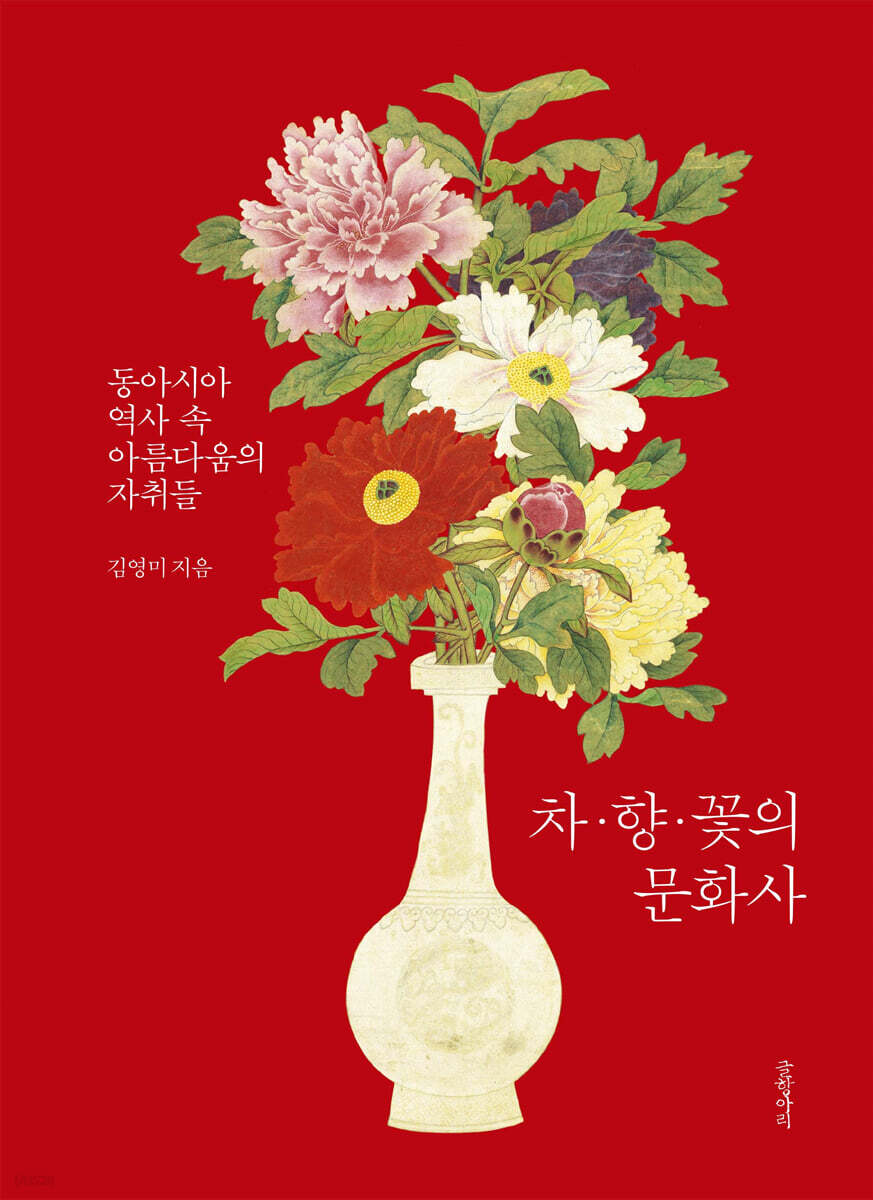
Cultural History of Tea, Incense, and Flowers
 |
Description
Book Introduction
See with your own eyes
Savor it with your mouth
Feel it with your nose
A History of High-End Hobbies in East Asia
The essence of oriental culture, a vibrant blend of class and religion, trade and markets, literature and painting, fashion and gatherings, craftsmanship and the spirit of art.
This book is the first to examine the hobbies related to tea, incense, and flowers that have shaped East Asian culture.
It divides the East Asian region into Korea, China, and Japan, and explains the flow by country and era, while unfolding the story of the perspectives of various people who looked at tea, fragrance, and flowers, and the artistic forms that captured them.
The author sought to meticulously distinguish the similarities and differences between the tea, incense, and flower cultures of these three countries, and described them based on clearly supported sources such as literature and archaeological excavations.
In the process of developing the story, we actively utilized related stories and character narratives, and provided ample, rarely seen illustrations from each country to aid understanding.
The story begins in China and continues to Korea and Japan.
Although tea is said to have originated in China, its fragrance and flowers first attracted interest in regions such as ancient Mesopotamia and Egypt.
Looking at the route that incense and flower culture took to East Asia, it started in ancient Greece and Rome, passed through India and Central Asia, and entered China, and then spread to Korea and Japan.
It is undeniable that China is the starting point of East Asian tea, incense, and flower culture, and that its resources are vast and its cultural history is much longer than that of Korea or Japan.
The author shows how these cultures were accepted and transformed after being transmitted to Korea and Japan.
In the text, the cultural trends of tea, incense, and flowers were explained separately, but in fact, tea, incense, and flowers have the character of a comprehensive art performed in a single time and space.
When tea culture flourished, fragrance and flowers were also present, and together they created great synergy.
In recent years, the number of people enjoying tea, incense, and flowers has been steadily increasing in Korea. The publication of this book will greatly contribute to understanding the relationship between the tea, incense, flower culture, and utensils of the three East Asian countries.
Savor it with your mouth
Feel it with your nose
A History of High-End Hobbies in East Asia
The essence of oriental culture, a vibrant blend of class and religion, trade and markets, literature and painting, fashion and gatherings, craftsmanship and the spirit of art.
This book is the first to examine the hobbies related to tea, incense, and flowers that have shaped East Asian culture.
It divides the East Asian region into Korea, China, and Japan, and explains the flow by country and era, while unfolding the story of the perspectives of various people who looked at tea, fragrance, and flowers, and the artistic forms that captured them.
The author sought to meticulously distinguish the similarities and differences between the tea, incense, and flower cultures of these three countries, and described them based on clearly supported sources such as literature and archaeological excavations.
In the process of developing the story, we actively utilized related stories and character narratives, and provided ample, rarely seen illustrations from each country to aid understanding.
The story begins in China and continues to Korea and Japan.
Although tea is said to have originated in China, its fragrance and flowers first attracted interest in regions such as ancient Mesopotamia and Egypt.
Looking at the route that incense and flower culture took to East Asia, it started in ancient Greece and Rome, passed through India and Central Asia, and entered China, and then spread to Korea and Japan.
It is undeniable that China is the starting point of East Asian tea, incense, and flower culture, and that its resources are vast and its cultural history is much longer than that of Korea or Japan.
The author shows how these cultures were accepted and transformed after being transmitted to Korea and Japan.
In the text, the cultural trends of tea, incense, and flowers were explained separately, but in fact, tea, incense, and flowers have the character of a comprehensive art performed in a single time and space.
When tea culture flourished, fragrance and flowers were also present, and together they created great synergy.
In recent years, the number of people enjoying tea, incense, and flowers has been steadily increasing in Korea. The publication of this book will greatly contribute to understanding the relationship between the tea, incense, flower culture, and utensils of the three East Asian countries.
- You can preview some of the book's contents.
Preview
index
preface
Part 1: Tea Culture
Chapter 1: Tea in China
――The Age of Tea Bamboo: Before the Tang Dynasty
――The era of 『Da-gyeong』: Tang
1) Jeonda and teapot
2) Amda and tea
3) Dot and tea
――Tuda and various tea sets: Song
1) Dot it brilliantly and intensely
2) A game that wins with beautiful foam
3) Draw a pattern on the foam
4) Black glaze tea bowl created for white foam
5) A tea set for drinking tea
6) Stone tea set with excellent taste and energy
7) The scene of preparing tea in the picture and the tea set
――Tea ceremony spread to the frontier: Yo and Geum
――The transition period between matcha and leaf tea: Yuan
――Taste and aroma are more important than the color of the tea: Ming
1) The close relationship between tea ceremony and tea taste
――The era when tea was enjoyed by everyone from emperors to commoners: Qing
1) Emperor Kangxi and Emperor Yongzheng, who loved enamel teaware
2) Emperor Qianlong, who said, "I can't live a day without tea."
3) Empress Dowager Cixi, who introduced jasmine tea to the world
4) The precious tea of the royal court, Tibetan milk tea
5) Uiheung Jasahoh and Gongbucha
――Tea caught in the whirlpool of foreign powers: Modern and contemporary times
Chapter 2 Korean Tea
The Beginning of Korean Tea Culture: The Three Kingdoms
――Longing for 『Daegyeong』: Unified Silla
1) Chinese tea utensils excavated from Unified Silla ruins
2) Jade wall and jade ring
3) Jangsayo Cheongja
The Peak of Korean Tea Culture: Goryeo
1) The elegant drinking method of Goryeo literati and monks
2) Goryeo celadon surpassing Monday celadon
3) Diverse and sophisticated Goryeo tea utensils
4) Goryeo's tea culture on par with China's
5) Chinese tea ceremony that captivated Koreans
――Tea culture with an international flair: Joseon
1) Key figures in the revival of tea culture
2) Tea culture revived through exchanges between China and Japan
3) Tea, tea ceremony, and tea utensils popular during the Joseon Dynasty
――Maintaining life under external domination: Modern and contemporary times
Chapter 3: Japanese Tea
Tea Culture Brought in by Monks from the Kingdom of Kendo: Nara and Heian
The Influx of Chinese Tea and the Beginning of Japanese Tencha: Kamakura and Nanbokujo
1) Tuda who raised the awareness of warriors
――The Conflict Between Seowoncha and Wabicha: Muromachi
1) The genealogy of Rikyu and wabicha
2) Wabi-sabi and Goryeo tea bowls
3) Rikyu's one-room tea room
4) Leaders of Japanese Tea Culture: Machishu and Daimyo
――The popularization of tea and the establishment of sencha: Edo
1) The spirit of Japanese tea ceremony, wabi, sabi, and one-day-only
Part 2: Incense Culture
Chapter 1 Types of Incense
Mother's incense│Agarwood│Dragon's incense│Amber incense│Gangjin incense│Sohap incense│Sandalwood│Rosewood│Clove│Frankincense│Musk
Chapter 2: Chinese Incense
――Development of fusion technology
――Types and uses of incense
Incense burner│Incense bottle│Incense offering│Incense offering
――The use of incense and the evolution of incense tools
1) Longing for the world of the immortals: Jeon-guk and Jin-han
Apprentice training room│Dongje training room│Park San-hyang-ro
2) The popularity of romantic incense culture: Three Kingdoms, Wei, Jin, Southern and Northern Dynasties
Tubular incense burner│Three-legged incense burner│Parksan incense burner│Two-shaped incense burner│Byung incense burner
3) The popularity of various fragrances and fragrance tools through East-West exchanges: Sui and Tang dynasties
Multi-family incense burner│incense burner│incense burner│incense burner
4) Introduction of various spices and development of scented objects: Song
5) Popularization of incense and emergence of incense sticks: Won
Regular incense burner│Inverted incense burner│Yellow incense burner│Track-shaped incense burner│
Incense burner, incense stick, incense bottle
6) Incense sticks established as high-end ornaments: Ming and Qing Dynasties
Seondeok-ro, Inhyang-ro│No Byeong-sam-sa
Chapter 3: The Fragrance of Korea
Incense Culture that Began with Buddhism: The Three Kingdoms and Unified Silla
1) Baksan Incense Burner, popular during the Three Kingdoms Period
2) Various incense burners of Unified Silla
The Golden Age of Incense Culture: Goryeo
1) The trend of high-class retro fragrances
Lotus-shaped incense burner│incense burner│regular incense burner│figural incense burner│bowl incense burner│hyeon incense burner
2) Incense burners and incense boxes popular in the Song Dynasty capital Gaeseong
――Confucian culture and the literati's incense hobby: Joseon
1) Incense burners and incense burners
2) The introduction and popularity of Chinese incense burners
Chapter 4: The Incense of Japan
――Japanese who actively embraced incense culture: Asuka, Nara, and Heian
The Fragrance of the Warriors, the Incense of the Throwing Incense, and the Karamono Fever: Kamakura and Azuchi-Momoyama
――Makie Hyogu, the protagonist of the tea room: After Edo
Part 3 Flower Culture
Chapter 1: Chinese Flower Culture, Binghua
――Binghwa, which originated from Indian Buddhism: Wei, Jin, and Southern and Northern Dynasties
1) Foreign elements of Chinese medicine
The Golden Age of Weaponry Art: Sui, Tang, and Five Dynasties
1) A song of flowers offered to God
2) A painting elevated to an object of appreciation
――Byunghwa, who decorated the banquet table lavishly: Song
1) Tea, incense, flowers and paintings
2) Song Dynasty's war, unity and ideology
3) Poems and paintings about vases
――Stagnation of the culture of war: Won
――Revival of the culture of war: Ming
1) A humanistic perspective on disease
2) Firearms vary depending on location and use
――The pinnacle of military culture: Qing
1) The birth of the King of Fire
2) Symbolism in bonsai art
3) Creative flower arranging tools, Naedam
Chapter 2: Korean Flower Culture and Flower Arrangement
――The Flower of Silla that Went to the Tang Dynasty: The Three Kingdoms and Unified Silla
――A luxurious etymology, a banquet decorated with gold and silver: Goryeo
1) Coexistence of Buddhist republic and Confucian ideology
2) Secrets to extending the life of flowers: Tosil and Binghwa
3) Use of flower pots according to the type of flower arrangement
――Improving the theory and technique of flower arrangement: Joseon
1) Become familiar with floriculture techniques
2) Joseon flower arrangements as depicted in text and pictures
Chapter 3: Japanese Flower Culture, Ikebana
――The Realm of the Gods in Flowers: Asuka
――Ikebana Passed Down Through Song: Heian
The Popularity of Karamono and the Prosperity of Ikebana: Kamakura and Nanbokujo
1) Ikebana decorated indoors
2) Karamono Hobby and Ikebana
3) Ikebana and flower arrangements in the painting
4) Ikebana and flower arrangements enjoyed by mythological and historical figures
――The pinnacle of ikebana: Muromachi
1) Beyond religious boundaries, as an artistic form
2) Ikebana and flower arrangements shown in the picture
――The Combination of Ikebana and Chanoyu: Momoyama and Edo
1) The appearance of Rika and Yuye
2) The exquisite combination of chanoyu and ikebana
――The Search for Tradition and Innovation: Modern and Contemporary Times
References│Search
Part 1: Tea Culture
Chapter 1: Tea in China
――The Age of Tea Bamboo: Before the Tang Dynasty
――The era of 『Da-gyeong』: Tang
1) Jeonda and teapot
2) Amda and tea
3) Dot and tea
――Tuda and various tea sets: Song
1) Dot it brilliantly and intensely
2) A game that wins with beautiful foam
3) Draw a pattern on the foam
4) Black glaze tea bowl created for white foam
5) A tea set for drinking tea
6) Stone tea set with excellent taste and energy
7) The scene of preparing tea in the picture and the tea set
――Tea ceremony spread to the frontier: Yo and Geum
――The transition period between matcha and leaf tea: Yuan
――Taste and aroma are more important than the color of the tea: Ming
1) The close relationship between tea ceremony and tea taste
――The era when tea was enjoyed by everyone from emperors to commoners: Qing
1) Emperor Kangxi and Emperor Yongzheng, who loved enamel teaware
2) Emperor Qianlong, who said, "I can't live a day without tea."
3) Empress Dowager Cixi, who introduced jasmine tea to the world
4) The precious tea of the royal court, Tibetan milk tea
5) Uiheung Jasahoh and Gongbucha
――Tea caught in the whirlpool of foreign powers: Modern and contemporary times
Chapter 2 Korean Tea
The Beginning of Korean Tea Culture: The Three Kingdoms
――Longing for 『Daegyeong』: Unified Silla
1) Chinese tea utensils excavated from Unified Silla ruins
2) Jade wall and jade ring
3) Jangsayo Cheongja
The Peak of Korean Tea Culture: Goryeo
1) The elegant drinking method of Goryeo literati and monks
2) Goryeo celadon surpassing Monday celadon
3) Diverse and sophisticated Goryeo tea utensils
4) Goryeo's tea culture on par with China's
5) Chinese tea ceremony that captivated Koreans
――Tea culture with an international flair: Joseon
1) Key figures in the revival of tea culture
2) Tea culture revived through exchanges between China and Japan
3) Tea, tea ceremony, and tea utensils popular during the Joseon Dynasty
――Maintaining life under external domination: Modern and contemporary times
Chapter 3: Japanese Tea
Tea Culture Brought in by Monks from the Kingdom of Kendo: Nara and Heian
The Influx of Chinese Tea and the Beginning of Japanese Tencha: Kamakura and Nanbokujo
1) Tuda who raised the awareness of warriors
――The Conflict Between Seowoncha and Wabicha: Muromachi
1) The genealogy of Rikyu and wabicha
2) Wabi-sabi and Goryeo tea bowls
3) Rikyu's one-room tea room
4) Leaders of Japanese Tea Culture: Machishu and Daimyo
――The popularization of tea and the establishment of sencha: Edo
1) The spirit of Japanese tea ceremony, wabi, sabi, and one-day-only
Part 2: Incense Culture
Chapter 1 Types of Incense
Mother's incense│Agarwood│Dragon's incense│Amber incense│Gangjin incense│Sohap incense│Sandalwood│Rosewood│Clove│Frankincense│Musk
Chapter 2: Chinese Incense
――Development of fusion technology
――Types and uses of incense
Incense burner│Incense bottle│Incense offering│Incense offering
――The use of incense and the evolution of incense tools
1) Longing for the world of the immortals: Jeon-guk and Jin-han
Apprentice training room│Dongje training room│Park San-hyang-ro
2) The popularity of romantic incense culture: Three Kingdoms, Wei, Jin, Southern and Northern Dynasties
Tubular incense burner│Three-legged incense burner│Parksan incense burner│Two-shaped incense burner│Byung incense burner
3) The popularity of various fragrances and fragrance tools through East-West exchanges: Sui and Tang dynasties
Multi-family incense burner│incense burner│incense burner│incense burner
4) Introduction of various spices and development of scented objects: Song
5) Popularization of incense and emergence of incense sticks: Won
Regular incense burner│Inverted incense burner│Yellow incense burner│Track-shaped incense burner│
Incense burner, incense stick, incense bottle
6) Incense sticks established as high-end ornaments: Ming and Qing Dynasties
Seondeok-ro, Inhyang-ro│No Byeong-sam-sa
Chapter 3: The Fragrance of Korea
Incense Culture that Began with Buddhism: The Three Kingdoms and Unified Silla
1) Baksan Incense Burner, popular during the Three Kingdoms Period
2) Various incense burners of Unified Silla
The Golden Age of Incense Culture: Goryeo
1) The trend of high-class retro fragrances
Lotus-shaped incense burner│incense burner│regular incense burner│figural incense burner│bowl incense burner│hyeon incense burner
2) Incense burners and incense boxes popular in the Song Dynasty capital Gaeseong
――Confucian culture and the literati's incense hobby: Joseon
1) Incense burners and incense burners
2) The introduction and popularity of Chinese incense burners
Chapter 4: The Incense of Japan
――Japanese who actively embraced incense culture: Asuka, Nara, and Heian
The Fragrance of the Warriors, the Incense of the Throwing Incense, and the Karamono Fever: Kamakura and Azuchi-Momoyama
――Makie Hyogu, the protagonist of the tea room: After Edo
Part 3 Flower Culture
Chapter 1: Chinese Flower Culture, Binghua
――Binghwa, which originated from Indian Buddhism: Wei, Jin, and Southern and Northern Dynasties
1) Foreign elements of Chinese medicine
The Golden Age of Weaponry Art: Sui, Tang, and Five Dynasties
1) A song of flowers offered to God
2) A painting elevated to an object of appreciation
――Byunghwa, who decorated the banquet table lavishly: Song
1) Tea, incense, flowers and paintings
2) Song Dynasty's war, unity and ideology
3) Poems and paintings about vases
――Stagnation of the culture of war: Won
――Revival of the culture of war: Ming
1) A humanistic perspective on disease
2) Firearms vary depending on location and use
――The pinnacle of military culture: Qing
1) The birth of the King of Fire
2) Symbolism in bonsai art
3) Creative flower arranging tools, Naedam
Chapter 2: Korean Flower Culture and Flower Arrangement
――The Flower of Silla that Went to the Tang Dynasty: The Three Kingdoms and Unified Silla
――A luxurious etymology, a banquet decorated with gold and silver: Goryeo
1) Coexistence of Buddhist republic and Confucian ideology
2) Secrets to extending the life of flowers: Tosil and Binghwa
3) Use of flower pots according to the type of flower arrangement
――Improving the theory and technique of flower arrangement: Joseon
1) Become familiar with floriculture techniques
2) Joseon flower arrangements as depicted in text and pictures
Chapter 3: Japanese Flower Culture, Ikebana
――The Realm of the Gods in Flowers: Asuka
――Ikebana Passed Down Through Song: Heian
The Popularity of Karamono and the Prosperity of Ikebana: Kamakura and Nanbokujo
1) Ikebana decorated indoors
2) Karamono Hobby and Ikebana
3) Ikebana and flower arrangements in the painting
4) Ikebana and flower arrangements enjoyed by mythological and historical figures
――The pinnacle of ikebana: Muromachi
1) Beyond religious boundaries, as an artistic form
2) Ikebana and flower arrangements shown in the picture
――The Combination of Ikebana and Chanoyu: Momoyama and Edo
1) The appearance of Rika and Yuye
2) The exquisite combination of chanoyu and ikebana
――The Search for Tradition and Innovation: Modern and Contemporary Times
References│Search
Publisher's Review
1.
tea culture
Since the Han Dynasty in China, tea drinking has been popular among the upper class, and tea was distributed in the market as an everyday drink.
During the Wei and Jin Dynasties, tea, like alcohol, became an indispensable drink at banquets and gatherings, and during the Shang Dynasty, its distribution expanded even further, creating a scene where tea was consumed in every household.
Now, the act of drinking tea has gone beyond simply quenching thirst and has become a healing and artistic lifestyle custom that relieves mental tension and elevates the soul.
In other words, the meaning of drinking tea has been elevated to the realm of spiritual culture.
During the Song and Yuan dynasties, there was a playful tendency to focus on the external beauty of tea utensils, while during the Ming and Qing dynasties, there was much discussion on practical tea drinking methods, and an exploratory tendency to connect the act of drinking tea to an ideal world was prominent.
Until the Tang and Song Dynasties, mainly cake tea and single-cup tea were popular, and after the Ming Dynasty, leaf tea (scattered tea) became popular.
Depending on the environment and social trends surrounding tea, teacups also took on various forms.
Korea's tea culture began during the Three Kingdoms period.
Tea-related utensils such as celadon bowls, black glazed water jugs, and stone mortars from the Southern and Northern Dynasties of the Yang and Jin Dynasties have been discovered in various historical sites, which suggests that, like in China, tea was boiled and drunk like porridge on the Korean Peninsula.
In literature and relics of daily life from the Unified Silla period, it has been confirmed that Tang Dynasty Yue kiln celadon, Xing kiln white porcelain, and Jangsa kiln celadon were used as tea utensils. In fact, upper-class people including Choi Chi-won knew the Tang Dynasty's Jeon-dae method and Jeom-dae method, and they also applied the Am-da method, which involves a complex process.
During the Goryeo Dynasty, after the military regime came to power in 1170, tea culture spread among the hermitage-dwelling literati and monks.
Going one step further from the tea-making method, the tea-making competition, where tea producers competed to create beautiful foam while evaluating the tea's origin and taste, became popular, and at the same time, the tea-making method was also popular.
As tea culture developed during the Goryeo Dynasty, the demand for diverse and delicate tea utensils arose, leading to rapid growth in the Goryeo porcelain industry.
The tea culture of Goryeo, which can be said to have reached its peak in the history of Korean tea culture, was of a level that was no less than that of China.
During the Joseon Dynasty, when Confucianism was the ruling ideology, tea culture also showed a tendency to stagnate due to the policy of suppressing Buddhism.
However, in the late Joseon Dynasty, people who actively enjoyed tea emerged, centered around Jeong Yak-yong, Cho Ui-seonsa, and Kim Jeong-hui, and they began to experience and explore the diverse world of tea through diplomatic exchanges with China and Japan.
Dotting tea and pouring tea were still practiced, and as the bubble tea method of pouring water over tea leaves became popular, teapots and tea bells with handles became popular.
In Japan, tea culture began to emerge at least in the 8th century, and by the early 9th century, tea seeds imported from China had been planted and cultivated.
During the Heian period, the tea ceremony method and the tea bowl form made of celadon became popular through monks who crossed over to the Tang Dynasty.
During the Kamakura period, the tea-making method was introduced, and by learning about Shuangjingcha, a steamed leaf tea from Jiangnan, China, people began to make Tencha, the raw material for Japanese matcha.
The Kamakura shogunate used the competitive game of tuta to cultivate the spirit of its warriors, but it became so popular that there were social concerns that the gambling aspect of tuta should be regulated.
The shogunate's generals were enthusiastic collectors of Chinese teacups and banquet decorations called karamono.
At that time, the tea mainly consumed in Japan was not the sweet tea that was consumed by the Song Dynasty imperial family and the upper class, but the mountain tea (草茶) from Jiangnan, China.
During the Muromachi period, a vibrant tea culture blossomed amidst the conflict between the Chinese-style shoin-cha centered around the existing karamono and the wabi-cha valuing secluded grounds and simple utensils.
Tea houses called Mizuchaya were popular on the streets, and after the Edo period, when tea became popular and became part of everyday life, sencha, the green tea of today, became established.
From the perspective of tea and tea utensils, the tea cultures of the three East Asian countries are very similar, yet each exhibits its own unique characteristics.
In China, as tea evolved into bottled tea, single-serving tea, and mountain tea (leaf tea), the demands for tea utensils changed, as did the demands for the shape and material of the tea set.
During the Byungcha era, celadon tea utensils were welcomed, during the Dancha era, celadon or cheonmok tea utensils were welcomed, and during the Sancha era, white porcelain tea utensils were welcomed.
During the Ming and Qing Dynasties, teapots that retained the fragrance of tea for a long time and had excellent heat retention were created, and the functions of tea utensils expanded as tea was associated with mental health, such as incense cups and bowls.
In Korea, during the Goryeo Dynasty, when tea culture was at its peak, it displayed characteristics that combined with Taoist ideas of unity with nature, and Goryeo celadon was produced with such beautiful colors that even China admired it.
In the late Joseon Dynasty, white porcelain tea sets with simple, elegant, and rustic characteristics based on Confucian ideology were introduced.
On the other hand, Japan's tea culture has developed a unique aesthetic of inward gathering and reduction due to constant wars and power struggles.
The tea ceremony, which was established among the ruling class of warriors during the Edo period, was enjoyed as a type of political social gathering.
In the midst of this, a unique tea culture based on the spirit of 'wabi·sabi·tranquility' was formed, and the aesthetics of a simple tea ceremony were revered by adopting Joseon's Buncheong tea bowls and Japanese tea sets that fit well with this.
2.
Incense culture
It is known that the first place where fragrance appeared in human life was the Orient region, including ancient Mesopotamia and Egypt.
Afterwards, it spread through Central Asia to China, and then to the Korean Peninsula and Japan, forming a route that spread throughout East Asia.
The act of burning incense is fundamentally rooted in religious rituals and concerns about the afterlife.
In particular, the Chinese have long considered incense to be a medium connecting the real world and the afterlife or the world of the immortals, and therefore the act of burning incense was considered sacred and noble.
Therefore, incense was burned every time a ritual was performed, such as investiture, wedding, or funeral, and this tradition, which became established as a process of pious ritual, continues to this day.
China's incense culture has developed over time through the development of various incense and the production of new incense tools to match them.
During the Han Dynasty, when the Western Regions were developed, incense made from tree resin began to be introduced in earnest, and incense burners suited to its properties began to be introduced.
During the Wei, Jin, Southern and Northern Dynasties, when Buddhism was widely spread, incense was actively used in religious ceremonies, and during the Sui and Tang Dynasties, more diverse types of incense were imported through the Silk Road trade, and gorgeous and beautiful incense utensils became popular.
During the Song Dynasty, incense culture was popular not only among the aristocracy but also among upper-class women. In particular, incense-infusing clothing, called hunui, became widespread, and new forms of incense that mixed various scents appeared.
As interest in incense burners grew, porcelain incense burners, which could be mass-produced, became more popular than pottery or bronze incense burners.
During the Yuan Dynasty, incense, which is the most widely used incense today, began to become popular, and during the Ming and Qing Dynasties, the industry of cultivating incense and producing incense on its own flourished.
Also, with the rise of epigraphy, incense burners and incense boxes imitating old ones appeared.
The incense culture began in Korea during the Three Kingdoms Period. When Buddhism was accepted from China, the ritual of burning incense was also introduced. Initially, it was also used to treat diseases.
During the Unified Silla period, incense was not only imported through trade, but also cultivated and exported to Japan.
During the Goryeo Dynasty, when Buddhism was at its peak, incense was burned at all state events, and a culture of enjoying incense on a personal basis was formed even among the aristocracy.
During the Joseon Dynasty, high-quality incense such as agarwood and dragon's brain were imported from China and Japan, and the Joseon kings showed great interest in agarwood.
Many literati also loved incense, and beautiful incense burners and incense sticks decorated their study spaces alongside their stationery.
Japan's incense culture began as a Buddhist offering of incense brought in from China and the Korean Peninsula, but after the Heian period, it moved away from religious elements and moved toward aesthetic purposes.
During the Kamakura period, samurai enjoyed rare agarwood as a way to display their power.
At that time, warriors enjoyed the hobby of quietly burning incense and contemplating alone, and at the same time, they also enjoyed the game of incense fighting, where they gathered together in groups to guess the names of the incense.
During the Muromachi period, during the samurai regime, a trend of worshipping the stillness and gentleness that came from incense based on Zen philosophy was popular.
At that time, a craze for collecting Chinese artifacts swept the country, and Chinese incense sticks, incense burners, and incense boxes were imported in large quantities.
During the Momoyama period, when wabi-cha was popular, it was also popular to enjoy incense directly in a brazier or stove without using an incense burner.
During the Edo period, the upper classes welcomed the luxurious incense burners made with unique lacquer crafting techniques, and incense boxes, which had no direct relation to tea, were also used as tea utensils at tea parties.
When we look at the incense cultures of the three East Asian countries, in China, after the Han Dynasty, there was a qualitative improvement in the process of Eastern and Western civilizations fusing and Taoism, Buddhism, and Confucianism communicating.
The classes that played a leading role in the development of incense culture were the imperial family and the literati. They enjoyed incense along with tea, hanging flowers, and hanging scrolls in their daily lives.
However, with the advent of modern times and the introduction of Western civilization, traditional incense culture declined in the aristocratic and literati societies.
Korea developed its incense culture through long exchanges with China, but it went through a period of prosperity and decline depending on the influence of religion.
In other words, during the Goryeo Dynasty when Buddhism flourished, various incense and incense utensils appeared, but they were greatly diminished due to the influence of Confucianism during the Joseon Dynasty.
It was mainly used in ceremonies and funerals, and was maintained among the royal family and the literati, but in the late Joseon Dynasty, incense was enjoyed in a decorative and conceptual form.
The Japanese approach to incense is much more aesthetic than that of Korea or China.
The warrior class that emerged after the Kamakura period pioneered incense culture and elevated incense to art, continuing the tradition for a long time.
Even today, Japan's incense culture is still thriving, along with the tea ceremony and flower ceremony.
3.
Flower culture
Flowers, like tea and incense, have been a part of human life since ancient times.
The culture of appreciating flowers using flower vases originated in Mesopotamia and Egypt, then spread to Greece and Rome, and then to the Gandhara region of India.
And when Buddhism spread to China, the flower offering ritual was introduced along with it and developed into a new form, and then spread to Korea and Japan, where each developed its own unique culture.
In China, arranging or placing flowers in a vase is called 'byeonghwa', in Korea, it is called 'ikebana', and in Japan, it is called 'ikebana'.
The earliest artifact that confirms China's culture of war is a jar from the Western Jin Dynasty.
Later, in the early period of the Northern and Southern Dynasties, large and tall bottles appeared and the method of offering flowers became more diverse, and in the later period, styles reflecting the influence of Taoism and Zoroastrianism appeared.
By the Sui and Tang Dynasties, flower painting had established itself as a proper art form, and during the Northern Song Dynasty, a new way of appreciating flowers was developed.
In the Five Dynasties, hanging flowers, funeral flowers, and bamboo tube flowers appeared, and flower exhibitions were held regularly.
During the Song Dynasty, swordsmanship became so popular that it was included in the four arts of daily life, not only among the royal family but also among the common people.
During the Ming Dynasty, books linking the philosophical thought of science and flowers were written by literati, and tea flower arrangements, or flower arrangements enjoyed at tea parties, became popular.
During the Qing Dynasty, the culture of warfare reached its most splendid heyday.
The emperors of the past admired the refined Korean people of the Ming Dynasty and were active in military affairs. The stable world and the abundance of goods, which allowed people to enjoy a life of luxury, were the catalyst for such development.
It was also during this period that the art of bonsai and bonsai, which pursue the beauty of nature, developed greatly.
In general, the Chinese people identify with flowers and have a characteristic of expressing bold intuition while also looking at them subjectively.
Our country's flower arranging culture was first discovered in literature records from the Three Kingdoms period.
In the royal families of Baekje and Silla, we can confirm that they dug holes and created mountains to raise strange animals and plants.
Additionally, the record that Silla gifted flowers to the Tang Dynasty shows that the flower arranging culture was already actively developing.
This interest became established as a high-class hobby among the aristocratic society during the Goryeo Dynasty.
Kings invited their subjects to the royal gardens to view flowers and rare items and held banquets to strengthen the relationship between the ruler and his subjects.
Among the aristocrats, idealistic flowers reflecting the Song Dynasty's Confucianism were popular, and they sought to use flowers that projected the image of an ideal 'gentleman' as an object of self-cultivation.
Goryeo's flower arranging culture clearly grew out of Buddhist rituals, but it gradually transcended the religious realm and was welcomed as a hobby among scholars. This served as the driving force behind the production of Goryeo celadon, an excellent type of vase.
During the Joseon Dynasty, as understanding of floriculture deepened, many related books were written, and a new genre of painting called Byeonghwado (甁花圖) emerged that reflected the high tastes of the royal court and upper class.
In this painting, the main character is not a flower, but a rare and beautiful vase.
The aspects of Goryeo and Joseon are quite different.
In Goryeo, a grand and splendid character was revealed, centering on the royal family and temples, and various flower arrangements were produced, leaving traces of in-depth research on methods to extend the life of flowers.
On the other hand, Joseon has a strong practical side.
In other words, it seems that the emotion of appreciating flowers through a medium rather than experiencing them directly has developed more, from artificial flowers to potted flowers, flower arrangements drawn on flower vases, and even maps of the Gimyeongjeol Festival.
Among the three kingdoms, Korea's flower arranging culture understood the value of art while approaching it rationally and economically.
Japanese Ikebana originated from the worship of the gods that reside in flowers.
In literature, it can first be encountered in classical literary works of the Heian period, including the Tale of Genji.
The first firearm with a distinct form to appear in a painting is a jug-shaped bottle painted in a Buddhist painting from around the 9th century.
In Buddhist paintings from the Kamakura period, we can see vases filled with flowers, and in paintings depicting mythological and legendary figures, vessels made of various materials such as bronze, porcelain, and glass appear.
In the late Kamakura period, Zen Buddhism was accepted from China, and Chinese paintings and artifacts, known as "karamono" (唐物), were introduced and became very popular.
Among these, a gathering called 'Hanakai Flower Society', which competed for the rarity of Chinese vases, also played a significant role.
During the Momoyama period, the theory of flower arrangement and the Rika style were completed by the Ikebo family.
Ironically, in Japan, the place where fireworks were treated as the main subject was not the flower art, but the tea ceremony.
After that, as the tea and wabi-cha culture of Soan became popular, natural ikebana developed, focusing on flowers rather than instruments.
Ikebana in Japan, which began as a flower offering to Buddha, developed into a style of flower appreciation according to the characteristics and structure of architecture, such as tatami rooms and sho-won-jo, and the arrangement of flower vases also took on a specific style.
Since then, with the rise of wabi-cha, simple ikebana has emerged, steadily embracing Chinese techniques, forging a unique path between tradition and innovation.
Japanese ikebana, by emphasizing the enlightenment of life through self-cultivation while exploring the essence of flowers, has achieved the most imagery and emotional atmosphere among the three countries.
tea culture
Since the Han Dynasty in China, tea drinking has been popular among the upper class, and tea was distributed in the market as an everyday drink.
During the Wei and Jin Dynasties, tea, like alcohol, became an indispensable drink at banquets and gatherings, and during the Shang Dynasty, its distribution expanded even further, creating a scene where tea was consumed in every household.
Now, the act of drinking tea has gone beyond simply quenching thirst and has become a healing and artistic lifestyle custom that relieves mental tension and elevates the soul.
In other words, the meaning of drinking tea has been elevated to the realm of spiritual culture.
During the Song and Yuan dynasties, there was a playful tendency to focus on the external beauty of tea utensils, while during the Ming and Qing dynasties, there was much discussion on practical tea drinking methods, and an exploratory tendency to connect the act of drinking tea to an ideal world was prominent.
Until the Tang and Song Dynasties, mainly cake tea and single-cup tea were popular, and after the Ming Dynasty, leaf tea (scattered tea) became popular.
Depending on the environment and social trends surrounding tea, teacups also took on various forms.
Korea's tea culture began during the Three Kingdoms period.
Tea-related utensils such as celadon bowls, black glazed water jugs, and stone mortars from the Southern and Northern Dynasties of the Yang and Jin Dynasties have been discovered in various historical sites, which suggests that, like in China, tea was boiled and drunk like porridge on the Korean Peninsula.
In literature and relics of daily life from the Unified Silla period, it has been confirmed that Tang Dynasty Yue kiln celadon, Xing kiln white porcelain, and Jangsa kiln celadon were used as tea utensils. In fact, upper-class people including Choi Chi-won knew the Tang Dynasty's Jeon-dae method and Jeom-dae method, and they also applied the Am-da method, which involves a complex process.
During the Goryeo Dynasty, after the military regime came to power in 1170, tea culture spread among the hermitage-dwelling literati and monks.
Going one step further from the tea-making method, the tea-making competition, where tea producers competed to create beautiful foam while evaluating the tea's origin and taste, became popular, and at the same time, the tea-making method was also popular.
As tea culture developed during the Goryeo Dynasty, the demand for diverse and delicate tea utensils arose, leading to rapid growth in the Goryeo porcelain industry.
The tea culture of Goryeo, which can be said to have reached its peak in the history of Korean tea culture, was of a level that was no less than that of China.
During the Joseon Dynasty, when Confucianism was the ruling ideology, tea culture also showed a tendency to stagnate due to the policy of suppressing Buddhism.
However, in the late Joseon Dynasty, people who actively enjoyed tea emerged, centered around Jeong Yak-yong, Cho Ui-seonsa, and Kim Jeong-hui, and they began to experience and explore the diverse world of tea through diplomatic exchanges with China and Japan.
Dotting tea and pouring tea were still practiced, and as the bubble tea method of pouring water over tea leaves became popular, teapots and tea bells with handles became popular.
In Japan, tea culture began to emerge at least in the 8th century, and by the early 9th century, tea seeds imported from China had been planted and cultivated.
During the Heian period, the tea ceremony method and the tea bowl form made of celadon became popular through monks who crossed over to the Tang Dynasty.
During the Kamakura period, the tea-making method was introduced, and by learning about Shuangjingcha, a steamed leaf tea from Jiangnan, China, people began to make Tencha, the raw material for Japanese matcha.
The Kamakura shogunate used the competitive game of tuta to cultivate the spirit of its warriors, but it became so popular that there were social concerns that the gambling aspect of tuta should be regulated.
The shogunate's generals were enthusiastic collectors of Chinese teacups and banquet decorations called karamono.
At that time, the tea mainly consumed in Japan was not the sweet tea that was consumed by the Song Dynasty imperial family and the upper class, but the mountain tea (草茶) from Jiangnan, China.
During the Muromachi period, a vibrant tea culture blossomed amidst the conflict between the Chinese-style shoin-cha centered around the existing karamono and the wabi-cha valuing secluded grounds and simple utensils.
Tea houses called Mizuchaya were popular on the streets, and after the Edo period, when tea became popular and became part of everyday life, sencha, the green tea of today, became established.
From the perspective of tea and tea utensils, the tea cultures of the three East Asian countries are very similar, yet each exhibits its own unique characteristics.
In China, as tea evolved into bottled tea, single-serving tea, and mountain tea (leaf tea), the demands for tea utensils changed, as did the demands for the shape and material of the tea set.
During the Byungcha era, celadon tea utensils were welcomed, during the Dancha era, celadon or cheonmok tea utensils were welcomed, and during the Sancha era, white porcelain tea utensils were welcomed.
During the Ming and Qing Dynasties, teapots that retained the fragrance of tea for a long time and had excellent heat retention were created, and the functions of tea utensils expanded as tea was associated with mental health, such as incense cups and bowls.
In Korea, during the Goryeo Dynasty, when tea culture was at its peak, it displayed characteristics that combined with Taoist ideas of unity with nature, and Goryeo celadon was produced with such beautiful colors that even China admired it.
In the late Joseon Dynasty, white porcelain tea sets with simple, elegant, and rustic characteristics based on Confucian ideology were introduced.
On the other hand, Japan's tea culture has developed a unique aesthetic of inward gathering and reduction due to constant wars and power struggles.
The tea ceremony, which was established among the ruling class of warriors during the Edo period, was enjoyed as a type of political social gathering.
In the midst of this, a unique tea culture based on the spirit of 'wabi·sabi·tranquility' was formed, and the aesthetics of a simple tea ceremony were revered by adopting Joseon's Buncheong tea bowls and Japanese tea sets that fit well with this.
2.
Incense culture
It is known that the first place where fragrance appeared in human life was the Orient region, including ancient Mesopotamia and Egypt.
Afterwards, it spread through Central Asia to China, and then to the Korean Peninsula and Japan, forming a route that spread throughout East Asia.
The act of burning incense is fundamentally rooted in religious rituals and concerns about the afterlife.
In particular, the Chinese have long considered incense to be a medium connecting the real world and the afterlife or the world of the immortals, and therefore the act of burning incense was considered sacred and noble.
Therefore, incense was burned every time a ritual was performed, such as investiture, wedding, or funeral, and this tradition, which became established as a process of pious ritual, continues to this day.
China's incense culture has developed over time through the development of various incense and the production of new incense tools to match them.
During the Han Dynasty, when the Western Regions were developed, incense made from tree resin began to be introduced in earnest, and incense burners suited to its properties began to be introduced.
During the Wei, Jin, Southern and Northern Dynasties, when Buddhism was widely spread, incense was actively used in religious ceremonies, and during the Sui and Tang Dynasties, more diverse types of incense were imported through the Silk Road trade, and gorgeous and beautiful incense utensils became popular.
During the Song Dynasty, incense culture was popular not only among the aristocracy but also among upper-class women. In particular, incense-infusing clothing, called hunui, became widespread, and new forms of incense that mixed various scents appeared.
As interest in incense burners grew, porcelain incense burners, which could be mass-produced, became more popular than pottery or bronze incense burners.
During the Yuan Dynasty, incense, which is the most widely used incense today, began to become popular, and during the Ming and Qing Dynasties, the industry of cultivating incense and producing incense on its own flourished.
Also, with the rise of epigraphy, incense burners and incense boxes imitating old ones appeared.
The incense culture began in Korea during the Three Kingdoms Period. When Buddhism was accepted from China, the ritual of burning incense was also introduced. Initially, it was also used to treat diseases.
During the Unified Silla period, incense was not only imported through trade, but also cultivated and exported to Japan.
During the Goryeo Dynasty, when Buddhism was at its peak, incense was burned at all state events, and a culture of enjoying incense on a personal basis was formed even among the aristocracy.
During the Joseon Dynasty, high-quality incense such as agarwood and dragon's brain were imported from China and Japan, and the Joseon kings showed great interest in agarwood.
Many literati also loved incense, and beautiful incense burners and incense sticks decorated their study spaces alongside their stationery.
Japan's incense culture began as a Buddhist offering of incense brought in from China and the Korean Peninsula, but after the Heian period, it moved away from religious elements and moved toward aesthetic purposes.
During the Kamakura period, samurai enjoyed rare agarwood as a way to display their power.
At that time, warriors enjoyed the hobby of quietly burning incense and contemplating alone, and at the same time, they also enjoyed the game of incense fighting, where they gathered together in groups to guess the names of the incense.
During the Muromachi period, during the samurai regime, a trend of worshipping the stillness and gentleness that came from incense based on Zen philosophy was popular.
At that time, a craze for collecting Chinese artifacts swept the country, and Chinese incense sticks, incense burners, and incense boxes were imported in large quantities.
During the Momoyama period, when wabi-cha was popular, it was also popular to enjoy incense directly in a brazier or stove without using an incense burner.
During the Edo period, the upper classes welcomed the luxurious incense burners made with unique lacquer crafting techniques, and incense boxes, which had no direct relation to tea, were also used as tea utensils at tea parties.
When we look at the incense cultures of the three East Asian countries, in China, after the Han Dynasty, there was a qualitative improvement in the process of Eastern and Western civilizations fusing and Taoism, Buddhism, and Confucianism communicating.
The classes that played a leading role in the development of incense culture were the imperial family and the literati. They enjoyed incense along with tea, hanging flowers, and hanging scrolls in their daily lives.
However, with the advent of modern times and the introduction of Western civilization, traditional incense culture declined in the aristocratic and literati societies.
Korea developed its incense culture through long exchanges with China, but it went through a period of prosperity and decline depending on the influence of religion.
In other words, during the Goryeo Dynasty when Buddhism flourished, various incense and incense utensils appeared, but they were greatly diminished due to the influence of Confucianism during the Joseon Dynasty.
It was mainly used in ceremonies and funerals, and was maintained among the royal family and the literati, but in the late Joseon Dynasty, incense was enjoyed in a decorative and conceptual form.
The Japanese approach to incense is much more aesthetic than that of Korea or China.
The warrior class that emerged after the Kamakura period pioneered incense culture and elevated incense to art, continuing the tradition for a long time.
Even today, Japan's incense culture is still thriving, along with the tea ceremony and flower ceremony.
3.
Flower culture
Flowers, like tea and incense, have been a part of human life since ancient times.
The culture of appreciating flowers using flower vases originated in Mesopotamia and Egypt, then spread to Greece and Rome, and then to the Gandhara region of India.
And when Buddhism spread to China, the flower offering ritual was introduced along with it and developed into a new form, and then spread to Korea and Japan, where each developed its own unique culture.
In China, arranging or placing flowers in a vase is called 'byeonghwa', in Korea, it is called 'ikebana', and in Japan, it is called 'ikebana'.
The earliest artifact that confirms China's culture of war is a jar from the Western Jin Dynasty.
Later, in the early period of the Northern and Southern Dynasties, large and tall bottles appeared and the method of offering flowers became more diverse, and in the later period, styles reflecting the influence of Taoism and Zoroastrianism appeared.
By the Sui and Tang Dynasties, flower painting had established itself as a proper art form, and during the Northern Song Dynasty, a new way of appreciating flowers was developed.
In the Five Dynasties, hanging flowers, funeral flowers, and bamboo tube flowers appeared, and flower exhibitions were held regularly.
During the Song Dynasty, swordsmanship became so popular that it was included in the four arts of daily life, not only among the royal family but also among the common people.
During the Ming Dynasty, books linking the philosophical thought of science and flowers were written by literati, and tea flower arrangements, or flower arrangements enjoyed at tea parties, became popular.
During the Qing Dynasty, the culture of warfare reached its most splendid heyday.
The emperors of the past admired the refined Korean people of the Ming Dynasty and were active in military affairs. The stable world and the abundance of goods, which allowed people to enjoy a life of luxury, were the catalyst for such development.
It was also during this period that the art of bonsai and bonsai, which pursue the beauty of nature, developed greatly.
In general, the Chinese people identify with flowers and have a characteristic of expressing bold intuition while also looking at them subjectively.
Our country's flower arranging culture was first discovered in literature records from the Three Kingdoms period.
In the royal families of Baekje and Silla, we can confirm that they dug holes and created mountains to raise strange animals and plants.
Additionally, the record that Silla gifted flowers to the Tang Dynasty shows that the flower arranging culture was already actively developing.
This interest became established as a high-class hobby among the aristocratic society during the Goryeo Dynasty.
Kings invited their subjects to the royal gardens to view flowers and rare items and held banquets to strengthen the relationship between the ruler and his subjects.
Among the aristocrats, idealistic flowers reflecting the Song Dynasty's Confucianism were popular, and they sought to use flowers that projected the image of an ideal 'gentleman' as an object of self-cultivation.
Goryeo's flower arranging culture clearly grew out of Buddhist rituals, but it gradually transcended the religious realm and was welcomed as a hobby among scholars. This served as the driving force behind the production of Goryeo celadon, an excellent type of vase.
During the Joseon Dynasty, as understanding of floriculture deepened, many related books were written, and a new genre of painting called Byeonghwado (甁花圖) emerged that reflected the high tastes of the royal court and upper class.
In this painting, the main character is not a flower, but a rare and beautiful vase.
The aspects of Goryeo and Joseon are quite different.
In Goryeo, a grand and splendid character was revealed, centering on the royal family and temples, and various flower arrangements were produced, leaving traces of in-depth research on methods to extend the life of flowers.
On the other hand, Joseon has a strong practical side.
In other words, it seems that the emotion of appreciating flowers through a medium rather than experiencing them directly has developed more, from artificial flowers to potted flowers, flower arrangements drawn on flower vases, and even maps of the Gimyeongjeol Festival.
Among the three kingdoms, Korea's flower arranging culture understood the value of art while approaching it rationally and economically.
Japanese Ikebana originated from the worship of the gods that reside in flowers.
In literature, it can first be encountered in classical literary works of the Heian period, including the Tale of Genji.
The first firearm with a distinct form to appear in a painting is a jug-shaped bottle painted in a Buddhist painting from around the 9th century.
In Buddhist paintings from the Kamakura period, we can see vases filled with flowers, and in paintings depicting mythological and legendary figures, vessels made of various materials such as bronze, porcelain, and glass appear.
In the late Kamakura period, Zen Buddhism was accepted from China, and Chinese paintings and artifacts, known as "karamono" (唐物), were introduced and became very popular.
Among these, a gathering called 'Hanakai Flower Society', which competed for the rarity of Chinese vases, also played a significant role.
During the Momoyama period, the theory of flower arrangement and the Rika style were completed by the Ikebo family.
Ironically, in Japan, the place where fireworks were treated as the main subject was not the flower art, but the tea ceremony.
After that, as the tea and wabi-cha culture of Soan became popular, natural ikebana developed, focusing on flowers rather than instruments.
Ikebana in Japan, which began as a flower offering to Buddha, developed into a style of flower appreciation according to the characteristics and structure of architecture, such as tatami rooms and sho-won-jo, and the arrangement of flower vases also took on a specific style.
Since then, with the rise of wabi-cha, simple ikebana has emerged, steadily embracing Chinese techniques, forging a unique path between tradition and innovation.
Japanese ikebana, by emphasizing the enlightenment of life through self-cultivation while exploring the essence of flowers, has achieved the most imagery and emotional atmosphere among the three countries.
GOODS SPECIFICS
- Date of issue: December 24, 2024
- Format: Hardcover book binding method guide
- Page count, weight, size: 600 pages | 160*220*40mm
- ISBN13: 9791169093293
You may also like
카테고리
korean


korean

![ELLE 엘르 스페셜 에디션 A형 : 12월 [2025]](http://librairie.coreenne.fr/cdn/shop/files/b8e27a3de6c9538896439686c6b0e8fb.jpg?v=1766436872&width=3840)


