

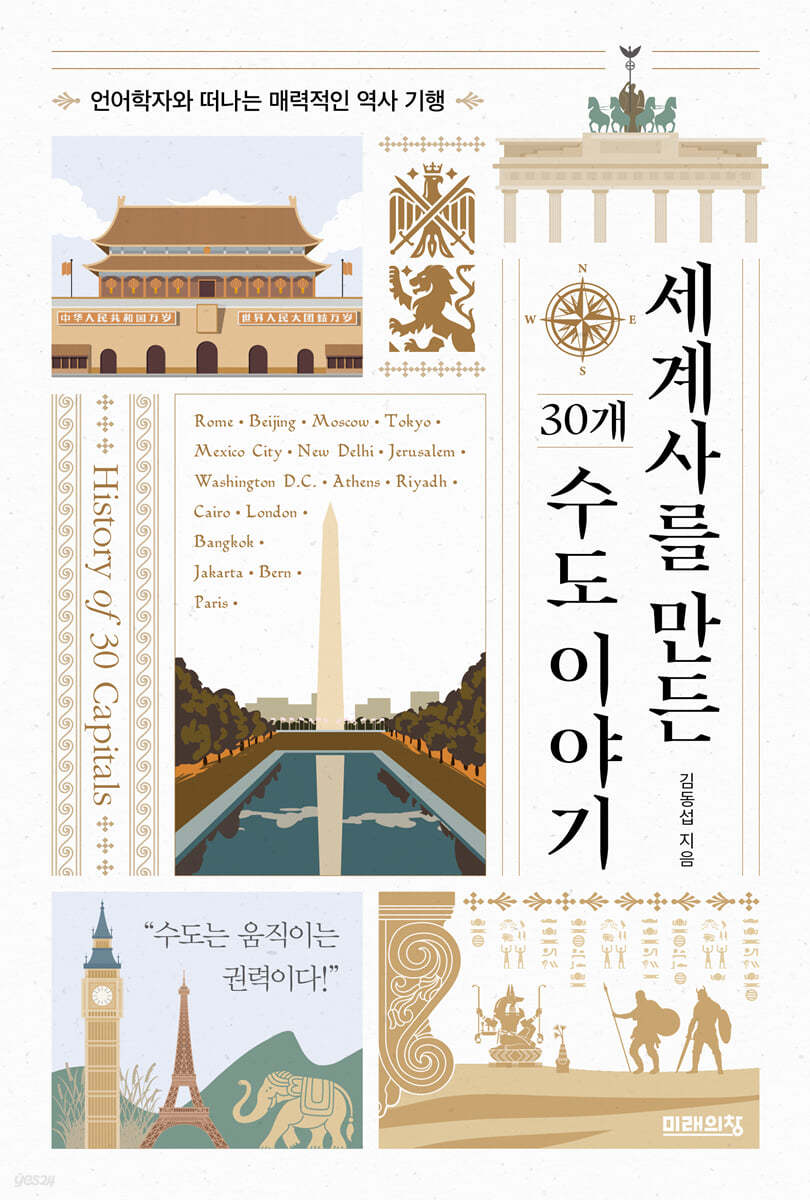
Stories of 30 Capitals That Shaped World History
 |
Description
Book Introduction
- A word from MD
- [If you look at the capital, you can see the history of the world] The capital, the center of a country's history, culture, and power.
A book that examines the history of a capital city, which has changed according to the historical flow of a region, and the history of that country as well as the intertwined world history.
A dynamic world history unfolds, told through 30 capitals, starting from the imperial capital and extending through medieval Europe, Asia, and the Middle East - Ahn Hyun-jae, History PD
“How did that city become the capital?”
From the birth of civilization to the discovery of the New World,
A fresher world history through the etymology of place names!
· Why even the Emperor could not answer the question of where the capital of the Holy Roman Empire was
· What do Bern, Berlin, and Madrid have in common? Bears?
· Beijing, Tokyo, Nanjing...
Why do East Asian capitals have the word 'Gyeong' in their names?
· The capital of the United States was originally New York?
The capital is the center of a country's history, culture, and power.
But culture changes, and power shifts.
From the birth of civilization to the present, capital cities have appeared at the forefront of history, playing a role for a certain period of time before giving way to new cities.
While there are capital cities like Rome and Paris that have been central since ancient times, there are also modern capital cities like Brasilia that were built in the middle of nowhere.
Canada's capital was chosen through over 200 votes, with French-speaking and English-speaking cities competing for it, while South Africa, which became a nation through the union of several federations, has three capitals.
By following the background of how the capital was decided, you can naturally learn about the country's history.
This book provides a comprehensive understanding of world history by illuminating not only the capitals of today but also the capitals of the past.
The author, one of Korea's leading linguists and an accomplished historical storyteller, not only tells fascinating stories about the etymologies of place names, but also unfolds the story of the capital city along the major historical lines.
Beginning with the capitals of empires that left a significant mark on human history, through Europe, the main stage of the Middle Ages, Asia and the Middle East that led the world before that, and even the capitals of the New World, the new centers of power, let's embark on a historical journey to 30 capitals through this book.
From the birth of civilization to the discovery of the New World,
A fresher world history through the etymology of place names!
· Why even the Emperor could not answer the question of where the capital of the Holy Roman Empire was
· What do Bern, Berlin, and Madrid have in common? Bears?
· Beijing, Tokyo, Nanjing...
Why do East Asian capitals have the word 'Gyeong' in their names?
· The capital of the United States was originally New York?
The capital is the center of a country's history, culture, and power.
But culture changes, and power shifts.
From the birth of civilization to the present, capital cities have appeared at the forefront of history, playing a role for a certain period of time before giving way to new cities.
While there are capital cities like Rome and Paris that have been central since ancient times, there are also modern capital cities like Brasilia that were built in the middle of nowhere.
Canada's capital was chosen through over 200 votes, with French-speaking and English-speaking cities competing for it, while South Africa, which became a nation through the union of several federations, has three capitals.
By following the background of how the capital was decided, you can naturally learn about the country's history.
This book provides a comprehensive understanding of world history by illuminating not only the capitals of today but also the capitals of the past.
The author, one of Korea's leading linguists and an accomplished historical storyteller, not only tells fascinating stories about the etymologies of place names, but also unfolds the story of the capital city along the major historical lines.
Beginning with the capitals of empires that left a significant mark on human history, through Europe, the main stage of the Middle Ages, Asia and the Middle East that led the world before that, and even the capitals of the New World, the new centers of power, let's embark on a historical journey to 30 capitals through this book.
- You can preview some of the book's contents.
Preview
index
Prologue: Stories of 30 Capitals That Shaped World History, Part 5
Part 1: Looking at the Capital, You See History
The capital is a mobile power 14
Four Types of Capitals 21
Part II: The Imperial Capital: Becoming the Center of History
Rome, the Eternal City 28
Constantinople, the Last Rome 47
Karakorum, the capital of the Mongol Empire 60
Beijing, the city founded by Kublai Khan 75
Vienna, the seat of the Habsburg dynasty 85
Moscow, St. Petersburg's Rivals 97
Tehran, Shadow of the Persian Empire 109
Baghdad, the City of a Thousand and One Nights 120
Part 3: Capitals of Europe: A Land Between Past and Present
Paris, the City of Light 130
London, the capital of Europe 147
Berlin, the capital of unified Germany 165
Madrid, the capital of unified Spain 180
Athens, the Roots of Western Civilization 194
Stockholm, the capital of Scandinavia 207
Bern, capital of the Swiss Confederation 219
Warsaw, Poland's Sorrow 230
Part 4: Capitals of Asia and the Middle East: Lands with Magnificent and Mysterious Histories
Tokyo, the birthplace of the Edo shogunate 244
Bangkok, the capital of Southeast Asia 259
Jakarta, the capital of the world's largest Muslim country 271
New Delhi, India's new capital 280
Jerusalem, the capital of three major religions 292
Cairo, Gift of the Nile 302
Riyadh, God's blessings 314
Part 5: The Capital of the New World: The Rise of a New Power
Washington, New York's rival 326
Ottawa, Queen Victoria's City 342
Mexico City, capital of the Aztec Empire 357
Brasilia, Model 368 of a Planned City
Buenos Aires, the Paris of South America 379
Canberra, Australia's administrative capital 390
Cape Town, 3 capitals 400
Epilogue: Stories from Seoul, Korea's Capital 412
Week 420
Image source 423
Part 1: Looking at the Capital, You See History
The capital is a mobile power 14
Four Types of Capitals 21
Part II: The Imperial Capital: Becoming the Center of History
Rome, the Eternal City 28
Constantinople, the Last Rome 47
Karakorum, the capital of the Mongol Empire 60
Beijing, the city founded by Kublai Khan 75
Vienna, the seat of the Habsburg dynasty 85
Moscow, St. Petersburg's Rivals 97
Tehran, Shadow of the Persian Empire 109
Baghdad, the City of a Thousand and One Nights 120
Part 3: Capitals of Europe: A Land Between Past and Present
Paris, the City of Light 130
London, the capital of Europe 147
Berlin, the capital of unified Germany 165
Madrid, the capital of unified Spain 180
Athens, the Roots of Western Civilization 194
Stockholm, the capital of Scandinavia 207
Bern, capital of the Swiss Confederation 219
Warsaw, Poland's Sorrow 230
Part 4: Capitals of Asia and the Middle East: Lands with Magnificent and Mysterious Histories
Tokyo, the birthplace of the Edo shogunate 244
Bangkok, the capital of Southeast Asia 259
Jakarta, the capital of the world's largest Muslim country 271
New Delhi, India's new capital 280
Jerusalem, the capital of three major religions 292
Cairo, Gift of the Nile 302
Riyadh, God's blessings 314
Part 5: The Capital of the New World: The Rise of a New Power
Washington, New York's rival 326
Ottawa, Queen Victoria's City 342
Mexico City, capital of the Aztec Empire 357
Brasilia, Model 368 of a Planned City
Buenos Aires, the Paris of South America 379
Canberra, Australia's administrative capital 390
Cape Town, 3 capitals 400
Epilogue: Stories from Seoul, Korea's Capital 412
Week 420
Image source 423
Detailed image

Into the book
The capital moves.
Just as living things are born and die, capital cities also appear at the forefront of history, serve as capitals for a certain period of time, and then give way to new cities.
If we consider a city with a king's residence and temples as a capital, the capital of the ancient Egyptian kingdom moved from Memphis to Thebes, and by the time of Caesar and Cleopatra, Alexandria had become the de facto capital of the Egyptian kingdom.
Cairo, the current capital of Egypt, only became the capital around the 7th century AD.
--- p.18
Rubruk also describes the Solangis, or Koryo people, in Karakorum.
According to him, Solange was short, had dark skin like the Spaniards, and wore a tunic with narrow sleeves, like the outer garment worn by Christian deacons.
It is similar to the faces of Koreans in photographs taken by Westerners in the late Joseon Dynasty, which were tanned and dark.
Even now, Mongolia does not call Korea 'Republic of Korea' but 'Solongos'.
The word Solongos means rainbow in Mongolian, but Korea and rainbows have nothing to do with each other.
In Mongolian records, the Chinese character spelling of Goryeo, 'Caule', also appears.
This is clearly a Chinese character reading of Goryeo, but Solongos is a different case.
Some scholars believe that this word originally referred to Later Liao, but later changed to refer to Goryeo.
--- p.69~70
Moscow was the capital of the now defunct Moscow principality, and St. Petersburg was the capital of the newly born Russian Empire.
The origins of the new and old capitals were thus different.
For the Muscovites, St. Petersburg was a rootless city built overnight.
Contemporaries who were hostile to St. Petersburg called Peter the Great a tyrant, a monster, a usurper, an enemy of Christ, a pagan, a blasphemer, an ancient Roman, a true German, and called St. Petersburg the city of the Antichrist.
--- p.105~106
In the center of the sentence, a boat is seen rocking on the overflowing river.
This is the coat of arms used by the guild of chancellors of medieval Paris.
In medieval Europe, land transportation was not developed, so rivers were an important means of transportation.
It was the same in Paris.
Cities such as Troyes, where the Champagne Festival is held, and Rouen, the capital of Normandy, were connected to Paris by the Seine River.
The guild of Parisian merchants had a monopoly on the waterborne trade, and most of Paris's revenue came from this.
This is why the athletes entered the Olympic opening ceremony by boat on the Seine River.
--- p.145~146
Just as the name of Paris comes from a Celtic tribe, the name of London also comes from a Celtic language.
When the Romans built a fortress in London, the native Celts called it Londonjon.
The most likely theory is that this place name is a Celtic word meaning 'often-flooded low-lying land'.
The Romans called this place Londinium in Latin.
--- p.148~149
On May 18, 1782, Count Romantsov (1754-1826), the Russian ambassador to Vienna, met with Holy Roman Emperor Joseph II and had the following conversation.
When Joseph II asked him, “Why are you staying in Frankfurt, Germany, and not in Vienna?” Romantsov replied:
“Then, Your Majesty, where do you think the capital of the empire is?”
The Russian ambassador asked the emperor a question that seemed so obvious to modern people, but the emperor avoided answering and changed the subject to something else.
The Emperor told of a conversation he had had with Empress Catherine of Russia in Crimea.
At that time, Empress Catherine the Great is said to have offered to help Joseph II take possession of Rome, the true capital of the Holy Roman Empire.
However, the Emperor responds to the Empress's proposal by saying that as the Emperor of the Holy Roman Empire, such a thing cannot be his goal.
--- p.166~167
The Barcelona Olympics were held in Barcelona, the capital of the Kingdom of Aragon, not Madrid, the capital of the Kingdom of Castile.
In Barcelona, where the Olympics were held, the Catalan flag was seen more often than the Spanish flag, and even in the city center where the marathon was held, citizens waved the Catalan flag to cheer on the athletes.
The reason Madrid, the capital of Spain, was classified as a dual-core capital was because of Barcelona, the capital of Catalonia.
Catalonia, which inherited the Kingdom of Aragon, has a population of 7.5 million, only 16% of the total population, but its GDP accounts for one-fifth of Spain's total.
This is why Catalans, who were historically a different country, spoke a different language, and even experienced the Spanish Civil War, still want independence.
--- p.192~193
The city of angels, the great city, the city of eternal jewels, the impregnable city guarded by Indra, the magnificent capital of the world with nine precious jewels, the city of joy filled with palaces resembling the earthly homes of the reincarnated gods, the city given by Indra and founded by Vishvakarma.
Surprisingly, this name, which is too long to remember, is the official name of Bangkok.
Translated from Sanskrit and Pali, both Indo-European languages, the name makes you wonder if there is a city more blessed than Bangkok.
Among the colorful adjectives, the names of the gods of Indian and Hindu mythology, 'Indra' and 'Vishvakarma', are also seen.
--- p.260
In the [Document of the Curse], Jerusalem appears under the name 'Rushalimu'.
It is the first name Jerusalem had.
At that time, it was customary to name cities after the names of local gods, so the name Rusharimu means a city that worships the god 'Shalem' or 'Shalimu'.
Shalem was a god worshipped in what is now Syria, and was the god of creation, the god of perfection, and the god of the setting sun.
--- p.296~298
When Washington began to conduct presidential business in New York, the city was making every effort to attract federal agencies.
However, there was not enough land to build government offices in the city.
Because it was already a densely populated area, there was no space to build a federal office.
Moreover, the aftereffects of inflation from the Revolutionary War continued until 1788, making it difficult to build a federal building using public funds.
New Yorkers increasingly began to feel that their city was a temporary, rather than the official, capital of the United States.
However, New York City's efforts to attract the capital continued.
In 1789, plans were made to build a large federal building, and the battery fort was demolished to make way for the building.
The plan was to demonstrate to the delegates from each state that New York was qualified to be the capital of the Union.
--- p.336
Argentina means 'land of silver'.
It comes from the Latin word 'argentum', meaning 'silver'.
Recall that in chemistry, the element symbol for silver is Ag.
The origin of Argentina being called the land of silver can be found in the legends of the indigenous people.
The Spaniards who discovered the New World went north to California in North America, and south to Peru through Central and South America, using Mexico as a base.
The legend associated with the Land of Silver comes from a Spanish expedition that set out to explore Peru.
A Spanish sailing ship bound for Peru was wrecked en route and landed on Santa Catarina Island in Brazil.
A sailor named Alexio Garcia hears a legend from the natives about a mountain that holds a great amount of precious metal.
Upon hearing this, Garcia abandons the expedition and sets out with his companions to find the legendary mountain, accompanied by the natives.
The name of the mountain in Spanish was 'Sierra de la Plata' (Silver Mountain).
Just as living things are born and die, capital cities also appear at the forefront of history, serve as capitals for a certain period of time, and then give way to new cities.
If we consider a city with a king's residence and temples as a capital, the capital of the ancient Egyptian kingdom moved from Memphis to Thebes, and by the time of Caesar and Cleopatra, Alexandria had become the de facto capital of the Egyptian kingdom.
Cairo, the current capital of Egypt, only became the capital around the 7th century AD.
--- p.18
Rubruk also describes the Solangis, or Koryo people, in Karakorum.
According to him, Solange was short, had dark skin like the Spaniards, and wore a tunic with narrow sleeves, like the outer garment worn by Christian deacons.
It is similar to the faces of Koreans in photographs taken by Westerners in the late Joseon Dynasty, which were tanned and dark.
Even now, Mongolia does not call Korea 'Republic of Korea' but 'Solongos'.
The word Solongos means rainbow in Mongolian, but Korea and rainbows have nothing to do with each other.
In Mongolian records, the Chinese character spelling of Goryeo, 'Caule', also appears.
This is clearly a Chinese character reading of Goryeo, but Solongos is a different case.
Some scholars believe that this word originally referred to Later Liao, but later changed to refer to Goryeo.
--- p.69~70
Moscow was the capital of the now defunct Moscow principality, and St. Petersburg was the capital of the newly born Russian Empire.
The origins of the new and old capitals were thus different.
For the Muscovites, St. Petersburg was a rootless city built overnight.
Contemporaries who were hostile to St. Petersburg called Peter the Great a tyrant, a monster, a usurper, an enemy of Christ, a pagan, a blasphemer, an ancient Roman, a true German, and called St. Petersburg the city of the Antichrist.
--- p.105~106
In the center of the sentence, a boat is seen rocking on the overflowing river.
This is the coat of arms used by the guild of chancellors of medieval Paris.
In medieval Europe, land transportation was not developed, so rivers were an important means of transportation.
It was the same in Paris.
Cities such as Troyes, where the Champagne Festival is held, and Rouen, the capital of Normandy, were connected to Paris by the Seine River.
The guild of Parisian merchants had a monopoly on the waterborne trade, and most of Paris's revenue came from this.
This is why the athletes entered the Olympic opening ceremony by boat on the Seine River.
--- p.145~146
Just as the name of Paris comes from a Celtic tribe, the name of London also comes from a Celtic language.
When the Romans built a fortress in London, the native Celts called it Londonjon.
The most likely theory is that this place name is a Celtic word meaning 'often-flooded low-lying land'.
The Romans called this place Londinium in Latin.
--- p.148~149
On May 18, 1782, Count Romantsov (1754-1826), the Russian ambassador to Vienna, met with Holy Roman Emperor Joseph II and had the following conversation.
When Joseph II asked him, “Why are you staying in Frankfurt, Germany, and not in Vienna?” Romantsov replied:
“Then, Your Majesty, where do you think the capital of the empire is?”
The Russian ambassador asked the emperor a question that seemed so obvious to modern people, but the emperor avoided answering and changed the subject to something else.
The Emperor told of a conversation he had had with Empress Catherine of Russia in Crimea.
At that time, Empress Catherine the Great is said to have offered to help Joseph II take possession of Rome, the true capital of the Holy Roman Empire.
However, the Emperor responds to the Empress's proposal by saying that as the Emperor of the Holy Roman Empire, such a thing cannot be his goal.
--- p.166~167
The Barcelona Olympics were held in Barcelona, the capital of the Kingdom of Aragon, not Madrid, the capital of the Kingdom of Castile.
In Barcelona, where the Olympics were held, the Catalan flag was seen more often than the Spanish flag, and even in the city center where the marathon was held, citizens waved the Catalan flag to cheer on the athletes.
The reason Madrid, the capital of Spain, was classified as a dual-core capital was because of Barcelona, the capital of Catalonia.
Catalonia, which inherited the Kingdom of Aragon, has a population of 7.5 million, only 16% of the total population, but its GDP accounts for one-fifth of Spain's total.
This is why Catalans, who were historically a different country, spoke a different language, and even experienced the Spanish Civil War, still want independence.
--- p.192~193
The city of angels, the great city, the city of eternal jewels, the impregnable city guarded by Indra, the magnificent capital of the world with nine precious jewels, the city of joy filled with palaces resembling the earthly homes of the reincarnated gods, the city given by Indra and founded by Vishvakarma.
Surprisingly, this name, which is too long to remember, is the official name of Bangkok.
Translated from Sanskrit and Pali, both Indo-European languages, the name makes you wonder if there is a city more blessed than Bangkok.
Among the colorful adjectives, the names of the gods of Indian and Hindu mythology, 'Indra' and 'Vishvakarma', are also seen.
--- p.260
In the [Document of the Curse], Jerusalem appears under the name 'Rushalimu'.
It is the first name Jerusalem had.
At that time, it was customary to name cities after the names of local gods, so the name Rusharimu means a city that worships the god 'Shalem' or 'Shalimu'.
Shalem was a god worshipped in what is now Syria, and was the god of creation, the god of perfection, and the god of the setting sun.
--- p.296~298
When Washington began to conduct presidential business in New York, the city was making every effort to attract federal agencies.
However, there was not enough land to build government offices in the city.
Because it was already a densely populated area, there was no space to build a federal office.
Moreover, the aftereffects of inflation from the Revolutionary War continued until 1788, making it difficult to build a federal building using public funds.
New Yorkers increasingly began to feel that their city was a temporary, rather than the official, capital of the United States.
However, New York City's efforts to attract the capital continued.
In 1789, plans were made to build a large federal building, and the battery fort was demolished to make way for the building.
The plan was to demonstrate to the delegates from each state that New York was qualified to be the capital of the Union.
--- p.336
Argentina means 'land of silver'.
It comes from the Latin word 'argentum', meaning 'silver'.
Recall that in chemistry, the element symbol for silver is Ag.
The origin of Argentina being called the land of silver can be found in the legends of the indigenous people.
The Spaniards who discovered the New World went north to California in North America, and south to Peru through Central and South America, using Mexico as a base.
The legend associated with the Land of Silver comes from a Spanish expedition that set out to explore Peru.
A Spanish sailing ship bound for Peru was wrecked en route and landed on Santa Catarina Island in Brazil.
A sailor named Alexio Garcia hears a legend from the natives about a mountain that holds a great amount of precious metal.
Upon hearing this, Garcia abandons the expedition and sets out with his companions to find the legendary mountain, accompanied by the natives.
The name of the mountain in Spanish was 'Sierra de la Plata' (Silver Mountain).
--- p.380
Publisher's Review
“The capital is a moving power!”
A dynamic world history told through 30 capitals
What is a capital city, and when did it first appear in history? Some capital cities, like Paris, France, and London, England, have played important roles since ancient times, but others haven't.
Canada chose the small city of Ottawa as its capital, rather than the famous metropolises of Toronto and Montreal.
South Africa has separate legislative, executive and judicial capitals.
New York, the world's largest city, is not the capital of the United States, and neither is São Paulo, Brazil's largest city.
Moreover, the capital is constantly changing.
Karakorum, the former capital of the Mongol Empire that conquered the world, now only remains as an empty site.
Constantinople, the capital of a thousand years and once called the last bastion of Christianity, is now a city of an Islamic country and is no longer the capital of a country.
From the birth of civilization to the present, capital cities have appeared at the forefront of history, playing a role for a certain period of time before giving way to new cities.
The capital city, with its diverse appearance and colorful stories, contains aspects of world history.
Paris was the center of France, but it was a 'capital without a king' because the kings toured various cities.
On the other hand, the Holy Roman Empire, divided into several principalities, was an 'empire without a capital.'
The Russian Empire moved its capital to St. Petersburg to escape the power struggles of the Moscow nobility.
In Spain, which was created through the union of the medieval kingdoms of Castile and Aragon, Madrid, the capital of Castile, and Barcelona, the capital of Aragon, still compete.
New York tried everything, including demolishing its fortifications, to become the capital of the United States, but was eliminated from the competition.
Canada chose a small city as its capital, a buffer zone from the competition and conflict between French-speaking and English-speaking regions.
This book provides a comprehensive understanding of world history by illuminating not only the capitals of today but also the capitals of the past.
Beginning with the capitals of empires that left a significant mark on human history, the stories of 30 capitals unfold along the course of world history, from Europe, the main stage of the Middle Ages, to Asia and the Middle East, which led the world before that, to the capitals of the New World, the new centers of power.
“Language always leaves traces.”
A Colorful History of the Etymology of Place Names
Author Kim Dong-seop, who captivated readers with the unique concept of "reading world history through place names" in his previous work, "The 50 States That Made America," has now returned with a story about capital cities.
The author, a specialist linguist in etymology and an accomplished historical storyteller, has unraveled the fascinating stories behind the etymologies of place names with a unique perspective.
The name of Paris, France, comes from the 'magic cauldron' in Celtic mythology.
The Polish capital, Warsaw, is named after a mermaid named Sava.
Even today, there is a mermaid statue in Warsaw Square that protects the city.
Argentina means 'land of silver'.
The name comes from a legend that there is a mountain where a huge amount of silver is hidden, and in fact, a huge amount of gold and silver is discovered in South America.
The names of Bern, Switzerland and Berlin, Germany come from the Germanic word 'ber', meaning bear.
Even today, the city's coat of arms contains a bear symbol.
In this way, language leaves traces.
Place names contain the history and culture of the region.
The author weaves together the warp and weft of 'language' and 'capital' to create a fresher world history story.
If history feels dry and boring, take a historical journey to 30 capital cities with this book.
You will encounter a living, breathing world history through fascinating stories of how a city became a capital, how it gave up its status, and what conflicts and reconciliations occurred along the way.
A dynamic world history told through 30 capitals
What is a capital city, and when did it first appear in history? Some capital cities, like Paris, France, and London, England, have played important roles since ancient times, but others haven't.
Canada chose the small city of Ottawa as its capital, rather than the famous metropolises of Toronto and Montreal.
South Africa has separate legislative, executive and judicial capitals.
New York, the world's largest city, is not the capital of the United States, and neither is São Paulo, Brazil's largest city.
Moreover, the capital is constantly changing.
Karakorum, the former capital of the Mongol Empire that conquered the world, now only remains as an empty site.
Constantinople, the capital of a thousand years and once called the last bastion of Christianity, is now a city of an Islamic country and is no longer the capital of a country.
From the birth of civilization to the present, capital cities have appeared at the forefront of history, playing a role for a certain period of time before giving way to new cities.
The capital city, with its diverse appearance and colorful stories, contains aspects of world history.
Paris was the center of France, but it was a 'capital without a king' because the kings toured various cities.
On the other hand, the Holy Roman Empire, divided into several principalities, was an 'empire without a capital.'
The Russian Empire moved its capital to St. Petersburg to escape the power struggles of the Moscow nobility.
In Spain, which was created through the union of the medieval kingdoms of Castile and Aragon, Madrid, the capital of Castile, and Barcelona, the capital of Aragon, still compete.
New York tried everything, including demolishing its fortifications, to become the capital of the United States, but was eliminated from the competition.
Canada chose a small city as its capital, a buffer zone from the competition and conflict between French-speaking and English-speaking regions.
This book provides a comprehensive understanding of world history by illuminating not only the capitals of today but also the capitals of the past.
Beginning with the capitals of empires that left a significant mark on human history, the stories of 30 capitals unfold along the course of world history, from Europe, the main stage of the Middle Ages, to Asia and the Middle East, which led the world before that, to the capitals of the New World, the new centers of power.
“Language always leaves traces.”
A Colorful History of the Etymology of Place Names
Author Kim Dong-seop, who captivated readers with the unique concept of "reading world history through place names" in his previous work, "The 50 States That Made America," has now returned with a story about capital cities.
The author, a specialist linguist in etymology and an accomplished historical storyteller, has unraveled the fascinating stories behind the etymologies of place names with a unique perspective.
The name of Paris, France, comes from the 'magic cauldron' in Celtic mythology.
The Polish capital, Warsaw, is named after a mermaid named Sava.
Even today, there is a mermaid statue in Warsaw Square that protects the city.
Argentina means 'land of silver'.
The name comes from a legend that there is a mountain where a huge amount of silver is hidden, and in fact, a huge amount of gold and silver is discovered in South America.
The names of Bern, Switzerland and Berlin, Germany come from the Germanic word 'ber', meaning bear.
Even today, the city's coat of arms contains a bear symbol.
In this way, language leaves traces.
Place names contain the history and culture of the region.
The author weaves together the warp and weft of 'language' and 'capital' to create a fresher world history story.
If history feels dry and boring, take a historical journey to 30 capital cities with this book.
You will encounter a living, breathing world history through fascinating stories of how a city became a capital, how it gave up its status, and what conflicts and reconciliations occurred along the way.
GOODS SPECIFICS
- Date of issue: December 18, 2024
- Page count, weight, size: 424 pages | 736g | 152*225*25mm
- ISBN13: 9791193638477
- ISBN10: 119363847X
You may also like
카테고리
korean


korean

![GQ KOREA Mark (Monthly): December [2025]](http://librairie.coreenne.fr/cdn/shop/files/8ef265dbbfbf186523ed75ba7319009d.jpg?v=1765340328&width=3840)


