

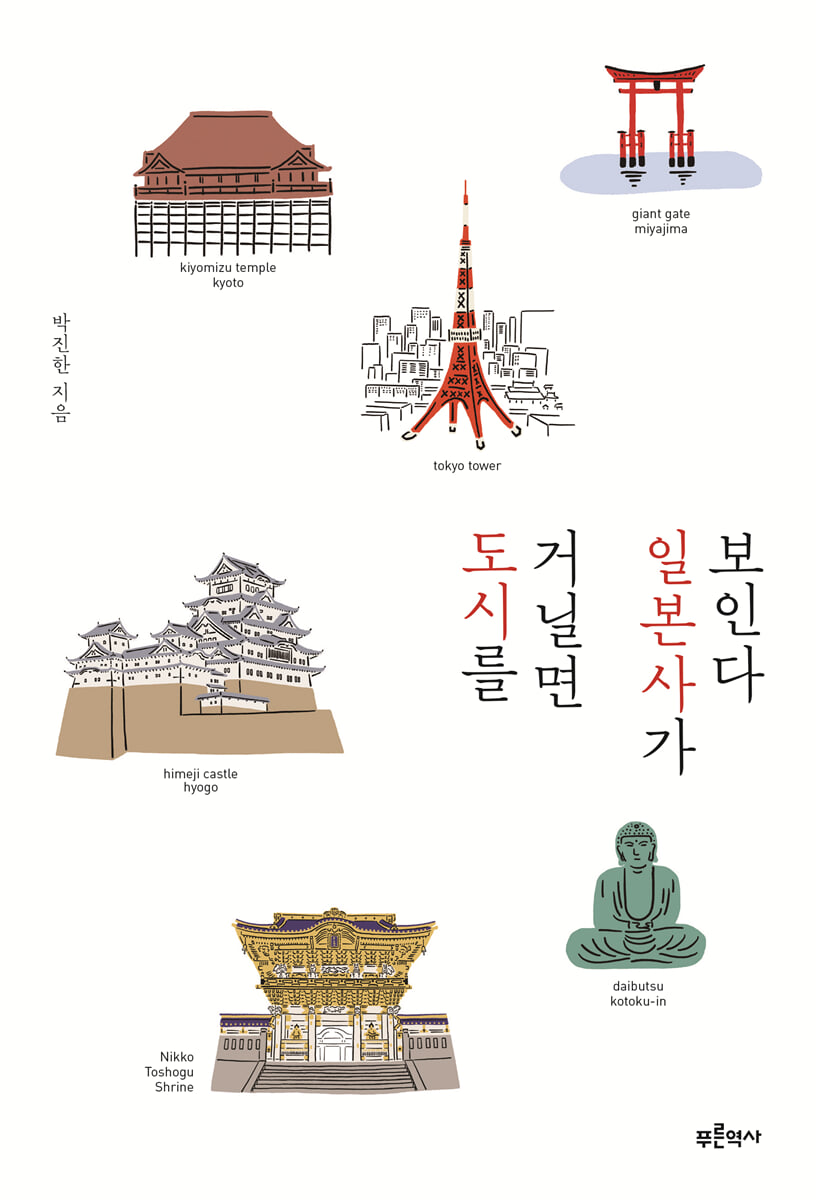
Walking around the city, you can see Japanese history.
 |
Description
Book Introduction
A Sentimental Travelogue - Beyond Flat History
It is a unique attempt to understand the true nature of Japan.
A must-read for understanding Japan properly.
You need to know Japanese history to understand Japan.
To us, Japan is literally a “close yet distant country.”
Geographically, it is a neighbor, and it is a 'close' country because it has maintained various relationships since ancient times, but after going through bitter experiences since the modern era, it is also a 'distant' country that does not easily evoke feelings of 'neighborhood.'
However, since it is a relationship that can never be physically separated, it can be said that it is essential to properly understand Japan at a national and social level.
It is said that the shortcut to understanding a country is knowing its history, but most of our readers do not know much about Japan.
There is only limited interest in fragmentary facts such as Toyotomi Hideyoshi, who started the Imjin War, and Tokugawa Ieyasu's 'shogunate', or in modern history after the Meiji Restoration.
This is probably largely because there are not many books on general history that cover Japanese history in an interesting and balanced way.
This book, written by an author who has studied Japanese urban history, is unique and valuable in that sense.
Because it transcends the level of sentimental and superficial travel essays while also escaping the dryness of syntax.
It is a unique attempt to understand the true nature of Japan.
A must-read for understanding Japan properly.
You need to know Japanese history to understand Japan.
To us, Japan is literally a “close yet distant country.”
Geographically, it is a neighbor, and it is a 'close' country because it has maintained various relationships since ancient times, but after going through bitter experiences since the modern era, it is also a 'distant' country that does not easily evoke feelings of 'neighborhood.'
However, since it is a relationship that can never be physically separated, it can be said that it is essential to properly understand Japan at a national and social level.
It is said that the shortcut to understanding a country is knowing its history, but most of our readers do not know much about Japan.
There is only limited interest in fragmentary facts such as Toyotomi Hideyoshi, who started the Imjin War, and Tokugawa Ieyasu's 'shogunate', or in modern history after the Meiji Restoration.
This is probably largely because there are not many books on general history that cover Japanese history in an interesting and balanced way.
This book, written by an author who has studied Japanese urban history, is unique and valuable in that sense.
Because it transcends the level of sentimental and superficial travel essays while also escaping the dryness of syntax.
- You can preview some of the book's contents.
Preview
index
· Publishing a book
· Japanese history chronology
· Map of Japan
Ancient: Acceptance and Transformation of the City Emperor
01 Asuka: The capital of the Yamato Dynasty, steeped in the scent of the Japanese
1.
The home of the Japanese people's hearts
2.
Spatial changes between Asuka's Heavenly Palace and Ohari Palace
3.
International situation in East Asia in the 7th century and the urbanization of Asuka
4.
Couldn't Asuka be considered an ancient city?
02 Fujiwara Castle: A ruined city lost to history
1.
Political changes in East Asia in the 7th century and the adoption of the capital city system
2.
Tenmu's creation of a new nation and the establishment of the Fujiwara clan
3.
The ideal and reality of the city of Doseongje
4.
Japan's first capital city modeled after the "Kogogi" in the "Book of Rites"
03 Heijo-kyo and Nara: Nando, overcoming the crisis of ruin and becoming a "temple city"
1.
Move to Heijo-kyo
2.
Construction of a Japanese-style capital and urban life
3.
Buddhist temples in Heijo-kyo and the establishment of the Southern Province
4.
Highly touristic urbanization
04 Heian-kyo and Kyoto: A Millennium-Old Capital that Overcame Numerous Hardships and Adversities
1.
The construction of Heian-kyo and the spatial changes of the capital city
2.
The urban life of nobles and commoners and the emergence of various urban problems
3.
The Onin War and the Spatial Changes of Kyoto
4.
The rise of the samurai power and the change in Kyoto's status
5.
The Meiji Restoration and the Birth of Kyoto as a "Historic City"
Middle and Early Modern Periods: The Rise of the Samurai and the Establishment of the Jokamachi
05 Kamakura: The Home of the Samurai with Colorful Charm
1.
The collapse of the expedition and the rise of the military regime
2.
Kamakura shogunate and Shogun Seii
3.
The Transformation of the City and the Prosperity of Buddhism in Kamakura
4.
The rise and fall of the Muga city and the patterns of new places
06 Azuchi: The ill-fated castle town that shared Oda Nobunaga's final days
1.
From a Sengoku daimyo's mountain fortress to a castle town
2.
Oda Nobunaga's Azuchi Castle and the Birth of the Tenshu
3.
Records of 'Tenshu' and the significance of space
4.
The Fate of Castles and Tenshu after the Meiji Restoration
07 Osaka: From 'Kitchen of the World' to 'City in Crisis'
1.
Osaka Castle, the city's symbol
2.
Construction and renovation of Osaka Castle
3.
Osaka's economic prosperity and the crisis immediately following the Meiji Restoration
4.
The Transition to an Industrial City and Seki Hajime's "Greater Osaka Urban Plan"
5.
The postwar "Osakaron" and Toru Hashimoto's "Osaka-do" concept
08 Tokyo: From the castle town of Edo to a world-class megalopolis
1.
Tokugawa Ieyasu's entry into Edo and construction of the castle
2.
Implementation of the Sankin Shift System and the Formation of the Yamanote
3.
The Great Fire of Meireki and the Edo Reforms
4.
Spatial changes in Tokyo after the Meiji Restoration
5.
The Great Kanto Earthquake and the Expansion of Tokyo
6.
The Transition to a 'Global City' and the Increase in Urban Space
Modernity: The Dissolution of Jokamachi and the Formation of the Modern City
09 From the epicenter of the 'Yang-i' and 'Domak' movements to a local city in crisis
1.
UNESCO World Heritage Sites of the Meiji Industrial Revolution
2.
The establishment of Jokamachi Hagi and Yoshida Shoin's Shokasonjuku
3.
Two Choshu Wars and the Great Restoration Edict
4.
The early Meiji Restoration reforms of the local government system and the conflicting fates of the jokamachi
10 Kagoshima: A land of glory and shame, preserving both the glory and tragedy of the Meiji Restoration.
1.
Satcho Alliance officer
2.
The establishment of the Satsuma Domain and its interest in overseas trade
3.
Political changes in the late shogunate and the rise of the Satsuma clan
4.
The Satsuma Rebellion and the Modernization of Kagoshima
11 Yokohama: A "Port City" That Began in the Face of the West Sea's East Sea Crisis
1.
The Colonization Crisis and Commodore Perry's Visit
2.
The opening of the Yokohama Port and the establishment of a foreign settlement
3.
Dejima's legacy left behind at the port
4.
Yokohama's Transformation and the Minato Mirai 21 Project
12 Kitakyushu: From Notorious 'Polluted City' to 'Eco-Friendly City'
1.
Kitakyushu's past and present
2.
Japan's industrialization and the emergence of the industrial city of Yahata
3.
The military industrialization of the Kitakyushu industrial zone and World War II
4.
The Birth and Crisis of Kitakyushu, a City of One Million People
13 Hiroshima: From Military City, Ground Zero to 'City of Water'
1.
Peace City and Ground Zero
2.
Why it became the target of the atomic bomb
3.
Restoration of Ground Zero and Creation of a Peace Memorial Park
4.
The End of Reconstruction Projects and Hiroshima, the "City of Water"
Going out
· References
· Search
· Japanese history chronology
· Map of Japan
Ancient: Acceptance and Transformation of the City Emperor
01 Asuka: The capital of the Yamato Dynasty, steeped in the scent of the Japanese
1.
The home of the Japanese people's hearts
2.
Spatial changes between Asuka's Heavenly Palace and Ohari Palace
3.
International situation in East Asia in the 7th century and the urbanization of Asuka
4.
Couldn't Asuka be considered an ancient city?
02 Fujiwara Castle: A ruined city lost to history
1.
Political changes in East Asia in the 7th century and the adoption of the capital city system
2.
Tenmu's creation of a new nation and the establishment of the Fujiwara clan
3.
The ideal and reality of the city of Doseongje
4.
Japan's first capital city modeled after the "Kogogi" in the "Book of Rites"
03 Heijo-kyo and Nara: Nando, overcoming the crisis of ruin and becoming a "temple city"
1.
Move to Heijo-kyo
2.
Construction of a Japanese-style capital and urban life
3.
Buddhist temples in Heijo-kyo and the establishment of the Southern Province
4.
Highly touristic urbanization
04 Heian-kyo and Kyoto: A Millennium-Old Capital that Overcame Numerous Hardships and Adversities
1.
The construction of Heian-kyo and the spatial changes of the capital city
2.
The urban life of nobles and commoners and the emergence of various urban problems
3.
The Onin War and the Spatial Changes of Kyoto
4.
The rise of the samurai power and the change in Kyoto's status
5.
The Meiji Restoration and the Birth of Kyoto as a "Historic City"
Middle and Early Modern Periods: The Rise of the Samurai and the Establishment of the Jokamachi
05 Kamakura: The Home of the Samurai with Colorful Charm
1.
The collapse of the expedition and the rise of the military regime
2.
Kamakura shogunate and Shogun Seii
3.
The Transformation of the City and the Prosperity of Buddhism in Kamakura
4.
The rise and fall of the Muga city and the patterns of new places
06 Azuchi: The ill-fated castle town that shared Oda Nobunaga's final days
1.
From a Sengoku daimyo's mountain fortress to a castle town
2.
Oda Nobunaga's Azuchi Castle and the Birth of the Tenshu
3.
Records of 'Tenshu' and the significance of space
4.
The Fate of Castles and Tenshu after the Meiji Restoration
07 Osaka: From 'Kitchen of the World' to 'City in Crisis'
1.
Osaka Castle, the city's symbol
2.
Construction and renovation of Osaka Castle
3.
Osaka's economic prosperity and the crisis immediately following the Meiji Restoration
4.
The Transition to an Industrial City and Seki Hajime's "Greater Osaka Urban Plan"
5.
The postwar "Osakaron" and Toru Hashimoto's "Osaka-do" concept
08 Tokyo: From the castle town of Edo to a world-class megalopolis
1.
Tokugawa Ieyasu's entry into Edo and construction of the castle
2.
Implementation of the Sankin Shift System and the Formation of the Yamanote
3.
The Great Fire of Meireki and the Edo Reforms
4.
Spatial changes in Tokyo after the Meiji Restoration
5.
The Great Kanto Earthquake and the Expansion of Tokyo
6.
The Transition to a 'Global City' and the Increase in Urban Space
Modernity: The Dissolution of Jokamachi and the Formation of the Modern City
09 From the epicenter of the 'Yang-i' and 'Domak' movements to a local city in crisis
1.
UNESCO World Heritage Sites of the Meiji Industrial Revolution
2.
The establishment of Jokamachi Hagi and Yoshida Shoin's Shokasonjuku
3.
Two Choshu Wars and the Great Restoration Edict
4.
The early Meiji Restoration reforms of the local government system and the conflicting fates of the jokamachi
10 Kagoshima: A land of glory and shame, preserving both the glory and tragedy of the Meiji Restoration.
1.
Satcho Alliance officer
2.
The establishment of the Satsuma Domain and its interest in overseas trade
3.
Political changes in the late shogunate and the rise of the Satsuma clan
4.
The Satsuma Rebellion and the Modernization of Kagoshima
11 Yokohama: A "Port City" That Began in the Face of the West Sea's East Sea Crisis
1.
The Colonization Crisis and Commodore Perry's Visit
2.
The opening of the Yokohama Port and the establishment of a foreign settlement
3.
Dejima's legacy left behind at the port
4.
Yokohama's Transformation and the Minato Mirai 21 Project
12 Kitakyushu: From Notorious 'Polluted City' to 'Eco-Friendly City'
1.
Kitakyushu's past and present
2.
Japan's industrialization and the emergence of the industrial city of Yahata
3.
The military industrialization of the Kitakyushu industrial zone and World War II
4.
The Birth and Crisis of Kitakyushu, a City of One Million People
13 Hiroshima: From Military City, Ground Zero to 'City of Water'
1.
Peace City and Ground Zero
2.
Why it became the target of the atomic bomb
3.
Restoration of Ground Zero and Creation of a Peace Memorial Park
4.
The End of Reconstruction Projects and Hiroshima, the "City of Water"
Going out
· References
· Search
Into the book
The Yamato Dynasty, the ancestor of the current imperial family, attempted to establish a centralized state system under the leadership of a monarch who used the title of "Emperor" in order to respond to the changes in the international situation in East Asia around the 7th century, such as the establishment of a unified empire by the Sui and Tang dynasties and the unification of the Korean Peninsula by Silla.
During this period, the capital of the Yamato Dynasty was Asuka.
--- p.24
The one who ordered the Asuka to go to Heaven was Empress Suiko, who ascended to the position of Great Empress in 592.
After she built the Toyura Palace in Asuka and carried out the Tengu ritual, it became the main stage of Japanese history for about 100 years until the capital was moved to Fujiwara-kyo, Japan's first capital, in 694.
--- p.27
In 603, three years after the account in the Book of Sui concerning the first envoy, according to the Nihon Shoki, the Yamato government, centered around Prince Shotoku, carried out a series of political reforms, including the establishment of the "12 Grades of Official Ranks" and the "17-Article Constitution."
--- p.33
After the Empress Suiko's palace, the Asuka Basin was lined with not only the royal palace but also the Soga clan's residences and several Buddhist temples, and its landscape must have been quite different from the surrounding rural areas.
In particular, Hokoji Temple, built by Soga no Umako, was a huge temple measuring approximately 220 meters from east to west and approximately 330 meters from north to south, with a site area of 7,000 square meters. It had three main halls centered around a large central pagoda.
--- p.49
Prince Oama later ascended to the throne and became Emperor Tenmu.
Tenmu tried to establish a code of laws to create a strong royal state.
The introduction of a Chinese-style capital city was also part of a plan to strengthen royal authority.… After Tenmu’s death, it was none other than his wife, Uno no Sarara, who upheld his will, promulgated the Ritsuryo code, and completed the construction of the Fujiwara-kyo.
--- p.60
Prince Oama… pushed the centralized policy even harder.
First, in order to strongly demonstrate his position as an absolute monarch, he established a new title in place of 'Great King', that is, Ookimi.
The new monarch's name was written in Chinese characters as 'Emperor' and pronounced as 'Sumeramikoto'.
--- p.62
Unlike Asuka, where the residences and temples of the powerful families were built haphazardly around the palace to show off the emperor's power, the new capital, Fujiwara-kyo, had the residences of the royal family and officials arranged according to hierarchy and rank, centered around the emperor's palace.
Through this spatial arrangement, the capital city could become a kind of monumental space that showed off the emperor's position as the ruler of the earthly world.
--- p.66
The palace buildings, including the Daikokuden and Chodan-in, the official administrative spaces of the Emperor, as well as the main gates within the palace, used an architectural style imported from abroad, with pillars placed on a stone foundation and roofed with tiles. The architectural style of pillars placed on a stone foundation and roofed with tiles was introduced during the Asuka period when Buddhist temples were built, but it was the Fujiwara clan that first used it in the construction of the palace.
--- p.69
Fujiwara-kyo met its end only 16 years after its construction, when the capital was moved to a new city.
The newly built capital was written as 'Heijo-kyo' and read as 'Nara-no-Miyako' meaning the capital established in 'Nara'.
--- p.79
Heijo-kyo, like Fujiwara-kyo, was built according to the principles of the Cho-bang-je system.
The Jobangje system refers to the system of dividing land together with the Jorije system under the Yullyeong system.
While the Joli system is a land division method for dividing farmland into certain sections to be distributed to farmers, the Jobang system can be said to be a type of urban design method for dividing residential land and dividing roads among government officials and residents living in the capital.
--- p.84
The period when Heijo-kyo was the capital is called the 'Nara Period'.
The Nara period refers to the period from 710, when the capital was moved from Fujiwara-kyo to Heijo-kyo, to 794, when it was moved to Heian-kyo.
During this period, many temples, including Todai-ji and Kofuku-ji, were built in Heijo-kyo, and a splendid Buddhist culture blossomed.
--- p.92
In the late 8th century, Emperor Kanmu, who had ascended to the throne, declared the relocation of the capital in order to reorganize the bloated temple power and escape the political influence of nobles such as the Fujiwara clan. Eventually, in 794, the capital was moved to Heian-kyo, which is now Kyoto.
--- p.96
After the capital was moved to Heian-kyo, Heijo-kyo came to be called 'Nankyeong' or 'Nanto'.
The nobles of Kyoto, in order to show their closeness to the country where Kasugasa Shrine, where the Fujiwara clan's clan god is enshrined, and Kofuku Shrine, where they prayed for the well-being of the clan, were located, called the old Heijo-kyo by the names "Nankyo" and "Nanto" because it was located south of Kyoto, instead of the old name of Heian-kyo.
--- p.97
Based on external peace and stability, the government officials and nobles residing in Heian-kyo entrusted the palace security and mansion protection to the "Tsawamono-hei", a group of warriors who had trained in martial arts and made combat their profession, instead of indulging in the elegant court culture.
They intervened in the political disputes of the court and took on the role of problem solver, gradually rising as a new political force, surpassing the situation and the Segwan-ga.
And in the late 12th century, they finally established a warrior regime based on military force.
--- p.100
Emperor Kanmu was a descendant of the Tenji clan, which had long been deposed from power, and was a member of the Towa clan, whose maternal relatives were weak. Therefore, it was difficult to expect any significant support within the imperial court. The political gamble he made was to move the capital.
He decided to reform the government and establish his own political foundation by moving the capital from Heijo-kyo, the home base of Emperor Tenmu, to a new location.
--- p.108
After Emperor Kanmu moved the capital, Heian-kyo prospered for a long time as the capital of the dynasty.
Even after the samurai government was established in Kamakura, the status and role of the capital remained unchanged.
However, the Muromachi shogunate faced a major crisis with the civil war of the samurai regime that began in 1467 over the succession of the shogun.
During the ten-year war called the Onin War (1467-1477) after the year in which the fighting began, Kyoto became the main stage of the power struggle and was virtually reduced to rubble.
--- p.132
Toyotomi Hideyoshi, who succeeded Oda Nobunaga in unifying the country, ascended to the position of Kanpaku, the highest official in the imperial court, in 1585, and went up to Kyoto, where he began building his own residence the following year.
He named his mansion 'Churakje', meaning 'a place where all the joys of the world are gathered'.
--- p.141
Since the mid-17th century, Kyoto has been recognized as a center of culture and tradition along with Osaka, a hub for production and distribution of goods, and Edo, a huge consumer market. This led to the popularization of the Santo Theory, which compares the three cities with different cultures and individualities.
Interest in Edo, the shogun's hometown; Osaka, the kitchen of the nation; and Kyoto, boasting a splendid court culture and long history...
--- p.147
1868… The new Meiji government sought to build a powerful modern nation-state with the emperor at the center of national unification.
To this end, the Emperor moved to Tokyo in 1869 despite opposition from the residents.
The new Meiji government also encouraged the nobles living in Kyoto to move to Tokyo to follow the emperor.
However, the nobles who had been accustomed to life in Kyoto for a long time since the Heian period did not prefer living in Tokyo.
Then, on November 20, 1870, the new government issued a proclamation ordering the former samurai and nobles to reside in Tokyo.
--- p.150
Another name for Kamakura, which can be reached in about an hour by train from Tokyo, is 'the hometown of the samurai.'
This is because Minamoto no Yoritomo, who won the long battle between the Taira clan and the Minamoto clan, established a shogunate here and established a samurai regime.
--- p.161
Kamakura has become a popular tourist destination today thanks to its history as a place of ill-fated history that shared the same fate as the Kamakura shogunate, the quiet and solemn atmosphere created by its long-standing temples and shrines, and the beautiful scenery of its seaside beaches.
--- p.162
Yoritomo, who arrived in Kamakura in October 1180, built a residence in Okura and moved his residence there on December 12 of that year.
Then, it is said that over 300 samurai gathered and proclaimed him the 'Lord of Kamakura' and established residences in the vicinity.… This spatial arrangement of the shrine as the center and the residences of the vassals surrounding it is a spatial characteristic unique to Kamakura that cannot be found in other samurai regimes.
--- p.169
The samurai regime that began with the Kamakura shogunate continued through the Muromachi and Edo shogunates, lasting for a full 700 years until the establishment of a new government through the Meiji Restoration in 1868.
As the samurai regime began with Yoritomo's Kamakura shogunate, Kamakura came to be called the "hometown of the samurai."
--- p.173
It was Hojo Yasutoki who laid the foundation for Kamakura to prosper as a commercial city.
Yasutoki built an artificial harbor facility on the shores of Kamakura to allow ships to anchor.
In addition, roads leading to the Kanto region were improved. Kamakura was able to become a commercial center for the entire eastern region, including Kanto.
--- p.178
After the Meiji Restoration, with the modernization that followed, the population of large cities such as Tokyo and Yokohama rapidly increased, bringing a new era to Kamakura.
In particular, in 1889, with the opening of the Yokosuka Line, wealthy people flocked to Kamakura, which boasted a warm climate and beautiful coastal scenery, to build villas.
As a result, Kamakura gained a reputation as a luxury resort near Tokyo.
--- p.187
Nobunaga's dream of unification and construction of a samurai city was passed on to his successors, Toyotomi Hideyoshi and Tokugawa Ieyasu.
Osaka, which developed into a nationwide commercial and industrial city, and Edo, which grew into a metropolis with a population of over one million, were castle towns built by inheriting and supplementing the castle-building experience of Hideyoshi and Ieyasu in Azuchi.
If Azuchi had not existed, Osaka and Tokyo would have been very different cities from what they are today.
--- p.192
Nobunaga built a seven-story castle tower about 34 meters high on top of a large stone foundation on the summit of Mount Azuchi, which is 198 meters above sea level, to show off to the world that he possessed the power to build such a grand structure.
At that time, merchants and outsiders visiting Azuchi would have naturally recognized the presence of Nobunaga residing there by looking at the tall Tenshu before entering the city.
--- p.203
After the Meiji Restoration, the new Meiji government, which desperately needed to foster a modern military, reorganized the military system and assigned the Ministry of the Army to manage castle sites as troop garrison sites and military facilities.
The Army Ministry… issued the Taijokanryeong in 1873, deciding to preserve 41 castles, including Edo Castle, and to abandon 144 others.
--- p.208
Hideyoshi built a castle on this ruined site after the battle with Honganji Temple and played an important role in attracting merchants from all over the region, laying the foundation for Osaka's future development as a commercial and industrial city.
Afterwards, Osaka grew into a national commercial and distribution center and enjoyed economic prosperity, earning it the nickname "Kitchen of the World."
--- p.217
Hideyoshi undertook a massive expansion project on Osaka Castle over the course of four years. Osaka Castle was transformed into an impregnable fortress, surrounded by a triple moat and a triple wall, created by drawing in the Yodo River.
The four-year-long large-scale expansion and reinforcement project of Osaka Castle was the result of Hideyoshi's wish to protect his late son, Hideyori, whom he had with difficulty in the later years of his life.
--- p.223
Rice and various necessities consumed in Edo had to be imported from Kinai, especially Osaka, which was economically advanced.
Edo residents valued the goods brought from Osaka as high-quality goods, calling them "things brought down" or "kudarimono."
--- p.230
The government-run munitions factories expanded in scale due to repeated external wars (the Sino-Japanese War--- p. 1894) and the Russo-Japanese War--- p. 1904) and became centers for the metal industry refining steel and copper used in cannons, the parts industry manufacturing screws and bolts, and machine tools.
Since then, the military industry has become an important stepping stone for Osaka's development into a modern industrial city.
--- p.240
The northwestern part of central Tokyo, centered around the Imperial Palace, is called Yamanote, and the low-lying area to the southeast facing the sea is called Shitamachi.… In the late 17th century, Yamanote and Shitamachi were terms that referred to a division based on topography and a place of residence based on social status.
--- p.265
He prohibited the construction of new castles by daimyo and instructed that any renovations must be reported to the shogunate in advance--- p. Article 6), and ordered the daimyo to stay in Edo for a certain period of time, called "sankin" (參勤)--- p. Article 9).
The shogunate strengthened its control over the daimyo by slightly modifying the contents of the “Buga-jehodo” depending on the situation.
--- p.275
After the Great Fire of Meireki, the shogunate relocated shrines and temples from the city center to the Asakusa area to prevent further fires.… The temples actively hosted events such as the Kaicho Opening Ceremony, where secret Buddhist statues and treasures known for their miraculous powers were made public, as well as sumo events.… As people flocked to the area, the temples… leased part of their land to jonin or built buildings and began leasing businesses. As a result, new urban areas were formed in front of the shrines and temples.
As a result, Asakusa gained the status of a 'famous place' located near Edo.
--- p.285
Emperor Meiji held his enthronement ceremony on August 27th, toured the country, and finally entered Tokyo.
And on October 13th, he issued a proclamation stating, “Edo Castle will be renamed Tokyo Castle and made the imperial residence.”
With this, Edo Castle became the official residence of the Emperor, not the Shogun.
--- p.288
The new government, which was struggling with how to use the samurai residences, came up with its own solution in August 1869... It issued a proclamation to create mulberry forests and tea plantations... It is said that mulberry and tea trees were planted in over 1 million pyeong (approximately 3,000 acres) in Tokyo, including Aoyama, where Aoyama Gakuin University is currently located.
It's hard to imagine that the Aoyama area, now famous for its trendy cafes and shopping districts, was once home to mulberry trees and tea fields.
--- p.291
The reconstruction of Ginza was entrusted to the British engineer Thomas James Waters.… He widened the streets to accommodate modern transportation such as trams, and then built a unified cityscape with two-story Georgian houses built of brick and stone with arcades on the ground floor.
--- p.295
Inoue Kaoru, who took office as the Minister of Foreign Affairs and the head of the Provisional Construction Bureau, commissioned the German architect Beckmann to design the "Government Office Centralization Plan" in 1886.
Instead of filling in the moat around Edo Castle and destroying the old Edo scenery, Beckmann proposed a capital renovation project centered around the present-day Ginza area, comparable to Baron Haussmann's great renovation of Paris.
--- p.298
At the time, newspapers called it 'Little London' because it felt like being in a commercial district of London.
The current name 'Marunouchi' began to be used in the late 1920s, and was a place name that contained the meaning of 'within the inner walls' of the old Edo Castle.
Marunouchi began its full-fledged development as Japan's commercial center in 1914, when Tokyo Station opened here. Today, it is called Japan's "Wall Street."
--- p.299
During the World Heritage registration process, criticism was raised that Prime Minister Abe was exercising political influence by including Hagi Jokamachi and Yoshida Shoin's Shokasonjuku on the list of Meiji Industrial Revolution sites in consideration of his constituency, Yamaguchi Prefecture.
--- p.322
The Choshu clan was able to stand at the center of the movement to honor the emperor and the movement to overthrow the shogunate not only because of the profits it earned through financial reform.
People who led the Meiji Restoration, such as Takasugi Shinsaku, Kido Takayoshi, Ito Hirobumi, and Yamagata Aritomo, were all from the Choshu domain.
However, they have something in common: they studied together at Yoshida Shoin's Shokasonjuku.
--- p.329
Yahata, where Japan's first modern steelworks were built; Tobata, an industrial city where the iron and machinery industries flourished alongside Yahata; Wakamatsu, a port for importing and exporting coal, iron ore, and steel products; Kokura, a castle town of the Kokura Domain and a strategic military base; and Moji, a special trading port facing the Kanmon Strait, are all cities that belong to the Kitakyushu industrial zone.
These five cities merged in 1963 to form the current Kitakyushu City.
--- p.404
At a time when environmental awareness was not very high, the “blazing flames” and “plump smoke” belching from the tall chimneys were symbols of the “spectacle of the world” steel mill and the iron city of Yahata.
During this period, the capital of the Yamato Dynasty was Asuka.
--- p.24
The one who ordered the Asuka to go to Heaven was Empress Suiko, who ascended to the position of Great Empress in 592.
After she built the Toyura Palace in Asuka and carried out the Tengu ritual, it became the main stage of Japanese history for about 100 years until the capital was moved to Fujiwara-kyo, Japan's first capital, in 694.
--- p.27
In 603, three years after the account in the Book of Sui concerning the first envoy, according to the Nihon Shoki, the Yamato government, centered around Prince Shotoku, carried out a series of political reforms, including the establishment of the "12 Grades of Official Ranks" and the "17-Article Constitution."
--- p.33
After the Empress Suiko's palace, the Asuka Basin was lined with not only the royal palace but also the Soga clan's residences and several Buddhist temples, and its landscape must have been quite different from the surrounding rural areas.
In particular, Hokoji Temple, built by Soga no Umako, was a huge temple measuring approximately 220 meters from east to west and approximately 330 meters from north to south, with a site area of 7,000 square meters. It had three main halls centered around a large central pagoda.
--- p.49
Prince Oama later ascended to the throne and became Emperor Tenmu.
Tenmu tried to establish a code of laws to create a strong royal state.
The introduction of a Chinese-style capital city was also part of a plan to strengthen royal authority.… After Tenmu’s death, it was none other than his wife, Uno no Sarara, who upheld his will, promulgated the Ritsuryo code, and completed the construction of the Fujiwara-kyo.
--- p.60
Prince Oama… pushed the centralized policy even harder.
First, in order to strongly demonstrate his position as an absolute monarch, he established a new title in place of 'Great King', that is, Ookimi.
The new monarch's name was written in Chinese characters as 'Emperor' and pronounced as 'Sumeramikoto'.
--- p.62
Unlike Asuka, where the residences and temples of the powerful families were built haphazardly around the palace to show off the emperor's power, the new capital, Fujiwara-kyo, had the residences of the royal family and officials arranged according to hierarchy and rank, centered around the emperor's palace.
Through this spatial arrangement, the capital city could become a kind of monumental space that showed off the emperor's position as the ruler of the earthly world.
--- p.66
The palace buildings, including the Daikokuden and Chodan-in, the official administrative spaces of the Emperor, as well as the main gates within the palace, used an architectural style imported from abroad, with pillars placed on a stone foundation and roofed with tiles. The architectural style of pillars placed on a stone foundation and roofed with tiles was introduced during the Asuka period when Buddhist temples were built, but it was the Fujiwara clan that first used it in the construction of the palace.
--- p.69
Fujiwara-kyo met its end only 16 years after its construction, when the capital was moved to a new city.
The newly built capital was written as 'Heijo-kyo' and read as 'Nara-no-Miyako' meaning the capital established in 'Nara'.
--- p.79
Heijo-kyo, like Fujiwara-kyo, was built according to the principles of the Cho-bang-je system.
The Jobangje system refers to the system of dividing land together with the Jorije system under the Yullyeong system.
While the Joli system is a land division method for dividing farmland into certain sections to be distributed to farmers, the Jobang system can be said to be a type of urban design method for dividing residential land and dividing roads among government officials and residents living in the capital.
--- p.84
The period when Heijo-kyo was the capital is called the 'Nara Period'.
The Nara period refers to the period from 710, when the capital was moved from Fujiwara-kyo to Heijo-kyo, to 794, when it was moved to Heian-kyo.
During this period, many temples, including Todai-ji and Kofuku-ji, were built in Heijo-kyo, and a splendid Buddhist culture blossomed.
--- p.92
In the late 8th century, Emperor Kanmu, who had ascended to the throne, declared the relocation of the capital in order to reorganize the bloated temple power and escape the political influence of nobles such as the Fujiwara clan. Eventually, in 794, the capital was moved to Heian-kyo, which is now Kyoto.
--- p.96
After the capital was moved to Heian-kyo, Heijo-kyo came to be called 'Nankyeong' or 'Nanto'.
The nobles of Kyoto, in order to show their closeness to the country where Kasugasa Shrine, where the Fujiwara clan's clan god is enshrined, and Kofuku Shrine, where they prayed for the well-being of the clan, were located, called the old Heijo-kyo by the names "Nankyo" and "Nanto" because it was located south of Kyoto, instead of the old name of Heian-kyo.
--- p.97
Based on external peace and stability, the government officials and nobles residing in Heian-kyo entrusted the palace security and mansion protection to the "Tsawamono-hei", a group of warriors who had trained in martial arts and made combat their profession, instead of indulging in the elegant court culture.
They intervened in the political disputes of the court and took on the role of problem solver, gradually rising as a new political force, surpassing the situation and the Segwan-ga.
And in the late 12th century, they finally established a warrior regime based on military force.
--- p.100
Emperor Kanmu was a descendant of the Tenji clan, which had long been deposed from power, and was a member of the Towa clan, whose maternal relatives were weak. Therefore, it was difficult to expect any significant support within the imperial court. The political gamble he made was to move the capital.
He decided to reform the government and establish his own political foundation by moving the capital from Heijo-kyo, the home base of Emperor Tenmu, to a new location.
--- p.108
After Emperor Kanmu moved the capital, Heian-kyo prospered for a long time as the capital of the dynasty.
Even after the samurai government was established in Kamakura, the status and role of the capital remained unchanged.
However, the Muromachi shogunate faced a major crisis with the civil war of the samurai regime that began in 1467 over the succession of the shogun.
During the ten-year war called the Onin War (1467-1477) after the year in which the fighting began, Kyoto became the main stage of the power struggle and was virtually reduced to rubble.
--- p.132
Toyotomi Hideyoshi, who succeeded Oda Nobunaga in unifying the country, ascended to the position of Kanpaku, the highest official in the imperial court, in 1585, and went up to Kyoto, where he began building his own residence the following year.
He named his mansion 'Churakje', meaning 'a place where all the joys of the world are gathered'.
--- p.141
Since the mid-17th century, Kyoto has been recognized as a center of culture and tradition along with Osaka, a hub for production and distribution of goods, and Edo, a huge consumer market. This led to the popularization of the Santo Theory, which compares the three cities with different cultures and individualities.
Interest in Edo, the shogun's hometown; Osaka, the kitchen of the nation; and Kyoto, boasting a splendid court culture and long history...
--- p.147
1868… The new Meiji government sought to build a powerful modern nation-state with the emperor at the center of national unification.
To this end, the Emperor moved to Tokyo in 1869 despite opposition from the residents.
The new Meiji government also encouraged the nobles living in Kyoto to move to Tokyo to follow the emperor.
However, the nobles who had been accustomed to life in Kyoto for a long time since the Heian period did not prefer living in Tokyo.
Then, on November 20, 1870, the new government issued a proclamation ordering the former samurai and nobles to reside in Tokyo.
--- p.150
Another name for Kamakura, which can be reached in about an hour by train from Tokyo, is 'the hometown of the samurai.'
This is because Minamoto no Yoritomo, who won the long battle between the Taira clan and the Minamoto clan, established a shogunate here and established a samurai regime.
--- p.161
Kamakura has become a popular tourist destination today thanks to its history as a place of ill-fated history that shared the same fate as the Kamakura shogunate, the quiet and solemn atmosphere created by its long-standing temples and shrines, and the beautiful scenery of its seaside beaches.
--- p.162
Yoritomo, who arrived in Kamakura in October 1180, built a residence in Okura and moved his residence there on December 12 of that year.
Then, it is said that over 300 samurai gathered and proclaimed him the 'Lord of Kamakura' and established residences in the vicinity.… This spatial arrangement of the shrine as the center and the residences of the vassals surrounding it is a spatial characteristic unique to Kamakura that cannot be found in other samurai regimes.
--- p.169
The samurai regime that began with the Kamakura shogunate continued through the Muromachi and Edo shogunates, lasting for a full 700 years until the establishment of a new government through the Meiji Restoration in 1868.
As the samurai regime began with Yoritomo's Kamakura shogunate, Kamakura came to be called the "hometown of the samurai."
--- p.173
It was Hojo Yasutoki who laid the foundation for Kamakura to prosper as a commercial city.
Yasutoki built an artificial harbor facility on the shores of Kamakura to allow ships to anchor.
In addition, roads leading to the Kanto region were improved. Kamakura was able to become a commercial center for the entire eastern region, including Kanto.
--- p.178
After the Meiji Restoration, with the modernization that followed, the population of large cities such as Tokyo and Yokohama rapidly increased, bringing a new era to Kamakura.
In particular, in 1889, with the opening of the Yokosuka Line, wealthy people flocked to Kamakura, which boasted a warm climate and beautiful coastal scenery, to build villas.
As a result, Kamakura gained a reputation as a luxury resort near Tokyo.
--- p.187
Nobunaga's dream of unification and construction of a samurai city was passed on to his successors, Toyotomi Hideyoshi and Tokugawa Ieyasu.
Osaka, which developed into a nationwide commercial and industrial city, and Edo, which grew into a metropolis with a population of over one million, were castle towns built by inheriting and supplementing the castle-building experience of Hideyoshi and Ieyasu in Azuchi.
If Azuchi had not existed, Osaka and Tokyo would have been very different cities from what they are today.
--- p.192
Nobunaga built a seven-story castle tower about 34 meters high on top of a large stone foundation on the summit of Mount Azuchi, which is 198 meters above sea level, to show off to the world that he possessed the power to build such a grand structure.
At that time, merchants and outsiders visiting Azuchi would have naturally recognized the presence of Nobunaga residing there by looking at the tall Tenshu before entering the city.
--- p.203
After the Meiji Restoration, the new Meiji government, which desperately needed to foster a modern military, reorganized the military system and assigned the Ministry of the Army to manage castle sites as troop garrison sites and military facilities.
The Army Ministry… issued the Taijokanryeong in 1873, deciding to preserve 41 castles, including Edo Castle, and to abandon 144 others.
--- p.208
Hideyoshi built a castle on this ruined site after the battle with Honganji Temple and played an important role in attracting merchants from all over the region, laying the foundation for Osaka's future development as a commercial and industrial city.
Afterwards, Osaka grew into a national commercial and distribution center and enjoyed economic prosperity, earning it the nickname "Kitchen of the World."
--- p.217
Hideyoshi undertook a massive expansion project on Osaka Castle over the course of four years. Osaka Castle was transformed into an impregnable fortress, surrounded by a triple moat and a triple wall, created by drawing in the Yodo River.
The four-year-long large-scale expansion and reinforcement project of Osaka Castle was the result of Hideyoshi's wish to protect his late son, Hideyori, whom he had with difficulty in the later years of his life.
--- p.223
Rice and various necessities consumed in Edo had to be imported from Kinai, especially Osaka, which was economically advanced.
Edo residents valued the goods brought from Osaka as high-quality goods, calling them "things brought down" or "kudarimono."
--- p.230
The government-run munitions factories expanded in scale due to repeated external wars (the Sino-Japanese War--- p. 1894) and the Russo-Japanese War--- p. 1904) and became centers for the metal industry refining steel and copper used in cannons, the parts industry manufacturing screws and bolts, and machine tools.
Since then, the military industry has become an important stepping stone for Osaka's development into a modern industrial city.
--- p.240
The northwestern part of central Tokyo, centered around the Imperial Palace, is called Yamanote, and the low-lying area to the southeast facing the sea is called Shitamachi.… In the late 17th century, Yamanote and Shitamachi were terms that referred to a division based on topography and a place of residence based on social status.
--- p.265
He prohibited the construction of new castles by daimyo and instructed that any renovations must be reported to the shogunate in advance--- p. Article 6), and ordered the daimyo to stay in Edo for a certain period of time, called "sankin" (參勤)--- p. Article 9).
The shogunate strengthened its control over the daimyo by slightly modifying the contents of the “Buga-jehodo” depending on the situation.
--- p.275
After the Great Fire of Meireki, the shogunate relocated shrines and temples from the city center to the Asakusa area to prevent further fires.… The temples actively hosted events such as the Kaicho Opening Ceremony, where secret Buddhist statues and treasures known for their miraculous powers were made public, as well as sumo events.… As people flocked to the area, the temples… leased part of their land to jonin or built buildings and began leasing businesses. As a result, new urban areas were formed in front of the shrines and temples.
As a result, Asakusa gained the status of a 'famous place' located near Edo.
--- p.285
Emperor Meiji held his enthronement ceremony on August 27th, toured the country, and finally entered Tokyo.
And on October 13th, he issued a proclamation stating, “Edo Castle will be renamed Tokyo Castle and made the imperial residence.”
With this, Edo Castle became the official residence of the Emperor, not the Shogun.
--- p.288
The new government, which was struggling with how to use the samurai residences, came up with its own solution in August 1869... It issued a proclamation to create mulberry forests and tea plantations... It is said that mulberry and tea trees were planted in over 1 million pyeong (approximately 3,000 acres) in Tokyo, including Aoyama, where Aoyama Gakuin University is currently located.
It's hard to imagine that the Aoyama area, now famous for its trendy cafes and shopping districts, was once home to mulberry trees and tea fields.
--- p.291
The reconstruction of Ginza was entrusted to the British engineer Thomas James Waters.… He widened the streets to accommodate modern transportation such as trams, and then built a unified cityscape with two-story Georgian houses built of brick and stone with arcades on the ground floor.
--- p.295
Inoue Kaoru, who took office as the Minister of Foreign Affairs and the head of the Provisional Construction Bureau, commissioned the German architect Beckmann to design the "Government Office Centralization Plan" in 1886.
Instead of filling in the moat around Edo Castle and destroying the old Edo scenery, Beckmann proposed a capital renovation project centered around the present-day Ginza area, comparable to Baron Haussmann's great renovation of Paris.
--- p.298
At the time, newspapers called it 'Little London' because it felt like being in a commercial district of London.
The current name 'Marunouchi' began to be used in the late 1920s, and was a place name that contained the meaning of 'within the inner walls' of the old Edo Castle.
Marunouchi began its full-fledged development as Japan's commercial center in 1914, when Tokyo Station opened here. Today, it is called Japan's "Wall Street."
--- p.299
During the World Heritage registration process, criticism was raised that Prime Minister Abe was exercising political influence by including Hagi Jokamachi and Yoshida Shoin's Shokasonjuku on the list of Meiji Industrial Revolution sites in consideration of his constituency, Yamaguchi Prefecture.
--- p.322
The Choshu clan was able to stand at the center of the movement to honor the emperor and the movement to overthrow the shogunate not only because of the profits it earned through financial reform.
People who led the Meiji Restoration, such as Takasugi Shinsaku, Kido Takayoshi, Ito Hirobumi, and Yamagata Aritomo, were all from the Choshu domain.
However, they have something in common: they studied together at Yoshida Shoin's Shokasonjuku.
--- p.329
Yahata, where Japan's first modern steelworks were built; Tobata, an industrial city where the iron and machinery industries flourished alongside Yahata; Wakamatsu, a port for importing and exporting coal, iron ore, and steel products; Kokura, a castle town of the Kokura Domain and a strategic military base; and Moji, a special trading port facing the Kanmon Strait, are all cities that belong to the Kitakyushu industrial zone.
These five cities merged in 1963 to form the current Kitakyushu City.
--- p.404
At a time when environmental awareness was not very high, the “blazing flames” and “plump smoke” belching from the tall chimneys were symbols of the “spectacle of the world” steel mill and the iron city of Yahata.
--- p.412
Publisher's Review
“History is a path that follows the ruins.”
This is what a Western historian said, and you will nod your head in agreement when you read this book.
This is because the difficult and unfamiliar history of Japan was examined through familiar cities such as Tokyo, Osaka, and Kyoto.
The author unfolds the story focusing on 13 cities that played an important role in Japanese history.
In Japan, where there was no change of dynasty, several samurai regimes took power in place of the emperor, who had no real power.
And with each change of government, the center of politics, economy, and culture shifted, and new cities emerged.
All of Japan's representative cities today were built this way.
The author shows the dynamic past and present of each city by dividing it into major currents of ancient, medieval, modern, and modern times.
For example, this is a orthodox approach, such as the origin of the term 'Emperor' (page 62) and the background of the rule by a warrior regime, unlike China and Joseon (page 100).
In addition, the reading is particularly enjoyable, with Natsume Soseki's novel "Botchan" and the manga "Slam Dunk" interjected into the explanations of Osaka and Kamakura, respectively.
13 cities spanning ancient and modern times
Part 1, Ancient Times, examines the 'capitals' of each era where the ruling class, including emperors and nobles, resided.
Through the relocation of the capital to Asuka, which is called the spiritual home of the Japanese, Fujiwara-kyo, Japan's first castle town, Nara, famous for its deer park and Todai-ji Temple, and Kyoto, which has a thousand years of history, we have carefully organized the process of establishing the capital based on the emperor-centered political system and the castle system.
Following the ancient capitals, Part 2, Medieval and Modern Times, we take a look at the 'warrior' cities.
Unlike neighboring Korea and China, Japan was ruled by samurai for approximately 700 years from the establishment of the Kamakura shogunate in the late 12th century until just before the Meiji Restoration.
We will examine how the long tradition of samurai rule was reflected in urban space through the process in which Kamakura, which can be said to be the beginning of the samurai city, and Edo and Osaka, founded by Tokugawa Ieyasu and Toyotomi Hideyoshi, along with Oda Nobunaga's Azuchi, were reborn as representative cities in eastern and western Japan after the Meiji Restoration.
Finally, in Part 3, Modern Times, we visit cities that were the stage for important historical events in Japan's modernization process after the Meiji Restoration.
Hagi and Kagoshima, now mere provincial cities, were the strongholds of the Satsuma and Choshu clans, the main players in the Meiji Restoration, and the center of the anti-shogunate movement that arose after the Satsuma-Choshu Alliance.
In contrast, Yokohama, Kitakyushu, and Hiroshima are cities that experienced ups and downs, overcoming numerous crises in the process of establishing a modern nation-state after the Meiji Restoration, industrialization, imperialist expansion, and defeat in World War II.
The turbulent stories of various cities since the opening of their ports will reveal the diverse facets of modernity that cannot be summarized within a single national narrative of Japan, and will reveal the duality of modernization.
A friendly guide to traveling in Japan
The closer you are to someone, the more likely you are to misunderstand them or hurt their feelings if you look at them from your own perspective.
So, the closer we become, the more we have to acknowledge each other's differences in order to properly see the other person's true feelings and inner self.
The Japanese cities I encountered in person while traveling abroad seemed to be no different from major Korean cities like Seoul and Busan, except for things like signs written in kanji and kana and walking on the left side of escalators.
But once you understand the dynamic history of Japan's cities and venture out into the streets, you'll discover hidden stories and charms hidden throughout the city, one by one.
In this regard, the inclusion of a chronology and map at the beginning of the book, allowing readers to grasp the overall flow of Japanese history and the locations of each city at a glance, is also noteworthy. This book will serve as an excellent guide for those planning a trip to Japan or who have already visited, helping them move beyond mere tourists to become travelers with a deep understanding of the city's history and culture.
This is what a Western historian said, and you will nod your head in agreement when you read this book.
This is because the difficult and unfamiliar history of Japan was examined through familiar cities such as Tokyo, Osaka, and Kyoto.
The author unfolds the story focusing on 13 cities that played an important role in Japanese history.
In Japan, where there was no change of dynasty, several samurai regimes took power in place of the emperor, who had no real power.
And with each change of government, the center of politics, economy, and culture shifted, and new cities emerged.
All of Japan's representative cities today were built this way.
The author shows the dynamic past and present of each city by dividing it into major currents of ancient, medieval, modern, and modern times.
For example, this is a orthodox approach, such as the origin of the term 'Emperor' (page 62) and the background of the rule by a warrior regime, unlike China and Joseon (page 100).
In addition, the reading is particularly enjoyable, with Natsume Soseki's novel "Botchan" and the manga "Slam Dunk" interjected into the explanations of Osaka and Kamakura, respectively.
13 cities spanning ancient and modern times
Part 1, Ancient Times, examines the 'capitals' of each era where the ruling class, including emperors and nobles, resided.
Through the relocation of the capital to Asuka, which is called the spiritual home of the Japanese, Fujiwara-kyo, Japan's first castle town, Nara, famous for its deer park and Todai-ji Temple, and Kyoto, which has a thousand years of history, we have carefully organized the process of establishing the capital based on the emperor-centered political system and the castle system.
Following the ancient capitals, Part 2, Medieval and Modern Times, we take a look at the 'warrior' cities.
Unlike neighboring Korea and China, Japan was ruled by samurai for approximately 700 years from the establishment of the Kamakura shogunate in the late 12th century until just before the Meiji Restoration.
We will examine how the long tradition of samurai rule was reflected in urban space through the process in which Kamakura, which can be said to be the beginning of the samurai city, and Edo and Osaka, founded by Tokugawa Ieyasu and Toyotomi Hideyoshi, along with Oda Nobunaga's Azuchi, were reborn as representative cities in eastern and western Japan after the Meiji Restoration.
Finally, in Part 3, Modern Times, we visit cities that were the stage for important historical events in Japan's modernization process after the Meiji Restoration.
Hagi and Kagoshima, now mere provincial cities, were the strongholds of the Satsuma and Choshu clans, the main players in the Meiji Restoration, and the center of the anti-shogunate movement that arose after the Satsuma-Choshu Alliance.
In contrast, Yokohama, Kitakyushu, and Hiroshima are cities that experienced ups and downs, overcoming numerous crises in the process of establishing a modern nation-state after the Meiji Restoration, industrialization, imperialist expansion, and defeat in World War II.
The turbulent stories of various cities since the opening of their ports will reveal the diverse facets of modernity that cannot be summarized within a single national narrative of Japan, and will reveal the duality of modernization.
A friendly guide to traveling in Japan
The closer you are to someone, the more likely you are to misunderstand them or hurt their feelings if you look at them from your own perspective.
So, the closer we become, the more we have to acknowledge each other's differences in order to properly see the other person's true feelings and inner self.
The Japanese cities I encountered in person while traveling abroad seemed to be no different from major Korean cities like Seoul and Busan, except for things like signs written in kanji and kana and walking on the left side of escalators.
But once you understand the dynamic history of Japan's cities and venture out into the streets, you'll discover hidden stories and charms hidden throughout the city, one by one.
In this regard, the inclusion of a chronology and map at the beginning of the book, allowing readers to grasp the overall flow of Japanese history and the locations of each city at a glance, is also noteworthy. This book will serve as an excellent guide for those planning a trip to Japan or who have already visited, helping them move beyond mere tourists to become travelers with a deep understanding of the city's history and culture.
GOODS SPECIFICS
- Date of issue: November 30, 2024
- Page count, weight, size: 468 pages | 676g | 152*224*23mm
- ISBN13: 9791156122876
- ISBN10: 1156122872
You may also like
카테고리
korean


korean

![GQ KOREA Mark (Monthly): December [2025]](http://librairie.coreenne.fr/cdn/shop/files/8ef265dbbfbf186523ed75ba7319009d.jpg?v=1765340328&width=3840)


