

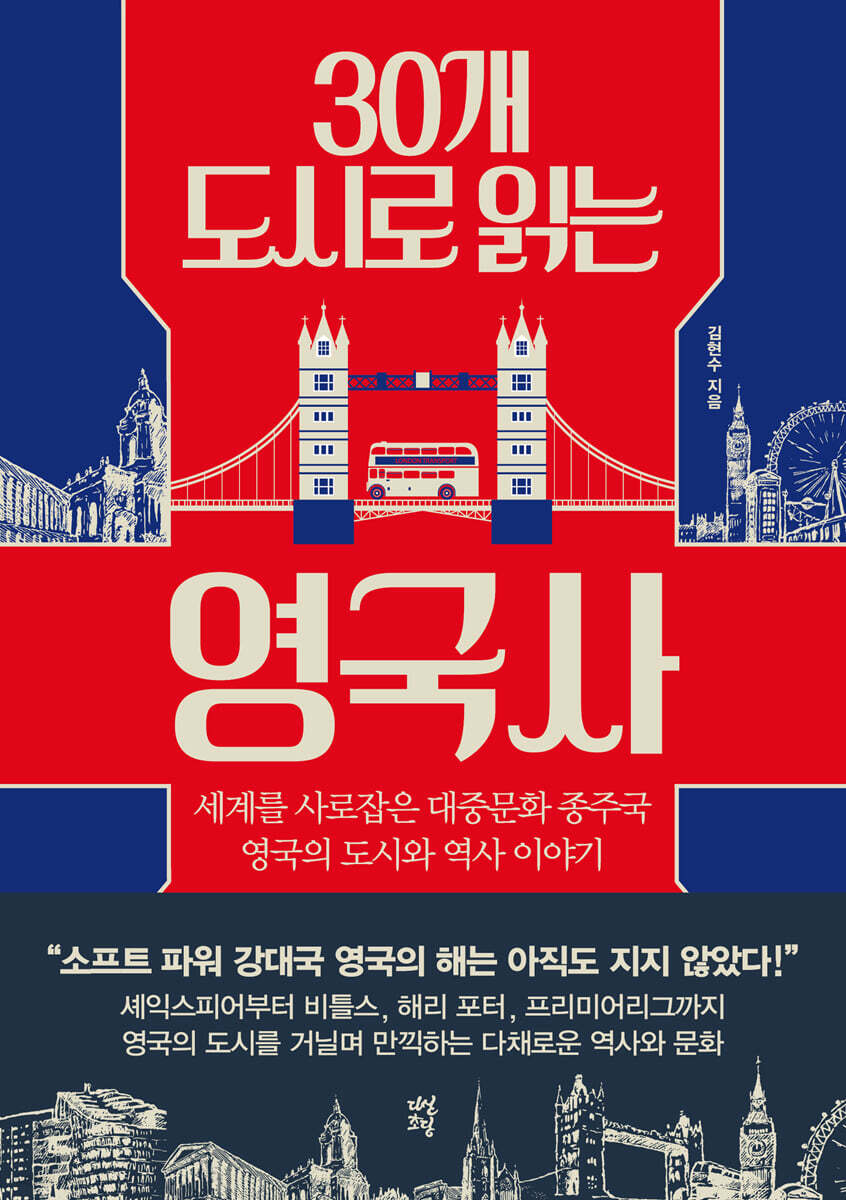
British History in 30 Cities
 |
Description
Book Introduction
“A soft power superpower
“The sun has not set on England yet!”
From Shakespeare to the Beatles, Harry Potter, and the Premier League
Enjoy the diverse history and culture of a British city while strolling through it.
Britain always appears in important events in world history.
The importance of the country of Britain in human history and culture is truly enormous.
From Shakespeare to Big Ben, the Beatles, the Premier League, and a diverse culture, to its history as a victorious nation in both World Wars.
As the country is made up of four regions—England, Scotland, Wales, and Northern Ireland—each with its own distinct history and culture, the UK's cities have unique and diverse stories.
As you stroll through the cities featured in this book and encounter their rich culture and fascinating history, you will naturally come to understand Britain's identity and, by extension, world history.
“The sun has not set on England yet!”
From Shakespeare to the Beatles, Harry Potter, and the Premier League
Enjoy the diverse history and culture of a British city while strolling through it.
Britain always appears in important events in world history.
The importance of the country of Britain in human history and culture is truly enormous.
From Shakespeare to Big Ben, the Beatles, the Premier League, and a diverse culture, to its history as a victorious nation in both World Wars.
As the country is made up of four regions—England, Scotland, Wales, and Northern Ireland—each with its own distinct history and culture, the UK's cities have unique and diverse stories.
As you stroll through the cities featured in this book and encounter their rich culture and fascinating history, you will naturally come to understand Britain's identity and, by extension, world history.
- You can preview some of the book's contents.
Preview
index
Introduction
A British History Travel Map of 30 Cities
Part 1: Defensive and Practical Southern England: Saxon and Jute Cities
01 Winchester, a city that retains only the fame of Alfred the Great
02 Greater London: The capital of England, a city steeped in the beauty of democracy.
03 Canterbury, the heart of the church city with many world cultural heritage sites
04 Portsmouth, a naval port city that embraces the hero Admiral Nelson
05 Plymouth: The port city that gave the world maritime dominance
06 Bristol, the port city that experienced the first voyage to the New World
07 Gloucester: A Harry Potter Filming Location, and More
08 Oxford: A University City with a Dark History
Part 2: Structural and Regional North-Central England: Anglo Cities
09 Cambridge, a university city shining with numerous Nobel Prize winners
10 Cities where the main characters of the Puritan Revolution remain
11 Norwich: A city steeped in medieval charm and charm
12 Colchester, the city with the most traces of the Roman Empire
13 Birmingham, the city of the Enlightenment with a history of steam engines
14 Nottingham, the city of racing, steeped in the legend of Robin Hood
15 The father of Leicester's Parliament and a city with traces of the Wars of the Roses
16 Coventry, the city of cars, embracing the legend of Godiva
17 The Cathedral City, famous for Worcestershire sauce
18 Newcastle upon Tyne: A Cultural City Built on Coal
19 York, the city of the northern church, with its white rose
20 Kingston upon Hull: A coastal city that grew in popularity with the King
21 Leeds, a city of success that led the Industrial Revolution
22 Sheffield, a key city of the Industrial Revolution, famous for its iron and steel production
23 Manchester, a city with a rich cultural heritage built on industrial heritage
24 Liverpool: A port city where diverse cultures coexist
25 Lancaster, a cotton-growing city with a red rose
Part 3: Outside the Isolated and Nature-Centric England: Celtic Cities
26 Edinburgh, the holy site of the Reformation and the capital of Scotland
27 Glasgow, the city where the tobacco barons were active
28 Cardiff, the capital of Wales, which had the largest coal port
29 Swansea: A city that moves quickly to keep pace with change
30 Belfast, the capital of Northern Ireland, free from conflict and pain
Source of the illustration
A British History Travel Map of 30 Cities
Part 1: Defensive and Practical Southern England: Saxon and Jute Cities
01 Winchester, a city that retains only the fame of Alfred the Great
02 Greater London: The capital of England, a city steeped in the beauty of democracy.
03 Canterbury, the heart of the church city with many world cultural heritage sites
04 Portsmouth, a naval port city that embraces the hero Admiral Nelson
05 Plymouth: The port city that gave the world maritime dominance
06 Bristol, the port city that experienced the first voyage to the New World
07 Gloucester: A Harry Potter Filming Location, and More
08 Oxford: A University City with a Dark History
Part 2: Structural and Regional North-Central England: Anglo Cities
09 Cambridge, a university city shining with numerous Nobel Prize winners
10 Cities where the main characters of the Puritan Revolution remain
11 Norwich: A city steeped in medieval charm and charm
12 Colchester, the city with the most traces of the Roman Empire
13 Birmingham, the city of the Enlightenment with a history of steam engines
14 Nottingham, the city of racing, steeped in the legend of Robin Hood
15 The father of Leicester's Parliament and a city with traces of the Wars of the Roses
16 Coventry, the city of cars, embracing the legend of Godiva
17 The Cathedral City, famous for Worcestershire sauce
18 Newcastle upon Tyne: A Cultural City Built on Coal
19 York, the city of the northern church, with its white rose
20 Kingston upon Hull: A coastal city that grew in popularity with the King
21 Leeds, a city of success that led the Industrial Revolution
22 Sheffield, a key city of the Industrial Revolution, famous for its iron and steel production
23 Manchester, a city with a rich cultural heritage built on industrial heritage
24 Liverpool: A port city where diverse cultures coexist
25 Lancaster, a cotton-growing city with a red rose
Part 3: Outside the Isolated and Nature-Centric England: Celtic Cities
26 Edinburgh, the holy site of the Reformation and the capital of Scotland
27 Glasgow, the city where the tobacco barons were active
28 Cardiff, the capital of Wales, which had the largest coal port
29 Swansea: A city that moves quickly to keep pace with change
30 Belfast, the capital of Northern Ireland, free from conflict and pain
Source of the illustration
Detailed image

Into the book
Licoricea was a Jewish female moneylender active in England in the early 13th century.
She was married twice, her second husband being David, a wealthy Jew from England.
After her husband's death, Licoricea inherited the estate and moved from Oxford to Winchester, where she expanded her usury business and gained social influence.
He was a wealthy financier who belonged to the top 1 percent of the Jewish community.
However, he was brutally murdered in his own home in 1277.
The three men accused of murder were brought to trial, but were eventually acquitted.
Benedict, son of Licoricea, became a metalworker who cut coins.
He was a Jew who belonged to the metal guilds of medieval England and Western Europe.
According to Jewish law at the time, Jews were not allowed to have contact with Christian communities, and Benedict was executed for violating this.
The tragedy of Lycorisia and Benedict in Winchester is a prime example of the oppression and discrimination suffered by Jews in medieval England.
---From "Winchester: A City Where Alfred's Fame Remains"
There is an interesting anecdote about King Athelbert's acceptance of Christianity.
One day, while Queen Bertha was still holding fast to her faith, she heard that Pope Gregory of Rome had sent 40 missionaries led by the monk Augustine to England to spread the gospel.
They headed to Canterbury in the Kingdom of Kent, which had close ties with the Frankish kingdom.
But when they reached the city gate, King Aethelbert, a pagan, rejected the Christians and would not let them into the city.
Queen Bertha appealed to the king, saying, “They are my friends and guests from afar, so I beg you to treat them well.”
The king allowed them in because they had promised to respect the queen's religion when they got married.
The king sent a message to the missionaries: “If you are a guest from the continent, you are welcome, but I hope you will leave quickly.”
However, soon after, the king was impressed by the sermons of the Augustinian monks and converted to Christianity, being baptized in the Church of St. Martin where the missionaries resided.
It was in 596 AD.
---From "Canterbury: The Heart of the Church, a World Heritage Site"
When you go to the Royal Naval Base to see HMS Victory, you naturally wonder why the ship is there in particular.
When you actually arrive at the port where the ship is, you will realize that this is an old shipyard commissioned by Henry VIII in 1495 and has the oldest surviving dry dock.
A dry dock is a place where facilities for building a ship are first built on dry land, then the ship is built, and once the ship is completed, the facilities are filled with water to float the ship and launch it.
HMS Victory was a first-rate battleship built and launched at Woolwich Dockyard in 1765, and is famous as the flagship where Admiral Nelson met his end during the Battle of Trafalgar.
The ship, badly damaged in the naval battle, continued to serve as a second-rate battleship for a long time after repairs.
The ship was destined for scrapping in the early 20th century, but in 1922, Sir Charles Doveton-Study, a former Admiral of the Fleet and President of the Institute for the Study of Navigation, wrote in The Times: “HMS Victory’s preservation value is not temporary.
After securing thousands of pounds in public funds through an appeal to the public, which included the words, “We and our ancestors should be proud of this ship and let our descendants feel the same inspiration she gave them,” she was transported to Dock 2 at Portsmouth Dockyard for extensive repairs.
Thus, HMS Victory became the oldest active ship in service, and now sits in the harbor of the Royal Naval Base, attracting countless visitors each year as a museum ship. As a symbol of the glory and tradition of the Royal Navy, HMS Victory continues to be revered and admired by generations to come.
---From "Portsmouth: The Naval Port City that Embraced the Hero Admiral Nelson"
The rapid expansion of universities brought many students into the city, which led to conflicts between them and local residents.
Conflicts between residents and students began to surface in 1209, when two students murdered a woman.
At the time, the local residents arbitrarily executed these students without legal procedures, and the school was dissatisfied with this.
This incident led some students and professors to leave Oxford and establish a new university in Cambridge.
There were continued clashes between Oxford residents and students after this, which eventually led to a shocking incident.
At the southeast corner of the intersection where the aforementioned Carfax Tower is located is a Santander Bank branch building.
This site was originally the site of a tavern called The Swindlestock Tavern, which opened in 1250.
The worst clash between residents and students occurred in this tavern on February 10, 1355, St. Scholastica's Day.
The incident began when several students complained about the quality of the pub's wine and got into an argument with the pub owner.
This led to a brawl and violence that lasted for three days.
At that time, armed gangs came to support the villagers and mercilessly massacred the students.
Students also resisted, but as a result, 63 students and 30 residents died.
This conflict is historically referred to as the Town versus Gown riot.
---From "Oxford: A University City with a Dark History"
The Stone of Scone is a square sandstone used in the coronation of Scottish kings in the 9th century. It was taken by Edward I of England in 1296 and placed under the coronation chair in Westminster Abbey.
In 1950, the stone was stolen by Scottish university students.
The Stone of Scone was then moved back to England, and in 1996 it was officially returned to Scotland and settled in Edinburgh Castle.
However, the British government returned the stone after receiving a promise from the Scottish side that the stone could be brought to London and placed under the coronation chair at each coronation.
The King's Sword (Scottish National Sword), displayed with the Scone Stone, was made in the 15th century and was used in the coronations of Scottish kings.
This sword also has a story.
After the execution of Charles I, Prince Charles (later Charles II), who was in exile in France, returned to Scotland from exile in 1650 and prepared for battle in order to eliminate Oliver Cromwell, who had executed his father.
However, because Cromwell's army was so strong, Prince Charles was defeated and fled back to France.
In the process, the royal steward moved the crown, scepter, and sword to Dunnottar Castle, a natural fortress, to prevent the symbols of royal authority from being stolen.
As Cromwell's army advanced, the situation became more precarious, so he dug a hole under the pulpit of a small village church near the castle and buried the crown and scepter, and broke the long sword in two and hid it in a hole dug under a bench at the back of the church.
Fortunately, these treasures were not stolen and are now stored back in Edinburgh Castle.
---From "Edinburgh: The Holy Land of the Reformation and the Capital of Scotland"
In particular, from the late 1960s onwards, the conflict between the two groups, 'republicans' who advocated for Irish independence and had nationalist goals and 'loyalists' who supported English rule, became more distinct in the Ulster region, and this deepened further.
The culmination of this conflict was the bombing of the McGurk's pub in Belfast city centre in December 1971.
A bomb was detonated by the loyalist Ulster Volunteer Force (UVF) a few weeks before Christmas in a pub frequented by republicans.
The incident left 15 Catholic civilians dead and 17 injured.
The Irish Republican Army (IRA), which included enraged republicans, detonated car bombs simultaneously in several locations in Belfast the following July, causing the "Bloody Friday" incident.
The incident left nine people dead and more than 130 injured.
Belfast was dubbed the world's most dangerous city in the 1970s and 1980s due to sectarian violence, and the Europa Hotel in the city centre was bombed 36 times during this period.
---From "Belfast: Northern Ireland's Capital, Free from Conflict and Pain"
Just past the second bridge (Prince Street Bridge) along the waterway from Floating Harbour towards the estuary, a crouching statue comes into view in front of a large arts centre.
This is a statue of John Cabot, an explorer from Italy.
And to the right, opposite the statue, a replica of the Matthew he sailed on is on display in the river in front of the Emshed Museum.
John Cabot crossed the Atlantic Ocean and arrived in North America in 1497 at the direction of Henry VIII.
An Italian-born navigator and adventurer, he heard of the Age of Exploration, which began when Christopher Columbus set sail from Spain in 1492 and reached the Bahamas and Haiti.
He also dreamed of finding a new sea route to the East Indies to obtain valuable trade goods such as spices and silk.
Historians speculate that he went to Bristol to seek the funds and political support he needed to realize his dream.
Henry VII, who had just founded a new dynasty, took an interest in his plans.
Henry VII encouraged a monopoly trade centered around Bristol to strengthen royal power and secure finances.
So in March 1496, a royal patent was granted to Cabot and his three sons.
---From "Bristol: The Port City That Tastes the First Voyage to the New World"
As you explore the history displayed inside the keep, the dark story of Colchester Castle stands out.
Between 1644 and 1647, the people of East Anglia were terrorized by a man named Matthew Hopkins.
He called himself the Witch Hunter General and went around town with his assistants, using various methods to find people he suspected of being witches.
One of them was to prick the skin to find the devil's mark.
Another is to torture with tools such as handcuffs or waterboarding to force a confession.
In just four years, Hopkins accused over 230 people of witchcraft, most of whom were imprisoned in the city jail at Colchester Castle for trial to their deaths.
There is another tragic history.
In 1648, during the English Civil War, Royalist leaders Sir Charles Lucas and Sir George Lyle were executed outside the castle.
There is a legend that even today, grass does not grow where their blood was shed.
A small obelisk was erected to commemorate the spot.
She was married twice, her second husband being David, a wealthy Jew from England.
After her husband's death, Licoricea inherited the estate and moved from Oxford to Winchester, where she expanded her usury business and gained social influence.
He was a wealthy financier who belonged to the top 1 percent of the Jewish community.
However, he was brutally murdered in his own home in 1277.
The three men accused of murder were brought to trial, but were eventually acquitted.
Benedict, son of Licoricea, became a metalworker who cut coins.
He was a Jew who belonged to the metal guilds of medieval England and Western Europe.
According to Jewish law at the time, Jews were not allowed to have contact with Christian communities, and Benedict was executed for violating this.
The tragedy of Lycorisia and Benedict in Winchester is a prime example of the oppression and discrimination suffered by Jews in medieval England.
---From "Winchester: A City Where Alfred's Fame Remains"
There is an interesting anecdote about King Athelbert's acceptance of Christianity.
One day, while Queen Bertha was still holding fast to her faith, she heard that Pope Gregory of Rome had sent 40 missionaries led by the monk Augustine to England to spread the gospel.
They headed to Canterbury in the Kingdom of Kent, which had close ties with the Frankish kingdom.
But when they reached the city gate, King Aethelbert, a pagan, rejected the Christians and would not let them into the city.
Queen Bertha appealed to the king, saying, “They are my friends and guests from afar, so I beg you to treat them well.”
The king allowed them in because they had promised to respect the queen's religion when they got married.
The king sent a message to the missionaries: “If you are a guest from the continent, you are welcome, but I hope you will leave quickly.”
However, soon after, the king was impressed by the sermons of the Augustinian monks and converted to Christianity, being baptized in the Church of St. Martin where the missionaries resided.
It was in 596 AD.
---From "Canterbury: The Heart of the Church, a World Heritage Site"
When you go to the Royal Naval Base to see HMS Victory, you naturally wonder why the ship is there in particular.
When you actually arrive at the port where the ship is, you will realize that this is an old shipyard commissioned by Henry VIII in 1495 and has the oldest surviving dry dock.
A dry dock is a place where facilities for building a ship are first built on dry land, then the ship is built, and once the ship is completed, the facilities are filled with water to float the ship and launch it.
HMS Victory was a first-rate battleship built and launched at Woolwich Dockyard in 1765, and is famous as the flagship where Admiral Nelson met his end during the Battle of Trafalgar.
The ship, badly damaged in the naval battle, continued to serve as a second-rate battleship for a long time after repairs.
The ship was destined for scrapping in the early 20th century, but in 1922, Sir Charles Doveton-Study, a former Admiral of the Fleet and President of the Institute for the Study of Navigation, wrote in The Times: “HMS Victory’s preservation value is not temporary.
After securing thousands of pounds in public funds through an appeal to the public, which included the words, “We and our ancestors should be proud of this ship and let our descendants feel the same inspiration she gave them,” she was transported to Dock 2 at Portsmouth Dockyard for extensive repairs.
Thus, HMS Victory became the oldest active ship in service, and now sits in the harbor of the Royal Naval Base, attracting countless visitors each year as a museum ship. As a symbol of the glory and tradition of the Royal Navy, HMS Victory continues to be revered and admired by generations to come.
---From "Portsmouth: The Naval Port City that Embraced the Hero Admiral Nelson"
The rapid expansion of universities brought many students into the city, which led to conflicts between them and local residents.
Conflicts between residents and students began to surface in 1209, when two students murdered a woman.
At the time, the local residents arbitrarily executed these students without legal procedures, and the school was dissatisfied with this.
This incident led some students and professors to leave Oxford and establish a new university in Cambridge.
There were continued clashes between Oxford residents and students after this, which eventually led to a shocking incident.
At the southeast corner of the intersection where the aforementioned Carfax Tower is located is a Santander Bank branch building.
This site was originally the site of a tavern called The Swindlestock Tavern, which opened in 1250.
The worst clash between residents and students occurred in this tavern on February 10, 1355, St. Scholastica's Day.
The incident began when several students complained about the quality of the pub's wine and got into an argument with the pub owner.
This led to a brawl and violence that lasted for three days.
At that time, armed gangs came to support the villagers and mercilessly massacred the students.
Students also resisted, but as a result, 63 students and 30 residents died.
This conflict is historically referred to as the Town versus Gown riot.
---From "Oxford: A University City with a Dark History"
The Stone of Scone is a square sandstone used in the coronation of Scottish kings in the 9th century. It was taken by Edward I of England in 1296 and placed under the coronation chair in Westminster Abbey.
In 1950, the stone was stolen by Scottish university students.
The Stone of Scone was then moved back to England, and in 1996 it was officially returned to Scotland and settled in Edinburgh Castle.
However, the British government returned the stone after receiving a promise from the Scottish side that the stone could be brought to London and placed under the coronation chair at each coronation.
The King's Sword (Scottish National Sword), displayed with the Scone Stone, was made in the 15th century and was used in the coronations of Scottish kings.
This sword also has a story.
After the execution of Charles I, Prince Charles (later Charles II), who was in exile in France, returned to Scotland from exile in 1650 and prepared for battle in order to eliminate Oliver Cromwell, who had executed his father.
However, because Cromwell's army was so strong, Prince Charles was defeated and fled back to France.
In the process, the royal steward moved the crown, scepter, and sword to Dunnottar Castle, a natural fortress, to prevent the symbols of royal authority from being stolen.
As Cromwell's army advanced, the situation became more precarious, so he dug a hole under the pulpit of a small village church near the castle and buried the crown and scepter, and broke the long sword in two and hid it in a hole dug under a bench at the back of the church.
Fortunately, these treasures were not stolen and are now stored back in Edinburgh Castle.
---From "Edinburgh: The Holy Land of the Reformation and the Capital of Scotland"
In particular, from the late 1960s onwards, the conflict between the two groups, 'republicans' who advocated for Irish independence and had nationalist goals and 'loyalists' who supported English rule, became more distinct in the Ulster region, and this deepened further.
The culmination of this conflict was the bombing of the McGurk's pub in Belfast city centre in December 1971.
A bomb was detonated by the loyalist Ulster Volunteer Force (UVF) a few weeks before Christmas in a pub frequented by republicans.
The incident left 15 Catholic civilians dead and 17 injured.
The Irish Republican Army (IRA), which included enraged republicans, detonated car bombs simultaneously in several locations in Belfast the following July, causing the "Bloody Friday" incident.
The incident left nine people dead and more than 130 injured.
Belfast was dubbed the world's most dangerous city in the 1970s and 1980s due to sectarian violence, and the Europa Hotel in the city centre was bombed 36 times during this period.
---From "Belfast: Northern Ireland's Capital, Free from Conflict and Pain"
Just past the second bridge (Prince Street Bridge) along the waterway from Floating Harbour towards the estuary, a crouching statue comes into view in front of a large arts centre.
This is a statue of John Cabot, an explorer from Italy.
And to the right, opposite the statue, a replica of the Matthew he sailed on is on display in the river in front of the Emshed Museum.
John Cabot crossed the Atlantic Ocean and arrived in North America in 1497 at the direction of Henry VIII.
An Italian-born navigator and adventurer, he heard of the Age of Exploration, which began when Christopher Columbus set sail from Spain in 1492 and reached the Bahamas and Haiti.
He also dreamed of finding a new sea route to the East Indies to obtain valuable trade goods such as spices and silk.
Historians speculate that he went to Bristol to seek the funds and political support he needed to realize his dream.
Henry VII, who had just founded a new dynasty, took an interest in his plans.
Henry VII encouraged a monopoly trade centered around Bristol to strengthen royal power and secure finances.
So in March 1496, a royal patent was granted to Cabot and his three sons.
---From "Bristol: The Port City That Tastes the First Voyage to the New World"
As you explore the history displayed inside the keep, the dark story of Colchester Castle stands out.
Between 1644 and 1647, the people of East Anglia were terrorized by a man named Matthew Hopkins.
He called himself the Witch Hunter General and went around town with his assistants, using various methods to find people he suspected of being witches.
One of them was to prick the skin to find the devil's mark.
Another is to torture with tools such as handcuffs or waterboarding to force a confession.
In just four years, Hopkins accused over 230 people of witchcraft, most of whom were imprisoned in the city jail at Colchester Castle for trial to their deaths.
There is another tragic history.
In 1648, during the English Civil War, Royalist leaders Sir Charles Lucas and Sir George Lyle were executed outside the castle.
There is a legend that even today, grass does not grow where their blood was shed.
A small obelisk was erected to commemorate the spot.
---From "Colchester: The City with the Most Remaining Traces of the Roman Empire"
Publisher's Review
In the alleys of British cities
The content we love is hidden!
Britain, a country that still exerts influence around the world
A vivid history that can only be seen when you look at the city.
If in ancient times Greece and Rome formed the foundation of the West, then in modern times Britain has had the greatest influence on the world.
Although the era of Pax Britannica has come to an end, British influence remains vast.
When Prince Harry of the United Kingdom, who is not even in line for the throne, visited the United States, President Obama and his family all went out to greet him, and when Prince William got married, the United States covered the news all day long, and Princess Kate's fashion became a big topic of conversation.
The modern superpower, the United States, envies the legitimacy of the British royal family and even has a sense of admiration for Britain.
Britain is often portrayed as a nation of gentlemen who fought two world wars, laid the foundations of the Industrial Revolution and democracy.
It is also famous for being a country with cultural content such as Shakespeare, Harry Potter, and Sherlock Holmes.
But people don't really know Britain well.
Each country in Europe has developed by influencing each other, and Britain has always been at the center of this.
The United Kingdom is the country that has stood at the top of the world for the longest time, and it is a country where you can see the history of Europe that spans 59 countries.
If you know British history, you can understand European history, and even world history.
This is precisely why we must know British history.
In the 21st century, the country that holds the world's hegemony is not Britain.
However, as a country on which the sun never sets, Britain still has a global influence in terms of politics, economy, society, and culture.
Representative examples include democracy, where the people have power and exercise it themselves, and the Industrial Revolution, which had a major impact on the affluent society of the 21st century.
Furthermore, as a united kingdom where people of diverse nationalities, religions, and origins live together, the UK maintains its own identity while accepting immigrants.
"A History of Britain in 30 Cities" breaks away from conventional historical narratives and unravels the hidden stories within cities that have remained in place and accumulated over time.
Among the many cities, we have carefully selected 30 cities that represent the UK, categorized by region and ethnicity.
Greater London, a mecca for performances and musicals, is a representative city where you can experience British politics, culture, and history. Cities such as Gloucester, the filming location for Hogwarts in Harry Potter, Norwich, where you can feel the medieval charm just by walking down the streets, and Portsmouth, which embraces Admiral Nelson, each have their own story waiting for us.
By following a travel route that begins at the city's most famous tourist attractions and travels through 30 cities in the UK, you will naturally gain a deeper understanding of British identity and culture.
Let's stroll through 30 cities, discovering major historical events from ancient times to modern times, as well as the stories hidden in their alleyways.
You will be captivated by the charm of Britain, a country that has captivated the world not only with its history preserved in literature but also with its vibrant present-day city.
Why has Britain become a cultural powerhouse?
An exciting solo trip to England from the comfort of your own home
Sherlock Holmes is a beloved work of fiction, drama, and film that is still loved by the public today.
Harry Potter invited countless readers into a world of fantasy, preceded by classics by great writers like Shakespeare.
The country that made tea time culture popular worldwide using tea leaves from India was England.
Before tea time culture became popular, port cities like Bristol, which pioneered voyages to the New World to bring in tea leaves, were at the forefront.
In this way, cities played a major role in creating a culture that Britain enjoyed worldwide.
Manchester is a city that pioneered the cotton industry by utilizing railways and canals.
The world's first passenger railway remains a symbol of the Industrial Revolution, and an industrial complex was built near the city center at Trafford Park, exporting large quantities of products.
As jobs were created and foreign workers flocked in, workers' human rights were neglected, leading to the infamous Peterloo Massacre.
Since then, Manchester has strengthened its sports and culture, transitioning from secondary industries to knowledge-based industries.
The world-famous rock band Oasis and Manchester's football club, which boasts immense popularity in the Premier League, also emerged from this background.
The well-known legend of Robin Hood originated in Nottingham.
If you go to Nottingham, there is a statue of Robin Hood.
Robin Hood, the protagonist of English folklore, is a character who practices justice even when breaking the law, and is famous for the anecdote in which he shot an arrow and pierced an apple on a man's head.
The story of Robin Hood, a middle-class farmer or nobleman, resisting tyranny and fighting for the people and the king to restore peace contains stories hidden in the city at that time, such as the Crusades, the execution of the traitor John, and the spirit of the common people resisting tyranny.
In this way, the stories that remained in the city became the source material for content and developed greatly into books, plays, performances, sports, etc.
These accumulated results made Britain the cultural powerhouse we know today.
The history of the city, which could not have been achieved overnight, has accumulated to create the Britain of today.
The birthplace of democracy and the industrial revolution, and the stories behind them.
Discover fascinating stories hidden in diverse cities.
Greater London, known as the representative city of the United Kingdom, is famous as the birthplace of parliamentary democracy.
Westminster Palace, located next to the River Thames, has witnessed many historical events.
It is even more significant because it is where the Model Assembly was held and the Bill of Rights was promulgated, establishing a constitutional monarchy.
When viewed from the River Thames, the Palace of Westminster, the Houses of Parliament, and Big Ben stand as symbols of the city.
Looking at this structure, we can feel the spirit of constitutional monarchy, which is the basis of British democracy: 'the king reigns but does not rule.'
This is because the layout of Buckingham Palace, the king's residence, is located behind the Parliament, showing that sovereignty lies with the people.
Additionally, the Lord Mayor of the City of London, the head of the autonomous Guildhall, is directly elected annually and holds an independent position.
Just looking at the fact that these traditions have been maintained for hundreds of years, London truly has the appearance of being the birthplace of democracy.
The Industrial Revolution was an event that took place across Britain, but Leeds was one of the cities that emerged as a major success.
Kirkstall Abbey in Leeds became financially independent through sheep farming and woolen cloth production, and a market naturally developed near the abbey.
As the market grew, Leeds became a hub for the wool industry, and with the innovation of transportation, canals and railways were used to transport raw materials and products for various industries.
Leeds, which was able to import coal, mass produce it, and even transport the finished product, grew significantly as a result.
The Industrial Revolution brought about rapid social development along with economic growth.
Many culturally advanced cities benefited greatly from the Industrial Revolution.
As people gained economic leeway, they focused on education and established universities. As machines replaced jobs and people had more free time, cultural industries such as sports, music, and musicals developed to allow people to enjoy culture.
Swansea is considered one of the best cities to have adapted to the transition from secondary to tertiary industries, shifting its focus away from the copper industry and towards developing more prominent industries.
Since the Industrial Revolution, cities have survived in a variety of ways, depending on how they were dealt with.
But we must also be aware of the shadow of the Industrial Revolution.
The majority of Sheffield's residents, who had developed through the iron industry, earned good wages and lived cleanly, but their health was poor.
The use of powerful machinery to make knives and forks affected growth and caused digestive problems.
Female workers, in particular, used dry whetstones for delicate work, which led to poor posture and inhalation of fine metal dust.
Their average lifespan was only about 35 years, about 10 years shorter than that of those who used wet whetstones.
There were many cities where workers' problems were exposed, such as the Newcastle-upon-Tyne industrial disputes and the Sheffield Field Rage, which began in the 16th century.
This book also introduces other fascinating cities, such as Coventry, home to the Godiva legend that inspired Godiva, famous for its chocolate, and Cambridge, home to numerous Nobel Prize winners.
The city contains all the stories of civilization created by humans, so when you visit the city, you can experience the flow of the times and the culture that remains in that area.
If you've only known Britain through the textbook history you learned in school, it's time to learn about the real history within Britain's cities.
The British history that remains in the city makes us think about both what we should avoid and what we should strive for.
In it we will be able to realize the path we should take.
The content we love is hidden!
Britain, a country that still exerts influence around the world
A vivid history that can only be seen when you look at the city.
If in ancient times Greece and Rome formed the foundation of the West, then in modern times Britain has had the greatest influence on the world.
Although the era of Pax Britannica has come to an end, British influence remains vast.
When Prince Harry of the United Kingdom, who is not even in line for the throne, visited the United States, President Obama and his family all went out to greet him, and when Prince William got married, the United States covered the news all day long, and Princess Kate's fashion became a big topic of conversation.
The modern superpower, the United States, envies the legitimacy of the British royal family and even has a sense of admiration for Britain.
Britain is often portrayed as a nation of gentlemen who fought two world wars, laid the foundations of the Industrial Revolution and democracy.
It is also famous for being a country with cultural content such as Shakespeare, Harry Potter, and Sherlock Holmes.
But people don't really know Britain well.
Each country in Europe has developed by influencing each other, and Britain has always been at the center of this.
The United Kingdom is the country that has stood at the top of the world for the longest time, and it is a country where you can see the history of Europe that spans 59 countries.
If you know British history, you can understand European history, and even world history.
This is precisely why we must know British history.
In the 21st century, the country that holds the world's hegemony is not Britain.
However, as a country on which the sun never sets, Britain still has a global influence in terms of politics, economy, society, and culture.
Representative examples include democracy, where the people have power and exercise it themselves, and the Industrial Revolution, which had a major impact on the affluent society of the 21st century.
Furthermore, as a united kingdom where people of diverse nationalities, religions, and origins live together, the UK maintains its own identity while accepting immigrants.
"A History of Britain in 30 Cities" breaks away from conventional historical narratives and unravels the hidden stories within cities that have remained in place and accumulated over time.
Among the many cities, we have carefully selected 30 cities that represent the UK, categorized by region and ethnicity.
Greater London, a mecca for performances and musicals, is a representative city where you can experience British politics, culture, and history. Cities such as Gloucester, the filming location for Hogwarts in Harry Potter, Norwich, where you can feel the medieval charm just by walking down the streets, and Portsmouth, which embraces Admiral Nelson, each have their own story waiting for us.
By following a travel route that begins at the city's most famous tourist attractions and travels through 30 cities in the UK, you will naturally gain a deeper understanding of British identity and culture.
Let's stroll through 30 cities, discovering major historical events from ancient times to modern times, as well as the stories hidden in their alleyways.
You will be captivated by the charm of Britain, a country that has captivated the world not only with its history preserved in literature but also with its vibrant present-day city.
Why has Britain become a cultural powerhouse?
An exciting solo trip to England from the comfort of your own home
Sherlock Holmes is a beloved work of fiction, drama, and film that is still loved by the public today.
Harry Potter invited countless readers into a world of fantasy, preceded by classics by great writers like Shakespeare.
The country that made tea time culture popular worldwide using tea leaves from India was England.
Before tea time culture became popular, port cities like Bristol, which pioneered voyages to the New World to bring in tea leaves, were at the forefront.
In this way, cities played a major role in creating a culture that Britain enjoyed worldwide.
Manchester is a city that pioneered the cotton industry by utilizing railways and canals.
The world's first passenger railway remains a symbol of the Industrial Revolution, and an industrial complex was built near the city center at Trafford Park, exporting large quantities of products.
As jobs were created and foreign workers flocked in, workers' human rights were neglected, leading to the infamous Peterloo Massacre.
Since then, Manchester has strengthened its sports and culture, transitioning from secondary industries to knowledge-based industries.
The world-famous rock band Oasis and Manchester's football club, which boasts immense popularity in the Premier League, also emerged from this background.
The well-known legend of Robin Hood originated in Nottingham.
If you go to Nottingham, there is a statue of Robin Hood.
Robin Hood, the protagonist of English folklore, is a character who practices justice even when breaking the law, and is famous for the anecdote in which he shot an arrow and pierced an apple on a man's head.
The story of Robin Hood, a middle-class farmer or nobleman, resisting tyranny and fighting for the people and the king to restore peace contains stories hidden in the city at that time, such as the Crusades, the execution of the traitor John, and the spirit of the common people resisting tyranny.
In this way, the stories that remained in the city became the source material for content and developed greatly into books, plays, performances, sports, etc.
These accumulated results made Britain the cultural powerhouse we know today.
The history of the city, which could not have been achieved overnight, has accumulated to create the Britain of today.
The birthplace of democracy and the industrial revolution, and the stories behind them.
Discover fascinating stories hidden in diverse cities.
Greater London, known as the representative city of the United Kingdom, is famous as the birthplace of parliamentary democracy.
Westminster Palace, located next to the River Thames, has witnessed many historical events.
It is even more significant because it is where the Model Assembly was held and the Bill of Rights was promulgated, establishing a constitutional monarchy.
When viewed from the River Thames, the Palace of Westminster, the Houses of Parliament, and Big Ben stand as symbols of the city.
Looking at this structure, we can feel the spirit of constitutional monarchy, which is the basis of British democracy: 'the king reigns but does not rule.'
This is because the layout of Buckingham Palace, the king's residence, is located behind the Parliament, showing that sovereignty lies with the people.
Additionally, the Lord Mayor of the City of London, the head of the autonomous Guildhall, is directly elected annually and holds an independent position.
Just looking at the fact that these traditions have been maintained for hundreds of years, London truly has the appearance of being the birthplace of democracy.
The Industrial Revolution was an event that took place across Britain, but Leeds was one of the cities that emerged as a major success.
Kirkstall Abbey in Leeds became financially independent through sheep farming and woolen cloth production, and a market naturally developed near the abbey.
As the market grew, Leeds became a hub for the wool industry, and with the innovation of transportation, canals and railways were used to transport raw materials and products for various industries.
Leeds, which was able to import coal, mass produce it, and even transport the finished product, grew significantly as a result.
The Industrial Revolution brought about rapid social development along with economic growth.
Many culturally advanced cities benefited greatly from the Industrial Revolution.
As people gained economic leeway, they focused on education and established universities. As machines replaced jobs and people had more free time, cultural industries such as sports, music, and musicals developed to allow people to enjoy culture.
Swansea is considered one of the best cities to have adapted to the transition from secondary to tertiary industries, shifting its focus away from the copper industry and towards developing more prominent industries.
Since the Industrial Revolution, cities have survived in a variety of ways, depending on how they were dealt with.
But we must also be aware of the shadow of the Industrial Revolution.
The majority of Sheffield's residents, who had developed through the iron industry, earned good wages and lived cleanly, but their health was poor.
The use of powerful machinery to make knives and forks affected growth and caused digestive problems.
Female workers, in particular, used dry whetstones for delicate work, which led to poor posture and inhalation of fine metal dust.
Their average lifespan was only about 35 years, about 10 years shorter than that of those who used wet whetstones.
There were many cities where workers' problems were exposed, such as the Newcastle-upon-Tyne industrial disputes and the Sheffield Field Rage, which began in the 16th century.
This book also introduces other fascinating cities, such as Coventry, home to the Godiva legend that inspired Godiva, famous for its chocolate, and Cambridge, home to numerous Nobel Prize winners.
The city contains all the stories of civilization created by humans, so when you visit the city, you can experience the flow of the times and the culture that remains in that area.
If you've only known Britain through the textbook history you learned in school, it's time to learn about the real history within Britain's cities.
The British history that remains in the city makes us think about both what we should avoid and what we should strive for.
In it we will be able to realize the path we should take.
GOODS SPECIFICS
- Date of issue: October 17, 2024
- Page count, weight, size: 488 pages | 764g | 148*210*30mm
- ISBN13: 9791130648842
- ISBN10: 1130648842
You may also like
카테고리
korean


korean

![GQ KOREA Mark (Monthly): December [2025]](http://librairie.coreenne.fr/cdn/shop/files/8ef265dbbfbf186523ed75ba7319009d.jpg?v=1765340328&width=3840)


