

Budapest
 |
Description
Book Introduction
A city that shines brightly at the crossroads of civilization
A 2,000-year history of Budapest unfolds, a mix of turbulence and turmoil, passion and frustration.
Budapest is a small city in Europe, but it has played an important role in the course of world history.
As a geographical gateway between the East and the West, this city has experienced numerous invasions and occupations, absorbing new cultures and knowledge each time, forming a unique history.
"Budapest" explores the history of Budapest in its entirety, vividly bringing to life the complex histories of the countless people who have lived here.
Budapest's history, older than Hungary as a nation, begins in ancient Rome and only truly gained liberation after experiencing occupation by the Mongols, Turks, Habsburgs, Nazi Germany, and the Soviet Union.
In the process, the cities of Buda and Pest, which had been divided across the Danube River, were united, and Budapest became the capital of Hungary.
The long and turbulent history has produced countless heroes and villains, and citizens have moved their own history, sometimes holding their breath and sometimes expressing their anger.
The trajectories of musicians, writers, filmmakers, and scientists who continued to speak of Budapest even after leaving it have spread the influence of this small city throughout Europe.
As a journalist who traveled to Budapest, author Victor Sebestien collected testimonies from both celebrities and locals, and lovingly compiles the records of those who lived there.
As you follow this book, which reconstructs history in a complex way through the eyes of a people who have experienced revolution, natural disaster, occupation, and siege, you feel as if you are sitting in a Budapest café, a place teeming with diverse aspirations and logics.
This book, which vividly brings to life historical figures, will invite readers into the heart of Budapest, a city brimming with revolutionary passion.
A 2,000-year history of Budapest unfolds, a mix of turbulence and turmoil, passion and frustration.
Budapest is a small city in Europe, but it has played an important role in the course of world history.
As a geographical gateway between the East and the West, this city has experienced numerous invasions and occupations, absorbing new cultures and knowledge each time, forming a unique history.
"Budapest" explores the history of Budapest in its entirety, vividly bringing to life the complex histories of the countless people who have lived here.
Budapest's history, older than Hungary as a nation, begins in ancient Rome and only truly gained liberation after experiencing occupation by the Mongols, Turks, Habsburgs, Nazi Germany, and the Soviet Union.
In the process, the cities of Buda and Pest, which had been divided across the Danube River, were united, and Budapest became the capital of Hungary.
The long and turbulent history has produced countless heroes and villains, and citizens have moved their own history, sometimes holding their breath and sometimes expressing their anger.
The trajectories of musicians, writers, filmmakers, and scientists who continued to speak of Budapest even after leaving it have spread the influence of this small city throughout Europe.
As a journalist who traveled to Budapest, author Victor Sebestien collected testimonies from both celebrities and locals, and lovingly compiles the records of those who lived there.
As you follow this book, which reconstructs history in a complex way through the eyes of a people who have experienced revolution, natural disaster, occupation, and siege, you feel as if you are sitting in a Budapest café, a place teeming with diverse aspirations and logics.
This book, which vividly brings to life historical figures, will invite readers into the heart of Budapest, a city brimming with revolutionary passion.
- You can preview some of the book's contents.
Preview
index
introduction
prolog
Part 1: The Magyars
Chapter 1 Aquincum
Chapter 2 The Magyars
Chapter 3: The Mongol Invasion
Chapter 4: The Crow King
Chapter 5: The Empire Strikes Back
Chapter 6: Budun, the City of the Turks
Chapter 7 Distribution of the Spoils
Chapter 8: Recapture of Buddha
Part 2: The Habsburg Dynasty
Chapter 9: Baroque, Melancholy and Glory
Chapter 10 Language, Truth, and Logic
Chapter 11 Bridge Builders
Chapter 12: The Great Flood
Chapter 13 March 15th
Chapter 14: The Revolutionary War
Chapter 15: Revenge
Chapter 16 Judapest
Chapter 17: Empress Shishi
Chapter 18: The Dual Monarchy: Victory in Defeat
Chapter 19: The Birth of Budapest
Chapter 20 Cafe Culture
Chapter 21: The Massacre of Jews in Hungary
Chapter 22 Illiberal Democracy
Chapter 23 Legitimacy of the State
Part 3 World War
Chapter 24: The Beginning of the End
Chapter 25: Lenin's Disciples
Chapter 26: An Admiral Without a Navy
Chapter 27 Marching with Hitler
Chapter 28: Madness Revealed
Chapter 29: The Siege of Budapest
Chapter 30 Liberation
Chapter 31: The Iron Curtain
Chapter 32: The House of Horrors
Chapter 33: Revolution Again
Chapter 34: The Suppressed Revolution
Chapter 35: The Most Pleasant Barracks in the Camp
Chapter 36: The Last Rites
conclusion
main
References
Acknowledgements
Pictorial source
Biographical Index
prolog
Part 1: The Magyars
Chapter 1 Aquincum
Chapter 2 The Magyars
Chapter 3: The Mongol Invasion
Chapter 4: The Crow King
Chapter 5: The Empire Strikes Back
Chapter 6: Budun, the City of the Turks
Chapter 7 Distribution of the Spoils
Chapter 8: Recapture of Buddha
Part 2: The Habsburg Dynasty
Chapter 9: Baroque, Melancholy and Glory
Chapter 10 Language, Truth, and Logic
Chapter 11 Bridge Builders
Chapter 12: The Great Flood
Chapter 13 March 15th
Chapter 14: The Revolutionary War
Chapter 15: Revenge
Chapter 16 Judapest
Chapter 17: Empress Shishi
Chapter 18: The Dual Monarchy: Victory in Defeat
Chapter 19: The Birth of Budapest
Chapter 20 Cafe Culture
Chapter 21: The Massacre of Jews in Hungary
Chapter 22 Illiberal Democracy
Chapter 23 Legitimacy of the State
Part 3 World War
Chapter 24: The Beginning of the End
Chapter 25: Lenin's Disciples
Chapter 26: An Admiral Without a Navy
Chapter 27 Marching with Hitler
Chapter 28: Madness Revealed
Chapter 29: The Siege of Budapest
Chapter 30 Liberation
Chapter 31: The Iron Curtain
Chapter 32: The House of Horrors
Chapter 33: Revolution Again
Chapter 34: The Suppressed Revolution
Chapter 35: The Most Pleasant Barracks in the Camp
Chapter 36: The Last Rites
conclusion
main
References
Acknowledgements
Pictorial source
Biographical Index
Detailed image
Publisher's Review
From Aquincum in Roman times to a refugee holiday destination in the Soviet Union,
Budapest: 2,000 Years of Revolution and Uprising, Occupation and Domination
Budapest has experienced ups and downs through invasions, revolutions, and uprisings by various forces.
Ancient Rome, Magyars, Mongols, and Turks occupied this place in succession, and it was called by various names each time, such as Aquincum (ancient Roman period), Buda (Magyar settlement period), and Budun (Turkish occupation period).
The Magyars, who make up the majority of Hungarians today, have sought help from various European countries whenever they have been invaded, but have always had to deal with foreign powers alone.
Hungary's history of belonging to Europe but being ostracized whenever attacked has positioned its identity between "East and West."
From the 17th century onwards, the Habsburg family took over Budapest.
The Habsburgs drove out the Turks who had previously occupied Buda and ruled it until World War I.
During this period, Hungary experienced deepening social conflicts, with the gap between the rich and poor between the Hungarian nobility, who had close ties to the Habsburg family, and the rest of the class widening, and discrimination against non-Magyars becoming more severe. However, Hungary also clearly established its identity as an independent nation, such as by building a bridge connecting Buda and Pest and launching a Hungarian language revival movement.
The demand for autonomy, which emphasized the Magyar identity, led to the revolution and war of independence in 1848, but it failed due to the limitations of not taking non-Magyars into account and the Habsburg counterattack.
After World War I, when the influence of the Habsburgs waned, Hungary threw in its lot with Nazi Germany.
Admiral Miklós Horthy, who ruled Hungary during World War II, was a loyal subordinate of Hitler and massacred countless Jews and carried out the White Terror using armed thugs.
At the end of the war, he belatedly declared a break with Hitler, anticipating defeat, but this led to the Nazis' siege of Budapest (Operation Margarethe).
After World War II, Hungary became a member of the Soviet Union.
Matthias Rákosi, who organized the Communist Party in Hungary, was the head of the Soviet dictatorship and purged many anti-communists, and declared himself an anti-Semite to gain support from the people.
As a result, a significant number of politicians, including Lucrezló László, disappeared for unknown reasons, and their names were not mentioned for a long time.
The place where the most people lost their lives was Budapest.
The revolutions of 1956 and 1989 proved that Budapest was a city with global influence.
In 1956, Budapest rose up against the Soviet “Red Army.”
This uprising, which demanded the withdrawal of Soviet troops stationed in Hungary, seemed to end in Hungarian victory, but was suppressed with more than 2,000 deaths in Budapest alone.
The once-thwarted revolution finally gained real momentum in 1989, just before the collapse of the Soviet Union.
On June 16, 1989, approximately 200,000 Budapest citizens gathered in the square.
They had gathered to participate in the ceremony to rebury the bodies of the heroes of the 1956 revolution.
They restored the honor of Nagy Imre, who had opposed the Soviets as prime minister during the revolution, and expressed the desire for freedom that had been suppressed for about 30 years.
Budapest's yearning for freedom made it a city that heralded the end of the Cold War.
In the revolutionary atmosphere that gripped Budapest, East German refugees used it as a gateway to the Western world.
East Germany asked Budapest to prevent its citizens from crossing into the West, but Budapest refused.
Budapest thus became the city at the forefront of the collapse of the socialist state.
Surviving turbulent times
Artists and Scientists of Budapest
Budapest is also home to some of the world's greatest writers, musicians, and scientists.
"Budapest" meticulously examines the history of Budapest throughout the 20th century, without missing a single detail about the artists and writers who lived there.
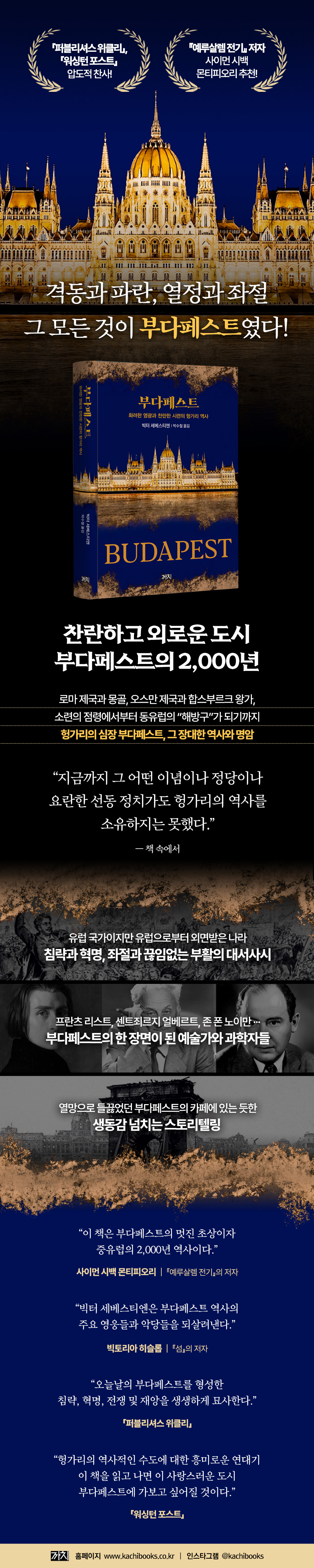
Franz Liszt (Liszt Ferenczi), a musician widely known to domestic readers, was loved by the Hungarian people even though he could not speak a word of Hungarian, and he never lost sight of his homeland.
Albert Szent-György, who won the Nobel Prize in Physiology or Medicine for discovering vitamin C, remained in Budapest while his fellow scientists fled their hometown and led an underground organization fighting against the Nazis.
Imre Kertész, the Nobel Prize winner in Literature, was persecuted as a Jew, but after returning from the concentration camp, he remained in Budapest and continued his creative work.
The poet Mihai Börösmircz and the novelists Jokai Mor, Arthur Koestler, and Serb Untal left detailed records of major political events, giving us a three-dimensional view of the history.
Meanwhile, photographers André Kertész and Robert Capa, film director Alexander Korder, and physicists Leo Szilard, Eugene Wigner, John von Neumann, and Edward Teller, who fled Budapest to escape political and racial persecution, show how Budapest's history impacts individual lives.
"Budapest" follows the records and life trajectories they left behind, providing a glimpse into contemporary Budapest.
Budapest, the city that was both the most tolerant and the most cruel to Jews.
When talking about Budapest, one cannot leave out the story of the Jews who lived here.
Hungary had been the most tolerant country towards Jews since the Middle Ages, and Budapest was a city with such a large Jewish population that it was called “Judapsest.”
The Jews of Budapest actively integrated into society, learning Hungarian and cooperating with Hungarians, and were active in industry, commerce, banking, and the professions.
However, the Jews, who were foreigners, were not spared from oppression here either.
They were blamed for the Black Death in the 14th century, and were treated as collaborators after the Turks withdrew from Buda.
In the 19th century, when Jews were active in many places, they were targeted by Magyar nationalist forces and even suffered massacres.
This trend was further aggravated when Hungary adopted the same path as Nazi Germany during World War II.
At the time, Jews were identified as agents of Bolshevism, who spread communism, and about 500,000 of them were forcibly deported to Auschwitz.
Although further massacres were prevented when Admiral Horthy, who had spearheaded the massacre of Jews, broke with Hitler, the history of Jewish persecution left deep scars on Hungary.
This book delves into Budapest's complex history, taking readers through its history as a Roman frontier city, the invasions of the Mongols and Turks, the revolution of 1848, and the wars and massacres of the 20th century.
Budapest, a region on the European border known as “between East and West,” was also the site of events that had global implications.
Through this book, readers will be able to fully experience a new side of Budapest: vibrant, noisy, yet beautiful.
Budapest: 2,000 Years of Revolution and Uprising, Occupation and Domination
Budapest has experienced ups and downs through invasions, revolutions, and uprisings by various forces.
Ancient Rome, Magyars, Mongols, and Turks occupied this place in succession, and it was called by various names each time, such as Aquincum (ancient Roman period), Buda (Magyar settlement period), and Budun (Turkish occupation period).
The Magyars, who make up the majority of Hungarians today, have sought help from various European countries whenever they have been invaded, but have always had to deal with foreign powers alone.
Hungary's history of belonging to Europe but being ostracized whenever attacked has positioned its identity between "East and West."
From the 17th century onwards, the Habsburg family took over Budapest.
The Habsburgs drove out the Turks who had previously occupied Buda and ruled it until World War I.
During this period, Hungary experienced deepening social conflicts, with the gap between the rich and poor between the Hungarian nobility, who had close ties to the Habsburg family, and the rest of the class widening, and discrimination against non-Magyars becoming more severe. However, Hungary also clearly established its identity as an independent nation, such as by building a bridge connecting Buda and Pest and launching a Hungarian language revival movement.
The demand for autonomy, which emphasized the Magyar identity, led to the revolution and war of independence in 1848, but it failed due to the limitations of not taking non-Magyars into account and the Habsburg counterattack.
After World War I, when the influence of the Habsburgs waned, Hungary threw in its lot with Nazi Germany.
Admiral Miklós Horthy, who ruled Hungary during World War II, was a loyal subordinate of Hitler and massacred countless Jews and carried out the White Terror using armed thugs.
At the end of the war, he belatedly declared a break with Hitler, anticipating defeat, but this led to the Nazis' siege of Budapest (Operation Margarethe).
After World War II, Hungary became a member of the Soviet Union.
Matthias Rákosi, who organized the Communist Party in Hungary, was the head of the Soviet dictatorship and purged many anti-communists, and declared himself an anti-Semite to gain support from the people.
As a result, a significant number of politicians, including Lucrezló László, disappeared for unknown reasons, and their names were not mentioned for a long time.
The place where the most people lost their lives was Budapest.
The revolutions of 1956 and 1989 proved that Budapest was a city with global influence.
In 1956, Budapest rose up against the Soviet “Red Army.”
This uprising, which demanded the withdrawal of Soviet troops stationed in Hungary, seemed to end in Hungarian victory, but was suppressed with more than 2,000 deaths in Budapest alone.
The once-thwarted revolution finally gained real momentum in 1989, just before the collapse of the Soviet Union.
On June 16, 1989, approximately 200,000 Budapest citizens gathered in the square.
They had gathered to participate in the ceremony to rebury the bodies of the heroes of the 1956 revolution.
They restored the honor of Nagy Imre, who had opposed the Soviets as prime minister during the revolution, and expressed the desire for freedom that had been suppressed for about 30 years.
Budapest's yearning for freedom made it a city that heralded the end of the Cold War.
In the revolutionary atmosphere that gripped Budapest, East German refugees used it as a gateway to the Western world.
East Germany asked Budapest to prevent its citizens from crossing into the West, but Budapest refused.
Budapest thus became the city at the forefront of the collapse of the socialist state.
Surviving turbulent times
Artists and Scientists of Budapest
Budapest is also home to some of the world's greatest writers, musicians, and scientists.
"Budapest" meticulously examines the history of Budapest throughout the 20th century, without missing a single detail about the artists and writers who lived there.
Franz Liszt (Liszt Ferenczi), a musician widely known to domestic readers, was loved by the Hungarian people even though he could not speak a word of Hungarian, and he never lost sight of his homeland.
Albert Szent-György, who won the Nobel Prize in Physiology or Medicine for discovering vitamin C, remained in Budapest while his fellow scientists fled their hometown and led an underground organization fighting against the Nazis.
Imre Kertész, the Nobel Prize winner in Literature, was persecuted as a Jew, but after returning from the concentration camp, he remained in Budapest and continued his creative work.
The poet Mihai Börösmircz and the novelists Jokai Mor, Arthur Koestler, and Serb Untal left detailed records of major political events, giving us a three-dimensional view of the history.
Meanwhile, photographers André Kertész and Robert Capa, film director Alexander Korder, and physicists Leo Szilard, Eugene Wigner, John von Neumann, and Edward Teller, who fled Budapest to escape political and racial persecution, show how Budapest's history impacts individual lives.
"Budapest" follows the records and life trajectories they left behind, providing a glimpse into contemporary Budapest.
Budapest, the city that was both the most tolerant and the most cruel to Jews.
When talking about Budapest, one cannot leave out the story of the Jews who lived here.
Hungary had been the most tolerant country towards Jews since the Middle Ages, and Budapest was a city with such a large Jewish population that it was called “Judapsest.”
The Jews of Budapest actively integrated into society, learning Hungarian and cooperating with Hungarians, and were active in industry, commerce, banking, and the professions.
However, the Jews, who were foreigners, were not spared from oppression here either.
They were blamed for the Black Death in the 14th century, and were treated as collaborators after the Turks withdrew from Buda.
In the 19th century, when Jews were active in many places, they were targeted by Magyar nationalist forces and even suffered massacres.
This trend was further aggravated when Hungary adopted the same path as Nazi Germany during World War II.
At the time, Jews were identified as agents of Bolshevism, who spread communism, and about 500,000 of them were forcibly deported to Auschwitz.
Although further massacres were prevented when Admiral Horthy, who had spearheaded the massacre of Jews, broke with Hitler, the history of Jewish persecution left deep scars on Hungary.
This book delves into Budapest's complex history, taking readers through its history as a Roman frontier city, the invasions of the Mongols and Turks, the revolution of 1848, and the wars and massacres of the 20th century.
Budapest, a region on the European border known as “between East and West,” was also the site of events that had global implications.
Through this book, readers will be able to fully experience a new side of Budapest: vibrant, noisy, yet beautiful.
GOODS SPECIFICS
- Date of issue: September 30, 2024
- Format: Hardcover book binding method guide
- Page count, weight, size: 592 pages | 786g | 152*218*35mm
- ISBN13: 9788972918561
- ISBN10: 8972918563
You may also like
카테고리
korean


korean

![GQ KOREA Mark (Monthly): December [2025]](http://librairie.coreenne.fr/cdn/shop/files/8ef265dbbfbf186523ed75ba7319009d.jpg?v=1765340328&width=3840)


