

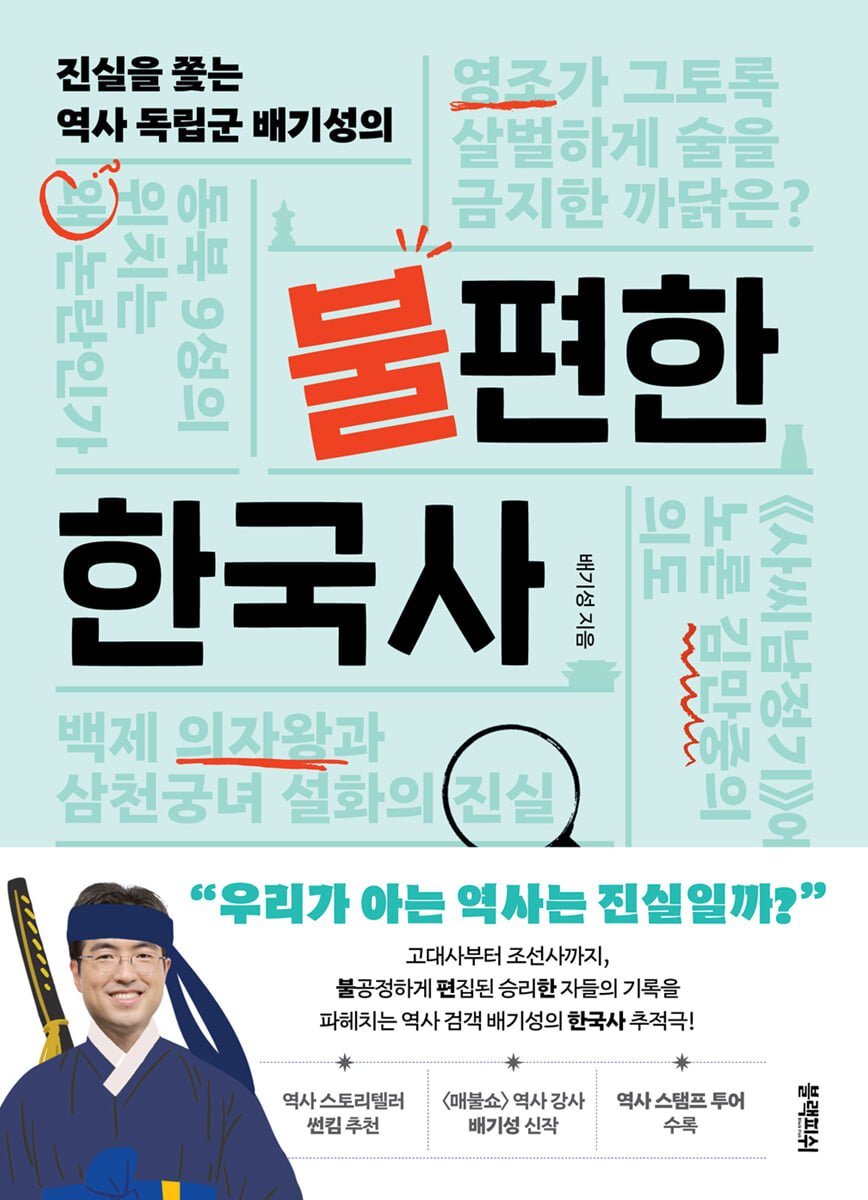
Inconvenient Korean History
 |
Description
Book Introduction
“Is the history we know true? “Dig into the unfairly edited records of Korean history!” From ancient history to Joseon, Baek Gi-seong's "Cider Korean History" (Part 42) "Is the difference between the Silla bone rank system's seonggol and jingol only bloodline?" "Was King Uija of Baekje a debauched monarch with three thousand court ladies?" "Was Jang Hui-bin truly a villainess of unprecedented proportions?" Are all these familiar stories of Korean history true? Let's think about them. History is always written after an event has occurred. The loser's record is often highly edited, with little or no information. Therefore, if we rely solely on records when learning or reading history, we run the risk of distorting our understanding of history. History lecturer Bae Ki-seong, who has caused a stir with his Korean history lectures on various media outlets, including the popular current affairs and culture channel [Maebul Show], has drawn attention to this inconvenient fact. Based on actual records of our history, spanning ancient history, Goryeo history, and Joseon history, the author carefully selects events and figures that are widely known to the public or (even if not) have great historical significance, and traces the hidden truths in this book, “An Inconvenient History of Korea.” The text begins with a few lines of historical records or a few artifacts, and then adds the author's imagination to tell a delightful story. We've carefully selected only the most interesting events that will explode our imaginations, including the story of a traitorous family that contributed to the downfall of Baekje, a fake princess of Joseon who was sold to the Qing Dynasty, and the worst siblings in Joseon's palace history who made King Jeongjo shed tears of blood. Even people who don't usually read history books can become engrossed in it as if they were watching a drama. 《Inconvenient Korean History》 is not a history to be passively memorized for exams, but a history to be actively interpreted. This is a new concept history book that uncovers the truth in unfairly edited records. Through this book, you will be able to properly understand Korean history, which has been misunderstood for a long time, and gain insight to discern the lies. |
- You can preview some of the book's contents.
Preview
index
Beginning_ A line of records and a few artifacts that add imagination to history
Part 1: Inconvenient Ancient History
1.
What is the real difference between the seonggol and jingol of the Silla Dynasty?
2.
Whose story is the original version of [Chunhyangjeon] and what is its author's story?
3.
The largest and best reservoir on the Korean Peninsula and the Imna Japanese colony
4.
About Muryura, the land of Goguryeo
5.
The moment of Baekje's downfall, Ye Sik-jin, a traitor to the nation
6.
Are they refugees from Baekje and Goguryeo? The sad story of the Lahu tribe.
7.
Goguryeo's descendant Go Seonji, who broke through the Afghan Wakhan Corridor
8.
Balhae's King Mun's political maneuvering against the Tang Dynasty? Uncovering the An Lushan Rebellion
9.
Do you know the third Goguryeo, the kingdom of Je, led by Lee Jeong-gi?
Part 2: The Inconvenient History of Goryeo
10.
Gung Ye's Cheorwon vs. Wang Geon's Gaeseong
11.
General Yun Gwan's Gongheumjin, the nine northeastern castles, and the Maritime Province?
12.
The nine-story wooden pagoda of Hwangryongsa Temple burned by the Mongols, and the Tripitaka Koreana stood against it.
13.
Wasn't the Wihwado Retreat the only trigger for the start of the Joseon Dynasty?
14.
Confucianism of Confucius vs. Confucianism of Emperor Wu of Han vs. Neo-Confucianism of Zhu Xi
Part 3: The Inconvenient History of Joseon
15.
The tragedy of the Sunheung Ahn clan who stood up to Sejo's sword
16.
Joseon's genius Yulgok Yi I, the origin of the 100,000-strong army theory
17.
I will not take any property other than my salary, Little Giant Ori Lee Won-ik
18.
Was there a Thai king who noticed the Imjin War and informed us?
19.
The great famine that struck Joseon right at the time of the Imjin War
20.
Your Majesty, Yi Sun-sin is not a traitor, but a loyal subject.
21.
Fly through the sky and defeat the Japanese at Jinjuseong!
22.
The greatest reform of Joseon, the Daedong Law, began with Lee Won-ik and was completed by Kim Yuk.
23.
A fake Joseon princess sold to the Qing Dynasty
24.
Was Jang Hui-bin really a great villainess?
25.
Queen Inhyeon's older brother, Min Jin-won, initiates large-scale reclamation projects.
26.
Are crab and persimmons poisonous when eaten together? The mystery of King Gyeongjong's death.
27.
King Yeongjo, enraged by the posters and answer sheets, the Naju Gwaeseo Incident, and the progress of the treason
28.
Why did King Yeongjo prohibit people from making or drinking alcohol?
29.
Why did King Jeongjo Yi San move his father's tomb?
30.
Who are the worst siblings in Joseon Dynasty history?
31.
King Jeongjo's feelings toward his mother and Kim Hong-do's posthumous Buddhist painting
32.
What book did King Jeongjo Yi San read and cry about?
33.
The worst corruption scandal involving the Naju Gisaeng and the Shin Andong Kim clan
34.
The catharsis of Yi Mong-ryong's poem recited at Byeon Hak-do's birthday party
35.
Who welcomed Kim Dae-geon, a theology student who went to Macau to study at the age of 15?
36.
Cholera was rampant in Joseon in the 19th century, and it was prevented by Donghak followers?
37.
The 1815 Tambora eruption changed the course of world history.
38.
Why were Satsuma and Choshu the starting point of Joseon's downfall?
39.
Joseon's idol Baudeok was the greatest contributor to the reconstruction of Gyeongbokgung Palace?
40.
From rice cake vendor to ambassador to the United States, the life of traitor Lee Ha-young.
41.
The cooking of Joseon's male chef, An Sun-hwan, and the Eulsa Treaty
42.
Tsushima Island is our land
In conclusion: When history and imagination meet
Part 1: Inconvenient Ancient History
1.
What is the real difference between the seonggol and jingol of the Silla Dynasty?
2.
Whose story is the original version of [Chunhyangjeon] and what is its author's story?
3.
The largest and best reservoir on the Korean Peninsula and the Imna Japanese colony
4.
About Muryura, the land of Goguryeo
5.
The moment of Baekje's downfall, Ye Sik-jin, a traitor to the nation
6.
Are they refugees from Baekje and Goguryeo? The sad story of the Lahu tribe.
7.
Goguryeo's descendant Go Seonji, who broke through the Afghan Wakhan Corridor
8.
Balhae's King Mun's political maneuvering against the Tang Dynasty? Uncovering the An Lushan Rebellion
9.
Do you know the third Goguryeo, the kingdom of Je, led by Lee Jeong-gi?
Part 2: The Inconvenient History of Goryeo
10.
Gung Ye's Cheorwon vs. Wang Geon's Gaeseong
11.
General Yun Gwan's Gongheumjin, the nine northeastern castles, and the Maritime Province?
12.
The nine-story wooden pagoda of Hwangryongsa Temple burned by the Mongols, and the Tripitaka Koreana stood against it.
13.
Wasn't the Wihwado Retreat the only trigger for the start of the Joseon Dynasty?
14.
Confucianism of Confucius vs. Confucianism of Emperor Wu of Han vs. Neo-Confucianism of Zhu Xi
Part 3: The Inconvenient History of Joseon
15.
The tragedy of the Sunheung Ahn clan who stood up to Sejo's sword
16.
Joseon's genius Yulgok Yi I, the origin of the 100,000-strong army theory
17.
I will not take any property other than my salary, Little Giant Ori Lee Won-ik
18.
Was there a Thai king who noticed the Imjin War and informed us?
19.
The great famine that struck Joseon right at the time of the Imjin War
20.
Your Majesty, Yi Sun-sin is not a traitor, but a loyal subject.
21.
Fly through the sky and defeat the Japanese at Jinjuseong!
22.
The greatest reform of Joseon, the Daedong Law, began with Lee Won-ik and was completed by Kim Yuk.
23.
A fake Joseon princess sold to the Qing Dynasty
24.
Was Jang Hui-bin really a great villainess?
25.
Queen Inhyeon's older brother, Min Jin-won, initiates large-scale reclamation projects.
26.
Are crab and persimmons poisonous when eaten together? The mystery of King Gyeongjong's death.
27.
King Yeongjo, enraged by the posters and answer sheets, the Naju Gwaeseo Incident, and the progress of the treason
28.
Why did King Yeongjo prohibit people from making or drinking alcohol?
29.
Why did King Jeongjo Yi San move his father's tomb?
30.
Who are the worst siblings in Joseon Dynasty history?
31.
King Jeongjo's feelings toward his mother and Kim Hong-do's posthumous Buddhist painting
32.
What book did King Jeongjo Yi San read and cry about?
33.
The worst corruption scandal involving the Naju Gisaeng and the Shin Andong Kim clan
34.
The catharsis of Yi Mong-ryong's poem recited at Byeon Hak-do's birthday party
35.
Who welcomed Kim Dae-geon, a theology student who went to Macau to study at the age of 15?
36.
Cholera was rampant in Joseon in the 19th century, and it was prevented by Donghak followers?
37.
The 1815 Tambora eruption changed the course of world history.
38.
Why were Satsuma and Choshu the starting point of Joseon's downfall?
39.
Joseon's idol Baudeok was the greatest contributor to the reconstruction of Gyeongbokgung Palace?
40.
From rice cake vendor to ambassador to the United States, the life of traitor Lee Ha-young.
41.
The cooking of Joseon's male chef, An Sun-hwan, and the Eulsa Treaty
42.
Tsushima Island is our land
In conclusion: When history and imagination meet
Detailed image

Into the book
The ruling class has created a truly uncomfortable and strange historical narrative by adding all sorts of fabrications, distortions, and absurd imaginations to historical facts.
Even if it's a distant past, if they feel that it's even slightly damaging to their vested interest cartel, they wash away even their ancestors' past.
---From "Starting"
There was a life of three generations of vile traitors.
The Ye family sold their homeland, Baekje, and lived as high-ranking officials and nobles in the Tang Dynasty.
So, when our nation was on the brink of destruction, why would we emphasize patriotism and a life of revival? We didn't even realize it, living in misunderstanding, believing in the legend of the Three Thousand Palace Maidens.
Due to the treasonous actions of the royal family, all of Baekje's pride and cultural heritage, which had been passed down for over 700 years, disappeared.
(…) King Uija takes Crown Prince Buyeo Hyo and moves to Ungjinseong.
Many people use the term "refuge," but I don't see it as refuge, but as a normal act of governance.
Here, King Uija of Baekje, who had once again declared his will to resist, was unexpectedly betrayed by the governor of Ungjinseong, Ye Sik-jin, and arrested.
---From "Part 1, Part 5_The Moment of Baekje's Destruction, Ye Sik-jin, the Traitor to the Nation"
General Yun Gwan, the commander of the Jurchen expeditionary force, heard of this and set up nine camps in this rugged place, where he relocated the people from the southern region.
However, in 1110, just two years after the establishment of the nine northeastern castles, the Jurchen people begged the Goryeo royal family to return the nine northeastern castles.
In the midst of all this, the Goryeo royal family eventually decided to return it, and the main reason given was that it was 'too far away to manage effectively.'
'Too far away', this becomes the point of imagination.
No, it is not a matter of imagination, but a point of historical fact.
Where exactly are the nine northeastern fortresses located? If nine military camps were established, we need to know where they are, but our historical community has yet to reach a definitive conclusion.
The first reason is that most of the current locations of the nine northeastern provinces are in North Korea, our enemy, and the second reason is our own self-deprecating view of history.
---From "Part 2, Chapter 11_General Yun Gwan's Gongheumjin, the 9 Northeastern Provinces, and the Maritime Province?"
If alcohol is banned, the village taverns will disappear.
This is the same as saying that they will completely block people from gathering together, talking, and cursing the country.
It's like telling the common people not to say anything about the Naju Wall in 1755, the incident where King Yeongjo eliminated hundreds of Soron members in the Toyeok Gyeong incident, the various suppression incidents that followed, and most crucially, the Imo Incident in 1762.
As the novel idea of eliminating alcohol lasted for nearly 10 years, all the traditional liquors that had been brewed at home in each family and region were completely lost.
Even if it's a distant past, if they feel that it's even slightly damaging to their vested interest cartel, they wash away even their ancestors' past.
---From "Starting"
There was a life of three generations of vile traitors.
The Ye family sold their homeland, Baekje, and lived as high-ranking officials and nobles in the Tang Dynasty.
So, when our nation was on the brink of destruction, why would we emphasize patriotism and a life of revival? We didn't even realize it, living in misunderstanding, believing in the legend of the Three Thousand Palace Maidens.
Due to the treasonous actions of the royal family, all of Baekje's pride and cultural heritage, which had been passed down for over 700 years, disappeared.
(…) King Uija takes Crown Prince Buyeo Hyo and moves to Ungjinseong.
Many people use the term "refuge," but I don't see it as refuge, but as a normal act of governance.
Here, King Uija of Baekje, who had once again declared his will to resist, was unexpectedly betrayed by the governor of Ungjinseong, Ye Sik-jin, and arrested.
---From "Part 1, Part 5_The Moment of Baekje's Destruction, Ye Sik-jin, the Traitor to the Nation"
General Yun Gwan, the commander of the Jurchen expeditionary force, heard of this and set up nine camps in this rugged place, where he relocated the people from the southern region.
However, in 1110, just two years after the establishment of the nine northeastern castles, the Jurchen people begged the Goryeo royal family to return the nine northeastern castles.
In the midst of all this, the Goryeo royal family eventually decided to return it, and the main reason given was that it was 'too far away to manage effectively.'
'Too far away', this becomes the point of imagination.
No, it is not a matter of imagination, but a point of historical fact.
Where exactly are the nine northeastern fortresses located? If nine military camps were established, we need to know where they are, but our historical community has yet to reach a definitive conclusion.
The first reason is that most of the current locations of the nine northeastern provinces are in North Korea, our enemy, and the second reason is our own self-deprecating view of history.
---From "Part 2, Chapter 11_General Yun Gwan's Gongheumjin, the 9 Northeastern Provinces, and the Maritime Province?"
If alcohol is banned, the village taverns will disappear.
This is the same as saying that they will completely block people from gathering together, talking, and cursing the country.
It's like telling the common people not to say anything about the Naju Wall in 1755, the incident where King Yeongjo eliminated hundreds of Soron members in the Toyeok Gyeong incident, the various suppression incidents that followed, and most crucially, the Imo Incident in 1762.
As the novel idea of eliminating alcohol lasted for nearly 10 years, all the traditional liquors that had been brewed at home in each family and region were completely lost.
---From "Part 3, Chapter 28_Why Did King Yeongjo Forbid Anyone from Brewing or Drinking Alcohol?"
Publisher's Review
* [Maebul Show] A new book from the history instructor and best-selling author of "History Repeats Itself"!
* Highly recommended by historical storyteller Sun Kim
It's time to face the uncomfortable truth of Korean history!
42 Stories That Shatter Historical Stereotypes
“The saying that history is fact is a lie of the vested interests.
History is one giant novel, a lie.
The saying that history must be written without any additions or subtractions is also a lie.
“History is written by the victors.” _From the beginning
'Is the history we know true?' When learning history in school, it's rare to study while thinking that the textbooks are wrong.
History is a record of facts, so it is written in books, and it is considered a typical subject that requires memorization as long as you memorize the content.
But if you think about it, history is always written backwards.
Therefore, the winner's record is often left behind, while the loser's record is relatively reduced or even completely eliminated, making it easy for it to be unfairly edited.
There are also many cases where people claim a completely different history depending on their own interests.
(Right now, our neighboring country, Japan, is persistently claiming sovereignty over Dokdo and is currently distorting the fact that Dokdo is our country's territory in its national textbooks for elementary, middle, and high schools.)
Bae Ki-seong, a history lecturer who is called a historical independence fighter for his resentful Korean history lectures that criticize historical errors, drew attention to these uncomfortable facts.
And based on actual records of Korean history, we carefully selected events and people that are well known to us or have great historical significance, and the truth contained therein is clearly revealed in this book, “An Inconvenient History of Korea.”
The text begins with a few lines of actual historical records, then adds the author's imagination to tell a richly detailed story, making the reader immersed in the story as if watching a drama.
We've gathered only the history that will explode your imagination!
From ancient history to Joseon history, Bae Ki-seong's Cider Korean History
- What is the real difference between Silla Seonggol and Jingol?
- Was Jang Hui-bin really just a villainess of the greatest caliber?
- Why did King Yeongjo, the 21st king of Joseon, strictly ban alcohol?
In this book, “Inconvenient Korean History,” the author sharply examines the unfairly edited records of Korean history.
From ancient history to Joseon history, we unearth stories that decisively changed the fate of our history, are exciting enough to stimulate the imagination, or have historical significance that is not taught in school curriculums, and trace the truth hidden within them.
What kind of historical story would it contain?
The author imagines the situation in which a certain historical keyword (person, event, institution, etc.) was recorded, how it was recorded, and why, and then rereads the record to approach the obscured truth.
For example, in the Silla bone rank system, it is widely known that both parents of the Seonggol clan were royal, while the Jingol clan had only one parent of royal, but the author says that the fundamental difference between the two lies in the Buddhistization of Silla.
Such content is missing from the Samguk Sagi, written during the reign of King Injong of Goryeo after the Silla Dynasty, and the reason for this is that the Samguk Sagi was written by Kim Bu-sik and others who had a Confucian mindset.
The story of why Jang Hui-bin is misunderstood as the representative evil woman of Joseon is also interesting.
The image of King Sukjong and Jang Hui-bin that we know is based on the Annals of King Sukjong, and the author reveals that the overall direction of the production of these Annals was taken by Min Jin-won, the older brother of Queen Inhyeon, and the leader of the Noron faction, and points out that it is necessary to question the objectivity of the Annals, as the production was influenced by a family that regarded Jang Hui-bin and her followers as enemies.
Imagine the situation and deduce the inside story!
A Korean history drama that uncovers unfairly edited records.
《Inconvenient Korean History》 is a book that does not take existing historical records at face value, but pursues the truth hidden behind them.
This is a new concept history book that reads each record as objectively as possible, while imagining specific scenes and searching for erased clues.
The author says, “A true historian must base his work on records, but must constantly question the veracity of those records,” and actively addresses in the book the history of our shameful and hidden past, the past of defeat, and the negative and uncomfortable past (which is rarely mentioned in mainstream academia).
This is where his courage as a scholar stands out.
Through this book, I will be able to re-read Korean history, which I have been misunderstanding or misunderstanding, and gain insight into what is true and what is false, as well as the strength to live righteously today.
Immerse yourself in Baek Gi-seong's thrilling Korean history drama that rereads history with imagination.
* Highly recommended by historical storyteller Sun Kim
It's time to face the uncomfortable truth of Korean history!
42 Stories That Shatter Historical Stereotypes
“The saying that history is fact is a lie of the vested interests.
History is one giant novel, a lie.
The saying that history must be written without any additions or subtractions is also a lie.
“History is written by the victors.” _From the beginning
'Is the history we know true?' When learning history in school, it's rare to study while thinking that the textbooks are wrong.
History is a record of facts, so it is written in books, and it is considered a typical subject that requires memorization as long as you memorize the content.
But if you think about it, history is always written backwards.
Therefore, the winner's record is often left behind, while the loser's record is relatively reduced or even completely eliminated, making it easy for it to be unfairly edited.
There are also many cases where people claim a completely different history depending on their own interests.
(Right now, our neighboring country, Japan, is persistently claiming sovereignty over Dokdo and is currently distorting the fact that Dokdo is our country's territory in its national textbooks for elementary, middle, and high schools.)
Bae Ki-seong, a history lecturer who is called a historical independence fighter for his resentful Korean history lectures that criticize historical errors, drew attention to these uncomfortable facts.
And based on actual records of Korean history, we carefully selected events and people that are well known to us or have great historical significance, and the truth contained therein is clearly revealed in this book, “An Inconvenient History of Korea.”
The text begins with a few lines of actual historical records, then adds the author's imagination to tell a richly detailed story, making the reader immersed in the story as if watching a drama.
We've gathered only the history that will explode your imagination!
From ancient history to Joseon history, Bae Ki-seong's Cider Korean History
- What is the real difference between Silla Seonggol and Jingol?
- Was Jang Hui-bin really just a villainess of the greatest caliber?
- Why did King Yeongjo, the 21st king of Joseon, strictly ban alcohol?
In this book, “Inconvenient Korean History,” the author sharply examines the unfairly edited records of Korean history.
From ancient history to Joseon history, we unearth stories that decisively changed the fate of our history, are exciting enough to stimulate the imagination, or have historical significance that is not taught in school curriculums, and trace the truth hidden within them.
What kind of historical story would it contain?
The author imagines the situation in which a certain historical keyword (person, event, institution, etc.) was recorded, how it was recorded, and why, and then rereads the record to approach the obscured truth.
For example, in the Silla bone rank system, it is widely known that both parents of the Seonggol clan were royal, while the Jingol clan had only one parent of royal, but the author says that the fundamental difference between the two lies in the Buddhistization of Silla.
Such content is missing from the Samguk Sagi, written during the reign of King Injong of Goryeo after the Silla Dynasty, and the reason for this is that the Samguk Sagi was written by Kim Bu-sik and others who had a Confucian mindset.
The story of why Jang Hui-bin is misunderstood as the representative evil woman of Joseon is also interesting.
The image of King Sukjong and Jang Hui-bin that we know is based on the Annals of King Sukjong, and the author reveals that the overall direction of the production of these Annals was taken by Min Jin-won, the older brother of Queen Inhyeon, and the leader of the Noron faction, and points out that it is necessary to question the objectivity of the Annals, as the production was influenced by a family that regarded Jang Hui-bin and her followers as enemies.
Imagine the situation and deduce the inside story!
A Korean history drama that uncovers unfairly edited records.
《Inconvenient Korean History》 is a book that does not take existing historical records at face value, but pursues the truth hidden behind them.
This is a new concept history book that reads each record as objectively as possible, while imagining specific scenes and searching for erased clues.
The author says, “A true historian must base his work on records, but must constantly question the veracity of those records,” and actively addresses in the book the history of our shameful and hidden past, the past of defeat, and the negative and uncomfortable past (which is rarely mentioned in mainstream academia).
This is where his courage as a scholar stands out.
Through this book, I will be able to re-read Korean history, which I have been misunderstanding or misunderstanding, and gain insight into what is true and what is false, as well as the strength to live righteously today.
Immerse yourself in Baek Gi-seong's thrilling Korean history drama that rereads history with imagination.
GOODS SPECIFICS
- Date of issue: August 22, 2024
- Page count, weight, size: 228 pages | 378g | 152*210*16mm
- ISBN13: 9788968334757
- ISBN10: 8968334757
You may also like
카테고리
korean


korean

![ELLE 엘르 스페셜 에디션 A형 : 12월 [2025]](http://librairie.coreenne.fr/cdn/shop/files/b8e27a3de6c9538896439686c6b0e8fb.jpg?v=1766436872&width=3840)


