

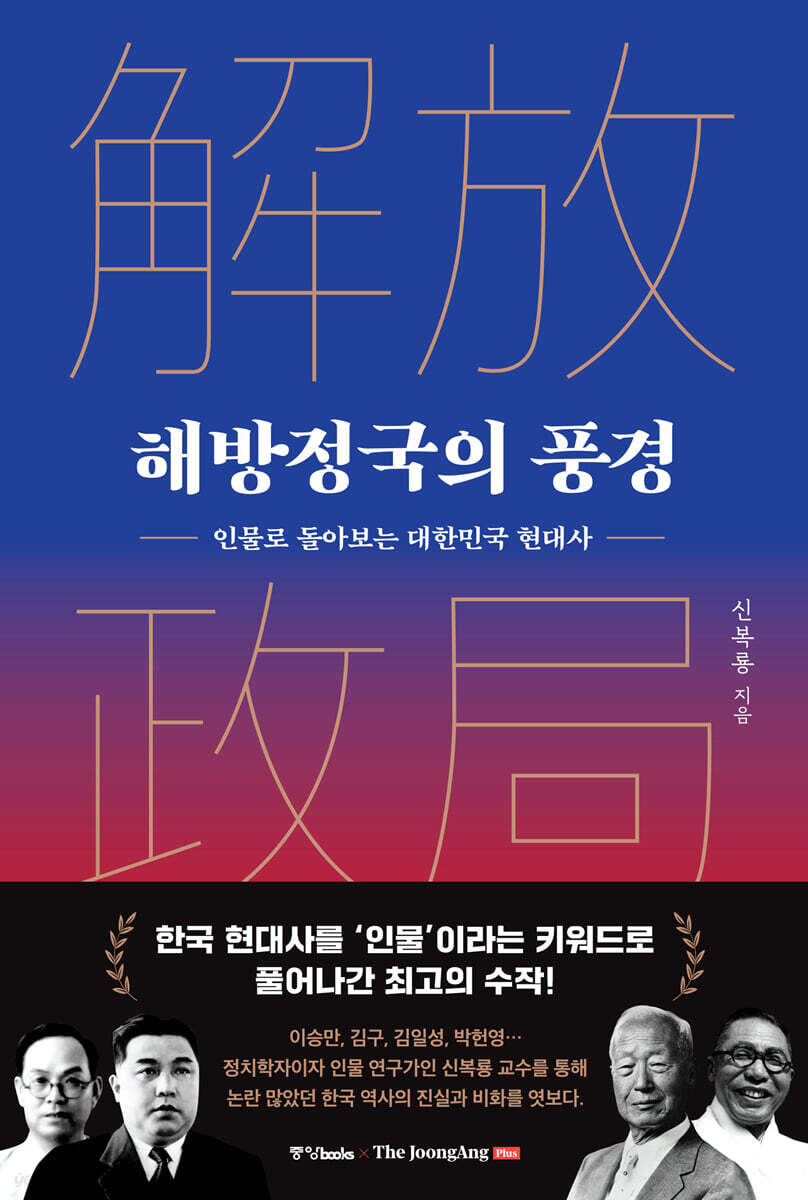
Scenery of the liberation period
 |
Description
Book Introduction
Professor Shin Bok-ryong, a leading political scientist and figure researcher of this era, has published a book titled “Landscape of the Liberation Period” (2024, Joongang Books), which explores modern Korean history through the keyword of “figures.”
This book introduces in detail anecdotes and incidents that occurred between figures representing the left, center, and right, such as Syngman Rhee, Kim Gu, Kim Il-sung, and Park Hon-yong, who influenced modern Korean history. Through meticulous analysis of these events, it provides a detailed look into the truth and hidden aspects of Korean history.
This book introduces in detail anecdotes and incidents that occurred between figures representing the left, center, and right, such as Syngman Rhee, Kim Gu, Kim Il-sung, and Park Hon-yong, who influenced modern Korean history. Through meticulous analysis of these events, it provides a detailed look into the truth and hidden aspects of Korean history.
- You can preview some of the book's contents.
Preview
index
introduction
At the beginning
Chapter 1: Liberation: A History That Doesn't Hold Us Responsible for the Fall of Our Nation
Chapter 2: World War II Exhibition Conference: The Dreams and Frustration of the Four Great Powers
Chapter 3: The Decision Process for the Division of the Korean Peninsula: Young Officers of the Three-Star Coordination Committee
Chapter 4: The Trusteeship Wave: The Bridge of No Return
Chapter 5: The Tragic Fate of the Moderates: Song Jin-woo
Chapter 6: Jang Deok-su's Novel-like Life
Chapter 7: The US-Soviet Joint Commission: General Hodge's Dreams and Ambitions
Chapter 8: The Dreams and Frustration of Yeo Un-hyeong and Kim Kyu-sik (1): The Japanese Colonial Period and the Liberation Period
Chapter 9: The Dreams and Frustration of Yeo Un-hyeong and Kim Kyu-sik (2): Victims of Left-Right Collaboration
Chapter 10: The Meeting and Parting of Syngman Rhee and Kim Gu (1): 30 Years of Eunwon and the Provisional Government
Chapter 11: The Meeting and Parting of Syngman Rhee and Kim Gu (2): The Conflict Surrounding the Sole Government
Chapter 12: Baek Gwan-su: A Patriot's Stained Life
Chapter 13: The Pro-Japanese Debate: The Karma We Must Shake Off
Chapter 14: Park Hon-yong: A Communist's Love and Ambition
Chapter 15: The Truth Behind the Kim Il-sung Myth (1): The Birth of a Young Marxist
Chapter 16: Three Tragedies (1): The Daegu Incident
Chapter 17: North-South Negotiations (1): Kim Gu and Kim Il-sung's Different Calculations
Chapter 18: Inter-Korean Negotiations (2): The Man Who Never Returned, Hong Myung-hee
Chapter 19: Inter-Korean Negotiations (3): Those Who Did Not Return, Baek Nam-un and Lee Geuk-ro
Chapter 20: A Story of Taking a Breath and Taking a Break
Chapter 21: Three Tragedies (2): The Jeju April 3 Incident
Chapter 22: Three Tragedies (3): The Yeosu-Suncheon Incident
Chapter 23: The Truth Behind the Kim Il-sung Myth (2): The Korean War
Chapter 24: The Mystery of the Korean War: Was It an American Trap?
Chapter 25: MacArthur: "America's Caesar"
Chapter 26: Mao Zedong, Who Buries His Children in His Heart
Chapter 27 Armistice Talks (1): There is no war without regrets.
Chapter 28: Armistice Talks (2): Behind the Scenes with the Secret Envoys
Chapter 29 Armistice Talks (3): The Reality of the Northern Limit Line (NLL)
Chapter 30: The Haewon of Jobongam in Juksan
Chapter 31: Fictions Surrounding the Unification Discussion
Chapter 32: What Hinders Unification?
index
At the beginning
Chapter 1: Liberation: A History That Doesn't Hold Us Responsible for the Fall of Our Nation
Chapter 2: World War II Exhibition Conference: The Dreams and Frustration of the Four Great Powers
Chapter 3: The Decision Process for the Division of the Korean Peninsula: Young Officers of the Three-Star Coordination Committee
Chapter 4: The Trusteeship Wave: The Bridge of No Return
Chapter 5: The Tragic Fate of the Moderates: Song Jin-woo
Chapter 6: Jang Deok-su's Novel-like Life
Chapter 7: The US-Soviet Joint Commission: General Hodge's Dreams and Ambitions
Chapter 8: The Dreams and Frustration of Yeo Un-hyeong and Kim Kyu-sik (1): The Japanese Colonial Period and the Liberation Period
Chapter 9: The Dreams and Frustration of Yeo Un-hyeong and Kim Kyu-sik (2): Victims of Left-Right Collaboration
Chapter 10: The Meeting and Parting of Syngman Rhee and Kim Gu (1): 30 Years of Eunwon and the Provisional Government
Chapter 11: The Meeting and Parting of Syngman Rhee and Kim Gu (2): The Conflict Surrounding the Sole Government
Chapter 12: Baek Gwan-su: A Patriot's Stained Life
Chapter 13: The Pro-Japanese Debate: The Karma We Must Shake Off
Chapter 14: Park Hon-yong: A Communist's Love and Ambition
Chapter 15: The Truth Behind the Kim Il-sung Myth (1): The Birth of a Young Marxist
Chapter 16: Three Tragedies (1): The Daegu Incident
Chapter 17: North-South Negotiations (1): Kim Gu and Kim Il-sung's Different Calculations
Chapter 18: Inter-Korean Negotiations (2): The Man Who Never Returned, Hong Myung-hee
Chapter 19: Inter-Korean Negotiations (3): Those Who Did Not Return, Baek Nam-un and Lee Geuk-ro
Chapter 20: A Story of Taking a Breath and Taking a Break
Chapter 21: Three Tragedies (2): The Jeju April 3 Incident
Chapter 22: Three Tragedies (3): The Yeosu-Suncheon Incident
Chapter 23: The Truth Behind the Kim Il-sung Myth (2): The Korean War
Chapter 24: The Mystery of the Korean War: Was It an American Trap?
Chapter 25: MacArthur: "America's Caesar"
Chapter 26: Mao Zedong, Who Buries His Children in His Heart
Chapter 27 Armistice Talks (1): There is no war without regrets.
Chapter 28: Armistice Talks (2): Behind the Scenes with the Secret Envoys
Chapter 29 Armistice Talks (3): The Reality of the Northern Limit Line (NLL)
Chapter 30: The Haewon of Jobongam in Juksan
Chapter 31: Fictions Surrounding the Unification Discussion
Chapter 32: What Hinders Unification?
index
Detailed image
.jpg)
Into the book
When we explain the conflict during the liberation period, we say that the conflict between the left and right led to tragedy, but I think a little differently.
What I am noticing is that the conflict within the left and right wings was more serious, more hostile, and more brutal than the conflict between the left and right, and this actually drove the liberation period down a more tragic path.
With the exception of Mongyang, most of the victims of the liberation period were not killed by ideologically opposing forces, but rather the right wing died at the hands of the right wing, and the left wing died at the hands of the left wing.
Why did this happen? The reason is simple.
This was because, even within the same ideological group, they were caught up in extreme dogmas and immature ideologies that viewed moderates as betrayers, defectors, or opportunists.
In this respect, I believe that the issues of ideology and policy during the liberation period were exaggerated by the parties involved and later historians.
Therefore, in a liberation situation like Nanma, Goh Ha-na, Seol-san, and Mong-yang, who insisted that “we should not think about the issue of trusteeship only with our hearts, but think about it wisely with composure and reason,” were sacrificed due to the crossfire from the left and right.
--- p.80~81
Some people who admire Kim Gu now openly say, “Syngman Rhee killed Kim Gu,” and Syngman Rhee’s side, not to be outdone, believes, “Kim Gu killed Jang Deok-su and Yeo Un-hyeong.”
It is not so easy to reveal this truth.
But one thing is clear: the motive behind the assassination is inherently vague, and such conflicts and friction can be painful to some and bring joy to others.
It should be covered here.
--- p.90
The political aspect of turbulent times is “running.”
Whether it is to the right or the left, if you want to appeal to the people amidst the noise of passion, you have to shout loudly first.
Even in such a situation, there are groups that observe the situation, do not give up their ambitions, and are cautious in their actions. In the liberation period, they are called moderates.
The US military government, which had heard the term “moderate” but was unfamiliar with the term “middle-of-the-road,” looked at them with suspicion, suspecting them of being “wobblers.”
First of all, it was difficult for Americans to tell whether they were “pink” or “blue.”
During the day it looked like a mosquito, and at night it looked like a mosquito, or vice versa.
--- p.115
In this situation, the first issue that caused conflict between Syngman Rhee and Kim Gu was, as is commonly known, money.
During the three months that Syngman Rhee served as president in Shanghai, the provisional government's greatest expectations of him were for funds for the independence movement.
Syngman Rhee also gave a statement that he could take responsibility for the matter.
There were donations from Koreans living in Hawaii and the eastern United States, but they amounted to only "small change," and even Syngman Rhee himself was not well off. (Seo Jae-pil's testimony) His official contribution to the provisional government was limited to $200.
Based on purchasing power, one dollar at that time was equivalent to about 20,000 won today.
This was not because Syngman Rhee neglected the Provisional Government, but because he himself was living a difficult life and was not in a position to provide financial support to the Provisional Government.
--- p.141~142
After my paper on Kim Il-sung's fake controversy was published, I suffered a lot.
Many readers of my writing commented that it was “precarious,” and now the accident has finally happened.
Soon, the phrase, “Professor Lee Myung-young of Sungkyunkwan University, who consistently claimed that Kim Il-sung was a fake, was an agent of the Central Intelligence Agency,” became a writing disaster.
To be exact, Lee Myung-young was not a KCIA agent, and it was my mistake to write without checking the stories that were circulating in some media and on the Internet.
From the perspective of the bereaved family, I can understand why they would feel offended by the record that their ancestor was an agent of the Central Intelligence Agency, but I was deeply disturbed when I heard that it could be considered defamation of the deceased.
--- p.246
While Japan was busy with post-war reconstruction, the Korean War broke out on June 25, 1950.
When the news of the outbreak of war reached Pacific Command, MacArthur's adjutants did not even wake him from his sleep.
Because fighting was always a thing. (M.
Higgins, 1951, p.
15) On the morning of June 29, he arrived at Suwon (Osan) Airport and immediately inspected the front line on the southern shore of the Han River.
And then he muttered this.
“If Korea becomes communist, what will happen to Japan?” (“And what of Japan?” Reminiscences, p.
333)
--- p.395
The delay in unification between North and South Korea is not due to the remnants of the Cold War, the conflicting interests of the great powers, or the ideological differences, but rather to the weak will of the ruling classes in both Koreas, their conflicting interests, corruption, and an unfair economic structure.
There is no historical example of a corrupt regime achieving unification.
Therefore, unification will not come easily in a situation where politics and the economy are so corrupt.
According to the lessons of history, national history generally consists of periods of 500 years of unification followed by 100 years of division.
In other words, Korea's division will last for about 100 years.
However, there is also a possibility that Korean unification will come “suddenly.”
This does not mean unification through South Korea's victory in the competition between systems or the collapse of North Korea, but rather the contingency of history.
What I am noticing is that the conflict within the left and right wings was more serious, more hostile, and more brutal than the conflict between the left and right, and this actually drove the liberation period down a more tragic path.
With the exception of Mongyang, most of the victims of the liberation period were not killed by ideologically opposing forces, but rather the right wing died at the hands of the right wing, and the left wing died at the hands of the left wing.
Why did this happen? The reason is simple.
This was because, even within the same ideological group, they were caught up in extreme dogmas and immature ideologies that viewed moderates as betrayers, defectors, or opportunists.
In this respect, I believe that the issues of ideology and policy during the liberation period were exaggerated by the parties involved and later historians.
Therefore, in a liberation situation like Nanma, Goh Ha-na, Seol-san, and Mong-yang, who insisted that “we should not think about the issue of trusteeship only with our hearts, but think about it wisely with composure and reason,” were sacrificed due to the crossfire from the left and right.
--- p.80~81
Some people who admire Kim Gu now openly say, “Syngman Rhee killed Kim Gu,” and Syngman Rhee’s side, not to be outdone, believes, “Kim Gu killed Jang Deok-su and Yeo Un-hyeong.”
It is not so easy to reveal this truth.
But one thing is clear: the motive behind the assassination is inherently vague, and such conflicts and friction can be painful to some and bring joy to others.
It should be covered here.
--- p.90
The political aspect of turbulent times is “running.”
Whether it is to the right or the left, if you want to appeal to the people amidst the noise of passion, you have to shout loudly first.
Even in such a situation, there are groups that observe the situation, do not give up their ambitions, and are cautious in their actions. In the liberation period, they are called moderates.
The US military government, which had heard the term “moderate” but was unfamiliar with the term “middle-of-the-road,” looked at them with suspicion, suspecting them of being “wobblers.”
First of all, it was difficult for Americans to tell whether they were “pink” or “blue.”
During the day it looked like a mosquito, and at night it looked like a mosquito, or vice versa.
--- p.115
In this situation, the first issue that caused conflict between Syngman Rhee and Kim Gu was, as is commonly known, money.
During the three months that Syngman Rhee served as president in Shanghai, the provisional government's greatest expectations of him were for funds for the independence movement.
Syngman Rhee also gave a statement that he could take responsibility for the matter.
There were donations from Koreans living in Hawaii and the eastern United States, but they amounted to only "small change," and even Syngman Rhee himself was not well off. (Seo Jae-pil's testimony) His official contribution to the provisional government was limited to $200.
Based on purchasing power, one dollar at that time was equivalent to about 20,000 won today.
This was not because Syngman Rhee neglected the Provisional Government, but because he himself was living a difficult life and was not in a position to provide financial support to the Provisional Government.
--- p.141~142
After my paper on Kim Il-sung's fake controversy was published, I suffered a lot.
Many readers of my writing commented that it was “precarious,” and now the accident has finally happened.
Soon, the phrase, “Professor Lee Myung-young of Sungkyunkwan University, who consistently claimed that Kim Il-sung was a fake, was an agent of the Central Intelligence Agency,” became a writing disaster.
To be exact, Lee Myung-young was not a KCIA agent, and it was my mistake to write without checking the stories that were circulating in some media and on the Internet.
From the perspective of the bereaved family, I can understand why they would feel offended by the record that their ancestor was an agent of the Central Intelligence Agency, but I was deeply disturbed when I heard that it could be considered defamation of the deceased.
--- p.246
While Japan was busy with post-war reconstruction, the Korean War broke out on June 25, 1950.
When the news of the outbreak of war reached Pacific Command, MacArthur's adjutants did not even wake him from his sleep.
Because fighting was always a thing. (M.
Higgins, 1951, p.
15) On the morning of June 29, he arrived at Suwon (Osan) Airport and immediately inspected the front line on the southern shore of the Han River.
And then he muttered this.
“If Korea becomes communist, what will happen to Japan?” (“And what of Japan?” Reminiscences, p.
333)
--- p.395
The delay in unification between North and South Korea is not due to the remnants of the Cold War, the conflicting interests of the great powers, or the ideological differences, but rather to the weak will of the ruling classes in both Koreas, their conflicting interests, corruption, and an unfair economic structure.
There is no historical example of a corrupt regime achieving unification.
Therefore, unification will not come easily in a situation where politics and the economy are so corrupt.
According to the lessons of history, national history generally consists of periods of 500 years of unification followed by 100 years of division.
In other words, Korea's division will last for about 100 years.
However, there is also a possibility that Korean unification will come “suddenly.”
This does not mean unification through South Korea's victory in the competition between systems or the collapse of North Korea, but rather the contingency of history.
--- p.532
Publisher's Review
Through the period of liberation, when ideological conflict was at its most extreme in modern Korean history,
A book that once again reflects the mirror of history, both sorrowful and brilliant!
The liberation period, which is the title of this book, was the period in modern Korean history when ideological conflict was most severe.
In Korean history, this period is usually considered modern history.
The author explains in the book that the period of the US military government in Korea (1945-1948) was in fact no freer or more sovereign than the Japanese Resident-General’s regime from 1907 to 1910.
Under the firm policy of the four major powers to “liberate but not grant independence,” Korea was called a semi-colony of the United States.
Then, the Republic of Korea was established, but the Korean War soon broke out.
The era of the "Republican Army" ruling for about three months began, and this continued until March 1952, when the "Winter Evacuation" (January 4th Retreat) ended after the Chinese army withdrew from the war.
South Korea regained its sovereignty, but in the process, it went through Japan, the US military government, South Korea, the so-called People's Republic of Korea (North Korea), and the commander of the US 8th Army (the commander of the UN forces), and then became a country ruled by South Korea again.
The ruling power changed six times, and the author says that there has never been a generation with such a strong fate in modern history, and that the ten years experienced during this period would be a novel to anyone, and that it is the whole story of the Korean War that is difficult to finish even if you talk about it all night.
The author, now well into his eighties, finally reveals through this book what he could not say in lectures or research papers.
The author points out that the tragedy of modern Korean history was ultimately the result of human karma, and that only a portion of it can be filled with contingency theory.
In turbulent times, ideologies, systems, and the influence of powerful nations may have swayed the world, but in any era, people have always been the independent variable, and this book deals with those very people, the key figures of modern history.
Readers who have seen the documentary film "National Foundation War" (2024), which recently created a stir and highlighted the sacrifices and struggles of President Syngman Rhee and the first generation of founding members, can get a glimpse of the vivid situation at the time and the author's unique analysis of the first generation of founding members, including President Syngman Rhee and Kim Gu, through this book.
The author points out in the book that Syngman Rhee and Kim Gu showed many differences in their perception of reality.
Kim Gu realized that the weak popular support base made it impossible to build a nation through popular uprising or support, and it is said that his expectation of the effectiveness of individual terrorists armed with a martyr's spirit of sacrifice, such as Yun Bong-gil and Lee Bong-chang, led him to devote himself to terrorism.
This analysis may be met with backlash from those who admire Kim Gu, but the author states that the academic definition of terrorism is "a method of struggle in which individual fighters armed with martyr-like patriotism launch armed attacks on enemy forces in situations where organized struggle is impossible due to lack of funds or training, thereby instilling fear in the enemy forces."
Scholars specializing in the history of the Korean independence movement also refer to this as a "righteous struggle," adding the interesting opinion that it is not fundamentally much different from terrorism.
In the movie “The War of National Foundation” (2024), there is a line that says, “The revolution happened because Syngman Rhee was a democrat.”
The author asks, "If the historical assessment changes like that, who will be able to comfort the 150 souls buried in Suyuri?"
History shows that all politicians have made both mistakes and merits, but that doesn't mean that merits cover up mistakes.
However, the author says that what admirers of Syngman Rhee and Kim Gu should do now is not to hold anyone accountable, but rather to prioritize reconciliation between the descendants of both sides and resistance against the left.
The author's wish is to see Syngman Rhee and Kim Gu send each other invitations on their anniversary, and to see them return the favor with flowers.
A hot topic that caused a lot of controversy among the media a dozen years ago,
Newly published ahead of the 80th anniversary of liberation in 2025
This book was originally serialized in Weekly Chosun in 2015 to commemorate the 70th anniversary of liberation, and the first edition was published in 2017. The original edition was out of print, but has now been republished by Joongang Books.
The author reports that while he was serializing the work, he was under fire from both the left and right wings.
Right-wingers attacked the author as a communist, while left-wingers commented that he was a parasite on conservative newspapers.
When dealing with sensitive issues such as the Daegu Incident, the Yeosu-Suncheon Incident, the Jeju April 3 Incident, and the truth of Kim Il-sung's anti-Japanese struggle and the fake controversy, the Weekly Chosun desk asked the author to revise the terminology because the article showed a somewhat leftist tone, which was different from the position of the Chosun Ilbo.
In the end, the series ended with 17 episodes without an end.
The year 2025 will soon mark the 80th anniversary of liberation.
As 2025 approaches, the author has the opportunity to serialize his controversial manuscript online at Dajungang Plus and republish it in book form.
This book stands slightly outside the mainstream debates of historical scholarship, capturing aspects of the liberation period that cannot be discussed in textbooks, research papers, or classrooms.
The author states in this book that his devotion to studying the liberation period is not the result of great anguish, nor is it due to ideological rigidity or partisanship. It is simply a simple and humble wish, namely, the question of why the liberation period collapsed.
He says that he has spent decades holding onto this topic without even the power of thought, believing that the karma of division lies at the root of Korea's 5,000-year history, including the fall of the nation, Japanese colonial rule, liberation, the Korean War, and the present grim reality.
The author says that looking back on that era in the present situation, 80 years before liberation and division, is based on the fact that history has not changed much between then and now, and is therefore simply based on the 'desire to adjust one's appearance in front of the mirror.'
As the author hopes, readers of this book will also be able to properly reflect on the liberation period and, as living beings in the present-day Republic of Korea, discover its true historical meaning.
A book that once again reflects the mirror of history, both sorrowful and brilliant!
The liberation period, which is the title of this book, was the period in modern Korean history when ideological conflict was most severe.
In Korean history, this period is usually considered modern history.
The author explains in the book that the period of the US military government in Korea (1945-1948) was in fact no freer or more sovereign than the Japanese Resident-General’s regime from 1907 to 1910.
Under the firm policy of the four major powers to “liberate but not grant independence,” Korea was called a semi-colony of the United States.
Then, the Republic of Korea was established, but the Korean War soon broke out.
The era of the "Republican Army" ruling for about three months began, and this continued until March 1952, when the "Winter Evacuation" (January 4th Retreat) ended after the Chinese army withdrew from the war.
South Korea regained its sovereignty, but in the process, it went through Japan, the US military government, South Korea, the so-called People's Republic of Korea (North Korea), and the commander of the US 8th Army (the commander of the UN forces), and then became a country ruled by South Korea again.
The ruling power changed six times, and the author says that there has never been a generation with such a strong fate in modern history, and that the ten years experienced during this period would be a novel to anyone, and that it is the whole story of the Korean War that is difficult to finish even if you talk about it all night.
The author, now well into his eighties, finally reveals through this book what he could not say in lectures or research papers.
The author points out that the tragedy of modern Korean history was ultimately the result of human karma, and that only a portion of it can be filled with contingency theory.
In turbulent times, ideologies, systems, and the influence of powerful nations may have swayed the world, but in any era, people have always been the independent variable, and this book deals with those very people, the key figures of modern history.
Readers who have seen the documentary film "National Foundation War" (2024), which recently created a stir and highlighted the sacrifices and struggles of President Syngman Rhee and the first generation of founding members, can get a glimpse of the vivid situation at the time and the author's unique analysis of the first generation of founding members, including President Syngman Rhee and Kim Gu, through this book.
The author points out in the book that Syngman Rhee and Kim Gu showed many differences in their perception of reality.
Kim Gu realized that the weak popular support base made it impossible to build a nation through popular uprising or support, and it is said that his expectation of the effectiveness of individual terrorists armed with a martyr's spirit of sacrifice, such as Yun Bong-gil and Lee Bong-chang, led him to devote himself to terrorism.
This analysis may be met with backlash from those who admire Kim Gu, but the author states that the academic definition of terrorism is "a method of struggle in which individual fighters armed with martyr-like patriotism launch armed attacks on enemy forces in situations where organized struggle is impossible due to lack of funds or training, thereby instilling fear in the enemy forces."
Scholars specializing in the history of the Korean independence movement also refer to this as a "righteous struggle," adding the interesting opinion that it is not fundamentally much different from terrorism.
In the movie “The War of National Foundation” (2024), there is a line that says, “The revolution happened because Syngman Rhee was a democrat.”
The author asks, "If the historical assessment changes like that, who will be able to comfort the 150 souls buried in Suyuri?"
History shows that all politicians have made both mistakes and merits, but that doesn't mean that merits cover up mistakes.
However, the author says that what admirers of Syngman Rhee and Kim Gu should do now is not to hold anyone accountable, but rather to prioritize reconciliation between the descendants of both sides and resistance against the left.
The author's wish is to see Syngman Rhee and Kim Gu send each other invitations on their anniversary, and to see them return the favor with flowers.
A hot topic that caused a lot of controversy among the media a dozen years ago,
Newly published ahead of the 80th anniversary of liberation in 2025
This book was originally serialized in Weekly Chosun in 2015 to commemorate the 70th anniversary of liberation, and the first edition was published in 2017. The original edition was out of print, but has now been republished by Joongang Books.
The author reports that while he was serializing the work, he was under fire from both the left and right wings.
Right-wingers attacked the author as a communist, while left-wingers commented that he was a parasite on conservative newspapers.
When dealing with sensitive issues such as the Daegu Incident, the Yeosu-Suncheon Incident, the Jeju April 3 Incident, and the truth of Kim Il-sung's anti-Japanese struggle and the fake controversy, the Weekly Chosun desk asked the author to revise the terminology because the article showed a somewhat leftist tone, which was different from the position of the Chosun Ilbo.
In the end, the series ended with 17 episodes without an end.
The year 2025 will soon mark the 80th anniversary of liberation.
As 2025 approaches, the author has the opportunity to serialize his controversial manuscript online at Dajungang Plus and republish it in book form.
This book stands slightly outside the mainstream debates of historical scholarship, capturing aspects of the liberation period that cannot be discussed in textbooks, research papers, or classrooms.
The author states in this book that his devotion to studying the liberation period is not the result of great anguish, nor is it due to ideological rigidity or partisanship. It is simply a simple and humble wish, namely, the question of why the liberation period collapsed.
He says that he has spent decades holding onto this topic without even the power of thought, believing that the karma of division lies at the root of Korea's 5,000-year history, including the fall of the nation, Japanese colonial rule, liberation, the Korean War, and the present grim reality.
The author says that looking back on that era in the present situation, 80 years before liberation and division, is based on the fact that history has not changed much between then and now, and is therefore simply based on the 'desire to adjust one's appearance in front of the mirror.'
As the author hopes, readers of this book will also be able to properly reflect on the liberation period and, as living beings in the present-day Republic of Korea, discover its true historical meaning.
GOODS SPECIFICS
- Date of issue: August 15, 2024
- Page count, weight, size: 548 pages | 152*225*35mm
- ISBN13: 9788927880561
- ISBN10: 8927880560
You may also like
카테고리
korean


korean

![GQ KOREA Mark (Monthly): December [2025]](http://librairie.coreenne.fr/cdn/shop/files/8ef265dbbfbf186523ed75ba7319009d.jpg?v=1765340328&width=3840)


