

Japanese History Citizens' Lecture
 |
Description
Book Introduction
Reading Japanese history as a ‘method’
Observing history through systematic understanding and sound criticism beyond emotions
The first public lecture on Japanese history in one book!
A neighboring country that has become part of our daily lives through travel, food, and popular culture.
They are fated rivals who cannot even lose at 'rock-paper-scissors' because they share the bitter history of colonial experience.
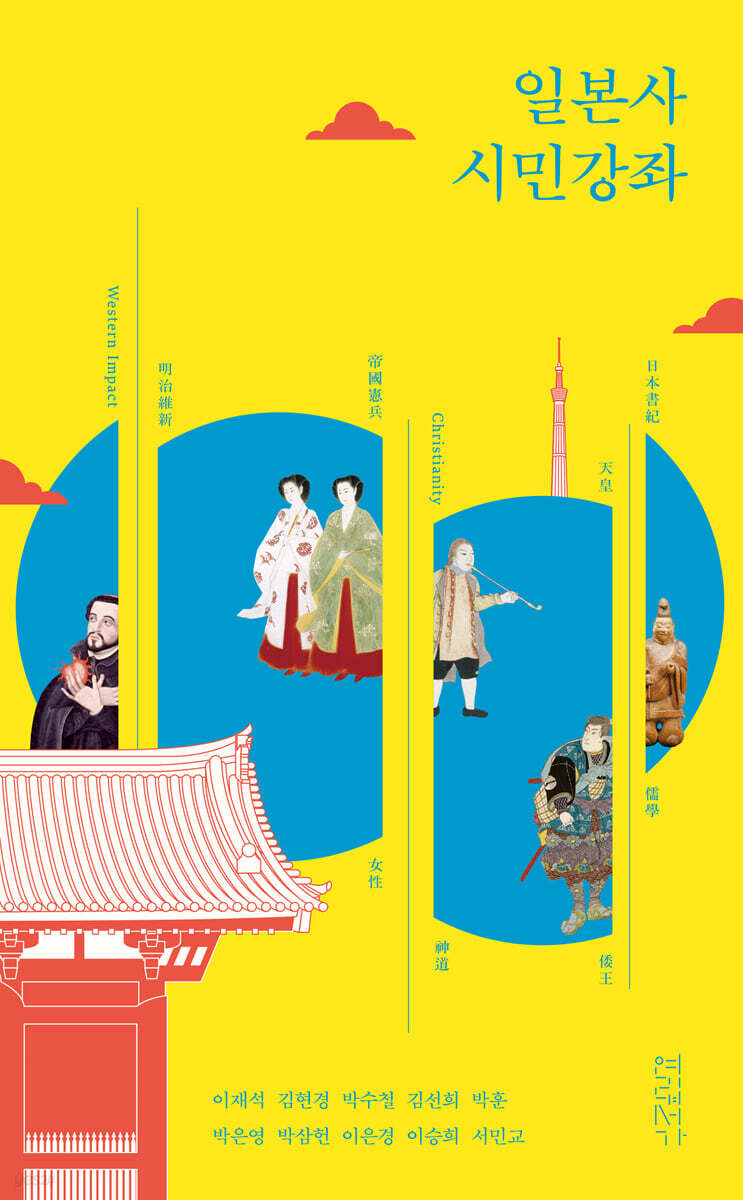
Despite our fervent interest, entwined with curiosity and discomfort, how much of a sobering understanding do we have of Japan's history? With this question in mind, the first "full-fledged" public lecture on Japanese history, co-hosted by the Japan History Society and the Kyunghyang Shinmun Humanities Research Institute in the fall of 2022, was compiled into a book.
The first study method suggested by the ten instructors is not the burdensome chronological reading of the entire text, but rather an in-depth reading of Japanese history that expands on specific areas of interest.
So, this book begins with the ancient history of relations between the two countries, which became the prototype of the bickering Korea-Japan relationship, and explores the historical meaning of the titles "Emperor" and "King of Wa," which are hot topics.
We examine the turbulent early modern Japan, sparked by guns and silver amidst a major global shift, and examine how Confucianism and Christianity developed in Japan compared to our own.
In addition, we set the milestone of the 'Meiji Restoration', which became the starting point of all present, and examine the situation in Japan thereafter through keywords such as the imperial system, women's movement, colonial rule strategy, war, and genocide.
The second proposal of the "Citizens' Lecture on Japanese History" is to read Japanese history as a "method," understanding Japanese history as a source of knowledge for understanding certain objects and situations.
Study methods like the above go beyond simply learning about the history of neighboring countries, providing an intellectual experience that expands our understanding of ourselves, Asia, and the world.
The ten instructors' fascinating topics, presented like a menu of "omakase" courses at a Japanese restaurant, will provide a reading experience that creates a virtuous cycle of interest and learning for citizens who wish to observe Korea-Japan relations wisely and critically through objective historical awareness.
Observing history through systematic understanding and sound criticism beyond emotions
The first public lecture on Japanese history in one book!
A neighboring country that has become part of our daily lives through travel, food, and popular culture.
They are fated rivals who cannot even lose at 'rock-paper-scissors' because they share the bitter history of colonial experience.
Despite our fervent interest, entwined with curiosity and discomfort, how much of a sobering understanding do we have of Japan's history? With this question in mind, the first "full-fledged" public lecture on Japanese history, co-hosted by the Japan History Society and the Kyunghyang Shinmun Humanities Research Institute in the fall of 2022, was compiled into a book.
The first study method suggested by the ten instructors is not the burdensome chronological reading of the entire text, but rather an in-depth reading of Japanese history that expands on specific areas of interest.
So, this book begins with the ancient history of relations between the two countries, which became the prototype of the bickering Korea-Japan relationship, and explores the historical meaning of the titles "Emperor" and "King of Wa," which are hot topics.
We examine the turbulent early modern Japan, sparked by guns and silver amidst a major global shift, and examine how Confucianism and Christianity developed in Japan compared to our own.
In addition, we set the milestone of the 'Meiji Restoration', which became the starting point of all present, and examine the situation in Japan thereafter through keywords such as the imperial system, women's movement, colonial rule strategy, war, and genocide.
The second proposal of the "Citizens' Lecture on Japanese History" is to read Japanese history as a "method," understanding Japanese history as a source of knowledge for understanding certain objects and situations.
Study methods like the above go beyond simply learning about the history of neighboring countries, providing an intellectual experience that expands our understanding of ourselves, Asia, and the world.
The ten instructors' fascinating topics, presented like a menu of "omakase" courses at a Japanese restaurant, will provide a reading experience that creates a virtuous cycle of interest and learning for citizens who wish to observe Korea-Japan relations wisely and critically through objective historical awareness.
- You can preview some of the book's contents.
Preview
index
Starting a Citizens' Lecture on Japanese History
Lecture 1: The Original Landscape of Korea-Japan Relations in Ancient History | Lee Jae-seok
Chapter 2: Between the King and the Emperor | Kim Hyeon-gyeong
Episode 3: "The Warring States Period": A Story of Guns and Silver | Park Soo-chul
Four Samurai Swordsman Talks About Studying Abroad | Kim Seon-hee
Lesson 5: What was the Meiji Restoration? | Park Hoon
Lecture 6: Why Don't Japanese People Believe in Christianity? | Eunyoung Park
Lecture 7: Modern Emperors and Imperial Politics | Park Sam-heon
The Struggles of Modern Japanese Women: A Brief History of the Eighth Quarterfinals | Lee Eun-kyung
The Imperial Military Police Rule Colonial Joseon | Lee Seung-hee
Lecture 10: Why Innocent Lives Must Be Lost in War | Seo Min-kyo
Search
Source of the illustration
Lecture 1: The Original Landscape of Korea-Japan Relations in Ancient History | Lee Jae-seok
Chapter 2: Between the King and the Emperor | Kim Hyeon-gyeong
Episode 3: "The Warring States Period": A Story of Guns and Silver | Park Soo-chul
Four Samurai Swordsman Talks About Studying Abroad | Kim Seon-hee
Lesson 5: What was the Meiji Restoration? | Park Hoon
Lecture 6: Why Don't Japanese People Believe in Christianity? | Eunyoung Park
Lecture 7: Modern Emperors and Imperial Politics | Park Sam-heon
The Struggles of Modern Japanese Women: A Brief History of the Eighth Quarterfinals | Lee Eun-kyung
The Imperial Military Police Rule Colonial Joseon | Lee Seung-hee
Lecture 10: Why Innocent Lives Must Be Lost in War | Seo Min-kyo
Search
Source of the illustration
Into the book
If someone were to ask me, "What on earth is Japan?", I would say that Japan is both the object of study and the "method" itself.
Through Japanese studies, we can talk about Japan, but we can also talk about Korea, and through Japan, we can talk about Asia and the world.
Japan is a material for understanding a certain subject.
To make something a subject of perception or a method of study like this, interest and curiosity are required.
When interest and curiosity arise, you look at it for a long time, pay attention, and take a step further and observe it in detail.
In academic terms, observing can be expressed as ‘studying.’
As you research, your interests and curiosity will branch out into other fields, and through further observation and observation, the scope of your research will expand.
A virtuous cycle will be created where interest and study lead to each other.
--- p.17
If we look for the original landscape of Korea-Japan relations today, we can find it in the relationship between Silla and Japan in the 8th and 9th centuries.
So, in the first lecture, I'm going to talk about the relationship between Silla and Japan.
The two keywords that characterized the relationship between Silla and Japan at that time were ‘self-respect’ and ‘exchange.’
It's the same now.
There is a sense of rivalry between Korea and Japan, where they do not compromise their pride and do not want to lose to each other.
On the one hand, the two countries look to each other as a stimulant.
The relationship between Korea and Japan holds considerable weight in both Korean and Japanese history.
This is because both Korea and Japan can confirm their own country's true nature and appearance through their related history.
The study of relationship history is not simply about studying the relationship between A and B; it is also an important methodology that allows us to reflect on ourselves through the other person.
--- p.33~34
What would be an appropriate title for the Japanese monarch? Frankly, it's a difficult question.
Because each person's choice will be different depending on their situation.
However, in the second lecture, we will leave aside the question of whether or not we should use the title of Emperor, and consider whether the title truly carries the meaning of God or the Emperor of Heaven, and what meaning the title of Emperor originally had.
(Omitted) Japan probably didn't use the title of Emperor from the beginning.
The title of emperor, the monarch, originated in ancient Japan, and before that, there was the title of king or 'Wa-wang'.
If we examine the process by which the title of the monarch changed in Japan, it will be a useful reference for us to consider how we should address the Japanese monarch.
--- p.80~81
The Sengoku period, known as the "long 16th century," was a time of great turmoil and change internally in Japan, but it was also a time of upheaval externally, marking the beginning of a major transformation in world history.
In this lecture, I would like to talk about these external changes that most Koreans may find somewhat unfamiliar.
What was happening in world history at the time when Japan was going through the Warring States period, and what impact did such changes in the external environment have on Japanese society?
The external stimuli that Japanese society received during this period are symbolized by 'guns' and 'silver'.
These two things brought about dramatic changes in Japanese society at the time.
So, let's take a look at what these changes mean historically.
--- p.132
One day, Ansai asked his disciples, “What would you do if China attacked Japan with Confucius as its leader and Mencius as its deputy?”
This is an extremely irreverent and bold idea that Joseon Confucian scholars would not dare to mention Confucius and Mencius in this way.
To his hesitant disciples, Ansai replied, “Fighting with all your might and taking Confucius and Mencius captive to repay the country’s kindness is the way of Confucius and Mencius.”
From these dialogues, we can see that within the Ansai school, the consciousness of their own country, Japan, was very strong.
It is easy to imagine that this consciousness would later develop into the perception that Japan was a special and superior country compared to other countries.
--- p.225
Some Japanese scholars even describe the Meiji Restoration as a "class suicide" by the samurai.
This is because lower-ranking samurai staged a revolution and seized power, but instead of establishing a new shogunate to replace the Edo shogunate, they abolished the samurai status itself in order to create a "nation-state" like Britain or France.
The Meiji Restoration was something close to a self-reform by the samurai themselves.
In this process, the participation of the general public was extremely limited.
Social change in Japan has been primarily driven by the elite, with the people accepting the changes later.
This is a characteristic of Japanese society that contrasts with Korean society.
--- p.311
In Japan, the concept of God as an 'absolute being' was relatively weak.
If we have to make a comparison, Koreans are accustomed to always living with an absolute heaven above their heads.
Toegye Yi Hwang taught that even when sitting alone in a room, one should maintain a correct posture and attitude because Heaven sees through everything.
But in Japan, they think that even if you do something shameful, no one will know unless you 'get caught' by someone.
It can be said that the concept of an absolute God in Christianity, a God who sees through even the sins committed in one's heart, was rare among the Japanese.
--- p.326
The photo of Emperor Meiji was taken again around September 1873.
There are quite a few changes since a year ago.
The first thing you notice is the change in clothing.
At this time, the spirit of the times emerged as "Shiksan hongeop," which aimed to "make Japan prosperous for once" by stimulating Japanese industry, and "Bukguk gangbyeong," which aimed to make the country rich and strengthen its military.
So, the Emperor, who embodies the ideal of a rich and powerful nation, no longer appears in traditional Japanese clothing but in military uniform.
Not only that, but I also cut my hair short.
In this way, the emperor had to justify his existence by reflecting the spirit of the times.
Another change is the handling of gaze.
The Emperor is showing a gaze directed at the person who will be looking at this photo.
This becomes more evident when placed side by side with the Empress's photo.
--- p.423
The fact that a six-year-old girl went abroad to study as part of a long-term national strategy that foresaw the next 100 years, and that upon her return, she performed brilliantly and lived up to the nation's expectations, is certainly worthy of being remembered as a success story of the Meiji government's reforms.
Or it could be used as an anecdote to illustrate the exceptional insight and foresight of a Meiji era politician.
However, when we hear this story from the Japanese government's perspective and from Umeko's perspective, the same incident can be read as a completely different narrative.
It's not just Umeko.
The Japanese government, which is comprised entirely of men, must have had roles and image that it expected and pursued for women.
But I wanted to see how real women reacted to such situations.
Furthermore, I would like to think about the history of modern Japan from the perspective of women at the time, rather than from the perspective of the government or men.
--- p.457
Although military police systems exist in many other countries, the unique characteristic of the Japanese military police system is that it uses the military police as a tool to rule over ruled regions and oppress the people of colonies.
After the Meiji Restoration, Japan adopted many institutions and systems from Western powers and, based on these, created its own unique system.
For example, there is the imperial system, which is similar to the monarchies of the Western powers, but also different.
The same goes for the military police system.
Japan modeled its military police system after France, but when this system was actually implemented in Japanese society, it changed considerably.
The Japanese army dreamed of imperial rule by military police.
And since it was in colonial Korea that Japan tested and developed its 'rule by military police,' it can be said that understanding the military police system that Japan operated in Korea is of significant significance.
--- p.516
‘War’ and the ‘genocide’ or ‘mass murder’ committed during the war are heavy topics that cannot be discussed lightly, but they are also very realistic and important topics.
Because even if you haven't experienced war firsthand, you must learn through the 'history of war' that war is a tragic event and that it must never be repeated in the real world.
The technical term for learning something vividly through history without experiencing it firsthand is 'experiencing it'.
I hope this lecture will serve as a kind of 're-experience' that raises awareness of 'war' and 'genocide.'
Through Japanese studies, we can talk about Japan, but we can also talk about Korea, and through Japan, we can talk about Asia and the world.
Japan is a material for understanding a certain subject.
To make something a subject of perception or a method of study like this, interest and curiosity are required.
When interest and curiosity arise, you look at it for a long time, pay attention, and take a step further and observe it in detail.
In academic terms, observing can be expressed as ‘studying.’
As you research, your interests and curiosity will branch out into other fields, and through further observation and observation, the scope of your research will expand.
A virtuous cycle will be created where interest and study lead to each other.
--- p.17
If we look for the original landscape of Korea-Japan relations today, we can find it in the relationship between Silla and Japan in the 8th and 9th centuries.
So, in the first lecture, I'm going to talk about the relationship between Silla and Japan.
The two keywords that characterized the relationship between Silla and Japan at that time were ‘self-respect’ and ‘exchange.’
It's the same now.
There is a sense of rivalry between Korea and Japan, where they do not compromise their pride and do not want to lose to each other.
On the one hand, the two countries look to each other as a stimulant.
The relationship between Korea and Japan holds considerable weight in both Korean and Japanese history.
This is because both Korea and Japan can confirm their own country's true nature and appearance through their related history.
The study of relationship history is not simply about studying the relationship between A and B; it is also an important methodology that allows us to reflect on ourselves through the other person.
--- p.33~34
What would be an appropriate title for the Japanese monarch? Frankly, it's a difficult question.
Because each person's choice will be different depending on their situation.
However, in the second lecture, we will leave aside the question of whether or not we should use the title of Emperor, and consider whether the title truly carries the meaning of God or the Emperor of Heaven, and what meaning the title of Emperor originally had.
(Omitted) Japan probably didn't use the title of Emperor from the beginning.
The title of emperor, the monarch, originated in ancient Japan, and before that, there was the title of king or 'Wa-wang'.
If we examine the process by which the title of the monarch changed in Japan, it will be a useful reference for us to consider how we should address the Japanese monarch.
--- p.80~81
The Sengoku period, known as the "long 16th century," was a time of great turmoil and change internally in Japan, but it was also a time of upheaval externally, marking the beginning of a major transformation in world history.
In this lecture, I would like to talk about these external changes that most Koreans may find somewhat unfamiliar.
What was happening in world history at the time when Japan was going through the Warring States period, and what impact did such changes in the external environment have on Japanese society?
The external stimuli that Japanese society received during this period are symbolized by 'guns' and 'silver'.
These two things brought about dramatic changes in Japanese society at the time.
So, let's take a look at what these changes mean historically.
--- p.132
One day, Ansai asked his disciples, “What would you do if China attacked Japan with Confucius as its leader and Mencius as its deputy?”
This is an extremely irreverent and bold idea that Joseon Confucian scholars would not dare to mention Confucius and Mencius in this way.
To his hesitant disciples, Ansai replied, “Fighting with all your might and taking Confucius and Mencius captive to repay the country’s kindness is the way of Confucius and Mencius.”
From these dialogues, we can see that within the Ansai school, the consciousness of their own country, Japan, was very strong.
It is easy to imagine that this consciousness would later develop into the perception that Japan was a special and superior country compared to other countries.
--- p.225
Some Japanese scholars even describe the Meiji Restoration as a "class suicide" by the samurai.
This is because lower-ranking samurai staged a revolution and seized power, but instead of establishing a new shogunate to replace the Edo shogunate, they abolished the samurai status itself in order to create a "nation-state" like Britain or France.
The Meiji Restoration was something close to a self-reform by the samurai themselves.
In this process, the participation of the general public was extremely limited.
Social change in Japan has been primarily driven by the elite, with the people accepting the changes later.
This is a characteristic of Japanese society that contrasts with Korean society.
--- p.311
In Japan, the concept of God as an 'absolute being' was relatively weak.
If we have to make a comparison, Koreans are accustomed to always living with an absolute heaven above their heads.
Toegye Yi Hwang taught that even when sitting alone in a room, one should maintain a correct posture and attitude because Heaven sees through everything.
But in Japan, they think that even if you do something shameful, no one will know unless you 'get caught' by someone.
It can be said that the concept of an absolute God in Christianity, a God who sees through even the sins committed in one's heart, was rare among the Japanese.
--- p.326
The photo of Emperor Meiji was taken again around September 1873.
There are quite a few changes since a year ago.
The first thing you notice is the change in clothing.
At this time, the spirit of the times emerged as "Shiksan hongeop," which aimed to "make Japan prosperous for once" by stimulating Japanese industry, and "Bukguk gangbyeong," which aimed to make the country rich and strengthen its military.
So, the Emperor, who embodies the ideal of a rich and powerful nation, no longer appears in traditional Japanese clothing but in military uniform.
Not only that, but I also cut my hair short.
In this way, the emperor had to justify his existence by reflecting the spirit of the times.
Another change is the handling of gaze.
The Emperor is showing a gaze directed at the person who will be looking at this photo.
This becomes more evident when placed side by side with the Empress's photo.
--- p.423
The fact that a six-year-old girl went abroad to study as part of a long-term national strategy that foresaw the next 100 years, and that upon her return, she performed brilliantly and lived up to the nation's expectations, is certainly worthy of being remembered as a success story of the Meiji government's reforms.
Or it could be used as an anecdote to illustrate the exceptional insight and foresight of a Meiji era politician.
However, when we hear this story from the Japanese government's perspective and from Umeko's perspective, the same incident can be read as a completely different narrative.
It's not just Umeko.
The Japanese government, which is comprised entirely of men, must have had roles and image that it expected and pursued for women.
But I wanted to see how real women reacted to such situations.
Furthermore, I would like to think about the history of modern Japan from the perspective of women at the time, rather than from the perspective of the government or men.
--- p.457
Although military police systems exist in many other countries, the unique characteristic of the Japanese military police system is that it uses the military police as a tool to rule over ruled regions and oppress the people of colonies.
After the Meiji Restoration, Japan adopted many institutions and systems from Western powers and, based on these, created its own unique system.
For example, there is the imperial system, which is similar to the monarchies of the Western powers, but also different.
The same goes for the military police system.
Japan modeled its military police system after France, but when this system was actually implemented in Japanese society, it changed considerably.
The Japanese army dreamed of imperial rule by military police.
And since it was in colonial Korea that Japan tested and developed its 'rule by military police,' it can be said that understanding the military police system that Japan operated in Korea is of significant significance.
--- p.516
‘War’ and the ‘genocide’ or ‘mass murder’ committed during the war are heavy topics that cannot be discussed lightly, but they are also very realistic and important topics.
Because even if you haven't experienced war firsthand, you must learn through the 'history of war' that war is a tragic event and that it must never be repeated in the real world.
The technical term for learning something vividly through history without experiencing it firsthand is 'experiencing it'.
I hope this lecture will serve as a kind of 're-experience' that raises awareness of 'war' and 'genocide.'
--- p.577
Publisher's Review
Japanese History Read Together by Citizens
Japanese history is a subject I'm curious about, but somehow it's difficult to approach.
The barrier to entry may be high, starting with long and difficult-to-pronounce names and terms, but above all, the psychological resistance associated with the uncomfortable past is great.
Park Hoon, the course planner and co-author, said that before leaving for Japan to study, he heard from his family elders, “Why are you learning ‘Japanese history?’”
“Among Korean citizens, there are those who think Japan is a disgusting country and do not want to look at its history, and those who, although it is an uncomfortable history, want to look back and understand why it came to be that way and study by taking a citizen’s course on Japanese history.
“If you were a Japanese person, which of these two people would you respect more?” (Page 257 of this book)
Readers who remember the magazine 『Korean History Citizens' Lecture』 (Iljogak, 1987-2012), which was published in 50 volumes over 25 years, will be familiar with the title of this book.
If the "Citizens' Lecture on Korean History" stated its intention to "share the research achievements and major issues of academia with the general public" and "understand history rationally and scientifically and present it as systematized knowledge," then the "Citizens' Lecture on Japanese History" can also be said to follow in that lineage, although it covers a different area.
There is no faster way to know a country than to understand and study its history.
Korea-Japan relations are still plagued by unresolved historical issues as well as political and economic conflicts.
However, 『Citizens' Lecture on Japanese History』 proposes a "new Japanese history" to be read together by citizens who wish to dispel vague hostility and untangle the tangled threads through objective understanding and proper criticism.
No more grammar! Approaching Japanese history through ten themes
Oda Nobunaga and Tokugawa Ieyasu, who commanded the Warring States period in the historical novel 『Daim』, Miyamoto Musashi, the swordsman (warrior) in the manga 『Vagabond』, Toyotomi Hideyoshi, the mastermind of the Imjin War, and Ito Hirobumi, the mastermind of the Japanese invasion…
Japanese history is often imprinted with superficial images of a few heroes in literature or popular culture, or problematic figures related to the Korean Peninsula.
Even when I occasionally try to study Japanese history through school lectures or books on Japanese history, the status, class, and political system that I don't see in Korean history, such as shoguns, emperors, daimyo, and samurai, seem unfamiliar.
Although they claim that the imperial bloodline has never been broken, even when we divide it into eras such as Asuka, Nara, Heian, Kamakura, Nanboku-cho, Sengoku, Muromachi, Momoyama, and Edo, it is more complex and numerous than ours, which often discourages the will to learn.
Therefore, rather than covering all eras in a general way, the 『Citizens' Lecture on Japanese History』 selected topics that Koreans are particularly interested in, but that should also be addressed as core topics when studying Japanese history in earnest.
The ten lectures are independent in content, reducing the burden of reading, while organically connecting them to depict the historical flow.
In the first lecture, which opens the lecture series, Jae-Seok Lee says, “Whether it is recent or distant history, the moment of remembering it is always the present and now,” and delves into the original landscape of Korea-Japan relations in ancient history, more than a thousand years ago.
However, when it comes to ancient Korean-Japanese history, it is a little different from the 'theory of advanced cultural inheritance' of Baekje that we always talk about (want to talk about).
The story of the rivalry between Silla and Japan, which maintained a honeymoon relationship when necessary even amidst a tense battle of pride, is presented through exciting events in historical materials.
In the second lecture, we delve into the issue of the title of "Japanese King," which has been the subject of much debate and controversy due to its connection to national sentiment.
The debate over whether he was the 'Emperor' or the 'Emperor of Japan' was also brought up in JTBC Newsroom's fact check, but rather than hastily giving an answer, Kim Hyun-kyung carefully traces the process in which the title, which started as 'King of Japan', changed into 'Emperor' as myths and history became intertwined and sometimes became entangled in relations with the outside world (China).
This interesting and concise summary of complex Japanese mythology for argument development is also a valuable appendix to the second lecture.
In Lecture 3, Park Soo-chul discusses the external stimuli received by 16th-century Japanese society, its responses, and the dramatic changes that followed.
The background is the 'Warring States Period', an era of warlords and rebellion, which has been depicted countless times as material for novels, movies, and dramas.
Although we can list characters such as Oda Nobunaga and Takeda Shingen, the main characters that drive the story are the 'gun (matchlock gun)' and 'silver' (its refining method).
These advanced civilizations were introduced through the West and Joseon, and this was possible because it was a time of great openness and not a period of isolation.
This speaks to the characteristics of the 'open society' of the Warring States period, when local power brokers competed freely.
In the fourth lecture, Kim Seon-hee, a researcher of Japanese intellectual history, travels to the Edo period to explain the conflicting images of sword-wielding warriors studying Confucian classics, a symbol of civil rule.
Confucianism, which originated in China, spread freely and in various forms through the Korean Peninsula (Joseon) and then to Japan, where it was considered a hobby or practicality, and especially had the characteristic of following the world.
The author suggests that by comparing and examining how different molecules have emerged from the common denominator of studying abroad, we can find a way to understand the differences in familiarity and alienation that still exist between Japan and Korea.
Lecture 5 covers the Meiji Restoration, which was the starting point of modern Japan and enabled Japan to become the first country in the East to achieve modernization and become a powerful nation.
Park Hoon, an authority on Meiji Restoration studies, presents the trials and errors and responses Japan experienced during the Western Impact, or the chaos of the Western powers' annexation, using the keywords of civilization and enlightenment, and the enrichment and military power of the nation. He examines various aspects, including the reorganization of various systems including education, economic policies based on the promotion of industry and industry, and the strengthening of military forces and strategies for external expansion.
Japan, which experienced elite-led, proactive social transformation as epitomized by the Meiji Restoration, and Korea, which created a social turning point through the direct participation and action of the people, can broaden their understanding by reflecting on themselves through each other's perspectives.
In Lecture 6, Eunyoung Park provides an opportunity to understand Japanese religious views, including animism, Buddhism, and Shinto.
It focuses particularly on the relationship between Japan and Christianity, examining it across eras: the Warring States period, when Christianity was actively introduced and spread; the Edo period, when Christianity was thoroughly persecuted and forced into hiding during the isolationist period; and the Meiji period, when Christianity sought a way out amidst growing nationalism and the imperial system.
Why is the influence of Christianity so weak in Japan, a country that actively embraced Western thought and culture before Korea and achieved modernization? The answer to this question, which has likely been asked at least once, can be found by examining the Japanese religious view within context.
Chapter 7 is an in-depth chapter in which the problematic keywords of this book, 'Emperor' and the core keyword, 'Meiji Restoration', reappear from a different angle.
In Lecture 2, what kind of figure could we say the emperor was, as examined through the names in ancient history? Park Sam-heon provides a captivating account of the tumultuous period before and after the Meiji Restoration, through photographs and portraits, of the emperor's arduous efforts to re-emerge as a political force.
Furthermore, we will examine the current state of affairs in which the Emperor has been remembered and interpreted as the "Emperor of the People" since the Meiji period through spaces and facilities that we can visit today, such as the Meiji Shrine and the Shotoku Memorial Picture Gallery, and gauge the future of the symbolic emperor system.
When describing Japan or writing about Japanese history, particularly 'masculine' elements such as samurai and the shogunate are often emphasized.
In the eighth lecture, Eun-Kyung Lee encourages readers to listen to the perspectives and voices of actual women and how they responded to the roles and roles expected of them by the modern Japanese government, which consisted entirely of men.
The main subjects of consideration are women's issues and their activities in the two areas of education and politics.
In other words, it takes us to the site where women's activists such as Tsuda Umeko, who founded Tsuda College to provide true higher education for social advancement rather than education for the purpose of nurturing good wives and wise mothers, and Yosano Akiko, Hiratsuka Raicho, and Ichikawa Fusae, who fought for the protection of motherhood and led the movement to secure women's suffrage, fought.
Although the high-denomination banknotes feature female figures (Shin Saimdang and Tsuda Umeko), it will also be an opportunity to look back on the current status of Korea and Japan, which are now shoulder to shoulder with each other at the bottom of the gender gap index among OECD countries.
Lecture 9 examines modern Japanese history, which can be said to be a history of invasion, focusing on the special institution of the "military police."
Lee Seung-hee explains the process by which Japan, which imported and modified the French-style gendarmerie system, dreamed of imperial rule by the gendarmerie, and organically connects the application of the gendarmerie system during the annexation and rule of Joseon to the complex political situation within Japan.
The operation of the military police system in Korea, which was a model and testing ground for Japan's colonial rule, was not only later used in Taiwan and occupied Manchukuo, but also led to the reverse flow (reimport) of imperialistic expansion back to Japan itself.
Lecture 9 presents a perspective for viewing the history of empires and East Asian history in an integrated manner, within the larger framework of imperial history, rather than the dichotomous structure of ruling empires and resisting colonies.
The final 10 lectures of the "Citizens' Lecture on Japanese History" conclude with the story of war, the tragic culmination of modern East Asian history.
By examining the Lushun Massacre during the First Sino-Japanese War, the suppression of the Jeongmi Righteous Army, the Gando Massacre, the Nanjing Massacre, and the genocide targeting even Japanese "citizens" such as the "Attu Island Suicide" and the "Saipan Suicide", and the Battle of Okinawa, Seo Min-gyo goes beyond simply condemning and criticizing the war crimes of the Japanese Empire and asks the weighty question, "Why must innocent lives be sacrificed in war?"
It encourages studying history as a form of 're-experience' without having to experience it firsthand, thereby raising awareness of the 'war' and 'genocide' that continue to occur in the world today.
Rich images, further reading for deeper learning, and even a tour of Japanese history that will take you off the bookshelf.
"Citizen's Lecture on Japanese History" is a book that contains the accumulated research capabilities of Korean Japanese history academia, as well as lectures that explain the latest and most specialized research trends in a way that is accessible to the general public.
To visually explain the explanation, we included approximately 190 color materials divided into photographs, artwork illustrations, tables, and maps.
At the end of each chapter, we've included reference books and papers for further study as "Further Reading" to create a virtuous cycle of curiosity that continues after the lecture.
In addition, after opening the door to studying Japanese history with interesting and friendly commentary, it suggests a 'historical field trip' outside the book and includes 'places worth visiting' with photos.
We have compiled travel information for over 20 places, including the Hongryogwan ruins, which show traces of exchange between ancient Silla and Japan; Shikanoshima in Fukuoka, where a gold seal recognizing a "king" by the Chinese emperor was discovered; Iwami Ginzan Silver Mine, Japan's leading silver producer during the Warring States Period; Yushima Cathedral, a learning center established by the Edo shogun to encourage Confucianism; Uraga Port in Yokosuka, where Commodore Perry landed and opened Japan with his black ships; the Yokohama port opening; the ruins of Nagasaki, a city where the history of the beginning, persecution, and martyrdom of Christianity in Japan remains intact; the Shotoku Memorial Picture Gallery, a memorial space for Emperor Meiji; Tsuda Juku University, an elite women's university founded by Tsuda Umeko, who became the model for the new 5,000 yen note; the Masan Military Police Detachment Building, which shows traces of the imperial military rule; and the Okinawa Peace Memorial Park, which commemorates the genocide that killed 200,000 people, including civilians.
Japanese history is a subject I'm curious about, but somehow it's difficult to approach.
The barrier to entry may be high, starting with long and difficult-to-pronounce names and terms, but above all, the psychological resistance associated with the uncomfortable past is great.
Park Hoon, the course planner and co-author, said that before leaving for Japan to study, he heard from his family elders, “Why are you learning ‘Japanese history?’”
“Among Korean citizens, there are those who think Japan is a disgusting country and do not want to look at its history, and those who, although it is an uncomfortable history, want to look back and understand why it came to be that way and study by taking a citizen’s course on Japanese history.
“If you were a Japanese person, which of these two people would you respect more?” (Page 257 of this book)
Readers who remember the magazine 『Korean History Citizens' Lecture』 (Iljogak, 1987-2012), which was published in 50 volumes over 25 years, will be familiar with the title of this book.
If the "Citizens' Lecture on Korean History" stated its intention to "share the research achievements and major issues of academia with the general public" and "understand history rationally and scientifically and present it as systematized knowledge," then the "Citizens' Lecture on Japanese History" can also be said to follow in that lineage, although it covers a different area.
There is no faster way to know a country than to understand and study its history.
Korea-Japan relations are still plagued by unresolved historical issues as well as political and economic conflicts.
However, 『Citizens' Lecture on Japanese History』 proposes a "new Japanese history" to be read together by citizens who wish to dispel vague hostility and untangle the tangled threads through objective understanding and proper criticism.
No more grammar! Approaching Japanese history through ten themes
Oda Nobunaga and Tokugawa Ieyasu, who commanded the Warring States period in the historical novel 『Daim』, Miyamoto Musashi, the swordsman (warrior) in the manga 『Vagabond』, Toyotomi Hideyoshi, the mastermind of the Imjin War, and Ito Hirobumi, the mastermind of the Japanese invasion…
Japanese history is often imprinted with superficial images of a few heroes in literature or popular culture, or problematic figures related to the Korean Peninsula.
Even when I occasionally try to study Japanese history through school lectures or books on Japanese history, the status, class, and political system that I don't see in Korean history, such as shoguns, emperors, daimyo, and samurai, seem unfamiliar.
Although they claim that the imperial bloodline has never been broken, even when we divide it into eras such as Asuka, Nara, Heian, Kamakura, Nanboku-cho, Sengoku, Muromachi, Momoyama, and Edo, it is more complex and numerous than ours, which often discourages the will to learn.
Therefore, rather than covering all eras in a general way, the 『Citizens' Lecture on Japanese History』 selected topics that Koreans are particularly interested in, but that should also be addressed as core topics when studying Japanese history in earnest.
The ten lectures are independent in content, reducing the burden of reading, while organically connecting them to depict the historical flow.
In the first lecture, which opens the lecture series, Jae-Seok Lee says, “Whether it is recent or distant history, the moment of remembering it is always the present and now,” and delves into the original landscape of Korea-Japan relations in ancient history, more than a thousand years ago.
However, when it comes to ancient Korean-Japanese history, it is a little different from the 'theory of advanced cultural inheritance' of Baekje that we always talk about (want to talk about).
The story of the rivalry between Silla and Japan, which maintained a honeymoon relationship when necessary even amidst a tense battle of pride, is presented through exciting events in historical materials.
In the second lecture, we delve into the issue of the title of "Japanese King," which has been the subject of much debate and controversy due to its connection to national sentiment.
The debate over whether he was the 'Emperor' or the 'Emperor of Japan' was also brought up in JTBC Newsroom's fact check, but rather than hastily giving an answer, Kim Hyun-kyung carefully traces the process in which the title, which started as 'King of Japan', changed into 'Emperor' as myths and history became intertwined and sometimes became entangled in relations with the outside world (China).
This interesting and concise summary of complex Japanese mythology for argument development is also a valuable appendix to the second lecture.
In Lecture 3, Park Soo-chul discusses the external stimuli received by 16th-century Japanese society, its responses, and the dramatic changes that followed.
The background is the 'Warring States Period', an era of warlords and rebellion, which has been depicted countless times as material for novels, movies, and dramas.
Although we can list characters such as Oda Nobunaga and Takeda Shingen, the main characters that drive the story are the 'gun (matchlock gun)' and 'silver' (its refining method).
These advanced civilizations were introduced through the West and Joseon, and this was possible because it was a time of great openness and not a period of isolation.
This speaks to the characteristics of the 'open society' of the Warring States period, when local power brokers competed freely.
In the fourth lecture, Kim Seon-hee, a researcher of Japanese intellectual history, travels to the Edo period to explain the conflicting images of sword-wielding warriors studying Confucian classics, a symbol of civil rule.
Confucianism, which originated in China, spread freely and in various forms through the Korean Peninsula (Joseon) and then to Japan, where it was considered a hobby or practicality, and especially had the characteristic of following the world.
The author suggests that by comparing and examining how different molecules have emerged from the common denominator of studying abroad, we can find a way to understand the differences in familiarity and alienation that still exist between Japan and Korea.
Lecture 5 covers the Meiji Restoration, which was the starting point of modern Japan and enabled Japan to become the first country in the East to achieve modernization and become a powerful nation.
Park Hoon, an authority on Meiji Restoration studies, presents the trials and errors and responses Japan experienced during the Western Impact, or the chaos of the Western powers' annexation, using the keywords of civilization and enlightenment, and the enrichment and military power of the nation. He examines various aspects, including the reorganization of various systems including education, economic policies based on the promotion of industry and industry, and the strengthening of military forces and strategies for external expansion.
Japan, which experienced elite-led, proactive social transformation as epitomized by the Meiji Restoration, and Korea, which created a social turning point through the direct participation and action of the people, can broaden their understanding by reflecting on themselves through each other's perspectives.
In Lecture 6, Eunyoung Park provides an opportunity to understand Japanese religious views, including animism, Buddhism, and Shinto.
It focuses particularly on the relationship between Japan and Christianity, examining it across eras: the Warring States period, when Christianity was actively introduced and spread; the Edo period, when Christianity was thoroughly persecuted and forced into hiding during the isolationist period; and the Meiji period, when Christianity sought a way out amidst growing nationalism and the imperial system.
Why is the influence of Christianity so weak in Japan, a country that actively embraced Western thought and culture before Korea and achieved modernization? The answer to this question, which has likely been asked at least once, can be found by examining the Japanese religious view within context.
Chapter 7 is an in-depth chapter in which the problematic keywords of this book, 'Emperor' and the core keyword, 'Meiji Restoration', reappear from a different angle.
In Lecture 2, what kind of figure could we say the emperor was, as examined through the names in ancient history? Park Sam-heon provides a captivating account of the tumultuous period before and after the Meiji Restoration, through photographs and portraits, of the emperor's arduous efforts to re-emerge as a political force.
Furthermore, we will examine the current state of affairs in which the Emperor has been remembered and interpreted as the "Emperor of the People" since the Meiji period through spaces and facilities that we can visit today, such as the Meiji Shrine and the Shotoku Memorial Picture Gallery, and gauge the future of the symbolic emperor system.
When describing Japan or writing about Japanese history, particularly 'masculine' elements such as samurai and the shogunate are often emphasized.
In the eighth lecture, Eun-Kyung Lee encourages readers to listen to the perspectives and voices of actual women and how they responded to the roles and roles expected of them by the modern Japanese government, which consisted entirely of men.
The main subjects of consideration are women's issues and their activities in the two areas of education and politics.
In other words, it takes us to the site where women's activists such as Tsuda Umeko, who founded Tsuda College to provide true higher education for social advancement rather than education for the purpose of nurturing good wives and wise mothers, and Yosano Akiko, Hiratsuka Raicho, and Ichikawa Fusae, who fought for the protection of motherhood and led the movement to secure women's suffrage, fought.
Although the high-denomination banknotes feature female figures (Shin Saimdang and Tsuda Umeko), it will also be an opportunity to look back on the current status of Korea and Japan, which are now shoulder to shoulder with each other at the bottom of the gender gap index among OECD countries.
Lecture 9 examines modern Japanese history, which can be said to be a history of invasion, focusing on the special institution of the "military police."
Lee Seung-hee explains the process by which Japan, which imported and modified the French-style gendarmerie system, dreamed of imperial rule by the gendarmerie, and organically connects the application of the gendarmerie system during the annexation and rule of Joseon to the complex political situation within Japan.
The operation of the military police system in Korea, which was a model and testing ground for Japan's colonial rule, was not only later used in Taiwan and occupied Manchukuo, but also led to the reverse flow (reimport) of imperialistic expansion back to Japan itself.
Lecture 9 presents a perspective for viewing the history of empires and East Asian history in an integrated manner, within the larger framework of imperial history, rather than the dichotomous structure of ruling empires and resisting colonies.
The final 10 lectures of the "Citizens' Lecture on Japanese History" conclude with the story of war, the tragic culmination of modern East Asian history.
By examining the Lushun Massacre during the First Sino-Japanese War, the suppression of the Jeongmi Righteous Army, the Gando Massacre, the Nanjing Massacre, and the genocide targeting even Japanese "citizens" such as the "Attu Island Suicide" and the "Saipan Suicide", and the Battle of Okinawa, Seo Min-gyo goes beyond simply condemning and criticizing the war crimes of the Japanese Empire and asks the weighty question, "Why must innocent lives be sacrificed in war?"
It encourages studying history as a form of 're-experience' without having to experience it firsthand, thereby raising awareness of the 'war' and 'genocide' that continue to occur in the world today.
Rich images, further reading for deeper learning, and even a tour of Japanese history that will take you off the bookshelf.
"Citizen's Lecture on Japanese History" is a book that contains the accumulated research capabilities of Korean Japanese history academia, as well as lectures that explain the latest and most specialized research trends in a way that is accessible to the general public.
To visually explain the explanation, we included approximately 190 color materials divided into photographs, artwork illustrations, tables, and maps.
At the end of each chapter, we've included reference books and papers for further study as "Further Reading" to create a virtuous cycle of curiosity that continues after the lecture.
In addition, after opening the door to studying Japanese history with interesting and friendly commentary, it suggests a 'historical field trip' outside the book and includes 'places worth visiting' with photos.
We have compiled travel information for over 20 places, including the Hongryogwan ruins, which show traces of exchange between ancient Silla and Japan; Shikanoshima in Fukuoka, where a gold seal recognizing a "king" by the Chinese emperor was discovered; Iwami Ginzan Silver Mine, Japan's leading silver producer during the Warring States Period; Yushima Cathedral, a learning center established by the Edo shogun to encourage Confucianism; Uraga Port in Yokosuka, where Commodore Perry landed and opened Japan with his black ships; the Yokohama port opening; the ruins of Nagasaki, a city where the history of the beginning, persecution, and martyrdom of Christianity in Japan remains intact; the Shotoku Memorial Picture Gallery, a memorial space for Emperor Meiji; Tsuda Juku University, an elite women's university founded by Tsuda Umeko, who became the model for the new 5,000 yen note; the Masan Military Police Detachment Building, which shows traces of the imperial military rule; and the Okinawa Peace Memorial Park, which commemorates the genocide that killed 200,000 people, including civilians.
GOODS SPECIFICS
- Date of issue: June 30, 2024
- Format: Hardcover book binding method guide
- Page count, weight, size: 635 pages | 758g | 135*210*40mm
- ISBN13: 9791193598016
- ISBN10: 119359801X
You may also like
카테고리
korean


korean

![GQ KOREA Mark (Monthly): December [2025]](http://librairie.coreenne.fr/cdn/shop/files/8ef265dbbfbf186523ed75ba7319009d.jpg?v=1765340328&width=3840)


