

Vietnam today
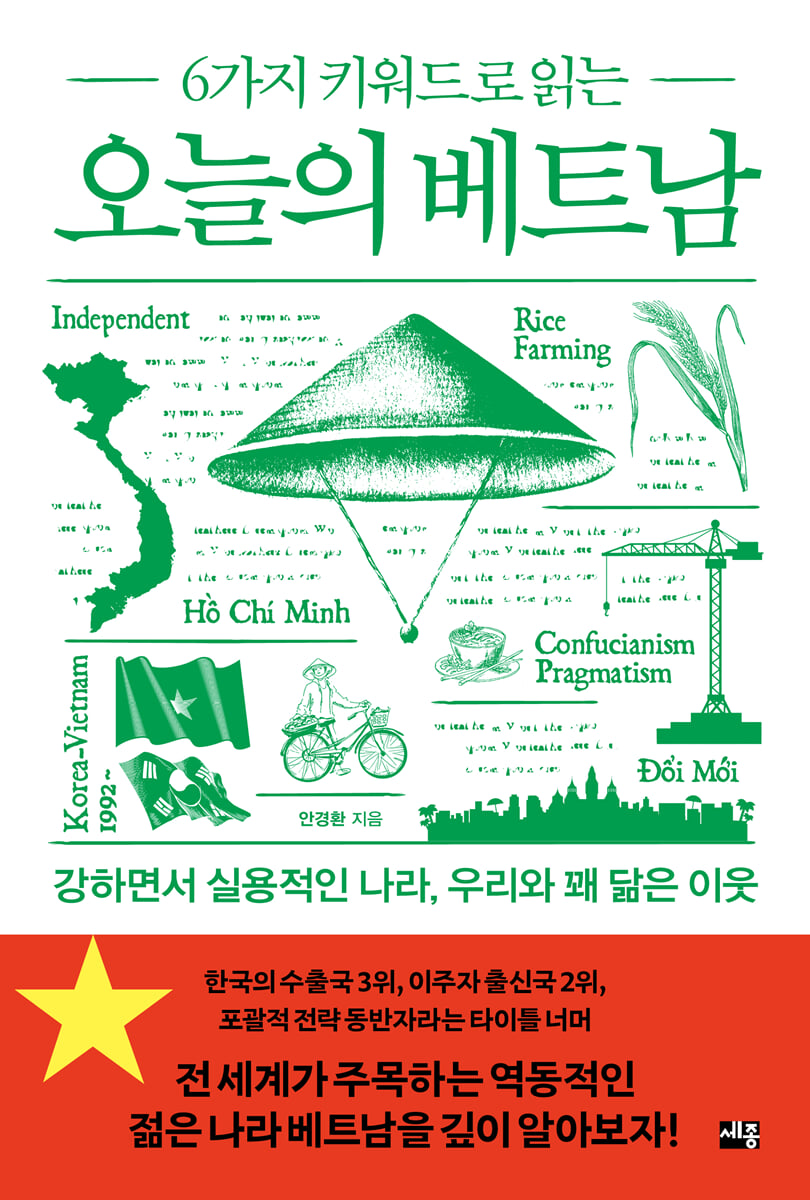 |
Description
Book Introduction
- A word from MD
- [Everything about Vietnam] It is said that Koreans are the largest group of foreigners visiting Vietnam for tourism purposes.
(3.6 million people in 2023) But Vietnam is still unfamiliar to us.
Everything about Vietnam written by Professor Ahn Kyung-hwan, a local expert with 35 years of experience.
We explore Vietnam through six keywords, introducing Vietnam's vivid present and future.
- Ahn Hyeon-jae, History PD
From a CEO to a university president, from diverse perspectives -
Written by Professor Ahn Gyeong-hwan, a local expert with 35 years of experience in Vietnam
Real Vietnam
Korea is the third largest exporting country and the second largest country of origin for immigrants.
It shows the true nature of Vietnam, a country that is still unfamiliar to us.
Currently, Koreans are the largest group of foreigners visiting Vietnam for tourism purposes.
(1st place with 3.6 million people in 2023) In addition, Vietnam has become Korea's 3rd largest export country and the 2nd largest country of origin for immigrants after China.
If you look into it, there is a long history of exchanges dating back to the Goryeo Dynasty, but after severing diplomatic ties during the Cold War, it has now been over 30 years since the establishment of diplomatic relations between Korea and Vietnam.
Recently, the two countries have entered into a close new relationship called the Comprehensive Strategic Partnership.
"Today's Vietnam" has selected six keywords for those who want to know the inside story of Vietnam, including the rice noodles "Pho" that come to mind when thinking of "Vietnam," the white Ao Dai and hat, and the history and culture essential to properly understanding Vietnam beyond the Vietnam War, as well as the lifestyles of the local people.
The author adds vividness to the story by adding big and small experiences he had in Vietnam since 1989, before the establishment of diplomatic relations between Korea and Vietnam, such as the 'self-reliance and pride' that came from the long years of protecting the country from foreign powers such as China, Mongolia, France, and the United States; the only 'Confucian country' in Southeast Asia; the respected 'father of the nation Ho Chi Minh'; the Vietnamese-style reform and openness 'Doi Moi'; a lifestyle permeated with 'agricultural culture' and the future of Vietnam with its young population.
We also introduce places you shouldn't miss in Vietnam, which is gaining recognition as one of the world's top 10 travel destinations.
Korea and Vietnam are similar in many ways in terms of history and culture.
Former South Korean Ambassador to Vietnam Cho Won-il and Vietnamese Ambassador to Korea Tran Trong Toan speak in unison.
“There is no country with a culture as similar to Vietnam as Korea.” Moreover, with K-culture and the Korean language learning craze currently popular among the younger generation in Vietnam, Vietnam is “an old but new friend.”
This book will lead readers beyond preconceptions and into the 'real Vietnam'.
Written by Professor Ahn Gyeong-hwan, a local expert with 35 years of experience in Vietnam
Real Vietnam
Korea is the third largest exporting country and the second largest country of origin for immigrants.
It shows the true nature of Vietnam, a country that is still unfamiliar to us.
Currently, Koreans are the largest group of foreigners visiting Vietnam for tourism purposes.
(1st place with 3.6 million people in 2023) In addition, Vietnam has become Korea's 3rd largest export country and the 2nd largest country of origin for immigrants after China.
If you look into it, there is a long history of exchanges dating back to the Goryeo Dynasty, but after severing diplomatic ties during the Cold War, it has now been over 30 years since the establishment of diplomatic relations between Korea and Vietnam.
Recently, the two countries have entered into a close new relationship called the Comprehensive Strategic Partnership.
"Today's Vietnam" has selected six keywords for those who want to know the inside story of Vietnam, including the rice noodles "Pho" that come to mind when thinking of "Vietnam," the white Ao Dai and hat, and the history and culture essential to properly understanding Vietnam beyond the Vietnam War, as well as the lifestyles of the local people.
The author adds vividness to the story by adding big and small experiences he had in Vietnam since 1989, before the establishment of diplomatic relations between Korea and Vietnam, such as the 'self-reliance and pride' that came from the long years of protecting the country from foreign powers such as China, Mongolia, France, and the United States; the only 'Confucian country' in Southeast Asia; the respected 'father of the nation Ho Chi Minh'; the Vietnamese-style reform and openness 'Doi Moi'; a lifestyle permeated with 'agricultural culture' and the future of Vietnam with its young population.
We also introduce places you shouldn't miss in Vietnam, which is gaining recognition as one of the world's top 10 travel destinations.
Korea and Vietnam are similar in many ways in terms of history and culture.
Former South Korean Ambassador to Vietnam Cho Won-il and Vietnamese Ambassador to Korea Tran Trong Toan speak in unison.
“There is no country with a culture as similar to Vietnam as Korea.” Moreover, with K-culture and the Korean language learning craze currently popular among the younger generation in Vietnam, Vietnam is “an old but new friend.”
This book will lead readers beyond preconceptions and into the 'real Vietnam'.
- You can preview some of the book's contents.
Preview
index
Prologue: Old but New Friends
Eight Small but Important Facts About Vietnam
Chapter 1: The Self-Reliance and Pride That Have Been Protected for 5,000 Years
Looking back on history and protecting it
- One Step Further into Vietnam 01: Strong Women Like the Trung Sisters
A founding myth that contains the pride of the brave ancestors
There is no Chinese chauvinism.
-One Step Further Into Vietnam 02: Is the 'Wol' in 'May 18th' Vietnam?
Repelling the Mongol invasion, the world's most powerful empire
- One Step Further into Vietnam 03: The First and Unlucky Queen
- Information for travelers (1): There is a heavenly gate in Hajangseong.
Chapter 2 Confucian States in Southeast Asia
The story of sending jasmine as a wedding gift
- One Step Further into Vietnam 04: Folktales Filled with Hope
Confucian values deeply rooted in classical literature
Why do Vietnamese people change their names?
- One Step Further into Vietnam 05: Latin and Chinese Characters
High educational enthusiasm among Vietnamese youth
- Information for Travelers (2): Cao Bang's 7 Scenic Spots That Drive the Tourism Industry
Chapter 3: Ho Chi Minh and the Birth of a Socialist State
Vietnam's Father, President Ho Chi Minh and the Ba Cung Spirit
-One Step Further into Vietnam 06: Was Ho Chi Minh an avid reader of 《The Book of the Shepherd》?
General Vo Nguyen Giap, the strategist of the century
- One Step Further into Vietnam 07: Cao Dai, at the forefront of the independence movement
Hoang Sa and Truong Sa Archipelagoes, the scene of fierce territorial disputes
- One Step Further into Vietnam 08: National Defense Education for the Doomsday Situation
A national festival, the parliamentary elections
- Information for Travelers (3): Backpackers' Dream Destinations 1
Chapter 4: Doimoi and Growth Potential
The story of Doi Moi, Vietnam's version of reform and opening up
-One Step Further into Vietnam 09: Are Vietnam and the United States sworn enemies?
If you're a businessperson, study labor law.
- One Step Further into Vietnam 10: The Ho Chi Minh Route as an Artery of Industrialization
Six Things You Need to Know When Investing in Vietnam
- One Step Further into Vietnam 11: Coach Park Hang-seo's Leadership
If you want to join the apartment construction boom,
Things to keep in mind when investing in real estate
Who is leading the Vietnamese economy?
- Traveler's Guide (4): Backpackers' Dream Destinations 2
Chapter 5: The Country of Rice
Lunar New Year
A representative street food, 5-Hap's representative pho
- One Step Further into Vietnam 12: The Appetizing Banh Mi Quang
A Hanoian must know how to drink tea.
-One Step Further into Vietnam 13: Cultural Outsiders, Muslims
Traditional costumes, ao dai and rice
Vietnam's unique lifestyle, a legacy of agricultural culture
- Information for Travelers (5): The Story of Love Market Koubai
Chapter 6: Countries Similar to Korea
Old New Friend, Vietnam
How did the envoys from Vietnam and Joseon interact?
- One Step Further into Vietnam 14: General Nguyen Thon of the Le Dynasty
Challenges to overcome for the future of both countries
-One Step Further into Vietnam 15: South and North Korea, What is Vietnam's Choice?
Where is Vietnam's future headed?
Eight Small but Important Facts About Vietnam
Chapter 1: The Self-Reliance and Pride That Have Been Protected for 5,000 Years
Looking back on history and protecting it
- One Step Further into Vietnam 01: Strong Women Like the Trung Sisters
A founding myth that contains the pride of the brave ancestors
There is no Chinese chauvinism.
-One Step Further Into Vietnam 02: Is the 'Wol' in 'May 18th' Vietnam?
Repelling the Mongol invasion, the world's most powerful empire
- One Step Further into Vietnam 03: The First and Unlucky Queen
- Information for travelers (1): There is a heavenly gate in Hajangseong.
Chapter 2 Confucian States in Southeast Asia
The story of sending jasmine as a wedding gift
- One Step Further into Vietnam 04: Folktales Filled with Hope
Confucian values deeply rooted in classical literature
Why do Vietnamese people change their names?
- One Step Further into Vietnam 05: Latin and Chinese Characters
High educational enthusiasm among Vietnamese youth
- Information for Travelers (2): Cao Bang's 7 Scenic Spots That Drive the Tourism Industry
Chapter 3: Ho Chi Minh and the Birth of a Socialist State
Vietnam's Father, President Ho Chi Minh and the Ba Cung Spirit
-One Step Further into Vietnam 06: Was Ho Chi Minh an avid reader of 《The Book of the Shepherd》?
General Vo Nguyen Giap, the strategist of the century
- One Step Further into Vietnam 07: Cao Dai, at the forefront of the independence movement
Hoang Sa and Truong Sa Archipelagoes, the scene of fierce territorial disputes
- One Step Further into Vietnam 08: National Defense Education for the Doomsday Situation
A national festival, the parliamentary elections
- Information for Travelers (3): Backpackers' Dream Destinations 1
Chapter 4: Doimoi and Growth Potential
The story of Doi Moi, Vietnam's version of reform and opening up
-One Step Further into Vietnam 09: Are Vietnam and the United States sworn enemies?
If you're a businessperson, study labor law.
- One Step Further into Vietnam 10: The Ho Chi Minh Route as an Artery of Industrialization
Six Things You Need to Know When Investing in Vietnam
- One Step Further into Vietnam 11: Coach Park Hang-seo's Leadership
If you want to join the apartment construction boom,
Things to keep in mind when investing in real estate
Who is leading the Vietnamese economy?
- Traveler's Guide (4): Backpackers' Dream Destinations 2
Chapter 5: The Country of Rice
Lunar New Year
A representative street food, 5-Hap's representative pho
- One Step Further into Vietnam 12: The Appetizing Banh Mi Quang
A Hanoian must know how to drink tea.
-One Step Further into Vietnam 13: Cultural Outsiders, Muslims
Traditional costumes, ao dai and rice
Vietnam's unique lifestyle, a legacy of agricultural culture
- Information for Travelers (5): The Story of Love Market Koubai
Chapter 6: Countries Similar to Korea
Old New Friend, Vietnam
How did the envoys from Vietnam and Joseon interact?
- One Step Further into Vietnam 14: General Nguyen Thon of the Le Dynasty
Challenges to overcome for the future of both countries
-One Step Further into Vietnam 15: South and North Korea, What is Vietnam's Choice?
Where is Vietnam's future headed?
Detailed image

Into the book
In January 1989, the Korean government decided to recruit a market development team comprised mainly of large corporations and dispatch them to Vietnam, with which the two countries did not have diplomatic relations at the time, in order to develop new markets and stimulate exports.
At the time, I was an employee of Hyundai Corporation and volunteered to be dispatched to Vietnam because I majored in Vietnamese.
This is the reason why we established direct ties with Vietnam before the establishment of formal diplomatic relations.
It was the beginning of a long, long relationship with Vietnam.
However, when I was dispatched to the market development team, I was at a loss as there was almost no information about Vietnam in Korea.
It was difficult to predict what difficulties might lie ahead, like a poisonous snake lurking in the jungle, so I felt like I might never return.
Before leaving the country, I was so determined that I visited my ancestors' graves and paid my respects with a serious heart.
---From the "Prologue"
The next day, when the landlord visited, his face immediately changed color as he saw that the banter (the altar) had been cleaned up.
Before the shrine is removed, a sacrifice must be made, but I arbitrarily removed the things placed on it, so there is a big problem.
The landlord bought candles, fruit, and beer from the supermarket, and asked for a bowl of rice from our house, placed it on the altar, lit a candle, and offered a ritual before demolishing the ancestral rite.
When I offered the sacrifice, I heard him muttering, “I beg you! I beg you! I beg you to forgive me.
I asked for your forgiveness for the Korean who, out of ignorance, demolished the house without notice and without even giving me time to offer a memorial service.
“I will make sure that this never happens again,” he said.
The demolition ceremony, which I thought would be over quickly, took an hour.
I found out that the ritual had to be performed until the long incense stick burned out.
In this way, the Vietnamese people's ups and downs culture regarding banter is special.
---From "Chapter 1: The Self-Reliance and Pride That Has Been Protected for 5,000 Years"
The Vietnamese people insist that, for the survival of their nation, they should “close the door to the past and move forward into the future.”
When we look at the way the Vietnamese people think and act, this statement deserves deep consideration.
Primarily, it can be interpreted to mean 'let's close the door to the past for a moment' in order to complete the socialist revolution, develop the economy, and attract foreign investment.
But if you think about it the other way around, this means that you can open the door to the past and uncover it one by one whenever necessary.
Rather than saying, "Let's forget the past," saying, "Let's close the door to the past," is another way of saying that we can "never" forget the past.
---From "Chapter 1: The Self-Reliance and Pride That Has Been Protected for 5,000 Years"
It was a great stroke of luck that I happened to come across a masterpiece of Vietnamese literature, became absorbed in translating it, and was even able to publish a book about it.
2020 marked the 200th anniversary of the death of Nguyen Du, author of Truyen Kieu.
In 1965, UNESCO recognized Nguyen Du as a world cultural figure, and it is said that the 36th President of the United States, Lyndon B. Johnson, who intensified the Vietnam War, said, “If I had read Truyen Kieu earlier, the tragic situation we face today would not have occurred.”
Nguyen Du left behind the 3,254-line "Truyen Kieu".
The meaning of this work is 'Kieu's story', and the keyword of this work is 'heart'.
No matter how many talents you have, you can't have even one good heart.
---From "Chapter 2 Confucian States in Southeast Asia"
When I first set foot in Vietnam in 1989, I exchanged business cards and greeted people I met for the first time in business, and I noticed that most of them had the same surname.
The surname was 'Nguyen 阮'.
Although there are many people in Korea with the surnames Kim, Lee, and Park, there were far more Nguyen.
I later found out that four out of ten Vietnamese people had the surname Nguyen.
---From "Chapter 2 Confucian States in Southeast Asia"
In Korea, confusion often arises because various media outlets still do not follow the Vietnamese spelling rules established by the National Institute of the Korean Language.
This causes confusion not only for Vietnamese learners but also for Vietnamese students learning Korean, and causes problems in Korean language education.
For example, 'Nha Trang', which is written boldly on tourist products and at the airport, is a place name that the Vietnamese people are completely unaware of.
You have to say 'Nha Trang' to understand.
Another example is Kkuinyeon, which has recently become increasingly popular among Korean tourists.
It's not 'quinone'.
---「One Step Further Into Vietnam 05」 Among Latin letters and Chinese characters
Caodaism is reminiscent of the Donghak Peasant Revolution that occurred in Joseon around the same time, as it integrates the teachings of five religions, including Eastern Confucianism, Buddhism, Taoism, and animism, and Western Christian doctrines, and had a decisive influence on the independence movement.
I felt that the two religions were similar, like decals, in that they integrated Eastern and Western religious teachings, promoted human dignity and national self-reliance based on them, and further played an active role in the national liberation movement.
---From "Chapter 3: Ho Chi Minh and the Birth of a Socialist State"
The territorial dispute surrounding the Bien Dong (South China Sea) is a highly sensitive international issue, and the United States and Japan are expected to strengthen their alliance and expand economic cooperation with coastal countries to prevent China from taking control of Bien Dong.
On the other hand, China is expected to expand aid to Southeast Asian countries, accelerating their "distant from the US and pro-China" diplomatic line.
In this way, Vietnam is at a critical juncture of whether to lose or regain sovereignty over its inherent territories, the Hoang Sa and Truong Sa Archipelagoes.
South Korea, too, is a direct stakeholder in the conflict in Bien Dong, an energy transport route, and, given its own territorial disputes over Dokdo and Ieodo, it must approach this issue with caution, recognizing that it can never be free from them.
---From "Chapter 3: Ho Chi Minh and the Birth of a Socialist State"
Vietnam has a population of about 100 million, an average life expectancy of about 75 years, but the average age of the entire population is about 29 years, making it a very labor-abundant production and consumption market.
Vietnam is now upgrading its diplomatic relations with the United States and South Korea to a comprehensive strategic partnership, strengthening its semiconductor and artificial intelligence supply chains.
Economic cooperation between the U.S. and Vietnam is expected to accelerate in the future, and Vietnam is emerging as an alternative for the de-Chinese supply chain.
As China intensifies its competition with the United States by weaponizing its resources, claiming to be the world's largest producer of rare earths, the two countries will likely share economic and security strategies to counter threats to China's supply chains.
---From "Chapter 4: Doimoi and Growth Potential"
The case of an investor who purchased an apartment in the Phu My Hung district of Ho Chi Minh City, Vietnam, and aimed for monthly rental income and capital gains, shows the true nature of real estate investment in Vietnam.
Phu My Hung is a sophisticated area with a similar atmosphere to Korea's Songdo New City, and is home to the largest Korean town in Southeast Asia.
Mr. L, the president of a mid-sized company who had been in the trade business and frequently traveled to Vietnam before the establishment of diplomatic relations with Vietnam, purchased an apartment measuring 113.82 square meters (approximately 35 pyeong) in Phu My Hung, a newly emerging residential area, for 2.16258 billion VND in 2008.
---From "Chapter 4: Doimoi and Growth Potential"
The traditional Vietnamese hat, the 'nón', has many uses.
They hang mirrors on the ground and use them to check their appearance, and they also serve as fans when resting under the shade of a tree.
At the well, it is used as a water bowl to hold water and wash the face, hands, and feet.
In windy weather, it acts as a visor, preventing you from lighting a cigarette by lighting a match.
When sleeping outside, it is used to cover the eyes to prevent glare, and it is also used as a substitute for a container to hold fruits, fish, vegetables, etc.
---From "Chapter 5: The Country of Rice"
Building a dam or constructing a canal is something that no matter how capable or strong a person is, he or she cannot accomplish alone.
Therefore, if all members of the community do not join forces to deal with it, the entire village will perish.
For this reason, we have needed ordinary people, people who are not unique, who can breathe together for the common good, rather than one outstanding individual.
Over a long history, the Vietnamese have internalized these cultural characteristics and have embodied the egalitarian mindset that “all people are equal.”
For that reason, in Vietnam, the salary of the Prime Minister and the salary of the Minister are similar, as are the salaries of university professors and general office workers.
This kind of community culture certainly served as a good tradition until independence and unification were achieved.
However, in today's world, where we are introducing a market economy and making every effort to build the economy, it is difficult to say that egalitarianism is playing a positive role, as there are aspects that make hierarchical relationships ambiguous.
Vietnam is also expected to soon transition to a system that is more in line with the market economy system implemented by foreign companies, such as a merit-based incentive system and performance-based bonus payments.
At the time, I was an employee of Hyundai Corporation and volunteered to be dispatched to Vietnam because I majored in Vietnamese.
This is the reason why we established direct ties with Vietnam before the establishment of formal diplomatic relations.
It was the beginning of a long, long relationship with Vietnam.
However, when I was dispatched to the market development team, I was at a loss as there was almost no information about Vietnam in Korea.
It was difficult to predict what difficulties might lie ahead, like a poisonous snake lurking in the jungle, so I felt like I might never return.
Before leaving the country, I was so determined that I visited my ancestors' graves and paid my respects with a serious heart.
---From the "Prologue"
The next day, when the landlord visited, his face immediately changed color as he saw that the banter (the altar) had been cleaned up.
Before the shrine is removed, a sacrifice must be made, but I arbitrarily removed the things placed on it, so there is a big problem.
The landlord bought candles, fruit, and beer from the supermarket, and asked for a bowl of rice from our house, placed it on the altar, lit a candle, and offered a ritual before demolishing the ancestral rite.
When I offered the sacrifice, I heard him muttering, “I beg you! I beg you! I beg you to forgive me.
I asked for your forgiveness for the Korean who, out of ignorance, demolished the house without notice and without even giving me time to offer a memorial service.
“I will make sure that this never happens again,” he said.
The demolition ceremony, which I thought would be over quickly, took an hour.
I found out that the ritual had to be performed until the long incense stick burned out.
In this way, the Vietnamese people's ups and downs culture regarding banter is special.
---From "Chapter 1: The Self-Reliance and Pride That Has Been Protected for 5,000 Years"
The Vietnamese people insist that, for the survival of their nation, they should “close the door to the past and move forward into the future.”
When we look at the way the Vietnamese people think and act, this statement deserves deep consideration.
Primarily, it can be interpreted to mean 'let's close the door to the past for a moment' in order to complete the socialist revolution, develop the economy, and attract foreign investment.
But if you think about it the other way around, this means that you can open the door to the past and uncover it one by one whenever necessary.
Rather than saying, "Let's forget the past," saying, "Let's close the door to the past," is another way of saying that we can "never" forget the past.
---From "Chapter 1: The Self-Reliance and Pride That Has Been Protected for 5,000 Years"
It was a great stroke of luck that I happened to come across a masterpiece of Vietnamese literature, became absorbed in translating it, and was even able to publish a book about it.
2020 marked the 200th anniversary of the death of Nguyen Du, author of Truyen Kieu.
In 1965, UNESCO recognized Nguyen Du as a world cultural figure, and it is said that the 36th President of the United States, Lyndon B. Johnson, who intensified the Vietnam War, said, “If I had read Truyen Kieu earlier, the tragic situation we face today would not have occurred.”
Nguyen Du left behind the 3,254-line "Truyen Kieu".
The meaning of this work is 'Kieu's story', and the keyword of this work is 'heart'.
No matter how many talents you have, you can't have even one good heart.
---From "Chapter 2 Confucian States in Southeast Asia"
When I first set foot in Vietnam in 1989, I exchanged business cards and greeted people I met for the first time in business, and I noticed that most of them had the same surname.
The surname was 'Nguyen 阮'.
Although there are many people in Korea with the surnames Kim, Lee, and Park, there were far more Nguyen.
I later found out that four out of ten Vietnamese people had the surname Nguyen.
---From "Chapter 2 Confucian States in Southeast Asia"
In Korea, confusion often arises because various media outlets still do not follow the Vietnamese spelling rules established by the National Institute of the Korean Language.
This causes confusion not only for Vietnamese learners but also for Vietnamese students learning Korean, and causes problems in Korean language education.
For example, 'Nha Trang', which is written boldly on tourist products and at the airport, is a place name that the Vietnamese people are completely unaware of.
You have to say 'Nha Trang' to understand.
Another example is Kkuinyeon, which has recently become increasingly popular among Korean tourists.
It's not 'quinone'.
---「One Step Further Into Vietnam 05」 Among Latin letters and Chinese characters
Caodaism is reminiscent of the Donghak Peasant Revolution that occurred in Joseon around the same time, as it integrates the teachings of five religions, including Eastern Confucianism, Buddhism, Taoism, and animism, and Western Christian doctrines, and had a decisive influence on the independence movement.
I felt that the two religions were similar, like decals, in that they integrated Eastern and Western religious teachings, promoted human dignity and national self-reliance based on them, and further played an active role in the national liberation movement.
---From "Chapter 3: Ho Chi Minh and the Birth of a Socialist State"
The territorial dispute surrounding the Bien Dong (South China Sea) is a highly sensitive international issue, and the United States and Japan are expected to strengthen their alliance and expand economic cooperation with coastal countries to prevent China from taking control of Bien Dong.
On the other hand, China is expected to expand aid to Southeast Asian countries, accelerating their "distant from the US and pro-China" diplomatic line.
In this way, Vietnam is at a critical juncture of whether to lose or regain sovereignty over its inherent territories, the Hoang Sa and Truong Sa Archipelagoes.
South Korea, too, is a direct stakeholder in the conflict in Bien Dong, an energy transport route, and, given its own territorial disputes over Dokdo and Ieodo, it must approach this issue with caution, recognizing that it can never be free from them.
---From "Chapter 3: Ho Chi Minh and the Birth of a Socialist State"
Vietnam has a population of about 100 million, an average life expectancy of about 75 years, but the average age of the entire population is about 29 years, making it a very labor-abundant production and consumption market.
Vietnam is now upgrading its diplomatic relations with the United States and South Korea to a comprehensive strategic partnership, strengthening its semiconductor and artificial intelligence supply chains.
Economic cooperation between the U.S. and Vietnam is expected to accelerate in the future, and Vietnam is emerging as an alternative for the de-Chinese supply chain.
As China intensifies its competition with the United States by weaponizing its resources, claiming to be the world's largest producer of rare earths, the two countries will likely share economic and security strategies to counter threats to China's supply chains.
---From "Chapter 4: Doimoi and Growth Potential"
The case of an investor who purchased an apartment in the Phu My Hung district of Ho Chi Minh City, Vietnam, and aimed for monthly rental income and capital gains, shows the true nature of real estate investment in Vietnam.
Phu My Hung is a sophisticated area with a similar atmosphere to Korea's Songdo New City, and is home to the largest Korean town in Southeast Asia.
Mr. L, the president of a mid-sized company who had been in the trade business and frequently traveled to Vietnam before the establishment of diplomatic relations with Vietnam, purchased an apartment measuring 113.82 square meters (approximately 35 pyeong) in Phu My Hung, a newly emerging residential area, for 2.16258 billion VND in 2008.
---From "Chapter 4: Doimoi and Growth Potential"
The traditional Vietnamese hat, the 'nón', has many uses.
They hang mirrors on the ground and use them to check their appearance, and they also serve as fans when resting under the shade of a tree.
At the well, it is used as a water bowl to hold water and wash the face, hands, and feet.
In windy weather, it acts as a visor, preventing you from lighting a cigarette by lighting a match.
When sleeping outside, it is used to cover the eyes to prevent glare, and it is also used as a substitute for a container to hold fruits, fish, vegetables, etc.
---From "Chapter 5: The Country of Rice"
Building a dam or constructing a canal is something that no matter how capable or strong a person is, he or she cannot accomplish alone.
Therefore, if all members of the community do not join forces to deal with it, the entire village will perish.
For this reason, we have needed ordinary people, people who are not unique, who can breathe together for the common good, rather than one outstanding individual.
Over a long history, the Vietnamese have internalized these cultural characteristics and have embodied the egalitarian mindset that “all people are equal.”
For that reason, in Vietnam, the salary of the Prime Minister and the salary of the Minister are similar, as are the salaries of university professors and general office workers.
This kind of community culture certainly served as a good tradition until independence and unification were achieved.
However, in today's world, where we are introducing a market economy and making every effort to build the economy, it is difficult to say that egalitarianism is playing a positive role, as there are aspects that make hierarchical relationships ambiguous.
Vietnam is also expected to soon transition to a system that is more in line with the market economy system implemented by foreign companies, such as a merit-based incentive system and performance-based bonus payments.
---From "Chapter 5: The Country of Rice"
Publisher's Review
“Old but new friends” Vietnam
"Today's Vietnam" captures the true face of Vietnam, which has emerged as Korea's third-largest trading nation, through six keywords ranging from history to economy and culture.
It would not be wrong to say that the Vietnamese people, with their Confucian traditions alive and hard-working, are the most similar to Koreans in the world.
The author, Professor Ahn Gyeong-hwan, is a Vietnam expert who has consistently served as a bridge between Korea and Vietnam even before the establishment of diplomatic relations between the two countries.
As I listen to his stories of firsthand experience and enlightenment, I find myself wanting to walk down the streets of Vietnam and chat with people as passionate as we are.
① Keywords for reading Vietnam: "Self-reliance and pride preserved for 5,000 years"
- What is the source of the strength that has repelled the invasions of China, Mongolia, France, and the United States?
There is an impressive saying that the author heard from the locals when he entered the Vietnamese market development team.
“When drinking water, think of the source.” This means that when drinking water, think of the source of the water, that is, do not forget your ancestors.
The Vietnamese people, who call themselves “descendants of the dragon,” firmly believe in the myth of the birth of the Hung Vuong Dynasty some 3,000 years ago.
The 10th day of the third lunar month, the anniversary of Hung Vuong's death, is a public holiday in Vietnam, and many people still visit Ung E Linh Mountain (100km northwest of Hanoi), where Hung Vuong's tomb is said to be.
Vietnam also honors the historical heroes who fought off foreign invasions in everyday life.
The Trung sisters, Trung Trac and Trung Nhi (the Trung sisters), who led Vietnam's first independence movement against China in 40 AD, are remembered at the Hai Ba Trung Festival, held every year after Vietnam's Lunar New Year (Tet).
Thanks to this sense of independence, Vietnam developed the perception that it was equal to China despite being under Chinese rule for 1,049 years.
This also served as the driving force behind repelling three invasions by the world's most powerful empire, the Mongol Empire.
On the other hand, a strong sense of independence can lead to wariness toward foreigners, so we must be careful with our words and actions so as not to offend their pride.
Even so, the United States, with which we fought until the 1970s, has maintained friendly relations with South Korea thanks to a pragmatic mindset of “let’s close the door on the past and move forward into the future.”
This is two-faced.
You can open the door at any time.
② Keywords for reading Vietnam: 'Confucian country in Southeast Asia'
- Southeast Asia's only Confucian society, equipped with practicality
Vietnam went through a period of direct Chinese rule for over a thousand years.
For that reason, unlike other Southeast Asian countries, it has developed a culture based on Confucian values.
Vietnamese traditional weddings are similar to those in Korea, with the gift of tea and 'chau cau', a red-colored cake with a deep story behind it, when chewed.
Tea represents an eternal promise because once the seed is planted, it cannot be moved.
In Vietnam, there is a literary masterpiece called 『Truyen Kieu』, which embodies ‘filial piety’ similar to our 『Simcheongjeon』.
However, in order to avoid his father's unjust imprisonment, Kieu marries someone other than his lover. Through hardships and accumulated virtue, he eventually transcends Confucian morality by reuniting with his first lover.
『Tzu Yen Kieu』 is still alive in the lives of young people, to the point that they can open the book anywhere and use it to tell their fortune for the day.
Vietnam's pragmatism is also evident in women's active social lives and the 'culture of changing names'.
According to traditional Confucianism, it is not okay to change the family name or given name given by one's parents, but it is common for Vietnamese people to change their family name.
As a result, there is a saying that one in three people is a 'Nguyen'.
③ Keyword for Reading Vietnam: "Ho Chi Minh and the Birth of a Socialist State"
- Who is Ho Chi Minh, the father of the nation, known as ‘Uncle Ho’?
When the author was a college student learning Vietnamese, his first impression of Ho Chi Minh was simply that he was a 'communist.'
However, Ho Chi Minh was a figure who transcended ideology, to the extent that UNESCO recognized him as “a hero of the liberation of the Vietnamese people and a world-renowned cultural figure” in 1990, the 100th anniversary of his birth.
In Vietnam, it is common sense to call others by their first names rather than their last names, but Ho Chi Minh is the only one who is called by his last name, 'Bach Ho', which means 'Uncle Ho'.
It is an expression of affection and respect for Ho Chi Minh, the so-called 'professional revolutionary', who devoted his life to the independence and founding of Vietnam.
The Vietnamese people are proud of having achieved independence and the founding of their nation thanks to the outstanding leadership of two leaders, Ho Chi Minh and General Vo Nguyen Giap, and the united people under them.
That spirit carries over into elections that are held like national festivals.
The '5 Nos' electoral system, which strictly verifies candidates who are qualified to serve the people, even though they are single-party, continues that spirit.
Of course, a multi-party system is a future that Vietnam must pioneer in order to take a leap forward.
④ Keywords for understanding Vietnam: Doi Moi and growth potential
- Vietnam's reform and opening-up and investment considerations
Vietnam suffered from economic hardship for a long time after the entire country was devastated by the 30-year war for unification that began in 1945.
As a way to overcome this, the Vietnamese government adopted the Doi Moi policy, a Vietnamese version of reform and opening up, in 1986.
This term, a combination of 'doi' meaning 'to change' and 'meoi' meaning 'new, newly', signified entry into a market economic system.
While the Doi Moi policy has revitalized the Vietnamese economy by achieving rapid economic growth, it also has a dark side, such as widening the gap between rich and poor and encouraging corruption among public officials.
However, Vietnam is a country with great potential, with its international status as a post-China supply chain rising and its abundant young population.
Based on his extensive local experience, the author also offers tips on what to keep in mind when doing business or investing in Vietnam.
⑤ Keyword for reading Vietnam: 'Land of Rice'
- Living culture left behind by agricultural culture, such as Lunar New Year, Tet, a representative street food, and Ao Dai, a traditional costume
In Vietnam, where 62% of the total population lives in rural areas, agricultural customs are still observed even in the cities.
On the biggest holiday, Lunar New Year, people invite the head of the household and men with matching zodiac signs to pray for good fortune for the year, hold a ritual called 'Songdeot', offer sacrifices to various gods including the kitchen god, and set off firecrackers to drive away evil spirits.
Also, as a nation that eats rice, they make and eat various noodles made from rice, and the most representative food is Ph?.
It is a representative food of the resistance that filled the hungry stomachs of soldiers during the war of independence, and it shows regional characteristics by differentiating the taste and ingredients by region, and today it has spread to all over the world and has become a representative food of Vietnam.
In addition, the unique tea culture that connects people, the 10 uses of the Ao Dai and the hat 'Non', which are symbols of Vietnam, and the gift culture are also introduced with episodes.
⑥ Keyword for reading Vietnam: 'A country similar to Korea'
- Challenges that must be overcome for the future of Vietnam and the future of both countries.
Although it has been over 30 years since Korea and Vietnam established diplomatic relations, the two countries are actually long-standing neighbors who have maintained exchanges since the Goryeo Dynasty.
The author defines cousin relationships in four aspects.
Between these two countries, which share many similarities, there are also tangled threads that need to be unraveled over the years.
Let's listen to the author's suggestions for the future.
A little fun to read
"One Step Further Into Vietnam," "Traveler Information"
This book provides a break corner at the end of each chapter, offering small reading material and practical information.
It introduces stories that were not covered in the main text, such as whether Ho Chi Minh really enjoyed reading 『Mokminsimseo』, what Caodaism is, the indigenous religion of Vietnam that led the independence movement, how Muslims in Vietnam live, and why the Vietnamese people are so enthusiastic about coach Park Hang-seo's national soccer team.
It also provides useful common sense, including practical travel information, to those planning to travel to Vietnam.
You can look forward to a list of travel destinations carefully selected by the author of Vietnam Tong.
"Today's Vietnam" captures the true face of Vietnam, which has emerged as Korea's third-largest trading nation, through six keywords ranging from history to economy and culture.
It would not be wrong to say that the Vietnamese people, with their Confucian traditions alive and hard-working, are the most similar to Koreans in the world.
The author, Professor Ahn Gyeong-hwan, is a Vietnam expert who has consistently served as a bridge between Korea and Vietnam even before the establishment of diplomatic relations between the two countries.
As I listen to his stories of firsthand experience and enlightenment, I find myself wanting to walk down the streets of Vietnam and chat with people as passionate as we are.
① Keywords for reading Vietnam: "Self-reliance and pride preserved for 5,000 years"
- What is the source of the strength that has repelled the invasions of China, Mongolia, France, and the United States?
There is an impressive saying that the author heard from the locals when he entered the Vietnamese market development team.
“When drinking water, think of the source.” This means that when drinking water, think of the source of the water, that is, do not forget your ancestors.
The Vietnamese people, who call themselves “descendants of the dragon,” firmly believe in the myth of the birth of the Hung Vuong Dynasty some 3,000 years ago.
The 10th day of the third lunar month, the anniversary of Hung Vuong's death, is a public holiday in Vietnam, and many people still visit Ung E Linh Mountain (100km northwest of Hanoi), where Hung Vuong's tomb is said to be.
Vietnam also honors the historical heroes who fought off foreign invasions in everyday life.
The Trung sisters, Trung Trac and Trung Nhi (the Trung sisters), who led Vietnam's first independence movement against China in 40 AD, are remembered at the Hai Ba Trung Festival, held every year after Vietnam's Lunar New Year (Tet).
Thanks to this sense of independence, Vietnam developed the perception that it was equal to China despite being under Chinese rule for 1,049 years.
This also served as the driving force behind repelling three invasions by the world's most powerful empire, the Mongol Empire.
On the other hand, a strong sense of independence can lead to wariness toward foreigners, so we must be careful with our words and actions so as not to offend their pride.
Even so, the United States, with which we fought until the 1970s, has maintained friendly relations with South Korea thanks to a pragmatic mindset of “let’s close the door on the past and move forward into the future.”
This is two-faced.
You can open the door at any time.
② Keywords for reading Vietnam: 'Confucian country in Southeast Asia'
- Southeast Asia's only Confucian society, equipped with practicality
Vietnam went through a period of direct Chinese rule for over a thousand years.
For that reason, unlike other Southeast Asian countries, it has developed a culture based on Confucian values.
Vietnamese traditional weddings are similar to those in Korea, with the gift of tea and 'chau cau', a red-colored cake with a deep story behind it, when chewed.
Tea represents an eternal promise because once the seed is planted, it cannot be moved.
In Vietnam, there is a literary masterpiece called 『Truyen Kieu』, which embodies ‘filial piety’ similar to our 『Simcheongjeon』.
However, in order to avoid his father's unjust imprisonment, Kieu marries someone other than his lover. Through hardships and accumulated virtue, he eventually transcends Confucian morality by reuniting with his first lover.
『Tzu Yen Kieu』 is still alive in the lives of young people, to the point that they can open the book anywhere and use it to tell their fortune for the day.
Vietnam's pragmatism is also evident in women's active social lives and the 'culture of changing names'.
According to traditional Confucianism, it is not okay to change the family name or given name given by one's parents, but it is common for Vietnamese people to change their family name.
As a result, there is a saying that one in three people is a 'Nguyen'.
③ Keyword for Reading Vietnam: "Ho Chi Minh and the Birth of a Socialist State"
- Who is Ho Chi Minh, the father of the nation, known as ‘Uncle Ho’?
When the author was a college student learning Vietnamese, his first impression of Ho Chi Minh was simply that he was a 'communist.'
However, Ho Chi Minh was a figure who transcended ideology, to the extent that UNESCO recognized him as “a hero of the liberation of the Vietnamese people and a world-renowned cultural figure” in 1990, the 100th anniversary of his birth.
In Vietnam, it is common sense to call others by their first names rather than their last names, but Ho Chi Minh is the only one who is called by his last name, 'Bach Ho', which means 'Uncle Ho'.
It is an expression of affection and respect for Ho Chi Minh, the so-called 'professional revolutionary', who devoted his life to the independence and founding of Vietnam.
The Vietnamese people are proud of having achieved independence and the founding of their nation thanks to the outstanding leadership of two leaders, Ho Chi Minh and General Vo Nguyen Giap, and the united people under them.
That spirit carries over into elections that are held like national festivals.
The '5 Nos' electoral system, which strictly verifies candidates who are qualified to serve the people, even though they are single-party, continues that spirit.
Of course, a multi-party system is a future that Vietnam must pioneer in order to take a leap forward.
④ Keywords for understanding Vietnam: Doi Moi and growth potential
- Vietnam's reform and opening-up and investment considerations
Vietnam suffered from economic hardship for a long time after the entire country was devastated by the 30-year war for unification that began in 1945.
As a way to overcome this, the Vietnamese government adopted the Doi Moi policy, a Vietnamese version of reform and opening up, in 1986.
This term, a combination of 'doi' meaning 'to change' and 'meoi' meaning 'new, newly', signified entry into a market economic system.
While the Doi Moi policy has revitalized the Vietnamese economy by achieving rapid economic growth, it also has a dark side, such as widening the gap between rich and poor and encouraging corruption among public officials.
However, Vietnam is a country with great potential, with its international status as a post-China supply chain rising and its abundant young population.
Based on his extensive local experience, the author also offers tips on what to keep in mind when doing business or investing in Vietnam.
⑤ Keyword for reading Vietnam: 'Land of Rice'
- Living culture left behind by agricultural culture, such as Lunar New Year, Tet, a representative street food, and Ao Dai, a traditional costume
In Vietnam, where 62% of the total population lives in rural areas, agricultural customs are still observed even in the cities.
On the biggest holiday, Lunar New Year, people invite the head of the household and men with matching zodiac signs to pray for good fortune for the year, hold a ritual called 'Songdeot', offer sacrifices to various gods including the kitchen god, and set off firecrackers to drive away evil spirits.
Also, as a nation that eats rice, they make and eat various noodles made from rice, and the most representative food is Ph?.
It is a representative food of the resistance that filled the hungry stomachs of soldiers during the war of independence, and it shows regional characteristics by differentiating the taste and ingredients by region, and today it has spread to all over the world and has become a representative food of Vietnam.
In addition, the unique tea culture that connects people, the 10 uses of the Ao Dai and the hat 'Non', which are symbols of Vietnam, and the gift culture are also introduced with episodes.
⑥ Keyword for reading Vietnam: 'A country similar to Korea'
- Challenges that must be overcome for the future of Vietnam and the future of both countries.
Although it has been over 30 years since Korea and Vietnam established diplomatic relations, the two countries are actually long-standing neighbors who have maintained exchanges since the Goryeo Dynasty.
The author defines cousin relationships in four aspects.
Between these two countries, which share many similarities, there are also tangled threads that need to be unraveled over the years.
Let's listen to the author's suggestions for the future.
A little fun to read
"One Step Further Into Vietnam," "Traveler Information"
This book provides a break corner at the end of each chapter, offering small reading material and practical information.
It introduces stories that were not covered in the main text, such as whether Ho Chi Minh really enjoyed reading 『Mokminsimseo』, what Caodaism is, the indigenous religion of Vietnam that led the independence movement, how Muslims in Vietnam live, and why the Vietnamese people are so enthusiastic about coach Park Hang-seo's national soccer team.
It also provides useful common sense, including practical travel information, to those planning to travel to Vietnam.
You can look forward to a list of travel destinations carefully selected by the author of Vietnam Tong.
GOODS SPECIFICS
- Date of issue: May 30, 2024
- Page count, weight, size: 360 pages | 534g | 152*225*20mm
- ISBN13: 9788984073197
- ISBN10: 8984073199
You may also like
카테고리
korean


korean

![ELLE 엘르 스페셜 에디션 A형 : 12월 [2025]](http://librairie.coreenne.fr/cdn/shop/files/b8e27a3de6c9538896439686c6b0e8fb.jpg?v=1766436872&width=3840)


