

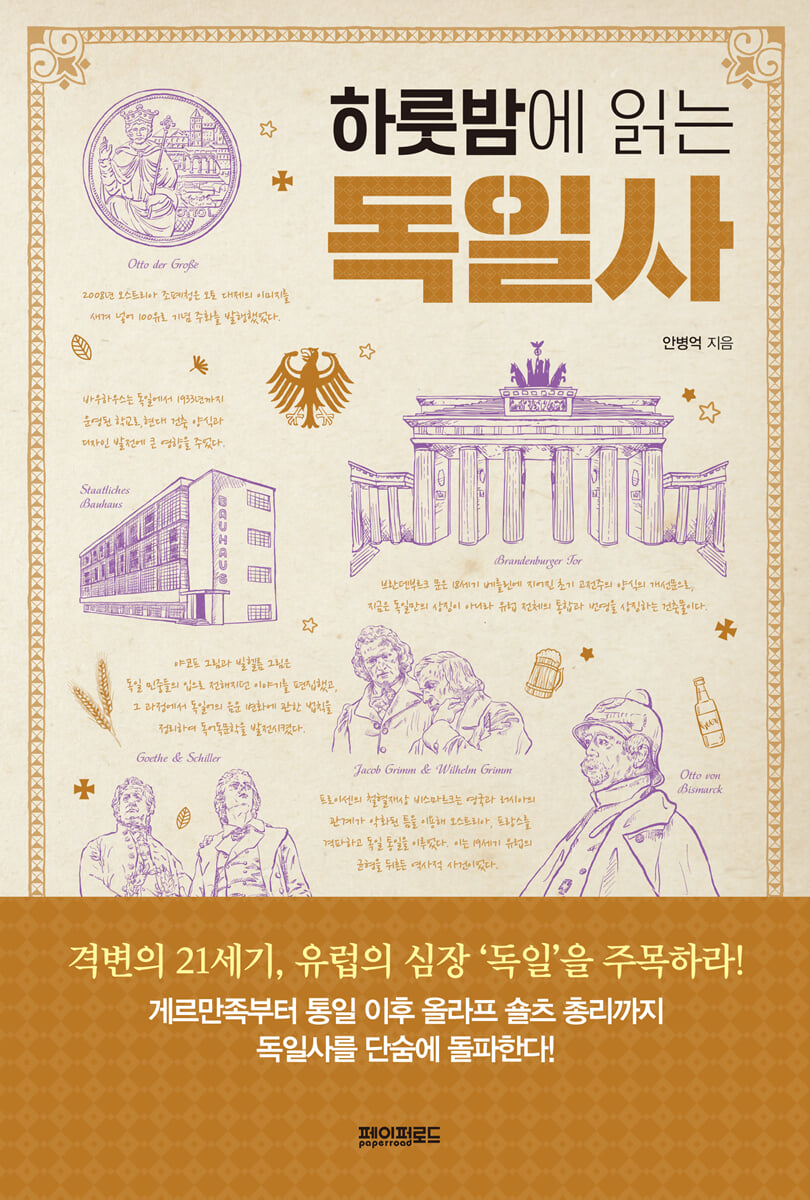
German History in One Night
 |
Description
Book Introduction
A feast of history through maps, drawings, timelines, and photographs
Following 『A History of Britain in One Night』,
International relations expert Ahn Byeong-eok's second European history story
From barbaric Germanic tribes to the heart of Europe
The Advancing Civilization of Steel: Germany's Turbulent History
“How could the country of philosopher Kant and great writer Goethe give birth to a monster like Hitler?”
François Mitterrand, who was President of France for 14 years from 1981, fought in World War II and was taken prisoner by the Germans.
He once said something like the question above about the country called 'Germany'.
His remarks cut to the heart of German history.
German history is so turbulent that it goes from one extreme to the other.
From barbarism and civilization, division and compromise, reaction and reform, division and unification, the more one studies German history, the more conflicting concepts arise, making one wonder what the essence of Germany is.
The outskirts of ancient Rome, a history divided into numerous principalities, and geographical conditions that inevitably led to numerous crises.
Yet, Germany has managed to become the heart of Europe and leads Europe today in the 21st century.
What are the keys to Germany's success, the world's third-largest economy and a leader in the European Union? "A History of Germany in One Night" traverses the entirety of German history, from the Germanic tribes to Chancellor Olaf Scholz's presidency.
This is an excellent introduction that approaches the interplay between Germany and the surrounding world in a public way, and presents key historical events in an easily understandable narrative format.
As it is advertised as a ‘German history book that anyone can read,’ it has added abundant visual materials.
Seven illustrations, 11 maps, 22 timelines, and 35 photographs will guide even readers unfamiliar with Germany to the last page.
It also introduces each of the figures who left a significant mark on German history, and through this process, we can learn in detail how they overcame the challenges of their time as Germans.
This book is suitable for readers interested in Germany as well as those who want to explore European history in a multi-layered manner.
In today's world, where countless crises are overlapping, let's learn about the wisdom of a community that overcomes the challenges of its time through Germany's history.
From the story of the Germanic warrior 'Hermann' to the present-day Germany led by Chancellor Olaf Scholz, let's embark on a tumultuous journey through German history, going from one extreme to the next, with this book.
Following 『A History of Britain in One Night』,
International relations expert Ahn Byeong-eok's second European history story
From barbaric Germanic tribes to the heart of Europe
The Advancing Civilization of Steel: Germany's Turbulent History
“How could the country of philosopher Kant and great writer Goethe give birth to a monster like Hitler?”
François Mitterrand, who was President of France for 14 years from 1981, fought in World War II and was taken prisoner by the Germans.
He once said something like the question above about the country called 'Germany'.
His remarks cut to the heart of German history.
German history is so turbulent that it goes from one extreme to the other.
From barbarism and civilization, division and compromise, reaction and reform, division and unification, the more one studies German history, the more conflicting concepts arise, making one wonder what the essence of Germany is.
The outskirts of ancient Rome, a history divided into numerous principalities, and geographical conditions that inevitably led to numerous crises.
Yet, Germany has managed to become the heart of Europe and leads Europe today in the 21st century.
What are the keys to Germany's success, the world's third-largest economy and a leader in the European Union? "A History of Germany in One Night" traverses the entirety of German history, from the Germanic tribes to Chancellor Olaf Scholz's presidency.
This is an excellent introduction that approaches the interplay between Germany and the surrounding world in a public way, and presents key historical events in an easily understandable narrative format.
As it is advertised as a ‘German history book that anyone can read,’ it has added abundant visual materials.
Seven illustrations, 11 maps, 22 timelines, and 35 photographs will guide even readers unfamiliar with Germany to the last page.
It also introduces each of the figures who left a significant mark on German history, and through this process, we can learn in detail how they overcame the challenges of their time as Germans.
This book is suitable for readers interested in Germany as well as those who want to explore European history in a multi-layered manner.
In today's world, where countless crises are overlapping, let's learn about the wisdom of a community that overcomes the challenges of its time through Germany's history.
From the story of the Germanic warrior 'Hermann' to the present-day Germany led by Chancellor Olaf Scholz, let's embark on a tumultuous journey through German history, going from one extreme to the next, with this book.
- You can preview some of the book's contents.
Preview
index
Recommendation… 5
Preface … 7
Prologue… 10
Chapter 1: The Germanic Tribes that Successored Rome Gradually Separate from Rome
Hermann, the warrior who defended the freedom of the Germanic people… 24
The Birth and Transformation of 'Doichi'… 29
Charlemagne, the Creator of Europe… 35
The Starting Point of German History: The 911 or 936 Debate… 45
The Hanseatic League, a vast trade network centered on the North Sea and Baltic Sea… 53
The greatest influencer, religious reformer Martin Luther… 59
The Thirty Years' War and the Rise of the German Territorial States… 67
Chapter 2: The Rise of Prussia and the Formation of the German Nation
Frederick I ascends the throne of Prussia… 76
Frederick II (the Great), who completed the map of Europe… 82
Frederick the Great ushered in the era of the Axis between Austria and Prussia… 91
The German nation was formed in response to Napoleon's invasion… 98
Prussia, from death to life in the Napoleonic Wars… 102
Prussia, the greatest beneficiary of the Congress of Vienna… 110
Immanuel Kant presents his theory of perpetual peace… 115
Hegel Praises Prussia as an Absolute State… 120
The Golden Age of German Culture: A Look at Goethe's 82-Year Life… 124
Appendix 1: Clausewitz's "On War" by the Western Sun Tzu… 131
Chapter 3: From Economic Integration to Political Integration, Late Unification and the Development of the German Empire
Customs Union: A Foundation for Unification… 140
Snow White confronts Napoleon… 147
The People's Spring, the March Revolution of 1848… 153
Karl Marx promotes the German socialist movement… 160
Iron Chancellor Bismarck,
Prussian-led unification of Germany… 167
Why Bismarck Established a Complex System of Alliances… 177
The Cultural Struggle That Strengthened Catholic Power… 182
The Carrot and the Stick, the Socialist Anti-Socialist Act of 1878
The first welfare policy appears… 185
'Maiden in Germany' Leads Britain… 189
Wilhelm II's world policy and the clash between imperialist powers… 194
Unrestricted submarine warfare contributed to Germany's defeat… 200
The World War I Responsibility Debate… 208
Appendix 2: World War I Shatters the Illusion That Trade Promotes Peace… 213
Chapter 4: The Weimar Republic, the Nazi Third Reich, and World War II
The Paris Peace Conference and the Versailles Regime, preoccupied with the destruction of Europe… 222
The Stresemann Era, the Stability of the Weimar Republic (1923–1929) … 231
All Quiet on the Western Front and the Golden Twenties,
The heyday of Weimar culture… 236
Hitler became chancellor with 33% of the vote… 242
The Great Depression Makes Hitler Chancellor… 248
Autobahn construction and economic recovery, the Nazis who favored cannons over butter… 254
From the abrogation of the Treaty of Versailles to the annexation of Czechoslovakia,
Nazi foreign policy before the outbreak of World War II… 260
Hitler seizes the early advantage of the war with the Blitzkrieg and the capture of Paris… 266
Hitler's invasion of the Soviet Union and declaration of war against the United States,
Deciding the outcome of World War II… 271
Could the Holocaust have happened without Hitler? … 278
Pale Resistance During the Nazi Era, the White Rose and the July Plot… 286
Chapter 5: National Division and Unification, and the Ukrainian War
The West's victory in the Berlin Blockade, the true signal of the Cold War… 296
Konrad Adenauer, who became West German Chancellor by a single vote, established a pro-Western policy… 303
The Franco-German Treaty of Friendship Institutionalizes Policy Consultation Between the Two Countries… 311
The Grammar of German Politics: Coalition Governments… 315
Playwright Brecht calls for change for the people.
-1953 East German uprising… 321
Chancellor Ludwig Erhard, the father of the social market economy… 325
Willy Brandt, the standard-bearer of Ostpolitik and reconciliation… 331
The Basic Treaty between East and West Germany expands exchanges between the two Germanys… 339
The heated student protests of 1968,
Leading to the Women's and Anti-Nuclear Movements… 343
Labor-Management Joint Decision and Dual Decision, "Captain" Helmut Schmidt… 347
Helmut Kohl, the "Chancellor of Unification," achieves rapid absorption and unification… 353
The continued aftermath of unification… 364
Chancellor Schröder, a member of the 68th generation, reforms the welfare state with "Agenda 2010"… 368
Merkel, the "Crisis Chancellor," Saves Europe from Crisis… 373
"We must not support Greece." - The far-right Alternative for Germany party enters the Bundestag… 381
The Ukrainian War of Invasion and the Dramatic Shift in German Foreign Policy… 385
Appendix 3: Reconciling a Unified Germany's Dark Past - The Honecker Trial and the Release of Stasi Surveillance Documents… 390
Appendix 4: Werther in East Germany, "The New Anguish of Young W" Becomes a Bestseller… 394
References … 398
Photo and map sources … 402
Preface … 7
Prologue… 10
Chapter 1: The Germanic Tribes that Successored Rome Gradually Separate from Rome
Hermann, the warrior who defended the freedom of the Germanic people… 24
The Birth and Transformation of 'Doichi'… 29
Charlemagne, the Creator of Europe… 35
The Starting Point of German History: The 911 or 936 Debate… 45
The Hanseatic League, a vast trade network centered on the North Sea and Baltic Sea… 53
The greatest influencer, religious reformer Martin Luther… 59
The Thirty Years' War and the Rise of the German Territorial States… 67
Chapter 2: The Rise of Prussia and the Formation of the German Nation
Frederick I ascends the throne of Prussia… 76
Frederick II (the Great), who completed the map of Europe… 82
Frederick the Great ushered in the era of the Axis between Austria and Prussia… 91
The German nation was formed in response to Napoleon's invasion… 98
Prussia, from death to life in the Napoleonic Wars… 102
Prussia, the greatest beneficiary of the Congress of Vienna… 110
Immanuel Kant presents his theory of perpetual peace… 115
Hegel Praises Prussia as an Absolute State… 120
The Golden Age of German Culture: A Look at Goethe's 82-Year Life… 124
Appendix 1: Clausewitz's "On War" by the Western Sun Tzu… 131
Chapter 3: From Economic Integration to Political Integration, Late Unification and the Development of the German Empire
Customs Union: A Foundation for Unification… 140
Snow White confronts Napoleon… 147
The People's Spring, the March Revolution of 1848… 153
Karl Marx promotes the German socialist movement… 160
Iron Chancellor Bismarck,
Prussian-led unification of Germany… 167
Why Bismarck Established a Complex System of Alliances… 177
The Cultural Struggle That Strengthened Catholic Power… 182
The Carrot and the Stick, the Socialist Anti-Socialist Act of 1878
The first welfare policy appears… 185
'Maiden in Germany' Leads Britain… 189
Wilhelm II's world policy and the clash between imperialist powers… 194
Unrestricted submarine warfare contributed to Germany's defeat… 200
The World War I Responsibility Debate… 208
Appendix 2: World War I Shatters the Illusion That Trade Promotes Peace… 213
Chapter 4: The Weimar Republic, the Nazi Third Reich, and World War II
The Paris Peace Conference and the Versailles Regime, preoccupied with the destruction of Europe… 222
The Stresemann Era, the Stability of the Weimar Republic (1923–1929) … 231
All Quiet on the Western Front and the Golden Twenties,
The heyday of Weimar culture… 236
Hitler became chancellor with 33% of the vote… 242
The Great Depression Makes Hitler Chancellor… 248
Autobahn construction and economic recovery, the Nazis who favored cannons over butter… 254
From the abrogation of the Treaty of Versailles to the annexation of Czechoslovakia,
Nazi foreign policy before the outbreak of World War II… 260
Hitler seizes the early advantage of the war with the Blitzkrieg and the capture of Paris… 266
Hitler's invasion of the Soviet Union and declaration of war against the United States,
Deciding the outcome of World War II… 271
Could the Holocaust have happened without Hitler? … 278
Pale Resistance During the Nazi Era, the White Rose and the July Plot… 286
Chapter 5: National Division and Unification, and the Ukrainian War
The West's victory in the Berlin Blockade, the true signal of the Cold War… 296
Konrad Adenauer, who became West German Chancellor by a single vote, established a pro-Western policy… 303
The Franco-German Treaty of Friendship Institutionalizes Policy Consultation Between the Two Countries… 311
The Grammar of German Politics: Coalition Governments… 315
Playwright Brecht calls for change for the people.
-1953 East German uprising… 321
Chancellor Ludwig Erhard, the father of the social market economy… 325
Willy Brandt, the standard-bearer of Ostpolitik and reconciliation… 331
The Basic Treaty between East and West Germany expands exchanges between the two Germanys… 339
The heated student protests of 1968,
Leading to the Women's and Anti-Nuclear Movements… 343
Labor-Management Joint Decision and Dual Decision, "Captain" Helmut Schmidt… 347
Helmut Kohl, the "Chancellor of Unification," achieves rapid absorption and unification… 353
The continued aftermath of unification… 364
Chancellor Schröder, a member of the 68th generation, reforms the welfare state with "Agenda 2010"… 368
Merkel, the "Crisis Chancellor," Saves Europe from Crisis… 373
"We must not support Greece." - The far-right Alternative for Germany party enters the Bundestag… 381
The Ukrainian War of Invasion and the Dramatic Shift in German Foreign Policy… 385
Appendix 3: Reconciling a Unified Germany's Dark Past - The Honecker Trial and the Release of Stasi Surveillance Documents… 390
Appendix 4: Werther in East Germany, "The New Anguish of Young W" Becomes a Bestseller… 394
References … 398
Photo and map sources … 402
Detailed image
.jpg)
Into the book
Because European countries are geographically adjacent, they have influenced each other's history, creating the fabric of 'European history.'
Especially in the 19th century, Europe exerted influence on countries around the world through its imperialist policies.
Europeans consider this period to be the time when European history became a major player in world history, and within this historical context, Europe and Germany became even more strongly connected.
--- p.14, from “Prologue”
As British professor Mary Fullbrook emphasized, the name 'Deutschland' derives from a language, not a tribe or a specific territory.
This is a unique case in European history.
Although the expressions "Terra Teutonica" and "Regnum Teutonicum" were not used until the 11th century, the concept of a "German nation" remained unclear for a long time.
Until the mid-14th century, the plural "German countries" was used much more frequently than the singular "Deutschland", a single German-speaking country.
--- p.34, from “Chapter 1: The Germanic Tribes that Successored Rome, Gradually Separated from Rome”
Scholars who emphasize Germany's role in European history naturally claim that Charlemagne, considered the "father of Europe," is the origin of German history.
On the other hand, scholars who emphasize the identity of 'Germany (Deutsche)' consider 911, when Conrad of Franconia was crowned king, or 936, when Otto the Great ascended to the throne, as the true beginning of German history.
However, the very identity of 'Germany' is a highly controversial concept.
As Professor Hagen Schulze points out, the nobles who lived east of the Rhine since ancient Rome considered themselves members of the Frankish kingdom.
The ruling class of East Frankish people traced their roots to the Carolingian tradition or, more recently, to Rome.
For them, the name or concept of 'Germany' did not exist at all.
Likewise, the empire of Otto I was understood as 'the empire of all Franks and Saxons'.
This means that the country's history began with the Franks, and later the Saxons were added.
--- p.47, from “Chapter 1: The Germanic Tribes that Successored Rome Gradually Separate from Rome”
The Peace of Westphalia granted sovereignty over their territories, diplomatic rights, and the right to conclude treaties to the princes of the more than 300 states within the Holy Roman Empire.
Although it imposed an obligation to respect the sovereignty of the Holy Roman Empire and to remain loyal to its institutions, it was a formality.
Here, sovereignty refers to the power of princes such as dukes and counts to independently decide on policies, independent of the emperor or the pope.
The princes came to have authority over not only religious matters but also the running of the state (the principality).
Sovereignty and the right to conclude treaties, which are the characteristics of a modern state, were clearly stated.
For this reason, the Treaty of Westphalia is called the starting point of the modern international system.
--- p.70, from “Chapter 1: The Germanic Tribes that Successored Rome, Gradually Separated from Rome”
British novelist DH, author of "Story of European History"
Lawrence defined Frederick the Great as "one of the men who completed the map of Europe."
Frederick the Great greatly expanded the territory of Prussia, which had a small presence in the gap between the European powers of the time, such as France, England, and Austria, and made it a country that could compete with Austria.
In a similar vein, Professor Kim Jang-soo evaluated the king's achievement as 'establishing a two-axis era in the German-speaking region of Prussia.'
If there had previously been only one axis, Austria, then after Frederick the Great came to power, Prussia emerged as another axis.
--- p.95, from “Chapter 2: The Rise of Prussia and the Formation of the German Nation”
Historians generally consider the Customs Union to have laid the foundation for German political unification under Prussian leadership.
On the other hand, according to the economic historian Hans-Joachim Voth, the small territorial states that joined the customs union used the profits gained from the trade facilitation resulting from lower tariffs to strengthen their own independence.
They had no choice but to join the customs union led by the great power of Prussia, but they still had doubts about Prussia-led unification.
--- p.142, from “Chapter 3: From Economic Integration to Political Integration, Belated Unification and the Development of the German Empire”
The Brothers Grimm collected and published fairy tales while Germany was suffering under the oppression of Napoleon.
He also systematically organized German grammar and contributed to the establishment of the academic discipline of German language and literature.
All of these works contributed to strengthening German nationalism and German identity.
As Neil McGregor, director of the British Museum, put it, Snow White fought against Napoleon.
--- p.151, from “Chapter 3: From Economic Integration to Political Integration, Belated Unification and the Development of the German Empire”
Bismarck had to constantly reassure the other powers that Germany was satisfied with unification and would not pursue an expansionist foreign policy.
Thus, until he stepped down as prime minister in 1890, the Iron Chancellor made the maintenance of the status quo and the isolation of France the core of his foreign policy.
He blocked France's alliance and formed a complex alliance system centered around Germany, which is called the 'Bismarck system'.
--- p.178, from “Chapter 3: From Economic Integration to Political Integration, Belated Unification and the Development of the German Empire”
Keynes warned that such a 'forced peace' would destroy the European economy and invite German retaliation.
In this book, he used statistical data to easily explain how the European economy revolved around Germany before the outbreak of World War I.
In the past, Germany was the most important export market for many European countries, including Russia, Austria-Hungary, the United Kingdom, France, Italy, Belgium, and the Netherlands.
However, if Germany were to pay reparations that France demanded, which the German economy could not afford, the economy would be destroyed.
This is Keynes's clear explanation.
This conference was supposed to be about reviving post-war Europe, but it destroyed Germany.
Keynes attacked the conference, saying it would ultimately destroy Europe.
--- p.229~230, from “Chapter 4: The Weimar Republic, the Nazi Third Reich, and World War II”
Prime Minister Chamberlain was heavily criticized as a representative politician who implemented a policy of appeasement because he was manipulated by the dictator and further fueled Hitler's ambitions.
However, at the time, less than 20 years had passed since the end of World War I and the country was still barely recovering from the Great Depression, and public opinion in Britain was that another war had to be prevented.
There was also a perception that the Treaty of Versailles was too harsh on Germany and that Britain bore some responsibility for it.
This was also the reason why rearmament in Britain was sluggish.
--- p.264, from “Chapter 4: The Weimar Republic, the Nazi Third Reich, and World War II”
Erhard is often called the 'father of the social market economy (Soziale Marktwirtschaft)'.
This refers to Germany's economic system.
While guaranteeing a free market economy, the government strongly regulates acts that harm competition, such as monopolies and price fixing.
In addition, we will establish a thorough welfare system for the socially disadvantaged.
For example, the requirements for laying off workers are very strict, and unemployment benefits are guaranteed to unemployed workers for a certain period of time.
It is usually contrasted with neoliberalism, which guarantees the functioning of the market as much as possible while maintaining a minimal welfare system.
Even today, the German Federal Ministry of Economic Affairs states on its official website that “the social market economy is the foundation of a free and open democratic society,” indicating that it has inherited Erhard’s social market economy.
--- p.329, from “Chapter 5: Division and Unification of the Nation, and the War in Ukraine”
The Social Democratic Party, which had suffered consecutive defeats to the Democratic Party since the first general election in 1949, attempted to change.
The first fruit of this was the Godesberg Program.
In this document, the Social Democratic Party announced to the world that it was no longer a class-based party but a mass party, and declared its support for and commitment to reform the market economy.
The Godesberg Program was adopted at the SPD congress held near Bonn, the capital of West Germany, in November 1959.
The party, which had undergone a major leadership shake-up and was undergoing a major restructuring, needed a fresh figure who would be a stark contrast to the "old man" Adenauer.
That was Willy Brandt.
He ran for prime minister in the autumn 1961 general election at the age of 47.
He was 38 years younger than Adenauer, so he was like a son.
The Social Democratic Party also devised a new election strategy.
They were the young President of the United States, John F.
Emulating Kennedy's campaign, Brandt was called "Germany's John F.
He described it as 'Kennedy'.
It focused on his affectionate time with his family and his friendly interactions with citizens while campaigning across the country.
--- p.333, from “Chapter 5: Division and Unification of the Nation, and the War in Ukraine”
After unification, the slang term 'Ossis and Wessis' was created.
West Germans call their East German compatriots 'Osis' or 'Zonis'.
Behind this pejorative slang term, meaning "country bumpkin," lies a resentment against the policy of West Germans giving the hard-earned economic gains to lazy East Germans for free.
On the other hand, East Germans call West Germans 'Besis', meaning 'nouveau riche'.
In addition, there is a sense of pride in the East German region as a place where German culture developed, centered around Berlin, while there is also a sense of sarcasm mixed in that the West German region is selfish, only interested in money, and lacks cultural authenticity.
Especially in the 19th century, Europe exerted influence on countries around the world through its imperialist policies.
Europeans consider this period to be the time when European history became a major player in world history, and within this historical context, Europe and Germany became even more strongly connected.
--- p.14, from “Prologue”
As British professor Mary Fullbrook emphasized, the name 'Deutschland' derives from a language, not a tribe or a specific territory.
This is a unique case in European history.
Although the expressions "Terra Teutonica" and "Regnum Teutonicum" were not used until the 11th century, the concept of a "German nation" remained unclear for a long time.
Until the mid-14th century, the plural "German countries" was used much more frequently than the singular "Deutschland", a single German-speaking country.
--- p.34, from “Chapter 1: The Germanic Tribes that Successored Rome, Gradually Separated from Rome”
Scholars who emphasize Germany's role in European history naturally claim that Charlemagne, considered the "father of Europe," is the origin of German history.
On the other hand, scholars who emphasize the identity of 'Germany (Deutsche)' consider 911, when Conrad of Franconia was crowned king, or 936, when Otto the Great ascended to the throne, as the true beginning of German history.
However, the very identity of 'Germany' is a highly controversial concept.
As Professor Hagen Schulze points out, the nobles who lived east of the Rhine since ancient Rome considered themselves members of the Frankish kingdom.
The ruling class of East Frankish people traced their roots to the Carolingian tradition or, more recently, to Rome.
For them, the name or concept of 'Germany' did not exist at all.
Likewise, the empire of Otto I was understood as 'the empire of all Franks and Saxons'.
This means that the country's history began with the Franks, and later the Saxons were added.
--- p.47, from “Chapter 1: The Germanic Tribes that Successored Rome Gradually Separate from Rome”
The Peace of Westphalia granted sovereignty over their territories, diplomatic rights, and the right to conclude treaties to the princes of the more than 300 states within the Holy Roman Empire.
Although it imposed an obligation to respect the sovereignty of the Holy Roman Empire and to remain loyal to its institutions, it was a formality.
Here, sovereignty refers to the power of princes such as dukes and counts to independently decide on policies, independent of the emperor or the pope.
The princes came to have authority over not only religious matters but also the running of the state (the principality).
Sovereignty and the right to conclude treaties, which are the characteristics of a modern state, were clearly stated.
For this reason, the Treaty of Westphalia is called the starting point of the modern international system.
--- p.70, from “Chapter 1: The Germanic Tribes that Successored Rome, Gradually Separated from Rome”
British novelist DH, author of "Story of European History"
Lawrence defined Frederick the Great as "one of the men who completed the map of Europe."
Frederick the Great greatly expanded the territory of Prussia, which had a small presence in the gap between the European powers of the time, such as France, England, and Austria, and made it a country that could compete with Austria.
In a similar vein, Professor Kim Jang-soo evaluated the king's achievement as 'establishing a two-axis era in the German-speaking region of Prussia.'
If there had previously been only one axis, Austria, then after Frederick the Great came to power, Prussia emerged as another axis.
--- p.95, from “Chapter 2: The Rise of Prussia and the Formation of the German Nation”
Historians generally consider the Customs Union to have laid the foundation for German political unification under Prussian leadership.
On the other hand, according to the economic historian Hans-Joachim Voth, the small territorial states that joined the customs union used the profits gained from the trade facilitation resulting from lower tariffs to strengthen their own independence.
They had no choice but to join the customs union led by the great power of Prussia, but they still had doubts about Prussia-led unification.
--- p.142, from “Chapter 3: From Economic Integration to Political Integration, Belated Unification and the Development of the German Empire”
The Brothers Grimm collected and published fairy tales while Germany was suffering under the oppression of Napoleon.
He also systematically organized German grammar and contributed to the establishment of the academic discipline of German language and literature.
All of these works contributed to strengthening German nationalism and German identity.
As Neil McGregor, director of the British Museum, put it, Snow White fought against Napoleon.
--- p.151, from “Chapter 3: From Economic Integration to Political Integration, Belated Unification and the Development of the German Empire”
Bismarck had to constantly reassure the other powers that Germany was satisfied with unification and would not pursue an expansionist foreign policy.
Thus, until he stepped down as prime minister in 1890, the Iron Chancellor made the maintenance of the status quo and the isolation of France the core of his foreign policy.
He blocked France's alliance and formed a complex alliance system centered around Germany, which is called the 'Bismarck system'.
--- p.178, from “Chapter 3: From Economic Integration to Political Integration, Belated Unification and the Development of the German Empire”
Keynes warned that such a 'forced peace' would destroy the European economy and invite German retaliation.
In this book, he used statistical data to easily explain how the European economy revolved around Germany before the outbreak of World War I.
In the past, Germany was the most important export market for many European countries, including Russia, Austria-Hungary, the United Kingdom, France, Italy, Belgium, and the Netherlands.
However, if Germany were to pay reparations that France demanded, which the German economy could not afford, the economy would be destroyed.
This is Keynes's clear explanation.
This conference was supposed to be about reviving post-war Europe, but it destroyed Germany.
Keynes attacked the conference, saying it would ultimately destroy Europe.
--- p.229~230, from “Chapter 4: The Weimar Republic, the Nazi Third Reich, and World War II”
Prime Minister Chamberlain was heavily criticized as a representative politician who implemented a policy of appeasement because he was manipulated by the dictator and further fueled Hitler's ambitions.
However, at the time, less than 20 years had passed since the end of World War I and the country was still barely recovering from the Great Depression, and public opinion in Britain was that another war had to be prevented.
There was also a perception that the Treaty of Versailles was too harsh on Germany and that Britain bore some responsibility for it.
This was also the reason why rearmament in Britain was sluggish.
--- p.264, from “Chapter 4: The Weimar Republic, the Nazi Third Reich, and World War II”
Erhard is often called the 'father of the social market economy (Soziale Marktwirtschaft)'.
This refers to Germany's economic system.
While guaranteeing a free market economy, the government strongly regulates acts that harm competition, such as monopolies and price fixing.
In addition, we will establish a thorough welfare system for the socially disadvantaged.
For example, the requirements for laying off workers are very strict, and unemployment benefits are guaranteed to unemployed workers for a certain period of time.
It is usually contrasted with neoliberalism, which guarantees the functioning of the market as much as possible while maintaining a minimal welfare system.
Even today, the German Federal Ministry of Economic Affairs states on its official website that “the social market economy is the foundation of a free and open democratic society,” indicating that it has inherited Erhard’s social market economy.
--- p.329, from “Chapter 5: Division and Unification of the Nation, and the War in Ukraine”
The Social Democratic Party, which had suffered consecutive defeats to the Democratic Party since the first general election in 1949, attempted to change.
The first fruit of this was the Godesberg Program.
In this document, the Social Democratic Party announced to the world that it was no longer a class-based party but a mass party, and declared its support for and commitment to reform the market economy.
The Godesberg Program was adopted at the SPD congress held near Bonn, the capital of West Germany, in November 1959.
The party, which had undergone a major leadership shake-up and was undergoing a major restructuring, needed a fresh figure who would be a stark contrast to the "old man" Adenauer.
That was Willy Brandt.
He ran for prime minister in the autumn 1961 general election at the age of 47.
He was 38 years younger than Adenauer, so he was like a son.
The Social Democratic Party also devised a new election strategy.
They were the young President of the United States, John F.
Emulating Kennedy's campaign, Brandt was called "Germany's John F.
He described it as 'Kennedy'.
It focused on his affectionate time with his family and his friendly interactions with citizens while campaigning across the country.
--- p.333, from “Chapter 5: Division and Unification of the Nation, and the War in Ukraine”
After unification, the slang term 'Ossis and Wessis' was created.
West Germans call their East German compatriots 'Osis' or 'Zonis'.
Behind this pejorative slang term, meaning "country bumpkin," lies a resentment against the policy of West Germans giving the hard-earned economic gains to lazy East Germans for free.
On the other hand, East Germans call West Germans 'Besis', meaning 'nouveau riche'.
In addition, there is a sense of pride in the East German region as a place where German culture developed, centered around Berlin, while there is also a sense of sarcasm mixed in that the West German region is selfish, only interested in money, and lacks cultural authenticity.
--- p.366, from “Chapter 5: Division and Unification of the Nation, and the Ukrainian War”
Publisher's Review
Rich visuals, engaging narrative, and three-dimensional perspectives
A History of Germany for Koreans, Running Wildly
Refugees, war, recession, and history.
It's safe to say that all issues in the world today are connected to Germany.
Since Chancellor Merkel took office, Germany has accepted close to a million refugees.
Thanks to their initiative in solving the problem, they have a strong voice in the international community regarding the refugee issue, and they are able to confidently speak out even in front of numerous powerful countries.
Germany's actions since Russia's invasion of Ukraine have also been in the spotlight.
This is because the German government, which has long pursued 'change through contact', stopped importing Russian products.
The Ostpolitik established by West German Chancellor Willy Brandt and its ideology of "change through contact" have been Germany's main diplomatic principles to this day.
However, Chancellor Olaf Scholz, a Social Democratic Party member, responded decisively to Russia's invasion of Ukraine, even sacrificing German interests, on the grounds that he remembered Germany's past war crimes and condemned Russia's aggression.
Meanwhile, hundreds of thousands of people have been protesting across Germany against the Alternative for Germany (AfD) party for nearly a month, starting in mid-January.
The AfD is a far-right party founded in 2010 in the wake of the Greek bailout crisis. It has recently been gaining ground in Germany by putting forward anti-Islam and anti-immigrant policies.
While it is true that far-right parties are on the rise around the world, their significance is particularly pronounced in Germany.
Immediately after World War II, Germany pursued the liquidation of Nazism and the reconstruction of Germany domestically, and promoted European integration and its return to the international stage through it externally.
In other words, for Germans, reflecting on the past was a process of restoring moral legitimacy and, at the same time, a prerequisite for securing leadership in the European Union.
In this way, German history closely corresponded with world history, and this characteristic was not limited to simply modern history.
『A History of Germany in One Night』 covers the history of Germany, starting from the Germanic warrior 'Hermann' to the current Chancellor, Olaf Scholz.
Through this, we trace the turbulent history of Germany and further highlight hidden aspects of Germany that Koreans were unaware of.
Accordingly, I would like to depict German history within European history and the story of Europe contained within German history.
There are three main points that readers of this book should pay attention to.
First, it describes German history from a European and global perspective.
Because each country in Europe is geographically adjacent, they have greatly influenced each other's history.
Among them, Germany, due to its geopolitical location in the heart of the European continent, has influenced historical changes throughout European history and has also been influenced by external factors.
Just as Martin Luther's Reformation shook not only Germany but the entire Christian world, Bismarck's unification of Germany upset the balance of power among the great powers of the 19th century, and the Nazi Third Reich sparked another great war.
Therefore, German history can be called a shadow or mirror of European history, and the author places special emphasis on Germany's interactions with the outside world throughout the text.
Second, it was interpreted so that one can view German history in a three-dimensional way.
As mentioned earlier, German history is closely linked to other countries, other peoples, and other civilizations.
There are also quite a few conflicts and exchanges within the German region.
Therefore, a single perspective or fragmentary story cannot fully express German history.
The author uses several methods to avoid simply 'listening to stories'.
Use a timeline to compare events that occurred around the same time, or use related theories or researchers' theories to help you look at the same event from different perspectives.
Another charm of this book is that it uses dramatic writing style whenever necessary, allowing readers to easily imagine the story in their minds.
Third, it constantly presents readers with topics to ponder and think deeply about.
The author actively utilizes the academic achievements he encountered while writing this book.
And by citing this in the text, he boldly reveals to the readers what the issue of the debate is.
Unlike conventional history books that attempt to conceal controversy and provide readers with only a smooth knowledge, the author continually asks questions, as if he wants readers to develop their own thoughts and judgments as they read.
The author poses questions, as if communicating with readers, such as who is responsible for World War I, what the problems with the Treaty of Versailles were, how the post-war handling of World War II was inadequate, and what the achievements and limitations of the '68 Movement were.
Therefore, this book can be said to be useful not only for readers who want to learn German history, but also for readers who want to teach German or European history to others.
A careful examination of German history reveals a particularly striking picture of how the German people, or nation, addressed the challenges of the community.
Since they were basically divided by region and dialect, they solved common problems by coordinating their respective interests.
Sometimes, the process involved overwhelming force or authority, but ultimately, it involved compromise and coordination.
In the process, it was agreed that the nation called 'Germany' would be born, and this tradition of agreement culture has developed into the basic grammar of German politics today.
Therefore, for Koreans living in a divided country, German history will remind us of the values of compromise, agreement, and mutual recognition.
I am confident that the regional customs that have maintained their independence for a long time, the tolerance that recognizes each other despite religious differences, and the culture of agreement and deliberation that has accumulated over a long period of time, to the point that even Bismarck, who enforced German unification with force, considered compromise with his rivals, will serve as valuable reference points for Koreans who will face increasingly detailed and diverse challenges in the future.
A History of Germany for Koreans, Running Wildly
Refugees, war, recession, and history.
It's safe to say that all issues in the world today are connected to Germany.
Since Chancellor Merkel took office, Germany has accepted close to a million refugees.
Thanks to their initiative in solving the problem, they have a strong voice in the international community regarding the refugee issue, and they are able to confidently speak out even in front of numerous powerful countries.
Germany's actions since Russia's invasion of Ukraine have also been in the spotlight.
This is because the German government, which has long pursued 'change through contact', stopped importing Russian products.
The Ostpolitik established by West German Chancellor Willy Brandt and its ideology of "change through contact" have been Germany's main diplomatic principles to this day.
However, Chancellor Olaf Scholz, a Social Democratic Party member, responded decisively to Russia's invasion of Ukraine, even sacrificing German interests, on the grounds that he remembered Germany's past war crimes and condemned Russia's aggression.
Meanwhile, hundreds of thousands of people have been protesting across Germany against the Alternative for Germany (AfD) party for nearly a month, starting in mid-January.
The AfD is a far-right party founded in 2010 in the wake of the Greek bailout crisis. It has recently been gaining ground in Germany by putting forward anti-Islam and anti-immigrant policies.
While it is true that far-right parties are on the rise around the world, their significance is particularly pronounced in Germany.
Immediately after World War II, Germany pursued the liquidation of Nazism and the reconstruction of Germany domestically, and promoted European integration and its return to the international stage through it externally.
In other words, for Germans, reflecting on the past was a process of restoring moral legitimacy and, at the same time, a prerequisite for securing leadership in the European Union.
In this way, German history closely corresponded with world history, and this characteristic was not limited to simply modern history.
『A History of Germany in One Night』 covers the history of Germany, starting from the Germanic warrior 'Hermann' to the current Chancellor, Olaf Scholz.
Through this, we trace the turbulent history of Germany and further highlight hidden aspects of Germany that Koreans were unaware of.
Accordingly, I would like to depict German history within European history and the story of Europe contained within German history.
There are three main points that readers of this book should pay attention to.
First, it describes German history from a European and global perspective.
Because each country in Europe is geographically adjacent, they have greatly influenced each other's history.
Among them, Germany, due to its geopolitical location in the heart of the European continent, has influenced historical changes throughout European history and has also been influenced by external factors.
Just as Martin Luther's Reformation shook not only Germany but the entire Christian world, Bismarck's unification of Germany upset the balance of power among the great powers of the 19th century, and the Nazi Third Reich sparked another great war.
Therefore, German history can be called a shadow or mirror of European history, and the author places special emphasis on Germany's interactions with the outside world throughout the text.
Second, it was interpreted so that one can view German history in a three-dimensional way.
As mentioned earlier, German history is closely linked to other countries, other peoples, and other civilizations.
There are also quite a few conflicts and exchanges within the German region.
Therefore, a single perspective or fragmentary story cannot fully express German history.
The author uses several methods to avoid simply 'listening to stories'.
Use a timeline to compare events that occurred around the same time, or use related theories or researchers' theories to help you look at the same event from different perspectives.
Another charm of this book is that it uses dramatic writing style whenever necessary, allowing readers to easily imagine the story in their minds.
Third, it constantly presents readers with topics to ponder and think deeply about.
The author actively utilizes the academic achievements he encountered while writing this book.
And by citing this in the text, he boldly reveals to the readers what the issue of the debate is.
Unlike conventional history books that attempt to conceal controversy and provide readers with only a smooth knowledge, the author continually asks questions, as if he wants readers to develop their own thoughts and judgments as they read.
The author poses questions, as if communicating with readers, such as who is responsible for World War I, what the problems with the Treaty of Versailles were, how the post-war handling of World War II was inadequate, and what the achievements and limitations of the '68 Movement were.
Therefore, this book can be said to be useful not only for readers who want to learn German history, but also for readers who want to teach German or European history to others.
A careful examination of German history reveals a particularly striking picture of how the German people, or nation, addressed the challenges of the community.
Since they were basically divided by region and dialect, they solved common problems by coordinating their respective interests.
Sometimes, the process involved overwhelming force or authority, but ultimately, it involved compromise and coordination.
In the process, it was agreed that the nation called 'Germany' would be born, and this tradition of agreement culture has developed into the basic grammar of German politics today.
Therefore, for Koreans living in a divided country, German history will remind us of the values of compromise, agreement, and mutual recognition.
I am confident that the regional customs that have maintained their independence for a long time, the tolerance that recognizes each other despite religious differences, and the culture of agreement and deliberation that has accumulated over a long period of time, to the point that even Bismarck, who enforced German unification with force, considered compromise with his rivals, will serve as valuable reference points for Koreans who will face increasingly detailed and diverse challenges in the future.
GOODS SPECIFICS
- Date of issue: February 28, 2024
- Page count, weight, size: 403 pages | 532g | 152*225*20mm
- ISBN13: 9791192376387
- ISBN10: 1192376382
You may also like
카테고리
korean


korean

![ELLE 엘르 스페셜 에디션 A형 : 12월 [2025]](http://librairie.coreenne.fr/cdn/shop/files/b8e27a3de6c9538896439686c6b0e8fb.jpg?v=1766436872&width=3840)


