

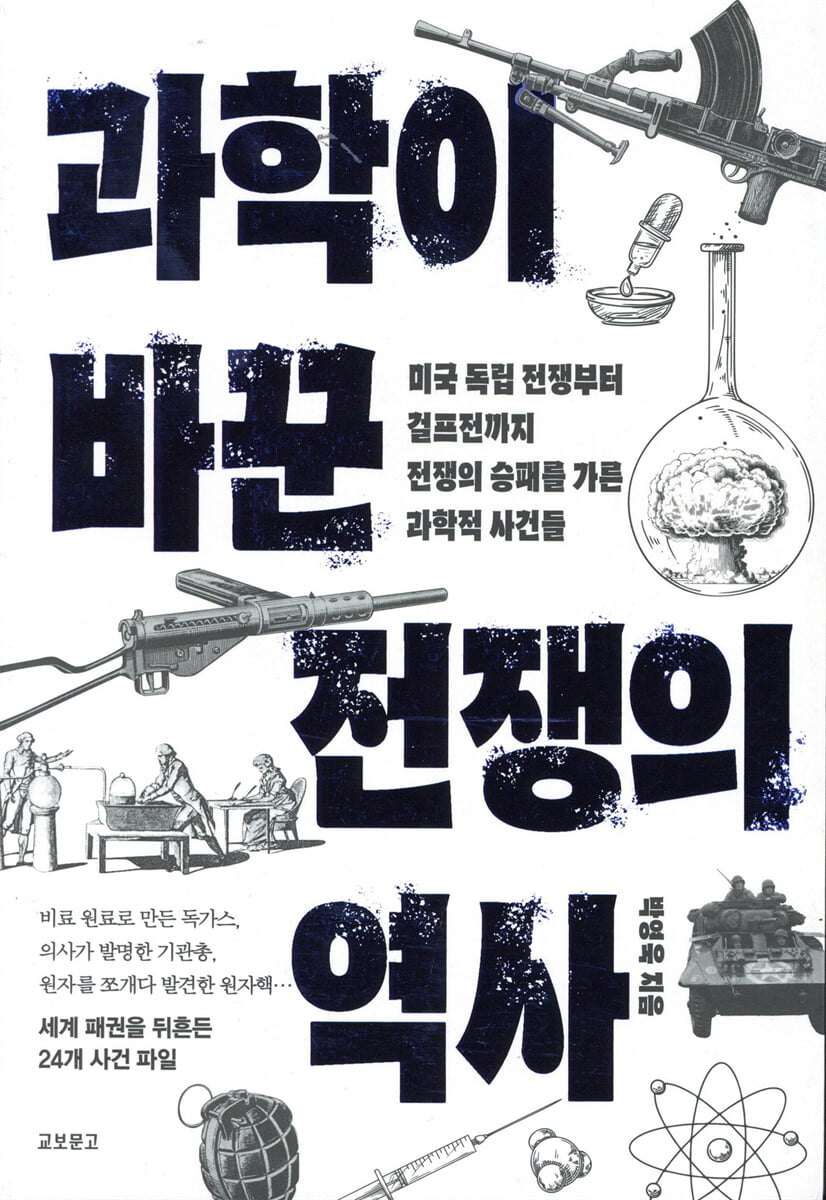
The History of War Changed by Science
 |
Description
Book Introduction
“There is no such thing as an accidental war!”
The outcome of the 'war' changed world hegemony.
There's always 'science' behind it.
200 Years of War and Science: The History That Saved Humanity and Pushed It into Crisis
Why is North Korea so obsessed with ICBM technology? Why does the state support science? Because science has always been behind wars that have upended global hegemony.
It wasn't long before scientists began to be recognized as professionals.
Even Newton, the greatest physicist of the 18th century, had to work as the head of the mint during the day and conduct research at night.
As science began to intervene in wars at the call of the state, its status began to change.
This book begins with the introduction of science into modern warfare, and introduces how science has transformed the nature of warfare, and how world hegemony has shifted based on the victories and defeats of wars and the choices of nations, through 24 crucial events.
From the American Revolutionary War to the French Revolution, World Wars I and II, and the Gulf War, from gunpowder improvements to the atomic bomb, ICBMs, and the relatively recent development of modern weapons systems, a glance at the history of war and the scientific developments that followed allows one to quickly understand the changes in the world situation.
This book, published by the author, who majored in the history of science and has researched defense science and technology, is a collection of excerpts and supplements from the series "War Stories in the History of Science" in the Defense Daily, which the author used to write, combining his expertise and will be an enjoyable read for all readers interested in the history of war or science.
The outcome of the 'war' changed world hegemony.
There's always 'science' behind it.
200 Years of War and Science: The History That Saved Humanity and Pushed It into Crisis
Why is North Korea so obsessed with ICBM technology? Why does the state support science? Because science has always been behind wars that have upended global hegemony.
It wasn't long before scientists began to be recognized as professionals.
Even Newton, the greatest physicist of the 18th century, had to work as the head of the mint during the day and conduct research at night.
As science began to intervene in wars at the call of the state, its status began to change.
This book begins with the introduction of science into modern warfare, and introduces how science has transformed the nature of warfare, and how world hegemony has shifted based on the victories and defeats of wars and the choices of nations, through 24 crucial events.
From the American Revolutionary War to the French Revolution, World Wars I and II, and the Gulf War, from gunpowder improvements to the atomic bomb, ICBMs, and the relatively recent development of modern weapons systems, a glance at the history of war and the scientific developments that followed allows one to quickly understand the changes in the world situation.
This book, published by the author, who majored in the history of science and has researched defense science and technology, is a collection of excerpts and supplements from the series "War Stories in the History of Science" in the Defense Daily, which the author used to write, combining his expertise and will be an enjoyable read for all readers interested in the history of war or science.
- You can preview some of the book's contents.
Preview
index
Introduction: The Encounter of Creation and Destruction
Chapter 1: Scientist as a Profession
- Lavoisier's gunpowder
Chapter 2: Science Meets Politics
- Royal Academy of Sciences and the Metric System
Chapter 3: School for a Strong Army
- École Polytechnique, loved by Napoleon
Chapter 4: The Prussian Counterattack
- Build-up to the Battle of Waterloo
Chapter 5: The Birth of Engineering
- Gribeauval's Cannon
Chapter 6: The Crimean War and the First Generation of Defense Enterprises
- Armstrong Four vs.
Whitworth rifle
Chapter 7: The Evolution of Modern Naval Power: The Battle of Trafalgar
- From Napoleon to Dreadnought
Chapter 8: The Merchant of Death in the Age of Militarism
-Arms lobbyist, Basil Zakharov
Chapter 9: The Murderous Weapons of World War I
- Ammonia in the harbor
Chapter 10: The Age of Mass Firearm Production
- Gatling's machine gun and Whitney's cotton gin
Chapter 11: No war happens by accident.
- Ford's armored car
Chapter 12 Everything the same for fast military supply
- Standard screws for Sellus
Chapter 13: Creating Elite Soldiers
- Thayer's West Point
Chapter 14: Science and Technology Make Money
- Edison's GE and Bell's AT&T
Chapter 15 Fibers Stronger Than Steel for Military Use
- DuPont's nylon
Chapter 16: The School Raised by War
- MIT's Engineering vs.
Basic Science at Caltech
Chapter 17: World War II: The American Era Begins
- Vannevar Bush's Defense Research Board
Chapter 18: Atoms are split
- Theory of relativity and nuclear fission experiments
Chapter 19: Ending the War
- Oppenheimer's Manhattan Project
Chapter 20 From Hot War to Cold War
- The Fuchs and McMahon Acts of the Cold War
Chapter 21: Another Nuclear Weapon
- Teller's hydrogen bomb
Chapter 22 Army vs. Navy vs. Air Force
- Recover's nuclear submarine
Chapter 23 Launching into Space
- Goddard and intercontinental ballistic missiles
Chapter 24: After the Cold War, the Unfinished War
- From precision guided weapons to artificial intelligence
Chronology of the history of war and science in this book
References
Chapter 1: Scientist as a Profession
- Lavoisier's gunpowder
Chapter 2: Science Meets Politics
- Royal Academy of Sciences and the Metric System
Chapter 3: School for a Strong Army
- École Polytechnique, loved by Napoleon
Chapter 4: The Prussian Counterattack
- Build-up to the Battle of Waterloo
Chapter 5: The Birth of Engineering
- Gribeauval's Cannon
Chapter 6: The Crimean War and the First Generation of Defense Enterprises
- Armstrong Four vs.
Whitworth rifle
Chapter 7: The Evolution of Modern Naval Power: The Battle of Trafalgar
- From Napoleon to Dreadnought
Chapter 8: The Merchant of Death in the Age of Militarism
-Arms lobbyist, Basil Zakharov
Chapter 9: The Murderous Weapons of World War I
- Ammonia in the harbor
Chapter 10: The Age of Mass Firearm Production
- Gatling's machine gun and Whitney's cotton gin
Chapter 11: No war happens by accident.
- Ford's armored car
Chapter 12 Everything the same for fast military supply
- Standard screws for Sellus
Chapter 13: Creating Elite Soldiers
- Thayer's West Point
Chapter 14: Science and Technology Make Money
- Edison's GE and Bell's AT&T
Chapter 15 Fibers Stronger Than Steel for Military Use
- DuPont's nylon
Chapter 16: The School Raised by War
- MIT's Engineering vs.
Basic Science at Caltech
Chapter 17: World War II: The American Era Begins
- Vannevar Bush's Defense Research Board
Chapter 18: Atoms are split
- Theory of relativity and nuclear fission experiments
Chapter 19: Ending the War
- Oppenheimer's Manhattan Project
Chapter 20 From Hot War to Cold War
- The Fuchs and McMahon Acts of the Cold War
Chapter 21: Another Nuclear Weapon
- Teller's hydrogen bomb
Chapter 22 Army vs. Navy vs. Air Force
- Recover's nuclear submarine
Chapter 23 Launching into Space
- Goddard and intercontinental ballistic missiles
Chapter 24: After the Cold War, the Unfinished War
- From precision guided weapons to artificial intelligence
Chronology of the history of war and science in this book
References
Detailed image

Into the book
The Royal Academy of Sciences dispatched surveying missions to various places abroad to measure the shape and circumference of the Earth.
In 1735, mathematician La Condamine led an expedition to Peru, and in 1740, astronomer Pierre Maupertuis led an expedition to Swedish Lapland.
The final measurements revealed that the Earth was an elongated oval, like a rugby ball.
It was the moment when 'Newton's Laws' were proven to be true.
--- p.34
At a time when other countries' armies were primarily composed of long-term professional soldiers, Prussia, which found it financially burdensome to maintain a state-employed army, formed a regular army with a three-year term to save costs.
At the same time, a reserve force system called the militia was created after military service, establishing a practical national conscription system that could maintain the size of the military force in both wartime and peacetime.
The Prussian army, using these reforms as a foundation, finally achieved victory by dealing a final blow to Napoleon at the Battle of Waterloo, and at the same time began to take the lead in Europe while avenging its defeat at Jena in 1806.
--- p.57
As Haber did, scientists can be heroes of humanity, or they can be war criminals who take the lives of tens of millions.
It can either save humanity or destroy it.
Haber, who won the 1918 Nobel Prize in Chemistry for his work on ammonia synthesis, once said, “In peacetime, the scientist belongs to the world, but in wartime, he belongs to his country.”
It is a heavy statement to be taken as just a protest from a scientist.
--- p.110
At the beginning of the war, Gatling, who had watched in despair as countless soldiers died from injuries sustained in conventional gunfights, was pondering a way to break the enemy's will to fight in the first battle by gaining an overwhelming advantage with a small number of soldiers without the need for a large army. He got a hint from the seed sower and developed and patented the first manual machine gun.
And this machine gun first appeared on the battlefield at the end of the Civil War.
In a letter to an acquaintance, Gatling reflected on his reasons for inventing the machine gun: “I wanted to make it possible for one man to fight like a hundred.”
--- p.114
World War I broke out during a period of industrialization that enabled the mass production of not only military vehicles and mobile weapon systems, but also naval weapon systems such as fighter planes and ships.
Few scholars see this as a coincidence.
In other words, experts say that war was a way to consume large quantities of large-scale weapons produced through a mass production system, and that this product of modern industrialization became an invisible pressure and factor in the outbreak of world war.
--- p.130
Although he was a brilliant physicist who had made significant contributions to the success of the project, including the plutonium implosion method, he believed that the ideal alternative to overthrowing the fascist Nazis was the communist Soviet Union rather than the United States.
He also held the idealistic view that, rather than a single country monopolizing nuclear weapons, balanced sharing of development information and capabilities among multiple countries would better ensure postwar world peace, saying, “Knowledge of nuclear research should be shared with the entire world for the benefit of humanity.”
That is why he passed on to the Soviet Union key information related to the development of the atomic bomb, which he learned while working at the Los Alamos Laboratory.
In 1735, mathematician La Condamine led an expedition to Peru, and in 1740, astronomer Pierre Maupertuis led an expedition to Swedish Lapland.
The final measurements revealed that the Earth was an elongated oval, like a rugby ball.
It was the moment when 'Newton's Laws' were proven to be true.
--- p.34
At a time when other countries' armies were primarily composed of long-term professional soldiers, Prussia, which found it financially burdensome to maintain a state-employed army, formed a regular army with a three-year term to save costs.
At the same time, a reserve force system called the militia was created after military service, establishing a practical national conscription system that could maintain the size of the military force in both wartime and peacetime.
The Prussian army, using these reforms as a foundation, finally achieved victory by dealing a final blow to Napoleon at the Battle of Waterloo, and at the same time began to take the lead in Europe while avenging its defeat at Jena in 1806.
--- p.57
As Haber did, scientists can be heroes of humanity, or they can be war criminals who take the lives of tens of millions.
It can either save humanity or destroy it.
Haber, who won the 1918 Nobel Prize in Chemistry for his work on ammonia synthesis, once said, “In peacetime, the scientist belongs to the world, but in wartime, he belongs to his country.”
It is a heavy statement to be taken as just a protest from a scientist.
--- p.110
At the beginning of the war, Gatling, who had watched in despair as countless soldiers died from injuries sustained in conventional gunfights, was pondering a way to break the enemy's will to fight in the first battle by gaining an overwhelming advantage with a small number of soldiers without the need for a large army. He got a hint from the seed sower and developed and patented the first manual machine gun.
And this machine gun first appeared on the battlefield at the end of the Civil War.
In a letter to an acquaintance, Gatling reflected on his reasons for inventing the machine gun: “I wanted to make it possible for one man to fight like a hundred.”
--- p.114
World War I broke out during a period of industrialization that enabled the mass production of not only military vehicles and mobile weapon systems, but also naval weapon systems such as fighter planes and ships.
Few scholars see this as a coincidence.
In other words, experts say that war was a way to consume large quantities of large-scale weapons produced through a mass production system, and that this product of modern industrialization became an invisible pressure and factor in the outbreak of world war.
--- p.130
Although he was a brilliant physicist who had made significant contributions to the success of the project, including the plutonium implosion method, he believed that the ideal alternative to overthrowing the fascist Nazis was the communist Soviet Union rather than the United States.
He also held the idealistic view that, rather than a single country monopolizing nuclear weapons, balanced sharing of development information and capabilities among multiple countries would better ensure postwar world peace, saying, “Knowledge of nuclear research should be shared with the entire world for the benefit of humanity.”
That is why he passed on to the Soviet Union key information related to the development of the atomic bomb, which he learned while working at the Los Alamos Laboratory.
--- p.216
Publisher's Review
Why should the government support science and technology?
Why are cutting-edge technologies used first in national defense?
History answers the questions entangled between science and the state today.
A glimpse into the world situation with 24 decisive events!
Contrary to the people's desire to live in a world without war, countries have gone to war, sometimes to protect their people, and sometimes under the pretext of becoming a stronger country.
Although battles known as wars have continued since the formation of nations, this book begins with modern wars, when science and war met and created unexpectedly great synergy.
Science, which began under the name of natural philosophy, is a great discipline that benefits the world by observing and proving natural phenomena, but it has not received much recognition in the country.
It was only when science began to be actively utilized in national tasks that it began to receive full recognition.
Amidst the turmoil of national discipline shaking, external invasion, and expansion of territory, it has always been science that has brought about major transformations.
Science, War, and Shaking World Hegemony
Beginning with Lavoisier, a chemist who was appointed director of the Gunpowder Bureau to improve gunpowder, Haber, a chemist who developed fertilizer raw materials that saved humanity from the food crisis and used them to make poison gas, Gatling, a doctor who invented the machine gun in hopes of ending the war quickly, Oppenheimer, a physicist who perfected the scientific discovery that atoms could be split into atomic bombs, and Teller, a physicist who developed a hydrogen bomb with a destructive power greater than that of the atomic bomb by fusing atomic nuclei, scientific discoveries and inventions that created decisive scenes at every critical juncture of war determined the outcome of the war and changed world hegemony.
The author, who majored in the history of science and studies defense technology, has identified 24 incidents in which science met war and changed the world situation, and says that war cannot be viewed as an accidental event.
Science has aided war, and countries that have achieved world hegemony by winning wars using science and technology have competitively supported science to maintain or regain that status.
In the process, weapons became more powerful, battles became more intense, and inevitably, humanity was constantly faced with new crises.
Rich photo material with interesting episodes,
A glance at the history of war and science in books, including a chronology
It is not a heavy or difficult story just because it is a history of war or science.
It's nice to see familiar inventors like Edison and Bell, or familiar companies like DuPont and Ford, and you can tilt your head in wonder at the stories of Zakharov, the lobbyist who profited from instigating the arms race, and Fuchs, who became a spy out of concern that one country would monopolize atomic bomb technology, and you can turn the pages as if you were listening to an interesting story.
What makes these interesting events even more vivid is the abundance of photographic evidence.
The text is written as simply and concisely as possible, and photographs are added to aid understanding, bringing the scenery of the time to life.
I tried to arrange the events in the book in chronological order as much as possible, but it was difficult to organize them neatly as they crossed over the world and eras, including France, England, Germany, the United States, and the Soviet Union. For readers who may feel disappointed in this aspect, I have included a chronological table at the back of the book that summarizes the major events.
The left side is about military history, and the right side is about scientific events. After reading the book, it is good to look through it and organize the contents. It will also be helpful to read the book after skimming the related contents in advance.
Science and technology are advancing rapidly day by day, making humanity more convenient but also more dangerous.
How we use science and technology is entirely up to human will.
War is not a thing of the past.
Even today, wars are raging all over the world, and at the same time, we do not know what the future holds for us.
The most important reason we need to know history is because history repeats itself.
There are no right answers in life, so it seems difficult to make a hasty judgment about which choice would have been right even when looking at past history.
But even so, we must always think about what is a better direction for humanity, and I hope that this book can spark some such thoughts.
Why are cutting-edge technologies used first in national defense?
History answers the questions entangled between science and the state today.
A glimpse into the world situation with 24 decisive events!
Contrary to the people's desire to live in a world without war, countries have gone to war, sometimes to protect their people, and sometimes under the pretext of becoming a stronger country.
Although battles known as wars have continued since the formation of nations, this book begins with modern wars, when science and war met and created unexpectedly great synergy.
Science, which began under the name of natural philosophy, is a great discipline that benefits the world by observing and proving natural phenomena, but it has not received much recognition in the country.
It was only when science began to be actively utilized in national tasks that it began to receive full recognition.
Amidst the turmoil of national discipline shaking, external invasion, and expansion of territory, it has always been science that has brought about major transformations.
Science, War, and Shaking World Hegemony
Beginning with Lavoisier, a chemist who was appointed director of the Gunpowder Bureau to improve gunpowder, Haber, a chemist who developed fertilizer raw materials that saved humanity from the food crisis and used them to make poison gas, Gatling, a doctor who invented the machine gun in hopes of ending the war quickly, Oppenheimer, a physicist who perfected the scientific discovery that atoms could be split into atomic bombs, and Teller, a physicist who developed a hydrogen bomb with a destructive power greater than that of the atomic bomb by fusing atomic nuclei, scientific discoveries and inventions that created decisive scenes at every critical juncture of war determined the outcome of the war and changed world hegemony.
The author, who majored in the history of science and studies defense technology, has identified 24 incidents in which science met war and changed the world situation, and says that war cannot be viewed as an accidental event.
Science has aided war, and countries that have achieved world hegemony by winning wars using science and technology have competitively supported science to maintain or regain that status.
In the process, weapons became more powerful, battles became more intense, and inevitably, humanity was constantly faced with new crises.
Rich photo material with interesting episodes,
A glance at the history of war and science in books, including a chronology
It is not a heavy or difficult story just because it is a history of war or science.
It's nice to see familiar inventors like Edison and Bell, or familiar companies like DuPont and Ford, and you can tilt your head in wonder at the stories of Zakharov, the lobbyist who profited from instigating the arms race, and Fuchs, who became a spy out of concern that one country would monopolize atomic bomb technology, and you can turn the pages as if you were listening to an interesting story.
What makes these interesting events even more vivid is the abundance of photographic evidence.
The text is written as simply and concisely as possible, and photographs are added to aid understanding, bringing the scenery of the time to life.
I tried to arrange the events in the book in chronological order as much as possible, but it was difficult to organize them neatly as they crossed over the world and eras, including France, England, Germany, the United States, and the Soviet Union. For readers who may feel disappointed in this aspect, I have included a chronological table at the back of the book that summarizes the major events.
The left side is about military history, and the right side is about scientific events. After reading the book, it is good to look through it and organize the contents. It will also be helpful to read the book after skimming the related contents in advance.
Science and technology are advancing rapidly day by day, making humanity more convenient but also more dangerous.
How we use science and technology is entirely up to human will.
War is not a thing of the past.
Even today, wars are raging all over the world, and at the same time, we do not know what the future holds for us.
The most important reason we need to know history is because history repeats itself.
There are no right answers in life, so it seems difficult to make a hasty judgment about which choice would have been right even when looking at past history.
But even so, we must always think about what is a better direction for humanity, and I hope that this book can spark some such thoughts.
GOODS SPECIFICS
- Date of issue: February 28, 2024
- Page count, weight, size: 272 pages | 444g | 145*210*20mm
- ISBN13: 9791170610953
- ISBN10: 1170610951
You may also like
카테고리
korean


korean

![ELLE 엘르 스페셜 에디션 A형 : 12월 [2025]](http://librairie.coreenne.fr/cdn/shop/files/b8e27a3de6c9538896439686c6b0e8fb.jpg?v=1766436872&width=3840)


