

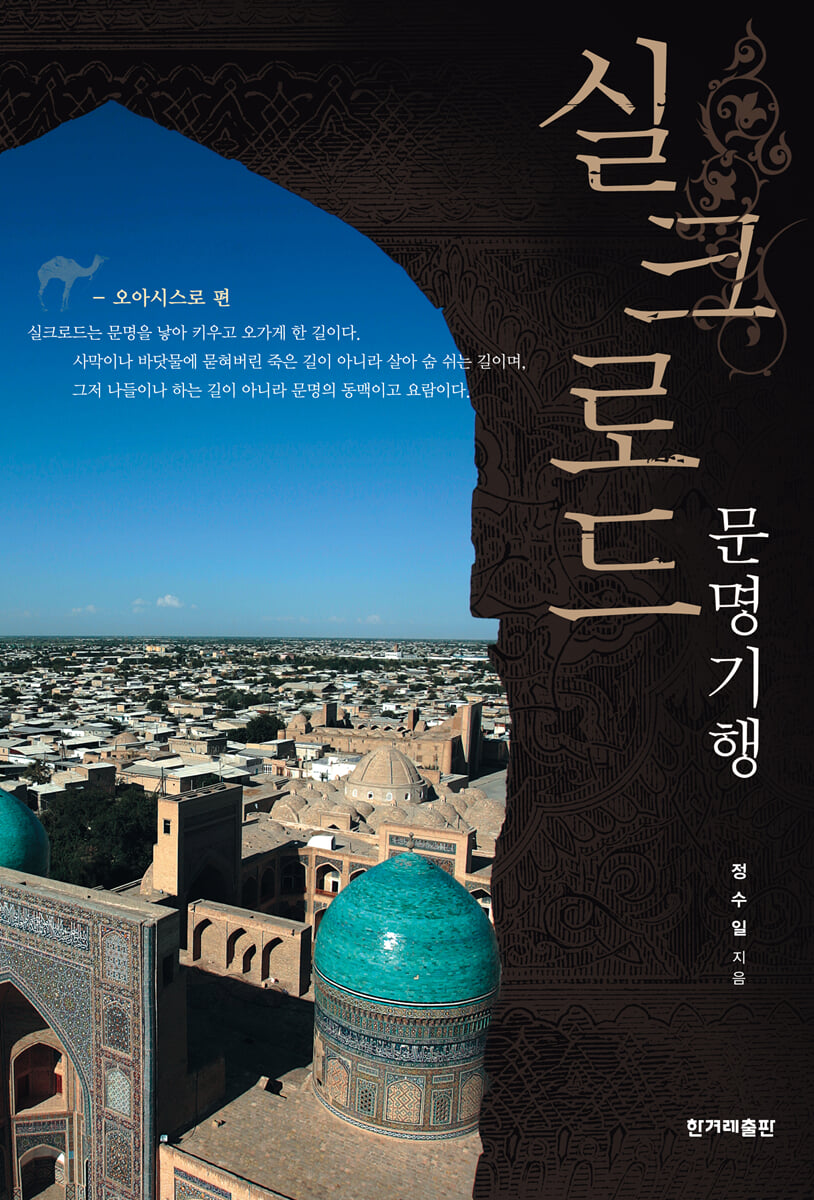
Silk Road Civilization Journey
 |
Description
Book Introduction
From July 17 to August 25, 2005, Professor Jeong Su-il and the Hankyoreh Silk Road Exploration Team walked along the Oasis Road, one of the three major Silk Road routes from Seoul to Istanbul, for 40 days, capturing every trace of civilization they discovered with their cameras and notebooks.
By following the 200-plus color photos taken by professional photographers, detailed commentary by Professor Jeong Su-il, and historical research uncovered through interactions with local scholars, readers will soon feel like they are the masters of the Silk Road.
Let's discover the traces of our people engraved on the Silk Road under the friendly guidance of Mr. Jeong Su-il.
By following the 200-plus color photos taken by professional photographers, detailed commentary by Professor Jeong Su-il, and historical research uncovered through interactions with local scholars, readers will soon feel like they are the masters of the Silk Road.
Let's discover the traces of our people engraved on the Silk Road under the friendly guidance of Mr. Jeong Su-il.
index
Author's Note
Introduction: Why did we walk the arduous path of martyrdom?
01 Beijing, the city that nurtured the dream of the Silk Road_ China's ambition and spirit are being revived.
02 Xi'an, the junction of Eastern and Western civilizations_ Xi'an is not the end of the Silk Road.
03 Smell the fragrance of our great monks in Xi'an, a city steeped in the scent of our ancestors.
04 Oasis, the bottleneck of the land route, Dunhuang_ Mysterious spring of civilization, burgeoning energy of development
05 Korean Cultural Heritage Preserved by Makgogul Cave_ A Premonition of Hyecho's Place of Death from the 'Silla Stupa'
06 Oasis, the gateway to the northern island, Okmun Pass_ The gateway to the western region, where only the survivors can pass through
07 Turpan, the melting pot of civilizations - a melting pot of civilizations, simmered in fire, sand, and wind.
08 The Passion of the Bezeklik Caves: A Scene of Civilization's Destruction Encountered in a 'Beautifully Decorated House'
09 Turpan's Specialty, Karez and Grapes - Spoils of War in the Battle Against the Harsh Environment
10 The Long-standing Relationship between Kucha and the Korean Peninsula_ Proud Koreans You Can Meet in Kucha
11 Kizil Grottoes and Hanrakyeon - China's Picasso Revives a Trapped Ancient Culture
12. Urumqi, a key point on the new Silk Road - A base on the Silk Road that washes away its shame and rises again.
13 The Taklamakan Desert, a place teeming with life_ A sea of life opens up, splitting the dry sand.
14 Hometown of Jade, Heoten_ Along the Jade Road, Along the Silk Road
15. Kashgar, a miniature version of Xinjiang_ You can't say you've been to Xinjiang without coming to Kashgar.
16 Pearl of the Tian Shan, Yisik Cool_ A mysterious blue pearl that moistens the dry desert
17 Golden Steppes, Kazakhstan_ The Golden Road Reopens on the Golden Steppes Road
18 Going to the site of the Talas Battle_ The roar of the prophet heard from Pokrovka Hill
19 In Search of the Home of the Horse_ Horses Always Stand at the Center of Life
20 Islamic Holy City, Tashkent_ The Heart of Central Asia, Where the Islamic Renaissance Blossomed
21. Korean Cultural Missionaries, Koryo-saram: The Original Korean Wave That Taken Root in the Aftermath of a Fallen Nation
22 Timur, the man of Central Asia's fortunes_ An oasis built on a history of blood and glory
23 The first Korean envoy to Central Asia_ The envoy in the mural is undoubtedly from Goguryeo.
24 Samarkand, the Road of Paper_ Papermakers who connected the East and the West with paper
25 A single volume of history, Bukhara_ A long history of glory and shame, layered like a rice cake
26 The Three Musketeers of the Bukhara School of Thought_ The greatest Islamic school that blossomed in an oasis
27 The Western Frontier of Buddhist Spread, Merv_ Their Lives Resemble Our Hometown
28 Nysa, the birthplace of Hellenism_ Hellenism was born in the Orient
29. Anau, who opened the path of saturation_ Fields with exposed soil, porcelain with a face
30 The land where Koreans left their footprints, Persia_ What was Hyecho's last travel destination 1,200 years ago?
31. The Land of the Sun, Khwarazm: A Sun-drenched Civilization Embraced in a Land of Natural Blessings
32 Museum City, Khiva_ Ruins are not relics of the past, but treasures
33 Mashhad, the holy city of Shia Islam - A land of martyrdom dressed in colorful attire
34. Persepolis, a gathering place of civilizations_ An eternal royal capital beautifully blossoming with an open mind
35 The Face of Persia, Shiraz_ A multi-ethnic city imbued with the virtues of harmony and tolerance
36 Iran's poet, Hafiz_ The Persian poet who soothed souls with his mysterious tongue
37 The Home of Pomegranates, Sir Kuch_ The Fruit of Life, Bringing the Fragrance of Persia to the Korean Peninsula
38 Yazd, the holy city of Zoroastrianism - A land of silence where the sacred fire never goes out
39 The Pearl of Iran, Isfahan - A City Where Civilization Lives and Breathes
The 'Gutenberg of Iran' who paved the way for movable type_ How was Goryeo's metal type transmitted to Germany?
41 Tehran, where tradition and modernity clash: Outdated modernization and returned tradition
42 Damascus, Embracing Christianity and Islam - A Place Where Long-Gone Prejudices Were Abandoned and a Civilization of Harmony Blossomed
43 The Noble Enemy, Saladin_ The Age of Conflict, Awaiting the Return of Saladin
44 Palmyra, the westernmost point of the Oasis land route - a 4,000-year-old trading city coveted by Rome
45 Ugarit, the birthplace of the alphabet_ The wonders of the first alphabet 3,000 years ago
46 Türkiye's Holy Land, Haran and Sanli Urfa - Abraham and his sons lived there.
47 The Holy Resting Place, Nemrut_ An old site where everyone fell asleep but a holy aura remained
48 Noah's Ark, the Eternal Mystery_ It is natural for a mystery to be solved as a mystery.
49 The East Where the Sun Rises, Anatolian Civilization_ The Golden Hand of Midas Sleeps Here
50 Harmony between Nature and Man, Cappadocia - Whose work are these fantastic rock formations and underground labyrinths?
51 Istanbul, an open-air museum of human civilization - Relics at every step, the entire city a World Heritage Site
52 Istanbul, the meeting point of Eastern and Western civilizations_ The thrill of experiencing Taegeuk-patterned white porcelain at the end of a field trip
53 Rediscovering the Silk Road_ Hoping for the rediscovery of the continuing steppe and sea routes
Introduction: Why did we walk the arduous path of martyrdom?
01 Beijing, the city that nurtured the dream of the Silk Road_ China's ambition and spirit are being revived.
02 Xi'an, the junction of Eastern and Western civilizations_ Xi'an is not the end of the Silk Road.
03 Smell the fragrance of our great monks in Xi'an, a city steeped in the scent of our ancestors.
04 Oasis, the bottleneck of the land route, Dunhuang_ Mysterious spring of civilization, burgeoning energy of development
05 Korean Cultural Heritage Preserved by Makgogul Cave_ A Premonition of Hyecho's Place of Death from the 'Silla Stupa'
06 Oasis, the gateway to the northern island, Okmun Pass_ The gateway to the western region, where only the survivors can pass through
07 Turpan, the melting pot of civilizations - a melting pot of civilizations, simmered in fire, sand, and wind.
08 The Passion of the Bezeklik Caves: A Scene of Civilization's Destruction Encountered in a 'Beautifully Decorated House'
09 Turpan's Specialty, Karez and Grapes - Spoils of War in the Battle Against the Harsh Environment
10 The Long-standing Relationship between Kucha and the Korean Peninsula_ Proud Koreans You Can Meet in Kucha
11 Kizil Grottoes and Hanrakyeon - China's Picasso Revives a Trapped Ancient Culture
12. Urumqi, a key point on the new Silk Road - A base on the Silk Road that washes away its shame and rises again.
13 The Taklamakan Desert, a place teeming with life_ A sea of life opens up, splitting the dry sand.
14 Hometown of Jade, Heoten_ Along the Jade Road, Along the Silk Road
15. Kashgar, a miniature version of Xinjiang_ You can't say you've been to Xinjiang without coming to Kashgar.
16 Pearl of the Tian Shan, Yisik Cool_ A mysterious blue pearl that moistens the dry desert
17 Golden Steppes, Kazakhstan_ The Golden Road Reopens on the Golden Steppes Road
18 Going to the site of the Talas Battle_ The roar of the prophet heard from Pokrovka Hill
19 In Search of the Home of the Horse_ Horses Always Stand at the Center of Life
20 Islamic Holy City, Tashkent_ The Heart of Central Asia, Where the Islamic Renaissance Blossomed
21. Korean Cultural Missionaries, Koryo-saram: The Original Korean Wave That Taken Root in the Aftermath of a Fallen Nation
22 Timur, the man of Central Asia's fortunes_ An oasis built on a history of blood and glory
23 The first Korean envoy to Central Asia_ The envoy in the mural is undoubtedly from Goguryeo.
24 Samarkand, the Road of Paper_ Papermakers who connected the East and the West with paper
25 A single volume of history, Bukhara_ A long history of glory and shame, layered like a rice cake
26 The Three Musketeers of the Bukhara School of Thought_ The greatest Islamic school that blossomed in an oasis
27 The Western Frontier of Buddhist Spread, Merv_ Their Lives Resemble Our Hometown
28 Nysa, the birthplace of Hellenism_ Hellenism was born in the Orient
29. Anau, who opened the path of saturation_ Fields with exposed soil, porcelain with a face
30 The land where Koreans left their footprints, Persia_ What was Hyecho's last travel destination 1,200 years ago?
31. The Land of the Sun, Khwarazm: A Sun-drenched Civilization Embraced in a Land of Natural Blessings
32 Museum City, Khiva_ Ruins are not relics of the past, but treasures
33 Mashhad, the holy city of Shia Islam - A land of martyrdom dressed in colorful attire
34. Persepolis, a gathering place of civilizations_ An eternal royal capital beautifully blossoming with an open mind
35 The Face of Persia, Shiraz_ A multi-ethnic city imbued with the virtues of harmony and tolerance
36 Iran's poet, Hafiz_ The Persian poet who soothed souls with his mysterious tongue
37 The Home of Pomegranates, Sir Kuch_ The Fruit of Life, Bringing the Fragrance of Persia to the Korean Peninsula
38 Yazd, the holy city of Zoroastrianism - A land of silence where the sacred fire never goes out
39 The Pearl of Iran, Isfahan - A City Where Civilization Lives and Breathes
The 'Gutenberg of Iran' who paved the way for movable type_ How was Goryeo's metal type transmitted to Germany?
41 Tehran, where tradition and modernity clash: Outdated modernization and returned tradition
42 Damascus, Embracing Christianity and Islam - A Place Where Long-Gone Prejudices Were Abandoned and a Civilization of Harmony Blossomed
43 The Noble Enemy, Saladin_ The Age of Conflict, Awaiting the Return of Saladin
44 Palmyra, the westernmost point of the Oasis land route - a 4,000-year-old trading city coveted by Rome
45 Ugarit, the birthplace of the alphabet_ The wonders of the first alphabet 3,000 years ago
46 Türkiye's Holy Land, Haran and Sanli Urfa - Abraham and his sons lived there.
47 The Holy Resting Place, Nemrut_ An old site where everyone fell asleep but a holy aura remained
48 Noah's Ark, the Eternal Mystery_ It is natural for a mystery to be solved as a mystery.
49 The East Where the Sun Rises, Anatolian Civilization_ The Golden Hand of Midas Sleeps Here
50 Harmony between Nature and Man, Cappadocia - Whose work are these fantastic rock formations and underground labyrinths?
51 Istanbul, an open-air museum of human civilization - Relics at every step, the entire city a World Heritage Site
52 Istanbul, the meeting point of Eastern and Western civilizations_ The thrill of experiencing Taegeuk-patterned white porcelain at the end of a field trip
53 Rediscovering the Silk Road_ Hoping for the rediscovery of the continuing steppe and sea routes
Into the book
The Silk Road is the path that gave birth to civilization, fostered its development, and allowed people to travel back and forth.
It is a path that connects the east, west, south, and north of the Earth and connects the past of human history to the present.
It is not a dead road buried in the desert or seawater, but a living, breathing road.
It is also a path that combines hardship and romance.
And it is a path that is far yet close within us.
In short, the Silk Road was not just a road for excursions, but an artery and cradle of civilization.
The five-member 'Hankyoreh Silk Road Survey Group' successfully surveyed Oasis Road, one of the three major Silk Road routes connecting Seoul and Istanbul, over a period of 40 days from July 17 to August 25, 2005.
Throughout the field trip, we tried to fulfill our mission of ‘traveling through civilization.’
As a result, we were able to confirm the extent of our culture's external globality and trace the countless cultural artifacts that have passed along this path.
I was also able to proudly enjoy the fragrance of the great human civilization that blossomed along this road.
It is a path that connects the east, west, south, and north of the Earth and connects the past of human history to the present.
It is not a dead road buried in the desert or seawater, but a living, breathing road.
It is also a path that combines hardship and romance.
And it is a path that is far yet close within us.
In short, the Silk Road was not just a road for excursions, but an artery and cradle of civilization.
The five-member 'Hankyoreh Silk Road Survey Group' successfully surveyed Oasis Road, one of the three major Silk Road routes connecting Seoul and Istanbul, over a period of 40 days from July 17 to August 25, 2005.
Throughout the field trip, we tried to fulfill our mission of ‘traveling through civilization.’
As a result, we were able to confirm the extent of our culture's external globality and trace the countless cultural artifacts that have passed along this path.
I was also able to proudly enjoy the fragrance of the great human civilization that blossomed along this road.
---From the author's note
Publisher's Review
The right 'meaning' found on the right 'path'
Why did we choose the rough road through the heat?
In a word, it was to understand the true meaning of this path.
This is also a bold decision by the Hankyoreh newspaper to find the right meaning on the right path.
Our path is not a path of entertainment or enjoyment, but a path of finding something.
On this path, we sought to confirm our status as "Korea in the world," trace the countless traces of cultural exchange between East and West, and experience the wisdom of the great civilizations created by humanity.
Because I believed that this was the true meaning of this path, I walked and walked without stopping, immersed in the fragrance of oasis civilization, without hesitation of the heat or the high mountains.
After completing the journey, I can feel that the newspaper's short-sightedness and our target were right on target.
Premonition of the death site of the great Silla monk Hyecho
In Xi'an (Chang'an), China, a neighboring city, we visited the pagoda and memorial pavilion honoring the great monks Woncheuk and Hyecho of Silla, and reflected on their achievements. We also discovered the site of the old house of General Go Seon-ji.
In the Mogao Caves of Dunhuang, where the spirit of Mingsha Mountain dwells, a clue was discovered to reveal the place of death of Monk Hyecho, which had always remained a mystery.
There is a place marked as ‘Silla Monk’s Pagoda’ on the ‘Wudaesan Miniature Map’, which is said to be the world’s largest map drawn during the Song Dynasty, so the enemy had a premonition that that place was the place where the monk died.
In addition, we have reconfirmed the fact that valuable relics related to our external historical culture are stored in various places in Makgogul Caves, including Janggyeong-dong.
Talas, where the roar of Goguryeo refugee General Go Seonji was heard…
The envoy in the mural of the Afrasiab Palace is definitely a Goguryeo envoy!
Although geographically distant, Central Asia somehow feels familiar.
There is the site of the Afrasiab Palace, where Goguryeo envoys visited, and the famous Battle of Talas, where General Go Seonji fought against the Islamic army. Today, Karaisgi (Goryeo people) live in many places, so kimchi is a popular food that is familiar to them.
Until now, we could only encounter the Goguryeo envoy portraits on the Afrasiab Palace murals in museum replicas, but with the guidance of the local archaeological research institute director, we were able to witness the excavation site where the artifacts had been excavated, then reburied, and kept secret.
The Battle of Talas, which left a lasting impression on the history of world wars and civilization, has always been a source of controversy, even in its location.
This time, with the guidance of a local expert, we heard from local archaeologists that the wide hillside along the Talas River may have been the site of a fierce battle, and that the remains of numerous soldiers may be buried there.
This could be a promising research clue.
However, I felt a pang of guilt at not being able to properly commemorate the feats of the general who had shaken the spirit of the Goguryeo people to the world.
The thrill of the Silk Road that stretched from the Korean Peninsula to the Western Regions
The remaining blue and white porcelain of unknown origin, could it possibly be ours?
As we pass through Central Asia and head west on this road, the distance between us becomes increasingly greater.
But even there, we were greeted by relics symbolizing our connection with our national history.
We sometimes see in historical documentaries people riding horses to compete in a martial art called polo, but it turns out that the game originated in Imam Square in the center of Isfahan, the ancient city of Iran.
The two pairs of stone skeletons that remained there silently testified to it.
Turkey, the final destination of our journey, is of interest to us in many ways.
It was such an irony that I always carried it close to my heart that not a single piece of our ceramics, which once led the world in ceramics history, had been discovered in the West.
So when I visited the Topkapi Palace Museum, which is said to have the largest collection of porcelain in the world, the first place I stopped by was the porcelain exhibition hall.
There, unexpectedly, my eyes stopped on a piece of blue and white porcelain with a clear eight trigrams and Taegeuk pattern.
Since only that one remains of unknown origin, I wonder if it might be ours. Half-suspicion, half-hope, I wonder if it really is, and I take heavy steps forward.
The Silk Road, which stretched to Palmyra, continues to expand.
The oasis city of Palmyra in Syria played a crucial role in extending the route we are following to the eastern coast of the Mediterranean.
Initially, the Silk Road was thought to run from China through Central Asia and end on the northwestern coast of India, but it was only when a piece of Hanjin (漢錦), a silk from the Han Dynasty of China, was discovered in a ruin in this city that it was finally confirmed that the road extended all the way to the Mediterranean Sea.
When we witnessed the origin of that piece of silk, our hearts could not help but flutter.
In addition, the original species of the 'Han-hyeol-ma (汗血馬)', which has been favored as a fantastic Western Region specialty horse since the Han Dynasty of China, was discovered in the mountains of the Tian Shan (天山) at an altitude of 3,300 meters, and it was also discovered locally that the home of the pomegranate is the Lion Mountain (獅子山) area in Iran.
And we could feel that the typical origin of our kaftan-type (unfolded) traditional costume was West Asia from the costume relics found here and there.
Our faces today, meeting yesterday
The delegation was captivated by the splendidly flourishing Islamic architectural culture in Central Asia, and in Iran, they were also filled with a sense of solemnity in front of Persepolis, the largest civilization site in the Middle East that encapsulates the essence of Oriental civilization, and the sacred fire of Zoroastrianism that has burned undiminished for over 1,500 years.
In Syria, we confirmed the coexistence of Christianity and Islam, which is often seen as conflict, and we also traced the Ugaritic script, the mother of the Latin script, at the excavation site.
All that we have seen and discovered along the way to the oasis is the product of the great civilizations that were created along this road.
Knowing those civilizations properly becomes a nutrient that enriches our knowledge and life.
Another true meaning of this journey is that I set out to gain those nutrients.
Shaking off the turbidity of modern civilization and immersing our bodies and minds in the pure, clean, and profound civilizations is a truly rewarding experience for us living today.
Now, we must stop lingering in the immediate vicinity and expand our reach to encompass various civilizations.
Why did we choose the rough road through the heat?
In a word, it was to understand the true meaning of this path.
This is also a bold decision by the Hankyoreh newspaper to find the right meaning on the right path.
Our path is not a path of entertainment or enjoyment, but a path of finding something.
On this path, we sought to confirm our status as "Korea in the world," trace the countless traces of cultural exchange between East and West, and experience the wisdom of the great civilizations created by humanity.
Because I believed that this was the true meaning of this path, I walked and walked without stopping, immersed in the fragrance of oasis civilization, without hesitation of the heat or the high mountains.
After completing the journey, I can feel that the newspaper's short-sightedness and our target were right on target.
Premonition of the death site of the great Silla monk Hyecho
In Xi'an (Chang'an), China, a neighboring city, we visited the pagoda and memorial pavilion honoring the great monks Woncheuk and Hyecho of Silla, and reflected on their achievements. We also discovered the site of the old house of General Go Seon-ji.
In the Mogao Caves of Dunhuang, where the spirit of Mingsha Mountain dwells, a clue was discovered to reveal the place of death of Monk Hyecho, which had always remained a mystery.
There is a place marked as ‘Silla Monk’s Pagoda’ on the ‘Wudaesan Miniature Map’, which is said to be the world’s largest map drawn during the Song Dynasty, so the enemy had a premonition that that place was the place where the monk died.
In addition, we have reconfirmed the fact that valuable relics related to our external historical culture are stored in various places in Makgogul Caves, including Janggyeong-dong.
Talas, where the roar of Goguryeo refugee General Go Seonji was heard…
The envoy in the mural of the Afrasiab Palace is definitely a Goguryeo envoy!
Although geographically distant, Central Asia somehow feels familiar.
There is the site of the Afrasiab Palace, where Goguryeo envoys visited, and the famous Battle of Talas, where General Go Seonji fought against the Islamic army. Today, Karaisgi (Goryeo people) live in many places, so kimchi is a popular food that is familiar to them.
Until now, we could only encounter the Goguryeo envoy portraits on the Afrasiab Palace murals in museum replicas, but with the guidance of the local archaeological research institute director, we were able to witness the excavation site where the artifacts had been excavated, then reburied, and kept secret.
The Battle of Talas, which left a lasting impression on the history of world wars and civilization, has always been a source of controversy, even in its location.
This time, with the guidance of a local expert, we heard from local archaeologists that the wide hillside along the Talas River may have been the site of a fierce battle, and that the remains of numerous soldiers may be buried there.
This could be a promising research clue.
However, I felt a pang of guilt at not being able to properly commemorate the feats of the general who had shaken the spirit of the Goguryeo people to the world.
The thrill of the Silk Road that stretched from the Korean Peninsula to the Western Regions
The remaining blue and white porcelain of unknown origin, could it possibly be ours?
As we pass through Central Asia and head west on this road, the distance between us becomes increasingly greater.
But even there, we were greeted by relics symbolizing our connection with our national history.
We sometimes see in historical documentaries people riding horses to compete in a martial art called polo, but it turns out that the game originated in Imam Square in the center of Isfahan, the ancient city of Iran.
The two pairs of stone skeletons that remained there silently testified to it.
Turkey, the final destination of our journey, is of interest to us in many ways.
It was such an irony that I always carried it close to my heart that not a single piece of our ceramics, which once led the world in ceramics history, had been discovered in the West.
So when I visited the Topkapi Palace Museum, which is said to have the largest collection of porcelain in the world, the first place I stopped by was the porcelain exhibition hall.
There, unexpectedly, my eyes stopped on a piece of blue and white porcelain with a clear eight trigrams and Taegeuk pattern.
Since only that one remains of unknown origin, I wonder if it might be ours. Half-suspicion, half-hope, I wonder if it really is, and I take heavy steps forward.
The Silk Road, which stretched to Palmyra, continues to expand.
The oasis city of Palmyra in Syria played a crucial role in extending the route we are following to the eastern coast of the Mediterranean.
Initially, the Silk Road was thought to run from China through Central Asia and end on the northwestern coast of India, but it was only when a piece of Hanjin (漢錦), a silk from the Han Dynasty of China, was discovered in a ruin in this city that it was finally confirmed that the road extended all the way to the Mediterranean Sea.
When we witnessed the origin of that piece of silk, our hearts could not help but flutter.
In addition, the original species of the 'Han-hyeol-ma (汗血馬)', which has been favored as a fantastic Western Region specialty horse since the Han Dynasty of China, was discovered in the mountains of the Tian Shan (天山) at an altitude of 3,300 meters, and it was also discovered locally that the home of the pomegranate is the Lion Mountain (獅子山) area in Iran.
And we could feel that the typical origin of our kaftan-type (unfolded) traditional costume was West Asia from the costume relics found here and there.
Our faces today, meeting yesterday
The delegation was captivated by the splendidly flourishing Islamic architectural culture in Central Asia, and in Iran, they were also filled with a sense of solemnity in front of Persepolis, the largest civilization site in the Middle East that encapsulates the essence of Oriental civilization, and the sacred fire of Zoroastrianism that has burned undiminished for over 1,500 years.
In Syria, we confirmed the coexistence of Christianity and Islam, which is often seen as conflict, and we also traced the Ugaritic script, the mother of the Latin script, at the excavation site.
All that we have seen and discovered along the way to the oasis is the product of the great civilizations that were created along this road.
Knowing those civilizations properly becomes a nutrient that enriches our knowledge and life.
Another true meaning of this journey is that I set out to gain those nutrients.
Shaking off the turbidity of modern civilization and immersing our bodies and minds in the pure, clean, and profound civilizations is a truly rewarding experience for us living today.
Now, we must stop lingering in the immediate vicinity and expand our reach to encompass various civilizations.
GOODS SPECIFICS
- Date of issue: February 15, 2024
- Page count, weight, size: 392 pages | 152*223*30mm
- ISBN13: 9791172130169
- ISBN10: 1172130167
You may also like
카테고리
korean


korean

![GQ KOREA Mark (Monthly): December [2025]](http://librairie.coreenne.fr/cdn/shop/files/8ef265dbbfbf186523ed75ba7319009d.jpg?v=1765340328&width=3840)


