

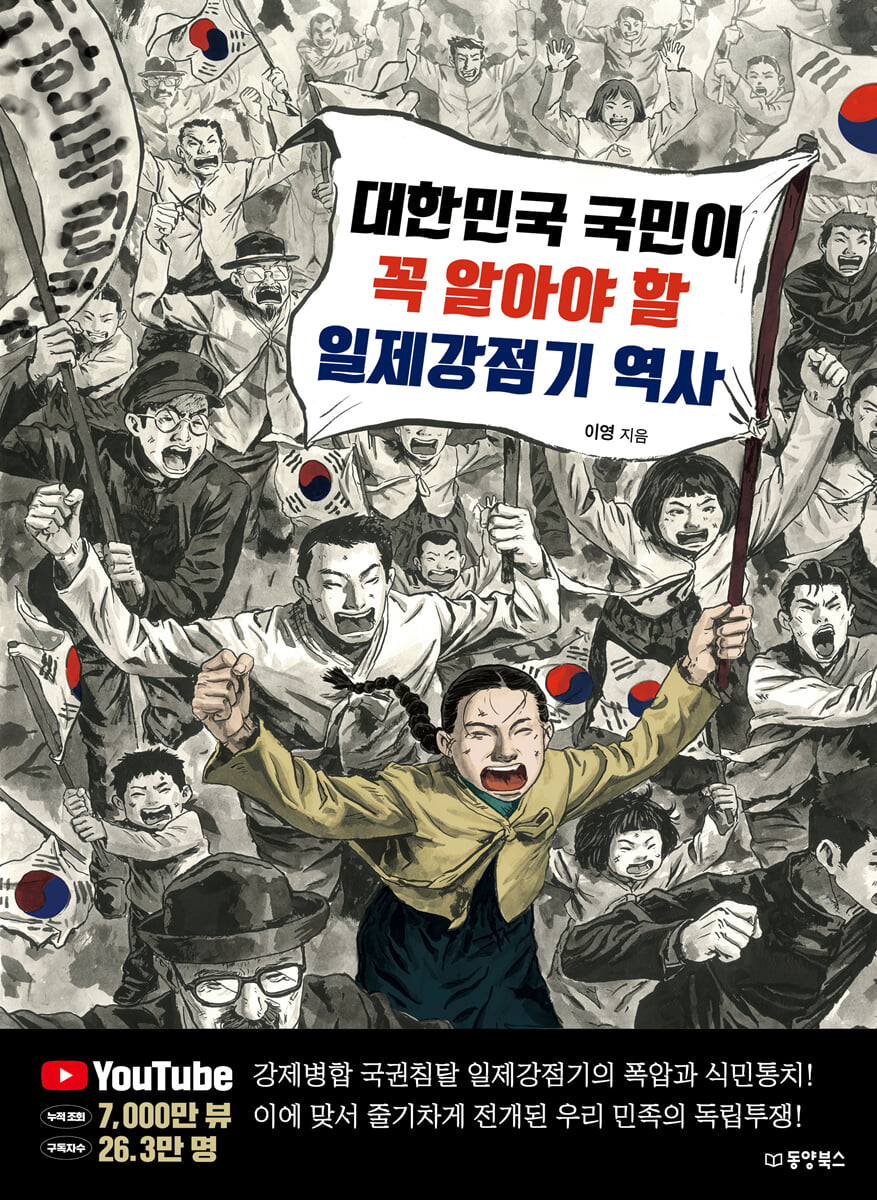
History of the Japanese colonial period that all Korean citizens must know
 |
Description
Book Introduction
When we correctly recognize history as it is and reflect on its significance,
Only then can we properly illuminate today and plan for a bright future! The Japanese colonial period refers to the period from 1910 to 1945 when Korea was under colonial rule by Japanese imperialism. Japan's colonial policy toward Korea was the most oppressive, arbitrary, and vicious in that it aimed not only at social and economic exploitation but also at the annihilation of the nation. The Japanese did not hesitate to distort history, reform the spiritual culture, suppress the use of the Korean language, and destroy the national cultural heritage. The anti-Japanese independence struggle against this was so tenacious and persistent that it served as an example for weak nations around the world, and ultimately led to liberation. The damage that Japanese colonial rule inflicted on our history was truly profound, even leading to the division of North and South Korea. |
- You can preview some of the book's contents.
Preview
index
Recommended Comments
prolog
Chapter 1: The Unprecedented Violation of Sovereignty
1.
Japanese military rule
Military police rule / Privy Council and historical distortion / 105 people incident
2.
Land survey projects and resource exploitation
Land survey projects / deprivation of economic rights of tenant farmers / forced return of land / various administrative orders for resource exploitation
3.
The birth of the independence movement
Domestic secret society movement / Korean Independence Army / Korean Liberation Association
4.
Establishment of Shinheung Military Academy
Korean National Association in the Americas / New Korea Youth Party in China / Anti-Japanese Independence Movement in Maritime Province / Anti-Japanese National Movement in Gando / Shinheung Military Academy
5.
March 1st Movement
International situation and the principle of national self-determination / Declaration of Independence / 33 national representatives / Reading of the Gimi Declaration of Independence / Spread of Manse demonstrations / Yu Gwan-sun and the Aunae Manse Movement / Manse demonstrations and civilian massacres /
The causes and significance of the March 1st Movement
6.
Establishment of the Provisional Government
The Korean National Assembly, the Seoul Government, and the Shanghai Provisional Government / Unifying the Three Provisional Governments / Syngman Rhee's Petition for a League of Nations Mandate
Quotes from Independence Activists 1
Yoo In-seok / Lee Sang-seol / Lee Seok-yeong / Lee Hoe-yeong / Son Byeong-hui / Kang Ki-deok / Yu Gwan-sun / Lee Dong-hwi / Lee Dong-nyeong / Park Eun-sik / Kim Kyu-sik
Chapter 2: The Beginning of the War of Independence
7.
Cunning cultural rule
The Japanese Government-General of Korea's appeasement policies and deception
8.
The Sanmi Increase Plan: Japan's Food Exploitation
Japan's Rice Shortage / Increased Rice Production and Exploitation in Colonial Korea
9.
Kim Won-bong and the Uiyoldan
Kim Won-bong of Yaksan / Early activities of the Uiyoldan / Shin Chae-ho's [Declaration of the Korean Revolution] / Later activities of the Uiyoldan / The end of the Uiyoldan / Appearances of Uiyoldan members
10.
Battle of Bongodong
Yeocheon Hong Beom-do / Battle of Bongodong
11.
Battle of Cheongsanri
Hunchun Incident / Movement of Independence Army Units
12.
Jayu City Massacre
Gando Massacre / Move to Russia
13.
3rd Part Integration Movement
Part 3: Independence Army Base | ① New People's Department / Part 3: Independence Army Base | ② Council of State / Part 3: Independence Army Base | ③ Justice Department / Part 3: Unification Movement
Quotes from Independence Activists 2
Kang Woo-gyu / Kim Won-bong / Park Jae-hyeok / Choi Su-bong / Kim Ik-sang / Kim Sang-ok / Kim Ji-seop / Na Seok-ju / Kim Jwa-jin / Hong Beom-do / Lee Beom-seok / Seo Il
Chapter 3: Awakening of National Consciousness
14.
Movement to establish private universities
Skills Development Movement / Second Joseon Education Ordinance / Lee Sang-jae's Movement to Establish Private Universities
15.
Dosan Ahn Chang-ho's Heungsadan
Orator, Dosan Ahn Chang-ho / Founder of Heungsadan / Ahn Chang-ho's educational theory
16.
Growth of national capital
Company Ordinance of the Government-General of Korea / Kim Seong-su's Gyeongseong Textile Company
17.
Movement to promote domestic products
The Japanese Government-General of Korea's tariff abolition/development of the movement to promote domestic products/side effects of the movement to promote domestic products
18.
Founding of the Communist Party
Kim Alexandra and the Korean Socialist Party / Koryo Communist Party, Irkutsk and Shanghai factions / Founding of the Korean Communist Party
19.
Tenant disputes and labor disputes
Tenant dispute / labor dispute
20.
A traitor to the nation, the autonomist
The debate on suffrage for colonial Koreans / The Yeonjeonghoe / Autonomy vs. uncompromising nationalism / The duality of autonomy advocates
21.
New People's Association's left-right joint movement
June 10th Independence Movement / Jeongwoohoe Declaration / Singanhoe Formation / Singanhoe Dissolution
22.
Mass Movement 1 - Student Movement
Mass Movement / Gwangju Student Anti-Japanese Movement / Student Independence Movement Anniversary
23.
Mass Movement 2 - Women's Movement
Patriotic Women's Association / Geunwoohoe / Gisaeng during the Japanese colonial period
24.
Mass Movement 3 - Children's Movement
Sofa Bang Jeong-hwan / Children's Day
25.
Mass Movement 4 - Equality Movement
The lowest class, Baekjeong / Equality Movement
26.
Colonial vs. Nationalist Historiography: Socio-economic History vs. Positivist History
Colonial history / Nationalist history / Socio-economic history / Positivism history
27.
Modernist Literature and KAPF Literature
Modernist Literature / KAPF Literature / The Birth of Modern Theater and Film / The Beginning of Popular Songs
28.
Kanto Massacre
Great Kanto Earthquake / Kanto Massacre
Quotes from Independence Activists 3
Lee Sang-jae / Ahn Chang-ho / Jo Man-sik / Kim Maria / Jeong Jeong-hwa / Shin Chae-ho / Ahn Jae-hong / Jeong In-bo / Han Yong-un / Na Un-gyu
Chapter 4: The Fascism of Japanese Imperialism
29.
Literacy Movement and the Bnarod Movement
Illiteracy Rates in Colonial Korea / Dong-A Ilbo's Campaign to Eliminate Blind Writers / Chosun Ilbo's Literacy Movement / Dong-A Ilbo's Bnarod Movement
30.
Fattening colonial Korea
The Manchurian Incident / The Government-General of Korea's Rural Development Movement / The Spread of Militarism / The Government-General of Korea's Southern and Northern Expansion Movement / The Government-General of Korea's Supply Base Policy
31.
Lee Bong-chang and Yun Bong-gil's righteous deeds
Kim Gu's formation of the Korean Patriotic Corps / Lee Bong-chang's righteous deed / Yun Bong-gil's righteous deed
32.
ROK-China joint operation
Manchurian Independence Army - Korean Independence Party and Korean Revolutionary Party / Ji Cheong-cheon's Korean Independence Army / Yang Se-bong's Korean Revolutionary Army / Five Parties Unified! Formation of the National Revolutionary Party
33.
National mobilization order
Conscription and rationing system / forced conscription and forced military service
34.
Forced migration from Central Asia
Stalin's rise to power in the Soviet Union / forced migration of Koreans
Quotes from Independence Activists 4
Choi Yong-sin / Kim Gu / Lee Bong-chang / Yun Bong-gil / Lee Hwa-rim / Ji Cheong-cheon / Yang Se-bong / Shin Ik-hee
Chapter 5: The Final Battle
35.
policy of genocide
Ban on the Korean language / suppression of the press / imperialization policy
36.
Protect Hangul, Korean Language Society
Linguistic determinism / The Korean Empire's National Institute of Korean Literature / Ji Seok-yeong and Ju Si-gyeong / Dictionary compilation work /
Founding of the Korean Language Research Association / Korean Language Society / Korean Language Society Incident
37.
Cultural President Jeon Hyeong-pil
Gansong Jeon Hyeong-pil and Wichang Oh Se-chang / Recovery of Gansong's Cultural Heritage / Hunminjeongeum Haeryebon
38.
The last round of the provisional government
The founding principles of the Republic of Korea / Kim Won-bong's joining of the Provisional Government / The activities of the Korean Liberation Army
39.
The story immediately after liberation
Yeo Un-hyeong's National Foundation Preparatory Committee / The issue of returning Japanese nationals who remained in Japan
40.
Koreans in Japan
Colonial Koreans who fled to Japan / The sinking of the Ukijima Maru / Utoro Village / Chongryon and Mindan / The current state of Koreans in Japan
Quotes from Independence Activists 5
Ji Seok-yeong / Joo Si-kyung / Choi Hyeon-bae / Jeon Hyeong-pil / Jo So-ang / Jang Jun-ha / Kim Jun-yeop / Yeo Woon-hyung / Park Yeol / Kaneko Fumiko
Epilogue
prolog
Chapter 1: The Unprecedented Violation of Sovereignty
1.
Japanese military rule
Military police rule / Privy Council and historical distortion / 105 people incident
2.
Land survey projects and resource exploitation
Land survey projects / deprivation of economic rights of tenant farmers / forced return of land / various administrative orders for resource exploitation
3.
The birth of the independence movement
Domestic secret society movement / Korean Independence Army / Korean Liberation Association
4.
Establishment of Shinheung Military Academy
Korean National Association in the Americas / New Korea Youth Party in China / Anti-Japanese Independence Movement in Maritime Province / Anti-Japanese National Movement in Gando / Shinheung Military Academy
5.
March 1st Movement
International situation and the principle of national self-determination / Declaration of Independence / 33 national representatives / Reading of the Gimi Declaration of Independence / Spread of Manse demonstrations / Yu Gwan-sun and the Aunae Manse Movement / Manse demonstrations and civilian massacres /
The causes and significance of the March 1st Movement
6.
Establishment of the Provisional Government
The Korean National Assembly, the Seoul Government, and the Shanghai Provisional Government / Unifying the Three Provisional Governments / Syngman Rhee's Petition for a League of Nations Mandate
Quotes from Independence Activists 1
Yoo In-seok / Lee Sang-seol / Lee Seok-yeong / Lee Hoe-yeong / Son Byeong-hui / Kang Ki-deok / Yu Gwan-sun / Lee Dong-hwi / Lee Dong-nyeong / Park Eun-sik / Kim Kyu-sik
Chapter 2: The Beginning of the War of Independence
7.
Cunning cultural rule
The Japanese Government-General of Korea's appeasement policies and deception
8.
The Sanmi Increase Plan: Japan's Food Exploitation
Japan's Rice Shortage / Increased Rice Production and Exploitation in Colonial Korea
9.
Kim Won-bong and the Uiyoldan
Kim Won-bong of Yaksan / Early activities of the Uiyoldan / Shin Chae-ho's [Declaration of the Korean Revolution] / Later activities of the Uiyoldan / The end of the Uiyoldan / Appearances of Uiyoldan members
10.
Battle of Bongodong
Yeocheon Hong Beom-do / Battle of Bongodong
11.
Battle of Cheongsanri
Hunchun Incident / Movement of Independence Army Units
12.
Jayu City Massacre
Gando Massacre / Move to Russia
13.
3rd Part Integration Movement
Part 3: Independence Army Base | ① New People's Department / Part 3: Independence Army Base | ② Council of State / Part 3: Independence Army Base | ③ Justice Department / Part 3: Unification Movement
Quotes from Independence Activists 2
Kang Woo-gyu / Kim Won-bong / Park Jae-hyeok / Choi Su-bong / Kim Ik-sang / Kim Sang-ok / Kim Ji-seop / Na Seok-ju / Kim Jwa-jin / Hong Beom-do / Lee Beom-seok / Seo Il
Chapter 3: Awakening of National Consciousness
14.
Movement to establish private universities
Skills Development Movement / Second Joseon Education Ordinance / Lee Sang-jae's Movement to Establish Private Universities
15.
Dosan Ahn Chang-ho's Heungsadan
Orator, Dosan Ahn Chang-ho / Founder of Heungsadan / Ahn Chang-ho's educational theory
16.
Growth of national capital
Company Ordinance of the Government-General of Korea / Kim Seong-su's Gyeongseong Textile Company
17.
Movement to promote domestic products
The Japanese Government-General of Korea's tariff abolition/development of the movement to promote domestic products/side effects of the movement to promote domestic products
18.
Founding of the Communist Party
Kim Alexandra and the Korean Socialist Party / Koryo Communist Party, Irkutsk and Shanghai factions / Founding of the Korean Communist Party
19.
Tenant disputes and labor disputes
Tenant dispute / labor dispute
20.
A traitor to the nation, the autonomist
The debate on suffrage for colonial Koreans / The Yeonjeonghoe / Autonomy vs. uncompromising nationalism / The duality of autonomy advocates
21.
New People's Association's left-right joint movement
June 10th Independence Movement / Jeongwoohoe Declaration / Singanhoe Formation / Singanhoe Dissolution
22.
Mass Movement 1 - Student Movement
Mass Movement / Gwangju Student Anti-Japanese Movement / Student Independence Movement Anniversary
23.
Mass Movement 2 - Women's Movement
Patriotic Women's Association / Geunwoohoe / Gisaeng during the Japanese colonial period
24.
Mass Movement 3 - Children's Movement
Sofa Bang Jeong-hwan / Children's Day
25.
Mass Movement 4 - Equality Movement
The lowest class, Baekjeong / Equality Movement
26.
Colonial vs. Nationalist Historiography: Socio-economic History vs. Positivist History
Colonial history / Nationalist history / Socio-economic history / Positivism history
27.
Modernist Literature and KAPF Literature
Modernist Literature / KAPF Literature / The Birth of Modern Theater and Film / The Beginning of Popular Songs
28.
Kanto Massacre
Great Kanto Earthquake / Kanto Massacre
Quotes from Independence Activists 3
Lee Sang-jae / Ahn Chang-ho / Jo Man-sik / Kim Maria / Jeong Jeong-hwa / Shin Chae-ho / Ahn Jae-hong / Jeong In-bo / Han Yong-un / Na Un-gyu
Chapter 4: The Fascism of Japanese Imperialism
29.
Literacy Movement and the Bnarod Movement
Illiteracy Rates in Colonial Korea / Dong-A Ilbo's Campaign to Eliminate Blind Writers / Chosun Ilbo's Literacy Movement / Dong-A Ilbo's Bnarod Movement
30.
Fattening colonial Korea
The Manchurian Incident / The Government-General of Korea's Rural Development Movement / The Spread of Militarism / The Government-General of Korea's Southern and Northern Expansion Movement / The Government-General of Korea's Supply Base Policy
31.
Lee Bong-chang and Yun Bong-gil's righteous deeds
Kim Gu's formation of the Korean Patriotic Corps / Lee Bong-chang's righteous deed / Yun Bong-gil's righteous deed
32.
ROK-China joint operation
Manchurian Independence Army - Korean Independence Party and Korean Revolutionary Party / Ji Cheong-cheon's Korean Independence Army / Yang Se-bong's Korean Revolutionary Army / Five Parties Unified! Formation of the National Revolutionary Party
33.
National mobilization order
Conscription and rationing system / forced conscription and forced military service
34.
Forced migration from Central Asia
Stalin's rise to power in the Soviet Union / forced migration of Koreans
Quotes from Independence Activists 4
Choi Yong-sin / Kim Gu / Lee Bong-chang / Yun Bong-gil / Lee Hwa-rim / Ji Cheong-cheon / Yang Se-bong / Shin Ik-hee
Chapter 5: The Final Battle
35.
policy of genocide
Ban on the Korean language / suppression of the press / imperialization policy
36.
Protect Hangul, Korean Language Society
Linguistic determinism / The Korean Empire's National Institute of Korean Literature / Ji Seok-yeong and Ju Si-gyeong / Dictionary compilation work /
Founding of the Korean Language Research Association / Korean Language Society / Korean Language Society Incident
37.
Cultural President Jeon Hyeong-pil
Gansong Jeon Hyeong-pil and Wichang Oh Se-chang / Recovery of Gansong's Cultural Heritage / Hunminjeongeum Haeryebon
38.
The last round of the provisional government
The founding principles of the Republic of Korea / Kim Won-bong's joining of the Provisional Government / The activities of the Korean Liberation Army
39.
The story immediately after liberation
Yeo Un-hyeong's National Foundation Preparatory Committee / The issue of returning Japanese nationals who remained in Japan
40.
Koreans in Japan
Colonial Koreans who fled to Japan / The sinking of the Ukijima Maru / Utoro Village / Chongryon and Mindan / The current state of Koreans in Japan
Quotes from Independence Activists 5
Ji Seok-yeong / Joo Si-kyung / Choi Hyeon-bae / Jeon Hyeong-pil / Jo So-ang / Jang Jun-ha / Kim Jun-yeop / Yeo Woon-hyung / Park Yeol / Kaneko Fumiko
Epilogue
Detailed image

Into the book
The pro-Japanese ministers had no choice but to stamp the imperial seal called 'Chikmyongjibo', which was used for administrative work, in place of Emperor Sunjong's signature or the imperial seal of the Korean Empire.
Empress Sunjeong, the wife of Emperor Sunjong, who noticed this, secretly took out the imperial seal and hid it in the folds of her skirt.
When the pro-Japanese ministers were flustered, one of the ten Gyeongsul nationals, Yun Deok-yeong, a royal secretary, forcibly lifted Empress Sunjeonghyo Yun's skirt and took her royal seal.
With such regrets, the treaty was finally signed.
The Japan-Korea Annexation Treaty, which was stamped with the Imperial Seal of the Imperial Order in place of Emperor Sunjong's signature or the Imperial Seal of the Korean Empire, cannot be recognized as legitimate. (While Emperor Sunjong's signature was later included in the treaty, it was merely a forgery by the Japanese.)
---From "The Shame of That Day, the Gyeongsul National Shame"
The main activity area of the New People's Association was Pyeongan Province, and there were a significant number of Catholic believers within Pyeongan Province.
In 1911, the military police arrested Catholics in Pyeongan Province, most of whom were Shinminhoe leaders.
The charge of arrest was attempted assassination.
It is said that ethnic Catholic believers in Pyeongan Province attempted to assassinate Governor-General Terauchi, who was attending the completion ceremony of the Yalu River Bridge.
However, the Shinminhoe had never planned to assassinate Terauchi.
The attempted assassination of Terauchi was a fabrication by the military police and the Governor-General's Office to arrest nationalist activists.
The Government-General arrested about 600 people, tortured them all severely, and indicted 128 of them, 105 of whom were convicted.
This was called the '105 People Incident', and the Shinminhoe was disbanded as a result.
---From the "105 People Incident"
It is noteworthy why this nationwide movement took place only in 1919, ten years after the country was forcibly annexed by Japan.
The most decisive reason why the March 1st Movement was able to expand into a nationwide movement was because Japan was the common enemy of the colonial Korean people.
For ten years after the loss of national sovereignty, Koreans were oppressed and their right to survive was threatened simply because they were a subject of a colonial rule, regardless of class, wealth, gender, occupation, or rank.
The land survey project of the Japanese Government-General of Korea, which lasted for a full nine years from 1910 to 1918, resulted in the loss of land, the ruin of independent farmers, and the forced wandering of tenant farmers.
Korean workers were forced to endure poor working conditions and low wages, and welfare discrimination was blatant.
Even wealthy people were unable to preserve and manage their assets intact due to the promulgation of the Company Ordinance in 1910.
Joseon's economic power was invaded by all kinds of measures.
Regardless of wealth, all colonial Koreans suffered under colonial rule.
---From “The Causes and Significance of the March 1st Movement”
After the defeat in the Battle of Cheongsanri, the Japanese imperialists' desire for revenge against Koreans and independence fighters became mad.
After being defeated in the Battle of Bongodong, Japan initiated the Hunchun Incident and used it as a pretext to station troops in Manchuria.
After the Battle of Cheongsanri, the Japanese became much more brutal.
The indiscriminate massacre of civilians by the Japanese military stationed in Manchuria that occurred in the Gando region for 27 days from October 9 to November 5, 1920, is called the 'Gando Massacre' or the 'Gyeongsin Massacre'.
At the time, it was estimated that approximately 3,400 Koreans were killed, but the actual number of casualties is believed to have been much higher.
Even if no one was killed, inhumane acts such as rape, looting, and arson occurred everywhere.
---From "The Gando Massacre"
Regardless of time or place, everyone emphasizes the importance of education.
This is because the better a country's education system was, the stronger its national power was.
In the same vein, one way for a conqueror to effectively rule a conquered people is to limit and deprive them of educational opportunities.
Compared to Japan, which quickly established an advanced education system, the Korean people and even the ruling class immediately before the occupation were ignorant and indifferent to the international situation and new civilizations.
Intellectuals in colonial Korea believed that one of the reasons for Japanese rule was the backwardness of education.
After the March 1st Movement, some independence activists argued that it was more important for each and every Korean to become competent than to achieve independence through struggle.
This kind of ideology and movement is called the 'capability development movement'.
There were two streams in this movement, one of which was the educational movement.
---From "Ability Development Movement"
Following Lee Bong-chang's uprising in January 1932, Yun Bong-gil's uprising in April 1932 shocked not only the Korean Peninsula but also the Chinese people.
Chiang Kai-shek of the Chinese Nationalist Party praised Yun Bong-gil, saying, “One Korean has accomplished what 200 million Chinese people could not do.” He gave the bereaved family the calligraphy “Jangryeolcheonchu (壯烈千秋),” meaning “the most heroic person in history.”
Chiang Kai-shek subsequently decided to actively support the Provisional Government of the Republic of Korea and actively discussed Korean independence at the Cairo Conference, where international leaders gathered.
Additionally, as Koreans living in the Americas, Hawaii, Mexico, and Cuba began to send support to the provisional government, the provisional government began to accumulate enormous financial resources.
The righteous deeds of Lee Bong-chang and Yun Bong-gil shook East Asia and created the most important turning point in the history of the Provisional Government of the Republic of Korea.
---From "Lee Bong-chang's Righteous Deed, Yun Bong-gil's Righteous Deed"
Japan decided to change its ruling method in order to exploit Joseon more forcefully.
The plan was to brainwash Koreans and completely destroy their national identity.
In the 1930s, the Japanese Government-General of Korea ended its cultural rule and implemented a policy of ethnic annihilation.
In 1938, the Government-General of Korea announced the 3rd Korean Education Ordinance, changing the Korean language, which had previously been a required subject, to an elective subject.
Soon after, in 1943, the use of the Korean language was completely banned with the 4th Korean Education Ordinance.
In addition, all educational courses were reorganized to focus on war training.
The Japanese Government-General of Korea changed the name of elementary education institutions, previously called "elementary schools," to "national schools," shortening the name from "Imperial Subjects' Schools," with the intention of brainwashing children from an early age.
Empress Sunjeong, the wife of Emperor Sunjong, who noticed this, secretly took out the imperial seal and hid it in the folds of her skirt.
When the pro-Japanese ministers were flustered, one of the ten Gyeongsul nationals, Yun Deok-yeong, a royal secretary, forcibly lifted Empress Sunjeonghyo Yun's skirt and took her royal seal.
With such regrets, the treaty was finally signed.
The Japan-Korea Annexation Treaty, which was stamped with the Imperial Seal of the Imperial Order in place of Emperor Sunjong's signature or the Imperial Seal of the Korean Empire, cannot be recognized as legitimate. (While Emperor Sunjong's signature was later included in the treaty, it was merely a forgery by the Japanese.)
---From "The Shame of That Day, the Gyeongsul National Shame"
The main activity area of the New People's Association was Pyeongan Province, and there were a significant number of Catholic believers within Pyeongan Province.
In 1911, the military police arrested Catholics in Pyeongan Province, most of whom were Shinminhoe leaders.
The charge of arrest was attempted assassination.
It is said that ethnic Catholic believers in Pyeongan Province attempted to assassinate Governor-General Terauchi, who was attending the completion ceremony of the Yalu River Bridge.
However, the Shinminhoe had never planned to assassinate Terauchi.
The attempted assassination of Terauchi was a fabrication by the military police and the Governor-General's Office to arrest nationalist activists.
The Government-General arrested about 600 people, tortured them all severely, and indicted 128 of them, 105 of whom were convicted.
This was called the '105 People Incident', and the Shinminhoe was disbanded as a result.
---From the "105 People Incident"
It is noteworthy why this nationwide movement took place only in 1919, ten years after the country was forcibly annexed by Japan.
The most decisive reason why the March 1st Movement was able to expand into a nationwide movement was because Japan was the common enemy of the colonial Korean people.
For ten years after the loss of national sovereignty, Koreans were oppressed and their right to survive was threatened simply because they were a subject of a colonial rule, regardless of class, wealth, gender, occupation, or rank.
The land survey project of the Japanese Government-General of Korea, which lasted for a full nine years from 1910 to 1918, resulted in the loss of land, the ruin of independent farmers, and the forced wandering of tenant farmers.
Korean workers were forced to endure poor working conditions and low wages, and welfare discrimination was blatant.
Even wealthy people were unable to preserve and manage their assets intact due to the promulgation of the Company Ordinance in 1910.
Joseon's economic power was invaded by all kinds of measures.
Regardless of wealth, all colonial Koreans suffered under colonial rule.
---From “The Causes and Significance of the March 1st Movement”
After the defeat in the Battle of Cheongsanri, the Japanese imperialists' desire for revenge against Koreans and independence fighters became mad.
After being defeated in the Battle of Bongodong, Japan initiated the Hunchun Incident and used it as a pretext to station troops in Manchuria.
After the Battle of Cheongsanri, the Japanese became much more brutal.
The indiscriminate massacre of civilians by the Japanese military stationed in Manchuria that occurred in the Gando region for 27 days from October 9 to November 5, 1920, is called the 'Gando Massacre' or the 'Gyeongsin Massacre'.
At the time, it was estimated that approximately 3,400 Koreans were killed, but the actual number of casualties is believed to have been much higher.
Even if no one was killed, inhumane acts such as rape, looting, and arson occurred everywhere.
---From "The Gando Massacre"
Regardless of time or place, everyone emphasizes the importance of education.
This is because the better a country's education system was, the stronger its national power was.
In the same vein, one way for a conqueror to effectively rule a conquered people is to limit and deprive them of educational opportunities.
Compared to Japan, which quickly established an advanced education system, the Korean people and even the ruling class immediately before the occupation were ignorant and indifferent to the international situation and new civilizations.
Intellectuals in colonial Korea believed that one of the reasons for Japanese rule was the backwardness of education.
After the March 1st Movement, some independence activists argued that it was more important for each and every Korean to become competent than to achieve independence through struggle.
This kind of ideology and movement is called the 'capability development movement'.
There were two streams in this movement, one of which was the educational movement.
---From "Ability Development Movement"
Following Lee Bong-chang's uprising in January 1932, Yun Bong-gil's uprising in April 1932 shocked not only the Korean Peninsula but also the Chinese people.
Chiang Kai-shek of the Chinese Nationalist Party praised Yun Bong-gil, saying, “One Korean has accomplished what 200 million Chinese people could not do.” He gave the bereaved family the calligraphy “Jangryeolcheonchu (壯烈千秋),” meaning “the most heroic person in history.”
Chiang Kai-shek subsequently decided to actively support the Provisional Government of the Republic of Korea and actively discussed Korean independence at the Cairo Conference, where international leaders gathered.
Additionally, as Koreans living in the Americas, Hawaii, Mexico, and Cuba began to send support to the provisional government, the provisional government began to accumulate enormous financial resources.
The righteous deeds of Lee Bong-chang and Yun Bong-gil shook East Asia and created the most important turning point in the history of the Provisional Government of the Republic of Korea.
---From "Lee Bong-chang's Righteous Deed, Yun Bong-gil's Righteous Deed"
Japan decided to change its ruling method in order to exploit Joseon more forcefully.
The plan was to brainwash Koreans and completely destroy their national identity.
In the 1930s, the Japanese Government-General of Korea ended its cultural rule and implemented a policy of ethnic annihilation.
In 1938, the Government-General of Korea announced the 3rd Korean Education Ordinance, changing the Korean language, which had previously been a required subject, to an elective subject.
Soon after, in 1943, the use of the Korean language was completely banned with the 4th Korean Education Ordinance.
In addition, all educational courses were reorganized to focus on war training.
The Japanese Government-General of Korea changed the name of elementary education institutions, previously called "elementary schools," to "national schools," shortening the name from "Imperial Subjects' Schools," with the intention of brainwashing children from an early age.
---From "Ban on Korean"
Publisher's Review
Beyond social and economic exploitation, to the annihilation of the nation,
There has never been such colonial rule anywhere in the world!
Our history during the Japanese colonial period, read with your heart and engrave on your bones!
How did Japan oppress and exploit our people?
What kind of exploitative policies did the successive governors of the Japanese Government-General of Korea pursue?
Where and how did the war of independence against violence and oppression begin?
Who were the people who willingly sacrificed their lives for independence?
How was our national consciousness awakened to fight against the policy of ethnic annihilation?
What impact did the Japanese colonial period have on our people after liberation?
After occupying the Korean Empire as a colony, Japanese imperialism pursued its own unique colonial policy, which differed from the colonial policies of Western powers.
The characteristics of the colonial policy implemented by Japanese imperialism against the Korean Empire can be summarized as a fusion of the 'policy of annihilating the Korean people' and the 'policy of colonial exploitation.'
This book deals with the specifics of how Japanese colonial rule was carried out and how our people's struggle for independence unfolded in a fact-based and straightforward manner.
Japan's colonial policy was the most oppressive, arbitrary, and vicious in that it aimed not only at social and economic exploitation but also at the annihilation of the nation.
The Japanese did not hesitate to distort history, reform the spiritual culture, suppress the use of the Korean language, and destroy the national cultural heritage.
But our people did not just sit back and do nothing.
Throughout our history, during the heartbreaking Japanese colonial period, the struggle for independence against Japanese tyranny and colonial rule continued.
Although it was the Allied Forces that defeated Japan, the indomitable struggle of our independence activists was not meaningless or worthless.
Among the Japanese colonies, there are some that, like Okinawa, failed to achieve independence after Japan's defeat.
Thanks to our independence activists risking their lives to resist Japanese imperialism and actively informing the international community of their will for independence, the Allied Powers that led them to victory in World War II were able to seriously discuss Korea's independence.
Thanks to the righteous actions of Lee Bong-chang and Yun Bong-gil and the activities of Kim Gu in the provisional government, it was possible to secure Chiang Kai-shek's assistance, and Chiang Kai-shek even proposed Korean independence as an agenda item at international conferences such as the Cairo Conference.
In order to liquidate the history of colonial rule and restore friendly relations between Korea and Japan, we must face the facts of the past, reflect on their significance, and never repeat the mistakes of the past.
We must establish true friendly relations between Korea and Japan by correctly recognizing and interpreting history as it is.
1.
user-*****8qb5s
The reason why the Republic of Korea exists today is thanks to the patriotic martyrs and martyrs.
We must always be grateful, and we must strive to never forget them, and never forget history.
2.
mir_c****7
The history of the Japanese colonial period belongs to modern and contemporary history, and I believe it is a painful experience that we must never forget, and the first step toward becoming a nation where the people have sovereignty.
3.
user-*****6yl9n
The records of our ancestors' joys and sorrows become history, providing lessons for our descendants living in the present so that they can succeed without repeating their failures.
4.
ri***jj
I think it's understandable for any Korean to be curious about what happened during the Japanese colonial period.
5.
user-*****3bn8z
It is an era in which every Korean knows and is indignant, but it is difficult to know for sure, and it is treated as a learning process, so it is known vaguely.
I would like to know more about the Japanese invasion period.
There has never been such colonial rule anywhere in the world!
Our history during the Japanese colonial period, read with your heart and engrave on your bones!
How did Japan oppress and exploit our people?
What kind of exploitative policies did the successive governors of the Japanese Government-General of Korea pursue?
Where and how did the war of independence against violence and oppression begin?
Who were the people who willingly sacrificed their lives for independence?
How was our national consciousness awakened to fight against the policy of ethnic annihilation?
What impact did the Japanese colonial period have on our people after liberation?
After occupying the Korean Empire as a colony, Japanese imperialism pursued its own unique colonial policy, which differed from the colonial policies of Western powers.
The characteristics of the colonial policy implemented by Japanese imperialism against the Korean Empire can be summarized as a fusion of the 'policy of annihilating the Korean people' and the 'policy of colonial exploitation.'
This book deals with the specifics of how Japanese colonial rule was carried out and how our people's struggle for independence unfolded in a fact-based and straightforward manner.
Japan's colonial policy was the most oppressive, arbitrary, and vicious in that it aimed not only at social and economic exploitation but also at the annihilation of the nation.
The Japanese did not hesitate to distort history, reform the spiritual culture, suppress the use of the Korean language, and destroy the national cultural heritage.
But our people did not just sit back and do nothing.
Throughout our history, during the heartbreaking Japanese colonial period, the struggle for independence against Japanese tyranny and colonial rule continued.
Although it was the Allied Forces that defeated Japan, the indomitable struggle of our independence activists was not meaningless or worthless.
Among the Japanese colonies, there are some that, like Okinawa, failed to achieve independence after Japan's defeat.
Thanks to our independence activists risking their lives to resist Japanese imperialism and actively informing the international community of their will for independence, the Allied Powers that led them to victory in World War II were able to seriously discuss Korea's independence.
Thanks to the righteous actions of Lee Bong-chang and Yun Bong-gil and the activities of Kim Gu in the provisional government, it was possible to secure Chiang Kai-shek's assistance, and Chiang Kai-shek even proposed Korean independence as an agenda item at international conferences such as the Cairo Conference.
In order to liquidate the history of colonial rule and restore friendly relations between Korea and Japan, we must face the facts of the past, reflect on their significance, and never repeat the mistakes of the past.
We must establish true friendly relations between Korea and Japan by correctly recognizing and interpreting history as it is.
1.
user-*****8qb5s
The reason why the Republic of Korea exists today is thanks to the patriotic martyrs and martyrs.
We must always be grateful, and we must strive to never forget them, and never forget history.
2.
mir_c****7
The history of the Japanese colonial period belongs to modern and contemporary history, and I believe it is a painful experience that we must never forget, and the first step toward becoming a nation where the people have sovereignty.
3.
user-*****6yl9n
The records of our ancestors' joys and sorrows become history, providing lessons for our descendants living in the present so that they can succeed without repeating their failures.
4.
ri***jj
I think it's understandable for any Korean to be curious about what happened during the Japanese colonial period.
5.
user-*****3bn8z
It is an era in which every Korean knows and is indignant, but it is difficult to know for sure, and it is treated as a learning process, so it is known vaguely.
I would like to know more about the Japanese invasion period.
GOODS SPECIFICS
- Date of issue: February 13, 2024
- Page count, weight, size: 312 pages | 654g | 188*257*15mm
- ISBN13: 9791172100056
- ISBN10: 1172100055
You may also like
카테고리
korean


korean

![ELLE 엘르 스페셜 에디션 A형 : 12월 [2025]](http://librairie.coreenne.fr/cdn/shop/files/b8e27a3de6c9538896439686c6b0e8fb.jpg?v=1766436872&width=3840)


