

The Spring and Autumn Period and the Warring States Period 1
 |
Description
Book Introduction
Guan Zhong, the architect of the Spring and Autumn period order and the first economist
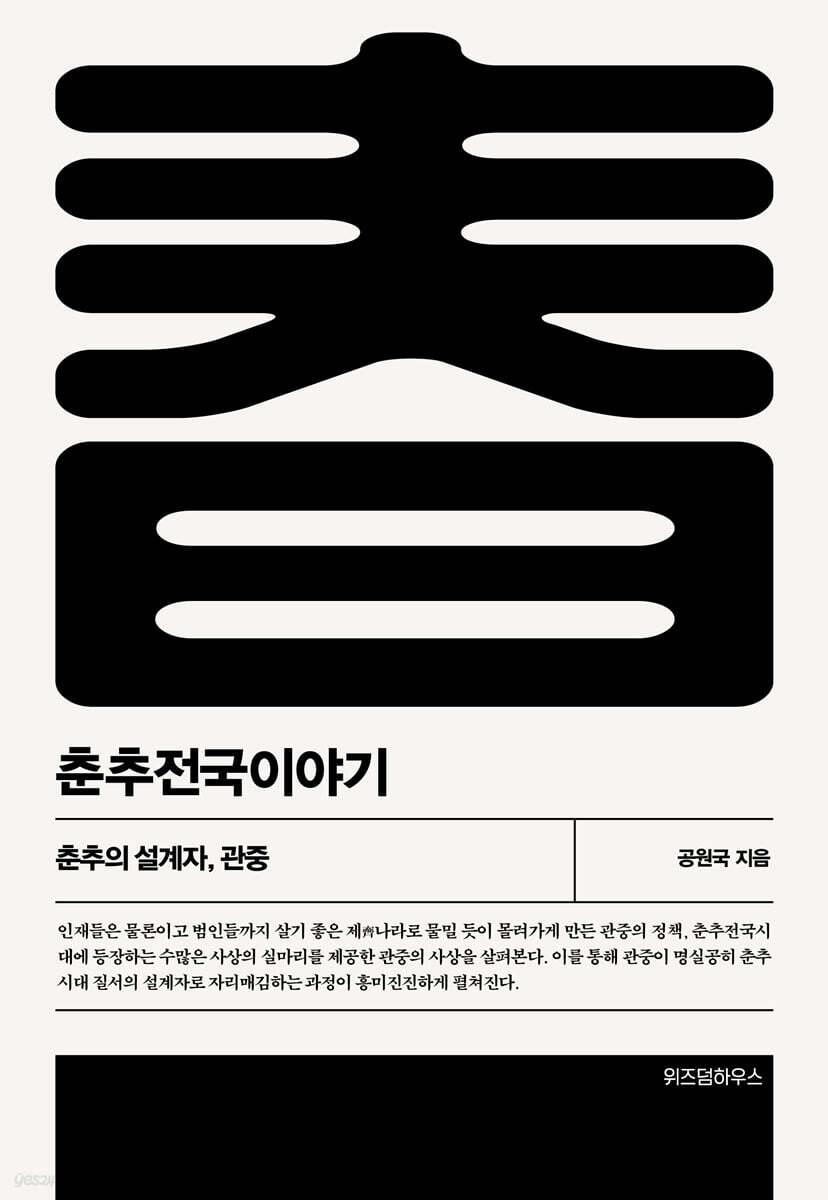
This is the revised second edition of 『The Spring and Autumn Annals and Warring States Stories』.
In the first volume of the series, Guan Zhong of the State of Qi appears as the main character, and the exciting process of him establishing himself as the true architect of the order of the Spring and Autumn Period unfolds.
Guan Zhong was the person who established Duke Huan of Qi as the first of the Five Hegemons of the Spring and Autumn Period, and established order in all aspects, including the economic system of the Spring and Autumn Period.
It can be said that the paradigm he presented has continued for 2,500 years and created today's China.
This is the revised second edition of 『The Spring and Autumn Annals and Warring States Stories』.
In the first volume of the series, Guan Zhong of the State of Qi appears as the main character, and the exciting process of him establishing himself as the true architect of the order of the Spring and Autumn Period unfolds.
Guan Zhong was the person who established Duke Huan of Qi as the first of the Five Hegemons of the Spring and Autumn Period, and established order in all aspects, including the economic system of the Spring and Autumn Period.
It can be said that the paradigm he presented has continued for 2,500 years and created today's China.
- You can preview some of the book's contents.
Preview
index
Main Character 4
Beginning with the Spring and Autumn Period and the Warring States Period 11
Chapter 1: About the World We Want to Travel 27
Chapter 2: The Beginning of History and the Birth of the Zhou Dynasty 83
Chapter 3: The Establishment of the Feudal System and the Shaking Servant Order 129
Chapter 4: The Beginning of the Eastern Zhou and Spring and Autumn Periods 149
Chapter 5: The Appearance of the Audience 175
Chapter 6: Politics of the State of Qi Before the Appearance of Guan Zhong 197
Chapter 7: The Adoption of Guan Zhong 215
Chapter 8: The Grand Strategy: Economic Entry 229
Chapter 9: Responsible Politics and the Market Economy 259
Chapter 10: Laying the Foundation for Trust Politics 277
Chapter 11: Setting the Standards for International Politics 297
Chapter 12: Sunlight in the World: Setting the World Right in One Go 339
Chapter 13: The Limits of Qi's Hegemony and the Formation of the Four-Power System (365)
Going out 383
Travelogue: Climbing a Famous Mountain 407
supplement
Chronology of the Reigns of the Major States of the Spring and Autumn Period, 428
Major Events of the Spring and Autumn Period 435
Note 436
Search 437
Key contents of each volume in the series 449
Beginning with the Spring and Autumn Period and the Warring States Period 11
Chapter 1: About the World We Want to Travel 27
Chapter 2: The Beginning of History and the Birth of the Zhou Dynasty 83
Chapter 3: The Establishment of the Feudal System and the Shaking Servant Order 129
Chapter 4: The Beginning of the Eastern Zhou and Spring and Autumn Periods 149
Chapter 5: The Appearance of the Audience 175
Chapter 6: Politics of the State of Qi Before the Appearance of Guan Zhong 197
Chapter 7: The Adoption of Guan Zhong 215
Chapter 8: The Grand Strategy: Economic Entry 229
Chapter 9: Responsible Politics and the Market Economy 259
Chapter 10: Laying the Foundation for Trust Politics 277
Chapter 11: Setting the Standards for International Politics 297
Chapter 12: Sunlight in the World: Setting the World Right in One Go 339
Chapter 13: The Limits of Qi's Hegemony and the Formation of the Four-Power System (365)
Going out 383
Travelogue: Climbing a Famous Mountain 407
supplement
Chronology of the Reigns of the Major States of the Spring and Autumn Period, 428
Major Events of the Spring and Autumn Period 435
Note 436
Search 437
Key contents of each volume in the series 449
Into the book
How did a tiny tribal state that began in the Yellow River basin eventually reach the "boundaries of nature"? How did they integrate disparate cultures to create the vast nation we know today as "China"? Was it a "natural" progression of history? If so, when and how did it begin? A journey that began with curiosity and interest has now posed these challenging questions.
So I started traveling again.
Let's go back to the special period called the 'Spring and Autumn Period and Warring States Period', which was more than 2000 years ago when the framework of today's China was formed.
--- p.13~14, from “Starting the Spring and Autumn Annals and Warring States Stories”
The crowd was like a rolling stone, so there was no foundation.
Also, since the audience was not from a prestigious family, they could not tightrope walk.
Gwanjung, Posuk, and Sohol were a group of scholars united by loyalty and ability, and they sought to open a more advanced generation by insisting on titles based solely on merit.
Of course, after Guan Zhong's death, the state of Qi was once again taken over by the noble families of the provinces, but it is no exaggeration to say that Guan Zhong's attempt was the first bureaucratic revolution of the Spring and Autumn Period.
The audience's policies are truly diverse, and his words and actions are full of personality.
But when thinking of the audience, we should not only think of the rich and noble later years.
This is because the audience was formed during the youth when they were wandering around only believing in their abilities and during their middle age when they experienced the harsh realities of politics firsthand in the midst of power struggles.
--- p.193, from “Chapter 5: The Appearance of the Audience”
Duke Huan knew how to trust people.
Hwan-gong already knows Po-suk's humanity well.
The audience would not have appeared in the first place if there was no foreskin.
Duke Huan, who knows Posuk's character well, having shared life and death with him, cannot help but believe what Posuk says.
But didn't Posuk say that Guan Zhong was a world-class talent, and that if he could win Guan Zhong, he could rule the feudal lords of the world? A great leader must possess the intuition to make a decisive move in such situations.
'good night.
Let's use the audience.' In this way, the audience rises from a death row inmate to a prime minister.
So, what kind of alternative to conquer the world was there in the minds of the baseless 'country bumpkin' audience?
--- p.227~228, from “Chapter 7: Guan Zhong’s Recruitment”
What makes a great politician is that he sticks to the basics.
The audience never pulls on the hind legs.
Power that uses force to retaliate behind the scenes is like a water snake.
That law is like a water snake.
The law, in the eyes of the audience, should be understandable even to a child.
The law is like water; it must not flow backwards.
The law is like a river, it is scary, but it must be avoided.
So the audience says, “It is clearly revealed that if you commit a crime, you will surely die [明必死之路].”
What the audience is talking about now is trust.
The fact that the law doesn't hit you in the back of the head means that the law can be trusted.
Sometimes, even when faced with adverse circumstances, the audience does not say things they cannot keep.
--- p.282, from “Chapter 10: Laying the Foundation for Trust Politics”
Among the vassal states, if a son commits adultery with his father, 'my country' intervenes and kills him.
Even if you change the eldest son or take a concubine as your wife, 'my country' intervenes.
Even if you don't respect talent, you can still be criticized by your own country.
In particular, if you touch the envoys or travelers of 'my country', you will definitely intervene.
Even if the vassal states kill their lords and pursue excessive centralization, 'the state of Qi' intervenes.
Finally, if you bend the embankment or obstruct the grain flow, you will be punished by 'your country'.
In fact, my country attacked weaker countries for moral reasons, and this became the guiding principle for Chinese intervention in international affairs in the future history.
When the Tang Dynasty attacked Yeon Gaesomun, they gave the superficial reason that he had assassinated the king.
It would be thrilling to know that even the principles of this tradition were established by the audience.
So Confucius respected Guan Zhong as the master of order.
So I started traveling again.
Let's go back to the special period called the 'Spring and Autumn Period and Warring States Period', which was more than 2000 years ago when the framework of today's China was formed.
--- p.13~14, from “Starting the Spring and Autumn Annals and Warring States Stories”
The crowd was like a rolling stone, so there was no foundation.
Also, since the audience was not from a prestigious family, they could not tightrope walk.
Gwanjung, Posuk, and Sohol were a group of scholars united by loyalty and ability, and they sought to open a more advanced generation by insisting on titles based solely on merit.
Of course, after Guan Zhong's death, the state of Qi was once again taken over by the noble families of the provinces, but it is no exaggeration to say that Guan Zhong's attempt was the first bureaucratic revolution of the Spring and Autumn Period.
The audience's policies are truly diverse, and his words and actions are full of personality.
But when thinking of the audience, we should not only think of the rich and noble later years.
This is because the audience was formed during the youth when they were wandering around only believing in their abilities and during their middle age when they experienced the harsh realities of politics firsthand in the midst of power struggles.
--- p.193, from “Chapter 5: The Appearance of the Audience”
Duke Huan knew how to trust people.
Hwan-gong already knows Po-suk's humanity well.
The audience would not have appeared in the first place if there was no foreskin.
Duke Huan, who knows Posuk's character well, having shared life and death with him, cannot help but believe what Posuk says.
But didn't Posuk say that Guan Zhong was a world-class talent, and that if he could win Guan Zhong, he could rule the feudal lords of the world? A great leader must possess the intuition to make a decisive move in such situations.
'good night.
Let's use the audience.' In this way, the audience rises from a death row inmate to a prime minister.
So, what kind of alternative to conquer the world was there in the minds of the baseless 'country bumpkin' audience?
--- p.227~228, from “Chapter 7: Guan Zhong’s Recruitment”
What makes a great politician is that he sticks to the basics.
The audience never pulls on the hind legs.
Power that uses force to retaliate behind the scenes is like a water snake.
That law is like a water snake.
The law, in the eyes of the audience, should be understandable even to a child.
The law is like water; it must not flow backwards.
The law is like a river, it is scary, but it must be avoided.
So the audience says, “It is clearly revealed that if you commit a crime, you will surely die [明必死之路].”
What the audience is talking about now is trust.
The fact that the law doesn't hit you in the back of the head means that the law can be trusted.
Sometimes, even when faced with adverse circumstances, the audience does not say things they cannot keep.
--- p.282, from “Chapter 10: Laying the Foundation for Trust Politics”
Among the vassal states, if a son commits adultery with his father, 'my country' intervenes and kills him.
Even if you change the eldest son or take a concubine as your wife, 'my country' intervenes.
Even if you don't respect talent, you can still be criticized by your own country.
In particular, if you touch the envoys or travelers of 'my country', you will definitely intervene.
Even if the vassal states kill their lords and pursue excessive centralization, 'the state of Qi' intervenes.
Finally, if you bend the embankment or obstruct the grain flow, you will be punished by 'your country'.
In fact, my country attacked weaker countries for moral reasons, and this became the guiding principle for Chinese intervention in international affairs in the future history.
When the Tang Dynasty attacked Yeon Gaesomun, they gave the superficial reason that he had assassinated the king.
It would be thrilling to know that even the principles of this tradition were established by the audience.
So Confucius respected Guan Zhong as the master of order.
--- p.321, from “Chapter 11: Establishing the Standards of International Politics”
Publisher's Review
Three years of planning, ten years of direct exploration across China
Korea's first historical textbook that directly addresses the Spring and Autumn Period and the Warring States Period.
Stories of the Spring and Autumn Period and the Warring States are back with a new design and meticulous proofreading.
This is the revised second edition of the 『Spring and Autumn Annals and Warring States』 series, planned over three years by traveling humanist Park Won-guk and Wisdom House, and written by the author after exploring all of China for ten years.
After the first edition published in 2010 and the revised edition in 2017, it meets readers in a new form after six years.
In this revision, the composition has changed first and foremost.
The original 11 volumes were changed to a combined 6 volumes to take into account the flow of the story.
Readers can feel a powerful sense of immersion in the feast of stories that continues seamlessly from the Spring and Autumn Period to the Warring States Period and the Hundred Schools of Thought.
The second thing that changes is the design.
The cover design has been renewed to enhance the completeness of the series.
If you unfold the covers of all volumes, it seems as if the 550-year Spring and Autumn Period and the Warring States Period unfolds like a panorama.
As a reader, you can visually feel the thrill of breaking through a brick book and the fulfillment of understanding an era every time you finish reading each volume of 'Spring, Autumn, Jeon, Guk, Poetry, and Dae'.
The main text format was also reduced from the existing new national format to a national format and the line spacing was widened to increase readability while allowing readers to enjoy the pleasure of reading.
The third thing that has changed is the proofreading of the entire text.
We have carefully corrected errors in the content, reflected typos and unified terminology, as well as changed spelling.
This series is an unprecedented series that presents a completely new historical perspective through a 'geographical approach' that took a long time to plan and write.
Even in China, the birthplace of 『The Spring and Autumn Annals and the Warring States』, its value was recognized, and in an unusual move, the complete volume was translated and published in Chinese by the Yelin Publishing House under the Jiangsu Phoenix Publishing Group.
As this is a work that is unlikely to be reproduced again in Korean publishing history, we hope that this revision will allow it to be read by readers for a longer period of time.
The origin of East Asian culture and a keyword for understanding modern China.
The Spring and Autumn Period and the Warring States Period, a collection of unprecedented events and characters.
In the overwhelming pleasure of narrative that provides insight into the times,
Read history and gain wisdom to understand life!
The Spring and Autumn Period and the Warring States Period refers to a period of approximately 550 years from 770 BC, when the Zhou Dynasty was forced by the Rong people and moved east to Luoyang (Luoyi), until 221 BC, when the Qin Dynasty unified the country.
Chinese history began with the Shang Dynasty and developed into a vast empire through the Zhou Dynasty and the Warring States Period.
During the Spring and Autumn Period and the Warring States Period, powerful centralized states emerged around major rivers, including the Yellow River.
In addition, the foundation of an agricultural nation was established in which ordinary people took charge of production instead of slaves, and a national tax system and standing army were created.
Towards the end of the Warring States period, Qin finally absorbed the six rival states and formed the first unified empire.
And the Han Dynasty inherited this, and the huge body we call 'China' was born today.
This is why the Spring and Autumn Period and the Warring States Period can be said to be the period when the great framework called 'China' was born, and the flesh of history was added to that framework to create the China of today.
The "Spring and Autumn Annals and Warring States" series does not focus on fragmentary events, but rather examines Chinese history by focusing on the fierce competition and rise and fall of the great powers in a macroscopic way.
Through the rise and fall of numerous nations and the people who played a central role in their development, we can gain wisdom for life through the broad perspective of history.
In addition to known sources, the author meticulously researched the field and examined various bamboo slips, inscriptions, and stone steles to capture the essence of the Spring and Autumn Period and the Warring States Period, a time of constant conflict, convergence, and development.
This series presents a profound insight that allows us to understand the past, reflect on the present, and open the door to the future by intertwining the contemporary assessments of the Spring and Autumn Period and the Warring States Period, the records of later generations, and the author's perspective on them.
You can also look at the flow of the world that creates the joys and sorrows of life, winners and losers.
Based on the geographical background I personally investigated
It presents a completely new historical perspective.
The Four Books and Five Classics, which were required reading for scholars in the Joseon Dynasty, were established during the Spring and Autumn Period and the Warring States Period.
In China, until the Xinhai Revolution, the institutions of the Spring and Autumn Period and the Warring States Period continued to be adopted even when dynasties changed.
Ultimately, the keyword that can help us understand the roots of not only China but also East Asian countries at once is the 'Spring and Autumn Period and Warring States Period'.
Just as there were hundreds of states at the beginning of the Spring and Autumn Period, but only seven remained at the end of the Warring States Period, the Spring and Autumn Period and the Warring States Period were a battleground for survival and competition more fiercely than any other period in history.
In this fierce battlefield, countless heroes and iron men have competed with their strength and wisdom, and tens of millions of people have poured their lives into it.
In the process, the paths of humanity and evil, virtue and power, justification and practicality collided with each other, ultimately creating a crossroads of victory and defeat.
The author has spent several years traveling through China and its neighboring countries, seeking to understand how a small tribal state that began in the Yellow River basin expanded to the limits of nature, and how it integrated diverse cultures to create the vast nation we know today as "China."
And the original form of China was traced back to a special period called the 'Spring and Autumn Period and Warring States Period' two thousand years ago.
Because the author describes the history of the Spring and Autumn Period and the Warring States Period based on the geographical background he personally confirmed through field research, readers will be able to imagine this era in a more three-dimensional way with a broad outline.
The 'first economist' audience,
I will raise my Duke Huan to become the first ruler of the Spring and Autumn Period and establish order in the Spring and Autumn Period and the Warring States Period!
Guan Zhong is the person who established Duke Huan of Qi as the first of the Five Hegemons of the Spring and Autumn Period. He is the architect of the order of the Spring and Autumn Period and can be said to be the first economist in China.
Guan Zhong designed the order of all aspects of the Spring and Autumn Period, including the economic system, administration, military, law, and diplomacy.
He demonstrated trustworthiness through 'consistency between words and actions' and enriched the lives of the people through politics based on 'benevolence'.
He led the growth of his country by ‘recruiting talent’ beyond class, which was innovative at the time.
The division of labor among scholars, farmers, artisans, and merchants, the revitalization of markets, international trade, land reclamation, tax reform, the establishment of central and local administrative systems, the reorganization of the Three Armies system, the establishment of methods for enforcing laws, and the establishment of the order of respecting the king and expelling barbarians and the alliance system all came from Guan Zhong's hands.
Guan Zhong, who was active in the 7th century BC, has been talked about by countless people since his time.
Some people praised him to the point of dry mouth, while others belittled him.
But there is one thing that all audience critics agree on.
The audience has presented a new paradigm.
Some people rejected the audience-created paradigm, while others embraced it.
But like it or not, what is clear is that the audience has changed the paradigm of the past.
As my country grew through confrontation and coexistence with numerous surrounding countries, everything I attempted, regardless of whether it was successful or not, was revolutionary.
The paradigm presented by the audience continued for the next 2,500 years, creating the China of today.
This book presents a fascinating account of Guan Zhong's policies, which allowed both the talented and the common people to flock to his country, a place where life was easy, and his ideas, which provided the basis for numerous ideas that emerged during the Spring and Autumn Period and the Warring States Period. Through these insights, Guan Zhong establishes himself as the true architect of the order of the Spring and Autumn Period.
Korea's first historical textbook that directly addresses the Spring and Autumn Period and the Warring States Period.
Stories of the Spring and Autumn Period and the Warring States are back with a new design and meticulous proofreading.
This is the revised second edition of the 『Spring and Autumn Annals and Warring States』 series, planned over three years by traveling humanist Park Won-guk and Wisdom House, and written by the author after exploring all of China for ten years.
After the first edition published in 2010 and the revised edition in 2017, it meets readers in a new form after six years.
In this revision, the composition has changed first and foremost.
The original 11 volumes were changed to a combined 6 volumes to take into account the flow of the story.
Readers can feel a powerful sense of immersion in the feast of stories that continues seamlessly from the Spring and Autumn Period to the Warring States Period and the Hundred Schools of Thought.
The second thing that changes is the design.
The cover design has been renewed to enhance the completeness of the series.
If you unfold the covers of all volumes, it seems as if the 550-year Spring and Autumn Period and the Warring States Period unfolds like a panorama.
As a reader, you can visually feel the thrill of breaking through a brick book and the fulfillment of understanding an era every time you finish reading each volume of 'Spring, Autumn, Jeon, Guk, Poetry, and Dae'.
The main text format was also reduced from the existing new national format to a national format and the line spacing was widened to increase readability while allowing readers to enjoy the pleasure of reading.
The third thing that has changed is the proofreading of the entire text.
We have carefully corrected errors in the content, reflected typos and unified terminology, as well as changed spelling.
This series is an unprecedented series that presents a completely new historical perspective through a 'geographical approach' that took a long time to plan and write.
Even in China, the birthplace of 『The Spring and Autumn Annals and the Warring States』, its value was recognized, and in an unusual move, the complete volume was translated and published in Chinese by the Yelin Publishing House under the Jiangsu Phoenix Publishing Group.
As this is a work that is unlikely to be reproduced again in Korean publishing history, we hope that this revision will allow it to be read by readers for a longer period of time.
The origin of East Asian culture and a keyword for understanding modern China.
The Spring and Autumn Period and the Warring States Period, a collection of unprecedented events and characters.
In the overwhelming pleasure of narrative that provides insight into the times,
Read history and gain wisdom to understand life!
The Spring and Autumn Period and the Warring States Period refers to a period of approximately 550 years from 770 BC, when the Zhou Dynasty was forced by the Rong people and moved east to Luoyang (Luoyi), until 221 BC, when the Qin Dynasty unified the country.
Chinese history began with the Shang Dynasty and developed into a vast empire through the Zhou Dynasty and the Warring States Period.
During the Spring and Autumn Period and the Warring States Period, powerful centralized states emerged around major rivers, including the Yellow River.
In addition, the foundation of an agricultural nation was established in which ordinary people took charge of production instead of slaves, and a national tax system and standing army were created.
Towards the end of the Warring States period, Qin finally absorbed the six rival states and formed the first unified empire.
And the Han Dynasty inherited this, and the huge body we call 'China' was born today.
This is why the Spring and Autumn Period and the Warring States Period can be said to be the period when the great framework called 'China' was born, and the flesh of history was added to that framework to create the China of today.
The "Spring and Autumn Annals and Warring States" series does not focus on fragmentary events, but rather examines Chinese history by focusing on the fierce competition and rise and fall of the great powers in a macroscopic way.
Through the rise and fall of numerous nations and the people who played a central role in their development, we can gain wisdom for life through the broad perspective of history.
In addition to known sources, the author meticulously researched the field and examined various bamboo slips, inscriptions, and stone steles to capture the essence of the Spring and Autumn Period and the Warring States Period, a time of constant conflict, convergence, and development.
This series presents a profound insight that allows us to understand the past, reflect on the present, and open the door to the future by intertwining the contemporary assessments of the Spring and Autumn Period and the Warring States Period, the records of later generations, and the author's perspective on them.
You can also look at the flow of the world that creates the joys and sorrows of life, winners and losers.
Based on the geographical background I personally investigated
It presents a completely new historical perspective.
The Four Books and Five Classics, which were required reading for scholars in the Joseon Dynasty, were established during the Spring and Autumn Period and the Warring States Period.
In China, until the Xinhai Revolution, the institutions of the Spring and Autumn Period and the Warring States Period continued to be adopted even when dynasties changed.
Ultimately, the keyword that can help us understand the roots of not only China but also East Asian countries at once is the 'Spring and Autumn Period and Warring States Period'.
Just as there were hundreds of states at the beginning of the Spring and Autumn Period, but only seven remained at the end of the Warring States Period, the Spring and Autumn Period and the Warring States Period were a battleground for survival and competition more fiercely than any other period in history.
In this fierce battlefield, countless heroes and iron men have competed with their strength and wisdom, and tens of millions of people have poured their lives into it.
In the process, the paths of humanity and evil, virtue and power, justification and practicality collided with each other, ultimately creating a crossroads of victory and defeat.
The author has spent several years traveling through China and its neighboring countries, seeking to understand how a small tribal state that began in the Yellow River basin expanded to the limits of nature, and how it integrated diverse cultures to create the vast nation we know today as "China."
And the original form of China was traced back to a special period called the 'Spring and Autumn Period and Warring States Period' two thousand years ago.
Because the author describes the history of the Spring and Autumn Period and the Warring States Period based on the geographical background he personally confirmed through field research, readers will be able to imagine this era in a more three-dimensional way with a broad outline.
The 'first economist' audience,
I will raise my Duke Huan to become the first ruler of the Spring and Autumn Period and establish order in the Spring and Autumn Period and the Warring States Period!
Guan Zhong is the person who established Duke Huan of Qi as the first of the Five Hegemons of the Spring and Autumn Period. He is the architect of the order of the Spring and Autumn Period and can be said to be the first economist in China.
Guan Zhong designed the order of all aspects of the Spring and Autumn Period, including the economic system, administration, military, law, and diplomacy.
He demonstrated trustworthiness through 'consistency between words and actions' and enriched the lives of the people through politics based on 'benevolence'.
He led the growth of his country by ‘recruiting talent’ beyond class, which was innovative at the time.
The division of labor among scholars, farmers, artisans, and merchants, the revitalization of markets, international trade, land reclamation, tax reform, the establishment of central and local administrative systems, the reorganization of the Three Armies system, the establishment of methods for enforcing laws, and the establishment of the order of respecting the king and expelling barbarians and the alliance system all came from Guan Zhong's hands.
Guan Zhong, who was active in the 7th century BC, has been talked about by countless people since his time.
Some people praised him to the point of dry mouth, while others belittled him.
But there is one thing that all audience critics agree on.
The audience has presented a new paradigm.
Some people rejected the audience-created paradigm, while others embraced it.
But like it or not, what is clear is that the audience has changed the paradigm of the past.
As my country grew through confrontation and coexistence with numerous surrounding countries, everything I attempted, regardless of whether it was successful or not, was revolutionary.
The paradigm presented by the audience continued for the next 2,500 years, creating the China of today.
This book presents a fascinating account of Guan Zhong's policies, which allowed both the talented and the common people to flock to his country, a place where life was easy, and his ideas, which provided the basis for numerous ideas that emerged during the Spring and Autumn Period and the Warring States Period. Through these insights, Guan Zhong establishes himself as the true architect of the order of the Spring and Autumn Period.
GOODS SPECIFICS
- Date of issue: December 28, 2023
- Page count, weight, size: 460 pages | 145*210*21mm
- ISBN13: 9791171710690
- ISBN10: 1171710690
You may also like
카테고리
korean


korean

![GQ KOREA Mark (Monthly): December [2025]](http://librairie.coreenne.fr/cdn/shop/files/8ef265dbbfbf186523ed75ba7319009d.jpg?v=1765340328&width=3840)


