

1945, Last Voyage
 |
Description
Book Introduction
The memoirs of a sunken ship,
Become a flame of history that will never go out
On August 22, 1945, less than ten days after liberation, a ship set sail from Ominato Port in Japan.
This ship, which was sailing towards the 'Port of Busan, Korea', exploded and sank in Maizuru Bay, Japan on August 24, two days after departure, without even reaching its destination.
The name of the ship that was 'sank' that day was 'Ukishima-maru'.
The liberation they had been desperately crying for had arrived, and this was a ship that promised to send the Koreans who had lost their homeland back to their longed-for 'our country.'
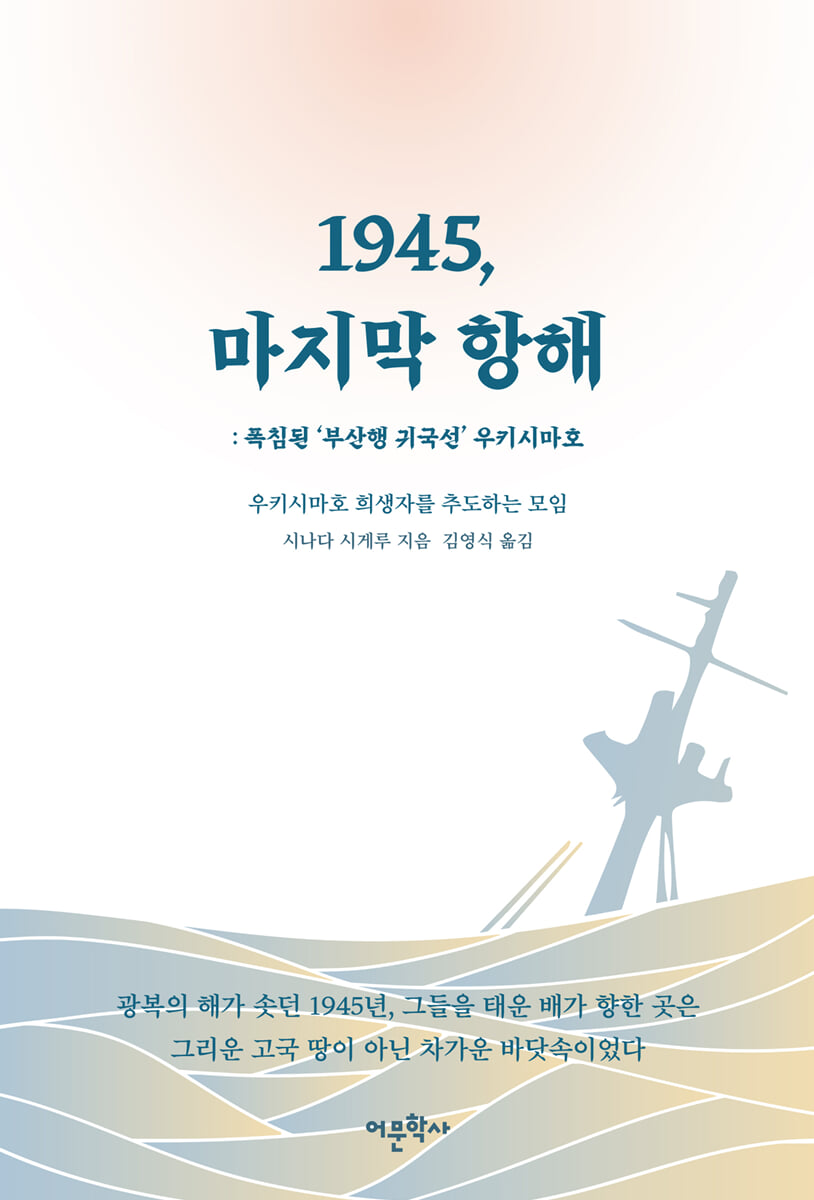
"1945, The Last Voyage" is a book written by Japanese author Shigeru Shinada to record the activities of the "Association to Remember the Victims of the Ukijima Maru", which also consisted of many Japanese people, and the Ukijima Maru incident.
But there are no excuses, no evasions, no absolutions in this book.
There is only an unwavering will to look only at the truth even in the midst of the storm.
The 'Memorial Group', which started with their firm belief that "a historical mistake like the Ukishima Maru Incident must never be repeated," has expanded its activities to include erecting a memorial monument for the victims of the Ukishima Maru, holding memorial rallies (memorial services), producing a film ([Asian Blue - The Ukishima Maru Incident]) and a play ([A Story of a Crowd Looking at the Sea]) informing the public about the Ukishima Maru Incident, and hosting a Korea-Japan-China East Asia Symposium, and has been a beacon of this 'history' for decades.
And finally, in order to continue to stand on the side of the truth of the Ukishima Maru incident, which still lies dormant in the sea, and with the hope that the lighthouse's lighthouse will shine for a long time without going out, they compiled the history of the Ukishima Maru incident and the activities of the memorial group into a book titled "1945, The Last Voyage."
As we move forward to remember history, I hope the light of this book will illuminate our path.
Become a flame of history that will never go out
On August 22, 1945, less than ten days after liberation, a ship set sail from Ominato Port in Japan.
This ship, which was sailing towards the 'Port of Busan, Korea', exploded and sank in Maizuru Bay, Japan on August 24, two days after departure, without even reaching its destination.
The name of the ship that was 'sank' that day was 'Ukishima-maru'.
The liberation they had been desperately crying for had arrived, and this was a ship that promised to send the Koreans who had lost their homeland back to their longed-for 'our country.'
"1945, The Last Voyage" is a book written by Japanese author Shigeru Shinada to record the activities of the "Association to Remember the Victims of the Ukijima Maru", which also consisted of many Japanese people, and the Ukijima Maru incident.
But there are no excuses, no evasions, no absolutions in this book.
There is only an unwavering will to look only at the truth even in the midst of the storm.
The 'Memorial Group', which started with their firm belief that "a historical mistake like the Ukishima Maru Incident must never be repeated," has expanded its activities to include erecting a memorial monument for the victims of the Ukishima Maru, holding memorial rallies (memorial services), producing a film ([Asian Blue - The Ukishima Maru Incident]) and a play ([A Story of a Crowd Looking at the Sea]) informing the public about the Ukishima Maru Incident, and hosting a Korea-Japan-China East Asia Symposium, and has been a beacon of this 'history' for decades.
And finally, in order to continue to stand on the side of the truth of the Ukishima Maru incident, which still lies dormant in the sea, and with the hope that the lighthouse's lighthouse will shine for a long time without going out, they compiled the history of the Ukishima Maru incident and the activities of the memorial group into a book titled "1945, The Last Voyage."
As we move forward to remember history, I hope the light of this book will illuminate our path.
- You can preview some of the book's contents.
Preview
index
The Ukishima Maru Incident and the "Memorial Meeting for the Victims" - 7
Part 1: The Ukishima Incident
1.
What was the incident? - 23
2.
To understand the Ukishima Maru incident - 35
·Maizuru Street 35
·Port 38 where the returning ship arrived
·Ominato 41, where Ukishima-maru departed
·Departure order 46 enforced by the Ominato Navy Coast Guard
·Site of the explosion 49
· 51 remaining questions
Part 2: Progress of Memorial Activities for the Ukishima Incident
1.
The Unknown Ukishima Incident - 65
·Mikio Noda, 66, a middle school teacher
·Causes and Background of Children's Fights 68
·Mr. Noda and Mr. Sunaga's Meeting 71
·Learn about Joseon culture 72
·Formation of the Maizuru Branch of the Sunshine Association (74)
·Encounter with the Ukishima Maru Incident 75
·Memorial Ceremony 78, Celebrating 20 Years
2.
Let's Create a Memorial Monument for the Victims of the Ukishima Incident - 80
·The Weathering War Experience 80
·Sunaga's Growth 84
·Military Life 87
Defeat and detention in Siberia 88
·The first 'return to Japan' 91
·I don't want war again 93
Let's create a monument commemorating the Ukishima Maru incident. 95
·The construction site 98 has just been decided
· 3 Principles for Creating a Memorial to the Victims
·'Oksin-gakshin', Image 104 of the memorial stone
·A memorial stone is not a grave 110
3.
A Fundamental Question: Why Do We Commemorate and Inherit? - 114
·Memorial service on August 24th 114
·Encountering the Ukishima Maru Incident Victims' List 119
Publication of the "Record of the Ukishima Incident" (123)
The Little-Known Ukishima Incident 126
·Turning Point in Memorial Activities 131
4.
Telling the Story of the Ukishima Maru Incident - 133
(1) Movie "Asian Blue - The Ukishima Incident"
·Sudden Visit 133
·Maizuru's Meeting 137, Production Collaboration for the Film "Ukishima-Maru"
·Scenario Creation 142
·Maizuru filming 144
·The start of the 'Memorial Meeting for the Victims of the Ukishima Maru' 152
Message from the Minister of Health, Labour and Welfare 155
(2) Creating the play “A Story of a Crowd Looking at the Sea”
·Sunaga's traffic accident 159
·Visit Ominato 160
·Young people want to act as the main characters in a play 163
Will dreams come true in Maizuru? 165
·Learning about creating a dream stage 168
·Successful Stage 170
·Hope for the next generation 174
(3) Exchange with citizens of Gwangju, Korea
· 〈Asian Blue〉 screened in Korea 176 times
·Facing a turning point 177
·Film exports were approved, but… … 180
·Korean Youth's Impressions 182
·184 through interaction with Gwangju citizens at film screenings
·Gwangju Visitor Group 186 from Maizuru
· Honest exchange of opinions at the citizen level 188
(4) Korea-Japan-China 'East Asia International Peace Symposium' held in Maizuru
·Let's Think About Peace with the People of East Asia 194
Symposium Topics and Coordinators 196
·Summer 2005·Just before the symposium 199
Mr. Noda, who was discharged from the hospital just before the symposium, 200
Symposium "Ukishima Maru Incident: Conditions for Peace in Northeast Asia" 202
·Expectations from the coordinator 216
·'Memorial Gathering' - Then and Now 217
Chronology of the Ukishima Incident - 221
Author's Note - 226
Part 1: The Ukishima Incident
1.
What was the incident? - 23
2.
To understand the Ukishima Maru incident - 35
·Maizuru Street 35
·Port 38 where the returning ship arrived
·Ominato 41, where Ukishima-maru departed
·Departure order 46 enforced by the Ominato Navy Coast Guard
·Site of the explosion 49
· 51 remaining questions
Part 2: Progress of Memorial Activities for the Ukishima Incident
1.
The Unknown Ukishima Incident - 65
·Mikio Noda, 66, a middle school teacher
·Causes and Background of Children's Fights 68
·Mr. Noda and Mr. Sunaga's Meeting 71
·Learn about Joseon culture 72
·Formation of the Maizuru Branch of the Sunshine Association (74)
·Encounter with the Ukishima Maru Incident 75
·Memorial Ceremony 78, Celebrating 20 Years
2.
Let's Create a Memorial Monument for the Victims of the Ukishima Incident - 80
·The Weathering War Experience 80
·Sunaga's Growth 84
·Military Life 87
Defeat and detention in Siberia 88
·The first 'return to Japan' 91
·I don't want war again 93
Let's create a monument commemorating the Ukishima Maru incident. 95
·The construction site 98 has just been decided
· 3 Principles for Creating a Memorial to the Victims
·'Oksin-gakshin', Image 104 of the memorial stone
·A memorial stone is not a grave 110
3.
A Fundamental Question: Why Do We Commemorate and Inherit? - 114
·Memorial service on August 24th 114
·Encountering the Ukishima Maru Incident Victims' List 119
Publication of the "Record of the Ukishima Incident" (123)
The Little-Known Ukishima Incident 126
·Turning Point in Memorial Activities 131
4.
Telling the Story of the Ukishima Maru Incident - 133
(1) Movie "Asian Blue - The Ukishima Incident"
·Sudden Visit 133
·Maizuru's Meeting 137, Production Collaboration for the Film "Ukishima-Maru"
·Scenario Creation 142
·Maizuru filming 144
·The start of the 'Memorial Meeting for the Victims of the Ukishima Maru' 152
Message from the Minister of Health, Labour and Welfare 155
(2) Creating the play “A Story of a Crowd Looking at the Sea”
·Sunaga's traffic accident 159
·Visit Ominato 160
·Young people want to act as the main characters in a play 163
Will dreams come true in Maizuru? 165
·Learning about creating a dream stage 168
·Successful Stage 170
·Hope for the next generation 174
(3) Exchange with citizens of Gwangju, Korea
· 〈Asian Blue〉 screened in Korea 176 times
·Facing a turning point 177
·Film exports were approved, but… … 180
·Korean Youth's Impressions 182
·184 through interaction with Gwangju citizens at film screenings
·Gwangju Visitor Group 186 from Maizuru
· Honest exchange of opinions at the citizen level 188
(4) Korea-Japan-China 'East Asia International Peace Symposium' held in Maizuru
·Let's Think About Peace with the People of East Asia 194
Symposium Topics and Coordinators 196
·Summer 2005·Just before the symposium 199
Mr. Noda, who was discharged from the hospital just before the symposium, 200
Symposium "Ukishima Maru Incident: Conditions for Peace in Northeast Asia" 202
·Expectations from the coordinator 216
·'Memorial Gathering' - Then and Now 217
Chronology of the Ukishima Incident - 221
Author's Note - 226
Publisher's Review
On August 22, 1945, less than ten days after liberation, a ship set sail from Ominato Port in Japan.
This ship, which was sailing towards the 'Port of Busan, Korea', exploded and sank in Maizuru Bay, Japan on August 24, two days after departure, without even reaching its destination.
People who were thrown from the wrecked ship are said to have cried out, “Oh my, oh my!” in the cold, dark water.
Maizuru residents working on a nearby beach began rescue efforts, but it is said that only a very small number of victims were able to survive.
The Japanese government officially announced that the incident was an "unavoidable accident caused by a mine laid in the shipping lane," and that "524 of the 3,735 Korean passengers on board died."
However, contrary to the Japanese government's position, the actual death toll from the incident at the time, as estimated by Korean civic groups, ranges from at least 3,000 to over 8,000.
The total number of passengers calculated by each country also varies.
According to testimony, the number of Korean passengers who were crammed into the cabins and decks at the time was between 6,000 and 8,000, which is more than double the number of passengers officially announced by Japan.
It is also difficult to believe the statement that 'an accident due to lightning was an unavoidable event'.
After the incident, the ship's operators and residents near Ominato Port stated that "from the beginning, the destination was Maizuru, not Joseon (Busan)." and "Rumors were circulating that the ship carrying Joseon people would explode during the voyage and that a bomb had already been planted." They stated that the explosion was "a deliberate suicide by the Japanese government."
In August 1945, spring finally bloomed in the 'taken fields', but there was one ship that was lost in the cold, vast ocean and never returned.
The name of the ship that was 'sank' that day was 'Ukishima-maru'.
The long-awaited 'day' had come, and the ship was said to be carrying the Koreans who had lost their homeland and sending them back to their longed-for 'our country'.
We still don't know the truth about that day, and those who never returned.
“I engrave this tragedy with the determination not to forget it.
“We convey their records from Maizuru, Kyoto.”
Despite the tragedy that led countless Koreans to their deaths, the Ukishima Maru incident is not widely known in Korea.
This is because the Japanese government at the time of the incident downplayed and concealed the incident and did not report it properly, and most of the passengers died at the time of the accident, so there were few opportunities to report it.
"1945, The Last Voyage" is a book written with the hope that the Ukishima Maru incident, which is being erased in both Korea and Japan as the "postwar generation" begins to disappear, will not be forgotten, and that the "Memorial Society for the Victims of the Ukishima Maru," which still commemorates the victims of that day, will not be forgotten.
In other words, this book was born as a tragic memoir and a charnel house of fading history.
Shigeru Shinada, the author of "1945, the Last Voyage," and Mikio Noda and Yasuro Sunaga, the heads of the "Association to Remember the Victims of the Ukishima Maru," to which he belongs, are surprisingly all ordinary Japanese people with no connection to Korea.
Living in a city adjacent to the sea where the Ukijima explosion occurred, they each learned of the "Ukijima Incident" by chance. As citizens of Japan, the nation that should be responsible for this disaster, and as human beings who once shared the same life, they felt a deep-rooted sense of sorrow and indebtedness.
The 'Memorial Group', which began with their firm belief that "a historical mistake like the Ukishima Maru Incident must never be repeated," has expanded its activities to include the erection of a memorial monument for the victims of the Ukishima Maru, a memorial service, the production of a film (〈Asian Blue - The Ukishima Maru Incident〉) and a play (〈A Story of a Crowd Looking at the Sea〉) informing the public about the Ukishima Maru Incident, and the hosting of a Korea-Japan-China East Asia Symposium, and has served as a beacon of that 'memory' for decades.
And finally, in order to continue to stand on the side of the truth of the Ukishima Maru incident, which still lies dormant in the sea, and with the hope that the lighthouse's lighthouse will shine for a long time without going out, they compiled the history of the Ukishima Maru incident and the activities of the memorial group into a book titled "1945, The Last Voyage."
There are no excuses, no evasions, no exemptions.
There is only an unwavering will to look only at the truth even in the midst of the storm.
“You must read so as not to lose by not forgetting
August 24, 1945,
“Our Sunken Record”
What is history? This question will likely yield countless answers, but for now, I'd like to emphasize that history is ultimately about memory.
Memory is the smallest unit of history.
Even if an event clearly existed, if no one remembers it, it is not history and is not even real.
The members of the 'Memorial Group' erected a 'memorial monument' on Shimosabaka Beach in the hope that someone would remember this incident for a long time.
Even now, on Shimosabaka Beach, a Korean woman standing tall in a hanbok looks with stern eyes across the distant sea toward “Spring in Her Hometown.”
As we take steps to remember the Ukijima Maru sinking incident as a historical event, so as not to forget the tragedy that befell our ancestors, and so as not to forget the fierce lives they must have lived, I sincerely hope that the light of this book will illuminate our path.
This ship, which was sailing towards the 'Port of Busan, Korea', exploded and sank in Maizuru Bay, Japan on August 24, two days after departure, without even reaching its destination.
People who were thrown from the wrecked ship are said to have cried out, “Oh my, oh my!” in the cold, dark water.
Maizuru residents working on a nearby beach began rescue efforts, but it is said that only a very small number of victims were able to survive.
The Japanese government officially announced that the incident was an "unavoidable accident caused by a mine laid in the shipping lane," and that "524 of the 3,735 Korean passengers on board died."
However, contrary to the Japanese government's position, the actual death toll from the incident at the time, as estimated by Korean civic groups, ranges from at least 3,000 to over 8,000.
The total number of passengers calculated by each country also varies.
According to testimony, the number of Korean passengers who were crammed into the cabins and decks at the time was between 6,000 and 8,000, which is more than double the number of passengers officially announced by Japan.
It is also difficult to believe the statement that 'an accident due to lightning was an unavoidable event'.
After the incident, the ship's operators and residents near Ominato Port stated that "from the beginning, the destination was Maizuru, not Joseon (Busan)." and "Rumors were circulating that the ship carrying Joseon people would explode during the voyage and that a bomb had already been planted." They stated that the explosion was "a deliberate suicide by the Japanese government."
In August 1945, spring finally bloomed in the 'taken fields', but there was one ship that was lost in the cold, vast ocean and never returned.
The name of the ship that was 'sank' that day was 'Ukishima-maru'.
The long-awaited 'day' had come, and the ship was said to be carrying the Koreans who had lost their homeland and sending them back to their longed-for 'our country'.
We still don't know the truth about that day, and those who never returned.
“I engrave this tragedy with the determination not to forget it.
“We convey their records from Maizuru, Kyoto.”
Despite the tragedy that led countless Koreans to their deaths, the Ukishima Maru incident is not widely known in Korea.
This is because the Japanese government at the time of the incident downplayed and concealed the incident and did not report it properly, and most of the passengers died at the time of the accident, so there were few opportunities to report it.
"1945, The Last Voyage" is a book written with the hope that the Ukishima Maru incident, which is being erased in both Korea and Japan as the "postwar generation" begins to disappear, will not be forgotten, and that the "Memorial Society for the Victims of the Ukishima Maru," which still commemorates the victims of that day, will not be forgotten.
In other words, this book was born as a tragic memoir and a charnel house of fading history.
Shigeru Shinada, the author of "1945, the Last Voyage," and Mikio Noda and Yasuro Sunaga, the heads of the "Association to Remember the Victims of the Ukishima Maru," to which he belongs, are surprisingly all ordinary Japanese people with no connection to Korea.
Living in a city adjacent to the sea where the Ukijima explosion occurred, they each learned of the "Ukijima Incident" by chance. As citizens of Japan, the nation that should be responsible for this disaster, and as human beings who once shared the same life, they felt a deep-rooted sense of sorrow and indebtedness.
The 'Memorial Group', which began with their firm belief that "a historical mistake like the Ukishima Maru Incident must never be repeated," has expanded its activities to include the erection of a memorial monument for the victims of the Ukishima Maru, a memorial service, the production of a film (〈Asian Blue - The Ukishima Maru Incident〉) and a play (〈A Story of a Crowd Looking at the Sea〉) informing the public about the Ukishima Maru Incident, and the hosting of a Korea-Japan-China East Asia Symposium, and has served as a beacon of that 'memory' for decades.
And finally, in order to continue to stand on the side of the truth of the Ukishima Maru incident, which still lies dormant in the sea, and with the hope that the lighthouse's lighthouse will shine for a long time without going out, they compiled the history of the Ukishima Maru incident and the activities of the memorial group into a book titled "1945, The Last Voyage."
There are no excuses, no evasions, no exemptions.
There is only an unwavering will to look only at the truth even in the midst of the storm.
“You must read so as not to lose by not forgetting
August 24, 1945,
“Our Sunken Record”
What is history? This question will likely yield countless answers, but for now, I'd like to emphasize that history is ultimately about memory.
Memory is the smallest unit of history.
Even if an event clearly existed, if no one remembers it, it is not history and is not even real.
The members of the 'Memorial Group' erected a 'memorial monument' on Shimosabaka Beach in the hope that someone would remember this incident for a long time.
Even now, on Shimosabaka Beach, a Korean woman standing tall in a hanbok looks with stern eyes across the distant sea toward “Spring in Her Hometown.”
As we take steps to remember the Ukijima Maru sinking incident as a historical event, so as not to forget the tragedy that befell our ancestors, and so as not to forget the fierce lives they must have lived, I sincerely hope that the light of this book will illuminate our path.
GOODS SPECIFICS
- Date of issue: December 30, 2023
- Page count, weight, size: 232 pages | 152*223*20mm
- ISBN13: 9791169050258
- ISBN10: 1169050255
You may also like
카테고리
korean


korean

![GQ KOREA Mark (Monthly): December [2025]](http://librairie.coreenne.fr/cdn/shop/files/8ef265dbbfbf186523ed75ba7319009d.jpg?v=1765340328&width=3840)


