

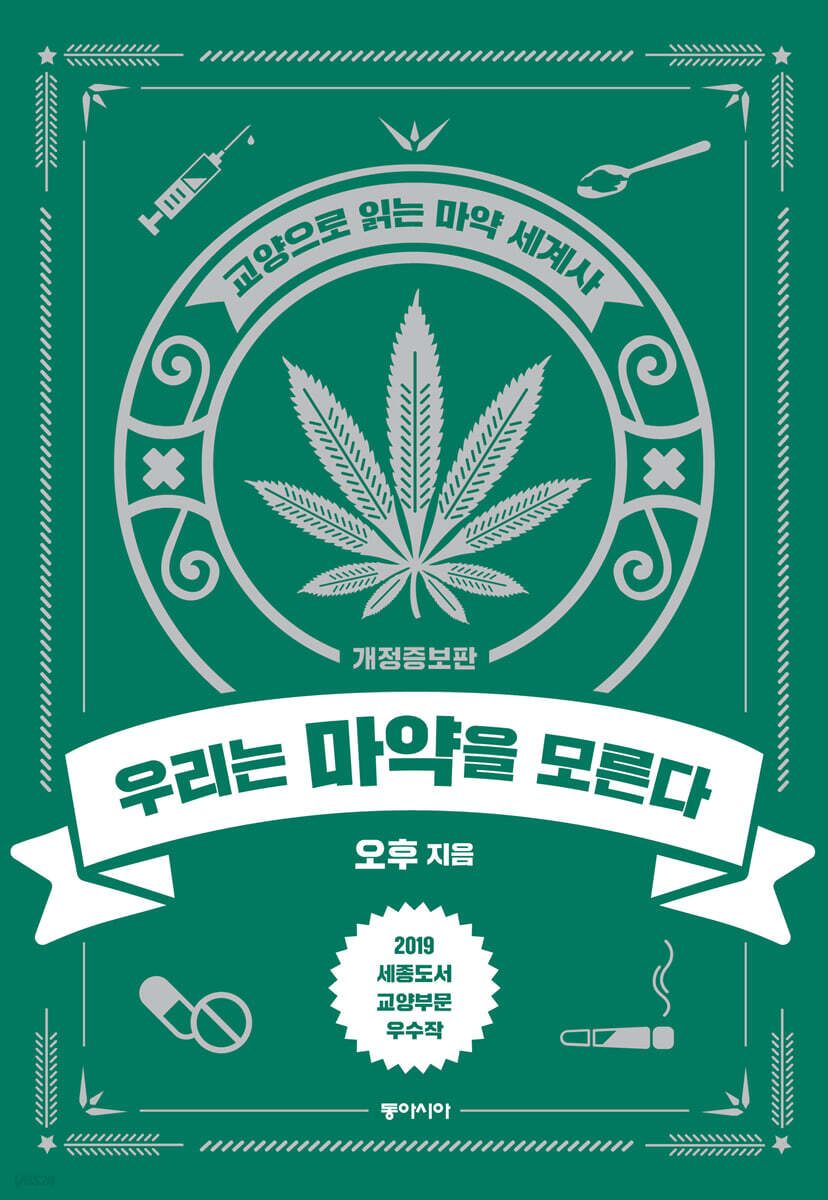
We don't know drugs
 |
Description
Book Introduction
Fentanyl, the new game-changer, just how dangerous is it?
The era of legalization of heroin has arrived.
A lively drug education book for those of us who still don't know about drugs.
An intellectual and daring drug education book that challenges taboos.
Capturing the radical shift in discourse surrounding drugs
Drugs are one of the biggest taboos in our society.
The atmosphere in our society is that drugs should not be tolerated under any circumstances and drug users should never be tolerated.
This book does not simply start from the value judgment that 'drugs are good or bad.'
It examines what drugs are, why they are banned, how they cause social controversy, and why people still use them.
Because our prevailing position only serves to reinforce ignorance and prejudice about drugs.
The author says that while producing a podcast about drugs, he began researching them and interviewing people involved, which gave him a new perspective on drugs.
This book is centered around the issues that arose at that time.
It deals with the subject of drugs in a playful, sophisticated, yet serious way.
Before saying 'drugs are bad', ask yourself what drugs are and why people do them.
It is unprecedented for a Korean author to take such a forward-looking stance on drugs and develop his argument within a historical context.
In 2023, a new game-changer called fentanyl is sweeping the globe, and the Canadian province of British Columbia has finally legalized possession of heroin, cocaine, and other drugs.
Local opinions on this matter are sharply divided.
Some people describe the streets where drug addicts run rampant as hell, but police provide information on facilities and institutions that can help people use drugs safely on these streets.
This unusual landscape clearly shows the changing perception of drugs.
Following Thailand's legalization of marijuana in 2022, the trend toward legalizing marijuana continues in various states in the United States, and discussions on legalization and deregulation surrounding marijuana are also heating up in Korea.
Other countries are also shifting their drug policies from a focus on prohibition to a focus on control and management.
It is impossible to keep up with this trend with only existing prejudices about drugs.
It is impossible to perceive or understand global changes without knowing what drugs are in the first place and what differences exist between different drugs.
Through this book, the author, Oh-hu, elevates drugs from being objects of prohibition and exclusion to objects of ‘knowledge.’
The release of this revised and expanded edition in 2023, with drug use continuing to be a problem in Korea and fentanyl becoming a global problem, is also part of this trend.
Perceptions and realities about drugs are constantly changing, and the author follows them.
Right now.
The era of legalization of heroin has arrived.
A lively drug education book for those of us who still don't know about drugs.
An intellectual and daring drug education book that challenges taboos.
Capturing the radical shift in discourse surrounding drugs
Drugs are one of the biggest taboos in our society.
The atmosphere in our society is that drugs should not be tolerated under any circumstances and drug users should never be tolerated.
This book does not simply start from the value judgment that 'drugs are good or bad.'
It examines what drugs are, why they are banned, how they cause social controversy, and why people still use them.
Because our prevailing position only serves to reinforce ignorance and prejudice about drugs.
The author says that while producing a podcast about drugs, he began researching them and interviewing people involved, which gave him a new perspective on drugs.
This book is centered around the issues that arose at that time.
It deals with the subject of drugs in a playful, sophisticated, yet serious way.
Before saying 'drugs are bad', ask yourself what drugs are and why people do them.
It is unprecedented for a Korean author to take such a forward-looking stance on drugs and develop his argument within a historical context.
In 2023, a new game-changer called fentanyl is sweeping the globe, and the Canadian province of British Columbia has finally legalized possession of heroin, cocaine, and other drugs.
Local opinions on this matter are sharply divided.
Some people describe the streets where drug addicts run rampant as hell, but police provide information on facilities and institutions that can help people use drugs safely on these streets.
This unusual landscape clearly shows the changing perception of drugs.
Following Thailand's legalization of marijuana in 2022, the trend toward legalizing marijuana continues in various states in the United States, and discussions on legalization and deregulation surrounding marijuana are also heating up in Korea.
Other countries are also shifting their drug policies from a focus on prohibition to a focus on control and management.
It is impossible to keep up with this trend with only existing prejudices about drugs.
It is impossible to perceive or understand global changes without knowing what drugs are in the first place and what differences exist between different drugs.
Through this book, the author, Oh-hu, elevates drugs from being objects of prohibition and exclusion to objects of ‘knowledge.’
The release of this revised and expanded edition in 2023, with drug use continuing to be a problem in Korea and fentanyl becoming a global problem, is also part of this trend.
Perceptions and realities about drugs are constantly changing, and the author follows them.
Right now.
- You can preview some of the book's contents.
Preview
index
To the revised edition.
We still don't know about drugs
prolog.
We don't know drugs
1.
In the beginning there were drugs
2.
Civilization with drugs
3.
The Rise of Christianity and the Fall of Drugs
4.
Witch hunts, the Renaissance, and the return of the prodigal son
5.
Earn like a dog and buy drugs: Industrial Revolution, Imperialism, and the Opium Trade
6.
What to do this afternoon: Types and classifications of drugs
- Appendix.
Drugs that can be legally enjoyed in everyday life 1
7.
The 19th century, the age of addiction
- Appendix.
Drugs You Can Legally Enjoy in Your Daily Life 2
8.
Drug Prohibition Policy as Seen Through Prohibition
- Appendix.
3 Drugs You Can Legally Enjoy in Your Daily Life
9.
Is marijuana a stepping stone to harder drugs?
- Appendix.
Why do people do drugs?
10.
The "War on Drugs" that even the world's strongest nation, the United States, can't win
11.
Pablo Escobar, the drug lord who created the monster created by Colombia's tragedy
12.
Gap.Tuk.Twi Netherlands
13.
Is Korea a Drug-Free Nation? Dangerous Signs
- Appendix.
How much do drugs cost? Drug prices in Korea
14.
The land of stimulants that never sleep
15.
The emergence of a game changer
16.
Finding drugs in real life and movies
Epilogue.
Are drugs the problem or is society the problem?
References
Acknowledgements
We still don't know about drugs
prolog.
We don't know drugs
1.
In the beginning there were drugs
2.
Civilization with drugs
3.
The Rise of Christianity and the Fall of Drugs
4.
Witch hunts, the Renaissance, and the return of the prodigal son
5.
Earn like a dog and buy drugs: Industrial Revolution, Imperialism, and the Opium Trade
6.
What to do this afternoon: Types and classifications of drugs
- Appendix.
Drugs that can be legally enjoyed in everyday life 1
7.
The 19th century, the age of addiction
- Appendix.
Drugs You Can Legally Enjoy in Your Daily Life 2
8.
Drug Prohibition Policy as Seen Through Prohibition
- Appendix.
3 Drugs You Can Legally Enjoy in Your Daily Life
9.
Is marijuana a stepping stone to harder drugs?
- Appendix.
Why do people do drugs?
10.
The "War on Drugs" that even the world's strongest nation, the United States, can't win
11.
Pablo Escobar, the drug lord who created the monster created by Colombia's tragedy
12.
Gap.Tuk.Twi Netherlands
13.
Is Korea a Drug-Free Nation? Dangerous Signs
- Appendix.
How much do drugs cost? Drug prices in Korea
14.
The land of stimulants that never sleep
15.
The emergence of a game changer
16.
Finding drugs in real life and movies
Epilogue.
Are drugs the problem or is society the problem?
References
Acknowledgements
Into the book
One of the misconceptions we have is lumping all drugs together into one category called drugs.
Just as shortening a school uniform skirt and bullying a specific student are completely different issues, even though they are both violations of school rules, drugs cannot be lumped into one category.
As will be explained later, legally, narcotics can be divided into 'narcotics' such as cocaine, opium, and heroin; 'psychotropic drugs' such as LSD, propofol, and methamphetamine (philopon); and 'cannabis' including marijuana and hashish.
Although not included in the narcotics category, bond, butane gas, and nitrous oxide are also designated as “hallucinogenic substances” and their inhalation is prohibited.
Drugs can be classified into hundreds of categories not only by legal classification but also by their mode of action, ingredients, and concentration.
However, if we lump this all together with the word 'drug', there is a very high possibility that we will take the wrong approach.
But even in this book, which begins by pointing out this mistake, there are many cases where it is explained as a drug.
There are some aspects that cannot be helped for convenience's sake... That is an excuse, and it is ultimately due to my limited vocabulary, so I ask for the readers' understanding in advance.
---From "Page 13, Prologue"
The point is, drugs aren't some special plant that grows in hell.
Hemp has been cultivated in the Korean Peninsula for a very long time, and is still grown in the Andong region.
“They grow hemp in Korea?” Some of you might be surprised, but the hemp used to make hemp clothes is hemp.
Until the 1970s, it was common to see elderly people in rural areas smoking marijuana instead of cigarettes.
However, as the military regime implemented a large-scale marijuana prohibition policy, marijuana fields disappeared and the culture of smoking marijuana also disappeared.
The narcotic effects of cannabis are purer in the order of flowers, leaves, and stems (flowers 〉 leaves 〉 stems), and among flowers, female flowers are purer than male flowers (female flowers 〉 male flowers).
So, not the entire cannabis plant, but only the flowers and leaves are designated as narcotic drugs.
Hemp stems, roots, and seeds are legally available in Korea.
The stems are used for hemp fiber (hemp cloth), and the roots and seeds are used for oil or as herbal medicine.
---From "What to do this afternoon? Types and classifications of drugs" on page 67
Third, banning drugs to improve the workforce and enhance national competitiveness? This, too, ultimately proved wrong.
Whether it's alcohol or drugs, if it becomes a crime, those who use it become criminals, and once they are branded, it becomes difficult for them to live in society.
For example, even if someone is an addict, if it is not a crime, their work efficiency may decrease, but they will not be completely excluded from society.
But if it becomes a crime, even people who are not addicted but have tried it once or twice out of curiosity are branded as criminals for life.
They find it difficult to function properly in society, their lives become increasingly squalid, and unfortunately, they are more likely to resort to drugs.
---From "Drug Prohibition Policy as Seen Through Prohibition Law" on page 148
Many people criticize the Dutch drug policy as a policy that "disregards morality for efficiency," but in my view, this is closer to malicious slander against the Netherlands.
The Dutch drug policy was able to emerge because it prioritized human rights over efficiency.
The Dutch approach to drugs is not 'war' but 'harm reduction'.
There are various policies in place for this, the most representative of which is a service that provides free syringe replacement for drug users.
The biggest threat to the health of hard drug addicts is not the drugs themselves, but the syringes.
If you go to the hospital, you will know that syringes are meant to be used once and then thrown away.
But addicts keep using these syringes.
I don't even have enough money to buy drugs, so how can I buy a new syringe?
So the Dutch government has a policy where anyone who brings in a used syringe will be replaced, no questions asked.
At first, many people criticized the policy, saying it was a policy that "mass-produced drug addicts using government funds," but as the policy continued, problems arising from syringe reuse decreased dramatically.
---From "Page 222, Gap.Tuk.Twi Netherlands"
What image comes to mind when you think of drugs? It may vary from person to person, but for Koreans, drugs are generally seen as "a new form of entertainment that only the children of wealthy families, powerful politicians, or celebrities, who get bored with their various pastimes, turn to." 3 Drugs still seem like something very special and distant to ordinary people.
There is nothing Korean about smoking a hashish after a hard day's work, going to the bathroom to snort cocaine after annoyed a customer, taking Adderall as a student, or handing out ecstasy at a friend's birthday party.
Sometimes, we see news reports that international drug cartels use Korea as a manufacturing base or transit point. This suggests that the Korean police are lax, but it also suggests that Korea is a drug-free country.
Because drugs are not a problem that comes into contact with the skin, the authorities do not take it seriously, so surveillance is not thorough, and so there are loopholes, and honest illegal organizations do not miss these loopholes.
So can we be at ease like this?
---Page 235, "Is Korea a Drug-Free Nation? Dangerous Signs"
The third wave is the fentanyl wave, which continues to this day.
This third wave is so large that the previous two waves appear as ripples on the graph.
Fentanyl is a drug developed by Janssen in 1959 that is both effective and easy to administer.
As patents expired and generic drugs appeared, painkillers became a blessing for patients with severe pain, such as cancer patients.
In particular, since the 2000s, sales have increased rapidly as China has mass-produced raw materials and sold them cheaply.
Not only raw materials, but also most finished products are made in China and then imported to the United States via Mexico and other countries.
For this reason, fentanyl is sometimes called "China White" in the United States.
Doctors began prescribing this cheap and powerful drug, fentanyl, instead of other opioids.
Just as shortening a school uniform skirt and bullying a specific student are completely different issues, even though they are both violations of school rules, drugs cannot be lumped into one category.
As will be explained later, legally, narcotics can be divided into 'narcotics' such as cocaine, opium, and heroin; 'psychotropic drugs' such as LSD, propofol, and methamphetamine (philopon); and 'cannabis' including marijuana and hashish.
Although not included in the narcotics category, bond, butane gas, and nitrous oxide are also designated as “hallucinogenic substances” and their inhalation is prohibited.
Drugs can be classified into hundreds of categories not only by legal classification but also by their mode of action, ingredients, and concentration.
However, if we lump this all together with the word 'drug', there is a very high possibility that we will take the wrong approach.
But even in this book, which begins by pointing out this mistake, there are many cases where it is explained as a drug.
There are some aspects that cannot be helped for convenience's sake... That is an excuse, and it is ultimately due to my limited vocabulary, so I ask for the readers' understanding in advance.
---From "Page 13, Prologue"
The point is, drugs aren't some special plant that grows in hell.
Hemp has been cultivated in the Korean Peninsula for a very long time, and is still grown in the Andong region.
“They grow hemp in Korea?” Some of you might be surprised, but the hemp used to make hemp clothes is hemp.
Until the 1970s, it was common to see elderly people in rural areas smoking marijuana instead of cigarettes.
However, as the military regime implemented a large-scale marijuana prohibition policy, marijuana fields disappeared and the culture of smoking marijuana also disappeared.
The narcotic effects of cannabis are purer in the order of flowers, leaves, and stems (flowers 〉 leaves 〉 stems), and among flowers, female flowers are purer than male flowers (female flowers 〉 male flowers).
So, not the entire cannabis plant, but only the flowers and leaves are designated as narcotic drugs.
Hemp stems, roots, and seeds are legally available in Korea.
The stems are used for hemp fiber (hemp cloth), and the roots and seeds are used for oil or as herbal medicine.
---From "What to do this afternoon? Types and classifications of drugs" on page 67
Third, banning drugs to improve the workforce and enhance national competitiveness? This, too, ultimately proved wrong.
Whether it's alcohol or drugs, if it becomes a crime, those who use it become criminals, and once they are branded, it becomes difficult for them to live in society.
For example, even if someone is an addict, if it is not a crime, their work efficiency may decrease, but they will not be completely excluded from society.
But if it becomes a crime, even people who are not addicted but have tried it once or twice out of curiosity are branded as criminals for life.
They find it difficult to function properly in society, their lives become increasingly squalid, and unfortunately, they are more likely to resort to drugs.
---From "Drug Prohibition Policy as Seen Through Prohibition Law" on page 148
Many people criticize the Dutch drug policy as a policy that "disregards morality for efficiency," but in my view, this is closer to malicious slander against the Netherlands.
The Dutch drug policy was able to emerge because it prioritized human rights over efficiency.
The Dutch approach to drugs is not 'war' but 'harm reduction'.
There are various policies in place for this, the most representative of which is a service that provides free syringe replacement for drug users.
The biggest threat to the health of hard drug addicts is not the drugs themselves, but the syringes.
If you go to the hospital, you will know that syringes are meant to be used once and then thrown away.
But addicts keep using these syringes.
I don't even have enough money to buy drugs, so how can I buy a new syringe?
So the Dutch government has a policy where anyone who brings in a used syringe will be replaced, no questions asked.
At first, many people criticized the policy, saying it was a policy that "mass-produced drug addicts using government funds," but as the policy continued, problems arising from syringe reuse decreased dramatically.
---From "Page 222, Gap.Tuk.Twi Netherlands"
What image comes to mind when you think of drugs? It may vary from person to person, but for Koreans, drugs are generally seen as "a new form of entertainment that only the children of wealthy families, powerful politicians, or celebrities, who get bored with their various pastimes, turn to." 3 Drugs still seem like something very special and distant to ordinary people.
There is nothing Korean about smoking a hashish after a hard day's work, going to the bathroom to snort cocaine after annoyed a customer, taking Adderall as a student, or handing out ecstasy at a friend's birthday party.
Sometimes, we see news reports that international drug cartels use Korea as a manufacturing base or transit point. This suggests that the Korean police are lax, but it also suggests that Korea is a drug-free country.
Because drugs are not a problem that comes into contact with the skin, the authorities do not take it seriously, so surveillance is not thorough, and so there are loopholes, and honest illegal organizations do not miss these loopholes.
So can we be at ease like this?
---Page 235, "Is Korea a Drug-Free Nation? Dangerous Signs"
The third wave is the fentanyl wave, which continues to this day.
This third wave is so large that the previous two waves appear as ripples on the graph.
Fentanyl is a drug developed by Janssen in 1959 that is both effective and easy to administer.
As patents expired and generic drugs appeared, painkillers became a blessing for patients with severe pain, such as cancer patients.
In particular, since the 2000s, sales have increased rapidly as China has mass-produced raw materials and sold them cheaply.
Not only raw materials, but also most finished products are made in China and then imported to the United States via Mexico and other countries.
For this reason, fentanyl is sometimes called "China White" in the United States.
Doctors began prescribing this cheap and powerful drug, fentanyl, instead of other opioids.
---From "Page 270, The Emergence of a Game Changer"
Publisher's Review
The history of drugs we didn't know about,
In the beginning there were drugs
When we think of 'drugs', we think of them as something unconditionally bad, a devil's drug that we can never quit once we start.
But drugs are a kind of legal concept.
Drugs with different effects, toxicity, and addictiveness are classified into the category of 'narcotics' according to necessity.
There are many drugs that were not drugs but become drugs due to some incident.
Why did drugs become drugs? When did drugs become taboo?
If we look at the history of drugs, drugs have been with mankind since the beginning of mankind.
Terence McKenna proposes the "stunned ape" hypothesis, which suggests that ancient humans crossed a singularity by consuming mushrooms containing the hallucinogenic substance "psilocybin."
The claim is that ancient humans 'sucked on medicine' and rode the fast track to evolution.
Of course, this is just an interesting hypothesis that is difficult to verify and has a low probability of being true.
However, given that narcotic plants have been found in Neanderthal remains, it is highly likely that our ancestors were also familiar with drugs.
Even when shamanism emerged, shamans used narcotic substances in religious rituals and medical practices.
Traces of narcotic substances and their active use can be found in almost all uncivilized cultures.
For thousands of years afterward, narcotic substances such as cannabis and opium were not classified as "narcotics" and were widely used as painkillers or recreational drugs.
Then, as Christianity became recognized in the West, drugs became taboo, and in the 19th century, drug abuse and addiction became social problems and subject to legal sanctions.
Types of drugs we didn't know about
Not all drugs are the same
'Drugs' is a legal concept.
The same substance is classified as a drug in some countries and not in others.
In this book, we will learn about substances that we lump together under the single category of 'drugs' but are actually different substances.
It vividly explains various types of drugs and their characteristics using interesting case studies.
Depending on the manufacturing method, drugs are divided into natural drugs such as marijuana, opium, and coca, and synthetic drugs such as methamphetamine (philopon), LSD, and ecstasy.
It is interesting to note that most synthetic drugs were invented during the process of making regular drugs.
Drug characteristics can also be classified according to their effects.
For example, in the movie "The Wolf of Wall Street," Wall Street stockbrokers are seen snorting cocaine diligently. Cocaine has a short duration of effect and a strong stimulating effect, which is said to increase work efficiency to some extent.
So, it became a favorite drug among white-collar workers who handle a huge workload.
It would be difficult for such people to use marijuana or heroin during work hours, which would make their bodies feel heavy.
Although I can't actually try those drugs, reading the various stories in this book in an entertaining way makes me feel like I know what it's like to do them.
It's like when you watch food programs over and over again, you get the feeling that you know what food tastes like even if you've never tried it before.
Why We Ban Marijuana: The Reason We Never Knew
Does the drug stepping stone effect exist?
As marijuana becomes legal in many countries, including the United States, discussions on legalizing marijuana are also surfacing in Korea.
However, it seems that there is still a long way to go as the perception of marijuana is not good, as celebrities who are prosecuted for smoking marijuana are still the target of criticism.
From a medical perspective, marijuana is less harmful or addictive than alcohol or tobacco.
This is something that even marijuana opponents agree on.
But they argue that legalizing marijuana is dangerous.
The reason is the ‘stepping stone effect (gateway effect)’.
The theory is that although marijuana has low toxicity and addictiveness, habitual smokers develop tolerance and become addicted to more addictive drugs.
This book questions such stepping stone effects.
If we think about the alcohol or cigarettes we enjoy, we can easily see the flaws in the stepping stone effect.
Smokers do not develop tolerance and seek out stronger cigarettes.
This means that it is rare for someone to develop tolerance after smoking 1mg of Esse and then end up smoking Marlboro Reds.
But the relationship between marijuana and other drugs is different from the relationship between Esse and Marlboro.
The story of someone who smokes marijuana and develops tolerance to it and then turns to heroin is similar to the story of someone who smokes cigarettes and develops tolerance to it and then turns to vodka.
This means that it is difficult for the stepping stone effect to occur because the types and effects are different from the beginning.
This book persuasively argues that the stepping stone effect occurs not because we are addicted to marijuana, but because we think of marijuana and hard drugs as the same category of drugs.
The reality of drugs in Korea that we didn't know about
What is the most popular drug in Korea?
Cannabis is the most popular drug worldwide and is gradually becoming legal in many countries.
With news of celebrities being indicted for smoking marijuana seemingly becoming an annual event, it seems marijuana is the most popular drug in our country as well.
But the results we see in the statistics are a bit surprising.
Among the drug offenders arrested each year, the number of people related to marijuana is around 1,000, while the number of people related to methamphetamine (meta-meta-methamphetamine and other amphetamines) ranges from 7,000 to 10,000.
The most beloved drug in South Korea is methamphetamine.
Unlike marijuana, methamphetamine is a hard drug that is highly addictive and causes significant harm to the body, so it is not a problem to be taken lightly.
The preference for methamphetamine has not increased sharply in recent times, but has been a phenomenon that has persisted for decades. The specific circumstances are as follows.
Hiropon was originally invented in Japan to make cold medicine, and was administered in large quantities to the Japanese military during World War II.
After the war, methamphetamine was classified as a narcotic in Japan, and its production as well as administration was strictly prohibited.
At that time, our country emerged as an intermediate production base.
As a manufacturing powerhouse, our country produced high-quality methamphetamine and supplied it to Japan, and the amount not consumed in Japan was distributed throughout the country through criminal organizations.
That's why there are still many people who take methamphetamine.
When we look at the overall drug crime rate and social climate, drugs have not yet penetrated deeply into our society.
The media widely reported that Korea was no longer a drug-free country as the number of drug offenders exceeded 20 per 100,000 people as of 2017. However, this is not a very meaningful standard as there are only a few drug-free countries that meet that standard. Looking at various indicators, our country is still not a society close to drugs.
However, it is true that there are some worrying signs when looking at some situations.
This tells us that it is time to rethink how we deal with drugs.
How to Effectively Deal with Drugs We Didn't Know We Had
Why Are More and More Countries Legalizing Drugs?
Although this book takes a radical stance in classifying the types and hazards of drugs, it never recommends drug use or claims that drugs are safe.
But I challenge the perception we have about drugs, the perception that the government needs to step in and strongly control drugs.
The basis for such claims is the Dutch drug policy.
The Netherlands is famous for decriminalizing marijuana.
In the Netherlands, noting that more people die from sharing syringes than from drug addiction, they implemented a groundbreaking drug policy, including providing syringe replacements free of charge and conducting on-site tests to determine whether ecstasy was adulterated.
As a result, the Netherlands has suffered less from drug-related harm than countries with a hardline stance on drugs, such as the United States and the United Kingdom, and other countries have since followed suit.
Policies that label drug users as criminals encourage drugs to go underground and increase the profits of criminal organizations, which in reality results in more drug users and worsens their environment.
The story is that more people fall into the swamp not because they are addicted to drugs, but because drug use is a crime.
This book insightfully portrays the global problem of drugs and the reasons for it.
Addictive writing will provide new intellectual stimulation that will satisfy curious readers.
In the beginning there were drugs
When we think of 'drugs', we think of them as something unconditionally bad, a devil's drug that we can never quit once we start.
But drugs are a kind of legal concept.
Drugs with different effects, toxicity, and addictiveness are classified into the category of 'narcotics' according to necessity.
There are many drugs that were not drugs but become drugs due to some incident.
Why did drugs become drugs? When did drugs become taboo?
If we look at the history of drugs, drugs have been with mankind since the beginning of mankind.
Terence McKenna proposes the "stunned ape" hypothesis, which suggests that ancient humans crossed a singularity by consuming mushrooms containing the hallucinogenic substance "psilocybin."
The claim is that ancient humans 'sucked on medicine' and rode the fast track to evolution.
Of course, this is just an interesting hypothesis that is difficult to verify and has a low probability of being true.
However, given that narcotic plants have been found in Neanderthal remains, it is highly likely that our ancestors were also familiar with drugs.
Even when shamanism emerged, shamans used narcotic substances in religious rituals and medical practices.
Traces of narcotic substances and their active use can be found in almost all uncivilized cultures.
For thousands of years afterward, narcotic substances such as cannabis and opium were not classified as "narcotics" and were widely used as painkillers or recreational drugs.
Then, as Christianity became recognized in the West, drugs became taboo, and in the 19th century, drug abuse and addiction became social problems and subject to legal sanctions.
Types of drugs we didn't know about
Not all drugs are the same
'Drugs' is a legal concept.
The same substance is classified as a drug in some countries and not in others.
In this book, we will learn about substances that we lump together under the single category of 'drugs' but are actually different substances.
It vividly explains various types of drugs and their characteristics using interesting case studies.
Depending on the manufacturing method, drugs are divided into natural drugs such as marijuana, opium, and coca, and synthetic drugs such as methamphetamine (philopon), LSD, and ecstasy.
It is interesting to note that most synthetic drugs were invented during the process of making regular drugs.
Drug characteristics can also be classified according to their effects.
For example, in the movie "The Wolf of Wall Street," Wall Street stockbrokers are seen snorting cocaine diligently. Cocaine has a short duration of effect and a strong stimulating effect, which is said to increase work efficiency to some extent.
So, it became a favorite drug among white-collar workers who handle a huge workload.
It would be difficult for such people to use marijuana or heroin during work hours, which would make their bodies feel heavy.
Although I can't actually try those drugs, reading the various stories in this book in an entertaining way makes me feel like I know what it's like to do them.
It's like when you watch food programs over and over again, you get the feeling that you know what food tastes like even if you've never tried it before.
Why We Ban Marijuana: The Reason We Never Knew
Does the drug stepping stone effect exist?
As marijuana becomes legal in many countries, including the United States, discussions on legalizing marijuana are also surfacing in Korea.
However, it seems that there is still a long way to go as the perception of marijuana is not good, as celebrities who are prosecuted for smoking marijuana are still the target of criticism.
From a medical perspective, marijuana is less harmful or addictive than alcohol or tobacco.
This is something that even marijuana opponents agree on.
But they argue that legalizing marijuana is dangerous.
The reason is the ‘stepping stone effect (gateway effect)’.
The theory is that although marijuana has low toxicity and addictiveness, habitual smokers develop tolerance and become addicted to more addictive drugs.
This book questions such stepping stone effects.
If we think about the alcohol or cigarettes we enjoy, we can easily see the flaws in the stepping stone effect.
Smokers do not develop tolerance and seek out stronger cigarettes.
This means that it is rare for someone to develop tolerance after smoking 1mg of Esse and then end up smoking Marlboro Reds.
But the relationship between marijuana and other drugs is different from the relationship between Esse and Marlboro.
The story of someone who smokes marijuana and develops tolerance to it and then turns to heroin is similar to the story of someone who smokes cigarettes and develops tolerance to it and then turns to vodka.
This means that it is difficult for the stepping stone effect to occur because the types and effects are different from the beginning.
This book persuasively argues that the stepping stone effect occurs not because we are addicted to marijuana, but because we think of marijuana and hard drugs as the same category of drugs.
The reality of drugs in Korea that we didn't know about
What is the most popular drug in Korea?
Cannabis is the most popular drug worldwide and is gradually becoming legal in many countries.
With news of celebrities being indicted for smoking marijuana seemingly becoming an annual event, it seems marijuana is the most popular drug in our country as well.
But the results we see in the statistics are a bit surprising.
Among the drug offenders arrested each year, the number of people related to marijuana is around 1,000, while the number of people related to methamphetamine (meta-meta-methamphetamine and other amphetamines) ranges from 7,000 to 10,000.
The most beloved drug in South Korea is methamphetamine.
Unlike marijuana, methamphetamine is a hard drug that is highly addictive and causes significant harm to the body, so it is not a problem to be taken lightly.
The preference for methamphetamine has not increased sharply in recent times, but has been a phenomenon that has persisted for decades. The specific circumstances are as follows.
Hiropon was originally invented in Japan to make cold medicine, and was administered in large quantities to the Japanese military during World War II.
After the war, methamphetamine was classified as a narcotic in Japan, and its production as well as administration was strictly prohibited.
At that time, our country emerged as an intermediate production base.
As a manufacturing powerhouse, our country produced high-quality methamphetamine and supplied it to Japan, and the amount not consumed in Japan was distributed throughout the country through criminal organizations.
That's why there are still many people who take methamphetamine.
When we look at the overall drug crime rate and social climate, drugs have not yet penetrated deeply into our society.
The media widely reported that Korea was no longer a drug-free country as the number of drug offenders exceeded 20 per 100,000 people as of 2017. However, this is not a very meaningful standard as there are only a few drug-free countries that meet that standard. Looking at various indicators, our country is still not a society close to drugs.
However, it is true that there are some worrying signs when looking at some situations.
This tells us that it is time to rethink how we deal with drugs.
How to Effectively Deal with Drugs We Didn't Know We Had
Why Are More and More Countries Legalizing Drugs?
Although this book takes a radical stance in classifying the types and hazards of drugs, it never recommends drug use or claims that drugs are safe.
But I challenge the perception we have about drugs, the perception that the government needs to step in and strongly control drugs.
The basis for such claims is the Dutch drug policy.
The Netherlands is famous for decriminalizing marijuana.
In the Netherlands, noting that more people die from sharing syringes than from drug addiction, they implemented a groundbreaking drug policy, including providing syringe replacements free of charge and conducting on-site tests to determine whether ecstasy was adulterated.
As a result, the Netherlands has suffered less from drug-related harm than countries with a hardline stance on drugs, such as the United States and the United Kingdom, and other countries have since followed suit.
Policies that label drug users as criminals encourage drugs to go underground and increase the profits of criminal organizations, which in reality results in more drug users and worsens their environment.
The story is that more people fall into the swamp not because they are addicted to drugs, but because drug use is a crime.
This book insightfully portrays the global problem of drugs and the reasons for it.
Addictive writing will provide new intellectual stimulation that will satisfy curious readers.
GOODS SPECIFICS
- Date of issue: February 14, 2023
- Page count, weight, size: 324 pages | 438g | 140*215*20mm
- ISBN13: 9788962624823
- ISBN10: 8962624826
You may also like
카테고리
korean


korean

![GQ KOREA Mark (Monthly): December [2025]](http://librairie.coreenne.fr/cdn/shop/files/8ef265dbbfbf186523ed75ba7319009d.jpg?v=1765340328&width=3840)


