

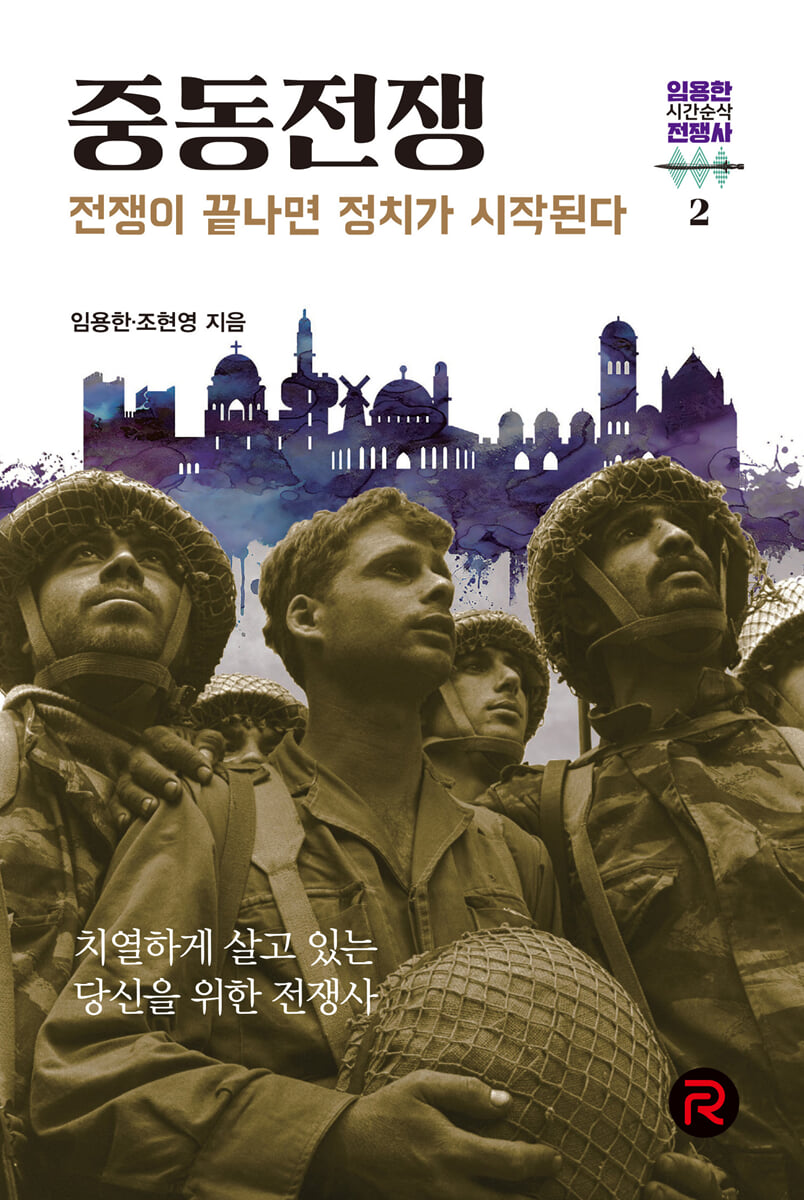
Middle East War
 |
Description
Book Introduction
For you who live fiercely
The second installment of Dr. Im Yong-han's 'Time-Swept War History Series', easily explained!
'Im Yong-han's Time-Swept War History' is a war history series written by Dr. Im Yong-han, who received much love for 'Talkumentary War History', and writer Jo Hyeon-yeong, who wrote the script.
We've written it in an easy-to-understand way and introduced infographics so that you can understand the entire history of war by reading just one volume.
Anyone who is a war historian, military nerd, or history reader, as well as someone who lives each day as if it were a war, can read it as if it were their own story.
The second book in the series, "The Middle East Wars: When Wars End, Politics Begins," covers the Middle East Wars, a series of four wars.
Starting with the formation of the Jewish people as its background, the detailed progress and results of the first, second, third, and fourth wars are explained in short, easy-to-read formats.
Reading this book will not only help you understand the context of the Middle East war, but also provide you with a variety of insights, including how Israel, once considered a weak nation, won the war, the nature of the war, and the impact of the war.
The second installment of Dr. Im Yong-han's 'Time-Swept War History Series', easily explained!
'Im Yong-han's Time-Swept War History' is a war history series written by Dr. Im Yong-han, who received much love for 'Talkumentary War History', and writer Jo Hyeon-yeong, who wrote the script.
We've written it in an easy-to-understand way and introduced infographics so that you can understand the entire history of war by reading just one volume.
Anyone who is a war historian, military nerd, or history reader, as well as someone who lives each day as if it were a war, can read it as if it were their own story.
The second book in the series, "The Middle East Wars: When Wars End, Politics Begins," covers the Middle East Wars, a series of four wars.
Starting with the formation of the Jewish people as its background, the detailed progress and results of the first, second, third, and fourth wars are explained in short, easy-to-read formats.
Reading this book will not only help you understand the context of the Middle East war, but also provide you with a variety of insights, including how Israel, once considered a weak nation, won the war, the nature of the war, and the impact of the war.
- You can preview some of the book's contents.
Preview
index
Author's Note
Part 1: The First and Second Middle East Wars (1948 War, Suez War)
01 Palestine in the 1940s - A Seething Pot
02 The History of the 'Wandering' Jews - Eternal Foreigners
03 Why It Had to Be 'Palestine' - Let's Return to Zion
04 Britain's Double Contract - The Prelude to a Great War
05 Palestinians vs. Jews - David and Goliath
06 Simultaneous Independence of Israel and Palestine - Partition Palestine
07 City Wars and Road Wars - Winners of City Wars
08 City Wars and Road Wars 2 - The Winner of Road Wars
09 The Atrocities of Deir Yassin Village - The Runaway Locomotive
10 The Birth of a Palestinian Refugee - Opening Pandora's Box
11 The First Middle East War, which began with the founding of the state - Divide Israel into three parts.
12 First Middle East War, Round 1 - Pharaoh's Army
13 Jordanian Army's Unexpected Action - The Man Who Holds the Key to War
14 Operation Jerusalem Recapture - Defend the Holy Land, Jerusalem
15 Burma Road - Clear the Way to Jerusalem
16 Altalena Incident - One Israeli Army
Round 17, Nazareth and Fallujah - Operation Defend the Northern Territories
Round 18, Israel's Offensive - Fast & Furious
19 Israel's Great Victory - Intense Violence
20 The Rise of Nasser - Provocations from Egypt's New Master
21 The Gulf of Aqaba Blockade and Operation Kadesh - Another Provocation
22 British and French 72-Hour Air Raid - Defend Suez
23 Results of the Second Middle East War - The Final Winner, Nasser
Part 2: The Third and Fourth Middle East Wars (Six-Day War, Yom Kippur War)
01 The Formation and Cracking of the Arab League - Under the Banner of Saladin
02 Israel's Preemptive Strike - Syria Syndrome
03 The Arab Offensive and Israeli Terror - The Real War Begins
04 The Israeli Air Force's Perfect Surprise - Operation Moked
05 The Israeli Air Force's Legendary Operation - Sinai Blitzkrieg
06 Reclaim the Holy Land - The Siege of Jerusalem
07 The Myth of the Golani Brigade - Northern Front
08 Nasser's Fate - The War of Attrition
09 Israel's Metamorphosis - The Six-Day War and Aftermath
10 Egypt's Transformation - Sadat's Egypt, War Again
11 They Could Not Have Changed - Israel's Misjudgment
12 48 Hours - The Cannons of Yom Kippur
13 Victory in the History of Victory - The Battle of the Golan Heights
14 The Changed Situation - The War East of Suez
15 The Resurrected Sleeping Dragon - A Reversal of the Tides
16 What the Yom Kippur War Left Behind - Lessons from War History
17 The Never-ending Tragedy - The Yom Kippur War and Aftermath
18 Epilogue - Now
INFOGRAPHY
References, illustrations, and photo sources
Part 1: The First and Second Middle East Wars (1948 War, Suez War)
01 Palestine in the 1940s - A Seething Pot
02 The History of the 'Wandering' Jews - Eternal Foreigners
03 Why It Had to Be 'Palestine' - Let's Return to Zion
04 Britain's Double Contract - The Prelude to a Great War
05 Palestinians vs. Jews - David and Goliath
06 Simultaneous Independence of Israel and Palestine - Partition Palestine
07 City Wars and Road Wars - Winners of City Wars
08 City Wars and Road Wars 2 - The Winner of Road Wars
09 The Atrocities of Deir Yassin Village - The Runaway Locomotive
10 The Birth of a Palestinian Refugee - Opening Pandora's Box
11 The First Middle East War, which began with the founding of the state - Divide Israel into three parts.
12 First Middle East War, Round 1 - Pharaoh's Army
13 Jordanian Army's Unexpected Action - The Man Who Holds the Key to War
14 Operation Jerusalem Recapture - Defend the Holy Land, Jerusalem
15 Burma Road - Clear the Way to Jerusalem
16 Altalena Incident - One Israeli Army
Round 17, Nazareth and Fallujah - Operation Defend the Northern Territories
Round 18, Israel's Offensive - Fast & Furious
19 Israel's Great Victory - Intense Violence
20 The Rise of Nasser - Provocations from Egypt's New Master
21 The Gulf of Aqaba Blockade and Operation Kadesh - Another Provocation
22 British and French 72-Hour Air Raid - Defend Suez
23 Results of the Second Middle East War - The Final Winner, Nasser
Part 2: The Third and Fourth Middle East Wars (Six-Day War, Yom Kippur War)
01 The Formation and Cracking of the Arab League - Under the Banner of Saladin
02 Israel's Preemptive Strike - Syria Syndrome
03 The Arab Offensive and Israeli Terror - The Real War Begins
04 The Israeli Air Force's Perfect Surprise - Operation Moked
05 The Israeli Air Force's Legendary Operation - Sinai Blitzkrieg
06 Reclaim the Holy Land - The Siege of Jerusalem
07 The Myth of the Golani Brigade - Northern Front
08 Nasser's Fate - The War of Attrition
09 Israel's Metamorphosis - The Six-Day War and Aftermath
10 Egypt's Transformation - Sadat's Egypt, War Again
11 They Could Not Have Changed - Israel's Misjudgment
12 48 Hours - The Cannons of Yom Kippur
13 Victory in the History of Victory - The Battle of the Golan Heights
14 The Changed Situation - The War East of Suez
15 The Resurrected Sleeping Dragon - A Reversal of the Tides
16 What the Yom Kippur War Left Behind - Lessons from War History
17 The Never-ending Tragedy - The Yom Kippur War and Aftermath
18 Epilogue - Now
INFOGRAPHY
References, illustrations, and photo sources
Detailed image

Into the book
I was also worried about readers' reactions.
Most people who are interested in the Middle East war have already taken sides.
Although I was worried, this difficulty actually fueled my desire to write.
I decided to navigate the complex web of ideology, religion, and Cold War biases through the story of a human being who falls victim to those biases.
---From the author's note
In the 1940s, Palestine was a melting pot on the verge of eruption.
World War II was in full swing, and the most complex struggle for independence and ethnic conflict in world history, the most stubborn and uncompromising religious conflict, and the resource war that would rock the 20th century were all brewing simultaneously.
And the warriors who would lead this struggle, the wounded heroes, were gathering in Palestine.
---From "Part 1 | 01 Palestine in the 1940s - A Seething Pot"
At that moment, a loud noise erupted from the north side of the street and flames erupted.
Then a loud gunshot rang out.
People scattered in an instant.
Shaihi, who had quickly sat down, realized that it was in the direction of his uncle's shop.
The boy jumped up and started running.
A phrase he had heard on the radio earlier began to come out in his own voice.
“Jews, the evil of the world, germs, seeds that must be destroyed…!”
---From "Part 1 | 05 Palestinians vs. Jews - David and Goliath"
The organizational and factional strife within the Israeli military was so intense that it would have led to a civil war or a coup in other countries.
But as the Irgun case shows, this conflict was resolved on a dramatic note.
Although these conflicts hindered many military actions, they did not lead to defeat.
Israel's unique situation, with nowhere else to go, and the relatively low level of Arab armies also played a role.
However, humans are not as rational as we think, and there are many cases where they make the worst choices in situations that are obviously hopeless.
When the opponent is weak, there are many cases where you let your guard down and make the wrong decision.
Israel's compromise was surprising.
Ben-Gurion's tenacious yet flexible, powerful yet appropriate execution skills also deserve to be highly praised.
---From "Part 1 | 16 The Altalena Incident - One Israeli Army"
Seeing the birth of the Arab League, Egypt's number two, Sadat, felt uneasy.
At some point, the two people's personalities became polar opposites.
Nasser, who liked to remain in the solid darkness, a mysterious being, now shined.
Sadat, the Egyptian samurai who did not hesitate to commit political assassination, became a ninja who quietly watched Nasser from behind his shadow and came forward only when called upon.
---From "Part 2 | 01 The Formation and Cracks of the Arab League - Under the Flag of Saladin"
The Syrian army's performance before and after the Battle of the Golan Heights was completely different.
The pre-war pride and morale were nowhere to be found, and they showed a poor performance in battle.
The Syrian army was well-equipped, but its defenses were anything but.
The name 'Operation Nasr' sounded promising, but they lacked the capability to carry it out.
---From "Part 2 | The Myth of the Golani Brigade - Northern Front"
Even if we cannot replicate the Israeli approach, the Israeli example is sufficient to demonstrate the importance of nurturing and deploying talent in war.
Our society is overly regulated in every aspect.
All these regulations claim to be about justice and preventing corruption, but their real purpose is to avoid accountability.
Fearing that their weaknesses will be exposed or compared, the government imposes regulations even on private sectors such as corporations and threatens them in the name of justice.
A world without conflict, noise, injustice, or discrimination is only the space of the dead.
Most people who are interested in the Middle East war have already taken sides.
Although I was worried, this difficulty actually fueled my desire to write.
I decided to navigate the complex web of ideology, religion, and Cold War biases through the story of a human being who falls victim to those biases.
---From the author's note
In the 1940s, Palestine was a melting pot on the verge of eruption.
World War II was in full swing, and the most complex struggle for independence and ethnic conflict in world history, the most stubborn and uncompromising religious conflict, and the resource war that would rock the 20th century were all brewing simultaneously.
And the warriors who would lead this struggle, the wounded heroes, were gathering in Palestine.
---From "Part 1 | 01 Palestine in the 1940s - A Seething Pot"
At that moment, a loud noise erupted from the north side of the street and flames erupted.
Then a loud gunshot rang out.
People scattered in an instant.
Shaihi, who had quickly sat down, realized that it was in the direction of his uncle's shop.
The boy jumped up and started running.
A phrase he had heard on the radio earlier began to come out in his own voice.
“Jews, the evil of the world, germs, seeds that must be destroyed…!”
---From "Part 1 | 05 Palestinians vs. Jews - David and Goliath"
The organizational and factional strife within the Israeli military was so intense that it would have led to a civil war or a coup in other countries.
But as the Irgun case shows, this conflict was resolved on a dramatic note.
Although these conflicts hindered many military actions, they did not lead to defeat.
Israel's unique situation, with nowhere else to go, and the relatively low level of Arab armies also played a role.
However, humans are not as rational as we think, and there are many cases where they make the worst choices in situations that are obviously hopeless.
When the opponent is weak, there are many cases where you let your guard down and make the wrong decision.
Israel's compromise was surprising.
Ben-Gurion's tenacious yet flexible, powerful yet appropriate execution skills also deserve to be highly praised.
---From "Part 1 | 16 The Altalena Incident - One Israeli Army"
Seeing the birth of the Arab League, Egypt's number two, Sadat, felt uneasy.
At some point, the two people's personalities became polar opposites.
Nasser, who liked to remain in the solid darkness, a mysterious being, now shined.
Sadat, the Egyptian samurai who did not hesitate to commit political assassination, became a ninja who quietly watched Nasser from behind his shadow and came forward only when called upon.
---From "Part 2 | 01 The Formation and Cracks of the Arab League - Under the Flag of Saladin"
The Syrian army's performance before and after the Battle of the Golan Heights was completely different.
The pre-war pride and morale were nowhere to be found, and they showed a poor performance in battle.
The Syrian army was well-equipped, but its defenses were anything but.
The name 'Operation Nasr' sounded promising, but they lacked the capability to carry it out.
---From "Part 2 | The Myth of the Golani Brigade - Northern Front"
Even if we cannot replicate the Israeli approach, the Israeli example is sufficient to demonstrate the importance of nurturing and deploying talent in war.
Our society is overly regulated in every aspect.
All these regulations claim to be about justice and preventing corruption, but their real purpose is to avoid accountability.
Fearing that their weaknesses will be exposed or compared, the government imposes regulations even on private sectors such as corporations and threatens them in the name of justice.
A world without conflict, noise, injustice, or discrimination is only the space of the dead.
---From "Part 2 | What the 16 Yom Kippur War Left Behind? Lessons from the History of War"
Publisher's Review
The "Im Yong-han's Time-Saving War History" series, which simultaneously captures knowledge, fun, and insight in one volume.
Continuing the fun of "Talkumentary War History," which has captivated 80 million people!
“I’m excited even before I see it!”
“If you hire him, you can trust him!”
“Listening to the story gives you a new understanding of history!”
David 'Israel' vs. Goliath 'Arab Union'
How did Israel achieve victory?
The Middle East war is famous for the four victories Israel, which was considered weak, won against the Arab coalition.
While chance certainly played a role in these victories, there were very fundamental differences between the two armies.
So what determined the outcome of this war? The author identifies "politics" as the most important factor.
In the Middle East war, most Arab countries were in internal political turmoil during the war, while Israel relatively avoided conflict.
But the author also argues that, paradoxically, both Israel and the Arab world have suffered as political logic has been applied to the battlefield.
In fact, Israel also suffered significant damage in the Fourth Middle East War (Yom Kippur War), as political factors intervened in Israel's judgment, leading to miscalculation.
A mess of religion and Cold War order
Enter the vivid battlefield with Im Yong-han's insight!
“History, especially the history of war, shows how imperfect human beings are, how easily they succumb to selfishness and self-interest as much as they desire peace and justice.” - From the text
The Middle East is still called a powder keg.
The violent conflict between Israel and Palestine continues, and tensions between Israel and other Middle Eastern countries remain high.
This situation is actually an extension of the four Middle East wars that have occurred over the decades since World War II.
The Middle East war, which began with Israel's independence, was both a religious war in which religious fundamentalism clashed and a proxy war between the great powers during the Cold War.
This war, which involved ethnic, resource, and political issues, was difficult to fully understand due to its complexity and the physical and psychological distance between them.
Materials on the Middle East wars are often too broad in scope or narrowly describe only one battle, making them difficult for general readers without basic knowledge to understand.
So, in this book, Dr. Im Yong-han explained the entire course of the war and the context surrounding it in an easy-to-understand manner.
Also, unlike existing books, I tried to describe the positions of the Middle East and Israel as balanced as possible.
“The fierce survive!”
Make history your ally in this war-like everyday life.
Why should we study the history of war? Until now, war has felt like a distant story.
But the Russo-Ukrainian War broke out, and the United States and China were still struggling for hegemony.
The world situation has become chaotic again.
These wars ultimately affected our daily lives, including stock investments, politics, and prices.
Also, our daily life is already a war.
Rapid economic austerity has frozen society, leading to numerous internal wars, such as generational conflict, conflict between the rich and the poor, and conflict between men and women.
This is an obvious phenomenon and requires fierce effort to survive here.
The Middle East war, though a distant one, offers insights into the conditions under which the underdog can triumph, both from Israel, which achieved its strategic objectives under constraints, and from the Arab League, which suffered defeat despite overwhelming superiority.
In these harsh times, to survive, you must make history work for you.
Continuing the fun of "Talkumentary War History," which has captivated 80 million people!
“I’m excited even before I see it!”
“If you hire him, you can trust him!”
“Listening to the story gives you a new understanding of history!”
David 'Israel' vs. Goliath 'Arab Union'
How did Israel achieve victory?
The Middle East war is famous for the four victories Israel, which was considered weak, won against the Arab coalition.
While chance certainly played a role in these victories, there were very fundamental differences between the two armies.
So what determined the outcome of this war? The author identifies "politics" as the most important factor.
In the Middle East war, most Arab countries were in internal political turmoil during the war, while Israel relatively avoided conflict.
But the author also argues that, paradoxically, both Israel and the Arab world have suffered as political logic has been applied to the battlefield.
In fact, Israel also suffered significant damage in the Fourth Middle East War (Yom Kippur War), as political factors intervened in Israel's judgment, leading to miscalculation.
A mess of religion and Cold War order
Enter the vivid battlefield with Im Yong-han's insight!
“History, especially the history of war, shows how imperfect human beings are, how easily they succumb to selfishness and self-interest as much as they desire peace and justice.” - From the text
The Middle East is still called a powder keg.
The violent conflict between Israel and Palestine continues, and tensions between Israel and other Middle Eastern countries remain high.
This situation is actually an extension of the four Middle East wars that have occurred over the decades since World War II.
The Middle East war, which began with Israel's independence, was both a religious war in which religious fundamentalism clashed and a proxy war between the great powers during the Cold War.
This war, which involved ethnic, resource, and political issues, was difficult to fully understand due to its complexity and the physical and psychological distance between them.
Materials on the Middle East wars are often too broad in scope or narrowly describe only one battle, making them difficult for general readers without basic knowledge to understand.
So, in this book, Dr. Im Yong-han explained the entire course of the war and the context surrounding it in an easy-to-understand manner.
Also, unlike existing books, I tried to describe the positions of the Middle East and Israel as balanced as possible.
“The fierce survive!”
Make history your ally in this war-like everyday life.
Why should we study the history of war? Until now, war has felt like a distant story.
But the Russo-Ukrainian War broke out, and the United States and China were still struggling for hegemony.
The world situation has become chaotic again.
These wars ultimately affected our daily lives, including stock investments, politics, and prices.
Also, our daily life is already a war.
Rapid economic austerity has frozen society, leading to numerous internal wars, such as generational conflict, conflict between the rich and the poor, and conflict between men and women.
This is an obvious phenomenon and requires fierce effort to survive here.
The Middle East war, though a distant one, offers insights into the conditions under which the underdog can triumph, both from Israel, which achieved its strategic objectives under constraints, and from the Arab League, which suffered defeat despite overwhelming superiority.
In these harsh times, to survive, you must make history work for you.
GOODS SPECIFICS
- Publication date: November 30, 2022
- Page count, weight, size: 552 pages | 554g | 125*188*27mm
- ISBN13: 9788950942977
- ISBN10: 8950942976
You may also like
카테고리
korean


korean

![GQ KOREA Mark (Monthly): December [2025]](http://librairie.coreenne.fr/cdn/shop/files/8ef265dbbfbf186523ed75ba7319009d.jpg?v=1765340328&width=3840)


