

Who was the first person to eat oysters?
 |
Description
Book Introduction
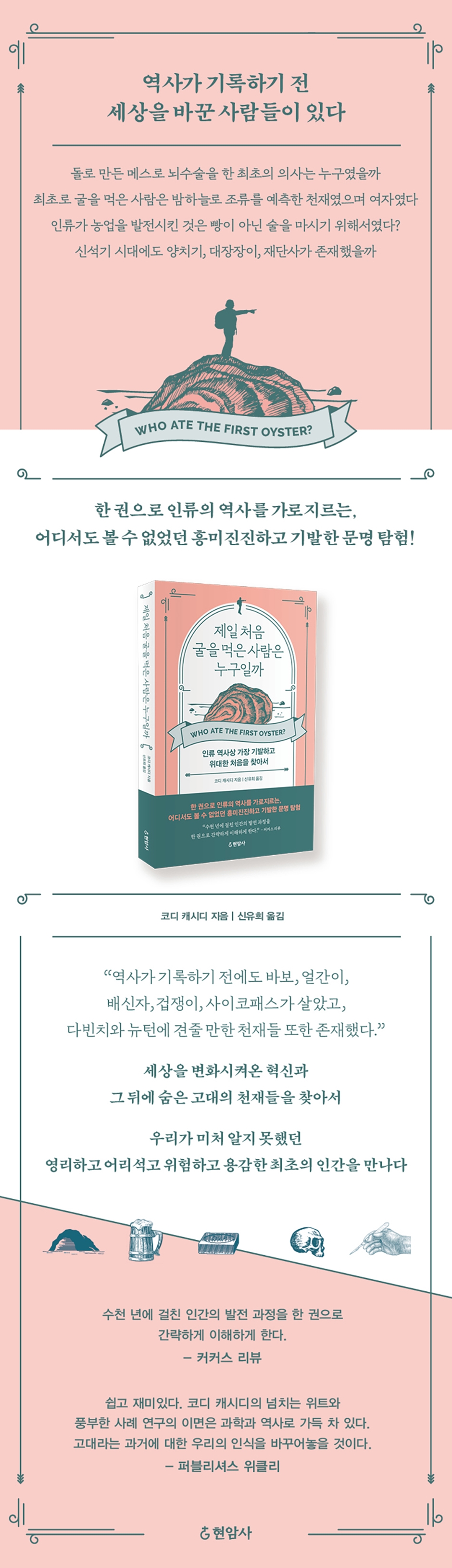
Before history was written, there were people who changed the world.
A single volume that covers the history of mankind,
An exciting and unique civilization exploration unlike anything you've seen before!
"A concise overview of human development over thousands of years, presented in one volume." - Kirkus Reviews
Jonathan Swift, the British satirist who wrote Gulliver's Travels, famously said, "He was the first man in the world to eat oysters."
He is right that eating an oyster that looked like a pale earlobe for the first time was an act of great courage, but he is actually wrong.
The first person in the world to dare to eat an oyster was probably not a man, but a woman.
This is because 164,000 years ago, the roles of men and women were strictly divided, and gathering was women's work.
"Who was the first person to eat oysters?" is a question no one has ever pondered, but we set out to find the beginnings of things that have changed our lives.
Author Cody Cassidy delves into the past, profiling the people who changed the world before history recorded them, drawing on extensive research.
Who invented the wheel? What was the first recorded joke? Who drank the first beer? Who was the killer of the first murder mystery, who performed the first brain surgery, and who bravely ate the first slimy, pale oyster?
To uncover the untold stories of these remarkable innovators, the author ferments yeast himself, visits breweries, and visits play labs to learn about ancient bows and arrows.
You can also walk through the Alps yourself and retrace the last steps of an ancient murder victim.
This seemingly crazy journey delves deeply into fields ranging from modern genetics to evolutionary biology, archaeology, psychology, and anthropology.
Before recorded history, there were fools, idiots, traitors, cowards, and psychopaths, as well as geniuses comparable to da Vinci and Newton.
By following the journey of discovering the innovations that have transformed the world and the ancient geniuses behind them, you can see at a glance how human civilization has developed.
This book is an exciting and enjoyable exploration of civilization, condensing the development of human civilization into a single volume like no other.
A single volume that covers the history of mankind,
An exciting and unique civilization exploration unlike anything you've seen before!
"A concise overview of human development over thousands of years, presented in one volume." - Kirkus Reviews
Jonathan Swift, the British satirist who wrote Gulliver's Travels, famously said, "He was the first man in the world to eat oysters."
He is right that eating an oyster that looked like a pale earlobe for the first time was an act of great courage, but he is actually wrong.
The first person in the world to dare to eat an oyster was probably not a man, but a woman.
This is because 164,000 years ago, the roles of men and women were strictly divided, and gathering was women's work.
"Who was the first person to eat oysters?" is a question no one has ever pondered, but we set out to find the beginnings of things that have changed our lives.
Author Cody Cassidy delves into the past, profiling the people who changed the world before history recorded them, drawing on extensive research.
Who invented the wheel? What was the first recorded joke? Who drank the first beer? Who was the killer of the first murder mystery, who performed the first brain surgery, and who bravely ate the first slimy, pale oyster?
To uncover the untold stories of these remarkable innovators, the author ferments yeast himself, visits breweries, and visits play labs to learn about ancient bows and arrows.
You can also walk through the Alps yourself and retrace the last steps of an ancient murder victim.
This seemingly crazy journey delves deeply into fields ranging from modern genetics to evolutionary biology, archaeology, psychology, and anthropology.
Before recorded history, there were fools, idiots, traitors, cowards, and psychopaths, as well as geniuses comparable to da Vinci and Newton.
By following the journey of discovering the innovations that have transformed the world and the ancient geniuses behind them, you can see at a glance how human civilization has developed.
This book is an exciting and enjoyable exploration of civilization, condensing the development of human civilization into a single volume like no other.
- You can preview some of the book's contents.
Preview
index
Introduction
1 Who was the first inventor in human history?
2 Who discovered fire?
3 Who was the first to eat oysters?
4 Who invented clothes?
5 Who was the first to shoot a bow?
6 Who painted the world's first masterpiece?
7 Who first discovered the American continent?
8 Who was the first to drink beer?
9 Who performed the first brain surgery?
10 Who was the first to ride a horse?
11 Who invented the wheel?
12 Who was the killer in the first murder mystery?
13 Who is the first person whose name we know?
14 Who made the first soap?
15 Who was the first to get smallpox?
16 Who told the first recorded joke?
17 Who discovered Hawaii?
References
Acknowledgements
1 Who was the first inventor in human history?
2 Who discovered fire?
3 Who was the first to eat oysters?
4 Who invented clothes?
5 Who was the first to shoot a bow?
6 Who painted the world's first masterpiece?
7 Who first discovered the American continent?
8 Who was the first to drink beer?
9 Who performed the first brain surgery?
10 Who was the first to ride a horse?
11 Who invented the wheel?
12 Who was the killer in the first murder mystery?
13 Who is the first person whose name we know?
14 Who made the first soap?
15 Who was the first to get smallpox?
16 Who told the first recorded joke?
17 Who discovered Hawaii?
References
Acknowledgements
Detailed image
Into the book
Initially, I started by looking for the greatest 'first' in human history.
But soon it changed to a story about the 'people' who created it in the first place.
The more I learned about the discoveries and inventions that took place in prehistoric times, the more curious I became about the people who created them.
However, most reconstructions of prehistoric times to date have treated people only as 'humans of that era', rather than as individual people, completely ignoring the individuality of each individual.
So I set out to find these amazing people buried deep in human history.
I met with over 100 experts and read dozens of books and hundreds of papers.
I ordered obsidian online, tried shaving myself, and visited the site of the first work of art ever created.
They made fire with flint and pyrite, and shot arrows with a model of an ancient bow.
They even made beer by rotting dead meat.
And at the place of Oechi's death, I almost followed Oechi.
--- p.13
But just as prehistoric times were filled with fools, idiots, fools, buffoons, traitors, cowards, troublemakers, and evil psychopaths (some of whom we will explore in this book), so too were geniuses on par with da Vinci and Newton.
This is not mere speculation.
It is an undeniable and obvious fact that has already been clearly proven.
Evidence of this can be found in cave paintings in France, in symbols carved on clay tablets in the Middle East, on islands in the South Pacific, and on four wheels discovered in Russia.
If Newton is revered for inventing calculus, how great is the man who invented mathematics itself? How great is the man who "deliberately" discovered the world's most isolated archipelago, 500 years before Columbus "accidentally" discovered America?
--- p.17
If we consider the 300,000 years since the evolution of anatomically modern humans, Homo sapiens, as 24 hours, recorded history begins only 30 minutes before the end of that day.
The remaining 23 hours and 30 minutes correspond to prehistoric times, when about 15 billion nameless people lived.
--- p.23
What makes the invention of the bow so difficult to understand is its originality.
Almost all of the inventions of early hominins were imitations of things they saw in nature.
When I saw a rolling log, I thought of a wheel, and when I saw an object floating on water, I thought of a boat.
Branches became spears, vines became ropes, rocks became hatchets, and birds became airplanes.
In this way, nature often provided ideas, and humans took inspiration from them and designed new inventions.
However, the origin of the bow and arrow was completely unknown.
The idea of shooting projectiles using the energy generated by bending tree branches was not something that came from nature, but was an ingenious human invention.
--- p.87
For those of us today who often picture cave dwellers wearing tiger skins and foraging for food, or being the prey, it may seem hard to believe that hunter-gatherers in the days when Europe was covered in ice invested such time and resources in art.
But the evidence suggests that our preconceptions and knowledge about them are not just wrong, they're completely outdated.
There is absolutely no reason to think that the probability of a genius being born in the future is lower than that of a modern person.
In fact, there is evidence suggesting that people who lived during the Jang era were, on average, smarter than we are today.
--- p.98
Compared to footprints on lunar dust or wheel marks on ancient roads, worn horse teeth may not seem like much.
But this means that for the first time in human history, we can move across the land faster than we can walk on two legs.
--- p.149
The fact that some of the oldest jokes in recorded history have much in common with today's humor has caught the attention of psychologists.
It's as if, somewhere in the brain of Homo sapiens, there's some basic formula for humor written down.
Many scholars, philosophers, comedians, and writers have struggled to find a universal explanation for laughter and humor.
But soon it changed to a story about the 'people' who created it in the first place.
The more I learned about the discoveries and inventions that took place in prehistoric times, the more curious I became about the people who created them.
However, most reconstructions of prehistoric times to date have treated people only as 'humans of that era', rather than as individual people, completely ignoring the individuality of each individual.
So I set out to find these amazing people buried deep in human history.
I met with over 100 experts and read dozens of books and hundreds of papers.
I ordered obsidian online, tried shaving myself, and visited the site of the first work of art ever created.
They made fire with flint and pyrite, and shot arrows with a model of an ancient bow.
They even made beer by rotting dead meat.
And at the place of Oechi's death, I almost followed Oechi.
--- p.13
But just as prehistoric times were filled with fools, idiots, fools, buffoons, traitors, cowards, troublemakers, and evil psychopaths (some of whom we will explore in this book), so too were geniuses on par with da Vinci and Newton.
This is not mere speculation.
It is an undeniable and obvious fact that has already been clearly proven.
Evidence of this can be found in cave paintings in France, in symbols carved on clay tablets in the Middle East, on islands in the South Pacific, and on four wheels discovered in Russia.
If Newton is revered for inventing calculus, how great is the man who invented mathematics itself? How great is the man who "deliberately" discovered the world's most isolated archipelago, 500 years before Columbus "accidentally" discovered America?
--- p.17
If we consider the 300,000 years since the evolution of anatomically modern humans, Homo sapiens, as 24 hours, recorded history begins only 30 minutes before the end of that day.
The remaining 23 hours and 30 minutes correspond to prehistoric times, when about 15 billion nameless people lived.
--- p.23
What makes the invention of the bow so difficult to understand is its originality.
Almost all of the inventions of early hominins were imitations of things they saw in nature.
When I saw a rolling log, I thought of a wheel, and when I saw an object floating on water, I thought of a boat.
Branches became spears, vines became ropes, rocks became hatchets, and birds became airplanes.
In this way, nature often provided ideas, and humans took inspiration from them and designed new inventions.
However, the origin of the bow and arrow was completely unknown.
The idea of shooting projectiles using the energy generated by bending tree branches was not something that came from nature, but was an ingenious human invention.
--- p.87
For those of us today who often picture cave dwellers wearing tiger skins and foraging for food, or being the prey, it may seem hard to believe that hunter-gatherers in the days when Europe was covered in ice invested such time and resources in art.
But the evidence suggests that our preconceptions and knowledge about them are not just wrong, they're completely outdated.
There is absolutely no reason to think that the probability of a genius being born in the future is lower than that of a modern person.
In fact, there is evidence suggesting that people who lived during the Jang era were, on average, smarter than we are today.
--- p.98
Compared to footprints on lunar dust or wheel marks on ancient roads, worn horse teeth may not seem like much.
But this means that for the first time in human history, we can move across the land faster than we can walk on two legs.
--- p.149
The fact that some of the oldest jokes in recorded history have much in common with today's humor has caught the attention of psychologists.
It's as if, somewhere in the brain of Homo sapiens, there's some basic formula for humor written down.
Many scholars, philosophers, comedians, and writers have struggled to find a universal explanation for laughter and humor.
--- p.248
Publisher's Review
There's no way a genius lived in prehistoric times!
The history of human civilization viewed through various lenses, including evolutionary biology, archaeology, psychology, and anthropology.
Innovations that changed the world and the ancient geniuses behind them.
Comics and media often portray prehistoric people as primitive people who lived in caves, wearing animal skins and making strange noises.
I think their intelligence would have been significantly lower than it is now, because the tools and technology they used back then were less advanced.
So the claim that geniuses lived even in prehistoric times may seem somewhat puzzling.
However, this book argues through numerous examples that prehistoric people possessed a much wider range of knowledge than modern people, who live in an age where food is mass-produced and people only need to excel at specialized tasks.
In other words, they had to understand their surroundings at an encyclopedic level in order to survive.
Each individual gathered, hunted, made, and prepared all their own food, shelter, and household goods.
To do this, they had to know which plants were edible and which were inedible, where and when each plant grew, and how the animals that could be eaten moved with the seasons.
In fact, the ancient geniuses in the book did things that required scientific knowledge, such as predicting bird movements by observing the night sky and breeding and taming horses that were once wild animals, without anyone telling them.
Thanks to advances in science, we can now even know what the last meal was of a person who died over 5,000 years ago.
Thanks to this, this book brings together experts from various fields, including evolutionary biologists, archaeologists, psychologists, anthropologists, artists, and even beer experts, to profile an ancient figure.
Through a colorful and rich lens, they are portrayed not as mere scenes from history, but as individual people, realistic and three-dimensional figures.
What we didn't know
Meet the first human: clever, foolish, dangerous, and brave.
When we look at tens of thousands of years of history from a distance, cultural and technological evolution appears to have been smooth and natural.
The transition from stone tools to iron tools, and from gathering to farming, also feels natural and expected.
That's why most people find it difficult to imagine that any one individual could have played a significant role in human evolution.
However, the transition from rolling logs to carts for moving goods was not a natural or inevitable change.
It happened because someone invented the wheel and axle, which many scholars recognize as the greatest mechanical invention in history.
Throughout the long history of civilization and the passage of time from one stage to the next, there has always been someone at the center of it all, someone trying something new.
Those attempts were things no one had ever thought of, and they probably had no idea that their invention would change human civilization.
But as we read this book, we can see that history has flowed to this point largely thanks to those unexpected people.
Yet, as the author notes, "the unique story and individuality of each individual has always been missing from the descriptions of humanity of that era." This book captures the first people—clever, foolish, risky, and courageous—who lived and breathed before history was written.
The history of human civilization viewed through various lenses, including evolutionary biology, archaeology, psychology, and anthropology.
Innovations that changed the world and the ancient geniuses behind them.
Comics and media often portray prehistoric people as primitive people who lived in caves, wearing animal skins and making strange noises.
I think their intelligence would have been significantly lower than it is now, because the tools and technology they used back then were less advanced.
So the claim that geniuses lived even in prehistoric times may seem somewhat puzzling.
However, this book argues through numerous examples that prehistoric people possessed a much wider range of knowledge than modern people, who live in an age where food is mass-produced and people only need to excel at specialized tasks.
In other words, they had to understand their surroundings at an encyclopedic level in order to survive.
Each individual gathered, hunted, made, and prepared all their own food, shelter, and household goods.
To do this, they had to know which plants were edible and which were inedible, where and when each plant grew, and how the animals that could be eaten moved with the seasons.
In fact, the ancient geniuses in the book did things that required scientific knowledge, such as predicting bird movements by observing the night sky and breeding and taming horses that were once wild animals, without anyone telling them.
Thanks to advances in science, we can now even know what the last meal was of a person who died over 5,000 years ago.
Thanks to this, this book brings together experts from various fields, including evolutionary biologists, archaeologists, psychologists, anthropologists, artists, and even beer experts, to profile an ancient figure.
Through a colorful and rich lens, they are portrayed not as mere scenes from history, but as individual people, realistic and three-dimensional figures.
What we didn't know
Meet the first human: clever, foolish, dangerous, and brave.
When we look at tens of thousands of years of history from a distance, cultural and technological evolution appears to have been smooth and natural.
The transition from stone tools to iron tools, and from gathering to farming, also feels natural and expected.
That's why most people find it difficult to imagine that any one individual could have played a significant role in human evolution.
However, the transition from rolling logs to carts for moving goods was not a natural or inevitable change.
It happened because someone invented the wheel and axle, which many scholars recognize as the greatest mechanical invention in history.
Throughout the long history of civilization and the passage of time from one stage to the next, there has always been someone at the center of it all, someone trying something new.
Those attempts were things no one had ever thought of, and they probably had no idea that their invention would change human civilization.
But as we read this book, we can see that history has flowed to this point largely thanks to those unexpected people.
Yet, as the author notes, "the unique story and individuality of each individual has always been missing from the descriptions of humanity of that era." This book captures the first people—clever, foolish, risky, and courageous—who lived and breathed before history was written.
GOODS SPECIFICS
- Publication date: November 30, 2021
- Pages, weight, size: 292 pages | 384g | 140*210*20mm
- ISBN13: 9788932321820
- ISBN10: 8932321825
You may also like
카테고리
korean


korean

![GQ KOREA Mark (Monthly): December [2025]](http://librairie.coreenne.fr/cdn/shop/files/8ef265dbbfbf186523ed75ba7319009d.jpg?v=1765340328&width=3840)


