

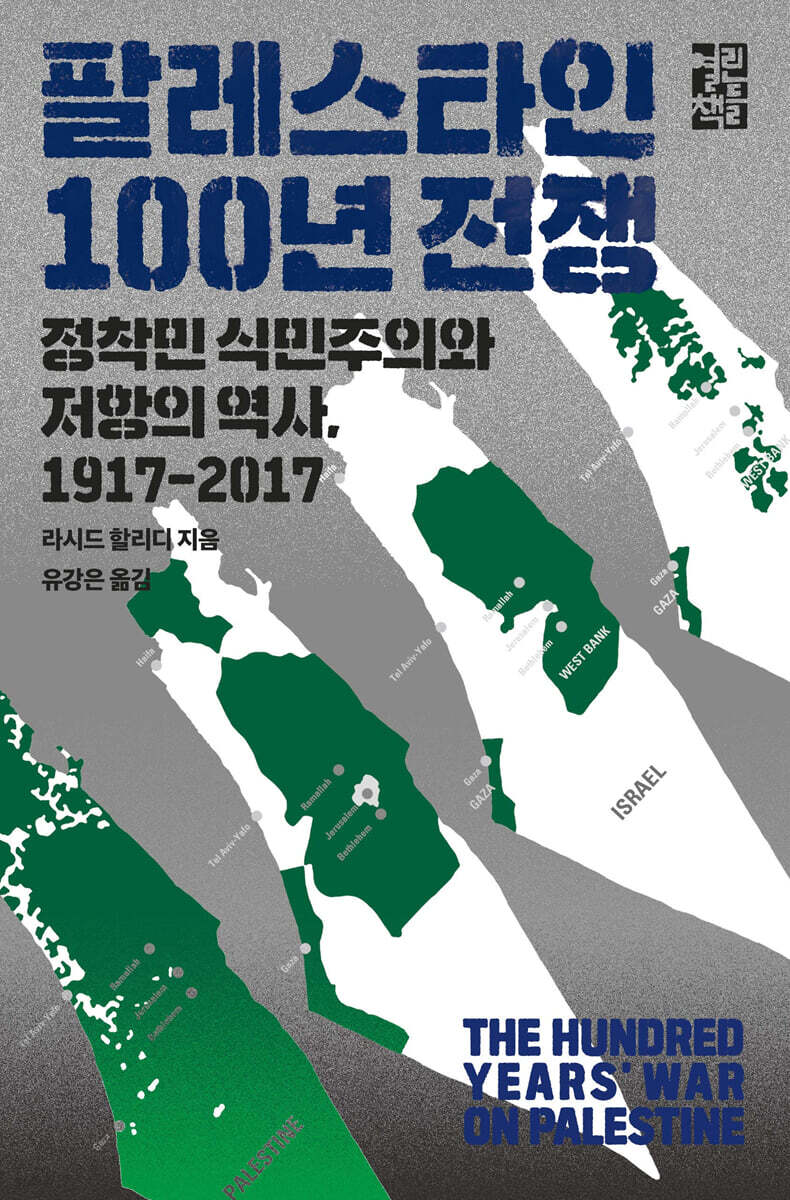
Hundred Years' War in Palestine
 |
Description
Book Introduction
The Origins and Nature of the Palestinian-Israeli Conflict [Israel strikes 130 locations in Gaza], [Bloody Palestine... Hamas rockets fired, retaliation with fighter jets]... … . It's all too familiar to see the Palestinian-Israeli conflict dominating international headlines. The most recent bloody clashes, which took place over ten days in May 2021, left nearly 300 Palestinians and 12 Israelis dead. The American international relations journal Foreign Affairs interpreted this conflict as a signal of [the dawn of a more violent era]. How did Palestine become the "powder keg of the Middle East"? Why has this war persisted for over a century? Palestinian-American historian Rashid Khalidi's new book, "The Hundred Years of Palestine," defines the origins and nature of the Palestinian-Israeli conflict as "Settler Colonialism." Just as Europeans massacred Native Americans and established the United States, Zionism, backed by powers such as Britain and the United States, drove out the indigenous Palestinians and then pushed in settlers. The frequent clashes between the two countries today are also explained as part of the colonial war that has continued for 100 years. This book became a New York Times bestseller immediately after its publication in 2020, receiving significant attention as a rare work that describes the conflict from the perspective of the Palestinian people, and garnered praise from world-renowned scholars such as Noam Chomsky and Avi Shleim. In particular, the author himself comes from the prestigious Khalid family, a family with roots in Palestine for hundreds of years, and he added depth and vividness to the study of the Palestinian-Israeli conflict based on comments and interviews with relatives who were present at the historical site. This book, which sharply examines six crucial periods from the Balfour Declaration in 1917 to the founding of Israel in 1948 to the present-day attack on Gaza, provides an excellent framework for the study of settler colonialism. |
- You can preview some of the book's contents.
Preview
index
Preface to the Korean edition
introduction
1 First declaration of war, 1917–1939
2 Second declaration of war, 1947–1948
Third declaration of war, 1967
4 Fourth declaration of war, 1982
5 Fifth Declaration of War, 1987–1995
6 Sixth Declaration of War, 2000–2014
Conclusion: The Hundred Years' War in Palestine
Acknowledgements
main
Translator's Note
Search
introduction
1 First declaration of war, 1917–1939
2 Second declaration of war, 1947–1948
Third declaration of war, 1967
4 Fourth declaration of war, 1982
5 Fifth Declaration of War, 1987–1995
6 Sixth Declaration of War, 2000–2014
Conclusion: The Hundred Years' War in Palestine
Acknowledgements
main
Translator's Note
Search
Into the book
This war, waged to expel Palestinians and replace their homeland with a national homeland for others, is not part of an age-old struggle, but has its origins in the rise of the Zionist movement in the late 19th century.
The Zionist movement, which emerged in response to the vicious anti-Semitism of Europe's long history, was both a settler colonial project and a nationalist project.
--- p.10
The influx of Jewish immigrants following the persecution of the German Nazi regime increased the Jewish population of Palestine from 18 percent of the total in 1932 to over 31 percent in 1939.
Thus, the demographic threshold and military force necessary for the ethnic cleansing of Palestine in 1948 were established.
--- p.25
At best, the conflict is portrayed as a tragic but simple ethnic clash between two peoples, each with their own rights to the same land.
In the worst cases, it is depicted as the result of fanatic and obstinate hatred on the part of Arabs and Muslims for the Jews' inalienable right to an eternal homeland given by God.
--- p.26
Palestine was a [land without owners] for those who came to settle there.
Because the people living there had no name or form.
Thus, in his letter to Yusuf Diya, Herzl referred to the Palestinian Arabs as [non-Jewish inhabitants].
At that time, it was about 95 percent of the population there.
--- p.28
The Balfour Declaration was the signal for a full-scale colonial conflict.
It was the beginning of a century-long offensive aimed at establishing an exclusive [national homeland] at the expense of the Palestinian people.
--- p.49
The rise of Hitler proved to be the most significant event in the modern history of both Palestine and Zionism.
In 1935 alone, more than 60,000 Jewish immigrants arrived in Palestine, a number greater than the entire Jewish population of the land in 1917.
--- p.68
A servant came in and told me that the BBC had just announced that the UN General Assembly had voted in favor of partitioning Palestine.
On November 29, 1947, at the very moment my father was meeting with the King of Transjordan, the historic vote on Resolution 181 to partition Palestine took place at the United Nations General Assembly.
--- p.93
The ethnic cleansing of Palestine began long before the proclamation of the State of Israel on May 15, 1948.
--- p.114
The Nakba was a watershed moment in the history of Palestine and the Middle East.
After the Nakba, much of Palestine, a land where Arabs had been for over a thousand years, was transformed into a new state with a substantial Jewish majority.
--- p.117
In fact, 90 percent of the Jews who escaped from Eastern Europe immigrated to the United States.
Modern political Zionism has taken deep root in the United States, both within the Jewish community and among many Christians.
--- p.121
Until 1966, most Palestinians lived under strict martial law and had most of their land confiscated.
This land, seized through expropriations deemed legal by the Israeli state and covering a significant portion of the arable land, was transferred to Jewish settlements, the Israel Land Corporation, or passed under the control of the Jewish National Fund.
--- p.126
What we witnessed that day was evidence that a new Middle Eastern axis was in operation.
On the ground, Israeli armored units were advancing in formation, while the United States was providing diplomatic cover.
This axis has been in operation for over half a century.
--- p.152
The refugee camp, besieged by a group called the Lebanese Forces, led by Bashir, was destroyed in August 1976 and its inhabitants were driven out.
It is estimated that 2,000 people were killed in what is probably the largest single massacre of the entire civil war.
Two teachers who worked at our kindergarten were also murdered in this way.
--- p.192
According to official Lebanese figures, more than 19,000 Palestinians and Lebanese, mostly civilians, were killed and more than 30,000 wounded in the ten weeks of fighting between early June and mid-October 1982.
--- p.210
The Intifada employed a variety of tactics, from strikes, boycotts, and refusal to pay taxes to other creative forms of civil disobedience, alongside protests.
Protests sometimes turned violent, with soldiers firing live rounds and rubber bullets at unarmed protesters or young people throwing rocks, causing many casualties and setting fires.
--- p.252
In the decades since 1993, the Gaza Strip has been gradually cut off from the rest of the world.
On land, the army surrounded them, and on the sea, the Israeli navy surrounded them.
Entry into the Gaza Strip required a rarely issued permit and passage through a massive, fortified checkpoint resembling a cattle pen.
--- p.300~301
The long resistance of Palestinians to their land loss and displacement shows that, as the late historian Tony Judt said, the Zionist movement "came too late."
[Because it brought the unique separatist plan of the late 19th century to a world that was already ahead of its time].
--- p.343
As Edward Said puts it, one reason for Zionism's success is that it "won the political struggle for Palestine in an international world where ideas and representations, language and images, are at stake."
--- p.345
There has always been a huge army on the side of Zionism and the State of Israel.
Before 1939, there was British support, in 1947–1948 there was American and Soviet support, in the 1950s and 1960s there was French and British support, and from the 1970s to the present there has been Israel's formidable military power in addition to unlimited American support.
--- p.348
While Zionism has transformed Judaism and the historical Jewish people into something quite different—a modern nationalism?—that doesn't erase the fact that Israeli Jews today consider themselves a people with a sense of [national] belonging to Palestine, which they consider the land of Israel.
The Zionist movement, which emerged in response to the vicious anti-Semitism of Europe's long history, was both a settler colonial project and a nationalist project.
--- p.10
The influx of Jewish immigrants following the persecution of the German Nazi regime increased the Jewish population of Palestine from 18 percent of the total in 1932 to over 31 percent in 1939.
Thus, the demographic threshold and military force necessary for the ethnic cleansing of Palestine in 1948 were established.
--- p.25
At best, the conflict is portrayed as a tragic but simple ethnic clash between two peoples, each with their own rights to the same land.
In the worst cases, it is depicted as the result of fanatic and obstinate hatred on the part of Arabs and Muslims for the Jews' inalienable right to an eternal homeland given by God.
--- p.26
Palestine was a [land without owners] for those who came to settle there.
Because the people living there had no name or form.
Thus, in his letter to Yusuf Diya, Herzl referred to the Palestinian Arabs as [non-Jewish inhabitants].
At that time, it was about 95 percent of the population there.
--- p.28
The Balfour Declaration was the signal for a full-scale colonial conflict.
It was the beginning of a century-long offensive aimed at establishing an exclusive [national homeland] at the expense of the Palestinian people.
--- p.49
The rise of Hitler proved to be the most significant event in the modern history of both Palestine and Zionism.
In 1935 alone, more than 60,000 Jewish immigrants arrived in Palestine, a number greater than the entire Jewish population of the land in 1917.
--- p.68
A servant came in and told me that the BBC had just announced that the UN General Assembly had voted in favor of partitioning Palestine.
On November 29, 1947, at the very moment my father was meeting with the King of Transjordan, the historic vote on Resolution 181 to partition Palestine took place at the United Nations General Assembly.
--- p.93
The ethnic cleansing of Palestine began long before the proclamation of the State of Israel on May 15, 1948.
--- p.114
The Nakba was a watershed moment in the history of Palestine and the Middle East.
After the Nakba, much of Palestine, a land where Arabs had been for over a thousand years, was transformed into a new state with a substantial Jewish majority.
--- p.117
In fact, 90 percent of the Jews who escaped from Eastern Europe immigrated to the United States.
Modern political Zionism has taken deep root in the United States, both within the Jewish community and among many Christians.
--- p.121
Until 1966, most Palestinians lived under strict martial law and had most of their land confiscated.
This land, seized through expropriations deemed legal by the Israeli state and covering a significant portion of the arable land, was transferred to Jewish settlements, the Israel Land Corporation, or passed under the control of the Jewish National Fund.
--- p.126
What we witnessed that day was evidence that a new Middle Eastern axis was in operation.
On the ground, Israeli armored units were advancing in formation, while the United States was providing diplomatic cover.
This axis has been in operation for over half a century.
--- p.152
The refugee camp, besieged by a group called the Lebanese Forces, led by Bashir, was destroyed in August 1976 and its inhabitants were driven out.
It is estimated that 2,000 people were killed in what is probably the largest single massacre of the entire civil war.
Two teachers who worked at our kindergarten were also murdered in this way.
--- p.192
According to official Lebanese figures, more than 19,000 Palestinians and Lebanese, mostly civilians, were killed and more than 30,000 wounded in the ten weeks of fighting between early June and mid-October 1982.
--- p.210
The Intifada employed a variety of tactics, from strikes, boycotts, and refusal to pay taxes to other creative forms of civil disobedience, alongside protests.
Protests sometimes turned violent, with soldiers firing live rounds and rubber bullets at unarmed protesters or young people throwing rocks, causing many casualties and setting fires.
--- p.252
In the decades since 1993, the Gaza Strip has been gradually cut off from the rest of the world.
On land, the army surrounded them, and on the sea, the Israeli navy surrounded them.
Entry into the Gaza Strip required a rarely issued permit and passage through a massive, fortified checkpoint resembling a cattle pen.
--- p.300~301
The long resistance of Palestinians to their land loss and displacement shows that, as the late historian Tony Judt said, the Zionist movement "came too late."
[Because it brought the unique separatist plan of the late 19th century to a world that was already ahead of its time].
--- p.343
As Edward Said puts it, one reason for Zionism's success is that it "won the political struggle for Palestine in an international world where ideas and representations, language and images, are at stake."
--- p.345
There has always been a huge army on the side of Zionism and the State of Israel.
Before 1939, there was British support, in 1947–1948 there was American and Soviet support, in the 1950s and 1960s there was French and British support, and from the 1970s to the present there has been Israel's formidable military power in addition to unlimited American support.
--- p.348
While Zionism has transformed Judaism and the historical Jewish people into something quite different—a modern nationalism?—that doesn't erase the fact that Israeli Jews today consider themselves a people with a sense of [national] belonging to Palestine, which they consider the land of Israel.
--- p.353
Publisher's Review
A researcher from a prominent Palestinian family shares a connection with Korea.
Although Rashid Khalidi is a scholar who is being introduced to Korea for the first time, he is already recognized as a world-renowned expert on Middle Eastern affairs. He frequently appears as an interviewee on media outlets like CNN and the BBC, and his major works, including "Palestinian Identity," are considered essential reading for researchers of nationalism and colonialism in 20th-century Middle Eastern societies.
His background is particularly remarkable. The author is from the prestigious Khalidi family in Palestine, which has produced politicians, judges, diplomats, and journalists since the Ottoman Empire, and his family is closely connected to the historical sites of Palestine.
His great-great-grandfather, Yusuf Diya al-Khalidi, served as mayor of Jerusalem three times between 1870 and 1906 (he was educated in Jerusalem, Malta, Istanbul, and Vienna), and his uncle, Hussein al-Khalidi, also served as mayor of Jerusalem (1934–1937) and was even exiled to the remote Seychelles Islands due to British oppression.
In particular, the preface reveals that the author, in the process of tracing the early Zionist movement, made frequent use of the Halidi Library, the largest private library in Palestine, established in Jerusalem in 1899 by the author's grandfather with a legacy from his great-grandmother (it boasts a vast collection of Palestinian literature and history).
Meanwhile, Khalidi's father, Ismail Raghib al-Khalidi, worked for the United Nations for 19 years (as a member of the Political and Security Council), and whenever an Arab-Israeli conflict broke out, he assisted the Secretary-General and was in charge of the practical affairs of the Security Council meetings (thanks to this, the author was able to be with his father in the UN conference room where the ceasefire was negotiated during the 1967 war).
Halidi himself was present with his family (wife, two daughters, mother, and younger brother) during the Israeli Air Force's 1982 airstrikes on Beirut, and endured the lack of water, electricity, fresh food, and the smell of burning garbage while caring for his children during the ten weeks of shelling and siege of West Beirut.
In 1992, he participated as an advisor to the Palestinian delegation in the Washington negotiations as part of the Oslo Conference.
In particular, his connection with Korea stands out. While Halliday's father was working in Korea as the Senior Secretary-General of the United Nations Commission for the Unification and Rehabilitation of Korea (1962-1965), Halliday spent three years as a student at Seoul American High School in Itaewon.
The preface to the Korean edition states that he read books about the Korean people's struggle against Japanese colonial rule during that period.
settler colonialism
The Palestinian-Israeli conflict is often portrayed as a conflict between two peoples, each with their own rights to the same land.
It's a kind of original argument.
Both those who claim rights to the land of their ancestors thousands of years ago (Jews) and those who have occupied the land for hundreds of years (Arabs) have certain rights.
However, according to this logic, just because their ancestors occupied a certain area in the past, their descendants can claim the same rights as the actual occupants of that area (can Goguryeo once ruled over Manchuria and now demand that China give up that land?)
Halliday urges us to face the truth of this absurd history.
He points out that the religious justifications and historical grounds put forward by Zionism are nothing more than illusions, and that the essence of this war has always been [colonialism].
However, the case of Palestine is special in that it was not the colonizers (British) who brought in Jews who were persecuted in Europe as settlers.
Moreover, the Palestinian conflict is portrayed as, at worst, [the result of the fanatical and obstinate hatred of Arabs and Muslims for the Jews' inalienable right to an eternal homeland given by God], the Diaspora and the Holocaust… … .
The Zionist narrative of a divided and persecuted people was extremely attractive [to Bible-minded British and American Protestants].
The influence of the Jews who flocked to America could not be ignored either.
Between 1880 and 1920, the Jewish population in the United States grew from 250,000 to 4 million.
[Modern political Zionism has taken deep root in the United States, both within the Jewish community and among many Christians.]
Ultimately, Britain supported the Zionist movement's dream of a Jewish state through the Balfour Declaration (1917).
Instead of the 94 percent Arab population of Palestine, the land rights were given to the 6 percent of Jews.
Afterwards, Jews began to pour in as new settlers, and the displaced indigenous people settled in refugee camps on the outskirts of Palestine and in neighboring Arab countries, and began to struggle to recover their lost land.
And so the long war began.
So, the current Palestinian-Israeli conflict is a result of settler colonialism declaring war on the indigenous people with the support of the then powerful nations (Britain and the United States) and continuing the war for 100 years.
Many people still believe that Israel is constantly seeking peace, only to be rejected by the Palestinians, but this is because, as Edward Said pointed out, Zionism has been victorious in the political struggle to claim Palestine in an international world where ideas and representations, language and images, are at stake.
Zionism and the Colonial Project
In this book, Halidi identifies several features of Zionism's colonial project.
First, reassure the indigenous people.
In an 1899 letter to Yusuf Diya, a prominent Jerusalem politician, Herzl, the founder of Zionism, made the clever argument that there was nothing to worry about if Jews entered Palestine.
Rather, it is written that large-scale Jewish immigration should be permitted, and that [if we (the Jews) work for our well-being and wealth, their (the Palestinian people's) well-being and wealth will also increase].
It was the obvious logic that colonists usually put forward to elicit consent from the natives.
Herzl adds that [if immigration were allowed to bring a large number of Jews with intellectual ability, economic talent, and business means into the land, the well-being of the entire land would be greatly improved].
However, as history has since proven, the purpose of Zionism was not the coexistence of Arabs (indigenous peoples) and Jews (settlers), but the construction of a [Jewish state] exclusively for the Jews.
Second, denying the identity and culture of indigenous peoples.
In 1969, Israeli Prime Minister Golda Meir caused a stir with her statement that "there is no such thing as Palestinians; they never existed."
However, the history of denying or making invisible the existence of Palestine has deep roots.
According to Halidi, before the advent of Zionism, there was already a large body of literature devoted to demonstrating that Palestine was a barren, uninhabited, and backward land.
[A small number of Bedouin people who lead a nomadic life] wander around, and they [have no distinct identity and no attachment to the land].
There was only one conclusion to be drawn from this.
[Let us give the land without people to the landless people.] Palestine was [land without people] to those (Jews) who came to settle there.
Third, radical social engineering that sacrifices the economic power and population of the indigenous people.
The dismantling of indigenous Palestinian society after World War I resulted in the political autonomy and economic power of Jewish settlers, while restricting the rights of indigenous people and subjecting them to economic discrimination.
The British Mandate granted Jewish settlers a quasi-state-like self-government structure, excluded Arab workers from the economy, and funneled vast amounts of foreign capital exclusively to Jews (from 1922 to 1947, the Jewish economy in Palestine grew at an annual rate of 13.2 percent).
There were also rapid changes in population ratios.
Discrimination and oppression led to a decline in the number of Palestinian natives (the Arab uprising of 1936–1939 killed, injured, and expelled 10 percent of adult Palestinian males), while the settler Jewish population increased dramatically.
The Jewish population in Palestine increased significantly from 18 percent in 1932 to 31 percent in 1939, particularly due to the large influx of immigrants fleeing Nazi persecution.
Thus, by 1948, the demographic threshold and military force necessary for the ethnic cleansing of Palestine had been reached.
[Finally, the military and political victory of Zionism was completed when the Israeli army, following the Zionist militia, drove out more than half of the Arab population from Palestine.]
Fourth, ruthless violence and retribution.
There has always been a huge army on the side of the Zionist movement and the State of Israel.
Before 1939, there was British support, in 1947-1948 there was American and Soviet support, in the 1950s-1960s there was French and British support, and from the 1970s to the present, in addition to unlimited American support, there was Israel's formidable military force.
The Israeli military responded with merciless violence to even minor Palestinian disturbances or violence (demonstrations, rocket launches, terror attacks).
The so-called [Dahiya principle] (named after a southern suburb of Beirut that the Israeli Air Force destroyed with lethal weapons, including 907-kilogram bombs) is a principle that goes beyond the principle of proportionality and indiscriminately destroys civilian settlements with the most lethal weapons.
In 2008, Israel's northern commander, Gadi Eizenkot, said: "In every village that fires rockets toward Israel... we will use disproportionate force to cause massive damage and destruction.
This is… …a set plan,” he said.
Is peace possible?
According to Hallidy, the conflict between settler colonialism and indigenous peoples ultimately follows three paths.
1) Completely pushed out and erased, like American Indians and Australasian indigenous peoples.
2) Break away from colonial rule (France) and become independent, like Algeria.
3) Like South Africa, it coexists precariously with a small number of settlers.
But neither path is easy for Palestine or Israel.
If it had been the 18th or 19th century, and the Palestinians had been a minority or had been completely exterminated like the indigenous peoples of Australasia and North America, it might have been possible for Zionist Jews to drive out Palestine.
But Zionism, which emerged in the late 20th century, came "too late," as historian Tony Judt puts it.
Also, in terms of population size today, the number of Israelis and the number of Palestinians living in the surrounding areas combined are roughly equal.
Whatever the starting point, nothing can be resolved unless Palestine and Israel recognize each other's very existence.
The war that lasted 100 years is proof of that.
The author now considers where Palestinian national goals should be placed.
The most ideal would be for Israel to [end its occupation and reverse its colonization of Palestine], but other options include [establishing a Palestinian state with Arab East Jerusalem as its capital on the remaining 22 percent of the land taken by Israel], [repatriating the remaining half of Palestinians living abroad], or [creating a democratic, two-nation state with equal rights for all in the land of Palestine] (or any combination or variation of these options).
Of course, none of this is easy, and Israel is especially unlikely to agree.
But that doesn't mean we can stop this fight.
Self-reflection within Palestine is also required.
Over the past period, Palestinian leadership, including the Palestine Liberation Organization and Hamas, failed to properly understand the geopolitical situation of the time and focused on internal division and reckless resistance.
The author urges Palestinians not to miss this opportunity to create a new image to counter Israel's narrative, but to focus on securing legitimacy by appealing to neighboring Arabs, world opinion, and even Israeli public opinion.
Countless Palestinians still face violations of their basic rights under Israeli control.
This is unfortunate for both Palestinians and Israelis.
The author calls for urgent efforts to bring the international community on Palestine's side, based on the principles of [mutual recognition], equality, and justice.
Only by obtaining this legitimacy, even in the face of overwhelming odds, can Palestine gain the support of the world.
Although Rashid Khalidi is a scholar who is being introduced to Korea for the first time, he is already recognized as a world-renowned expert on Middle Eastern affairs. He frequently appears as an interviewee on media outlets like CNN and the BBC, and his major works, including "Palestinian Identity," are considered essential reading for researchers of nationalism and colonialism in 20th-century Middle Eastern societies.
His background is particularly remarkable. The author is from the prestigious Khalidi family in Palestine, which has produced politicians, judges, diplomats, and journalists since the Ottoman Empire, and his family is closely connected to the historical sites of Palestine.
His great-great-grandfather, Yusuf Diya al-Khalidi, served as mayor of Jerusalem three times between 1870 and 1906 (he was educated in Jerusalem, Malta, Istanbul, and Vienna), and his uncle, Hussein al-Khalidi, also served as mayor of Jerusalem (1934–1937) and was even exiled to the remote Seychelles Islands due to British oppression.
In particular, the preface reveals that the author, in the process of tracing the early Zionist movement, made frequent use of the Halidi Library, the largest private library in Palestine, established in Jerusalem in 1899 by the author's grandfather with a legacy from his great-grandmother (it boasts a vast collection of Palestinian literature and history).
Meanwhile, Khalidi's father, Ismail Raghib al-Khalidi, worked for the United Nations for 19 years (as a member of the Political and Security Council), and whenever an Arab-Israeli conflict broke out, he assisted the Secretary-General and was in charge of the practical affairs of the Security Council meetings (thanks to this, the author was able to be with his father in the UN conference room where the ceasefire was negotiated during the 1967 war).
Halidi himself was present with his family (wife, two daughters, mother, and younger brother) during the Israeli Air Force's 1982 airstrikes on Beirut, and endured the lack of water, electricity, fresh food, and the smell of burning garbage while caring for his children during the ten weeks of shelling and siege of West Beirut.
In 1992, he participated as an advisor to the Palestinian delegation in the Washington negotiations as part of the Oslo Conference.
In particular, his connection with Korea stands out. While Halliday's father was working in Korea as the Senior Secretary-General of the United Nations Commission for the Unification and Rehabilitation of Korea (1962-1965), Halliday spent three years as a student at Seoul American High School in Itaewon.
The preface to the Korean edition states that he read books about the Korean people's struggle against Japanese colonial rule during that period.
settler colonialism
The Palestinian-Israeli conflict is often portrayed as a conflict between two peoples, each with their own rights to the same land.
It's a kind of original argument.
Both those who claim rights to the land of their ancestors thousands of years ago (Jews) and those who have occupied the land for hundreds of years (Arabs) have certain rights.
However, according to this logic, just because their ancestors occupied a certain area in the past, their descendants can claim the same rights as the actual occupants of that area (can Goguryeo once ruled over Manchuria and now demand that China give up that land?)
Halliday urges us to face the truth of this absurd history.
He points out that the religious justifications and historical grounds put forward by Zionism are nothing more than illusions, and that the essence of this war has always been [colonialism].
However, the case of Palestine is special in that it was not the colonizers (British) who brought in Jews who were persecuted in Europe as settlers.
Moreover, the Palestinian conflict is portrayed as, at worst, [the result of the fanatical and obstinate hatred of Arabs and Muslims for the Jews' inalienable right to an eternal homeland given by God], the Diaspora and the Holocaust… … .
The Zionist narrative of a divided and persecuted people was extremely attractive [to Bible-minded British and American Protestants].
The influence of the Jews who flocked to America could not be ignored either.
Between 1880 and 1920, the Jewish population in the United States grew from 250,000 to 4 million.
[Modern political Zionism has taken deep root in the United States, both within the Jewish community and among many Christians.]
Ultimately, Britain supported the Zionist movement's dream of a Jewish state through the Balfour Declaration (1917).
Instead of the 94 percent Arab population of Palestine, the land rights were given to the 6 percent of Jews.
Afterwards, Jews began to pour in as new settlers, and the displaced indigenous people settled in refugee camps on the outskirts of Palestine and in neighboring Arab countries, and began to struggle to recover their lost land.
And so the long war began.
So, the current Palestinian-Israeli conflict is a result of settler colonialism declaring war on the indigenous people with the support of the then powerful nations (Britain and the United States) and continuing the war for 100 years.
Many people still believe that Israel is constantly seeking peace, only to be rejected by the Palestinians, but this is because, as Edward Said pointed out, Zionism has been victorious in the political struggle to claim Palestine in an international world where ideas and representations, language and images, are at stake.
Zionism and the Colonial Project
In this book, Halidi identifies several features of Zionism's colonial project.
First, reassure the indigenous people.
In an 1899 letter to Yusuf Diya, a prominent Jerusalem politician, Herzl, the founder of Zionism, made the clever argument that there was nothing to worry about if Jews entered Palestine.
Rather, it is written that large-scale Jewish immigration should be permitted, and that [if we (the Jews) work for our well-being and wealth, their (the Palestinian people's) well-being and wealth will also increase].
It was the obvious logic that colonists usually put forward to elicit consent from the natives.
Herzl adds that [if immigration were allowed to bring a large number of Jews with intellectual ability, economic talent, and business means into the land, the well-being of the entire land would be greatly improved].
However, as history has since proven, the purpose of Zionism was not the coexistence of Arabs (indigenous peoples) and Jews (settlers), but the construction of a [Jewish state] exclusively for the Jews.
Second, denying the identity and culture of indigenous peoples.
In 1969, Israeli Prime Minister Golda Meir caused a stir with her statement that "there is no such thing as Palestinians; they never existed."
However, the history of denying or making invisible the existence of Palestine has deep roots.
According to Halidi, before the advent of Zionism, there was already a large body of literature devoted to demonstrating that Palestine was a barren, uninhabited, and backward land.
[A small number of Bedouin people who lead a nomadic life] wander around, and they [have no distinct identity and no attachment to the land].
There was only one conclusion to be drawn from this.
[Let us give the land without people to the landless people.] Palestine was [land without people] to those (Jews) who came to settle there.
Third, radical social engineering that sacrifices the economic power and population of the indigenous people.
The dismantling of indigenous Palestinian society after World War I resulted in the political autonomy and economic power of Jewish settlers, while restricting the rights of indigenous people and subjecting them to economic discrimination.
The British Mandate granted Jewish settlers a quasi-state-like self-government structure, excluded Arab workers from the economy, and funneled vast amounts of foreign capital exclusively to Jews (from 1922 to 1947, the Jewish economy in Palestine grew at an annual rate of 13.2 percent).
There were also rapid changes in population ratios.
Discrimination and oppression led to a decline in the number of Palestinian natives (the Arab uprising of 1936–1939 killed, injured, and expelled 10 percent of adult Palestinian males), while the settler Jewish population increased dramatically.
The Jewish population in Palestine increased significantly from 18 percent in 1932 to 31 percent in 1939, particularly due to the large influx of immigrants fleeing Nazi persecution.
Thus, by 1948, the demographic threshold and military force necessary for the ethnic cleansing of Palestine had been reached.
[Finally, the military and political victory of Zionism was completed when the Israeli army, following the Zionist militia, drove out more than half of the Arab population from Palestine.]
Fourth, ruthless violence and retribution.
There has always been a huge army on the side of the Zionist movement and the State of Israel.
Before 1939, there was British support, in 1947-1948 there was American and Soviet support, in the 1950s-1960s there was French and British support, and from the 1970s to the present, in addition to unlimited American support, there was Israel's formidable military force.
The Israeli military responded with merciless violence to even minor Palestinian disturbances or violence (demonstrations, rocket launches, terror attacks).
The so-called [Dahiya principle] (named after a southern suburb of Beirut that the Israeli Air Force destroyed with lethal weapons, including 907-kilogram bombs) is a principle that goes beyond the principle of proportionality and indiscriminately destroys civilian settlements with the most lethal weapons.
In 2008, Israel's northern commander, Gadi Eizenkot, said: "In every village that fires rockets toward Israel... we will use disproportionate force to cause massive damage and destruction.
This is… …a set plan,” he said.
Is peace possible?
According to Hallidy, the conflict between settler colonialism and indigenous peoples ultimately follows three paths.
1) Completely pushed out and erased, like American Indians and Australasian indigenous peoples.
2) Break away from colonial rule (France) and become independent, like Algeria.
3) Like South Africa, it coexists precariously with a small number of settlers.
But neither path is easy for Palestine or Israel.
If it had been the 18th or 19th century, and the Palestinians had been a minority or had been completely exterminated like the indigenous peoples of Australasia and North America, it might have been possible for Zionist Jews to drive out Palestine.
But Zionism, which emerged in the late 20th century, came "too late," as historian Tony Judt puts it.
Also, in terms of population size today, the number of Israelis and the number of Palestinians living in the surrounding areas combined are roughly equal.
Whatever the starting point, nothing can be resolved unless Palestine and Israel recognize each other's very existence.
The war that lasted 100 years is proof of that.
The author now considers where Palestinian national goals should be placed.
The most ideal would be for Israel to [end its occupation and reverse its colonization of Palestine], but other options include [establishing a Palestinian state with Arab East Jerusalem as its capital on the remaining 22 percent of the land taken by Israel], [repatriating the remaining half of Palestinians living abroad], or [creating a democratic, two-nation state with equal rights for all in the land of Palestine] (or any combination or variation of these options).
Of course, none of this is easy, and Israel is especially unlikely to agree.
But that doesn't mean we can stop this fight.
Self-reflection within Palestine is also required.
Over the past period, Palestinian leadership, including the Palestine Liberation Organization and Hamas, failed to properly understand the geopolitical situation of the time and focused on internal division and reckless resistance.
The author urges Palestinians not to miss this opportunity to create a new image to counter Israel's narrative, but to focus on securing legitimacy by appealing to neighboring Arabs, world opinion, and even Israeli public opinion.
Countless Palestinians still face violations of their basic rights under Israeli control.
This is unfortunate for both Palestinians and Israelis.
The author calls for urgent efforts to bring the international community on Palestine's side, based on the principles of [mutual recognition], equality, and justice.
Only by obtaining this legitimacy, even in the face of overwhelming odds, can Palestine gain the support of the world.
GOODS SPECIFICS
- Publication date: November 5, 2021
- Page count, weight, size: 448 pages | 638g | 143*217*30mm
- ISBN13: 9788932921488
- ISBN10: 8932921482
You may also like
카테고리
korean


korean

![GQ KOREA Mark (Monthly): December [2025]](http://librairie.coreenne.fr/cdn/shop/files/8ef265dbbfbf186523ed75ba7319009d.jpg?v=1765340328&width=3840)


