

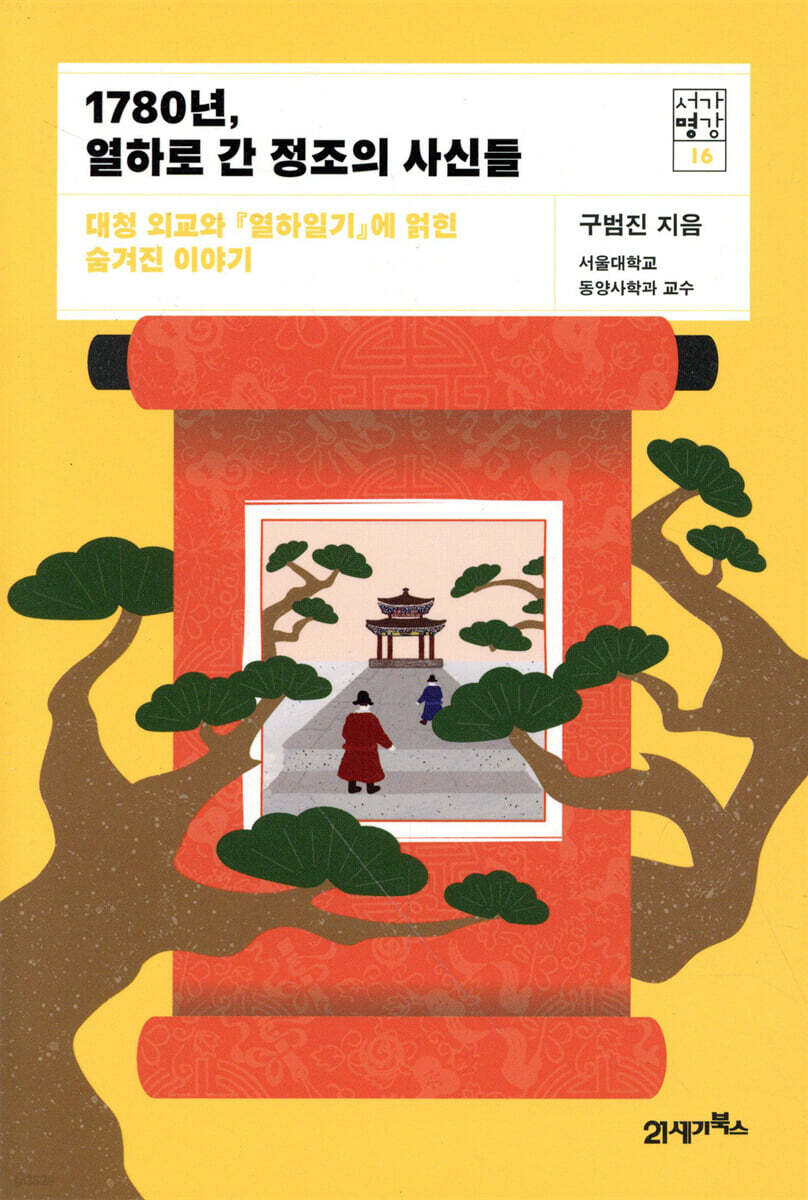
King Jeongjo's envoys to Jehol in 1780
 |
Description
Book Introduction
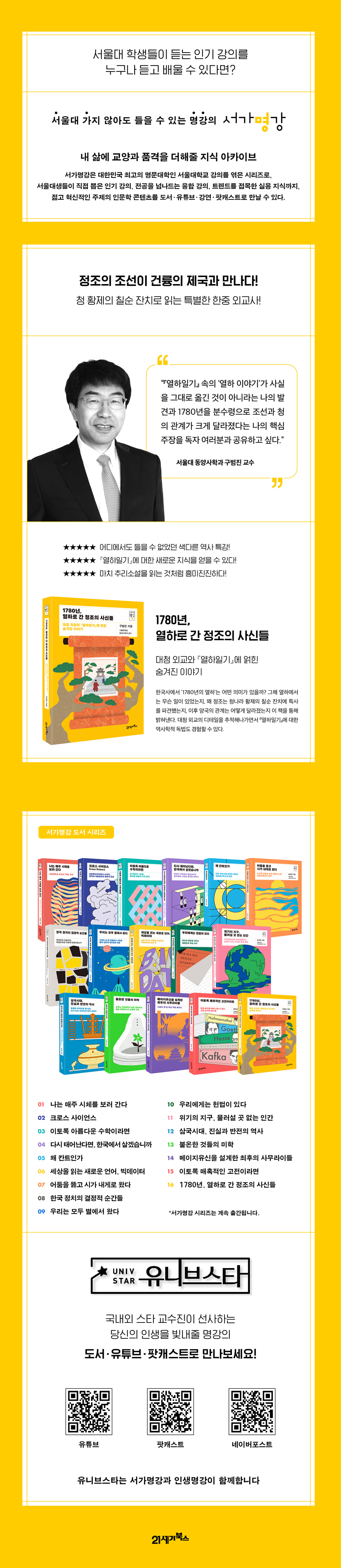
A famous lecture that you can listen to without going to Seoul National University. The Hidden Story of "Seo Ga-myeong-gang": Diplomacy with the Qing Dynasty and the "Yeolha Diary" Discover Korea's finest lectures in book form! The sixteenth volume in the "Seogamyeonggang" series, featuring carefully curated lectures by current Seoul National University faculty, has been published. The Seoga Myunggang series, which transcribes the lectures of Seoul National University's top professors in various fields, including history, philosophy, science, medicine, and art, into books, provides readers with the expansion of knowledge and the joy of learning. 『Jeongjo's Envoys to Jehol in 1780』 is a book written by Professor Koo Beom-jin of the Department of Oriental History at Seoul National University, an expert in modern Chinese history. It presents an interesting historical account of the diplomatic relations between Joseon and the Qing Dynasty, set against the backdrop of Jehol in 1780. In particular, the author's discovery that the 'Jeolha Story' in the 'Jeolha Diary' is not a direct translation of the facts, and the core assertion that the relationship between Joseon and Qing changed significantly with 1780 as a watershed year, are proven through historical materials. Through this book, you will experience the pleasure of taking a step closer to historical facts that you were previously unaware of. |
- You can preview some of the book's contents.
Preview
index
Before reading this book
- Classification of academic disciplines
- Main keywords
Introduction - Traveling to Jehol in 1780
Part 1: Joseon's Anti-Qing Consciousness and Tributary Diplomacy
Remembering the humiliation, I dream of the destruction of the barbarians.
Send tribute envoys to the Qing Dynasty every year
Q/A Ask and Answer
Part 2: King Jeongjo dispatches a special envoy to celebrate Qianlong's 70th birthday
In 1780, the Qing Emperor Qianlong held a 70th birthday banquet.
King Jeongjo sent a special envoy to congratulate Qianlong on his 70th birthday.
Q/A Ask and Answer
Part 3: Special Envoy Jin-ha Park Myeong-won's Speculation and the "Bongbuljisa" Incident
King Jeongjo's special envoy Park Myeong-won visits Jehol
Become a messenger who returns with a Buddhist statue
Q/A Ask and Answer 6
Part 4: Park Ji-won's Defense of the "Bongbuljisa" in "Yeolha Diary"
Defending the envoy by exposing the Qing Dynasty's lies
Mixing eyewitness accounts and expert accounts in the "Yeolha Diary"
Q/A Ask and Answer
Joseon-Qing relations and Qing perceptions during the transition period
Jeongjo and Qianlong significantly changed the relationship between the two countries.
Qianlong boasts of a prosperous era by gathering foreigners and feudal lords.
Q/A Ask and Answer
Outgoing Writing - Celebrating History through Encounters with Qianlong's Empire
- Classification of academic disciplines
- Main keywords
Introduction - Traveling to Jehol in 1780
Part 1: Joseon's Anti-Qing Consciousness and Tributary Diplomacy
Remembering the humiliation, I dream of the destruction of the barbarians.
Send tribute envoys to the Qing Dynasty every year
Q/A Ask and Answer
Part 2: King Jeongjo dispatches a special envoy to celebrate Qianlong's 70th birthday
In 1780, the Qing Emperor Qianlong held a 70th birthday banquet.
King Jeongjo sent a special envoy to congratulate Qianlong on his 70th birthday.
Q/A Ask and Answer
Part 3: Special Envoy Jin-ha Park Myeong-won's Speculation and the "Bongbuljisa" Incident
King Jeongjo's special envoy Park Myeong-won visits Jehol
Become a messenger who returns with a Buddhist statue
Q/A Ask and Answer 6
Part 4: Park Ji-won's Defense of the "Bongbuljisa" in "Yeolha Diary"
Defending the envoy by exposing the Qing Dynasty's lies
Mixing eyewitness accounts and expert accounts in the "Yeolha Diary"
Q/A Ask and Answer
Joseon-Qing relations and Qing perceptions during the transition period
Jeongjo and Qianlong significantly changed the relationship between the two countries.
Qianlong boasts of a prosperous era by gathering foreigners and feudal lords.
Q/A Ask and Answer
Outgoing Writing - Celebrating History through Encounters with Qianlong's Empire
Detailed image
Into the book
『Yeolha Diary』 is also a subject of keen interest among scholars both at home and abroad.
This is not limited to scholars in the field of Korean studies.
Foreign scholars studying China also pay attention to the 『Yeolha Diary』.
For Chinese history researchers, 'Jehol in 1780' is the time when the Qing emperor, Qianlong, held his '70th birthday party'.
It is famous for its location, as 『Yeolha Diary』 contains valuable records that cannot be found anywhere else regarding the emperor's 70th birthday celebration.
--- p.12, from “Introduction | Visiting Jehol in 1780”
For hundreds of years since its founding, Joseon regarded the Jurchen people as insignificant barbarians from the border region.
However, after suffering a humiliating defeat in the Second Manchu Invasion of Korea, they were reduced to subjects of the Qing Dynasty they had established.
Accordingly, just as the Ming Dynasty had been treated as a great power before the Byeongja Horan, from now on, they had to treat the Qing Dynasty as a great power and send envoys to pay tribute every time.
How miserable must have been the feelings of the Joseon envoys who had to embark on a journey to the barbarian den of Shenyang to collect tribute that had begun in this way?
--- p.36~37, from “Part 1 | Joseon’s Anti-Qing Consciousness and Tributary Diplomacy”
It goes without saying that the fact that a Joseon envoy attended the Qing emperor's longevity celebration for the first time in 140 years and since the Qing Dynasty entered the Qing Dynasty was possible because King Jeongjo of Joseon voluntarily sent a special envoy to Jinha, even though he was not obligated to do so.
Moreover, among the many foreign countries that paid tribute to the Qing Dynasty, Joseon was the only country that sent a congratulatory envoy to Jehol's 70th birthday celebration in 1780.
The dispatch of Joseon's special envoy to Jinha was an unusual gesture of sincerity that even the Qianlong Emperor had not expected at the time, and for that very reason it was "extremely colorful" even more than the previous celebration of Hwang In-jeom's 70th birthday.
--- p.140, from 「Part 2 | King Jeongjo's Special Envoy to Qianlong for His 70th Birthday」
Park Myeong-won and his party returned from Jehol with a hospitality unprecedented in history.
The treatment was so lavish that the Joseon Dynasty government decided it had to send a separate envoy to offer thanks.
It would have been great if only the emperor had treated them with great generosity, but soon after Park Myeong-won and his party returned to the country, they ended up buying the 'golden Buddha' they had received from Jehol.
--- p.183, from 「Part 3 | Jin-ha Special Envoy Park Myeong-won's Speculation and the 'Bongbuljisa' Incident」
From Park Ji-won's perspective, the suspicion of the envoys' deeds being defiled was not something he could ignore and remain silent about, dismissing it as someone else's business.
Isn't Park Myeong-won literally not a stranger, but his eighth cousin?
Furthermore, although he was officially a self-employed military officer who had no responsibility, he was in fact an active member of the Sa-gwan at the time, so he could not be completely free from the stigma of being a traitor.
--- p.210~211, from 「Part 4 | Defense of 'Bongbuljisa' in Park Ji-won's 『Yeolha Diary』」
Because Joseon and Qing were in a relationship of tributary and subservient, each time Joseon repeatedly showed its filial piety, Qing could not help but take corresponding preferential measures.
If a small country had treated the gesture of loyalty with a cold or lukewarm attitude without any particular reason, it would have been considered a mistake that would have greatly damaged the image of a great country.
From this perspective, the changes in Qing's reception of Joseon envoys in the early 1780s can be interpreted as a phenomenon of improvement or elevation of bilateral relations resulting from the synergistic repetition of friendly acts of exchange of sincerity and favor between Jeongjo and Qianlong.
--- p.291~292, from “Part 5 | Joseon-Qing Relations and Qing Perceptions in the Transitional Period”
If the changes examined in this book occurred in an era when diplomatic relations were virtually entirely based on the exchange of ambassadors in times of peace, then 1780, the year that marked the turning point of that change, can no longer be called "a year of nothing."
It would now be safe to say that it was a watershed moment in the history of relations between Joseon and Qing.
The experiences and knowledge of the Joseon envoys who visited Qing after 1780 were incomparably richer in both quantity and quality than before.
It is undeniable that this change again influenced the perception of the Qing by both the gambling participants and the Joseon government.
This is not limited to scholars in the field of Korean studies.
Foreign scholars studying China also pay attention to the 『Yeolha Diary』.
For Chinese history researchers, 'Jehol in 1780' is the time when the Qing emperor, Qianlong, held his '70th birthday party'.
It is famous for its location, as 『Yeolha Diary』 contains valuable records that cannot be found anywhere else regarding the emperor's 70th birthday celebration.
--- p.12, from “Introduction | Visiting Jehol in 1780”
For hundreds of years since its founding, Joseon regarded the Jurchen people as insignificant barbarians from the border region.
However, after suffering a humiliating defeat in the Second Manchu Invasion of Korea, they were reduced to subjects of the Qing Dynasty they had established.
Accordingly, just as the Ming Dynasty had been treated as a great power before the Byeongja Horan, from now on, they had to treat the Qing Dynasty as a great power and send envoys to pay tribute every time.
How miserable must have been the feelings of the Joseon envoys who had to embark on a journey to the barbarian den of Shenyang to collect tribute that had begun in this way?
--- p.36~37, from “Part 1 | Joseon’s Anti-Qing Consciousness and Tributary Diplomacy”
It goes without saying that the fact that a Joseon envoy attended the Qing emperor's longevity celebration for the first time in 140 years and since the Qing Dynasty entered the Qing Dynasty was possible because King Jeongjo of Joseon voluntarily sent a special envoy to Jinha, even though he was not obligated to do so.
Moreover, among the many foreign countries that paid tribute to the Qing Dynasty, Joseon was the only country that sent a congratulatory envoy to Jehol's 70th birthday celebration in 1780.
The dispatch of Joseon's special envoy to Jinha was an unusual gesture of sincerity that even the Qianlong Emperor had not expected at the time, and for that very reason it was "extremely colorful" even more than the previous celebration of Hwang In-jeom's 70th birthday.
--- p.140, from 「Part 2 | King Jeongjo's Special Envoy to Qianlong for His 70th Birthday」
Park Myeong-won and his party returned from Jehol with a hospitality unprecedented in history.
The treatment was so lavish that the Joseon Dynasty government decided it had to send a separate envoy to offer thanks.
It would have been great if only the emperor had treated them with great generosity, but soon after Park Myeong-won and his party returned to the country, they ended up buying the 'golden Buddha' they had received from Jehol.
--- p.183, from 「Part 3 | Jin-ha Special Envoy Park Myeong-won's Speculation and the 'Bongbuljisa' Incident」
From Park Ji-won's perspective, the suspicion of the envoys' deeds being defiled was not something he could ignore and remain silent about, dismissing it as someone else's business.
Isn't Park Myeong-won literally not a stranger, but his eighth cousin?
Furthermore, although he was officially a self-employed military officer who had no responsibility, he was in fact an active member of the Sa-gwan at the time, so he could not be completely free from the stigma of being a traitor.
--- p.210~211, from 「Part 4 | Defense of 'Bongbuljisa' in Park Ji-won's 『Yeolha Diary』」
Because Joseon and Qing were in a relationship of tributary and subservient, each time Joseon repeatedly showed its filial piety, Qing could not help but take corresponding preferential measures.
If a small country had treated the gesture of loyalty with a cold or lukewarm attitude without any particular reason, it would have been considered a mistake that would have greatly damaged the image of a great country.
From this perspective, the changes in Qing's reception of Joseon envoys in the early 1780s can be interpreted as a phenomenon of improvement or elevation of bilateral relations resulting from the synergistic repetition of friendly acts of exchange of sincerity and favor between Jeongjo and Qianlong.
--- p.291~292, from “Part 5 | Joseon-Qing Relations and Qing Perceptions in the Transitional Period”
If the changes examined in this book occurred in an era when diplomatic relations were virtually entirely based on the exchange of ambassadors in times of peace, then 1780, the year that marked the turning point of that change, can no longer be called "a year of nothing."
It would now be safe to say that it was a watershed moment in the history of relations between Joseon and Qing.
The experiences and knowledge of the Joseon envoys who visited Qing after 1780 were incomparably richer in both quantity and quality than before.
It is undeniable that this change again influenced the perception of the Qing by both the gambling participants and the Joseon government.
--- p.347, from “Coming Out | Encountering Qianlong’s Empire and Honoring History”
Publisher's Review
In 1780, King Jeongjo's envoys went to Jehol!
Joseon's changed diplomacy toward the Qing Dynasty, which dreamed of the destruction of the barbarians!
It is no exaggeration to say that 1780, which is also the background for the birth of 『Yeolha Diary』, has been regarded as an uneventful year in Korean history, despite its fame.
However, the author of this book argues that the relationship between Joseon and Qing changed significantly in that year, and reconstructs the time and space of 'Jehol in 1780' as if it were a mystery novel.
Jehol is a region located a little north of Beijing.
It is also famous for having the 'Piseosanjang' palace where the Qing emperors spent their summers.
But there is another reason why we should pay attention to Yeolha.
After the humiliation of the Byeongja Horan, Joseon and Qing transitioned into a vassal relationship.
The barbarians, who had been at the bottom of the hierarchy in the existing order, suddenly jumped to the top of the hierarchy, and naturally, this also created resentment in Joseon.
Joseon's diplomacy toward the Qing Dynasty, in which anti-Qing sentiment was deeply rooted, changed significantly around 1780.
Why and how did the relationship between Joseon and Qing change?
Jeongjo, who ascended to the throne after Yeongjo, voluntarily dispatched three special envoys to congratulate the Qing Emperor Qianlong on his 70th birthday in 1780.
It was a very unusual decision in Joseon, the first such decision in 150 years since the Byeongja Horan.
But it doesn't stop there, another unusual incident happens.
When Qianlong heard that Joseon's envoys had arrived in Beijing, he personally invited them to Jehol, where a 70th birthday banquet was being held.
The author not only closely traces various historical facts about the activities of Qianlong's special envoy, Jinha, in 1780, but also examines the changes in the Qing Dynasty's attitude toward receiving Joseon envoys thereafter, vividly depicting the details of "Korean-Chinese diplomacy."
What is most interesting is that Park Ji-won, the eighth cousin of Park Myeong-won, who led the special envoy to Jin-ha, was present at the scene in 1780.
The famous 『Yeolha Diary』 was created in 1780 thanks to the special envoy sent by King Jeongjo of Joseon to congratulate Qianlong on his 70th birthday.
Professor Gu Beom-jin, the author, focuses on the time and space of '1780 Jehol' and provides a three-dimensional view of an important scene in Korea-China diplomatic history that we were unaware of.
A historical interpretation of 『Yeolha Diary』 like you've never experienced before!
King Jeongjo's 'Joseon' meets Qianlong's 'Empire'!
How well do we know about Yeonam Park Ji-won's "Yeolha Diary," a work so famous that every Korean has heard of it? Considered a classic among classics, "Yeolha Diary" is renowned for its remarkable insight and humorous prose, spanning across ideology, politics, culture, and society, earning it a high reputation.
In 1780, King Jeongjo dispatched a special envoy to Jehol to celebrate the 70th birthday of Emperor Qianlong, and the record left by Park Ji-won, who accompanied him to Jehol, is the 『Jehol Diary』.
Professor Koo Beom-jin analyzed the 『Yeolha Diary』 from a historical perspective and discovered that there were some differences from the facts in the ‘Yeolha Story’ recorded by Park Ji-won.
And Professor Koo asks a 'bold' question about the 'Yeolha Diary' that no one has ever raised before.
“Would it have been possible for Park Ji-won, who was not even an official member of the entourage, to have personally ‘witnessed’ the scenes described in the ‘Yeolha Diary’?” The ‘Yeolha Diary’ describes in great detail the scene in which a Joseon envoy receives a Buddhist statue as a gift.
However, the Joseon envoys who returned from Jehol were criticized by the students of Sungkyunkwan for bringing back this Buddhist statue.
In this way, Park Ji-won helps readers understand in the direction he wants to defend the messenger in trouble.
Professor Koo's reasonable inference is that the story material was deliberately selected and the time and order of the events were arranged and composed.
Therefore, the author also describes the 『Yeolha Diary』 as a ‘defense for the envoy’ who brought the Buddha statue.
The author examines the agreements and inconsistencies between the 『Yeolha Diary』 and other historical sources and traces its writing intentions. The historical sources utilized here are extensive, including not only official records of the Joseon Dynasty but also Qing Dynasty historical sources and Tibetan historical sources.
And it redefines the historical meaning by reaching the 'daring' conclusion that Park Ji-won wrote 'Yeolha Diary' by mixing eyewitness accounts and expert testimony.
Now, through this book, readers can experience the historical interpretation of the 『Yeolha Diary』 in a new way, and savor the vivid aspects of Korean-Chinese diplomatic history through its sophisticated and detailed logical structure.
▶ Part 1: This section roughly explains how anti-Qing sentiment in Joseon developed and was expressed before 1780, and introduces how envoys were dispatched to Qing.
▶ Part 2: It introduces how the Qing emperors celebrated their birthdays and what kind of 'event' the 70th birthday banquet held by Qianlong in Jehol in 1780 meant to the Qing Dynasty.
Next, it details how in 1780, the young King Jeongjo of Joseon broke away from the traditional Joseon custom of celebrating the birthdays of the Qing emperors and celebrated Qianlong's 70th birthday in a special way by sending a special envoy to Jinha.
▶ Part 3: Closely traces various historical facts related to the activities of Qianlong's 70th birthday special envoy, Jinha, in 1780.
If King Jeongjo of Joseon had not sent a special envoy to celebrate Qianlong's 70th birthday in 1780, Park Ji-won's visit to Jehol, and thus the birth of the Jehol Diary, would not have occurred at all.
The importance of dispatching Special Envoy Jin Ha cannot be overemphasized, as it would have been impossible.
Also, in order to grasp how the story of Jeolha in the 『Yeolha Diary』 differs from historical reality, it is necessary to understand the facts related to the special envoy to Jinha in 1780.
This becomes a prerequisite for discussion.
▶ Part 4: We explore what issues Park Ji-won focused on when composing and narrating the story of Jehol in 『Yeolha Diary』, and what background and intentions led to such composition and narration.
▶ Part 5: Introduces changes in the Qing Dynasty's reception of Joseon envoys after the Rehe invasion of 1780.
What changes occurred in the reception of Joseon envoys, what circumstances led to them, and how did those changes relate to the history of Joseon-Qing relations?
I wonder if I can give it meaning.
It also reveals that these Qing changes were in fact part of a broader set of changes introduced by the Qianlong Emperor in the overall management of the empire and its foreign relations from the 1780s onwards, and explores the intentions and effects of these changes.
Joseon's changed diplomacy toward the Qing Dynasty, which dreamed of the destruction of the barbarians!
It is no exaggeration to say that 1780, which is also the background for the birth of 『Yeolha Diary』, has been regarded as an uneventful year in Korean history, despite its fame.
However, the author of this book argues that the relationship between Joseon and Qing changed significantly in that year, and reconstructs the time and space of 'Jehol in 1780' as if it were a mystery novel.
Jehol is a region located a little north of Beijing.
It is also famous for having the 'Piseosanjang' palace where the Qing emperors spent their summers.
But there is another reason why we should pay attention to Yeolha.
After the humiliation of the Byeongja Horan, Joseon and Qing transitioned into a vassal relationship.
The barbarians, who had been at the bottom of the hierarchy in the existing order, suddenly jumped to the top of the hierarchy, and naturally, this also created resentment in Joseon.
Joseon's diplomacy toward the Qing Dynasty, in which anti-Qing sentiment was deeply rooted, changed significantly around 1780.
Why and how did the relationship between Joseon and Qing change?
Jeongjo, who ascended to the throne after Yeongjo, voluntarily dispatched three special envoys to congratulate the Qing Emperor Qianlong on his 70th birthday in 1780.
It was a very unusual decision in Joseon, the first such decision in 150 years since the Byeongja Horan.
But it doesn't stop there, another unusual incident happens.
When Qianlong heard that Joseon's envoys had arrived in Beijing, he personally invited them to Jehol, where a 70th birthday banquet was being held.
The author not only closely traces various historical facts about the activities of Qianlong's special envoy, Jinha, in 1780, but also examines the changes in the Qing Dynasty's attitude toward receiving Joseon envoys thereafter, vividly depicting the details of "Korean-Chinese diplomacy."
What is most interesting is that Park Ji-won, the eighth cousin of Park Myeong-won, who led the special envoy to Jin-ha, was present at the scene in 1780.
The famous 『Yeolha Diary』 was created in 1780 thanks to the special envoy sent by King Jeongjo of Joseon to congratulate Qianlong on his 70th birthday.
Professor Gu Beom-jin, the author, focuses on the time and space of '1780 Jehol' and provides a three-dimensional view of an important scene in Korea-China diplomatic history that we were unaware of.
A historical interpretation of 『Yeolha Diary』 like you've never experienced before!
King Jeongjo's 'Joseon' meets Qianlong's 'Empire'!
How well do we know about Yeonam Park Ji-won's "Yeolha Diary," a work so famous that every Korean has heard of it? Considered a classic among classics, "Yeolha Diary" is renowned for its remarkable insight and humorous prose, spanning across ideology, politics, culture, and society, earning it a high reputation.
In 1780, King Jeongjo dispatched a special envoy to Jehol to celebrate the 70th birthday of Emperor Qianlong, and the record left by Park Ji-won, who accompanied him to Jehol, is the 『Jehol Diary』.
Professor Koo Beom-jin analyzed the 『Yeolha Diary』 from a historical perspective and discovered that there were some differences from the facts in the ‘Yeolha Story’ recorded by Park Ji-won.
And Professor Koo asks a 'bold' question about the 'Yeolha Diary' that no one has ever raised before.
“Would it have been possible for Park Ji-won, who was not even an official member of the entourage, to have personally ‘witnessed’ the scenes described in the ‘Yeolha Diary’?” The ‘Yeolha Diary’ describes in great detail the scene in which a Joseon envoy receives a Buddhist statue as a gift.
However, the Joseon envoys who returned from Jehol were criticized by the students of Sungkyunkwan for bringing back this Buddhist statue.
In this way, Park Ji-won helps readers understand in the direction he wants to defend the messenger in trouble.
Professor Koo's reasonable inference is that the story material was deliberately selected and the time and order of the events were arranged and composed.
Therefore, the author also describes the 『Yeolha Diary』 as a ‘defense for the envoy’ who brought the Buddha statue.
The author examines the agreements and inconsistencies between the 『Yeolha Diary』 and other historical sources and traces its writing intentions. The historical sources utilized here are extensive, including not only official records of the Joseon Dynasty but also Qing Dynasty historical sources and Tibetan historical sources.
And it redefines the historical meaning by reaching the 'daring' conclusion that Park Ji-won wrote 'Yeolha Diary' by mixing eyewitness accounts and expert testimony.
Now, through this book, readers can experience the historical interpretation of the 『Yeolha Diary』 in a new way, and savor the vivid aspects of Korean-Chinese diplomatic history through its sophisticated and detailed logical structure.
▶ Part 1: This section roughly explains how anti-Qing sentiment in Joseon developed and was expressed before 1780, and introduces how envoys were dispatched to Qing.
▶ Part 2: It introduces how the Qing emperors celebrated their birthdays and what kind of 'event' the 70th birthday banquet held by Qianlong in Jehol in 1780 meant to the Qing Dynasty.
Next, it details how in 1780, the young King Jeongjo of Joseon broke away from the traditional Joseon custom of celebrating the birthdays of the Qing emperors and celebrated Qianlong's 70th birthday in a special way by sending a special envoy to Jinha.
▶ Part 3: Closely traces various historical facts related to the activities of Qianlong's 70th birthday special envoy, Jinha, in 1780.
If King Jeongjo of Joseon had not sent a special envoy to celebrate Qianlong's 70th birthday in 1780, Park Ji-won's visit to Jehol, and thus the birth of the Jehol Diary, would not have occurred at all.
The importance of dispatching Special Envoy Jin Ha cannot be overemphasized, as it would have been impossible.
Also, in order to grasp how the story of Jeolha in the 『Yeolha Diary』 differs from historical reality, it is necessary to understand the facts related to the special envoy to Jinha in 1780.
This becomes a prerequisite for discussion.
▶ Part 4: We explore what issues Park Ji-won focused on when composing and narrating the story of Jehol in 『Yeolha Diary』, and what background and intentions led to such composition and narration.
▶ Part 5: Introduces changes in the Qing Dynasty's reception of Joseon envoys after the Rehe invasion of 1780.
What changes occurred in the reception of Joseon envoys, what circumstances led to them, and how did those changes relate to the history of Joseon-Qing relations?
I wonder if I can give it meaning.
It also reveals that these Qing changes were in fact part of a broader set of changes introduced by the Qianlong Emperor in the overall management of the empire and its foreign relations from the 1780s onwards, and explores the intentions and effects of these changes.
GOODS SPECIFICS
- Publication date: March 29, 2021
- Page count, weight, size: 352 pages | 454g | 128*188*21mm
- ISBN13: 9788950994693
- ISBN10: 8950994690
You may also like
카테고리
korean


korean

![GQ KOREA Mark (Monthly): December [2025]](http://librairie.coreenne.fr/cdn/shop/files/8ef265dbbfbf186523ed75ba7319009d.jpg?v=1765340328&width=3840)


