

Partial connections
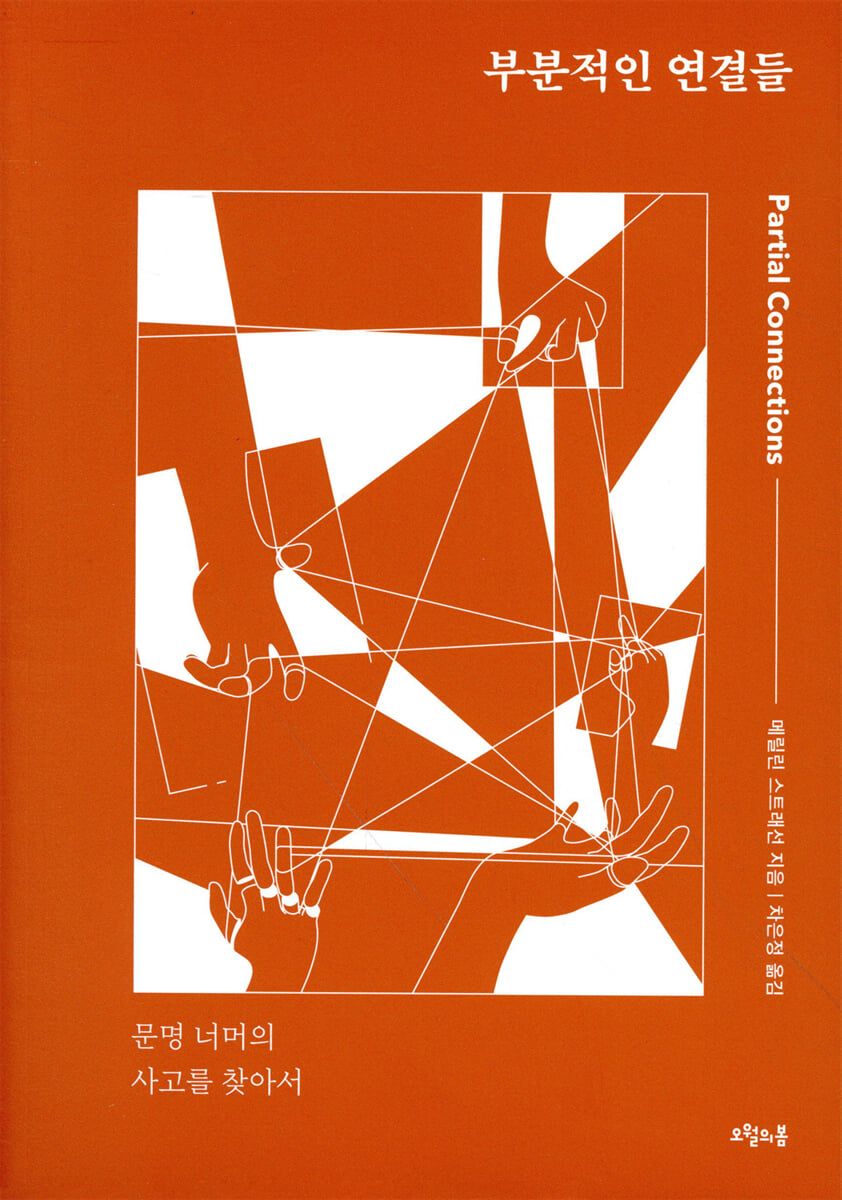 |
Description
Book Introduction
Partial Connections, which is considered to be “a book that led to a great change in direction in anthropology,” is introduced in Korean.
This book, published in 1991, did not receive a significant response at the time of its publication, but in the 21st century, amidst the revival of the 'ontological turn', it began to be re-evaluated by people, and was republished in a new edition in 2004.
The fact that the 'part' mentioned in 'Partial Connections' is not a part of the whole provides an important clue to understanding this book.
To explain why we immediately think of the 'whole' when we think of a 'part', traditional Western philosophy proposed the concept of 'mereography'.
Strathearn, on the other hand, proposes a new term, 'merography', to replace it.
The term merography comes from the biological term 'partial division', and is used to discuss parts that cannot be recovered as a whole.
In other words, the act of describing makes what is being described a separate part rather than a part of the whole.
Traditionally, Western anthropology has attempted to provide comprehensive descriptions of relatively small non-Western populations.
However, Strathairn points out that the typical image of the anthropologist as someone who goes into the field and uses what he sees and hears there to describe a culture or society is no longer effective.
The important thing now is to let go of the image of the 'whole' in your head and focus on the relationships between the individual parts.
This allows us to understand relationships by division, that is, relationships obtained by cutting apart apparently connected data from a single whole.
Above all, Strathearn's fieldwork in Melanesia vividly presents readers with a scene in which cuts (rather than cuttings) create relationships and elicit responses.
There are certainly places where cutting is considered a creative act, where we can clearly see that it demonstrates the inner power of the human being and the outer power of the relationships he forms.
This book, published in 1991, did not receive a significant response at the time of its publication, but in the 21st century, amidst the revival of the 'ontological turn', it began to be re-evaluated by people, and was republished in a new edition in 2004.
The fact that the 'part' mentioned in 'Partial Connections' is not a part of the whole provides an important clue to understanding this book.
To explain why we immediately think of the 'whole' when we think of a 'part', traditional Western philosophy proposed the concept of 'mereography'.
Strathearn, on the other hand, proposes a new term, 'merography', to replace it.
The term merography comes from the biological term 'partial division', and is used to discuss parts that cannot be recovered as a whole.
In other words, the act of describing makes what is being described a separate part rather than a part of the whole.
Traditionally, Western anthropology has attempted to provide comprehensive descriptions of relatively small non-Western populations.
However, Strathairn points out that the typical image of the anthropologist as someone who goes into the field and uses what he sees and hears there to describe a culture or society is no longer effective.
The important thing now is to let go of the image of the 'whole' in your head and focus on the relationships between the individual parts.
This allows us to understand relationships by division, that is, relationships obtained by cutting apart apparently connected data from a single whole.
Above all, Strathearn's fieldwork in Melanesia vividly presents readers with a scene in which cuts (rather than cuttings) create relationships and elicit responses.
There are certainly places where cutting is considered a creative act, where we can clearly see that it demonstrates the inner power of the human being and the outer power of the relationships he forms.
- You can preview some of the book's contents.
Preview
index
Translator's Note: Opening New Horizons for 21st Century Anthropology, Vol. 4
Introduction to Anthropology 26
New Edition Preface 53
Acknowledgments 66
Ⅰ.
Write anthropology
[Aesthetics] Part 1: Ethnography as Ventilation 72
[Aesthetics] Part 2: Complex Society, Incomplete Knowledge 94
[Politics] Part 1: Feminist Criticism 114
[Politics] Part 2: Invasion and Comparison 137
Ⅱ.
Partial connections
[Cultures] Part 1: Trees and flutes are overflowing 168
[Cultures] Part 2: Center and Periphery 197
[Societies] Part 1: Historical Criticism 223
[Societies] Part 2: Artificial Institutional Expansion 250
Appendix Dialogue: On the Edge of a Specific Language 279
Week 326
Reference 345
Search 359
Introduction to Anthropology 26
New Edition Preface 53
Acknowledgments 66
Ⅰ.
Write anthropology
[Aesthetics] Part 1: Ethnography as Ventilation 72
[Aesthetics] Part 2: Complex Society, Incomplete Knowledge 94
[Politics] Part 1: Feminist Criticism 114
[Politics] Part 2: Invasion and Comparison 137
Ⅱ.
Partial connections
[Cultures] Part 1: Trees and flutes are overflowing 168
[Cultures] Part 2: Center and Periphery 197
[Societies] Part 1: Historical Criticism 223
[Societies] Part 2: Artificial Institutional Expansion 250
Appendix Dialogue: On the Edge of a Specific Language 279
Week 326
Reference 345
Search 359
Into the book
The subtitle of this book, which is also the title of the first half, 'Writing Anthropology,' suggests that it is deriving a new research methodology for anthropology by rejecting the 'writing of culture' of postmodern anthropology.
Western anthropologists have prided themselves on viewing non-Western research areas as a single society or culture and on reproducing it holistically. However, in reality, this was a meeting of the West and the non-West as parts, and anthropologists simply took advantage of this meeting and wrote about the anthropology that emerged from it.
--- p.13
When the question, "Is there a fixed, unchanging world, and where do we fit into it?" returns to our own knowledge itself, Strathearn asks, "How are and will those innumerable worlds related?" instead of being scattered and confined to their own worlds.
Because those finite beings who wish to be infinite but cannot do so cannot fulfill their duty of knowledge for future humanity by simply burning themselves with Eros.
--- p.17
The scale of the field of view provides a simple view.
If one thing observed in detail feels as difficult as many things observed from a distance, the difficulty itself remains.
Each single element, which from a distance appears to constitute a plurality of elements, is, on closer inspection, actually composed of a similar plurality that requires comprehensive treatment.
--- p.32
I want to make clear the intermittent effect of the spacing or blank space between each section of this book.
They are irregular and unpredictable insofar as they arise from the unfolding (space-filling) of the argument itself.
At the same time, the balance must be unbalanced.
Because the rupture that permeates the discussion maintains its complexity 'regardless of scale'.
Therefore, the 'quantity' of a discussion or case depends on its position, that is, the space it occupies.
In conclusion, this exercise offers an alternative to the usual claim that it demonstrates the inherent connections between the parts that make up an 'ethnographic' account.
Yet, the book's implementation is grounded in real-world debates.
--- p.50
In analytical planning, insufficiency can manifest itself as a lack of solutions.
So there is always 'more' data to be pulled in or 'more' effort required for interpretation or analysis.
Thus, the analytical challenges we face ourselves may seem out of proportion to the amount or complexity of data at our disposal.
Or, conversely, the data may appear to fall short of theoretical ambitions.
This is the thesis pursued by Partial Connections.
--- p.55
The first paragraph of “Partial Connections” unfolds this point.
That is, if one dimension of anthropological practice necessarily relativizes another, and if the insufficiency of one dimension inevitably creates a 'range' of amplitude in the other, the question is how to achieve a 'balance' between these two dimensions.
To achieve this balance, there must be a degree of comparability that gives equal weight to each.
--- p.56~57
The anthropologist discovers himself in a new aesthetic.
No, the individual figure is replaced by the figure of a reflective person in the midst of the debate.
Accordingly, the 'sole author' is no longer an image of authority, and 'one culture' or 'one society' is no longer valid as a unit of study.
There is no longer any room to discuss the verdict of this change.
There is no such thing as right or wrong that can be measured on a scale.
What was once right has become wrong, simply in the sense that what was once persuasive is no longer so.
Formats that once worked to create real effects no longer work.
--- p.81
No matter how hard I tried to stretch my imagination, I couldn't imagine Elmden as a microcosm of British society, and it was difficult to imagine it as a microcosm of white English society either.
Such a vast society could not be captured through the eyes of a solitary field researcher.
While I might compare Hagen to various neighboring groups in the Papua New Guinea highlands, I wouldn't even begin to compare an Essex village to, say, the mining towns of Durham or the outskirts of Manchester, in order to think of Britain in relation to North America.
More precisely, I cannot let demographic scales slyly supplant theoretical intent.
--- p.106~107
What form, what shape, what kind of social relationship is being described here? What kind of image, then, contains within itself the idea of a personality capable of creating connections while knowing that the other is not fully absorbed into her/his experience of the other? If so, is it not itself a single entity, a particle among countless entities, neither a sum nor a fragment? I ask this question only because we have a model for how to support partial connections, and because, despite this, there exists a kind of authoritative image of "personality" that seeks to maintain aesthetic certainty.
The model is the very image of Donna Haraway's cyborg, half human, half machine, which is the very essence of academic feminist discourse.
--- p.113
Feminist scholarship is adept, so to speak, at reinventing the polyphony of social life within its own cultural artifacts, that is, within its own scope of interest.
What is important is the multidisciplinary, transdisciplinary and trans-disciplinary nature of its external interests.
"It", which does not conform to any perspective, cannot be imagined as the (collective) voice of a single personality, and thus the position it offers becomes all the more prominent. "Despite the diversity of its discourse, feminism is united by its challenge to male power" (Currie and Kazi). "Yet," on the contrary, feminism clearly exists beyond the understanding or grasp of individual scholars.
Pluralism creates a discourse that cannot be encompassed by a single participant.
This is not because its scope is too vast or extensive for us to grasp, but because of the way this external difference is connected to the internal difference.
--- p.123~124
Am I still naive? Of course, we don't have to decide what this format is.
Symbolic analysis has already made abundantly clear that whatever it is can 'mean' countless things to countless people on countless occasions.
In this endless series of potential analogies, all I do is collect meanings, and of course, no one dreams of comparing meanings.
Anthropologists simply compare the practices and uses that create meaning.
Rather than setting limits on potential analogies, we record the analogies people draw.
Certain levels and contexts certainly need to break away from this quasi-Fraserian pastiche.
--- p.186~188
I hate treating relationships emotionally, for example reducing reciprocity to altruism.
This means reducing sociality to sociability.
In each moment when this term is filled with meaning, it sometimes has a positive tone, but when it is associated with war or conflict, it begins to take on a negative tone.
All these problems are found in structural functionalism, which stems from the idea that society is essentially solidarity.
--- p.316~317
What's rewarding to me is the realization that Melanesians don't compartmentalize humans from the non-human world, but they compartmentalize different kinds of humans, and that gender differences are crucial here, so to speak, because they create differences between patrilineal and matrilineal kin.
And borrowing from Eduardo's interest in ontology, I can now formalize that the way a person relates to his paternal relatives places him in a different state of being than the way he relates to his maternal relatives.
These are different worlds in which people live.
Western anthropologists have prided themselves on viewing non-Western research areas as a single society or culture and on reproducing it holistically. However, in reality, this was a meeting of the West and the non-West as parts, and anthropologists simply took advantage of this meeting and wrote about the anthropology that emerged from it.
--- p.13
When the question, "Is there a fixed, unchanging world, and where do we fit into it?" returns to our own knowledge itself, Strathearn asks, "How are and will those innumerable worlds related?" instead of being scattered and confined to their own worlds.
Because those finite beings who wish to be infinite but cannot do so cannot fulfill their duty of knowledge for future humanity by simply burning themselves with Eros.
--- p.17
The scale of the field of view provides a simple view.
If one thing observed in detail feels as difficult as many things observed from a distance, the difficulty itself remains.
Each single element, which from a distance appears to constitute a plurality of elements, is, on closer inspection, actually composed of a similar plurality that requires comprehensive treatment.
--- p.32
I want to make clear the intermittent effect of the spacing or blank space between each section of this book.
They are irregular and unpredictable insofar as they arise from the unfolding (space-filling) of the argument itself.
At the same time, the balance must be unbalanced.
Because the rupture that permeates the discussion maintains its complexity 'regardless of scale'.
Therefore, the 'quantity' of a discussion or case depends on its position, that is, the space it occupies.
In conclusion, this exercise offers an alternative to the usual claim that it demonstrates the inherent connections between the parts that make up an 'ethnographic' account.
Yet, the book's implementation is grounded in real-world debates.
--- p.50
In analytical planning, insufficiency can manifest itself as a lack of solutions.
So there is always 'more' data to be pulled in or 'more' effort required for interpretation or analysis.
Thus, the analytical challenges we face ourselves may seem out of proportion to the amount or complexity of data at our disposal.
Or, conversely, the data may appear to fall short of theoretical ambitions.
This is the thesis pursued by Partial Connections.
--- p.55
The first paragraph of “Partial Connections” unfolds this point.
That is, if one dimension of anthropological practice necessarily relativizes another, and if the insufficiency of one dimension inevitably creates a 'range' of amplitude in the other, the question is how to achieve a 'balance' between these two dimensions.
To achieve this balance, there must be a degree of comparability that gives equal weight to each.
--- p.56~57
The anthropologist discovers himself in a new aesthetic.
No, the individual figure is replaced by the figure of a reflective person in the midst of the debate.
Accordingly, the 'sole author' is no longer an image of authority, and 'one culture' or 'one society' is no longer valid as a unit of study.
There is no longer any room to discuss the verdict of this change.
There is no such thing as right or wrong that can be measured on a scale.
What was once right has become wrong, simply in the sense that what was once persuasive is no longer so.
Formats that once worked to create real effects no longer work.
--- p.81
No matter how hard I tried to stretch my imagination, I couldn't imagine Elmden as a microcosm of British society, and it was difficult to imagine it as a microcosm of white English society either.
Such a vast society could not be captured through the eyes of a solitary field researcher.
While I might compare Hagen to various neighboring groups in the Papua New Guinea highlands, I wouldn't even begin to compare an Essex village to, say, the mining towns of Durham or the outskirts of Manchester, in order to think of Britain in relation to North America.
More precisely, I cannot let demographic scales slyly supplant theoretical intent.
--- p.106~107
What form, what shape, what kind of social relationship is being described here? What kind of image, then, contains within itself the idea of a personality capable of creating connections while knowing that the other is not fully absorbed into her/his experience of the other? If so, is it not itself a single entity, a particle among countless entities, neither a sum nor a fragment? I ask this question only because we have a model for how to support partial connections, and because, despite this, there exists a kind of authoritative image of "personality" that seeks to maintain aesthetic certainty.
The model is the very image of Donna Haraway's cyborg, half human, half machine, which is the very essence of academic feminist discourse.
--- p.113
Feminist scholarship is adept, so to speak, at reinventing the polyphony of social life within its own cultural artifacts, that is, within its own scope of interest.
What is important is the multidisciplinary, transdisciplinary and trans-disciplinary nature of its external interests.
"It", which does not conform to any perspective, cannot be imagined as the (collective) voice of a single personality, and thus the position it offers becomes all the more prominent. "Despite the diversity of its discourse, feminism is united by its challenge to male power" (Currie and Kazi). "Yet," on the contrary, feminism clearly exists beyond the understanding or grasp of individual scholars.
Pluralism creates a discourse that cannot be encompassed by a single participant.
This is not because its scope is too vast or extensive for us to grasp, but because of the way this external difference is connected to the internal difference.
--- p.123~124
Am I still naive? Of course, we don't have to decide what this format is.
Symbolic analysis has already made abundantly clear that whatever it is can 'mean' countless things to countless people on countless occasions.
In this endless series of potential analogies, all I do is collect meanings, and of course, no one dreams of comparing meanings.
Anthropologists simply compare the practices and uses that create meaning.
Rather than setting limits on potential analogies, we record the analogies people draw.
Certain levels and contexts certainly need to break away from this quasi-Fraserian pastiche.
--- p.186~188
I hate treating relationships emotionally, for example reducing reciprocity to altruism.
This means reducing sociality to sociability.
In each moment when this term is filled with meaning, it sometimes has a positive tone, but when it is associated with war or conflict, it begins to take on a negative tone.
All these problems are found in structural functionalism, which stems from the idea that society is essentially solidarity.
--- p.316~317
What's rewarding to me is the realization that Melanesians don't compartmentalize humans from the non-human world, but they compartmentalize different kinds of humans, and that gender differences are crucial here, so to speak, because they create differences between patrilineal and matrilineal kin.
And borrowing from Eduardo's interest in ontology, I can now formalize that the way a person relates to his paternal relatives places him in a different state of being than the way he relates to his maternal relatives.
These are different worlds in which people live.
--- p.320
Publisher's Review
Creation comes from connection,
Anthropologists set out to find that connection.
“A book that led to a massive shift in anthropology.”
"A book that saved anthropology itself with its unique insights."
Criticism of the dichotomies of Western-centrism is a long-standing topic in modern philosophy.
Attempts to overcome this and establish a new system have also continued steadily.
French philosopher Jacques Derrida is a representative example.
He has argued that Western holistic thinking is the root cause of the hierarchical order that divides the West and the non-West.
The 'logos' at the center of their thinking, its absolute law, placed the West and men at the center, and the non-West and women at the periphery, and that 'center' has guaranteed 'objectivity'.
This dichotomy also drew a boundary between nature and culture, with nature being understood as an unchanging reality and culture as something newly formed.
This critical awareness of the Western totality led to a trend in scholarship that rejected 'synthesis' and 'summation,' which came to be known as 'postmodernism' in the 1980s.
But the perception that totality is merely a rhetoric is not a proper alternative on its own.
In other words, despite being broken into so many pieces that refuse to come together, they fall into a cycle where they are presented again as a whole.
Pluralism has been proposed as another alternative.
Pluralism argues for partial truths against universal truths, discussing the diverse and innumerable worlds of each.
This pluralism acknowledged the limitations of the Western perspective and aimed for a plurality beyond it, and modern anthropology has led to a 'reflexive turn' from this.
In the 1980s, when the postmodern craze was sweeping the nation, contemporary anthropologists actively embraced pluralism and other trends, discarding the privileged and exclusive status of anthropology and presenting anthropology as a genre and narrative by drawing readers into their research.
“Partial Connections” starts from this very point.
The author of this book, Marilyn Strathairn, points out that although pluralism is an alternative, it still assumes a 'whole' and thus inevitably ends up in the existing framework of the whole.
Pluralists believe that there is a larger world (the whole) and countless smaller worlds (parts) beneath it.
So, no matter how decentralized, heterogeneous, and fragmented the parts included in the whole are, they cannot escape the whole.
In the end, we have no choice but to return to the center of the whole.
Among the anti-logos reflections that have received the most attention in the 21st century, the 'ontological turn' is the one.
This is a practical theory proposed by Viveiros de Castro, a representative scholar of modern anthropology, in an attempt to liberate anthropology from Western metaphysics by using non-Western philosophies such as Amazonian indigenous cosmology as a foundation.
This 'ontological turn', which began to focus on anthropology in the 21st century, is now becoming a trend that encompasses not only anthropology but also sociology, critical theory, and materialism.
“There is no map, only a kaleidoscope of endless permutations.”
The book that Viveiros de Castro, author of “The Metaphysics of Cannibalism,” called “the book that led to a great change in direction in anthropology” and selected as a representative book of the “ontological turn” is “Partial Connections.”
Marilyn Strathairn began writing this book in 1987 and published it in 1991.
This book, which did not receive a significant response after its publication, began to be re-evaluated by people in the 21st century amid the revival of the 'ontological turn' mentioned above, and was republished in a new edition in 2004.
This book is not structured in the form of an introduction, development, turn, and conclusion, but is divided into parts as the title suggests.
It is broadly divided into two parts: one part is 'Writing Anthropology', which targets 'Writing Culture', a representative concept of postmodern anthropology, and the other part is 'Partial Connections', which presents his own perspective as a methodology of anthropology that is completely different from the ones used so far.
(The book's organizational techniques, taken from Cantor's Dust, are clearly presented on page 25.)
In the late 1980s, when Marilyn Strathearn published Partial Connections, Anglo-American anthropology was reeling from the disarray of postmodernism.
Postmodern anthropology has undermined the 'ethnographic authority' of traditional anthropology and has granted new authority to the interaction between 'text-writer-reader' by incorporating readers into ethnographic research.
Now, rather than a 'reproduction' from field research, he advocated anthropology as a 'text' and 'genre' that allows readers to experience the sense of being there.
The so-called concept of 'writing culture' emerged at this time.
Strathairn fundamentally sympathizes with this problem awareness of contemporary anthropology.
However, he judged that the current crisis in anthropology could not be overcome by leaving ethnography to the genre dimension of text.
Thus, while he fully sympathizes with the pluralism implied by 'partial truth', he does not rest on his laurels and goes a step further to advocate post-pluralism.
Such concerns naturally return to a critique of the West/non-West dichotomy.
This dichotomy presupposes that the whole is made up of individual parts, and that humans at the center pluralistically integrate individuals as fragments of the center.
No matter how hard we try to avoid this dilemma, we are always faced with a choice between an atomistic perspective (the whole is a synthesis of individual, independent elements) and a holistic perspective (elements do not exist separately from the structure or system of the whole).
The fact that the 'part' mentioned in 'Partial Connections' is not a part of the whole provides an important clue to understanding this book.
To explain why we immediately think of the 'whole' when we think of a 'part', traditional Western philosophy proposed the concept of 'mereography'.
Instead, Strathearn proposes a new term: 'merography'.
The concept of merography comes from the biological term meroblast, where 'mero' means 'part' in Greek and 'graphic' refers to the way one idea describes another.
In other words, the act of describing makes what is being described a separate part rather than a part of the whole.
Merography speaks of the parts that cannot be recovered as a whole.
Strathearn realized the need for this type of technology while conducting field research in Melanesia, an island region in the South Pacific.
Most anthropologists who travel to non-Western regions attempt to produce comprehensive arrangements by closely examining individual cases there.
The problem is that anthropologists are faced with the confusing situation of having nothing that can be fixedly placed at the center.
“There is no map; there is only a kaleidoscope of permutations.” (Page 36)
Traditionally, Western anthropology has attempted to provide comprehensive descriptions of relatively small non-Western populations.
Strathairn points out that the typical image of the anthropologist as someone who goes into the field and uses what he sees and hears there to describe a culture or society has lost its validity.
“It turns out that the authority that comes from having been there is not legitimate authority, but rather a purchase and sale of authorship” (p. 77).
Contemporary Western anthropologists, who had achieved theoretical achievements through field research in non-Western regions, were unable to attempt a comprehensive description of their own culture, the West.
This is because there were too many factors to consider when trying to describe their culture in its entirety using conventional research methods.
Ultimately, anthropologists, by looking into their own culture, came to find a different standard from that of the subjects of study in other cultures.
Strathearn points out that this very point forces us to re-examine the relationship between Western anthropologists and their non-Western subjects.
When anthropologists realize that they cannot describe the whole of culture, they are simultaneously forced to look back at what they have defined as a 'total description' of other cultures.
In situations like this, Strashen's merography can provide a solution.
Strathairn now argues that we should abandon the image of the 'whole' in our heads and focus on the relationships between the parts.
This allows us to understand relationships by division, that is, relationships obtained by cutting apart clearly connected data from a single whole.
And this cut leads us to a new, subversive way of thinking.
A world overflowing with fragments and fragments, a message thrown into a space of anxiety.
People who despair of an individualized and fragmented world try to piece together the pieces again.
In these efforts, a certain ‘Western anxiety’ is detected.
Perhaps this anxiety stems from the perception that partiality and dismemberment are destructive acts, which will inevitably lead to the pluralization and fragmentation of any social whole.
In other words, one feels “the body losing limbs” (p. 267).
In response, Strathairn urges a shift in thinking by presenting some examples from Melanesia that he observed.
At first glance, the cases Stratton chose appear no different from other anthropological field studies.
Melanesian trees and flutes are, in the eyes of Westerners, objects that are inherently separate from humans.
In other words, the tree and the flute are originally separate from the body of each individual person.
However, Melanesians consider themselves directly connected to trees and flutes.
Strathearn hears from Melanesians that whether we look inside or outside a material object, whether it be a tree or a flute, it is both a person and a being beyond the person.
In other words, these sculptures are indispensable extensions of the relationships that humans create.
Just as a human body as a material is composed of relationships with numerous external things, it is also expanded and reorganized by structures such as trees, flutes, canoes, and stakes.
Stratton presents us with a scene in which, rather than cutting, a relationship is created and a response is elicited.
In other words, there is clearly a place where cutting is considered a creative act, where it demonstrates the inner power of the human being and the outer power of the relationships he forms.
The fact that cutting is a creative act leads us to a larger truth.
In other words, the bursting of information is also an expansion.
This allows Melanesians to feel that their “mother’s brothers are partially connected to their sister’s sons,” and this rupture of information also reveals one personality as an extension of another by “differentiating the places where individual identity is located” (p. 276).
In other words, cutting and expanding have the same effect.
At this point, we might naturally recall Donna Haraway's Cyborg theory, which shocked the world with its claim that 'the body is extended by a mixture of human and organic monster.'
In this book, Strathairn borrows Donna Haraway's theory of cyborgs to remind us that in the reality we live in, there are countless cyborgs, or hybrids.
In the world we live in, it is not easy to connect with others or invite them into our world and engage them.
When we say we are in a relationship, we do not mean adding a relationship to our own experience.
Rather, it only leads to a new understanding of the social objects created through the interaction of domination, power, social relations, etc.
Strathearn's theory seems far removed from the explanatory and investigative framework of much Western academic discourse.
However, he makes it clear that “the current formalization is only a momentary conceptualization and the current response is only a partial study.”
For Strathearn, anthropological writing is “a vital and vital way of creating infinite complexity out of complexity” (p. 277).
The more we fill, the more we create gaps.
“I support the form, not the process.”
This Korean translation includes a conversation with Marilyn Strathairn, not included in the original, to further enhance understanding of his theories.
The conversation was conducted with Viveiros de Castro and Carlos Fausto, anthropologists who study Amazonian shamanism.
In this conversation, held at the National Museum of Brazil in the fall of 1998, Strathearn presents 'form' as an aesthetic sense.
For him, form is “the appearance of things and their visualized properties and attributes” (p. 313).
That 'form' was something the Melanesians he studied had acquired a priori, before any theory.
In other words, for Melanesians, taking on a form is the only evidence of life that is no longer worth discussing.
To them, some objects are spoken of only as evidence of an action they themselves have just performed.
Strathearn's formalism breaks the conventional assumption that form is a framework for containing thoughts.
Strathearn's account of form does not focus on how knowledge conceives the world as a 'whole'.
Rather, it focuses on how it relates to worlds from 'somewhere' and what is created within them.
In the midst of the deluge of information in modern society, what we need to find is not the details of each piece of information, but the 'relationships' that connect them.
“In societies outside the orbit of the Enlightenment and the Scientific Revolution, relationships skillfully explain the opposite of things.
Anthropologists will not have much difficulty discovering other ways of explaining the world.
In short, relationships do not disappear.” Perhaps the reason why Western holism has been able to dominate the thinking of civilized humans is because, since the beginning of civilization, humans have tolerated asymmetrical relationships, that is, unequal relationships of power, and have equated the perspective of the powerful with knowledge of the world.
But because humanity is trying to abandon its own common sense and refuses to tolerate asymmetrical relationships and perspectives, we must now seek new relationships and knowledge.
"Partial Connections" is a book that serves as a key to finding that relationship.
Anthropologists set out to find that connection.
“A book that led to a massive shift in anthropology.”
"A book that saved anthropology itself with its unique insights."
Criticism of the dichotomies of Western-centrism is a long-standing topic in modern philosophy.
Attempts to overcome this and establish a new system have also continued steadily.
French philosopher Jacques Derrida is a representative example.
He has argued that Western holistic thinking is the root cause of the hierarchical order that divides the West and the non-West.
The 'logos' at the center of their thinking, its absolute law, placed the West and men at the center, and the non-West and women at the periphery, and that 'center' has guaranteed 'objectivity'.
This dichotomy also drew a boundary between nature and culture, with nature being understood as an unchanging reality and culture as something newly formed.
This critical awareness of the Western totality led to a trend in scholarship that rejected 'synthesis' and 'summation,' which came to be known as 'postmodernism' in the 1980s.
But the perception that totality is merely a rhetoric is not a proper alternative on its own.
In other words, despite being broken into so many pieces that refuse to come together, they fall into a cycle where they are presented again as a whole.
Pluralism has been proposed as another alternative.
Pluralism argues for partial truths against universal truths, discussing the diverse and innumerable worlds of each.
This pluralism acknowledged the limitations of the Western perspective and aimed for a plurality beyond it, and modern anthropology has led to a 'reflexive turn' from this.
In the 1980s, when the postmodern craze was sweeping the nation, contemporary anthropologists actively embraced pluralism and other trends, discarding the privileged and exclusive status of anthropology and presenting anthropology as a genre and narrative by drawing readers into their research.
“Partial Connections” starts from this very point.
The author of this book, Marilyn Strathairn, points out that although pluralism is an alternative, it still assumes a 'whole' and thus inevitably ends up in the existing framework of the whole.
Pluralists believe that there is a larger world (the whole) and countless smaller worlds (parts) beneath it.
So, no matter how decentralized, heterogeneous, and fragmented the parts included in the whole are, they cannot escape the whole.
In the end, we have no choice but to return to the center of the whole.
Among the anti-logos reflections that have received the most attention in the 21st century, the 'ontological turn' is the one.
This is a practical theory proposed by Viveiros de Castro, a representative scholar of modern anthropology, in an attempt to liberate anthropology from Western metaphysics by using non-Western philosophies such as Amazonian indigenous cosmology as a foundation.
This 'ontological turn', which began to focus on anthropology in the 21st century, is now becoming a trend that encompasses not only anthropology but also sociology, critical theory, and materialism.
“There is no map, only a kaleidoscope of endless permutations.”
The book that Viveiros de Castro, author of “The Metaphysics of Cannibalism,” called “the book that led to a great change in direction in anthropology” and selected as a representative book of the “ontological turn” is “Partial Connections.”
Marilyn Strathairn began writing this book in 1987 and published it in 1991.
This book, which did not receive a significant response after its publication, began to be re-evaluated by people in the 21st century amid the revival of the 'ontological turn' mentioned above, and was republished in a new edition in 2004.
This book is not structured in the form of an introduction, development, turn, and conclusion, but is divided into parts as the title suggests.
It is broadly divided into two parts: one part is 'Writing Anthropology', which targets 'Writing Culture', a representative concept of postmodern anthropology, and the other part is 'Partial Connections', which presents his own perspective as a methodology of anthropology that is completely different from the ones used so far.
(The book's organizational techniques, taken from Cantor's Dust, are clearly presented on page 25.)
In the late 1980s, when Marilyn Strathearn published Partial Connections, Anglo-American anthropology was reeling from the disarray of postmodernism.
Postmodern anthropology has undermined the 'ethnographic authority' of traditional anthropology and has granted new authority to the interaction between 'text-writer-reader' by incorporating readers into ethnographic research.
Now, rather than a 'reproduction' from field research, he advocated anthropology as a 'text' and 'genre' that allows readers to experience the sense of being there.
The so-called concept of 'writing culture' emerged at this time.
Strathairn fundamentally sympathizes with this problem awareness of contemporary anthropology.
However, he judged that the current crisis in anthropology could not be overcome by leaving ethnography to the genre dimension of text.
Thus, while he fully sympathizes with the pluralism implied by 'partial truth', he does not rest on his laurels and goes a step further to advocate post-pluralism.
Such concerns naturally return to a critique of the West/non-West dichotomy.
This dichotomy presupposes that the whole is made up of individual parts, and that humans at the center pluralistically integrate individuals as fragments of the center.
No matter how hard we try to avoid this dilemma, we are always faced with a choice between an atomistic perspective (the whole is a synthesis of individual, independent elements) and a holistic perspective (elements do not exist separately from the structure or system of the whole).
The fact that the 'part' mentioned in 'Partial Connections' is not a part of the whole provides an important clue to understanding this book.
To explain why we immediately think of the 'whole' when we think of a 'part', traditional Western philosophy proposed the concept of 'mereography'.
Instead, Strathearn proposes a new term: 'merography'.
The concept of merography comes from the biological term meroblast, where 'mero' means 'part' in Greek and 'graphic' refers to the way one idea describes another.
In other words, the act of describing makes what is being described a separate part rather than a part of the whole.
Merography speaks of the parts that cannot be recovered as a whole.
Strathearn realized the need for this type of technology while conducting field research in Melanesia, an island region in the South Pacific.
Most anthropologists who travel to non-Western regions attempt to produce comprehensive arrangements by closely examining individual cases there.
The problem is that anthropologists are faced with the confusing situation of having nothing that can be fixedly placed at the center.
“There is no map; there is only a kaleidoscope of permutations.” (Page 36)
Traditionally, Western anthropology has attempted to provide comprehensive descriptions of relatively small non-Western populations.
Strathairn points out that the typical image of the anthropologist as someone who goes into the field and uses what he sees and hears there to describe a culture or society has lost its validity.
“It turns out that the authority that comes from having been there is not legitimate authority, but rather a purchase and sale of authorship” (p. 77).
Contemporary Western anthropologists, who had achieved theoretical achievements through field research in non-Western regions, were unable to attempt a comprehensive description of their own culture, the West.
This is because there were too many factors to consider when trying to describe their culture in its entirety using conventional research methods.
Ultimately, anthropologists, by looking into their own culture, came to find a different standard from that of the subjects of study in other cultures.
Strathearn points out that this very point forces us to re-examine the relationship between Western anthropologists and their non-Western subjects.
When anthropologists realize that they cannot describe the whole of culture, they are simultaneously forced to look back at what they have defined as a 'total description' of other cultures.
In situations like this, Strashen's merography can provide a solution.
Strathairn now argues that we should abandon the image of the 'whole' in our heads and focus on the relationships between the parts.
This allows us to understand relationships by division, that is, relationships obtained by cutting apart clearly connected data from a single whole.
And this cut leads us to a new, subversive way of thinking.
A world overflowing with fragments and fragments, a message thrown into a space of anxiety.
People who despair of an individualized and fragmented world try to piece together the pieces again.
In these efforts, a certain ‘Western anxiety’ is detected.
Perhaps this anxiety stems from the perception that partiality and dismemberment are destructive acts, which will inevitably lead to the pluralization and fragmentation of any social whole.
In other words, one feels “the body losing limbs” (p. 267).
In response, Strathairn urges a shift in thinking by presenting some examples from Melanesia that he observed.
At first glance, the cases Stratton chose appear no different from other anthropological field studies.
Melanesian trees and flutes are, in the eyes of Westerners, objects that are inherently separate from humans.
In other words, the tree and the flute are originally separate from the body of each individual person.
However, Melanesians consider themselves directly connected to trees and flutes.
Strathearn hears from Melanesians that whether we look inside or outside a material object, whether it be a tree or a flute, it is both a person and a being beyond the person.
In other words, these sculptures are indispensable extensions of the relationships that humans create.
Just as a human body as a material is composed of relationships with numerous external things, it is also expanded and reorganized by structures such as trees, flutes, canoes, and stakes.
Stratton presents us with a scene in which, rather than cutting, a relationship is created and a response is elicited.
In other words, there is clearly a place where cutting is considered a creative act, where it demonstrates the inner power of the human being and the outer power of the relationships he forms.
The fact that cutting is a creative act leads us to a larger truth.
In other words, the bursting of information is also an expansion.
This allows Melanesians to feel that their “mother’s brothers are partially connected to their sister’s sons,” and this rupture of information also reveals one personality as an extension of another by “differentiating the places where individual identity is located” (p. 276).
In other words, cutting and expanding have the same effect.
At this point, we might naturally recall Donna Haraway's Cyborg theory, which shocked the world with its claim that 'the body is extended by a mixture of human and organic monster.'
In this book, Strathairn borrows Donna Haraway's theory of cyborgs to remind us that in the reality we live in, there are countless cyborgs, or hybrids.
In the world we live in, it is not easy to connect with others or invite them into our world and engage them.
When we say we are in a relationship, we do not mean adding a relationship to our own experience.
Rather, it only leads to a new understanding of the social objects created through the interaction of domination, power, social relations, etc.
Strathearn's theory seems far removed from the explanatory and investigative framework of much Western academic discourse.
However, he makes it clear that “the current formalization is only a momentary conceptualization and the current response is only a partial study.”
For Strathearn, anthropological writing is “a vital and vital way of creating infinite complexity out of complexity” (p. 277).
The more we fill, the more we create gaps.
“I support the form, not the process.”
This Korean translation includes a conversation with Marilyn Strathairn, not included in the original, to further enhance understanding of his theories.
The conversation was conducted with Viveiros de Castro and Carlos Fausto, anthropologists who study Amazonian shamanism.
In this conversation, held at the National Museum of Brazil in the fall of 1998, Strathearn presents 'form' as an aesthetic sense.
For him, form is “the appearance of things and their visualized properties and attributes” (p. 313).
That 'form' was something the Melanesians he studied had acquired a priori, before any theory.
In other words, for Melanesians, taking on a form is the only evidence of life that is no longer worth discussing.
To them, some objects are spoken of only as evidence of an action they themselves have just performed.
Strathearn's formalism breaks the conventional assumption that form is a framework for containing thoughts.
Strathearn's account of form does not focus on how knowledge conceives the world as a 'whole'.
Rather, it focuses on how it relates to worlds from 'somewhere' and what is created within them.
In the midst of the deluge of information in modern society, what we need to find is not the details of each piece of information, but the 'relationships' that connect them.
“In societies outside the orbit of the Enlightenment and the Scientific Revolution, relationships skillfully explain the opposite of things.
Anthropologists will not have much difficulty discovering other ways of explaining the world.
In short, relationships do not disappear.” Perhaps the reason why Western holism has been able to dominate the thinking of civilized humans is because, since the beginning of civilization, humans have tolerated asymmetrical relationships, that is, unequal relationships of power, and have equated the perspective of the powerful with knowledge of the world.
But because humanity is trying to abandon its own common sense and refuses to tolerate asymmetrical relationships and perspectives, we must now seek new relationships and knowledge.
"Partial Connections" is a book that serves as a key to finding that relationship.
GOODS SPECIFICS
- Publication date: November 25, 2019
- Page count, weight, size: 368 pages | 494g | 148*210*30mm
- ISBN13: 9791190422024
- ISBN10: 1190422026
You may also like
카테고리
korean


korean

![GQ KOREA Mark (Monthly): December [2025]](http://librairie.coreenne.fr/cdn/shop/files/8ef265dbbfbf186523ed75ba7319009d.jpg?v=1765340328&width=3840)


