

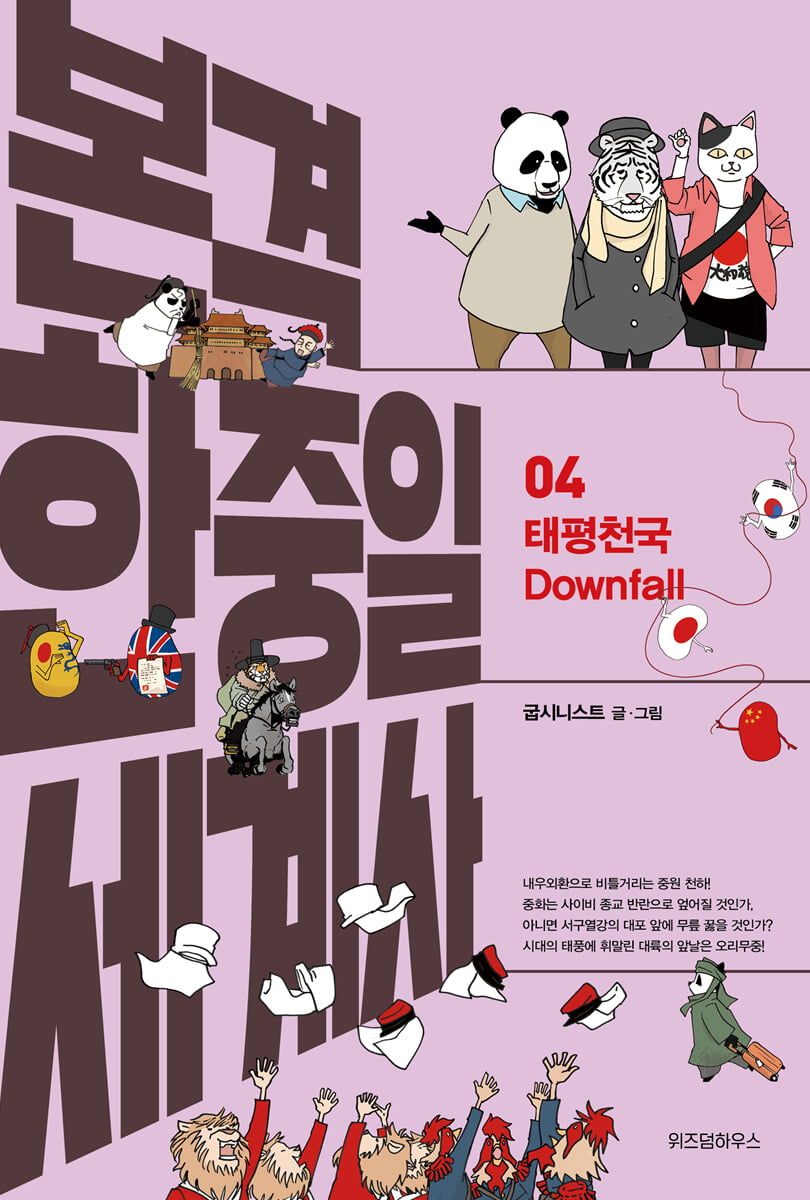
Full-fledged Korean-Chinese-Japanese World History 4
 |
Description
Book Introduction
What is the future of the continent, precariously standing before the storm of the times?
It deals with the Qing Dynasty after the outbreak of the Taiping Rebellion in the mid-19th century.
A year after the Tianjing Incident, the Taiping Heavenly Kingdom, which had managed to somehow manage internal conflict, began its operations in Hangzhou.
The Qing government forces, facing a desperate situation where the Jiangnan Great Camp is collapsing due to an attack by the Taiping Heavenly Kingdom army, request help from the Anglo-French allied forces.
The Anglo-French Allied Forces were willing to help the Qing government forces even though they were at war in order to further open up the Qing Dynasty.
Meanwhile, Emperor Xianfeng, who had fled to avoid the attacks of the Anglo-French allied forces demanding openness, died in Rehe, and the chaos in the Qing reached its peak.
It deals with the Qing Dynasty after the outbreak of the Taiping Rebellion in the mid-19th century.
A year after the Tianjing Incident, the Taiping Heavenly Kingdom, which had managed to somehow manage internal conflict, began its operations in Hangzhou.
The Qing government forces, facing a desperate situation where the Jiangnan Great Camp is collapsing due to an attack by the Taiping Heavenly Kingdom army, request help from the Anglo-French allied forces.
The Anglo-French Allied Forces were willing to help the Qing government forces even though they were at war in order to further open up the Qing Dynasty.
Meanwhile, Emperor Xianfeng, who had fled to avoid the attacks of the Anglo-French allied forces demanding openness, died in Rehe, and the chaos in the Qing reached its peak.
- You can preview some of the book's contents.
Preview
index
preface
Chapter 1 Miss me?
Chapter 2: The Battle of Samha
Chapter 3: The Second Battle of Dagupo
Chapter 4: 8 Miles to Glory
Chapter 5: End of the Second Opium War
Chapter 6: Chronology of the 1850s
Chapter 7 Meanwhile in the South
Chapter 8: Shanghai Twist
Chapter 9: Broken Scissors
Chapter 10: Hot River Run
Chapter 11: The Sinyujeong Coup
Chapter 12: The Distant Shanghai
Chapter 13: Battle of Uhwadae
Chapter 14 Paradise Lost
Major events and people
Chapter 1 Miss me?
Chapter 2: The Battle of Samha
Chapter 3: The Second Battle of Dagupo
Chapter 4: 8 Miles to Glory
Chapter 5: End of the Second Opium War
Chapter 6: Chronology of the 1850s
Chapter 7 Meanwhile in the South
Chapter 8: Shanghai Twist
Chapter 9: Broken Scissors
Chapter 10: Hot River Run
Chapter 11: The Sinyujeong Coup
Chapter 12: The Distant Shanghai
Chapter 13: Battle of Uhwadae
Chapter 14 Paradise Lost
Major events and people
Detailed image

Into the book
As a result, the Taiping Rebellion ended up as a local rebellion, only devastating a small area around Nanjing, while Western powers entered Beijing and quickly left to focus on trade.
Afterwards, the Qing Dynasty endured for another half a century, entering the Tongzhi Restoration period, where it resolved all the chaos and regained its strength. Therefore, it can be said that the judgment that the Qing Dynasty's rule would continue despite all the chaos was not far off.
However, in the long run, the Taiping Rebellion wasted 10 years of time and enormous economic power and manpower for the Qing Dynasty, so it can be seen as a waste of the golden time and potential of the mid-19th century. In addition, the Second Opium War was an opening for the great powers to encroach on China's interests, which led to the gradual decline of the Qing Dynasty and its destruction 50 years later.
In that case, the analysis of the situation as a crisis that threatens the existence of the Qing Dynasty is correct.
---From the "Preface"
Sanshan Wuyuan, an imperial garden built in the lake area northwest of Beijing.
The most famous of these is the Yuanmingyuan, also known as the Manwon Garden.
In the 18th century, the Qianlong Emperor hired Italian priest artist Castiglione to build the magnificent Western-style buildings, which were filled with all sorts of rare treasures, such as the twelve zodiac fountain clocks that spurt water every hour, representing the corresponding animal.
On October 6, 1860, when the French army stormed into the Yuanmingyuan, the Yuanmingyuan garrison was annihilated, the Minister of the Interior Wen Feng committed suicide, and the palace officials fled.
It is said that the Great Robbery of the Yuanmingyuan allowed 4,000 French soldiers to take treasures worth tens of millions to hundreds of millions of won per person.
---From "The Second Opium War"
Lee Su-seong believed that since the Qing Dynasty and Britain and France were at war, the British and French would not side with the Qing Dynasty in Shanghai - the instructions from the plenipotentiary delegation in the home country were - "The British and French forces in Shanghai will cooperate with the Qing authorities to defend Shanghai." The reason was, firstly, that if Shanghai were to be occupied by the Taiping Heavenly Kingdom army, it would be difficult for the British and French to renew the interests they had obtained from the Qing Dynasty from the Taiping Heavenly Kingdom.
Second, the Taiping Heavenly Kingdom's occupation of Shanghai could have hindered the achievement of Anglo-French war objectives.
Third, it is a shame that the efforts put into organizing the Qing Dynasty's hierarchy have been wasted.
---From "Shanghai Twist"
Su Xun, who had received the full trust of Emperor Xianfeng, wielded his influence as a powerful official who led the political situation.
However, in 1860, when he fled to Rehe with the Xianfeng Emperor to escape the Anglo-French allied forces, Susun's authority began to crack slightly.
Many of the officials who had been beaten by Su Xun's anti-corruption purge began sharpening their swords in Beijing to counterattack Su Xun.
Anti-Suksun and pro-government public opinion in Beijing was focused on Prince Gong, who remained in Beijing and helped resolve the crisis.
---From "Hor River Run"
(In the past, when the Taiping Heavenly Kingdom Army launched a gunpowder attack, a devout warrior would have carried a gunpowder barrel and willingly launched a suicide attack.)
But these days, it is difficult to find such great faith or belief among soldiers.
Even the gunpowder keg is just thrown far away, prioritizing life.
Afterwards, the Qing Dynasty endured for another half a century, entering the Tongzhi Restoration period, where it resolved all the chaos and regained its strength. Therefore, it can be said that the judgment that the Qing Dynasty's rule would continue despite all the chaos was not far off.
However, in the long run, the Taiping Rebellion wasted 10 years of time and enormous economic power and manpower for the Qing Dynasty, so it can be seen as a waste of the golden time and potential of the mid-19th century. In addition, the Second Opium War was an opening for the great powers to encroach on China's interests, which led to the gradual decline of the Qing Dynasty and its destruction 50 years later.
In that case, the analysis of the situation as a crisis that threatens the existence of the Qing Dynasty is correct.
---From the "Preface"
Sanshan Wuyuan, an imperial garden built in the lake area northwest of Beijing.
The most famous of these is the Yuanmingyuan, also known as the Manwon Garden.
In the 18th century, the Qianlong Emperor hired Italian priest artist Castiglione to build the magnificent Western-style buildings, which were filled with all sorts of rare treasures, such as the twelve zodiac fountain clocks that spurt water every hour, representing the corresponding animal.
On October 6, 1860, when the French army stormed into the Yuanmingyuan, the Yuanmingyuan garrison was annihilated, the Minister of the Interior Wen Feng committed suicide, and the palace officials fled.
It is said that the Great Robbery of the Yuanmingyuan allowed 4,000 French soldiers to take treasures worth tens of millions to hundreds of millions of won per person.
---From "The Second Opium War"
Lee Su-seong believed that since the Qing Dynasty and Britain and France were at war, the British and French would not side with the Qing Dynasty in Shanghai - the instructions from the plenipotentiary delegation in the home country were - "The British and French forces in Shanghai will cooperate with the Qing authorities to defend Shanghai." The reason was, firstly, that if Shanghai were to be occupied by the Taiping Heavenly Kingdom army, it would be difficult for the British and French to renew the interests they had obtained from the Qing Dynasty from the Taiping Heavenly Kingdom.
Second, the Taiping Heavenly Kingdom's occupation of Shanghai could have hindered the achievement of Anglo-French war objectives.
Third, it is a shame that the efforts put into organizing the Qing Dynasty's hierarchy have been wasted.
---From "Shanghai Twist"
Su Xun, who had received the full trust of Emperor Xianfeng, wielded his influence as a powerful official who led the political situation.
However, in 1860, when he fled to Rehe with the Xianfeng Emperor to escape the Anglo-French allied forces, Susun's authority began to crack slightly.
Many of the officials who had been beaten by Su Xun's anti-corruption purge began sharpening their swords in Beijing to counterattack Su Xun.
Anti-Suksun and pro-government public opinion in Beijing was focused on Prince Gong, who remained in Beijing and helped resolve the crisis.
---From "Hor River Run"
(In the past, when the Taiping Heavenly Kingdom Army launched a gunpowder attack, a devout warrior would have carried a gunpowder barrel and willingly launched a suicide attack.)
But these days, it is difficult to find such great faith or belief among soldiers.
Even the gunpowder keg is just thrown far away, prioritizing life.
---From "Battle of Uhwadae"
Publisher's Review
Will China be ignited by the detonator called the Taiping Heavenly Kingdom?
Or will we be annihilated by the cannons of the world's great powers?
How did the Taiping Heavenly Kingdom, a pseudo-religion that dominated the continent in the 19th century, disappear into thin air? Why did Western powers, having achieved their objectives in the First Opium War, once again gather on the shores of the Qing Dynasty? Why did the Anglo-French allied forces, firing guns in Beijing's courtyard, side with the Qing government forces in Shanghai and attack the Taiping Heavenly Kingdom? To answer these questions, we must examine the internal and external circumstances of the Qing Dynasty in the 19th century.
This book examines the situation in the Qing Dynasty in the 19th century, when chaos reached its peak due to the internal strife known as the Taiping Heavenly Kingdom and the external threat of the Anglo-French alliance.
It covers the situation of the Taiping Heavenly Kingdom after the internal conflict of the Tianjing Incident, the beginning and end of the Second Opium War, the death of the Qing Emperor Xianfeng, and the Xinyou Coup.
In addition, it includes an unpublished additional article titled 'Gup's Arrogance and Mischief', providing historical knowledge that was not included in the comic.
The world powers appear before the eyes of a continent preoccupied with internal conflict.
Launch an all-out offensive against the Qing Empire on the brink of collapse!
The world powers' views of the Qing Empire in the 19th century were complex and multifaceted.
While they want to subdue the Qing Dynasty smoothly through cannon fire, they do not want the Qing Dynasty to fall.
This is why the West formed an allied force, gathered in the South China Sea, and marched to Beijing with guns and swords, while at the same time cooperating with the Qing government forces, who were struggling against the Taiping Heavenly Kingdom's attacks, to protect Shanghai, showing a contradictory attitude.
The Qing Empire, though struggling under Western attacks, reached out to the West, asking them to help it defeat the Taiping Heavenly Kingdom.
The Taiping Heavenly Kingdom, in its own way, tried to appease Western missionaries by saying things like "brothers in the same Christian faith," and continued its offensive against the Qing government forces with a policy of sympathy to occupy the seaward side and a policy of westward expansion along the Yangtze River.
In this way, the continent in the mid-19th century was a complexly intertwined struggle between Western powers that were simultaneously defending and attacking the Qing Empire, the Taiping Heavenly Kingdom and the Qing Empire trying to win these Western powers over to their side, and political forces trying to take control of the Qing court.
This book wittily uses comics to explain the complex and difficult situation of the continent in the mid-19th century.
The author's extensive knowledge of history and the familiar material of comics combine to provide readers with a fresh and enjoyable experience.
The 『Authentic Korean-Chinese-Japanese World History』 series
This is foul play! They're not even losing their sense of humor while still providing profound content!
Easily overcoming the historical convention that "you have to memorize it to understand it."
When we talk about 'history', we often have the common perception that it is 'boring' and that 'you have to memorize it to understand it'.
This may be because the memories of memorizing the years and events that occurred during middle and high school history classes are all that remain of our image of history.
In contrast, this series deviates significantly from the conventional wisdom that history must be memorized.
This time, cartoonist Gupsinist has published a historical cartoon that covers the modern history of Korea, China, and Japan, utilizing his major.
This series describes the modern history of 19th-century East Asia, naturally incorporating various subcultures such as games, military, animation, and dramas into it.
As you slowly follow the story of the author's extensive knowledge of history, the various parodies and wordplay that are sprinkled throughout, the zeitgeist and world situation at that time will naturally come to mind.
Through this series, readers will experience a significant reduction in the barriers to entry into history, which has often been perceived as difficult.
In the face of the tidal wave of Western imperialist powers entering the world,
How did Korea, China, and Japan resist or comply?
Why must we read world history through the lens of "Korea, China, and Japan"? To observe the tree of Korean history, our own history, we must first see the forest of Eastern history. Without understanding this, we cannot grasp the larger picture of world history.
To understand our country's past and present, and the global situation, we will compare the history of three East Asian countries.
World history up to now has not strayed far from the form of a brief description of the history of Western powers and the surrounding nations and peoples within the global historical flow they created.
However, history is not only about the military and diplomacy of powerful nations, but also about the resistance and identity of weak nations.
This series is an attempt to break away from the traditional Western-centric historical narrative and look at history from our East Asian perspective.
Among them, we will take a closer look at the period from the mid-19th century to the mid-20th century, when Korea, China, and Japan were most closely connected.
01.
The beginning of the West Sea branch
02.
Typhoon Heaven Rising
03.
Japan's opening
04.
Taiping Heavenly Kingdom Downfall
05.
The game of the archipelago (the basis)…
* Will continue to be published.
Or will we be annihilated by the cannons of the world's great powers?
How did the Taiping Heavenly Kingdom, a pseudo-religion that dominated the continent in the 19th century, disappear into thin air? Why did Western powers, having achieved their objectives in the First Opium War, once again gather on the shores of the Qing Dynasty? Why did the Anglo-French allied forces, firing guns in Beijing's courtyard, side with the Qing government forces in Shanghai and attack the Taiping Heavenly Kingdom? To answer these questions, we must examine the internal and external circumstances of the Qing Dynasty in the 19th century.
This book examines the situation in the Qing Dynasty in the 19th century, when chaos reached its peak due to the internal strife known as the Taiping Heavenly Kingdom and the external threat of the Anglo-French alliance.
It covers the situation of the Taiping Heavenly Kingdom after the internal conflict of the Tianjing Incident, the beginning and end of the Second Opium War, the death of the Qing Emperor Xianfeng, and the Xinyou Coup.
In addition, it includes an unpublished additional article titled 'Gup's Arrogance and Mischief', providing historical knowledge that was not included in the comic.
The world powers appear before the eyes of a continent preoccupied with internal conflict.
Launch an all-out offensive against the Qing Empire on the brink of collapse!
The world powers' views of the Qing Empire in the 19th century were complex and multifaceted.
While they want to subdue the Qing Dynasty smoothly through cannon fire, they do not want the Qing Dynasty to fall.
This is why the West formed an allied force, gathered in the South China Sea, and marched to Beijing with guns and swords, while at the same time cooperating with the Qing government forces, who were struggling against the Taiping Heavenly Kingdom's attacks, to protect Shanghai, showing a contradictory attitude.
The Qing Empire, though struggling under Western attacks, reached out to the West, asking them to help it defeat the Taiping Heavenly Kingdom.
The Taiping Heavenly Kingdom, in its own way, tried to appease Western missionaries by saying things like "brothers in the same Christian faith," and continued its offensive against the Qing government forces with a policy of sympathy to occupy the seaward side and a policy of westward expansion along the Yangtze River.
In this way, the continent in the mid-19th century was a complexly intertwined struggle between Western powers that were simultaneously defending and attacking the Qing Empire, the Taiping Heavenly Kingdom and the Qing Empire trying to win these Western powers over to their side, and political forces trying to take control of the Qing court.
This book wittily uses comics to explain the complex and difficult situation of the continent in the mid-19th century.
The author's extensive knowledge of history and the familiar material of comics combine to provide readers with a fresh and enjoyable experience.
The 『Authentic Korean-Chinese-Japanese World History』 series
This is foul play! They're not even losing their sense of humor while still providing profound content!
Easily overcoming the historical convention that "you have to memorize it to understand it."
When we talk about 'history', we often have the common perception that it is 'boring' and that 'you have to memorize it to understand it'.
This may be because the memories of memorizing the years and events that occurred during middle and high school history classes are all that remain of our image of history.
In contrast, this series deviates significantly from the conventional wisdom that history must be memorized.
This time, cartoonist Gupsinist has published a historical cartoon that covers the modern history of Korea, China, and Japan, utilizing his major.
This series describes the modern history of 19th-century East Asia, naturally incorporating various subcultures such as games, military, animation, and dramas into it.
As you slowly follow the story of the author's extensive knowledge of history, the various parodies and wordplay that are sprinkled throughout, the zeitgeist and world situation at that time will naturally come to mind.
Through this series, readers will experience a significant reduction in the barriers to entry into history, which has often been perceived as difficult.
In the face of the tidal wave of Western imperialist powers entering the world,
How did Korea, China, and Japan resist or comply?
Why must we read world history through the lens of "Korea, China, and Japan"? To observe the tree of Korean history, our own history, we must first see the forest of Eastern history. Without understanding this, we cannot grasp the larger picture of world history.
To understand our country's past and present, and the global situation, we will compare the history of three East Asian countries.
World history up to now has not strayed far from the form of a brief description of the history of Western powers and the surrounding nations and peoples within the global historical flow they created.
However, history is not only about the military and diplomacy of powerful nations, but also about the resistance and identity of weak nations.
This series is an attempt to break away from the traditional Western-centric historical narrative and look at history from our East Asian perspective.
Among them, we will take a closer look at the period from the mid-19th century to the mid-20th century, when Korea, China, and Japan were most closely connected.
01.
The beginning of the West Sea branch
02.
Typhoon Heaven Rising
03.
Japan's opening
04.
Taiping Heavenly Kingdom Downfall
05.
The game of the archipelago (the basis)…
* Will continue to be published.
GOODS SPECIFICS
- Date of publication: December 21, 2018
- Page count, weight, size: 340 pages | 622g | 152*225*30mm
- ISBN13: 9791189709020
- ISBN10: 1189709023
You may also like
카테고리
korean


korean

![GQ KOREA Mark (Monthly): December [2025]](http://librairie.coreenne.fr/cdn/shop/files/8ef265dbbfbf186523ed75ba7319009d.jpg?v=1765340328&width=3840)


