

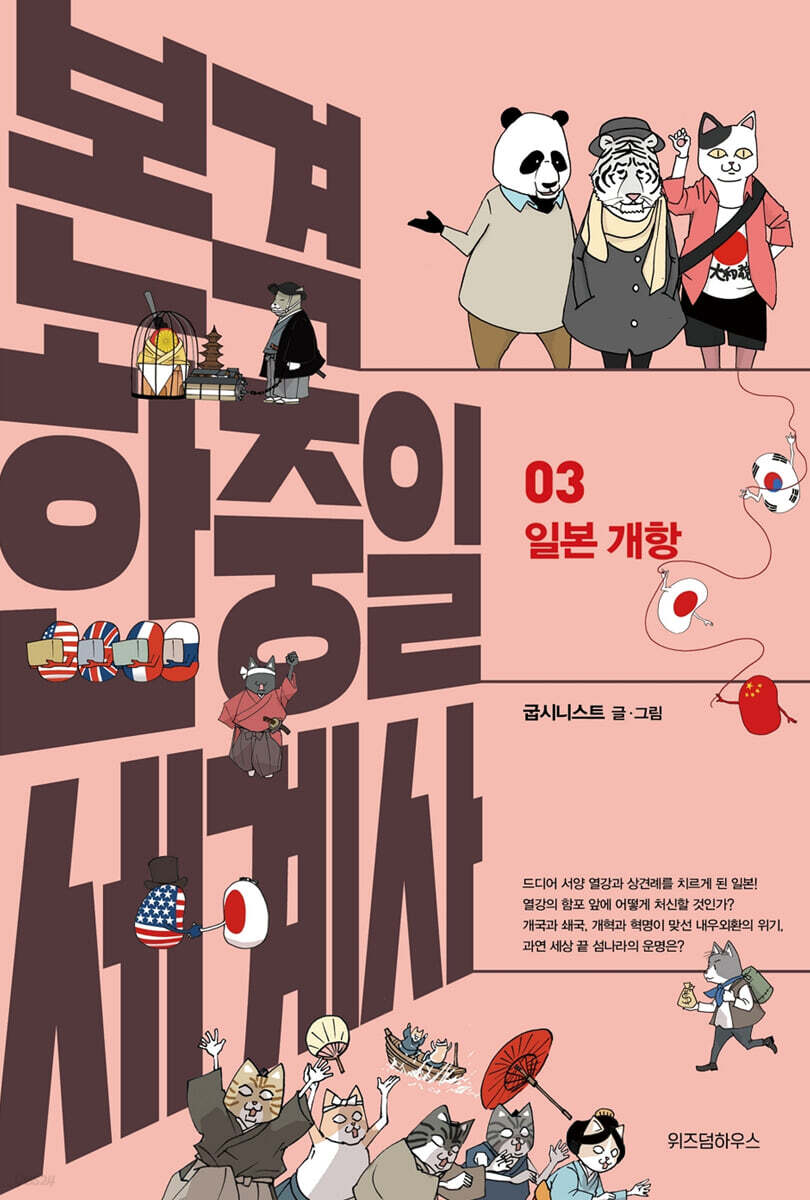
Full-fledged Korean-Chinese-Japanese World History 3
 |
Description
Book Introduction
What choice will the samurai make in the face of the West's passionate courtship?
The third volume of 『Authentic Korean-Chinese-Japanese World History』.
In Volume 3, the great Western powers, including Russia, Britain, and the United States, gather in the waters off Japan, each with their own objectives.
We take a close look at the vivid scene of the Japanese political world, divided between the isolationist and open-door factions, engaged in a power struggle over the issue of opening the country.
In particular, it focuses on major events in the early days of Japan's opening to foreign trade, from the "Ansei Purge" in which Ii Naosuke, the lord of the Hikone domain and a powerful figure in the shogunate, purged his opponents, to the "Sakurada Gate Incident" in which Ii Naosuke was beheaded by surprise by Mito domain radicals and their collaborators.
The third volume of 『Authentic Korean-Chinese-Japanese World History』.
In Volume 3, the great Western powers, including Russia, Britain, and the United States, gather in the waters off Japan, each with their own objectives.
We take a close look at the vivid scene of the Japanese political world, divided between the isolationist and open-door factions, engaged in a power struggle over the issue of opening the country.
In particular, it focuses on major events in the early days of Japan's opening to foreign trade, from the "Ansei Purge" in which Ii Naosuke, the lord of the Hikone domain and a powerful figure in the shogunate, purged his opponents, to the "Sakurada Gate Incident" in which Ii Naosuke was beheaded by surprise by Mito domain radicals and their collaborators.
- You can preview some of the book's contents.
Preview
index
preface
Chapter 1: The Circumstances of the Sheep
Chapter 2 Difficulties and Issues
Chapter 3: The Oily Invasion
Chapter 4: The First Half of the Second Opium War
Chapter 5 John Man
Chapter 6: Black Ships
Chapter 7: Black Ships
Chapter 8: The Game of General Jeong I
Chapter 9: The Inside Story of Late Edo Period Academics
Chapter 10: The Inside Story of the Last Emperor's Regime
Chapter 11: Harris Ridge
Chapter 12: The Little Ball Shot by Komei
Chapter 13: Leeing~
Chapter 14: Distant Kyoto
Chapter 15: Separate payment of registration fees
Chapter 16: The Ansei Prison
Chapter 17: Under the Pinetree
Chapter 18 Bye ee
Major events and people
Chapter 1: The Circumstances of the Sheep
Chapter 2 Difficulties and Issues
Chapter 3: The Oily Invasion
Chapter 4: The First Half of the Second Opium War
Chapter 5 John Man
Chapter 6: Black Ships
Chapter 7: Black Ships
Chapter 8: The Game of General Jeong I
Chapter 9: The Inside Story of Late Edo Period Academics
Chapter 10: The Inside Story of the Last Emperor's Regime
Chapter 11: Harris Ridge
Chapter 12: The Little Ball Shot by Komei
Chapter 13: Leeing~
Chapter 14: Distant Kyoto
Chapter 15: Separate payment of registration fees
Chapter 16: The Ansei Prison
Chapter 17: Under the Pinetree
Chapter 18 Bye ee
Major events and people
Into the book
There are points in history where enormous emotions—the desire to expand the self into the realms of the nation and society, the belief that the world should be governed by such and such justice, the sense of crisis about the fate of the community, and so on—significant emotions significantly influence history.
And such wills converge into politics.
And many history books, including history textbooks, usually use contemporary political stories as the first layer of historical narratives.
Political stories of power and factional strife are, in fact, a daily occurrence for many people, both in public and private life, and they offer enjoyable topics of conversation. Therefore, I hope readers will broadly agree with the manga artist's decision to begin by exploring the political landscape of the time, as he seeks to explore the profound upheaval in mid-to-late 19th century Japan.
_Pages 6 and 7, 〈Preface〉
First, as the United States had hoped, two ports were opened, and the safety, rescue, and supply of American ships and sailors were guaranteed.
Nagasaki, Shimoda and Hakodate opened as ports.
Various supplies available, low-carbon use available.
& The trade agreement is on hold as per Japan's wishes.
To this extent, there is nothing particularly unpleasant about this content - all subsequent peace treaties with other great powers were concluded by copying and pasting the contents of this US-Japan peace treaty.
_ Pages 184, 185, 〈Chapter 6_ Black Ship(s) Inner Harbor〉
Even if it wasn't necessarily for the sake of advancement, this rigid system of last resorts.
To the young, poor samurai trapped within, studying abroad offered a vast universal universe that transcended that framework.
The samurai who entered this world of Confucianism were not insignificant appendages at the bottom of the shogunate system, but rather loyal men pursuing the ideals of Confucianism, and they could be the driving force behind a grand vision for the future of the world.
_ Pages 233, 234, Chapter 9_ The Inside Story of Late Late Academics
In a situation where the pro-Emperor ideological movement could become an unpredictable risk due to the opening of the country, in order to control the energy of the ideological movement led by the Asa group, the opposition of the popular group must be suppressed, the Asa group must be accepted as the center of power, and after that, the authority of the shogunate must be re-established through the merger of the Kyoto court and the public and private sectors, and then a trade treaty or whatever can be done.
Oh, politics is so tough.
Page 268, Chapter 10: The Inside Story of the Tokugawa Regime
Abandoning the Hitotsubashi faction-friendly political line that had continued from Abe Masahiro to Hotta Masayoshi, and appointing Ii Naosuke as Tairo to side with the Nanki faction - the Hitotsubashi faction thinks they can overcome the crisis by appeasing the extremes of the student movement and the shogunate conservatives, saying they respect the emperor and oppose the left - but that will inevitably end up being a line that is rejected by both extremes.
_ Pages 328, 329, 〈Chapter 13_ Leeing~〉
And such wills converge into politics.
And many history books, including history textbooks, usually use contemporary political stories as the first layer of historical narratives.
Political stories of power and factional strife are, in fact, a daily occurrence for many people, both in public and private life, and they offer enjoyable topics of conversation. Therefore, I hope readers will broadly agree with the manga artist's decision to begin by exploring the political landscape of the time, as he seeks to explore the profound upheaval in mid-to-late 19th century Japan.
_Pages 6 and 7, 〈Preface〉
First, as the United States had hoped, two ports were opened, and the safety, rescue, and supply of American ships and sailors were guaranteed.
Nagasaki, Shimoda and Hakodate opened as ports.
Various supplies available, low-carbon use available.
& The trade agreement is on hold as per Japan's wishes.
To this extent, there is nothing particularly unpleasant about this content - all subsequent peace treaties with other great powers were concluded by copying and pasting the contents of this US-Japan peace treaty.
_ Pages 184, 185, 〈Chapter 6_ Black Ship(s) Inner Harbor〉
Even if it wasn't necessarily for the sake of advancement, this rigid system of last resorts.
To the young, poor samurai trapped within, studying abroad offered a vast universal universe that transcended that framework.
The samurai who entered this world of Confucianism were not insignificant appendages at the bottom of the shogunate system, but rather loyal men pursuing the ideals of Confucianism, and they could be the driving force behind a grand vision for the future of the world.
_ Pages 233, 234, Chapter 9_ The Inside Story of Late Late Academics
In a situation where the pro-Emperor ideological movement could become an unpredictable risk due to the opening of the country, in order to control the energy of the ideological movement led by the Asa group, the opposition of the popular group must be suppressed, the Asa group must be accepted as the center of power, and after that, the authority of the shogunate must be re-established through the merger of the Kyoto court and the public and private sectors, and then a trade treaty or whatever can be done.
Oh, politics is so tough.
Page 268, Chapter 10: The Inside Story of the Tokugawa Regime
Abandoning the Hitotsubashi faction-friendly political line that had continued from Abe Masahiro to Hotta Masayoshi, and appointing Ii Naosuke as Tairo to side with the Nanki faction - the Hitotsubashi faction thinks they can overcome the crisis by appeasing the extremes of the student movement and the shogunate conservatives, saying they respect the emperor and oppose the left - but that will inevitably end up being a line that is rejected by both extremes.
_ Pages 328, 329, 〈Chapter 13_ Leeing~〉
--- From the text
Publisher's Review
How on earth did Japan obtain the absolute ring of modernization?
What will the island nation choose when hit by the tsunami of its founding?
How did Japan achieve the success of modernization amidst the Western powers? This question cannot be overlooked when considering the impact of Japan's opening and modernization on us in the modern history of 19th-century East Asia.
This book traces the historical background and flow of Japan at the time to find an answer to that question.
It covers the tense history of the 1850s, when Britain was focused on the quest of the Sepoy Rebellion, and the United States was trying to take over the Pacific Ocean first, to the 1860s, when Daimyo Ii Naosuke was purged by assassins who opposed the opening of the country.
Additionally, the webtoon includes an additional article titled “Gup’s Arrogant Miscellany” to provide readers with more in-depth historical knowledge about topics not covered in the webtoon.
Japan is divided over systemic change.
Who will ultimately win between the pro-government and anti-isolation factions?
Outside, Western powers such as Russia, Britain, and the United States are lining up along the Pacific Ocean, and inside, Japan is embroiled in conflict between the pro-openness and pro-Western factions, and now there is conflict between political insiders and outsiders.
Samurai armed with ideologies such as Confucianism, national studies, and Mito-gaku (水??) shouted for respect for the king and expulsion of the barbarians, and the conflict between the Hitotsubashi faction, an outsider to the shogunate, and the Nanki faction, the established power of the shogunate, became increasingly intense over the issue of succession.
There, the emperor, who was nothing more than a puppet, began to oppose the authority of the shogunate, and Japan was divided in the face of an absolute crisis of internal strife and external trouble.
Although it was only a short period of about ten years, the early stages of Japan's opening to foreign trade were so complex and multifaceted that it would be difficult to grasp them all at once even if you read a whole book.
This book, which combines the familiar format of comics, B-movie sentiment and wit, and the author's extensive knowledge, presents a concise and entertaining introduction to Japan's often difficult-to-understand modern history.
The series “Authentic Korean, Chinese, and Japanese World History”
This is foul play! They're not even losing their sense of humor while still providing profound content!
Easily overcoming the historical convention that "you have to memorize it to understand it."
When we talk about 'history', we often have the common perception that it is 'boring' and that 'you have to memorize it to understand it'.
This may be because the memories of memorizing the years and events that occurred during middle and high school history classes are all that remain of our image of history.
In contrast, this series deviates significantly from the conventional wisdom that history must be memorized.
This time, cartoonist Gupsinist has published a historical cartoon that covers the modern history of Korea, China, and Japan, utilizing his major.
This series describes the modern history of 19th-century East Asia, naturally incorporating various subcultures such as games, military, animation, and dramas into it.
As you slowly follow the author's extensive knowledge of history, the various parodies and wordplay that are sprinkled throughout, the zeitgeist and world situation of the time will naturally come to mind.
Through this series, readers will experience a significant reduction in the barriers to entry into history, which has often been perceived as difficult.
In the face of the tidal wave of Western imperialist powers entering the world,
How did Korea, China, and Japan resist or comply?
Why must we read world history through the lens of "Korea, China, and Japan"? To observe the tree of Korean history, our own history, we must first see the forest of Eastern history. Without understanding this, we cannot grasp the larger picture of world history.
To understand our country's past and present, and the global situation, we will compare the history of three East Asian countries.
World history up to now has not strayed far from the form of a brief description of the history of Western powers and the surrounding nations and peoples within the global historical flow they created.
However, history is not only about the military and diplomacy of powerful nations, but also about the resistance and identity of weak nations.
This series is an attempt to break away from the traditional Western-centric historical narrative and look at history from our East Asian perspective.
Among them, we will take a closer look at the period from the mid-19th century to the mid-20th century, when Korea, China, and Japan were most closely connected.
01.
The beginning of the West Sea branch
02.
Typhoon Heaven Rising
03.
Japan's opening
04.
Game of the Continent (Basis)
05.
The game of the archipelago (the basis)…
* Will continue to be published.
What will the island nation choose when hit by the tsunami of its founding?
How did Japan achieve the success of modernization amidst the Western powers? This question cannot be overlooked when considering the impact of Japan's opening and modernization on us in the modern history of 19th-century East Asia.
This book traces the historical background and flow of Japan at the time to find an answer to that question.
It covers the tense history of the 1850s, when Britain was focused on the quest of the Sepoy Rebellion, and the United States was trying to take over the Pacific Ocean first, to the 1860s, when Daimyo Ii Naosuke was purged by assassins who opposed the opening of the country.
Additionally, the webtoon includes an additional article titled “Gup’s Arrogant Miscellany” to provide readers with more in-depth historical knowledge about topics not covered in the webtoon.
Japan is divided over systemic change.
Who will ultimately win between the pro-government and anti-isolation factions?
Outside, Western powers such as Russia, Britain, and the United States are lining up along the Pacific Ocean, and inside, Japan is embroiled in conflict between the pro-openness and pro-Western factions, and now there is conflict between political insiders and outsiders.
Samurai armed with ideologies such as Confucianism, national studies, and Mito-gaku (水??) shouted for respect for the king and expulsion of the barbarians, and the conflict between the Hitotsubashi faction, an outsider to the shogunate, and the Nanki faction, the established power of the shogunate, became increasingly intense over the issue of succession.
There, the emperor, who was nothing more than a puppet, began to oppose the authority of the shogunate, and Japan was divided in the face of an absolute crisis of internal strife and external trouble.
Although it was only a short period of about ten years, the early stages of Japan's opening to foreign trade were so complex and multifaceted that it would be difficult to grasp them all at once even if you read a whole book.
This book, which combines the familiar format of comics, B-movie sentiment and wit, and the author's extensive knowledge, presents a concise and entertaining introduction to Japan's often difficult-to-understand modern history.
The series “Authentic Korean, Chinese, and Japanese World History”
This is foul play! They're not even losing their sense of humor while still providing profound content!
Easily overcoming the historical convention that "you have to memorize it to understand it."
When we talk about 'history', we often have the common perception that it is 'boring' and that 'you have to memorize it to understand it'.
This may be because the memories of memorizing the years and events that occurred during middle and high school history classes are all that remain of our image of history.
In contrast, this series deviates significantly from the conventional wisdom that history must be memorized.
This time, cartoonist Gupsinist has published a historical cartoon that covers the modern history of Korea, China, and Japan, utilizing his major.
This series describes the modern history of 19th-century East Asia, naturally incorporating various subcultures such as games, military, animation, and dramas into it.
As you slowly follow the author's extensive knowledge of history, the various parodies and wordplay that are sprinkled throughout, the zeitgeist and world situation of the time will naturally come to mind.
Through this series, readers will experience a significant reduction in the barriers to entry into history, which has often been perceived as difficult.
In the face of the tidal wave of Western imperialist powers entering the world,
How did Korea, China, and Japan resist or comply?
Why must we read world history through the lens of "Korea, China, and Japan"? To observe the tree of Korean history, our own history, we must first see the forest of Eastern history. Without understanding this, we cannot grasp the larger picture of world history.
To understand our country's past and present, and the global situation, we will compare the history of three East Asian countries.
World history up to now has not strayed far from the form of a brief description of the history of Western powers and the surrounding nations and peoples within the global historical flow they created.
However, history is not only about the military and diplomacy of powerful nations, but also about the resistance and identity of weak nations.
This series is an attempt to break away from the traditional Western-centric historical narrative and look at history from our East Asian perspective.
Among them, we will take a closer look at the period from the mid-19th century to the mid-20th century, when Korea, China, and Japan were most closely connected.
01.
The beginning of the West Sea branch
02.
Typhoon Heaven Rising
03.
Japan's opening
04.
Game of the Continent (Basis)
05.
The game of the archipelago (the basis)…
* Will continue to be published.
GOODS SPECIFICS
- Date of publication: October 19, 2018
- Page count, weight, size: 460 pages | 816g | 152*225*26mm
- ISBN13: 9791162209042
- ISBN10: 1162209046
You may also like
카테고리
korean


korean

![GQ KOREA Mark (Monthly): December [2025]](http://librairie.coreenne.fr/cdn/shop/files/8ef265dbbfbf186523ed75ba7319009d.jpg?v=1765340328&width=3840)


