

Authentic Korean-Chinese-Japanese World History 1
 |
Description
Book Introduction
Isn't it time to take a look at the world history of Korea, China, and Japan?
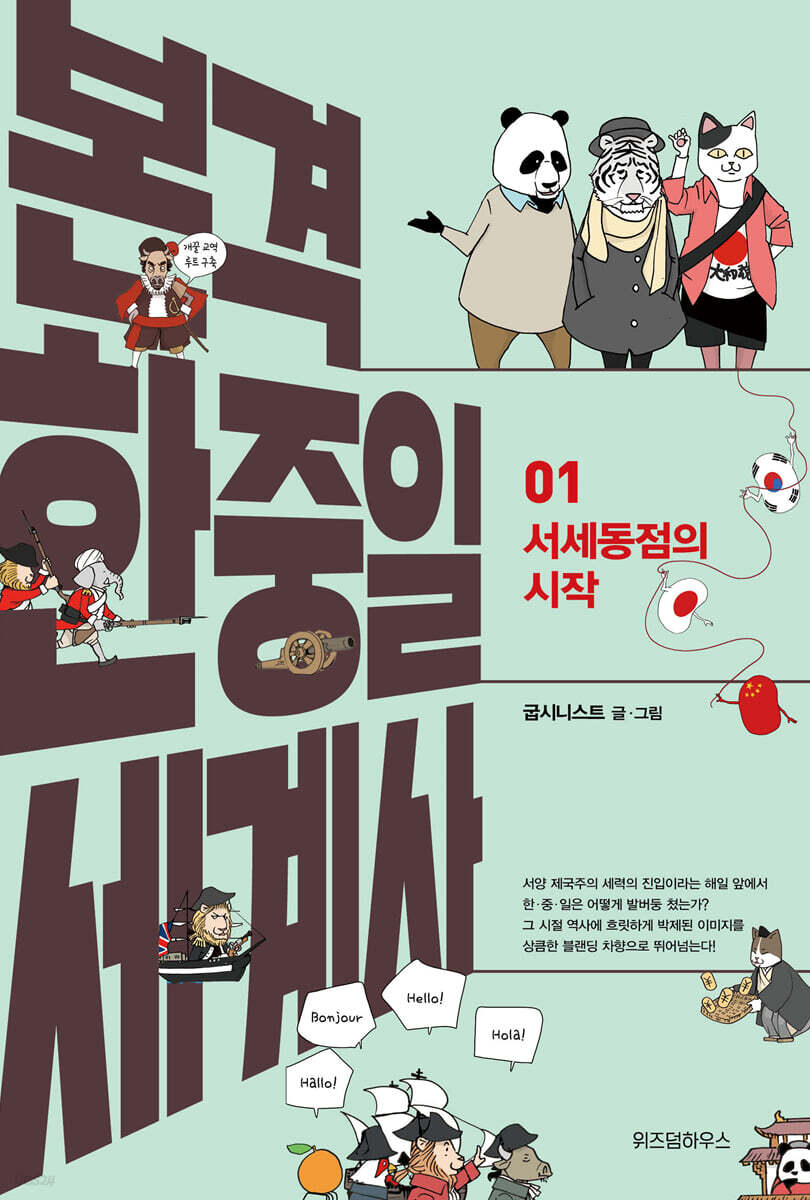
China, which fell from being the celestial power of East Asia to prey to the great powers; Joseon, which quietly lived in the shadow of that power; and Japan, which eventually rose to prominence from an island at the edge of the Pacific Ocean. This comic explores how the fates of these three countries intertwined in the labyrinth of the 19th century.
You can see how the three East Asian countries resisted and adapted to the storm of modernity brought about by Westerners, and how their actions shaped world history.
China, which fell from being the celestial power of East Asia to prey to the great powers; Joseon, which quietly lived in the shadow of that power; and Japan, which eventually rose to prominence from an island at the edge of the Pacific Ocean. This comic explores how the fates of these three countries intertwined in the labyrinth of the 19th century.
You can see how the three East Asian countries resisted and adapted to the storm of modernity brought about by Westerners, and how their actions shaped world history.
- You can preview some of the book's contents.
Preview
index
preface
Chapter 1_Prologue: The Origin of Jjamppong
Chapter 2: Chronology of Chinese History Before the 19th Century
Chapter 3: Chronology of Japanese History Before the 19th Century
Chapter 4: The Golden Age of Cotton Tech
Chapter 5_Cha Hyang-eun Port 1
Chapter 6_Cha Hyang-eun Port 2
Chapter 7: The Age of Exploration: Zipangu
Chapter 8: Why? Japan's Isolation
Chapter 9: The Hikikomori's Breath
Chapter 10: The Opium Wars 1: The Prelude to Catastrophe
Chapter 11: Opium Wars 2: The Sea is Their Warp Gate
Chapter 12: The Opium Wars 3: Is the Pearl River on Fire?
Chapter 13: Opium Wars 4: Towards Half the World
Chapter 14: Dawn with an Opium Hangover
Major events and people
Chapter 1_Prologue: The Origin of Jjamppong
Chapter 2: Chronology of Chinese History Before the 19th Century
Chapter 3: Chronology of Japanese History Before the 19th Century
Chapter 4: The Golden Age of Cotton Tech
Chapter 5_Cha Hyang-eun Port 1
Chapter 6_Cha Hyang-eun Port 2
Chapter 7: The Age of Exploration: Zipangu
Chapter 8: Why? Japan's Isolation
Chapter 9: The Hikikomori's Breath
Chapter 10: The Opium Wars 1: The Prelude to Catastrophe
Chapter 11: Opium Wars 2: The Sea is Their Warp Gate
Chapter 12: The Opium Wars 3: Is the Pearl River on Fire?
Chapter 13: Opium Wars 4: Towards Half the World
Chapter 14: Dawn with an Opium Hangover
Major events and people
Into the book
I hope this comic can bridge, even if only a little, the psychological gap in our perspective on modern history and provide a new thread of narrative about how that era unfolded.
If we can move beyond the narratives of success and failure in modern East Asian history and enjoy the inductive narrative of how history unfolds itself, and if through that enjoyment we can expand our historical universe to connect it with the history of the outer universe, I dare to hope that we can add at least one more brick to the weight of our logical foundation for understanding the world.
--- p.
5. Preface
Studying Korean history alone is difficult enough, so why bother studying Chinese and Japanese history as well? However, in order to properly observe the tree called 'Korean history', there are parts where you have to look at the forest called 'Eastern history' from afar.
So, let's get to the modern history of Korea, China, and Japan! --- p.20 〈Chapter 1_Prologue, The Origin of Jjamppong〉
Even if Western culture had a slight influence on a few people in a tightly woven, closed feudal society, Nanhak was just the smell of another food that passed by while eating.
My interest and curiosity about the West never went beyond the surface.
The vast sum total of Western civilization, scientific methodology, modern philosophy, natural sciences, various engineering disciplines, civil revolution, humanism, capitalism, and everything else that the West calls civilization.
It was a different universe, the size of which could not even be measured through the small hole of Nanhak.
--- p.222~223 〈Chapter 9_Hikikomori's Breathing Hole〉
Although it was an invasion of Britain at the alien assault level, those aliens didn't do the familiar foreign things like entering the Forbidden City and starting a dynasty of conquest, demanding tribute, or demanding everything south of the Yangtze River.
Western capitalism and imperialism knock on China's door.
So, even though the British may be a bunch of cheap drug dealers, they are not a threat that would endanger the existence of the Qing Dynasty.
If we can move beyond the narratives of success and failure in modern East Asian history and enjoy the inductive narrative of how history unfolds itself, and if through that enjoyment we can expand our historical universe to connect it with the history of the outer universe, I dare to hope that we can add at least one more brick to the weight of our logical foundation for understanding the world.
--- p.
5. Preface
Studying Korean history alone is difficult enough, so why bother studying Chinese and Japanese history as well? However, in order to properly observe the tree called 'Korean history', there are parts where you have to look at the forest called 'Eastern history' from afar.
So, let's get to the modern history of Korea, China, and Japan! --- p.20 〈Chapter 1_Prologue, The Origin of Jjamppong〉
Even if Western culture had a slight influence on a few people in a tightly woven, closed feudal society, Nanhak was just the smell of another food that passed by while eating.
My interest and curiosity about the West never went beyond the surface.
The vast sum total of Western civilization, scientific methodology, modern philosophy, natural sciences, various engineering disciplines, civil revolution, humanism, capitalism, and everything else that the West calls civilization.
It was a different universe, the size of which could not even be measured through the small hole of Nanhak.
--- p.222~223 〈Chapter 9_Hikikomori's Breathing Hole〉
Although it was an invasion of Britain at the alien assault level, those aliens didn't do the familiar foreign things like entering the Forbidden City and starting a dynasty of conquest, demanding tribute, or demanding everything south of the Yangtze River.
Western capitalism and imperialism knock on China's door.
So, even though the British may be a bunch of cheap drug dealers, they are not a threat that would endanger the existence of the Qing Dynasty.
--- p.366~367〈Chapter 14_Opium Wars 5, Dawn Welcomed by an Opium Hangover〉
Publisher's Review
From Britain's Industrial Revolution to China's Opium Wars... Get a bird's eye view of world history with insightful insights and comprehensive knowledge!
This book reveals the humor that is unique to comics, while not missing out on deep content.
The theme of Volume 1 of "A Complete History of the World between Korea, China, and Japan" is "The Beginning of the East Asian East-West East," and it covers in detail everything from the history of East Asia before the 19th century, the Industrial Revolution in Britain, Japan's isolationist policy and the spread of Dutch learning, and the Opium Wars between the Qing Dynasty and Britain.
It reveals at a glance why the Industrial Revolution began first in Britain, why China, once a dominant force in Asia, collapsed due to opium, how Japan, which rejected all Western influence and pursued a policy of national isolation, was the first in East Asia to recognize other civilizations across the ocean, and why Japan led the way in the great tide of the Age of Exploration while Joseon did not.
Knock knock, we've come to take over China! A dark shadow cast over the continent, the war against opium.
The Opium Wars were a war of aggression waged by Britain in the mid-19th century to force the Qing Dynasty to open its trade completely.
This book organically explains the cause of the Opium War and its aftermath.
This book covers everything from the Industrial Revolution that helped Britain rise to become a great empire, the imbalanced trade between Britain and the Qing Dynasty and the resulting British discontent, the beginning of the Western power struggle brought about by the West's preference for silver, the evils of the Qing Dynasty government at the time, and the positive changes that blew through the Qing Dynasty after the war.
By following this organic flow, we can naturally understand the overall world situation in the mid-19th century surrounding the Opium Wars.
The series "Authentic Korean, Chinese, and Japanese World History"
This is foul play! They're not even losing their sense of humor while still providing profound content!
Easily overcoming the historical convention that "you have to memorize it to understand it."
When we talk about 'history', we often have the common perception that it is 'boring' and that 'you have to memorize it to understand it'.
This may be because the memories of memorizing the years and events that occurred during middle and high school history classes are all that remain of our image of history.
In contrast, this series deviates significantly from the conventional wisdom that history must be memorized.
This time, cartoonist Gupsinist has published a historical cartoon that covers the modern history of Korea, China, and Japan, utilizing his major.
This series describes the modern history of 19th-century East Asia, naturally incorporating various subcultures such as games, military, animation, and dramas into it.
As you slowly follow the author's extensive knowledge of history, the various parodies and wordplay that are sprinkled throughout, the zeitgeist and world situation of the time will naturally come to mind.
Through this series, readers will experience a significant reduction in the barriers to entry into history, which has often been perceived as difficult.
How did Korea, China, and Japan resist or comply with the tidal wave of Western imperialist powers?
Why must we read world history through the lens of "Korea, China, and Japan"? To observe the tree of Korean history, our own history, we must first see the forest of Eastern history. Without understanding this, we cannot grasp the larger picture of world history.
To understand our country's past and present, and the global situation, we will compare the history of three East Asian countries.
World history up to now has not strayed far from the form of a brief description of the history of Western powers and the surrounding nations and peoples within the global historical flow they created.
However, history is not only about the military and diplomacy of powerful nations, but also about the resistance and identity of weak nations.
This series is an attempt to break away from the traditional Western-centric historical narrative and look at history from our East Asian perspective.
Among them, we will take a closer look at the period from the mid-19th century to the mid-20th century, when Korea, China, and Japan were most closely connected.
01.
The beginning of the West Sea branch
02.
Typhoon and Heaven (Basis)
03.
Chrysanthemum and gun (root)
04.
Game of Asia (Release)…
* Will continue to be published.
This book reveals the humor that is unique to comics, while not missing out on deep content.
The theme of Volume 1 of "A Complete History of the World between Korea, China, and Japan" is "The Beginning of the East Asian East-West East," and it covers in detail everything from the history of East Asia before the 19th century, the Industrial Revolution in Britain, Japan's isolationist policy and the spread of Dutch learning, and the Opium Wars between the Qing Dynasty and Britain.
It reveals at a glance why the Industrial Revolution began first in Britain, why China, once a dominant force in Asia, collapsed due to opium, how Japan, which rejected all Western influence and pursued a policy of national isolation, was the first in East Asia to recognize other civilizations across the ocean, and why Japan led the way in the great tide of the Age of Exploration while Joseon did not.
Knock knock, we've come to take over China! A dark shadow cast over the continent, the war against opium.
The Opium Wars were a war of aggression waged by Britain in the mid-19th century to force the Qing Dynasty to open its trade completely.
This book organically explains the cause of the Opium War and its aftermath.
This book covers everything from the Industrial Revolution that helped Britain rise to become a great empire, the imbalanced trade between Britain and the Qing Dynasty and the resulting British discontent, the beginning of the Western power struggle brought about by the West's preference for silver, the evils of the Qing Dynasty government at the time, and the positive changes that blew through the Qing Dynasty after the war.
By following this organic flow, we can naturally understand the overall world situation in the mid-19th century surrounding the Opium Wars.
The series "Authentic Korean, Chinese, and Japanese World History"
This is foul play! They're not even losing their sense of humor while still providing profound content!
Easily overcoming the historical convention that "you have to memorize it to understand it."
When we talk about 'history', we often have the common perception that it is 'boring' and that 'you have to memorize it to understand it'.
This may be because the memories of memorizing the years and events that occurred during middle and high school history classes are all that remain of our image of history.
In contrast, this series deviates significantly from the conventional wisdom that history must be memorized.
This time, cartoonist Gupsinist has published a historical cartoon that covers the modern history of Korea, China, and Japan, utilizing his major.
This series describes the modern history of 19th-century East Asia, naturally incorporating various subcultures such as games, military, animation, and dramas into it.
As you slowly follow the author's extensive knowledge of history, the various parodies and wordplay that are sprinkled throughout, the zeitgeist and world situation of the time will naturally come to mind.
Through this series, readers will experience a significant reduction in the barriers to entry into history, which has often been perceived as difficult.
How did Korea, China, and Japan resist or comply with the tidal wave of Western imperialist powers?
Why must we read world history through the lens of "Korea, China, and Japan"? To observe the tree of Korean history, our own history, we must first see the forest of Eastern history. Without understanding this, we cannot grasp the larger picture of world history.
To understand our country's past and present, and the global situation, we will compare the history of three East Asian countries.
World history up to now has not strayed far from the form of a brief description of the history of Western powers and the surrounding nations and peoples within the global historical flow they created.
However, history is not only about the military and diplomacy of powerful nations, but also about the resistance and identity of weak nations.
This series is an attempt to break away from the traditional Western-centric historical narrative and look at history from our East Asian perspective.
Among them, we will take a closer look at the period from the mid-19th century to the mid-20th century, when Korea, China, and Japan were most closely connected.
01.
The beginning of the West Sea branch
02.
Typhoon and Heaven (Basis)
03.
Chrysanthemum and gun (root)
04.
Game of Asia (Release)…
* Will continue to be published.
GOODS SPECIFICS
- Date of issue: March 20, 2018
- Page count, weight, size: 376 pages | 688g | 153*225*25mm
- ISBN13: 9791162203255
- ISBN10: 1162203250
You may also like
카테고리
korean


korean

![GQ KOREA Mark (Monthly): December [2025]](http://librairie.coreenne.fr/cdn/shop/files/8ef265dbbfbf186523ed75ba7319009d.jpg?v=1765340328&width=3840)


