

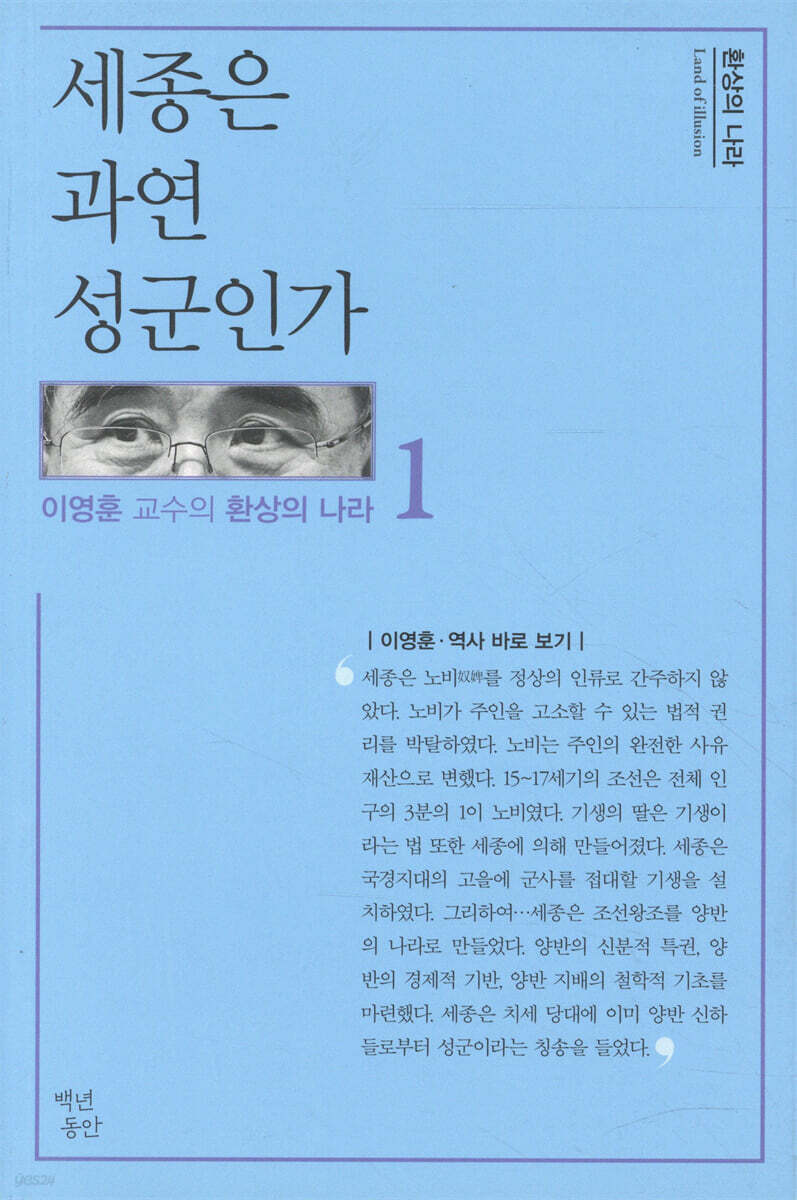
Was Sejong truly a wise king?
 |
Description
index
Preface - 004
1.
The Greatest Figure in Korean History - 015
2.
Sejong and the slave system
30-40% of the population in the 15th-17th centuries were slaves _ 024
The scale of the nobleman's slaves _ 026
Military service and tribute payment _ 028
Slaves are the master's property _ 033
Slaves could be killed without any crime _ 036
The path of slave proliferation is through marriage between good and bad people _ 039
The Slave Law of Gija _ 042
Social Structure of Goryeo and Joseon _ 045
The situation of Goryeo slaves was like that.
It wasn't bad _ 046
Taejong's policy of blocking the slave system _ 050
Sejong deprives slaves of their rights _ 053
The Runner's Beautiful Words _ 057
Byeong-gil didn't ask about the body _ 061
Sejong unlocks the Yangcheon Golden Soul _ 062
Loyal Slave Tales _ 065
Chuno (推奴) Action Drama _ 069
If he were a wise king, he would be Yeongjo _ 073
Comforting the Dead Servant _ 076
The World of "Heungbu and Nolbu" _ 079
3.
Sejong and the Gisaeng
Kimchi Jong _ 084
In the blue waters of the Nakdong River _ 087
Sad Fragrance Fortune _ 089
Direct maid _ 093
Rain of wind and rain _ 096
The Origin of Parasites _ 097
The Status of Goryeo Gisaengs _ 101
The Deepening of the Idea of Lowliness _ 104
Sejong, taking a gisaeng's daughter as a gisaeng _ 107
Hire a gisaeng to entertain the soldiers _ 110
The Reality of Comfort _ 114
Comforting for Generations _ 117
The Lowly Child and the Lowly Mother-in-Law _ 119
Parasite Head Raise _ 121
The Prostitute's Subordinate _ 124
Parasites of the 19th Century _ 127
Chunhyang's Dream _ 132
4.
Sejong and the Four Great Powers
Great Mongol Ulus _ 140
History of the Yi Dynasty _ 142
The First World Map _ 145
The Country of Gija _ 147
Sejong Abolishes Heavenly Rites _ 151
The Greatest Sincerity in Doing Things _ 156
The Lost Axe and Sword _ 160
Abolition of the Calendar-Month System _ 163
Purification into a Moral Nation _ 169
Correct Chinese characters for the people
Teach _ 171
Even in academia, there are groups with close ties _ 175
Choi Man-ri's Opposition _ 178
The Subjectivity of Sojunghwa _ 180
5.
The Republic of Korea is a republic of free people.
Summary _ 184
A few more _ 187
Problems in Modern Korean History _ 190
Thoughts on Freedom _ 194
Are You Free _ 199
Modern Edition of 『Elementary Learning』 _ 201
A Great Transition in the History of Civilization _ 203
The Formation of Fantasy _ 208
1.
The Greatest Figure in Korean History - 015
2.
Sejong and the slave system
30-40% of the population in the 15th-17th centuries were slaves _ 024
The scale of the nobleman's slaves _ 026
Military service and tribute payment _ 028
Slaves are the master's property _ 033
Slaves could be killed without any crime _ 036
The path of slave proliferation is through marriage between good and bad people _ 039
The Slave Law of Gija _ 042
Social Structure of Goryeo and Joseon _ 045
The situation of Goryeo slaves was like that.
It wasn't bad _ 046
Taejong's policy of blocking the slave system _ 050
Sejong deprives slaves of their rights _ 053
The Runner's Beautiful Words _ 057
Byeong-gil didn't ask about the body _ 061
Sejong unlocks the Yangcheon Golden Soul _ 062
Loyal Slave Tales _ 065
Chuno (推奴) Action Drama _ 069
If he were a wise king, he would be Yeongjo _ 073
Comforting the Dead Servant _ 076
The World of "Heungbu and Nolbu" _ 079
3.
Sejong and the Gisaeng
Kimchi Jong _ 084
In the blue waters of the Nakdong River _ 087
Sad Fragrance Fortune _ 089
Direct maid _ 093
Rain of wind and rain _ 096
The Origin of Parasites _ 097
The Status of Goryeo Gisaengs _ 101
The Deepening of the Idea of Lowliness _ 104
Sejong, taking a gisaeng's daughter as a gisaeng _ 107
Hire a gisaeng to entertain the soldiers _ 110
The Reality of Comfort _ 114
Comforting for Generations _ 117
The Lowly Child and the Lowly Mother-in-Law _ 119
Parasite Head Raise _ 121
The Prostitute's Subordinate _ 124
Parasites of the 19th Century _ 127
Chunhyang's Dream _ 132
4.
Sejong and the Four Great Powers
Great Mongol Ulus _ 140
History of the Yi Dynasty _ 142
The First World Map _ 145
The Country of Gija _ 147
Sejong Abolishes Heavenly Rites _ 151
The Greatest Sincerity in Doing Things _ 156
The Lost Axe and Sword _ 160
Abolition of the Calendar-Month System _ 163
Purification into a Moral Nation _ 169
Correct Chinese characters for the people
Teach _ 171
Even in academia, there are groups with close ties _ 175
Choi Man-ri's Opposition _ 178
The Subjectivity of Sojunghwa _ 180
5.
The Republic of Korea is a republic of free people.
Summary _ 184
A few more _ 187
Problems in Modern Korean History _ 190
Thoughts on Freedom _ 194
Are You Free _ 199
Modern Edition of 『Elementary Learning』 _ 201
A Great Transition in the History of Civilization _ 203
The Formation of Fantasy _ 208
Publisher's Review
Starting the "Fantasy Land" series
“The land of fantasy, that country is the Republic of Korea.
It's not a fantasy in the sense of very good, great, fantastic, etc.
It is an illusion, an illusion, an illusory, an illusion in that sense.
Everyone believes it without a doubt, but when you look into it, it turns out to be baseless, untrue, or even a lie. That's the illusion I'm talking about.
Illusion cannot lead people to great trust and cooperation.
The gap between history and reality created by fantasy causes a division between mind and body.
Fantasy itself is anti-science.
Illusions must be faced and overcome with appropriate alternatives.
It was a task of the times that the intellectuals of the new Republic of Korea had to face.
Looking back on the past 70 years of national history, it is difficult to evaluate whether the knowledge society, including universities, has adequately responded to it.
Rather, the knowledge society has been preoccupied with the role of promoting illusions.
As a result, today this country is so severely shackled by various illusions that it is difficult to breathe.
Internally, the ideological conflict is so severe that it is difficult to call them one nation, while externally, they are constantly engaging in unnecessary friction with their allies.
It was out of this sense of crisis that I gave a lecture titled “Land of Fantasy” on an internet media outlet for three months starting in May 2016.
There were 12 topics in total.
If I list a few in order of the viewers' reactions, they are 'Is Sejong truly a wise king?', 'Who sold the country?', 'Our people, the ominousness of it,' 'Women in comfort stations,' and 'The fantasy of unification.'
This book is an expanded version of the lecture notes from Lecture 1, “Was Sejong truly a wise king?”, in a format and volume that can be evaluated as an academic book.
“We plan to publish the remaining lectures one by one in the same way.”
Sejong and the slave system
In the mid-17th century, the population of the Joseon Dynasty was estimated at approximately 12 million.
Of these, 30-40%, or 3.6-4.8 million people, were slaves.
I have never heard of there being so many slaves.
But it is an undeniable fact.
The family registers of Saneum-hyeon and Danseong-hyeon in Gyeongsang-do, which were created in 1606, are handed down.
It is the oldest family register among those currently being handed down.
According to the Sanyin County household register, 42% of the population are slaves.
In Danseong-hyeon's household register, it is 64%.
There is a Ulsanbu family register created in 1609.
The slave population there is 47%.
If the above is from the early 17th century, then at the end of the 17th century, there is the Daegu-bu family register created in 1690.
There, 43% of the population are slaves.
In this way, in the case of Gyeongsang Province in the 17th century, 42-64% of the population registered in the household register were slaves.
As for household registers outside of Gyeongsang-do, we can cite the Hanseongbu household register created in 1663.
This is the household register of the area around Ahyeon-dong, Gajwa-dong, and Hapjeong-dong in Seoul today.
The total population registered in the family register is 2,374, of which 1,729, or 73%, are slaves.
At that time, the population of Hanseongbu was approximately 200,000.
Half of them lived within the castle walls within the four gates, and the other half lived in the castle grounds outside the four gates.
The above register shows that in the mid-17th century, nearly three-quarters of the population of Seongjeo were slaves.
It would have been the same in Seongnae.
As you know, Hanseongbu, or Seoul, is where the royal family and other noble families live.
In a word, 17th century Seoul was a city teeming with slaves.
Going back to the 15th and 16th centuries, it is difficult to know the exact proportion of the slave population because there are no household registers.
However, considering various circumstances, it is almost certain that there were more slaves than in the 17th century. A comprehensive review of various information found in the Annals of the Dynasty shows that at least 40% of the total population of 9 million at the end of the 15th century were slaves.
Even the lowest-ranking officials of the Yangban class who lived in Seoul in the 15th and 16th centuries owned 100 slaves.
As the official position increased, the number increased, and hundreds were common.
Among the records of wealth currently handed down, the person who owned the largest number of slaves was Lee Maeng-hyeon, who served as the Vice-Chancellor of Hongmungwan, a third-rank official, and owned a total of 758 slaves.
It was not difficult for a high-ranking official like a minister or prime minister of a higher rank to have more than 1,000 people.
If you go up to royalty, there would probably be thousands.
The largest known ones are Prince Gwangpyeong, the fifth prince of King Sejong, and Prince Yeong-eung, the eighth prince.
The Annals of the Dynasty states that each of these two princes had over 10,000 slaves.
The fall of the Goryeo Dynasty and the establishment of the Joseon Dynasty signified a transition from a communal society to a class society.
The political power that founded the Joseon Dynasty followed the tradition of the Goryeo Dynasty and initially adopted a policy of suppressing the expansion of the slave population.
In 1401, King Taejong issued a decree completely banning marriages between slaves and commoners.
The policy of blocking the slave system was implemented, which stated that slaves could only be reproduced through marriage between a slave and a female slave.
In August 1418, the era of King Sejong began.
In September 1420, Heo Jo, the Minister of Rites, argued that if a slave sued his master, the case should not be accepted and the slave should be executed.
Heo Jo cited the story of Emperor Taizong of Tang of China, who would not accept a lawsuit filed against a nobleman even if it was about treason, and instead executed the nobleman, as the basis for his argument.
Sejong agreed with this false claim.
The Joseon yangban officials did not pay attention to the fact that a slave's lawsuit against his master might be justified in the name of humanity.
Looking at the Annals of the Joseon Dynasty, we see that King Sejong readily agreed to his subjects' claim that all complaints against slaves should be dealt with by hanging.
In the establishment of the Joseon slave system, nothing was more important than the enactment of the Slave Complaint Prohibition Act in 1422.
The true condition of slavery lies in the loss of legal capacity.
Orlando Patterson called this 'social death'.
A slave is alive, but in reality he is as good as dead.
The essence of slavery is the lack of the right to confront the wrongdoings of others and the loss of a community to protect oneself.
Sejong played a major role in the great expansion of the slave population during the Joseon Dynasty.
Sejong deprived slaves of the legal right to sue their masters.
After that, slaves became the complete private property of their masters.
It has become an era where killing a slave without permission is not considered a serious crime.
Accordingly, the price of slaves increased fivefold compared to the Goryeo Dynasty.
Taejong prohibited marriages between slaves and commoners, and made children born from a woman's marriage to a commoner man have commoner status.
Sejong allowed marriages between slaves and commoners, and turned the children of slaves and commoners into slaves.
Sejong did not consider slaves as normal human beings.
Sejong did not acknowledge the chastity of his wife due to the prejudice that she frequently changed husbands.
This view of slavery was at work in Sejong's decision to make all of Bi's descendants slaves.
Afterwards, as the slave population increased rapidly, the golden age of the slave system began in Korean history.
Sejong and the Gisaeng
In 1419, the first year of King Sejong's reign, the governor of Pyeongan made two suggestions regarding the Gisaeng system.
One is that the morals of the officials are corrupted by parasites, so we should prohibit parasites from being committed by officials.
He argued that it was morally impossible for several officials to take turns admonishing a parasite.
The suggestion of the Pyeongan Gamsa was adopted by King Sejong despite the opposition of many of his ministers.
Another suggestion is to expand the parasites as they are in short supply.
It is unclear what decision Sejong made about it, but history has since flowed in that direction.
First of all, they supplemented the parasites with various kinds of rain or tried to do so, so parasites were actually considered to have the same status as rain.
Afterwards, the Gyeongguk Daejeon stipulated that the number of gisaeng in Gyobang was 230, and that they would be paid by selecting government officials from each county for three years.
People often think of parasites as professionals who dance, sing, and provide sexual services, but that is not the case.
Joseon's gisaeng were nothing more than government concubines forced by the state to perform such roles.
Also, since it was said that the daughter of a former gisaeng should be made a gisaeng, the gisaeng was considered to have inherited her status.
In fact, during the 10th year of King Sejong's reign, a phenomenon occurred where even the children of high-ranking officials could not escape the burden of hardship.
Finally, in January 1431, the most important measure related to the establishment of the Joseon Gisaeng System was taken.
Sejong accepted the Ministry of Justice's suggestion that the children born to prostitutes in each region be treated as commoners, following the example of public and private wives who frequently changed husbands.
Here, the law of hereditary status was officially decided, making the daughter of a gisaeng a gisaeng and the son of a gisaeng a government slave.
In November 1431, King Sejong agreed to a proposal to return all children born to a commoner, following the example of gisaeng, to the status of commoners, as the paternity of children born to a commoner cannot be recognized.
The establishment of the Jongmo Law, which laid the foundation for the Joseon slave system in March 1432, started with the establishment of the Jongmo Law targeting gisaengs one year and two months earlier.
If you think about it, the Joseon gisaeng system was the core of the Joseon slave system.
Throughout the Joseon Dynasty, there were women of the gisaeng class who danced, sang, and provided sexual comfort in the central government and local government offices.
The status of a parasite was passed down to her daughter.
It is unknown whether there are any examples in other countries where the role of sexual entertainment was forced upon certain women and made hereditary.
In that sense, parasites symbolize the unique characteristics of Korean history in world history.
The king who actually created the parasite was none other than Sejong.
The law that the daughter of a gisaeng is a gisaeng was created by King Sejong.
After that, the parasite was reduced to the status of a government concubine.
Even in the previous Goryeo Dynasty, gisaeng were not government officials.
Furthermore, Sejong installed gisaeng in border regions to entertain the military.
Afterwards, dozens of gisaeng were placed in each county and district across the country.
The parasite system created by King Sejong formed the historical origin of the 20th century military comfort women system.
Sejong and the Four Great Powers
When the Joseon Dynasty came into being, the claim was raised by the subjects that the Heavenly Rites were a unique ritual of the Emperor and that feudal lords could not perform them.
Taejo and Taejong performed the rites to heaven without being bound by it.
In 1419, the first year of King Sejong's reign, there was a severe drought.
Byeon Gye-ryang requested that a rite be held at Won-gu-dan.
Sejong replied, “It is impossible to practice such presumptuous etiquette.”
It means that you cannot perform the ritual.
Then, the king argued that it was unfair to abolish the customs that had been practiced for thousands of years, and furthermore, Joseon's territory was only a few thousand li, so it could not be compared to the hundreds of li feudal lords in China.
Sejong again refused, saying, “How can I treat the emperor’s rites without any respect when our territory is thousands of li?”
In response, Byeon Gye-ryang put forward the expedient argument that there was nothing wrong with a feudal lord offering sacrifices to heaven during a severe drought.
Sejong accepted the claim and held a ceremony to commemorate the heavens.
Sejong, a young man of 22 who had just ascended to the throne, could not defeat Byeon Gye-ryang, a high-ranking official of 50 years old.
Sejong waited patiently for his time.
King Sejong's great character is that he is gentle, respectful to his ministers, and unhurried.
There was a good reason why he was praised as a wise king by his subjects during his reign.
Sejong's conviction that the Emperor of Heaven was an arrogant rite that a feudal lord could not perform was finally put into practice after a long wait.
The following year, 1439, there was a great drought.
There was a petition asking King Sejong to personally go to Won-gu-dan and perform a ritual for heaven, but he refused.
Traditionally, in East Asian dynastic states, the Heavenly Rites, along with the Jongmyo Shrine, were the highest level of rituals symbolizing the legitimacy of the dynasty.
The Cheonje represented the absolute authority of the king in his relationship with heaven, and the Jongmyo represented the absolute authority of the king in his relationship with the ancestral gods.
With the final abolition of the Heavenly Emperor in 1443, the state system of the Joseon Dynasty was faithfully reorganized into that of a vassal state.
In the pre-modern world before the establishment of international law, the submission of a small and weak nation to a large and strong nation was a desperate measure to preserve the ancestral shrine and the country and to ensure the peace of the people.
A relationship of trust is a strategic one for both the giver and the receiver.
The one who gives hides his true feelings, and the one who receives is suspicious of the other person.
It was like that for the four generations up to the reign of King Taejong of Joseon.
There was latent military tension between the two countries.
The envoys who came and went spied on the politics of the other country.
When you enter the Sejong era, the atmosphere changes.
If you read the Annals of King Sejong, you will definitely feel that point.
In a word, Sejong was a man of intelligence.
The Goryeo Dynasty was a military state.
In that respect, it was different from the Joseon Dynasty, which was a moral nation.
Goryeo had a central army of about 30,000 soldiers.
They received land from the state and lived off of taxes collected from it.
Since they did not farm directly, they had strong fighting power as professional soldiers.
As a military state, Goryeo performed a military ceremony called Chuljeongui, sending generals to war.
When the expedition is decided, a ritual is first performed at Sajikdan and then it is reported to Jongmyo.
Next, a ceremony is held in the palace courtyard where the king bestows an axe on the commander of the expeditionary force.
Such a military expedition belongs to the example of the emperor.
The moon symbolized the authority of the emperor.
A general who receives a military commission has the authority to handle all matters related to the expedition from the moment he leaves the palace gate.
It goes without saying that he can, at his discretion, punish subordinate officers and soldiers who disobey military orders.
The vassal states also performed expeditionary ceremonies, but there was no ceremony to bestow the moon.
The feudal lord had no royal title to bestow.
Since there was no annexation, the commander of the expeditionary force had limited authority to execute his subordinate generals and soldiers.
In 1419, the first year of King Sejong's reign, when Lee Jong-mu became the military inspector general of the three armies and went to conquer Tsushima Island, King Sejong simply saw Lee Jong-mu and several generals off at the white sand beach of Dumopo, Hanseongbu.
There was no formal military salute.
The same thing happened in 1433 when the Jurchen invaded the border of Pyeongan Province and Choi Yun-deok went on a campaign as a military commander.
Afterwards, the military ceremonies of the Five Rites compiled by order of King Sejong did not include the military ceremonies of the expedition.
Sejong paid no attention to the emperor's intention to go on a campaign, let alone the intention of a feudal lord to go on a campaign.
It is questionable whether such an army can properly wage war.
Sejong's affection for the military may have been inadvertently destroying the Joseon Dynasty's military.
As I go out
It is an undeniable objective fact that the noblemen of the Joseon Dynasty praised King Sejong as a virtuous king.
The achievements made during the 30 years of his reign became the foundation for the 500-year-long Joseon Dynasty.
But should we, even today, revere him as a saint?
How should we accept the illusion that we should look to Sejong for 21st-century leadership, while completely omitting the fact that he established a slavery, parasitic system, and a vassal state system?
“The land of fantasy, that country is the Republic of Korea.
It's not a fantasy in the sense of very good, great, fantastic, etc.
It is an illusion, an illusion, an illusory, an illusion in that sense.
Everyone believes it without a doubt, but when you look into it, it turns out to be baseless, untrue, or even a lie. That's the illusion I'm talking about.
Illusion cannot lead people to great trust and cooperation.
The gap between history and reality created by fantasy causes a division between mind and body.
Fantasy itself is anti-science.
Illusions must be faced and overcome with appropriate alternatives.
It was a task of the times that the intellectuals of the new Republic of Korea had to face.
Looking back on the past 70 years of national history, it is difficult to evaluate whether the knowledge society, including universities, has adequately responded to it.
Rather, the knowledge society has been preoccupied with the role of promoting illusions.
As a result, today this country is so severely shackled by various illusions that it is difficult to breathe.
Internally, the ideological conflict is so severe that it is difficult to call them one nation, while externally, they are constantly engaging in unnecessary friction with their allies.
It was out of this sense of crisis that I gave a lecture titled “Land of Fantasy” on an internet media outlet for three months starting in May 2016.
There were 12 topics in total.
If I list a few in order of the viewers' reactions, they are 'Is Sejong truly a wise king?', 'Who sold the country?', 'Our people, the ominousness of it,' 'Women in comfort stations,' and 'The fantasy of unification.'
This book is an expanded version of the lecture notes from Lecture 1, “Was Sejong truly a wise king?”, in a format and volume that can be evaluated as an academic book.
“We plan to publish the remaining lectures one by one in the same way.”
Sejong and the slave system
In the mid-17th century, the population of the Joseon Dynasty was estimated at approximately 12 million.
Of these, 30-40%, or 3.6-4.8 million people, were slaves.
I have never heard of there being so many slaves.
But it is an undeniable fact.
The family registers of Saneum-hyeon and Danseong-hyeon in Gyeongsang-do, which were created in 1606, are handed down.
It is the oldest family register among those currently being handed down.
According to the Sanyin County household register, 42% of the population are slaves.
In Danseong-hyeon's household register, it is 64%.
There is a Ulsanbu family register created in 1609.
The slave population there is 47%.
If the above is from the early 17th century, then at the end of the 17th century, there is the Daegu-bu family register created in 1690.
There, 43% of the population are slaves.
In this way, in the case of Gyeongsang Province in the 17th century, 42-64% of the population registered in the household register were slaves.
As for household registers outside of Gyeongsang-do, we can cite the Hanseongbu household register created in 1663.
This is the household register of the area around Ahyeon-dong, Gajwa-dong, and Hapjeong-dong in Seoul today.
The total population registered in the family register is 2,374, of which 1,729, or 73%, are slaves.
At that time, the population of Hanseongbu was approximately 200,000.
Half of them lived within the castle walls within the four gates, and the other half lived in the castle grounds outside the four gates.
The above register shows that in the mid-17th century, nearly three-quarters of the population of Seongjeo were slaves.
It would have been the same in Seongnae.
As you know, Hanseongbu, or Seoul, is where the royal family and other noble families live.
In a word, 17th century Seoul was a city teeming with slaves.
Going back to the 15th and 16th centuries, it is difficult to know the exact proportion of the slave population because there are no household registers.
However, considering various circumstances, it is almost certain that there were more slaves than in the 17th century. A comprehensive review of various information found in the Annals of the Dynasty shows that at least 40% of the total population of 9 million at the end of the 15th century were slaves.
Even the lowest-ranking officials of the Yangban class who lived in Seoul in the 15th and 16th centuries owned 100 slaves.
As the official position increased, the number increased, and hundreds were common.
Among the records of wealth currently handed down, the person who owned the largest number of slaves was Lee Maeng-hyeon, who served as the Vice-Chancellor of Hongmungwan, a third-rank official, and owned a total of 758 slaves.
It was not difficult for a high-ranking official like a minister or prime minister of a higher rank to have more than 1,000 people.
If you go up to royalty, there would probably be thousands.
The largest known ones are Prince Gwangpyeong, the fifth prince of King Sejong, and Prince Yeong-eung, the eighth prince.
The Annals of the Dynasty states that each of these two princes had over 10,000 slaves.
The fall of the Goryeo Dynasty and the establishment of the Joseon Dynasty signified a transition from a communal society to a class society.
The political power that founded the Joseon Dynasty followed the tradition of the Goryeo Dynasty and initially adopted a policy of suppressing the expansion of the slave population.
In 1401, King Taejong issued a decree completely banning marriages between slaves and commoners.
The policy of blocking the slave system was implemented, which stated that slaves could only be reproduced through marriage between a slave and a female slave.
In August 1418, the era of King Sejong began.
In September 1420, Heo Jo, the Minister of Rites, argued that if a slave sued his master, the case should not be accepted and the slave should be executed.
Heo Jo cited the story of Emperor Taizong of Tang of China, who would not accept a lawsuit filed against a nobleman even if it was about treason, and instead executed the nobleman, as the basis for his argument.
Sejong agreed with this false claim.
The Joseon yangban officials did not pay attention to the fact that a slave's lawsuit against his master might be justified in the name of humanity.
Looking at the Annals of the Joseon Dynasty, we see that King Sejong readily agreed to his subjects' claim that all complaints against slaves should be dealt with by hanging.
In the establishment of the Joseon slave system, nothing was more important than the enactment of the Slave Complaint Prohibition Act in 1422.
The true condition of slavery lies in the loss of legal capacity.
Orlando Patterson called this 'social death'.
A slave is alive, but in reality he is as good as dead.
The essence of slavery is the lack of the right to confront the wrongdoings of others and the loss of a community to protect oneself.
Sejong played a major role in the great expansion of the slave population during the Joseon Dynasty.
Sejong deprived slaves of the legal right to sue their masters.
After that, slaves became the complete private property of their masters.
It has become an era where killing a slave without permission is not considered a serious crime.
Accordingly, the price of slaves increased fivefold compared to the Goryeo Dynasty.
Taejong prohibited marriages between slaves and commoners, and made children born from a woman's marriage to a commoner man have commoner status.
Sejong allowed marriages between slaves and commoners, and turned the children of slaves and commoners into slaves.
Sejong did not consider slaves as normal human beings.
Sejong did not acknowledge the chastity of his wife due to the prejudice that she frequently changed husbands.
This view of slavery was at work in Sejong's decision to make all of Bi's descendants slaves.
Afterwards, as the slave population increased rapidly, the golden age of the slave system began in Korean history.
Sejong and the Gisaeng
In 1419, the first year of King Sejong's reign, the governor of Pyeongan made two suggestions regarding the Gisaeng system.
One is that the morals of the officials are corrupted by parasites, so we should prohibit parasites from being committed by officials.
He argued that it was morally impossible for several officials to take turns admonishing a parasite.
The suggestion of the Pyeongan Gamsa was adopted by King Sejong despite the opposition of many of his ministers.
Another suggestion is to expand the parasites as they are in short supply.
It is unclear what decision Sejong made about it, but history has since flowed in that direction.
First of all, they supplemented the parasites with various kinds of rain or tried to do so, so parasites were actually considered to have the same status as rain.
Afterwards, the Gyeongguk Daejeon stipulated that the number of gisaeng in Gyobang was 230, and that they would be paid by selecting government officials from each county for three years.
People often think of parasites as professionals who dance, sing, and provide sexual services, but that is not the case.
Joseon's gisaeng were nothing more than government concubines forced by the state to perform such roles.
Also, since it was said that the daughter of a former gisaeng should be made a gisaeng, the gisaeng was considered to have inherited her status.
In fact, during the 10th year of King Sejong's reign, a phenomenon occurred where even the children of high-ranking officials could not escape the burden of hardship.
Finally, in January 1431, the most important measure related to the establishment of the Joseon Gisaeng System was taken.
Sejong accepted the Ministry of Justice's suggestion that the children born to prostitutes in each region be treated as commoners, following the example of public and private wives who frequently changed husbands.
Here, the law of hereditary status was officially decided, making the daughter of a gisaeng a gisaeng and the son of a gisaeng a government slave.
In November 1431, King Sejong agreed to a proposal to return all children born to a commoner, following the example of gisaeng, to the status of commoners, as the paternity of children born to a commoner cannot be recognized.
The establishment of the Jongmo Law, which laid the foundation for the Joseon slave system in March 1432, started with the establishment of the Jongmo Law targeting gisaengs one year and two months earlier.
If you think about it, the Joseon gisaeng system was the core of the Joseon slave system.
Throughout the Joseon Dynasty, there were women of the gisaeng class who danced, sang, and provided sexual comfort in the central government and local government offices.
The status of a parasite was passed down to her daughter.
It is unknown whether there are any examples in other countries where the role of sexual entertainment was forced upon certain women and made hereditary.
In that sense, parasites symbolize the unique characteristics of Korean history in world history.
The king who actually created the parasite was none other than Sejong.
The law that the daughter of a gisaeng is a gisaeng was created by King Sejong.
After that, the parasite was reduced to the status of a government concubine.
Even in the previous Goryeo Dynasty, gisaeng were not government officials.
Furthermore, Sejong installed gisaeng in border regions to entertain the military.
Afterwards, dozens of gisaeng were placed in each county and district across the country.
The parasite system created by King Sejong formed the historical origin of the 20th century military comfort women system.
Sejong and the Four Great Powers
When the Joseon Dynasty came into being, the claim was raised by the subjects that the Heavenly Rites were a unique ritual of the Emperor and that feudal lords could not perform them.
Taejo and Taejong performed the rites to heaven without being bound by it.
In 1419, the first year of King Sejong's reign, there was a severe drought.
Byeon Gye-ryang requested that a rite be held at Won-gu-dan.
Sejong replied, “It is impossible to practice such presumptuous etiquette.”
It means that you cannot perform the ritual.
Then, the king argued that it was unfair to abolish the customs that had been practiced for thousands of years, and furthermore, Joseon's territory was only a few thousand li, so it could not be compared to the hundreds of li feudal lords in China.
Sejong again refused, saying, “How can I treat the emperor’s rites without any respect when our territory is thousands of li?”
In response, Byeon Gye-ryang put forward the expedient argument that there was nothing wrong with a feudal lord offering sacrifices to heaven during a severe drought.
Sejong accepted the claim and held a ceremony to commemorate the heavens.
Sejong, a young man of 22 who had just ascended to the throne, could not defeat Byeon Gye-ryang, a high-ranking official of 50 years old.
Sejong waited patiently for his time.
King Sejong's great character is that he is gentle, respectful to his ministers, and unhurried.
There was a good reason why he was praised as a wise king by his subjects during his reign.
Sejong's conviction that the Emperor of Heaven was an arrogant rite that a feudal lord could not perform was finally put into practice after a long wait.
The following year, 1439, there was a great drought.
There was a petition asking King Sejong to personally go to Won-gu-dan and perform a ritual for heaven, but he refused.
Traditionally, in East Asian dynastic states, the Heavenly Rites, along with the Jongmyo Shrine, were the highest level of rituals symbolizing the legitimacy of the dynasty.
The Cheonje represented the absolute authority of the king in his relationship with heaven, and the Jongmyo represented the absolute authority of the king in his relationship with the ancestral gods.
With the final abolition of the Heavenly Emperor in 1443, the state system of the Joseon Dynasty was faithfully reorganized into that of a vassal state.
In the pre-modern world before the establishment of international law, the submission of a small and weak nation to a large and strong nation was a desperate measure to preserve the ancestral shrine and the country and to ensure the peace of the people.
A relationship of trust is a strategic one for both the giver and the receiver.
The one who gives hides his true feelings, and the one who receives is suspicious of the other person.
It was like that for the four generations up to the reign of King Taejong of Joseon.
There was latent military tension between the two countries.
The envoys who came and went spied on the politics of the other country.
When you enter the Sejong era, the atmosphere changes.
If you read the Annals of King Sejong, you will definitely feel that point.
In a word, Sejong was a man of intelligence.
The Goryeo Dynasty was a military state.
In that respect, it was different from the Joseon Dynasty, which was a moral nation.
Goryeo had a central army of about 30,000 soldiers.
They received land from the state and lived off of taxes collected from it.
Since they did not farm directly, they had strong fighting power as professional soldiers.
As a military state, Goryeo performed a military ceremony called Chuljeongui, sending generals to war.
When the expedition is decided, a ritual is first performed at Sajikdan and then it is reported to Jongmyo.
Next, a ceremony is held in the palace courtyard where the king bestows an axe on the commander of the expeditionary force.
Such a military expedition belongs to the example of the emperor.
The moon symbolized the authority of the emperor.
A general who receives a military commission has the authority to handle all matters related to the expedition from the moment he leaves the palace gate.
It goes without saying that he can, at his discretion, punish subordinate officers and soldiers who disobey military orders.
The vassal states also performed expeditionary ceremonies, but there was no ceremony to bestow the moon.
The feudal lord had no royal title to bestow.
Since there was no annexation, the commander of the expeditionary force had limited authority to execute his subordinate generals and soldiers.
In 1419, the first year of King Sejong's reign, when Lee Jong-mu became the military inspector general of the three armies and went to conquer Tsushima Island, King Sejong simply saw Lee Jong-mu and several generals off at the white sand beach of Dumopo, Hanseongbu.
There was no formal military salute.
The same thing happened in 1433 when the Jurchen invaded the border of Pyeongan Province and Choi Yun-deok went on a campaign as a military commander.
Afterwards, the military ceremonies of the Five Rites compiled by order of King Sejong did not include the military ceremonies of the expedition.
Sejong paid no attention to the emperor's intention to go on a campaign, let alone the intention of a feudal lord to go on a campaign.
It is questionable whether such an army can properly wage war.
Sejong's affection for the military may have been inadvertently destroying the Joseon Dynasty's military.
As I go out
It is an undeniable objective fact that the noblemen of the Joseon Dynasty praised King Sejong as a virtuous king.
The achievements made during the 30 years of his reign became the foundation for the 500-year-long Joseon Dynasty.
But should we, even today, revere him as a saint?
How should we accept the illusion that we should look to Sejong for 21st-century leadership, while completely omitting the fact that he established a slavery, parasitic system, and a vassal state system?
GOODS SPECIFICS
- Date of issue: March 5, 2018
- Page count, weight, size: 244 pages | 386g | 142*210*15mm
- ISBN13: 9791186061589
- ISBN10: 1186061588
You may also like
카테고리
korean


korean

![GQ KOREA Mark (Monthly): December [2025]](http://librairie.coreenne.fr/cdn/shop/files/8ef265dbbfbf186523ed75ba7319009d.jpg?v=1765340328&width=3840)


