

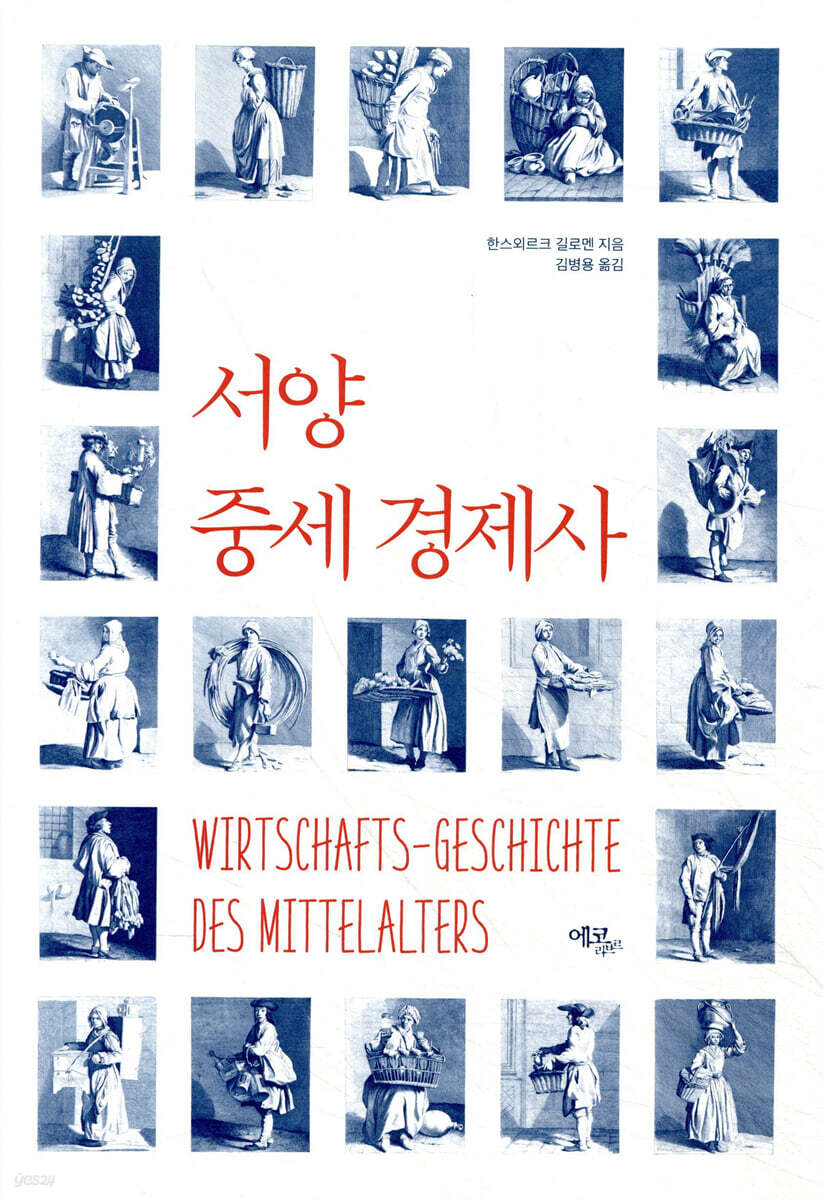
Western medieval economic history
 |
Description
Book Introduction
A concise yet insightful introduction to medieval economic history!
What is most surprising about this book is how the author, though a medieval expert, was able to so skillfully select the essential elements needed to explain the Middle Ages.
The author divides the approximately 1,000-year period from the 5th to 15th centuries (the Middle Ages are generally considered to be the period from the fall of the Western Roman Empire to the end of the Hundred Years' War, and the author's periodization is largely consistent with this) into four periods in terms of economic history.
First, it covers the transition from ancient Rome to the Middle Ages in the 5th to 7th centuries, then the early Middle Ages in the 7th to 9th centuries, and then the flourishing or middle period of the Middle Ages, with its economic downturn and new leap forward from the 10th to 13th centuries.
Finally, it describes the 14th and 15th centuries, the period of crisis and new challenges (transition to modern times) in the late Middle Ages.
The author selects only the essential elements that make up society in each period, and then provides a concise and clear explanation of how each element appears and what role it played in that society (the explanation of each element rarely exceeds two pages).
This can be easily confirmed by just looking at the table of contents.
The second thing that can be confirmed in this book is that the author compares the unique aspects of each period as well as common themes by period.
For example, we can examine changes over time in mining, viticulture, and livestock farming.
In this way, the author does a good job of explaining what continued to change and what new things emerged in the medieval economy.
Over the course of about 1,000 years, we can clearly see the gradual change from an agricultural society to a commercial society, largely through the emergence of new things.
Third, another characteristic of this book is that in several places, the author conceptualizes and explains history, perhaps under the guidance of Jacques Le Goff, a master of French medieval history.
This point is particularly prominent in the section that explains the entire era, divided into four stages.
This is particularly evident in the paragraph titled ‘Accumulation of Signs of Decline’ in Chapter 4.
What is most surprising about this book is how the author, though a medieval expert, was able to so skillfully select the essential elements needed to explain the Middle Ages.
The author divides the approximately 1,000-year period from the 5th to 15th centuries (the Middle Ages are generally considered to be the period from the fall of the Western Roman Empire to the end of the Hundred Years' War, and the author's periodization is largely consistent with this) into four periods in terms of economic history.
First, it covers the transition from ancient Rome to the Middle Ages in the 5th to 7th centuries, then the early Middle Ages in the 7th to 9th centuries, and then the flourishing or middle period of the Middle Ages, with its economic downturn and new leap forward from the 10th to 13th centuries.
Finally, it describes the 14th and 15th centuries, the period of crisis and new challenges (transition to modern times) in the late Middle Ages.
The author selects only the essential elements that make up society in each period, and then provides a concise and clear explanation of how each element appears and what role it played in that society (the explanation of each element rarely exceeds two pages).
This can be easily confirmed by just looking at the table of contents.
The second thing that can be confirmed in this book is that the author compares the unique aspects of each period as well as common themes by period.
For example, we can examine changes over time in mining, viticulture, and livestock farming.
In this way, the author does a good job of explaining what continued to change and what new things emerged in the medieval economy.
Over the course of about 1,000 years, we can clearly see the gradual change from an agricultural society to a commercial society, largely through the emergence of new things.
Third, another characteristic of this book is that in several places, the author conceptualizes and explains history, perhaps under the guidance of Jacques Le Goff, a master of French medieval history.
This point is particularly prominent in the section that explains the entire era, divided into four stages.
This is particularly evident in the paragraph titled ‘Accumulation of Signs of Decline’ in Chapter 4.
- You can preview some of the book's contents.
Preview
index
1 From Late Antiquity to the Middle Ages (5th–7th centuries): Discontinuity and Continuity
A New Economy Influenced by Christianity? | Population Decline | Settlement of the 'Barbarians' | The Fall of the Tax State | Agriculture | Land Cultivation | Viticulture | Olive Cultivation | Livestock, Hunting, Fishing | Mining, Ironworks | Expansion of Settlements, Cities, and Crafts | Commerce, Transport Roads | The Barbarian Economy
2 7th–9th centuries: The first boom
Representative forms of large-scale land management | Low yields and food crises | Vegetable cultivation | Viticulture | Hunting, fishing, and livestock farming | Farmers of various classes | Signs of an agricultural boom | Technology | Crafts | Mining, alchemy, and currency | Commerce
3. The Middle Ages: The Depression and New Economic Growth of the 10th to 13th Centuries
Economic crisis of the 10th century | Vikings, Normans, Saracens, Huns | Castles and autonomy | Economic growth phase | Population | Reclamation and migration | Agricultural productivity | Three-field system | Viticulture | New technologies | Spread of mills | Increased iron production | Production and sale of salt | Origin and construction of cities | Crafts and craftsmen's guilds | Increased use of money | Credit | Commercial boom ('Commercial Revolution') | Beginning of the Hanseatic League | Champagne market | New beginnings of distant trade | New beginnings of oceanic trade | Reaction of the Church
4 Late Middle Ages: Paralysis, Crisis, and New Beginnings
Accumulation of Signs of Decline | Population, Wages, and Prices | Alternatives to the Agrarian Economy | Remote Trade | Banking | Credit | Mining and Metals | Textile Production | Preemptive Rights and Innovation in the Textile Industry | Craftsmen's Guilds | View
References
Translator's Note
Search
A New Economy Influenced by Christianity? | Population Decline | Settlement of the 'Barbarians' | The Fall of the Tax State | Agriculture | Land Cultivation | Viticulture | Olive Cultivation | Livestock, Hunting, Fishing | Mining, Ironworks | Expansion of Settlements, Cities, and Crafts | Commerce, Transport Roads | The Barbarian Economy
2 7th–9th centuries: The first boom
Representative forms of large-scale land management | Low yields and food crises | Vegetable cultivation | Viticulture | Hunting, fishing, and livestock farming | Farmers of various classes | Signs of an agricultural boom | Technology | Crafts | Mining, alchemy, and currency | Commerce
3. The Middle Ages: The Depression and New Economic Growth of the 10th to 13th Centuries
Economic crisis of the 10th century | Vikings, Normans, Saracens, Huns | Castles and autonomy | Economic growth phase | Population | Reclamation and migration | Agricultural productivity | Three-field system | Viticulture | New technologies | Spread of mills | Increased iron production | Production and sale of salt | Origin and construction of cities | Crafts and craftsmen's guilds | Increased use of money | Credit | Commercial boom ('Commercial Revolution') | Beginning of the Hanseatic League | Champagne market | New beginnings of distant trade | New beginnings of oceanic trade | Reaction of the Church
4 Late Middle Ages: Paralysis, Crisis, and New Beginnings
Accumulation of Signs of Decline | Population, Wages, and Prices | Alternatives to the Agrarian Economy | Remote Trade | Banking | Credit | Mining and Metals | Textile Production | Preemptive Rights and Innovation in the Textile Industry | Craftsmen's Guilds | View
References
Translator's Note
Search
Into the book
grape cultivation
The next most important food item after wheat was wine, which was consumed daily by people of all classes.
This wine culture had already spread northward in the late Roman period.
The Allobroges people of the Rhone River basin succeeded in producing the grape variety 'allobrogica', which can withstand the harsh climate, in the 1st century.
The main sales markets for this wine were Vienne and Lyon.
The market could expand northward like this thanks to the boat transport along the Song River.
Another wine region at the same time was Bordeaux, which produced a new grape variety called 'biturica'.
Bordeaux was a centre for wine exports, particularly to Britain.
At the same time, neighboring Spain produced a new grape variety called 'cocolubis'.
In the 3rd century, vineyards appeared in Burgundy.
The regions of Burgenland and South Tyrol had been growing grapes since before the Romans.
In the Alsace and Mosel region, a wine press dating back to 200 AD has also been discovered, at Piesport-Mustert near the imperial city of Trier.
Literally, it has been confirmed that the 4th century poet Ausonius praised Moselle wine in his book Moselle (Mosella), a travelogue of the Moselle River.
According to the Historia Augusta, written by six authors around 300 AD, Emperor Probus (Marcus Aurelius Probus, reigned 276–282) made wine, previously enjoyed by a privileged few, available to everyone by granting permission for all Gauls, Spaniards, and Britons to produce wine.
The expansion of grape production to the basins of the Seine, Loire, Palatinate, and Rhine is probably related to this measure.
All the early wine-exporting regions were along waterways, such as the Rhône, Garonne, Saône, Seine, Loire, Moselle, and lower Rhine.
This shows that transportation played a big role in the wine trade.
Traditional wine-exporting regions, particularly Italy, have long faced fierce competition from regions north of the Alps. --- p.28-30
Accumulation of signs of decline
Certain historical sources and indicators show that population growth stagnated by the end of the 13th century.
It is not clear whether this was due to intentionally lowering the birth rate or high mortality rates, but population decline is occurring en masse in many areas.
The plain fact is that the climate has worsened.
The optimal conditions for the Medieval Warm Period ended around 1300.
The period from about 1315 to 1320, dubbed “the first economic crisis of the fourteenth century” by British academics, was, on the one hand, a decisive rupture that tilted the long-standing balance between resources and population, immediately leading to the next crisis, the plague crisis; on the other hand, it was a serendipitous event.
Due to bad weather, the harvest of all grains in England fell by 40.63 percent over a three-year period from 1315.
This was 10 percent lower than normal.
A new famine came in 1321.
In wheat cultivation, the yield ratio decreased from an average of 1 to 3.75 between 1270 and 1300 to 1 to 2.5.
Other parts of northwestern Europe, such as Scotland, Ireland, France and Flanders, also suffered from famines.
The harvest of 1316 in Germany was a disaster.
Grain prices rose dramatically and wages fell to late medieval lows.
As a result, 10 to 15 percent of the population died from starvation and disease.
Between 1313 and 1317, a livestock epidemic broke out, causing mass deaths of sheep.
English wool exports fell by a third between 1315/1316 and 1324/1325, and did not fully recover for the next decade.
From 1315 to 1325, the bubonic plague raged across northwestern Europe for a long time.
Between April 1319 and September 1320, 63 percent of the oxen and cows in England and Wales died, leading to shortages of animals for farming and transport.
It took English landowners thirty years—an impossible task for the peasants—to regain the number of livestock they had in 1319.
This resulted in a persistent shortage of dairy products.
Witnesses at the time already considered the first plague outbreak in 1348–1352 to be a turning point.
The epidemic began in 1347 on a Genoese ship from Asia.
To be precise, a ship carrying cargo from Kaffa in the Black Sea brought the disease, and it quickly spread throughout Europe through commercial routes.
As new plagues continued to break out, the epidemic lost its terrifying character.
People adapted to it and lived with it.
The people of that time viewed this period as a trap, a crisis that they had to overcome by getting out of it.
The next most important food item after wheat was wine, which was consumed daily by people of all classes.
This wine culture had already spread northward in the late Roman period.
The Allobroges people of the Rhone River basin succeeded in producing the grape variety 'allobrogica', which can withstand the harsh climate, in the 1st century.
The main sales markets for this wine were Vienne and Lyon.
The market could expand northward like this thanks to the boat transport along the Song River.
Another wine region at the same time was Bordeaux, which produced a new grape variety called 'biturica'.
Bordeaux was a centre for wine exports, particularly to Britain.
At the same time, neighboring Spain produced a new grape variety called 'cocolubis'.
In the 3rd century, vineyards appeared in Burgundy.
The regions of Burgenland and South Tyrol had been growing grapes since before the Romans.
In the Alsace and Mosel region, a wine press dating back to 200 AD has also been discovered, at Piesport-Mustert near the imperial city of Trier.
Literally, it has been confirmed that the 4th century poet Ausonius praised Moselle wine in his book Moselle (Mosella), a travelogue of the Moselle River.
According to the Historia Augusta, written by six authors around 300 AD, Emperor Probus (Marcus Aurelius Probus, reigned 276–282) made wine, previously enjoyed by a privileged few, available to everyone by granting permission for all Gauls, Spaniards, and Britons to produce wine.
The expansion of grape production to the basins of the Seine, Loire, Palatinate, and Rhine is probably related to this measure.
All the early wine-exporting regions were along waterways, such as the Rhône, Garonne, Saône, Seine, Loire, Moselle, and lower Rhine.
This shows that transportation played a big role in the wine trade.
Traditional wine-exporting regions, particularly Italy, have long faced fierce competition from regions north of the Alps. --- p.28-30
Accumulation of signs of decline
Certain historical sources and indicators show that population growth stagnated by the end of the 13th century.
It is not clear whether this was due to intentionally lowering the birth rate or high mortality rates, but population decline is occurring en masse in many areas.
The plain fact is that the climate has worsened.
The optimal conditions for the Medieval Warm Period ended around 1300.
The period from about 1315 to 1320, dubbed “the first economic crisis of the fourteenth century” by British academics, was, on the one hand, a decisive rupture that tilted the long-standing balance between resources and population, immediately leading to the next crisis, the plague crisis; on the other hand, it was a serendipitous event.
Due to bad weather, the harvest of all grains in England fell by 40.63 percent over a three-year period from 1315.
This was 10 percent lower than normal.
A new famine came in 1321.
In wheat cultivation, the yield ratio decreased from an average of 1 to 3.75 between 1270 and 1300 to 1 to 2.5.
Other parts of northwestern Europe, such as Scotland, Ireland, France and Flanders, also suffered from famines.
The harvest of 1316 in Germany was a disaster.
Grain prices rose dramatically and wages fell to late medieval lows.
As a result, 10 to 15 percent of the population died from starvation and disease.
Between 1313 and 1317, a livestock epidemic broke out, causing mass deaths of sheep.
English wool exports fell by a third between 1315/1316 and 1324/1325, and did not fully recover for the next decade.
From 1315 to 1325, the bubonic plague raged across northwestern Europe for a long time.
Between April 1319 and September 1320, 63 percent of the oxen and cows in England and Wales died, leading to shortages of animals for farming and transport.
It took English landowners thirty years—an impossible task for the peasants—to regain the number of livestock they had in 1319.
This resulted in a persistent shortage of dairy products.
Witnesses at the time already considered the first plague outbreak in 1348–1352 to be a turning point.
The epidemic began in 1347 on a Genoese ship from Asia.
To be precise, a ship carrying cargo from Kaffa in the Black Sea brought the disease, and it quickly spread throughout Europe through commercial routes.
As new plagues continued to break out, the epidemic lost its terrifying character.
People adapted to it and lived with it.
The people of that time viewed this period as a trap, a crisis that they had to overcome by getting out of it.
--- p.155~156
GOODS SPECIFICS
- Date of publication: December 29, 2017
- Page count, weight, size: 208 pages | 288g | 145*210*16mm
- ISBN13: 9788962631692
- ISBN10: 8962631695
You may also like
카테고리
korean


korean

![GQ KOREA Mark (Monthly): December [2025]](http://librairie.coreenne.fr/cdn/shop/files/8ef265dbbfbf186523ed75ba7319009d.jpg?v=1765340328&width=3840)


