

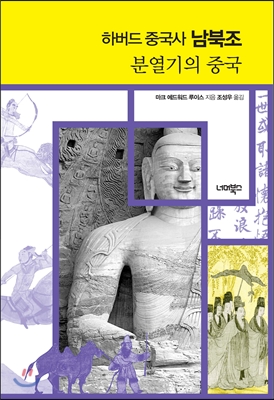
Harvard Chinese History, Southern and Northern Dynasties
 |
Description
Book Introduction
An era of redefinition of China
When the Han Dynasty collapsed, China was divided into the South and the North.
However, this division also meant the expansion and diversification of Chinese culture.
In his book, “Harvard Chinese History: The Southern and Northern Dynasties – China in the Age of Division,” Professor Mark Edward Lewis (Stanford University, USA) uses his characteristic expository style to depict the complex changes.
During the four hundred years between the Han and Tang dynasties, China's geographical definition changed and its relations with the outside world became more intimate.
There were also major changes in the family structure, advances in literature and society, and new religions emerged.
The newly developed Yangtze River basin emerged as a center of rice production.
Literature began to depict new social spaces and regional cultures emerging outside the court and capital, such as gardens, temples, and country villas.
As self-aware upper-class families grew, a concept of a ruling class different from the traditional Han magnates defined by material wealth emerged.
The emergence of Taoism and Buddhism following the religious rebellion that brought down the Han Dynasty brought about changes in all aspects of life, including the state, economy, and kinship.
When the Sui Dynasty reunified China in 589, the emperor's power became more consolidated and the ruling class became subject to imperial order.
The Chinese now became part of a new world order, interacting materially and ideologically with nations sharing a common Buddhist faith.
In this way, the centuries between the Han and Tang dynasties left deep and lasting marks on China.
When the Han Dynasty collapsed, China was divided into the South and the North.
However, this division also meant the expansion and diversification of Chinese culture.
In his book, “Harvard Chinese History: The Southern and Northern Dynasties – China in the Age of Division,” Professor Mark Edward Lewis (Stanford University, USA) uses his characteristic expository style to depict the complex changes.
During the four hundred years between the Han and Tang dynasties, China's geographical definition changed and its relations with the outside world became more intimate.
There were also major changes in the family structure, advances in literature and society, and new religions emerged.
The newly developed Yangtze River basin emerged as a center of rice production.
Literature began to depict new social spaces and regional cultures emerging outside the court and capital, such as gardens, temples, and country villas.
As self-aware upper-class families grew, a concept of a ruling class different from the traditional Han magnates defined by material wealth emerged.
The emergence of Taoism and Buddhism following the religious rebellion that brought down the Han Dynasty brought about changes in all aspects of life, including the state, economy, and kinship.
When the Sui Dynasty reunified China in 589, the emperor's power became more consolidated and the ruling class became subject to imperial order.
The Chinese now became part of a new world order, interacting materially and ideologically with nations sharing a common Buddhist faith.
In this way, the centuries between the Han and Tang dynasties left deep and lasting marks on China.
- You can preview some of the book's contents.
Preview
index
Preface to the Korean edition
Introduction
1_ Geography of North and South China
Agriculture and Water | Agriculture and Water | Mountains and Immigration | Writing on the Periphery | Painters, Hermits, and Sanctuaries | The Birth of Regional Superiority
2_ The rise of powerful families
The Quest for Status Among Powerful Families | The Fall of the Han Dynasty and the Emergence of the Three Kingdoms | Character Evaluation and Official Appointments | Cheongdam and the Reclusive Culture | The Golden Age of Powerful Families
3_ Military dynasty
Origins of the Military Dynasties | Military Dynasties of Southern China | Military Dynasties of Northern China
4_ Changes in the city
Provincial Cities and Customs | Urban Landscapes, Villas, and Gardens | Buddhist Temples as Semi-Public Spaces | Urban Economy
5_ Rural life
New Crops and Agricultural Technologies | The Family as a Social Organization | State Land | Writings on Village Life
6_ China and the outside world
Northern Nomadic Peoples in China | Surrounding Settled States | Trade and Buddhism | Foreigners in China
7_ Redefinition of kinship
Graveyards and Holidays | Writing about Family | Kinship and Buddhism | The New Role of Women
8_ Taoism and Buddhism
Daoism | Daoism | Overlaps and Borrowings Between Daoism and Buddhism | Taming the Wilderness
9_ Writing
The Quest for Subtlety | Lyric Poetry | Literary Theory | Calligraphy | Prose Narrative
Words that come out
Key chronological tables of the Wei, Jin, Southern and Northern Dynasties
Chinese dynasties
References
Author's Note
Translator's Note
Search
Introduction
1_ Geography of North and South China
Agriculture and Water | Agriculture and Water | Mountains and Immigration | Writing on the Periphery | Painters, Hermits, and Sanctuaries | The Birth of Regional Superiority
2_ The rise of powerful families
The Quest for Status Among Powerful Families | The Fall of the Han Dynasty and the Emergence of the Three Kingdoms | Character Evaluation and Official Appointments | Cheongdam and the Reclusive Culture | The Golden Age of Powerful Families
3_ Military dynasty
Origins of the Military Dynasties | Military Dynasties of Southern China | Military Dynasties of Northern China
4_ Changes in the city
Provincial Cities and Customs | Urban Landscapes, Villas, and Gardens | Buddhist Temples as Semi-Public Spaces | Urban Economy
5_ Rural life
New Crops and Agricultural Technologies | The Family as a Social Organization | State Land | Writings on Village Life
6_ China and the outside world
Northern Nomadic Peoples in China | Surrounding Settled States | Trade and Buddhism | Foreigners in China
7_ Redefinition of kinship
Graveyards and Holidays | Writing about Family | Kinship and Buddhism | The New Role of Women
8_ Taoism and Buddhism
Daoism | Daoism | Overlaps and Borrowings Between Daoism and Buddhism | Taming the Wilderness
9_ Writing
The Quest for Subtlety | Lyric Poetry | Literary Theory | Calligraphy | Prose Narrative
Words that come out
Key chronological tables of the Wei, Jin, Southern and Northern Dynasties
Chinese dynasties
References
Author's Note
Translator's Note
Search
Into the book
People moved more easily from the Yellow River basin to the Yangtze River basin thanks to routes that passed through mountains and followed waterways.
There were three main migration routes, each leading to one of the three regions of the Yangtze River.
The easiest route was to start from the lower Yellow River plains and proceed southeast, passing almost unnoticed through the watershed between the central Chinese Huaihai basin and the lower Yellow River.
(Omitted) As it approaches the Yangtze River, this route splits into a Shiot shape.
To the east, it goes to the mouth of the Yangtze River and enters Hangzhou, and to the west, it goes up the Yangtze River and enters Poyang Lake.
From Poyang Lake, you could go down the Gan River, pass Maeiling Pass, and go to the Beijiang River to reach present-day Guangdong.
Migrants following this southeastern migration route tended to flock to the lower Yangtze River region.
Migrants from this area around the southern capital Jiankang (formerly Jianye, today Nanjing) provided a skilled labor force and military personnel.
The second migration route began in Chang'an or Luoyang, the ancient capitals of Han.
The route from Chang'an crosses the Qinling Mountains via Wuguan Pass, a arduous path that requires crossing a plank road along a cliff face and climbing over 2,000 meters above sea level.
Next, we follow the Han River down to Yangyang, a city where the rivers meet.
From here, it joins the route that starts from Luoyang and crosses the Fuwu Mountains.
The unified route follows the Han River southward to the Dongting Lake area.
Refugees from the ancient capital of Han gathered along this route in the middle reaches of the Yangtze River and supplied troops for the Western Corps.
Some moved further south along the Gan River to Guangdong, or southwest along the Xiang River to Changsha, and then further down to present-day Vietnam.
The third, westernmost route was the most arduous and therefore of minimal historical importance.
This road went from Chang'an to Baojie in the west, then headed southwest along a winding mountain road to reach the Min River basin in the heart of Sichuan Province.
Of this 430-kilometer journey, one-third was a path carved into the cliff face.
A famous poem by contemporary poet Li Bai sings of the arduous hardships of following this arduous path.
--- pp.42-44
Although the non-state realm will appear repeatedly throughout this book, let us first examine two of the most important trends defining the new ruling class: the trend of cheongdam (淸談) and énil (隱逸).
The hierarchical structure of the nine-rank system linked promotion in the court to status in the local community, which was consolidated under the influence of a few major families, and the link between the two was Cheongdam.
The reason why Cheongdam was so crucial in the Nine Ranks System is because, as Yu So's 『Inmulji』 shows, conversation was used as a means of judging character.
The first part of 『People』, the section titled “Talents”, classifies the types of human talents and shows how each talent is expressed in conversation and debate.
In the latter part of the “Contact” section, it is said, “Half a morning is enough to get to know one side of a person.
However, it would take three days to fully review all aspects.
Why three days? Those who become essential to the nation possess three innate talents.
Therefore, it is impossible to fully understand a person without a three-day conversation.
One day we'll talk about ethics, one day we'll talk about law, and one day we'll talk about policy and strategy.
Only after doing this will you be able to fully appreciate that person's talents and recommend him without hesitation." (Omitted)
The term 'Cheongdam' is related to the ruling class of the late Han Dynasty.
They emerged with a sense of their own identity in the midst of a political struggle against the eunuch-dominated government.
This group's political discourse was called 'Cheongui' and was centered on evaluating people through dialogue.
Those leaders, especially Guo Tai, were renowned for their abilities in this field.
The ruling class at the end of the Han Dynasty had already combined dialogue, character evaluation, and the qualifications to become an official.
During the last years of the Han Dynasty and the early years of the Wei Dynasty, the terms "Qingyi" and "Qingtan" were interchangeable, and even as the term "Qingtan" expanded its scope over the centuries, it still retained its original, narrow meaning of character evaluation.
What is evident, therefore, in both theory and practice, is that a new type of dialogue-focused approach emerged within the Chinese ruling class, intertwined with a new type of political action and bureaucratic recruitment.
There were three main migration routes, each leading to one of the three regions of the Yangtze River.
The easiest route was to start from the lower Yellow River plains and proceed southeast, passing almost unnoticed through the watershed between the central Chinese Huaihai basin and the lower Yellow River.
(Omitted) As it approaches the Yangtze River, this route splits into a Shiot shape.
To the east, it goes to the mouth of the Yangtze River and enters Hangzhou, and to the west, it goes up the Yangtze River and enters Poyang Lake.
From Poyang Lake, you could go down the Gan River, pass Maeiling Pass, and go to the Beijiang River to reach present-day Guangdong.
Migrants following this southeastern migration route tended to flock to the lower Yangtze River region.
Migrants from this area around the southern capital Jiankang (formerly Jianye, today Nanjing) provided a skilled labor force and military personnel.
The second migration route began in Chang'an or Luoyang, the ancient capitals of Han.
The route from Chang'an crosses the Qinling Mountains via Wuguan Pass, a arduous path that requires crossing a plank road along a cliff face and climbing over 2,000 meters above sea level.
Next, we follow the Han River down to Yangyang, a city where the rivers meet.
From here, it joins the route that starts from Luoyang and crosses the Fuwu Mountains.
The unified route follows the Han River southward to the Dongting Lake area.
Refugees from the ancient capital of Han gathered along this route in the middle reaches of the Yangtze River and supplied troops for the Western Corps.
Some moved further south along the Gan River to Guangdong, or southwest along the Xiang River to Changsha, and then further down to present-day Vietnam.
The third, westernmost route was the most arduous and therefore of minimal historical importance.
This road went from Chang'an to Baojie in the west, then headed southwest along a winding mountain road to reach the Min River basin in the heart of Sichuan Province.
Of this 430-kilometer journey, one-third was a path carved into the cliff face.
A famous poem by contemporary poet Li Bai sings of the arduous hardships of following this arduous path.
--- pp.42-44
Although the non-state realm will appear repeatedly throughout this book, let us first examine two of the most important trends defining the new ruling class: the trend of cheongdam (淸談) and énil (隱逸).
The hierarchical structure of the nine-rank system linked promotion in the court to status in the local community, which was consolidated under the influence of a few major families, and the link between the two was Cheongdam.
The reason why Cheongdam was so crucial in the Nine Ranks System is because, as Yu So's 『Inmulji』 shows, conversation was used as a means of judging character.
The first part of 『People』, the section titled “Talents”, classifies the types of human talents and shows how each talent is expressed in conversation and debate.
In the latter part of the “Contact” section, it is said, “Half a morning is enough to get to know one side of a person.
However, it would take three days to fully review all aspects.
Why three days? Those who become essential to the nation possess three innate talents.
Therefore, it is impossible to fully understand a person without a three-day conversation.
One day we'll talk about ethics, one day we'll talk about law, and one day we'll talk about policy and strategy.
Only after doing this will you be able to fully appreciate that person's talents and recommend him without hesitation." (Omitted)
The term 'Cheongdam' is related to the ruling class of the late Han Dynasty.
They emerged with a sense of their own identity in the midst of a political struggle against the eunuch-dominated government.
This group's political discourse was called 'Cheongui' and was centered on evaluating people through dialogue.
Those leaders, especially Guo Tai, were renowned for their abilities in this field.
The ruling class at the end of the Han Dynasty had already combined dialogue, character evaluation, and the qualifications to become an official.
During the last years of the Han Dynasty and the early years of the Wei Dynasty, the terms "Qingyi" and "Qingtan" were interchangeable, and even as the term "Qingtan" expanded its scope over the centuries, it still retained its original, narrow meaning of character evaluation.
What is evident, therefore, in both theory and practice, is that a new type of dialogue-focused approach emerged within the Chinese ruling class, intertwined with a new type of political action and bureaucratic recruitment.
--- pp.100-102
Publisher's Review
An era of redefinition of China
When the Han Dynasty collapsed, China was divided into the South and the North.
However, this division also meant the expansion and diversification of Chinese culture.
In his book, “Harvard Chinese History: The Southern and Northern Dynasties – China in the Age of Division,” Professor Mark Edward Lewis (Stanford University, USA) uses his characteristic expository style to depict the complex changes.
During the four hundred years between the Han and Tang dynasties, China's geographical definition changed and its relations with the outside world became more intimate.
There were also major changes in the family structure, advances in literature and society, and new religions emerged.
The newly developed Yangtze River basin emerged as a center of rice production.
Literature began to depict new social spaces and regional cultures emerging outside the court and capital, such as gardens, temples, and country villas.
As self-aware upper-class families grew, a concept of a ruling class different from the traditional Han magnates defined by material wealth emerged.
The emergence of Taoism and Buddhism following the religious rebellion that brought down the Han Dynasty brought about changes in all aspects of life, including the state, economy, and kinship.
When the Sui Dynasty reunified China in 589, the emperor's power became more consolidated and the ruling class became subject to imperial order.
The Chinese now became part of a new world order, interacting materially and ideologically with nations sharing a common Buddhist faith.
In this way, the centuries between the Han and Tang dynasties left deep and lasting marks on China.
Focuses on the roles and contributions of non-Han ethnic groups during the Northern and Southern Dynasties.
What is the general impression of this period, commonly referred to as the "Wei, Jin, Southern and Northern Dynasties," spanning approximately 400 years between the collapse of the Eastern Han Dynasty and the reunification of China by the Sui and Tang dynasties? Perhaps it was a time of unprecedented turmoil, a time of division, and the spread of Buddhism and Taoism, the first time in Chinese history that a foreign nation occupied Central China. Moreover, with so many dynasties rising and falling, even the most seasoned specialists find it difficult to accurately identify the names, dates, and locations of individual dynasties.
Furthermore, the intellectual history of China during this period is often described in negative terms such as 'nihilism, escapism, and decadence.'
This was because the existing Chinese history tended to focus on the era of unification and military strength.
As a result, wouldn't the 400-year history between Han and Tang be ignored?
The author of this book, Professor Mark Edward Lewis (Stanford University), broadly redefines the geography of North and South China and explains the emergence of powerful families and the characteristics of military dynasties.
It also closely follows the internal context of this era, depicting its impact on Chinese history, from cities and countryside to family, religion, literature, and art, through rich descriptions and concise summaries.
So, it contains remarkable new research on Chinese history from Europe and the United States, and it is easy to understand and interesting.
Above all, this book focuses on the roles and contributions of non-Han ethnic groups in the history of the Northern and Southern Dynasties.
It shows that China is a place that is completely different from the conventional wisdom that it was always ruled by a strongly centralized dynasty.
Additionally, the Northern and Southern Dynasties period is closely related to ancient Korean history, providing a wealth of background knowledge for understanding ancient history.
For example, why did Emperor Yang of Sui adopt the classic strategy of divide and rule against the Turkic Turks, yet insist on conquering Goguryeo, ultimately destroying his own empire? The author explains this through the difference between nomads and sedentary peoples.
It is also pointed out that although the Sui and Tang dynasties claimed that their reunification of China was a continuation or revival of an empire, in fact the Sui and Tang dynasties absorbed many of the institutions and practices developed by the previous 'barbarian' dynasties that ruled northern China in the 5th and 6th centuries - the Northern Wei, Northern Zhou, and Northern Qi.
The implementation of the equal field system, the last nationalized land system; the implementation of the vice-military system, the last hereditary military system; collecting taxes in grain and fabric; the state sponsoring of Taoist and Buddhist sects; the establishment of regular external relations with distant eastern and southern countries that emerged after the Han Dynasty; and the Sui and Tang imperial families frequently forming marriages with non-Han Chinese families, allowing foreigners to enter the imperial family—all of these were legacies of the Wei, Jin, Southern and Northern Dynasties.
What significance does the Northern and Southern Dynasties period, a period of division in China, hold within the context of Chinese and world history? We will explore the key features the author highlights as he opens a window into this era.
China is divided into North China, centered around the Yellow River basin, and South China, centered around the Yangtze River basin.
The best feature of this book is revealed in its title.
While this period is usually called the 'Wei, Jin, Southern and Northern Dynasties' (in Korea and China, it is called the 'Wei, Jin, Southern and Northern Dynasties' in accordance with the tradition of dividing the era by dynasty, while Western scholars have suggested alternatives such as the 'Age of Division' or the 'Early Middle Ages'), the author calls it the shorter 'Southern and Northern Dynasties'.
The reason is, firstly, that it reveals the appearance of this era much more concisely than the 'Wei, Jin, Southern and Northern Dynasties'.
In other words, except for the very short period when the Western Jin Dynasty of the Sami Dynasty achieved unification, during this period of nearly four centuries, including the Three Kingdoms of Wei, Shu, and Wu, which we are familiar with, China was effectively divided into two parts: North China centered around the Yellow River basin and South China centered around the Yangtze River basin.
The Wei period of the Wei, Jin, Southern and Northern Dynasties is more commonly known as the period of the Three Kingdoms of Wei, Shu, and Wu. At that time, China was divided into one state, Wei, which ruled the northern Yellow River basin, and two states, Shu and Wu, which divided the southern Yangtze River basin.
After that, the Jin Dynasty was unified for only about 30 years, and then there was a period of division into the Yellow River basin and the Yangtze River basin.
The author understands this era, which can be easily understood separately as the Three Kingdoms of Wei, Shu, and Wu, the unification of the Western Jin, the Eastern Jin and the Five Hu and Sixteen Kingdoms, and the Southern and Northern Dynasties, by grouping them relatively broadly into the framework of the South and the North.
A second reason why the author prefers the framework of 'South and North' is that major changes related to the geographical division between North and South define the historical significance of this era in many ways.
During this period, a significant portion of the Han Chinese population migrated from the north to the south, encountering the unfamiliar natural environment and ethnic groups of southern China.
As a result of these large-scale migrations and the cultural changes that occurred during them, southern China became culturally differentiated from northern China.
The term 'North and South Dynasties' is a term that acknowledges the historical fact of political division, but at the same time, it also signifies the expansion and diversification of Chinese cultural sphere during this period.
The secret to China's longevity is its migration from north to south.
Professor Mark Lewis argues that the most significant development during the Northern and Southern Dynasties was the full-scale expansion and settlement of the region south of the Yangtze River, creating a new geographical definition of China.
Migration to southern China reached its peak in the early 4th century, when the ancient capitals of Central China, Luoyang and Chang'an, fell under the control of foreigners in 311 and 317 respectively.
As a result of this migration, the registered population in and south of the Yangtze River increased fivefold between 280 and 464, and by the time the Sui reunified China in 589, 40 percent of China's population lived in the Yangtze River region.
The so-called 'Jiangnan', or the region south of the Yangtze River, became the main center of Chinese culture.
Professor Hiroshi Miyajima (Sungkyunkwan University Institute of East Asian Studies) has called the historical significance of shifting the foundation of civilization from the North to the South the secret behind why Chinese civilization was able to last longer than any other civilization in the world, and a miracle in world history.
The long-term shift of the center of Chinese civilization southward was a process of filling previously undeveloped areas such as hills and mountains across the country.
As the Han Chinese steadily occupied the south, they expanded their farmland by reclaiming mountains and wetlands.
As a result, the local indigenous people were driven out of their original homes or absorbed into the Han Chinese.
The new geographical definition did not stop at the regional structure within China, defined as North and South.
Interaction with the outside world brought about even more profound changes, and China came to understand its place in a wider sphere.
During and after the Northern and Southern Dynasties, most of the dynasties that conquered all or a significant portion of China—the Liao, Jin, and Qing—emerged from the northeastern region of China.
To simplify, the ethnic groups surrounding China can be divided into three groups: the first is the purely nomadic nations in the north or northwest.
The Xiongnu are a prime example; they remained outside China, engaged in trade, demanded tribute, and regularly committed raids.
The second is the semi-sedentary northeastern states, which have a dual system combining a Chinese-style administrative system for collecting taxes from peasants and a nomadic army subordinate to the court.
An example is the Tuoba clan of Northern Wei, which unified the Yellow River basin in the 5th century.
Finally, the settled peoples of the far northeast (Korea and Japan), southeast (Vietnam), and southwest (Yunnan and Guizhou) established relations with China in a manner that imitated China.
They formed agricultural nations or city-states based on trade. Through the Northern and Southern Dynasties and into the Tang Dynasty, these nations developed sophisticated trading systems unified by a common script, Chinese characters, Chinese-style governance, and a common religion, Buddhism. When China was reunified in 589, they became part of a larger East Asian or pan-Asian world system.
After the fall of the Han Dynasty, the first nomadic states and the second semi-settled states came to occupy the Central Plains, the traditional heartland of China, in northern China.
It was in the northeast that a successful alternative emerged to the Xiongnu model, which relied on tribute and plunder.
The ethnic groups of the northeastern region, who established states such as the Northern Wei, Northern Zhou, and Northern Qi dynasties in northern China, including the Murong Yan dynasty, were able to resist repeated attempts to incorporate them into China later on, thanks to their sedentary or mixed nature.
Ultimately, most of the dynasties that conquered all or significant parts of China in later periods—the Liao, Jin, and Qing—emerged from the northeast.
Tensions between these peoples and China led to the establishment of Beijing, near the northeastern border, as the imperial capital.
Professor Mark Lewis emphasizes the historical role of the non-Han peoples, the non-Han peoples, who ruled northern China for a long period of four centuries.
Recently, even globally, there has been a growing interest in the role played by various ethnic groups other than the Han Chinese in the creation of Chinese history, to the point where some view the period from Northern Wei to Sui and Tang as a kind of "Tabbal Dynasty."
In Korea, Professor Park Han-je has long emphasized the role of northern nomadic peoples through the framework of the Hu-Han system theory.
As revealed in the final part of this book, the heritage of these immigrant peoples greatly contributed to the formation of the Sui and Tang empires, and it is necessary to remember that the historical significance of the Southern and Northern Dynasties cannot be overlooked in this respect.
Gardens, manors, and Cheongdam as spaces for powerful families
One of the characteristics that the author raises while looking at the Northern and Southern Dynasties period is the perspective on the ruling class of this era.
The point is that a new ruling class emerged, distinguished by new cultural and literary trends.
In Korea, the ruling class of the Wei, Jin, Southern and Northern Dynasties is often called the nobility.
The social status of the nobles was very strong, so they were called the nobility of the family.
However, Professor Mark Lewis uses the term 'great families' instead of 'aristocrats' to distinguish them from a single ruling class.
The elements that characterized a generation of aristocrats were mainly material wealth such as land, a network of social connections, and a monopoly on central government positions.
Wealth and power were the main indicators of status in the early days of the unified empire.
In contrast, the influential families of the Northern and Southern Dynasties were characterized by pursuing various cultural and literary activities and distinguishing themselves in detail.
To define themselves as of noble birth and to distinguish themselves from those who were merely wealthy or powerful, they developed and displayed poetry, calligraphy, philosophical discourse, distinctive dress, and refined bearing.
These activities to create social status gradually merged with new methods of selecting officials that recognized a hereditary right to pass the first stage of the civil service.
The Northern and Southern Dynasties were also a period when the ruling class began to define their own kin groups by creating detailed genealogies.
The urban gardens and country estates, which were created by the new ruling class, are noteworthy.
By artificially replicating nature, such as in gardens and manors, the newly important mountain landscapes were transferred to the city, and conversely, the realm of human civilization was extended into the mountains and hills.
Since these spaces were the exclusive property of the powerful families that dominated society at the time, they also became a new arena for competition to show off to others.
In the same way that pavilions, walls, and government offices spatially depicted a social hierarchy, urban gardens, country manors, and residential salons functioned as urban indicators of social status in a new era.
Temple halls, gardens, and pagodas also transformed China's cityscape.
What is important is that these spaces were also places for writing poetry and exchanging ideas.
As poetry and chungdam became indicators of the ruling class, gardens and manors defined the new terrain of power.
An interesting aspect of urban change is that women in southern China were largely excluded from the public sphere, even from the semi-public sphere of social interaction, whereas in northern China men and women were relatively equal.
This is believed to have originated from a non-Han nomadic society.
Buddhism transformed every aspect of life: cities, rural areas, countryside, and families.
Among the important changes that occurred over the centuries between the Han and Tang dynasties, one cannot overlook the emergence of large-scale, organized religious movements: Taoism and Buddhism.
In the Jin and Han empires, religious practices were carried out at the national level, with the emperor as the highest priest and members of the imperial family and officials assisting him.
However, when the Yellow Turban Rebellion broke out, claiming a millennial kingdom and overthrowing the Han Dynasty, it served to bring together individuals who had not been satisfied with traditional beliefs in ancestors, the gods of the land, or ancestral rites to heaven.
Buddhism, in particular, expanded exchanges with the outside world.
Items used in Buddhist rituals, such as tea, sugar, chairs, and cloisonné, were brought in, and the foreign monks and merchants who handled these items gradually established themselves as foreign entities in China.
As India became a holy place for Chinese Buddhists, there was also a tendency to regard India as “China” in the sense that it was the center of the world, and Buddhism became a watershed that made people rethink not only the relationship between Chinese people and foreigners, but also the relationship between China and the outside world.
Taoism and Buddhism met the social, emotional, and intellectual needs of the ruling class, and gradually permeated Chinese life—urban, rural, rural, and family—transforming every aspect of it.
Buddhist temples emerged as quasi-public spaces in cities, and gardens developed as spaces expressing paradise, forming a pan-Asian world connected by common Buddhist beliefs.
Until now, research on the Wei, Jin, Southern and Northern Dynasties in Korea has focused on political history, institutional history, and social history, and because Chinese literature and philosophy exist as separate disciplines, literature, thought, and religion have not received much attention.
However, since this was the period in which Taoism and Buddhism first appeared on the stage of Chinese history and began to create various historical events, it is necessary to pay special attention to religion in order to properly understand the atmosphere of this period.
『Harvard Chinese History: Southern and Northern Dynasties』 can be a rich reference in this regard.
When the Han Dynasty collapsed, China was divided into the South and the North.
However, this division also meant the expansion and diversification of Chinese culture.
In his book, “Harvard Chinese History: The Southern and Northern Dynasties – China in the Age of Division,” Professor Mark Edward Lewis (Stanford University, USA) uses his characteristic expository style to depict the complex changes.
During the four hundred years between the Han and Tang dynasties, China's geographical definition changed and its relations with the outside world became more intimate.
There were also major changes in the family structure, advances in literature and society, and new religions emerged.
The newly developed Yangtze River basin emerged as a center of rice production.
Literature began to depict new social spaces and regional cultures emerging outside the court and capital, such as gardens, temples, and country villas.
As self-aware upper-class families grew, a concept of a ruling class different from the traditional Han magnates defined by material wealth emerged.
The emergence of Taoism and Buddhism following the religious rebellion that brought down the Han Dynasty brought about changes in all aspects of life, including the state, economy, and kinship.
When the Sui Dynasty reunified China in 589, the emperor's power became more consolidated and the ruling class became subject to imperial order.
The Chinese now became part of a new world order, interacting materially and ideologically with nations sharing a common Buddhist faith.
In this way, the centuries between the Han and Tang dynasties left deep and lasting marks on China.
Focuses on the roles and contributions of non-Han ethnic groups during the Northern and Southern Dynasties.
What is the general impression of this period, commonly referred to as the "Wei, Jin, Southern and Northern Dynasties," spanning approximately 400 years between the collapse of the Eastern Han Dynasty and the reunification of China by the Sui and Tang dynasties? Perhaps it was a time of unprecedented turmoil, a time of division, and the spread of Buddhism and Taoism, the first time in Chinese history that a foreign nation occupied Central China. Moreover, with so many dynasties rising and falling, even the most seasoned specialists find it difficult to accurately identify the names, dates, and locations of individual dynasties.
Furthermore, the intellectual history of China during this period is often described in negative terms such as 'nihilism, escapism, and decadence.'
This was because the existing Chinese history tended to focus on the era of unification and military strength.
As a result, wouldn't the 400-year history between Han and Tang be ignored?
The author of this book, Professor Mark Edward Lewis (Stanford University), broadly redefines the geography of North and South China and explains the emergence of powerful families and the characteristics of military dynasties.
It also closely follows the internal context of this era, depicting its impact on Chinese history, from cities and countryside to family, religion, literature, and art, through rich descriptions and concise summaries.
So, it contains remarkable new research on Chinese history from Europe and the United States, and it is easy to understand and interesting.
Above all, this book focuses on the roles and contributions of non-Han ethnic groups in the history of the Northern and Southern Dynasties.
It shows that China is a place that is completely different from the conventional wisdom that it was always ruled by a strongly centralized dynasty.
Additionally, the Northern and Southern Dynasties period is closely related to ancient Korean history, providing a wealth of background knowledge for understanding ancient history.
For example, why did Emperor Yang of Sui adopt the classic strategy of divide and rule against the Turkic Turks, yet insist on conquering Goguryeo, ultimately destroying his own empire? The author explains this through the difference between nomads and sedentary peoples.
It is also pointed out that although the Sui and Tang dynasties claimed that their reunification of China was a continuation or revival of an empire, in fact the Sui and Tang dynasties absorbed many of the institutions and practices developed by the previous 'barbarian' dynasties that ruled northern China in the 5th and 6th centuries - the Northern Wei, Northern Zhou, and Northern Qi.
The implementation of the equal field system, the last nationalized land system; the implementation of the vice-military system, the last hereditary military system; collecting taxes in grain and fabric; the state sponsoring of Taoist and Buddhist sects; the establishment of regular external relations with distant eastern and southern countries that emerged after the Han Dynasty; and the Sui and Tang imperial families frequently forming marriages with non-Han Chinese families, allowing foreigners to enter the imperial family—all of these were legacies of the Wei, Jin, Southern and Northern Dynasties.
What significance does the Northern and Southern Dynasties period, a period of division in China, hold within the context of Chinese and world history? We will explore the key features the author highlights as he opens a window into this era.
China is divided into North China, centered around the Yellow River basin, and South China, centered around the Yangtze River basin.
The best feature of this book is revealed in its title.
While this period is usually called the 'Wei, Jin, Southern and Northern Dynasties' (in Korea and China, it is called the 'Wei, Jin, Southern and Northern Dynasties' in accordance with the tradition of dividing the era by dynasty, while Western scholars have suggested alternatives such as the 'Age of Division' or the 'Early Middle Ages'), the author calls it the shorter 'Southern and Northern Dynasties'.
The reason is, firstly, that it reveals the appearance of this era much more concisely than the 'Wei, Jin, Southern and Northern Dynasties'.
In other words, except for the very short period when the Western Jin Dynasty of the Sami Dynasty achieved unification, during this period of nearly four centuries, including the Three Kingdoms of Wei, Shu, and Wu, which we are familiar with, China was effectively divided into two parts: North China centered around the Yellow River basin and South China centered around the Yangtze River basin.
The Wei period of the Wei, Jin, Southern and Northern Dynasties is more commonly known as the period of the Three Kingdoms of Wei, Shu, and Wu. At that time, China was divided into one state, Wei, which ruled the northern Yellow River basin, and two states, Shu and Wu, which divided the southern Yangtze River basin.
After that, the Jin Dynasty was unified for only about 30 years, and then there was a period of division into the Yellow River basin and the Yangtze River basin.
The author understands this era, which can be easily understood separately as the Three Kingdoms of Wei, Shu, and Wu, the unification of the Western Jin, the Eastern Jin and the Five Hu and Sixteen Kingdoms, and the Southern and Northern Dynasties, by grouping them relatively broadly into the framework of the South and the North.
A second reason why the author prefers the framework of 'South and North' is that major changes related to the geographical division between North and South define the historical significance of this era in many ways.
During this period, a significant portion of the Han Chinese population migrated from the north to the south, encountering the unfamiliar natural environment and ethnic groups of southern China.
As a result of these large-scale migrations and the cultural changes that occurred during them, southern China became culturally differentiated from northern China.
The term 'North and South Dynasties' is a term that acknowledges the historical fact of political division, but at the same time, it also signifies the expansion and diversification of Chinese cultural sphere during this period.
The secret to China's longevity is its migration from north to south.
Professor Mark Lewis argues that the most significant development during the Northern and Southern Dynasties was the full-scale expansion and settlement of the region south of the Yangtze River, creating a new geographical definition of China.
Migration to southern China reached its peak in the early 4th century, when the ancient capitals of Central China, Luoyang and Chang'an, fell under the control of foreigners in 311 and 317 respectively.
As a result of this migration, the registered population in and south of the Yangtze River increased fivefold between 280 and 464, and by the time the Sui reunified China in 589, 40 percent of China's population lived in the Yangtze River region.
The so-called 'Jiangnan', or the region south of the Yangtze River, became the main center of Chinese culture.
Professor Hiroshi Miyajima (Sungkyunkwan University Institute of East Asian Studies) has called the historical significance of shifting the foundation of civilization from the North to the South the secret behind why Chinese civilization was able to last longer than any other civilization in the world, and a miracle in world history.
The long-term shift of the center of Chinese civilization southward was a process of filling previously undeveloped areas such as hills and mountains across the country.
As the Han Chinese steadily occupied the south, they expanded their farmland by reclaiming mountains and wetlands.
As a result, the local indigenous people were driven out of their original homes or absorbed into the Han Chinese.
The new geographical definition did not stop at the regional structure within China, defined as North and South.
Interaction with the outside world brought about even more profound changes, and China came to understand its place in a wider sphere.
During and after the Northern and Southern Dynasties, most of the dynasties that conquered all or a significant portion of China—the Liao, Jin, and Qing—emerged from the northeastern region of China.
To simplify, the ethnic groups surrounding China can be divided into three groups: the first is the purely nomadic nations in the north or northwest.
The Xiongnu are a prime example; they remained outside China, engaged in trade, demanded tribute, and regularly committed raids.
The second is the semi-sedentary northeastern states, which have a dual system combining a Chinese-style administrative system for collecting taxes from peasants and a nomadic army subordinate to the court.
An example is the Tuoba clan of Northern Wei, which unified the Yellow River basin in the 5th century.
Finally, the settled peoples of the far northeast (Korea and Japan), southeast (Vietnam), and southwest (Yunnan and Guizhou) established relations with China in a manner that imitated China.
They formed agricultural nations or city-states based on trade. Through the Northern and Southern Dynasties and into the Tang Dynasty, these nations developed sophisticated trading systems unified by a common script, Chinese characters, Chinese-style governance, and a common religion, Buddhism. When China was reunified in 589, they became part of a larger East Asian or pan-Asian world system.
After the fall of the Han Dynasty, the first nomadic states and the second semi-settled states came to occupy the Central Plains, the traditional heartland of China, in northern China.
It was in the northeast that a successful alternative emerged to the Xiongnu model, which relied on tribute and plunder.
The ethnic groups of the northeastern region, who established states such as the Northern Wei, Northern Zhou, and Northern Qi dynasties in northern China, including the Murong Yan dynasty, were able to resist repeated attempts to incorporate them into China later on, thanks to their sedentary or mixed nature.
Ultimately, most of the dynasties that conquered all or significant parts of China in later periods—the Liao, Jin, and Qing—emerged from the northeast.
Tensions between these peoples and China led to the establishment of Beijing, near the northeastern border, as the imperial capital.
Professor Mark Lewis emphasizes the historical role of the non-Han peoples, the non-Han peoples, who ruled northern China for a long period of four centuries.
Recently, even globally, there has been a growing interest in the role played by various ethnic groups other than the Han Chinese in the creation of Chinese history, to the point where some view the period from Northern Wei to Sui and Tang as a kind of "Tabbal Dynasty."
In Korea, Professor Park Han-je has long emphasized the role of northern nomadic peoples through the framework of the Hu-Han system theory.
As revealed in the final part of this book, the heritage of these immigrant peoples greatly contributed to the formation of the Sui and Tang empires, and it is necessary to remember that the historical significance of the Southern and Northern Dynasties cannot be overlooked in this respect.
Gardens, manors, and Cheongdam as spaces for powerful families
One of the characteristics that the author raises while looking at the Northern and Southern Dynasties period is the perspective on the ruling class of this era.
The point is that a new ruling class emerged, distinguished by new cultural and literary trends.
In Korea, the ruling class of the Wei, Jin, Southern and Northern Dynasties is often called the nobility.
The social status of the nobles was very strong, so they were called the nobility of the family.
However, Professor Mark Lewis uses the term 'great families' instead of 'aristocrats' to distinguish them from a single ruling class.
The elements that characterized a generation of aristocrats were mainly material wealth such as land, a network of social connections, and a monopoly on central government positions.
Wealth and power were the main indicators of status in the early days of the unified empire.
In contrast, the influential families of the Northern and Southern Dynasties were characterized by pursuing various cultural and literary activities and distinguishing themselves in detail.
To define themselves as of noble birth and to distinguish themselves from those who were merely wealthy or powerful, they developed and displayed poetry, calligraphy, philosophical discourse, distinctive dress, and refined bearing.
These activities to create social status gradually merged with new methods of selecting officials that recognized a hereditary right to pass the first stage of the civil service.
The Northern and Southern Dynasties were also a period when the ruling class began to define their own kin groups by creating detailed genealogies.
The urban gardens and country estates, which were created by the new ruling class, are noteworthy.
By artificially replicating nature, such as in gardens and manors, the newly important mountain landscapes were transferred to the city, and conversely, the realm of human civilization was extended into the mountains and hills.
Since these spaces were the exclusive property of the powerful families that dominated society at the time, they also became a new arena for competition to show off to others.
In the same way that pavilions, walls, and government offices spatially depicted a social hierarchy, urban gardens, country manors, and residential salons functioned as urban indicators of social status in a new era.
Temple halls, gardens, and pagodas also transformed China's cityscape.
What is important is that these spaces were also places for writing poetry and exchanging ideas.
As poetry and chungdam became indicators of the ruling class, gardens and manors defined the new terrain of power.
An interesting aspect of urban change is that women in southern China were largely excluded from the public sphere, even from the semi-public sphere of social interaction, whereas in northern China men and women were relatively equal.
This is believed to have originated from a non-Han nomadic society.
Buddhism transformed every aspect of life: cities, rural areas, countryside, and families.
Among the important changes that occurred over the centuries between the Han and Tang dynasties, one cannot overlook the emergence of large-scale, organized religious movements: Taoism and Buddhism.
In the Jin and Han empires, religious practices were carried out at the national level, with the emperor as the highest priest and members of the imperial family and officials assisting him.
However, when the Yellow Turban Rebellion broke out, claiming a millennial kingdom and overthrowing the Han Dynasty, it served to bring together individuals who had not been satisfied with traditional beliefs in ancestors, the gods of the land, or ancestral rites to heaven.
Buddhism, in particular, expanded exchanges with the outside world.
Items used in Buddhist rituals, such as tea, sugar, chairs, and cloisonné, were brought in, and the foreign monks and merchants who handled these items gradually established themselves as foreign entities in China.
As India became a holy place for Chinese Buddhists, there was also a tendency to regard India as “China” in the sense that it was the center of the world, and Buddhism became a watershed that made people rethink not only the relationship between Chinese people and foreigners, but also the relationship between China and the outside world.
Taoism and Buddhism met the social, emotional, and intellectual needs of the ruling class, and gradually permeated Chinese life—urban, rural, rural, and family—transforming every aspect of it.
Buddhist temples emerged as quasi-public spaces in cities, and gardens developed as spaces expressing paradise, forming a pan-Asian world connected by common Buddhist beliefs.
Until now, research on the Wei, Jin, Southern and Northern Dynasties in Korea has focused on political history, institutional history, and social history, and because Chinese literature and philosophy exist as separate disciplines, literature, thought, and religion have not received much attention.
However, since this was the period in which Taoism and Buddhism first appeared on the stage of Chinese history and began to create various historical events, it is necessary to pay special attention to religion in order to properly understand the atmosphere of this period.
『Harvard Chinese History: Southern and Northern Dynasties』 can be a rich reference in this regard.
GOODS SPECIFICS
- Date of issue: March 18, 2016
- Format: Hardcover book binding method guide
- Page count, weight, size: 556 pages | 682g | 153*224*30mm
- ISBN13: 9788994606415
- ISBN10: 8994606416
You may also like
카테고리
korean


korean

![GQ KOREA Mark (Monthly): December [2025]](http://librairie.coreenne.fr/cdn/shop/files/8ef265dbbfbf186523ed75ba7319009d.jpg?v=1765340328&width=3840)


