

Atlas of Chinese History
 |
Description
Book Introduction
A historical narrative that hits the nail on the head, written by the country's best writers.
A vivid three-dimensional relief map.
From the birth of Neolithic civilization to reform and opening up
A new revival of Chinese history in the vast space of East Asia!
An introductory book on authentic Chinese history spanning time and space
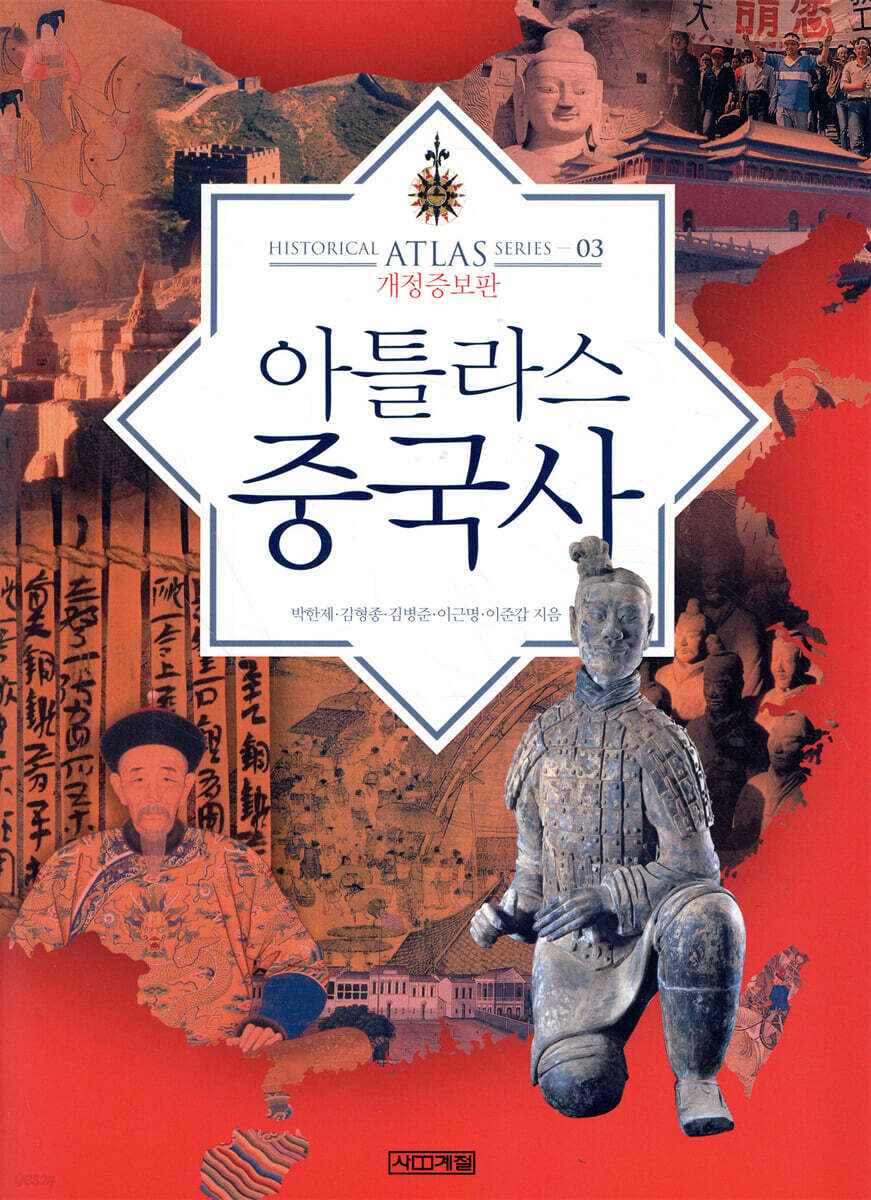
『Atlas of Chinese History』 is the third volume in the Atlas History series published by Sageseoul Publishing. It is an authentic introductory book on Chinese history that systematically reflects the latest research findings in Korean Chinese history academia, written by five of Korea's leading Chinese history researchers.
As leading experts in the history of each era, the authors display their own unique historical perspectives while also sharing a syntactic perspective, integrating diverse perspectives into a coherent flow.
The most significant feature of this book is that it condenses the content of the text into a map, broadening the scope of understanding of history, which is currently confined to time, to space.
The 142 maps in this book visually illustrate various aspects of Chinese history, including the development of political events, the movement of population and goods, the distribution of industry and culture, and the routes of travelers.
A vivid three-dimensional relief map.
From the birth of Neolithic civilization to reform and opening up
A new revival of Chinese history in the vast space of East Asia!
An introductory book on authentic Chinese history spanning time and space
『Atlas of Chinese History』 is the third volume in the Atlas History series published by Sageseoul Publishing. It is an authentic introductory book on Chinese history that systematically reflects the latest research findings in Korean Chinese history academia, written by five of Korea's leading Chinese history researchers.
As leading experts in the history of each era, the authors display their own unique historical perspectives while also sharing a syntactic perspective, integrating diverse perspectives into a coherent flow.
The most significant feature of this book is that it condenses the content of the text into a map, broadening the scope of understanding of history, which is currently confined to time, to space.
The 142 maps in this book visually illustrate various aspects of Chinese history, including the development of political events, the movement of population and goods, the distribution of industry and culture, and the routes of travelers.
- You can preview some of the book's contents.
Preview
index
Preface to the Revised and Expanded Edition
Preface to the first edition
youth of the world
Pluralistic Neolithic civilization
Development to the initial state stage
Shang and surrounding Bronze Age civilizations
Feudalism in the Western Zhou Dynasty
The order of alliances among the hegemons of the Spring and Autumn Period
Reforms in each country during the Warring States Period
War and Diplomacy in the Warring States Period
The Hundred Schools of Thought of the Spring and Autumn Period and Warring States Period
Jin's unification of the country
The tours of Qin Shi Huang and Emperor Wu of Han
Implementation of the county system and the formation of the empire
The growth of the Huns
The outer and inner borders of the Jinhan Empire
The establishment of the Hansa Commandery and the Korean Peninsula
Salt monopoly and equalization method
Zhang Qian's Western Regions Expedition
The establishment of Confucianism and Wang Mang's social reforms
The growth of the powerful families during the Later Han Dynasty
Middle Ages
The advent of the heroic age
The Sixteen Kingdoms Period
parish system
The era of North Gangnam medicine
The era of aristocracy
Hohan system
Emperor Hyojong's Hanhwa policy
The emergence of a joint political group
Religion of the people, religion of the emperor
The flowering of aristocratic culture
The division of China and the multiplication of the world
Sui's unification of the North and South Dynasties
The Sui Dynasty and East Asia
Development of the statute system
Jeonggwan's reign
The Age of the Female Empress
The Four Seasons of Chang'an
Banjin and eunuchs
The emergence of a two-tax system
The collapse of the world empire
Culture of allowance
Emperor, Gahan, and the East Asian World
Early modern times
Five Dynasties and Ten Kingdoms Period
Song's unification of China
Khitans and Liao
The rise of the Western Xia
Wang Anshi's new method
The establishment of a society of noblemen
factional strife in the late Northern Song Dynasty
The rise of the Jurchen people
The Jin War of the early Southern Song Dynasty
Goryeo, Song, Liao, and Jin
Establishment of Zhu Xi's teachings
Jin's rule over North China
Economic development of the Song Dynasty
The end of the Southern Song Dynasty
Genghis Khan's conquest of the steppes
Mongolia's wars of foreign conquest
The establishment of the circle and the four kingdoms
Mongolia, Goryeo, and Japan
Vietnam's independence and Sino-Vietnamese relations
Intellectuals under the original rule
The emergence of common people's culture
Travelers of the Eurasian Steppe
Late modern times
Founding of the Ming Dynasty
The Jeongnan Rebellion and the Move of the Capital to Beijing
Age of Exploration
Hogwang's rice production and distribution
Huizhou Merchants and Shanxi Merchants
The birth of Yangmingism
North Road South Road
Matteo Ricci's missionary work
Zhang Guozheng's reforms
Rebellion in the late Ming Dynasty
The Ming-Qing Dynasty transition and Joseon
Tribute Award and the Theory of the Two Wings of Ming
Koreans who went to Qing
Manchu conquest of China
Kangxi Emperor's era
Emperor Yongzheng's reformist policies
Emperor Qianlong's Great Unity
urban development
Activities of the gentlemen
The flowering of textual criticism
White Lotus Rebellion
Guangdong trade system
Modern and contemporary times
First and Second Opium Wars (Sino-British War)
Taiping Heavenly Kingdom Movement
The collapse of the Chinese order
Self-strengthening movement
Martial arts reform and the Boxer Rebellion
Transformation of Korea-China relations in the modern era
The Qing Dynasty's new government and preparations for constitutionalism
The Xinhai Revolution and the establishment of the Republic of China
Theory of the Chinese Nation and 20th-Century China
New Culture Movement and May Fourth Movement
The First Kuomintang-Communist Cooperation and the National Revolution
The Nanjing Nationalist Government's 'Golden Decade'
Theory of Chinese calligraphy and the theory of calligraphy in general
The emergence of a new social class
The Red Army and the Long March
Japan's invasion of China
Second Kuomintang-Communist Cooperation and the Anti-Japanese War
The Chinese Civil War and the establishment of the People's Republic of China
The People's Republic of China in its early days
The Great Leap Forward and the People's Communes
Cultural Revolution
reform and open system
Emperors of China
Source of the illustration
References
Find out
Preface to the first edition
youth of the world
Pluralistic Neolithic civilization
Development to the initial state stage
Shang and surrounding Bronze Age civilizations
Feudalism in the Western Zhou Dynasty
The order of alliances among the hegemons of the Spring and Autumn Period
Reforms in each country during the Warring States Period
War and Diplomacy in the Warring States Period
The Hundred Schools of Thought of the Spring and Autumn Period and Warring States Period
Jin's unification of the country
The tours of Qin Shi Huang and Emperor Wu of Han
Implementation of the county system and the formation of the empire
The growth of the Huns
The outer and inner borders of the Jinhan Empire
The establishment of the Hansa Commandery and the Korean Peninsula
Salt monopoly and equalization method
Zhang Qian's Western Regions Expedition
The establishment of Confucianism and Wang Mang's social reforms
The growth of the powerful families during the Later Han Dynasty
Middle Ages
The advent of the heroic age
The Sixteen Kingdoms Period
parish system
The era of North Gangnam medicine
The era of aristocracy
Hohan system
Emperor Hyojong's Hanhwa policy
The emergence of a joint political group
Religion of the people, religion of the emperor
The flowering of aristocratic culture
The division of China and the multiplication of the world
Sui's unification of the North and South Dynasties
The Sui Dynasty and East Asia
Development of the statute system
Jeonggwan's reign
The Age of the Female Empress
The Four Seasons of Chang'an
Banjin and eunuchs
The emergence of a two-tax system
The collapse of the world empire
Culture of allowance
Emperor, Gahan, and the East Asian World
Early modern times
Five Dynasties and Ten Kingdoms Period
Song's unification of China
Khitans and Liao
The rise of the Western Xia
Wang Anshi's new method
The establishment of a society of noblemen
factional strife in the late Northern Song Dynasty
The rise of the Jurchen people
The Jin War of the early Southern Song Dynasty
Goryeo, Song, Liao, and Jin
Establishment of Zhu Xi's teachings
Jin's rule over North China
Economic development of the Song Dynasty
The end of the Southern Song Dynasty
Genghis Khan's conquest of the steppes
Mongolia's wars of foreign conquest
The establishment of the circle and the four kingdoms
Mongolia, Goryeo, and Japan
Vietnam's independence and Sino-Vietnamese relations
Intellectuals under the original rule
The emergence of common people's culture
Travelers of the Eurasian Steppe
Late modern times
Founding of the Ming Dynasty
The Jeongnan Rebellion and the Move of the Capital to Beijing
Age of Exploration
Hogwang's rice production and distribution
Huizhou Merchants and Shanxi Merchants
The birth of Yangmingism
North Road South Road
Matteo Ricci's missionary work
Zhang Guozheng's reforms
Rebellion in the late Ming Dynasty
The Ming-Qing Dynasty transition and Joseon
Tribute Award and the Theory of the Two Wings of Ming
Koreans who went to Qing
Manchu conquest of China
Kangxi Emperor's era
Emperor Yongzheng's reformist policies
Emperor Qianlong's Great Unity
urban development
Activities of the gentlemen
The flowering of textual criticism
White Lotus Rebellion
Guangdong trade system
Modern and contemporary times
First and Second Opium Wars (Sino-British War)
Taiping Heavenly Kingdom Movement
The collapse of the Chinese order
Self-strengthening movement
Martial arts reform and the Boxer Rebellion
Transformation of Korea-China relations in the modern era
The Qing Dynasty's new government and preparations for constitutionalism
The Xinhai Revolution and the establishment of the Republic of China
Theory of the Chinese Nation and 20th-Century China
New Culture Movement and May Fourth Movement
The First Kuomintang-Communist Cooperation and the National Revolution
The Nanjing Nationalist Government's 'Golden Decade'
Theory of Chinese calligraphy and the theory of calligraphy in general
The emergence of a new social class
The Red Army and the Long March
Japan's invasion of China
Second Kuomintang-Communist Cooperation and the Anti-Japanese War
The Chinese Civil War and the establishment of the People's Republic of China
The People's Republic of China in its early days
The Great Leap Forward and the People's Communes
Cultural Revolution
reform and open system
Emperors of China
Source of the illustration
References
Find out
Publisher's Review
Revised and expanded edition after 8 years
Published in 2007, "Atlas of Chinese History" has been well-received and supported by readers, selling over 30,000 copies in 10 editions over the past eight years, establishing itself as the most reliable introductory book on Chinese history.
In addition, it was exported to Japan and played a role in further raising the level of research in Korean Chinese history academia.
Meanwhile, China has risen beyond the status of a superpower symbolized by the "G2" to become a central nation in the world. Consequently, our country has also been faced with the task of seeking and establishing a new and stable relationship with China.
The inclusion of the subject of ‘East Asian History’ in the high school curriculum can also be understood in that context.
The recently published revised and expanded edition of 『Atlas of Chinese History』 was planned to meet these contemporary challenges.
The latest Chinese history, which has further expanded its scope to East Asia
The primary purpose of this revised and expanded edition is to examine how China's relationship with its neighbors has evolved throughout history, and in particular, to identify the unique characteristics of China's policies toward the Korean Peninsula adopted by successive regimes.
To this end, the history of East Asian relations centered on China was chosen as the main topic, and a total of 10 topics were added (increasing the number of topics from 96 in the first edition to 106), with two topics each in five categories: ancient, medieval, early modern, late modern, and modern and contemporary times. The contents of the first edition were also revised and supplemented by the author.
Main and supplementary contents of each chapter
Chapter 1: Ancient Times
The ancient civilizations of East Asia were not limited to the Yellow River region.
A variety of Neolithic civilizations with different origins and lineages have been widely confirmed throughout East Asia, including the Yangtze River and Inner Mongolia.
It is difficult to say for sure whether the first state, Xia, actually existed, but it is safe to say that Xia culture existed as an archaeological culture.
On the other hand, regarding the Shang dynasty, we can know in detail about the royal genealogy, various political events, and sacrificial rites through oracle bone inscriptions.
Meanwhile, a bronze civilization separate from the Shang culture existed in the Sichuan region of the upper reaches of the Yangtze River.
During the Zhou Dynasty, the feudal system was implemented and a political order centered on the Zhou Dynasty was formed.
During the Spring and Autumn Period, the hegemons took the lead in politics on behalf of the Zhou kings under the pretext of protecting the Zhou royal family, but during the Warring States Period, it changed into an era of survival of the fittest.
Each country sought to establish a centralized system to become a wealthy and powerful nation.
After fierce war and fierce diplomacy, Qin eventually destroyed the remaining states and created a unified empire.
Qin Shi Huang implemented the county system nationwide and implemented several unification policies, but was soon destroyed and succeeded by the Han Dynasty.
In the early days of the Han Dynasty, the power of the feudal lords was strong, but by the time of Emperor Wu, the policy of dealing with the powerful feudal lords was successful, and a full-fledged centralized system centered on the emperor was established.
Ideologically, Confucianism was used as an ideology to support the imperial ruling system.
However, as the powerful clans grew significantly during the Later Han Dynasty, the existing national direction once again entered a period of adjustment, and this change also prepared for the Wei, Jin, Southern and Northern Dynasties period.
[Augmented Content]
The Outer and Inner Canons of the Jinhan Empire _ pp. 38-39
This book explains how the Qin and Han dynasties, China's first unified empires, developed relationships with neighboring countries such as the Xiongnu and the Western Regions using the concepts of 'external' and 'internal'.
The establishment of the Hansa Commandery and the Korean Peninsula _ pp. 40-41
This paper focuses on how the relationship between the Han Dynasty and the Korean Peninsula developed after the fall of Gojoseon in 108 BC.
We can examine the various aspects of the relationship between Han and the Korean Peninsula since Emperor Wu of Han destroyed Gojoseon.
Chapter 2: Middle Ages
The Wei, Jin, Southern and Northern Dynasties and Sui and Tang Dynasties have their own unique characteristics in Chinese history.
A striking feature is that it was an era of ethnic migration in the East Asian world, and as a result, an era in which world empires emerged.
The western migration of the Xiongnu, the first nomadic empire in the north, and the submission of the Southern Xiongnu to the Later Han Empire opened up the possibility of nomadic peoples advancing into the Central Plains.
The collapse of the Han Dynasty and the advent of an era of division promoted the advancement of the so-called Five Hu (Xiongnu, Xianbei, Di, Jiang, and Jie) into the Central Plains.
And for the first time in Chinese history, a situation arose where nomadic and agricultural peoples competed with each other in the agricultural region of North China.
The advance of nomadic peoples into the Central Plains caused the Han people of northern China to move to the south of the Yangtze River.
The Koreans in North China are now facing a situation where they are competing with the people of Gangnam.
In this respect, the population movement caused by the advance of nomadic peoples into the Central Plains after the late Han Dynasty can be called a ‘national movement.’
Migration does not simply mean the movement of people, but also the movement of culture.
People with different customs and different cultures came into contact in one area, transforming the existing cultural form.
Moreover, contact between different ethnic groups has not only broadened the scope of Chinese culture itself, but has also allowed people with different customs, languages, and cultures to find wisdom in coexisting.
As a result, the Sui and Tang world empires emerged, with "all roads leading to the capital Chang'an," and a splendid culture blossomed.
The dynamic appearance of the Sui Dynasty was the result of national migration.
Although the splendid spring of the empire was short-lived, it contributed to creating an open culture in China that transcended ethnic isolation, and it was this migration of peoples that ushered in the greatest imperial era in Chinese history.
[Augmented Content]
The Division of China and the Multiplication of the World _ pp. 72-73
Since the Jin Dynasty, China has established tributary and investiture relationships with various East Asian countries, and these relationships can never be explained by the schematic diagram of a "center" and a "periphery."
It shows the multifaceted nature of China-East Asia relations.
Emperor, Gahan, and the East Asian World _ pp. 94-95
The Central Plains states and nomadic peoples of China, once perceived as separate worlds, gradually began to find common ground as they entered the Middle Ages.
It can be understood in this context that Emperor Taizong of Tang was called the emperor of the Central Plains and the heavenly king of the nomadic peoples.
Chapter 3 Early Modern Period
Chinese society changed rapidly during the transition from the Tang to the Song dynasties.
An imperial dictatorship was established, and the nobility emerged as the ruling class, replacing the aristocracy.
The Jeonho system, which can be considered a contract-based tenancy system, also became widespread.
Agricultural productivity increased by leaps and bounds, and the commodity economy also developed significantly.
Culturally, for the first time in Chinese history, several cultural elements with a commoner flavor appeared.
These various changes are collectively called the Tang-Song Reforms.
Meanwhile, the Song Dynasty was the weakest militarily of all the orthodox dynasties.
Since its establishment, it has suffered from continuous threats from countries established by northern peoples.
During the Northern Song Dynasty, the Liao Dynasty of the Khitan people and the Western Xia Dynasty of the Tangut people, and during the Southern Song Dynasty, the Jin Dynasty of the Jurchen people and the Mongol Empire constantly pressured the Song Dynasty.
The Liao, Jin, and Mongol empires are called conquering dynasties, and the national awareness of these northern peoples and the emergence of conquering dynasties were also another aspect of the transformation between the Tang and Song Dynasties.
The Mongol Empire built an unprecedented empire on the Eurasian continent based on its powerful military power.
It took only a few decades for the Mongols to develop from a small tribe on the Mongolian steppe in the late 12th century into an unprecedented empire.
The Mongol Empire split into the Yuan Dynasty in China and the Four Han dynasties in the West in the late 13th century.
From the emergence of Genghis Khan to the mid-14th century, for about 150 years, the Mongols dominated history on Earth.
[Augmented Content]
Goryeo and Song, Liao, and Jin _ pp. 116-117
This book shows what kind of historical relationship the two dynasties of Chinese history, the Khitan (Liao) and the Song, had with Goryeo.
It describes the war between the Khitan (Liao) and Goryeo, focusing on Uicheon of Goryeo who crossed over to Song.
Vietnam's Independence and Sino-Vietnamese Relations _ pp. 134-135
It mainly deals with the relationship between China and Vietnam.
First, it outlines the period of Vietnam's subjugation to China, which lasted for nearly 1,000 years, and then covers the history of Vietnam's independence during the Song Dynasty and its struggle against the Mongols.
Chapter 4: Late Modern Times
The Ming and Qing dynasties were a period of perfection that brought the Chinese Empire, which had continued to flourish, to its peak, but also a period of preparation for the dawn of modern China within the confines of tradition.
Politically, the imperial dictatorship that Zhu Yuanzhang, the founder of the Ming Dynasty, had painstakingly built reached its peak during the reigns of the Yongzheng and Qianlong Emperors of the Qing Dynasty, but it was faced with demands for local decentralization centered on the gentry class.
Socio-economically, the active production of agricultural and handicraft products led to the emergence of groups that traded with them, ushering in an era of distribution, and large and medium-sized cities sprang up like mushrooms in various places.
These merchant groups and cities were sometimes destined to disappear into the back alleys of history, content with their traditions, but they also displayed tenacious vitality by pioneering a new era through self-transformation.
Culturally, Yangmingism flourished, overcoming the Neo-Confucian thought that thoroughly emphasized the social order and expressing full trust in the equality of scholars, farmers, artisans, and merchants and in humanity.
Yangmingism withered under the fierce counterattack of Neo-Confucianism, but textual criticism, which emerged during the Qing Dynasty, not only perfected traditional scholarship but also sprouted the seeds of modern scholarship.
Although there were twists and turns, by tolerating foreign trade and the activities of Catholic missionaries, China was able to engage in exchanges with the West and participate in the flow of world history.
[Augmented Content]
Tribute Award and the Theory of the Two Wings of Joseon _ pp. 166-167
It mainly deals with how the tributary relationship between the Ming and Joseon dynasties changed.
The relationship between the two countries changed with the rise of the Manchus, and this aspect is shown through the theory of the two sides being aligned, as proposed by Yi Yi, who went to the Ming as an envoy.
Koreans who went to Qing _ pp. 168-169
As military and diplomatic contacts between Joseon and the Qing (Later Jin) increased, so did the movement of people.
In the process, the number of Koreans who entered the Qing Dynasty and became active in various fields of politics and economy increased, and the focus is on the influence they had on the relationship between the two countries.
Chapter 5 Modern and Contemporary Times
The challenge from Western powers, which began in the late Ming Dynasty but became full-blown around the time of the Opium Wars, dealt a major blow to modern China, which was entering a period of decline.
Additionally, internal popular rebellions, including the Taiping Rebellion in the mid-19th century, nearly brought down the Qing Dynasty.
Moreover, the successive defeats, the signing of unequal treaties, and the payment of huge indemnities became major obstacles to the Qing Dynasty's pursuit of its own path to modernization.
Thus, the establishment of a nation-state capable of responding effectively to the modern world system and rescuing the nation and its people from national crises emerged as an urgent task.
The result was the establishment of the Republic of China, which replaced the Qing Dynasty, but the hastily accepted republican system of the Republic of China failed to function properly.
Western-style modernization, which became a trend in the 20th century, failed to overcome political turmoil despite its steady achievements.
For this reason, the Kuomintang and the Chinese Communist Party, which had been competing since the 1920s for control of state power and the direction of desirable modernization, both preferred a one-party dictatorship in which the state (the leading elite) could exercise strong leadership.
The full-scale Japanese invasion that began in the 1930s served as a key variable in this competition, and the Chinese Communist Party, which eventually won the power of the masses to its side, established the People's Republic of China in 1949.
However, the confusion surrounding the direction of socialist construction continued, eventually leading to the tragic civil war known as the Cultural Revolution.
After the end of the Cultural Revolution and the implementation of the reform and opening-up policy, China was able to once again focus on the task of modernization, which had been its greatest challenge since the 19th century.
[Augmented Content]
The Transformation of Modern Sino-Korean Relations _ pp. 200-201
The tributary relationship between China and Korea changed in the modern era as both countries were incorporated into an unequal treaty system.
Eventually, an equal relationship was established with the signing of the Korea-Qing Treaty of Commerce, but this changed once again as Japan emerged as a major power in Asia.
Theory of the Chinese Nation and 20th-Century China _ pp. 206-207
When the Qing Dynasty collapsed due to the Xinhai Revolution and the Republic of China was established, the relationship between the Han Chinese and other ethnic groups also changed.
The Han Chinese initially rejected and excluded other ethnic groups, but eventually assimilated and incorporated them into the "Chinese people."
That trend continues to this day.
Published in 2007, "Atlas of Chinese History" has been well-received and supported by readers, selling over 30,000 copies in 10 editions over the past eight years, establishing itself as the most reliable introductory book on Chinese history.
In addition, it was exported to Japan and played a role in further raising the level of research in Korean Chinese history academia.
Meanwhile, China has risen beyond the status of a superpower symbolized by the "G2" to become a central nation in the world. Consequently, our country has also been faced with the task of seeking and establishing a new and stable relationship with China.
The inclusion of the subject of ‘East Asian History’ in the high school curriculum can also be understood in that context.
The recently published revised and expanded edition of 『Atlas of Chinese History』 was planned to meet these contemporary challenges.
The latest Chinese history, which has further expanded its scope to East Asia
The primary purpose of this revised and expanded edition is to examine how China's relationship with its neighbors has evolved throughout history, and in particular, to identify the unique characteristics of China's policies toward the Korean Peninsula adopted by successive regimes.
To this end, the history of East Asian relations centered on China was chosen as the main topic, and a total of 10 topics were added (increasing the number of topics from 96 in the first edition to 106), with two topics each in five categories: ancient, medieval, early modern, late modern, and modern and contemporary times. The contents of the first edition were also revised and supplemented by the author.
Main and supplementary contents of each chapter
Chapter 1: Ancient Times
The ancient civilizations of East Asia were not limited to the Yellow River region.
A variety of Neolithic civilizations with different origins and lineages have been widely confirmed throughout East Asia, including the Yangtze River and Inner Mongolia.
It is difficult to say for sure whether the first state, Xia, actually existed, but it is safe to say that Xia culture existed as an archaeological culture.
On the other hand, regarding the Shang dynasty, we can know in detail about the royal genealogy, various political events, and sacrificial rites through oracle bone inscriptions.
Meanwhile, a bronze civilization separate from the Shang culture existed in the Sichuan region of the upper reaches of the Yangtze River.
During the Zhou Dynasty, the feudal system was implemented and a political order centered on the Zhou Dynasty was formed.
During the Spring and Autumn Period, the hegemons took the lead in politics on behalf of the Zhou kings under the pretext of protecting the Zhou royal family, but during the Warring States Period, it changed into an era of survival of the fittest.
Each country sought to establish a centralized system to become a wealthy and powerful nation.
After fierce war and fierce diplomacy, Qin eventually destroyed the remaining states and created a unified empire.
Qin Shi Huang implemented the county system nationwide and implemented several unification policies, but was soon destroyed and succeeded by the Han Dynasty.
In the early days of the Han Dynasty, the power of the feudal lords was strong, but by the time of Emperor Wu, the policy of dealing with the powerful feudal lords was successful, and a full-fledged centralized system centered on the emperor was established.
Ideologically, Confucianism was used as an ideology to support the imperial ruling system.
However, as the powerful clans grew significantly during the Later Han Dynasty, the existing national direction once again entered a period of adjustment, and this change also prepared for the Wei, Jin, Southern and Northern Dynasties period.
[Augmented Content]
The Outer and Inner Canons of the Jinhan Empire _ pp. 38-39
This book explains how the Qin and Han dynasties, China's first unified empires, developed relationships with neighboring countries such as the Xiongnu and the Western Regions using the concepts of 'external' and 'internal'.
The establishment of the Hansa Commandery and the Korean Peninsula _ pp. 40-41
This paper focuses on how the relationship between the Han Dynasty and the Korean Peninsula developed after the fall of Gojoseon in 108 BC.
We can examine the various aspects of the relationship between Han and the Korean Peninsula since Emperor Wu of Han destroyed Gojoseon.
Chapter 2: Middle Ages
The Wei, Jin, Southern and Northern Dynasties and Sui and Tang Dynasties have their own unique characteristics in Chinese history.
A striking feature is that it was an era of ethnic migration in the East Asian world, and as a result, an era in which world empires emerged.
The western migration of the Xiongnu, the first nomadic empire in the north, and the submission of the Southern Xiongnu to the Later Han Empire opened up the possibility of nomadic peoples advancing into the Central Plains.
The collapse of the Han Dynasty and the advent of an era of division promoted the advancement of the so-called Five Hu (Xiongnu, Xianbei, Di, Jiang, and Jie) into the Central Plains.
And for the first time in Chinese history, a situation arose where nomadic and agricultural peoples competed with each other in the agricultural region of North China.
The advance of nomadic peoples into the Central Plains caused the Han people of northern China to move to the south of the Yangtze River.
The Koreans in North China are now facing a situation where they are competing with the people of Gangnam.
In this respect, the population movement caused by the advance of nomadic peoples into the Central Plains after the late Han Dynasty can be called a ‘national movement.’
Migration does not simply mean the movement of people, but also the movement of culture.
People with different customs and different cultures came into contact in one area, transforming the existing cultural form.
Moreover, contact between different ethnic groups has not only broadened the scope of Chinese culture itself, but has also allowed people with different customs, languages, and cultures to find wisdom in coexisting.
As a result, the Sui and Tang world empires emerged, with "all roads leading to the capital Chang'an," and a splendid culture blossomed.
The dynamic appearance of the Sui Dynasty was the result of national migration.
Although the splendid spring of the empire was short-lived, it contributed to creating an open culture in China that transcended ethnic isolation, and it was this migration of peoples that ushered in the greatest imperial era in Chinese history.
[Augmented Content]
The Division of China and the Multiplication of the World _ pp. 72-73
Since the Jin Dynasty, China has established tributary and investiture relationships with various East Asian countries, and these relationships can never be explained by the schematic diagram of a "center" and a "periphery."
It shows the multifaceted nature of China-East Asia relations.
Emperor, Gahan, and the East Asian World _ pp. 94-95
The Central Plains states and nomadic peoples of China, once perceived as separate worlds, gradually began to find common ground as they entered the Middle Ages.
It can be understood in this context that Emperor Taizong of Tang was called the emperor of the Central Plains and the heavenly king of the nomadic peoples.
Chapter 3 Early Modern Period
Chinese society changed rapidly during the transition from the Tang to the Song dynasties.
An imperial dictatorship was established, and the nobility emerged as the ruling class, replacing the aristocracy.
The Jeonho system, which can be considered a contract-based tenancy system, also became widespread.
Agricultural productivity increased by leaps and bounds, and the commodity economy also developed significantly.
Culturally, for the first time in Chinese history, several cultural elements with a commoner flavor appeared.
These various changes are collectively called the Tang-Song Reforms.
Meanwhile, the Song Dynasty was the weakest militarily of all the orthodox dynasties.
Since its establishment, it has suffered from continuous threats from countries established by northern peoples.
During the Northern Song Dynasty, the Liao Dynasty of the Khitan people and the Western Xia Dynasty of the Tangut people, and during the Southern Song Dynasty, the Jin Dynasty of the Jurchen people and the Mongol Empire constantly pressured the Song Dynasty.
The Liao, Jin, and Mongol empires are called conquering dynasties, and the national awareness of these northern peoples and the emergence of conquering dynasties were also another aspect of the transformation between the Tang and Song Dynasties.
The Mongol Empire built an unprecedented empire on the Eurasian continent based on its powerful military power.
It took only a few decades for the Mongols to develop from a small tribe on the Mongolian steppe in the late 12th century into an unprecedented empire.
The Mongol Empire split into the Yuan Dynasty in China and the Four Han dynasties in the West in the late 13th century.
From the emergence of Genghis Khan to the mid-14th century, for about 150 years, the Mongols dominated history on Earth.
[Augmented Content]
Goryeo and Song, Liao, and Jin _ pp. 116-117
This book shows what kind of historical relationship the two dynasties of Chinese history, the Khitan (Liao) and the Song, had with Goryeo.
It describes the war between the Khitan (Liao) and Goryeo, focusing on Uicheon of Goryeo who crossed over to Song.
Vietnam's Independence and Sino-Vietnamese Relations _ pp. 134-135
It mainly deals with the relationship between China and Vietnam.
First, it outlines the period of Vietnam's subjugation to China, which lasted for nearly 1,000 years, and then covers the history of Vietnam's independence during the Song Dynasty and its struggle against the Mongols.
Chapter 4: Late Modern Times
The Ming and Qing dynasties were a period of perfection that brought the Chinese Empire, which had continued to flourish, to its peak, but also a period of preparation for the dawn of modern China within the confines of tradition.
Politically, the imperial dictatorship that Zhu Yuanzhang, the founder of the Ming Dynasty, had painstakingly built reached its peak during the reigns of the Yongzheng and Qianlong Emperors of the Qing Dynasty, but it was faced with demands for local decentralization centered on the gentry class.
Socio-economically, the active production of agricultural and handicraft products led to the emergence of groups that traded with them, ushering in an era of distribution, and large and medium-sized cities sprang up like mushrooms in various places.
These merchant groups and cities were sometimes destined to disappear into the back alleys of history, content with their traditions, but they also displayed tenacious vitality by pioneering a new era through self-transformation.
Culturally, Yangmingism flourished, overcoming the Neo-Confucian thought that thoroughly emphasized the social order and expressing full trust in the equality of scholars, farmers, artisans, and merchants and in humanity.
Yangmingism withered under the fierce counterattack of Neo-Confucianism, but textual criticism, which emerged during the Qing Dynasty, not only perfected traditional scholarship but also sprouted the seeds of modern scholarship.
Although there were twists and turns, by tolerating foreign trade and the activities of Catholic missionaries, China was able to engage in exchanges with the West and participate in the flow of world history.
[Augmented Content]
Tribute Award and the Theory of the Two Wings of Joseon _ pp. 166-167
It mainly deals with how the tributary relationship between the Ming and Joseon dynasties changed.
The relationship between the two countries changed with the rise of the Manchus, and this aspect is shown through the theory of the two sides being aligned, as proposed by Yi Yi, who went to the Ming as an envoy.
Koreans who went to Qing _ pp. 168-169
As military and diplomatic contacts between Joseon and the Qing (Later Jin) increased, so did the movement of people.
In the process, the number of Koreans who entered the Qing Dynasty and became active in various fields of politics and economy increased, and the focus is on the influence they had on the relationship between the two countries.
Chapter 5 Modern and Contemporary Times
The challenge from Western powers, which began in the late Ming Dynasty but became full-blown around the time of the Opium Wars, dealt a major blow to modern China, which was entering a period of decline.
Additionally, internal popular rebellions, including the Taiping Rebellion in the mid-19th century, nearly brought down the Qing Dynasty.
Moreover, the successive defeats, the signing of unequal treaties, and the payment of huge indemnities became major obstacles to the Qing Dynasty's pursuit of its own path to modernization.
Thus, the establishment of a nation-state capable of responding effectively to the modern world system and rescuing the nation and its people from national crises emerged as an urgent task.
The result was the establishment of the Republic of China, which replaced the Qing Dynasty, but the hastily accepted republican system of the Republic of China failed to function properly.
Western-style modernization, which became a trend in the 20th century, failed to overcome political turmoil despite its steady achievements.
For this reason, the Kuomintang and the Chinese Communist Party, which had been competing since the 1920s for control of state power and the direction of desirable modernization, both preferred a one-party dictatorship in which the state (the leading elite) could exercise strong leadership.
The full-scale Japanese invasion that began in the 1930s served as a key variable in this competition, and the Chinese Communist Party, which eventually won the power of the masses to its side, established the People's Republic of China in 1949.
However, the confusion surrounding the direction of socialist construction continued, eventually leading to the tragic civil war known as the Cultural Revolution.
After the end of the Cultural Revolution and the implementation of the reform and opening-up policy, China was able to once again focus on the task of modernization, which had been its greatest challenge since the 19th century.
[Augmented Content]
The Transformation of Modern Sino-Korean Relations _ pp. 200-201
The tributary relationship between China and Korea changed in the modern era as both countries were incorporated into an unequal treaty system.
Eventually, an equal relationship was established with the signing of the Korea-Qing Treaty of Commerce, but this changed once again as Japan emerged as a major power in Asia.
Theory of the Chinese Nation and 20th-Century China _ pp. 206-207
When the Qing Dynasty collapsed due to the Xinhai Revolution and the Republic of China was established, the relationship between the Han Chinese and other ethnic groups also changed.
The Han Chinese initially rejected and excluded other ethnic groups, but eventually assimilated and incorporated them into the "Chinese people."
That trend continues to this day.
GOODS SPECIFICS
- Date of issue: November 20, 2015
- Format: Hardcover book binding method guide
- Page count, weight, size: 264 pages | 1,000g | 188*254*24mm
- ISBN13: 9788958289081
- ISBN10: 8958289082
You may also like
카테고리
korean


korean

![GQ KOREA Mark (Monthly): December [2025]](http://librairie.coreenne.fr/cdn/shop/files/8ef265dbbfbf186523ed75ba7319009d.jpg?v=1765340328&width=3840)


