

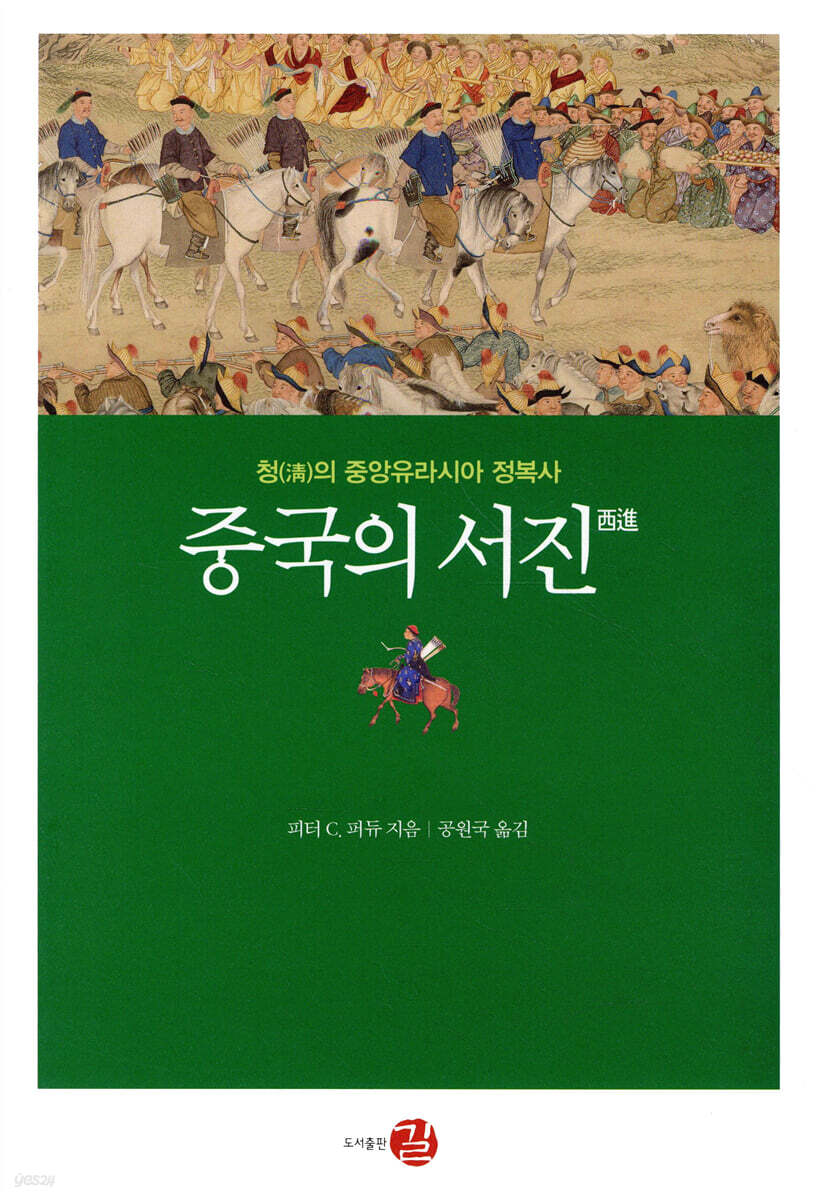
Western Jin of China
 |
Description
Book Introduction
Blacklisted by Chinese authorities, author Peter Perdue revolutionizes the narrative of Chinese history.
Since the book was published in the United States in 2005, there has been a heated debate in China over its historical perspective.
This is because it views Chinese history from the perspective of world history, with a focus on the historical narrative of change, which directly conflicts with the existing perspective on Chinese history.
In other words, this modern and contemporary Chinese history book, which is a meticulous rebuttal to China-centric historical writing, is a problematic work that presents a new perspective on the history of nomadic societies (Xinjiang, Uyghur regions, etc.), which have been evaluated as inferior to sedentary societies (China) by putting forward a non-Han-centric world order theory against the traditionally accepted Han-centric world order theory.
Maybe that's why.
The author is said to have been blacklisted by the Chinese authorities, which has severe restrictions on his research on Chinese history.
Since the book was published in the United States in 2005, there has been a heated debate in China over its historical perspective.
This is because it views Chinese history from the perspective of world history, with a focus on the historical narrative of change, which directly conflicts with the existing perspective on Chinese history.
In other words, this modern and contemporary Chinese history book, which is a meticulous rebuttal to China-centric historical writing, is a problematic work that presents a new perspective on the history of nomadic societies (Xinjiang, Uyghur regions, etc.), which have been evaluated as inferior to sedentary societies (China) by putting forward a non-Han-centric world order theory against the traditionally accepted Han-centric world order theory.
Maybe that's why.
The author is said to have been blacklisted by the Chinese authorities, which has severe restrictions on his research on Chinese history.
- You can preview some of the book's contents.
Preview
index
Introduction 13
Acknowledgments 17
21 Notation of names, dates, weights and measures, and Chinese characters
Introduction 27
History, Time, and Memory 31
The Qing Conquest as a World Historical Event 36
Part 1: The Formation of Central Eurasian States
Chapter 1: Environment, Nation Building, and National Identity 41
Borderlessness of Central Eurasia 46
Trade, Transport, and Travel 62
Border Zone 69
Isolation and Integration 73
Chapter 2: Ming, the Principality of Moscow, and Siberia, 1400–1600 (83)
Ming and Mongolia 84
The Formation of the Moscow State and the Expansion of Russia 112
Siberia and China's Border 132
Chapter 3: Interactions in Central Eurasia and the Rise of the Manchus, 1600–1670
The Construction of the Dzungar State 144
The Rise of the Manchus 154
Mongolia's Influence on the Manchurian State 169
Comparing the Construction of Early Modern States 176
Part 2: Power Conflict
Chapter 4: The Conflicts Between the Manchus, Mongols, and Russians, 1670–90 (181)
Emperor Kangxi, ruler of 182
Galdan's Intervention 193
Emperor Kangxi's first personal reign 201
The Treaty of Nerchinsk and the Excluded Intermediate 210
Chapter 5: Eating Eyes: The Last of Galdan, 1690–97 223
Dolon Nor Grand Synthesis 224
Battle of Zhao Modu 230
The Emperor Rewrites History 242
The Last Expedition and the Fate of Galdan 247
Chapter 6: The Far-Reaching Empire and the Dzungar Survival, 1700–31 (267)
The rise of Chewang Rabdan 268
Three Eurasian Travelers 272
Infiltration into Turkestan and Tibet 290
The new emperor changes his policy 307
Chapter 7: The Final Blow, 1734–71 (327)
Exchanging Barbarians through Trade 327
The Death Bell of the Dzungar Nation 342
Conquest of Turkestan 365
The Return of Torgut 369
Part 3: The Economic Foundation of the Empire
Chapter 8: Cannons on Camels: Economic Aspects 381
Nation-Builder Galdan 382
The annexation of Yanjiang and Qinghai in 389
Administration of Change 395
Chapter 9: Migration and Dungeon 407
Retreat from Turpan 411
Kidney transplant 415
Establishment of military farms (colonization) and reclamation 425
Economic Development 441
Chapter 10: Harvest and Relief 447
Harvest and Yield 448
Granary stockpile 452
Donation Scandal 456
The Relief Movement of 1756 462
Chapter 11: Money and Commerce 493
Currency of Change, from Song to Ming 494
Integration and Stabilization 500
Commerce as a Weapon of War 513
Tribute and Border Trade 518
Confirmation of changes to Part 4
Chapter 12: Land Movement 527
Travel and Authority 532
Marking Spaces on Stone 551
Maps and Power 565
Expanding the Empire's Horizons 580
Chapter 13: Time of Record: Writing the History of the Empire 585
Emperor Kangxi's expedition 586
Emperor Yongzheng and the Great Record of the Great Ancestral Rites, 596
Emperor Qianlong's account of the Dzungar Mongols, 604
Perspective on Change 610
Nomadic Chronicles 616
Part 5: Legacy and Its Implications
Chapter 14: Writing a National History of Conquest 629
Authors of the Book of State Affairs and the Empire 629
Geopolitics and Emperor Worship 637
Chinese Historians and the Multicultural Nation 640
Soviet and Mongolian condemnation of Chinese aggression 648
Empire, State, Nation 650
Chapter 15: Nation-Building in Europe and Asia 657
The Political Ecology of Conquest 659
665 European, Chinese, and Inland Asian Models
Nomadic Empire Theories 676
Rethinking Qing in the World 682
Chapter 16: Expansion and Change during the Rise and Decline of the Qing Dynasty 697
The End of the Qing Dynasty 699
702 Borders of the Northwest and Southwest
Negotiating Countries 707
Commercialization and Localization 712
Appendix A.
Rulers and Reigns 721
Appendix B.
Emperor Yongzheng, reeling from the news of disaster in 1731
Appendix C.
Border Squabble 728
Appendix D.
Gansu Province's harvest and per-unit yield: 738
Appendix E.
Climate and Harvest in the Northwest 743
Abbreviation 746
Note 747
Reference 857
Translator's Note 897
Plate source 902
Search 904
Acknowledgments 17
21 Notation of names, dates, weights and measures, and Chinese characters
Introduction 27
History, Time, and Memory 31
The Qing Conquest as a World Historical Event 36
Part 1: The Formation of Central Eurasian States
Chapter 1: Environment, Nation Building, and National Identity 41
Borderlessness of Central Eurasia 46
Trade, Transport, and Travel 62
Border Zone 69
Isolation and Integration 73
Chapter 2: Ming, the Principality of Moscow, and Siberia, 1400–1600 (83)
Ming and Mongolia 84
The Formation of the Moscow State and the Expansion of Russia 112
Siberia and China's Border 132
Chapter 3: Interactions in Central Eurasia and the Rise of the Manchus, 1600–1670
The Construction of the Dzungar State 144
The Rise of the Manchus 154
Mongolia's Influence on the Manchurian State 169
Comparing the Construction of Early Modern States 176
Part 2: Power Conflict
Chapter 4: The Conflicts Between the Manchus, Mongols, and Russians, 1670–90 (181)
Emperor Kangxi, ruler of 182
Galdan's Intervention 193
Emperor Kangxi's first personal reign 201
The Treaty of Nerchinsk and the Excluded Intermediate 210
Chapter 5: Eating Eyes: The Last of Galdan, 1690–97 223
Dolon Nor Grand Synthesis 224
Battle of Zhao Modu 230
The Emperor Rewrites History 242
The Last Expedition and the Fate of Galdan 247
Chapter 6: The Far-Reaching Empire and the Dzungar Survival, 1700–31 (267)
The rise of Chewang Rabdan 268
Three Eurasian Travelers 272
Infiltration into Turkestan and Tibet 290
The new emperor changes his policy 307
Chapter 7: The Final Blow, 1734–71 (327)
Exchanging Barbarians through Trade 327
The Death Bell of the Dzungar Nation 342
Conquest of Turkestan 365
The Return of Torgut 369
Part 3: The Economic Foundation of the Empire
Chapter 8: Cannons on Camels: Economic Aspects 381
Nation-Builder Galdan 382
The annexation of Yanjiang and Qinghai in 389
Administration of Change 395
Chapter 9: Migration and Dungeon 407
Retreat from Turpan 411
Kidney transplant 415
Establishment of military farms (colonization) and reclamation 425
Economic Development 441
Chapter 10: Harvest and Relief 447
Harvest and Yield 448
Granary stockpile 452
Donation Scandal 456
The Relief Movement of 1756 462
Chapter 11: Money and Commerce 493
Currency of Change, from Song to Ming 494
Integration and Stabilization 500
Commerce as a Weapon of War 513
Tribute and Border Trade 518
Confirmation of changes to Part 4
Chapter 12: Land Movement 527
Travel and Authority 532
Marking Spaces on Stone 551
Maps and Power 565
Expanding the Empire's Horizons 580
Chapter 13: Time of Record: Writing the History of the Empire 585
Emperor Kangxi's expedition 586
Emperor Yongzheng and the Great Record of the Great Ancestral Rites, 596
Emperor Qianlong's account of the Dzungar Mongols, 604
Perspective on Change 610
Nomadic Chronicles 616
Part 5: Legacy and Its Implications
Chapter 14: Writing a National History of Conquest 629
Authors of the Book of State Affairs and the Empire 629
Geopolitics and Emperor Worship 637
Chinese Historians and the Multicultural Nation 640
Soviet and Mongolian condemnation of Chinese aggression 648
Empire, State, Nation 650
Chapter 15: Nation-Building in Europe and Asia 657
The Political Ecology of Conquest 659
665 European, Chinese, and Inland Asian Models
Nomadic Empire Theories 676
Rethinking Qing in the World 682
Chapter 16: Expansion and Change during the Rise and Decline of the Qing Dynasty 697
The End of the Qing Dynasty 699
702 Borders of the Northwest and Southwest
Negotiating Countries 707
Commercialization and Localization 712
Appendix A.
Rulers and Reigns 721
Appendix B.
Emperor Yongzheng, reeling from the news of disaster in 1731
Appendix C.
Border Squabble 728
Appendix D.
Gansu Province's harvest and per-unit yield: 738
Appendix E.
Climate and Harvest in the Northwest 743
Abbreviation 746
Note 747
Reference 857
Translator's Note 897
Plate source 902
Search 904
Publisher's Review
The Qing Dynasty built a great empire through a different style of rule from the existing Han Chinese dynasties.
The territory of modern China as we know it was actually established during the Qing Dynasty.
By securing a territory that was nearly twice the size of the Ming Dynasty, China was able to establish itself as a great empire and demonstrate internally and externally that it was an absolute power in Eastern society.
Looking at the entire history of China, unlike the previous Han dynasty, which had never properly conquered and managed the border regions, the Qing dynasty, centered around the Manchu people, achieved that historical feat.
So how was it possible for the Qianlong Emperor of the Qing Dynasty to achieve such a feat?
The author finds the reason for this in the fact that the Qing Dynasty's foreign policy, unlike that of the existing Han Chinese, had the character of a dynasty of conquest.
In other words, the Manchu people, who originated in Manchuria, not only expanded their territory through wars of conquest, but also established a dynasty-like system in their society, thereby laying the foundation for conquering the Western Regions.
In addition, the method of managing the conquered territories was not simply a tributary relationship, but rather an active immigration policy and coercive rule in the conquered territories, eliminating the buds of rebellion from the beginning.
According to the author, Emperor Qianlong, a 'table-table' general, never went to the northwest and never directly participated in battle.
However, he considered control of the region crucial to his rule, and he focused on exterminating the local people as greedy, cruel, and cunning.
The Dzungars, a Nomadic Nation for 200 Years - How Should We Assess Them?
So how can we evaluate the Dzungar region, which occupies a central part of the narrative of this book?
The author's most important criterion for evaluating Dzungar history is his critical stance on viewing the history of nomads as a history of change or a passive position in the history of China, a settled people.
Since around the 15th century, the nomadic peoples of this region have controlled relatively vast territories, including Xinjiang, Uyghur, Mongolia, and parts of Russian Siberia.
This period lasted until the 17th century, so it was these Dzungar nomadic people who effectively ruled this region for approximately 200 years.
They collected tribute from neighboring countries and conducted extensive trade with the Qing, Russia, and the peoples of Central Eurasia.
However, it was a thorn in the side of the Qing Dynasty, which was trying to secure Ming territory and expand into the Western Regions, and the Russian Empire also had to acquire this region during its expansionist policy.
Therefore, the fierce territorial wars between the settled peoples (Qing Dynasty and Russia) and the nomadic peoples (Dzungars) in the 17th and 18th centuries, and the resulting demarcation of the current Chinese territory, brought about an opportunity where nomadic peoples could no longer play a central role in world history, and at the same time, it reveals that the conquest of the Central Eurasian region was a decisive factor in the flow of modern and contemporary Chinese history as a world-historical event.
This is because the author believes that the strategic mistake of trying to block foreign invasions into coastal areas in the same way based on the experience of conquering the Western Regions when Western powers (first Britain) encountered China in the 1780s, and the misjudgment of not seeing Western powers as such a great threat (after pacifying the Dzungar region) were brought about.
The Qing Dynasty's conquest of Central Eurasia as a world-historical event!
The author defines the history of the Qing Dynasty's conquest of Central Eurasia as a world-historical event from three perspectives.
For the rulers and subjects of the First Empire, this victory completely changed the scope of the world they had once possessed.
The vast expansion of national territory through conquest opened new chapters in the migration of subjects, trade, administration, and historical imagination.
Second, the expansion of the Qing Dynasty was part of a global process that took place in the 17th and 18th centuries.
In almost every part of the world, newly centralized, unified, and militarized states expanded their territories through military conquest, immigration, missionaries, and, later, traders.
Western historians often characterize this period as the 'crisis of the seventeenth century', preceding the eighteenth-century period of stability in state formation.
Treating China's imperial expansion as part of a global process allows us to view all of China's imperial experiences from a broader perspective, rather than just as unique to China.
Third, China's expansion brought about a turning point in Central Eurasian history.
This marked the end of the nomadic pastoralists' status as major actors on the stage of history.
The Qing Dynasty was the main character in the truly world-historical shift that shifted the balance from free nomadism to sedentary people (China).
The Dzungars participated in history as equals to the Qing, but were ultimately defeated.
Tibet participated as a coordinator of power and an ideological subject in the struggle between the Dzungars and the Qing, while at the same time pursuing its own goals throughout its turbulent history.
Russia was a typical imperialist nation, but it did not rush headlong toward the diabolical goal of expansion. Like other nations, it changed course countless times amidst various uncertainties.
It is rare to find a book that places not only Qing Dynasty history, but also Mongolian and Tibetan history, in the context of world history.
Moreover, it can be seen as a very valuable academic achievement in that it has provided an opportunity for a change in the perception of modern and contemporary Chinese history by overcoming the historical narrative centered on settled peoples, which has been generally accepted, and by placing the history of the nomadic peoples of the Dzungar states on an equal footing.
The territory of modern China as we know it was actually established during the Qing Dynasty.
By securing a territory that was nearly twice the size of the Ming Dynasty, China was able to establish itself as a great empire and demonstrate internally and externally that it was an absolute power in Eastern society.
Looking at the entire history of China, unlike the previous Han dynasty, which had never properly conquered and managed the border regions, the Qing dynasty, centered around the Manchu people, achieved that historical feat.
So how was it possible for the Qianlong Emperor of the Qing Dynasty to achieve such a feat?
The author finds the reason for this in the fact that the Qing Dynasty's foreign policy, unlike that of the existing Han Chinese, had the character of a dynasty of conquest.
In other words, the Manchu people, who originated in Manchuria, not only expanded their territory through wars of conquest, but also established a dynasty-like system in their society, thereby laying the foundation for conquering the Western Regions.
In addition, the method of managing the conquered territories was not simply a tributary relationship, but rather an active immigration policy and coercive rule in the conquered territories, eliminating the buds of rebellion from the beginning.
According to the author, Emperor Qianlong, a 'table-table' general, never went to the northwest and never directly participated in battle.
However, he considered control of the region crucial to his rule, and he focused on exterminating the local people as greedy, cruel, and cunning.
The Dzungars, a Nomadic Nation for 200 Years - How Should We Assess Them?
So how can we evaluate the Dzungar region, which occupies a central part of the narrative of this book?
The author's most important criterion for evaluating Dzungar history is his critical stance on viewing the history of nomads as a history of change or a passive position in the history of China, a settled people.
Since around the 15th century, the nomadic peoples of this region have controlled relatively vast territories, including Xinjiang, Uyghur, Mongolia, and parts of Russian Siberia.
This period lasted until the 17th century, so it was these Dzungar nomadic people who effectively ruled this region for approximately 200 years.
They collected tribute from neighboring countries and conducted extensive trade with the Qing, Russia, and the peoples of Central Eurasia.
However, it was a thorn in the side of the Qing Dynasty, which was trying to secure Ming territory and expand into the Western Regions, and the Russian Empire also had to acquire this region during its expansionist policy.
Therefore, the fierce territorial wars between the settled peoples (Qing Dynasty and Russia) and the nomadic peoples (Dzungars) in the 17th and 18th centuries, and the resulting demarcation of the current Chinese territory, brought about an opportunity where nomadic peoples could no longer play a central role in world history, and at the same time, it reveals that the conquest of the Central Eurasian region was a decisive factor in the flow of modern and contemporary Chinese history as a world-historical event.
This is because the author believes that the strategic mistake of trying to block foreign invasions into coastal areas in the same way based on the experience of conquering the Western Regions when Western powers (first Britain) encountered China in the 1780s, and the misjudgment of not seeing Western powers as such a great threat (after pacifying the Dzungar region) were brought about.
The Qing Dynasty's conquest of Central Eurasia as a world-historical event!
The author defines the history of the Qing Dynasty's conquest of Central Eurasia as a world-historical event from three perspectives.
For the rulers and subjects of the First Empire, this victory completely changed the scope of the world they had once possessed.
The vast expansion of national territory through conquest opened new chapters in the migration of subjects, trade, administration, and historical imagination.
Second, the expansion of the Qing Dynasty was part of a global process that took place in the 17th and 18th centuries.
In almost every part of the world, newly centralized, unified, and militarized states expanded their territories through military conquest, immigration, missionaries, and, later, traders.
Western historians often characterize this period as the 'crisis of the seventeenth century', preceding the eighteenth-century period of stability in state formation.
Treating China's imperial expansion as part of a global process allows us to view all of China's imperial experiences from a broader perspective, rather than just as unique to China.
Third, China's expansion brought about a turning point in Central Eurasian history.
This marked the end of the nomadic pastoralists' status as major actors on the stage of history.
The Qing Dynasty was the main character in the truly world-historical shift that shifted the balance from free nomadism to sedentary people (China).
The Dzungars participated in history as equals to the Qing, but were ultimately defeated.
Tibet participated as a coordinator of power and an ideological subject in the struggle between the Dzungars and the Qing, while at the same time pursuing its own goals throughout its turbulent history.
Russia was a typical imperialist nation, but it did not rush headlong toward the diabolical goal of expansion. Like other nations, it changed course countless times amidst various uncertainties.
It is rare to find a book that places not only Qing Dynasty history, but also Mongolian and Tibetan history, in the context of world history.
Moreover, it can be seen as a very valuable academic achievement in that it has provided an opportunity for a change in the perception of modern and contemporary Chinese history by overcoming the historical narrative centered on settled peoples, which has been generally accepted, and by placing the history of the nomadic peoples of the Dzungar states on an equal footing.
GOODS SPECIFICS
- Date of issue: April 30, 2012
- Format: Hardcover book binding method guide
- Page count, weight, size: 924 pages | 153*224*40mm
- ISBN13: 9788964450512
- ISBN10: 8964450515
You may also like
카테고리
korean


korean

![GQ KOREA Mark (Monthly): December [2025]](http://librairie.coreenne.fr/cdn/shop/files/8ef265dbbfbf186523ed75ba7319009d.jpg?v=1765340328&width=3840)


