

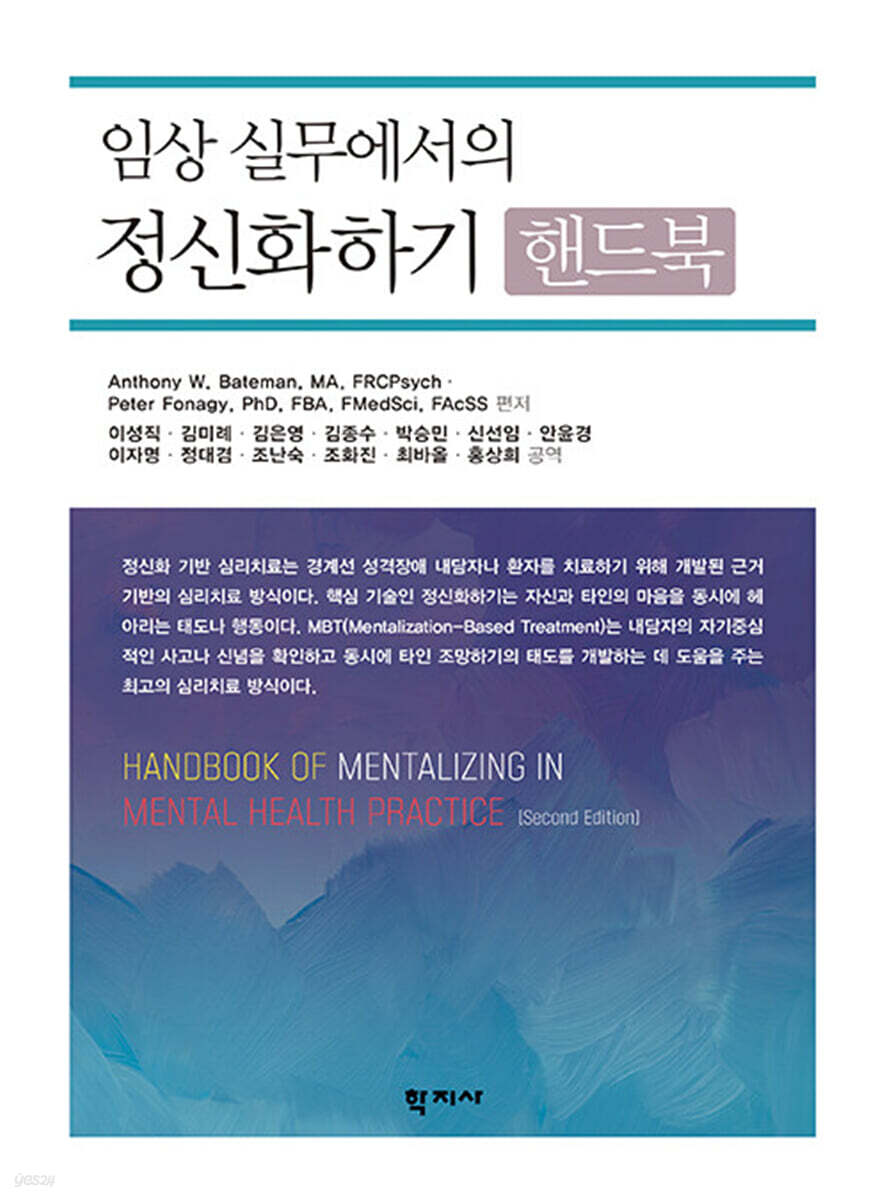
Handbook of Mentalization in Clinical Practice
 |
Description
Book Introduction
As mentioned in interviews for other books by the author, mentalization-based psychotherapy is not a difficult treatment method to learn, and counselors are already using intervention techniques to help clients mentalize.
It is also said that even if you are not a beginner counselor, you can learn it and apply it in just three days.
Above all, the principles of treatment are very practical, and spiritualization is an attitude that not only the client in the counseling session but all of our citizens must strive for.
Looking at the table of contents of the Handbook of Mentalization in Clinical Practice, Chapter 1, Introduction, discusses the developmental origins of mentalization and the negative impact of mentalization in dysfunctional environments.
Next, the multidimensional nature of mentalization and the imbalance of mentalization are explained.
Chapters 2 and 3 then introduce the components of mentalization from a neuropsychological perspective.
Part 2, Clinical Practice, discusses in detail individual counseling techniques, group therapy with adults and adolescents, and psychotherapy techniques based on mentalization for families and couples.
Chapter 11 presents a mentalization-based art therapy method, showing the expansion of the treatment method in a more diverse way.
Part 3 introduces clinical practice for clients or patients with more specific psychopathologies, including borderline personality disorder, conduct disorder, antisocial personality disorder, avoidant and narcissistic personality disorders, eating disorders, and substance abuse disorders in adolescents.
It is also said that even if you are not a beginner counselor, you can learn it and apply it in just three days.
Above all, the principles of treatment are very practical, and spiritualization is an attitude that not only the client in the counseling session but all of our citizens must strive for.
Looking at the table of contents of the Handbook of Mentalization in Clinical Practice, Chapter 1, Introduction, discusses the developmental origins of mentalization and the negative impact of mentalization in dysfunctional environments.
Next, the multidimensional nature of mentalization and the imbalance of mentalization are explained.
Chapters 2 and 3 then introduce the components of mentalization from a neuropsychological perspective.
Part 2, Clinical Practice, discusses in detail individual counseling techniques, group therapy with adults and adolescents, and psychotherapy techniques based on mentalization for families and couples.
Chapter 11 presents a mentalization-based art therapy method, showing the expansion of the treatment method in a more diverse way.
Part 3 introduces clinical practice for clients or patients with more specific psychopathologies, including borderline personality disorder, conduct disorder, antisocial personality disorder, avoidant and narcissistic personality disorders, eating disorders, and substance abuse disorders in adolescents.
index
Translator's Preface
Author's Preface
Part 1: The Principles of Mentalization
Chapter 1 Introduction
01 The developmental origins of mentalization and the impact of adversity
02 Development of mentalization in an environment of early adversity
03 Multidimensional Characteristics of Mentalization
04 Context and Relationship Specific Characteristics of Mentalization
05 Imbalance in Mentalization: Preliminary Mentalization Mode
06 Superficial Clues and Epistemic Trust
07 Social and Cultural Context of Mentalization
Chapter 2: Modern Neuroscience Research
01 Neuroscientific Components of MBT
02 Computational Approaches to Neuroscience: Implications for MBT
03 Conclusion
Chapter 3 Chapter 3 Mentalization Assessment
01 Dimensions of Mentalization and Mentalization Profile
02 Individual differences in mentalization, awakening, and attachment
03 Unstructured Mentalization Clinical Assessment
04 Structured Assessment of Mentalization
05 Conclusion
Chapter 4: Mentalization, Resilience, and Epistemological Trust
01 What is resilience?
02 Mentalization, Resilience, and the 'p' Factor
03 Mentalization and Social Imagination
04 Epistemological Trust
Chapter 5 Mentalization and Trauma
01 Developmental Psychobiology of Trauma
02 Trauma from a Mentalizing and Developmental Psychopathology Perspective
03 Clinical Implications: Mentalization-Based Treatment and Beyond
04 Conclusion
Part 2: Clinical Practice of Mentalization
Chapter 6 Personal Counseling Skills
01 MBT Compliance Scale
02 MBT Introductory Group (MBT-I)
03 Relational Mentalization
04 Most Mode
05 Conclusion
Chapter 7 Group Therapy for Adults and Adolescents
01 Historical Origins
02 Research on Group Mentalization Therapy
03 The Practice of Psychological Group Therapy
04 Summary of the Core Elements of MBT-G for Adults and Adolescents
Chapter 8 Working with Family
01 Development of a Mentalization-Based Approach to Working with Families
02 Difficulties in doing mental work in a family context
03 Goals of a Mentalization-Based Family Therapy Approach
04 Therapist's Attitude
05 Mentalization Loop
06 Specific techniques to enhance effective mentalization
07 Mentalizing Approaches to Families in Different Contexts
08 Evidence-Based Family Mentalization Work
09 Conclusion
Chapter 9 Couples Therapy
01 Starting Mentalization-Based Couples Therapy
02 Individual sessions for each couple
03 Running MBT-CO
Chapter 10 Treatment Models
01 What Treatment Outcome Studies Tell Us
02 A Universal Model of Psychotherapy for Common Factors in Psychopathology
03 Conclusion
Chapter 11 Creative Arts Therapy
01 Mentalization-Based Art Therapy: Overview
02 Keeping the broader context in mind
03 Implicit and Explicit Mentalization through Art
04 Creative Use of Metaphors
05 Explicit Mentalization and Art Forms
06 Maladaptive Attachment and Dementalization in Art Therapy
07 Art Therapy and Team Work
08 Art and Spiritualization Beyond the Clinical Scene
09 Conclusion
Chapter 12 Partial Hospitalization Settings
01 Patient group
02 Treatment Goals and Treatment Plan
03 End of treatment
04 Mentalization Environment
05 Implementing a Mental Health-Based Treatment Program
Chapter 13: Adaptive Mentalization-Based Integrated Therapy (AMBIT): Engaging the Client and the Community of Mind
01 Overview of Adaptive Mentalization-Based Integrated Therapy
02 Continuous adaptation and change
03 Innovation for Action: Tools to Support Communities of Mind
04 Innovation for Action: Approaches to Collaboration and Diffusion
05 Conclusion
Chapter 14 Social Systems: Beyond the Microcosm of the Individual and Family
01 Mentalizing the social process
02 Transcending Cultures
03 Characteristics of an Effectively Spiritualized Society
04 Characteristics of an Ineffectively Spiritualized Society
05 Mentalization at school
06 Mentalization in the Judicial System
07 Conclusion
Part 3 Applications in Specific Areas
Chapter 15 Children
01 What are the new features of the time-limited MBT-C?
02 Time-limited MBT-C Goal
03 Which children can benefit from time-limited MBT-C?
04 Structure and Frame of Time-Limited MBT-C
05 Physical environment for treatment
06 Time as a Framework for Treatment
07 Focus Formula
08 Counselor Attitude in Time-Limited MBT-C
09 Conclusion
Chapter 16 Parental Roles and Foster Care
01 Background
02 Reflective Parenting Model
03 Challenges in the Work
Chapter 17: Borderline Personality Pathology in Adolescence
01 Recent Research Results on Borderline Personality Pathology in Adolescents
02 Adolescence: The emergence of a coherent and integrated 'idea of self'
03 The Role of Empirical Evidence and Overmentalization
04 Mentalization-Based Treatment for Adolescents
Chapter 18 Conduct Disorder
01 Definition and Characteristics of Conduct Disorder
02 Causes of Conduct Problems
03 Mentalization Model of Conduct Disorder
04 Psychological Treatment for Adolescents with Conduct Disorder
05 Treatment Process
06 Family intervention
07 Case Conceptualization
08 Conclusion
Chapter 19 Borderline Personality Disorder
01 Core Characteristics of BPD
02 Mentalizing Profile of BPD Across Four Dimensions of Social Cognition
Clinical application of the 3-dimensional framework
04 Conclusion
Chapter 20: Antisocial Personality Disorder in Community and Prison Settings
01 ASPD and the Community Setting: General Considerations for Treatment
02 Mentalization Profile of ASPD
03 ASPD and Preliminary Mentalization Mode
04 ASPD and the Heterogeneous Self
05 MBT-ASPD: Group Therapy
06 MBT in the Forensic Community
07 MBT in Prison
08 Conclusion
Chapter 21: Avoidant and Narcissistic Personality Disorders
01 Avoidant personality disorder
02 Narcissistic personality disorder
03 Conclusion
Chapter 22 Eating Disorders
01 Eating Disorders as Self-Disorders
02 Mental Modes for Eating Disorders and Reality
03 Studies Showing Impaired Mentalization in Eating Disorders
04 Clinical Structure of Mentalization-Based Treatment for Eating Disorders (MBT-ED)
05 MBT-ED Training
06 Working as a team
07 Case Conceptualization
08 Action/Crisis Plan
09 Conclusion
Chapter 23 Depression
01 Case for a Mentalization-Based Approach
02 Depression and Mentalization: A Theoretical Perspective
03 Meaning/Implications for Treatment
04 Conclusion
Chapter 24: Comorbid Substance Use Disorders and Personality Disorders
01 Comorbid Disorders: Personality Disorder and Substance Use Disorder
02 Difficulty in mentalizing and regulating emotions
03 Attachment, Substance Use, and Neurobiology
04 Neurobiology of Substance Use Disorders
05 Dual-track treatment for coexisting substance use disorders and personality disorders
06 The Bergen MBT-SUD Model: Clinical Experience
07 Risk factors for treatment discontinuation
08 Substance Use Disorders and Shame
09 Countertransference: The Therapist's Feelings
10 Building Alliances Through Mental Health Education, Crisis Planning, and Mentalizing Case Conceptualization
11 Conclusion
Chapter 25 Psychosis
1 Attachment along the psychosis continuum
2 Neurobiological pathways contributing to new psychoses along the psychosis continuum
3. A Mentalization-Informed Approach Along the Psychosis Continuum
4 Prevention and Protection
Search
Author's Preface
Part 1: The Principles of Mentalization
Chapter 1 Introduction
01 The developmental origins of mentalization and the impact of adversity
02 Development of mentalization in an environment of early adversity
03 Multidimensional Characteristics of Mentalization
04 Context and Relationship Specific Characteristics of Mentalization
05 Imbalance in Mentalization: Preliminary Mentalization Mode
06 Superficial Clues and Epistemic Trust
07 Social and Cultural Context of Mentalization
Chapter 2: Modern Neuroscience Research
01 Neuroscientific Components of MBT
02 Computational Approaches to Neuroscience: Implications for MBT
03 Conclusion
Chapter 3 Chapter 3 Mentalization Assessment
01 Dimensions of Mentalization and Mentalization Profile
02 Individual differences in mentalization, awakening, and attachment
03 Unstructured Mentalization Clinical Assessment
04 Structured Assessment of Mentalization
05 Conclusion
Chapter 4: Mentalization, Resilience, and Epistemological Trust
01 What is resilience?
02 Mentalization, Resilience, and the 'p' Factor
03 Mentalization and Social Imagination
04 Epistemological Trust
Chapter 5 Mentalization and Trauma
01 Developmental Psychobiology of Trauma
02 Trauma from a Mentalizing and Developmental Psychopathology Perspective
03 Clinical Implications: Mentalization-Based Treatment and Beyond
04 Conclusion
Part 2: Clinical Practice of Mentalization
Chapter 6 Personal Counseling Skills
01 MBT Compliance Scale
02 MBT Introductory Group (MBT-I)
03 Relational Mentalization
04 Most Mode
05 Conclusion
Chapter 7 Group Therapy for Adults and Adolescents
01 Historical Origins
02 Research on Group Mentalization Therapy
03 The Practice of Psychological Group Therapy
04 Summary of the Core Elements of MBT-G for Adults and Adolescents
Chapter 8 Working with Family
01 Development of a Mentalization-Based Approach to Working with Families
02 Difficulties in doing mental work in a family context
03 Goals of a Mentalization-Based Family Therapy Approach
04 Therapist's Attitude
05 Mentalization Loop
06 Specific techniques to enhance effective mentalization
07 Mentalizing Approaches to Families in Different Contexts
08 Evidence-Based Family Mentalization Work
09 Conclusion
Chapter 9 Couples Therapy
01 Starting Mentalization-Based Couples Therapy
02 Individual sessions for each couple
03 Running MBT-CO
Chapter 10 Treatment Models
01 What Treatment Outcome Studies Tell Us
02 A Universal Model of Psychotherapy for Common Factors in Psychopathology
03 Conclusion
Chapter 11 Creative Arts Therapy
01 Mentalization-Based Art Therapy: Overview
02 Keeping the broader context in mind
03 Implicit and Explicit Mentalization through Art
04 Creative Use of Metaphors
05 Explicit Mentalization and Art Forms
06 Maladaptive Attachment and Dementalization in Art Therapy
07 Art Therapy and Team Work
08 Art and Spiritualization Beyond the Clinical Scene
09 Conclusion
Chapter 12 Partial Hospitalization Settings
01 Patient group
02 Treatment Goals and Treatment Plan
03 End of treatment
04 Mentalization Environment
05 Implementing a Mental Health-Based Treatment Program
Chapter 13: Adaptive Mentalization-Based Integrated Therapy (AMBIT): Engaging the Client and the Community of Mind
01 Overview of Adaptive Mentalization-Based Integrated Therapy
02 Continuous adaptation and change
03 Innovation for Action: Tools to Support Communities of Mind
04 Innovation for Action: Approaches to Collaboration and Diffusion
05 Conclusion
Chapter 14 Social Systems: Beyond the Microcosm of the Individual and Family
01 Mentalizing the social process
02 Transcending Cultures
03 Characteristics of an Effectively Spiritualized Society
04 Characteristics of an Ineffectively Spiritualized Society
05 Mentalization at school
06 Mentalization in the Judicial System
07 Conclusion
Part 3 Applications in Specific Areas
Chapter 15 Children
01 What are the new features of the time-limited MBT-C?
02 Time-limited MBT-C Goal
03 Which children can benefit from time-limited MBT-C?
04 Structure and Frame of Time-Limited MBT-C
05 Physical environment for treatment
06 Time as a Framework for Treatment
07 Focus Formula
08 Counselor Attitude in Time-Limited MBT-C
09 Conclusion
Chapter 16 Parental Roles and Foster Care
01 Background
02 Reflective Parenting Model
03 Challenges in the Work
Chapter 17: Borderline Personality Pathology in Adolescence
01 Recent Research Results on Borderline Personality Pathology in Adolescents
02 Adolescence: The emergence of a coherent and integrated 'idea of self'
03 The Role of Empirical Evidence and Overmentalization
04 Mentalization-Based Treatment for Adolescents
Chapter 18 Conduct Disorder
01 Definition and Characteristics of Conduct Disorder
02 Causes of Conduct Problems
03 Mentalization Model of Conduct Disorder
04 Psychological Treatment for Adolescents with Conduct Disorder
05 Treatment Process
06 Family intervention
07 Case Conceptualization
08 Conclusion
Chapter 19 Borderline Personality Disorder
01 Core Characteristics of BPD
02 Mentalizing Profile of BPD Across Four Dimensions of Social Cognition
Clinical application of the 3-dimensional framework
04 Conclusion
Chapter 20: Antisocial Personality Disorder in Community and Prison Settings
01 ASPD and the Community Setting: General Considerations for Treatment
02 Mentalization Profile of ASPD
03 ASPD and Preliminary Mentalization Mode
04 ASPD and the Heterogeneous Self
05 MBT-ASPD: Group Therapy
06 MBT in the Forensic Community
07 MBT in Prison
08 Conclusion
Chapter 21: Avoidant and Narcissistic Personality Disorders
01 Avoidant personality disorder
02 Narcissistic personality disorder
03 Conclusion
Chapter 22 Eating Disorders
01 Eating Disorders as Self-Disorders
02 Mental Modes for Eating Disorders and Reality
03 Studies Showing Impaired Mentalization in Eating Disorders
04 Clinical Structure of Mentalization-Based Treatment for Eating Disorders (MBT-ED)
05 MBT-ED Training
06 Working as a team
07 Case Conceptualization
08 Action/Crisis Plan
09 Conclusion
Chapter 23 Depression
01 Case for a Mentalization-Based Approach
02 Depression and Mentalization: A Theoretical Perspective
03 Meaning/Implications for Treatment
04 Conclusion
Chapter 24: Comorbid Substance Use Disorders and Personality Disorders
01 Comorbid Disorders: Personality Disorder and Substance Use Disorder
02 Difficulty in mentalizing and regulating emotions
03 Attachment, Substance Use, and Neurobiology
04 Neurobiology of Substance Use Disorders
05 Dual-track treatment for coexisting substance use disorders and personality disorders
06 The Bergen MBT-SUD Model: Clinical Experience
07 Risk factors for treatment discontinuation
08 Substance Use Disorders and Shame
09 Countertransference: The Therapist's Feelings
10 Building Alliances Through Mental Health Education, Crisis Planning, and Mentalizing Case Conceptualization
11 Conclusion
Chapter 25 Psychosis
1 Attachment along the psychosis continuum
2 Neurobiological pathways contributing to new psychoses along the psychosis continuum
3. A Mentalization-Informed Approach Along the Psychosis Continuum
4 Prevention and Protection
Search
GOODS SPECIFICS
- Date of issue: March 28, 2024
- Page count, weight, size: 589 pages | 1,189g | 188*255*35mm
- ISBN13: 9788999730498
- ISBN10: 8999730492
You may also like
카테고리
korean


korean

![GQ KOREA Mark (Monthly): December [2025]](http://librairie.coreenne.fr/cdn/shop/files/8ef265dbbfbf186523ed75ba7319009d.jpg?v=1765340328&width=3840)


