

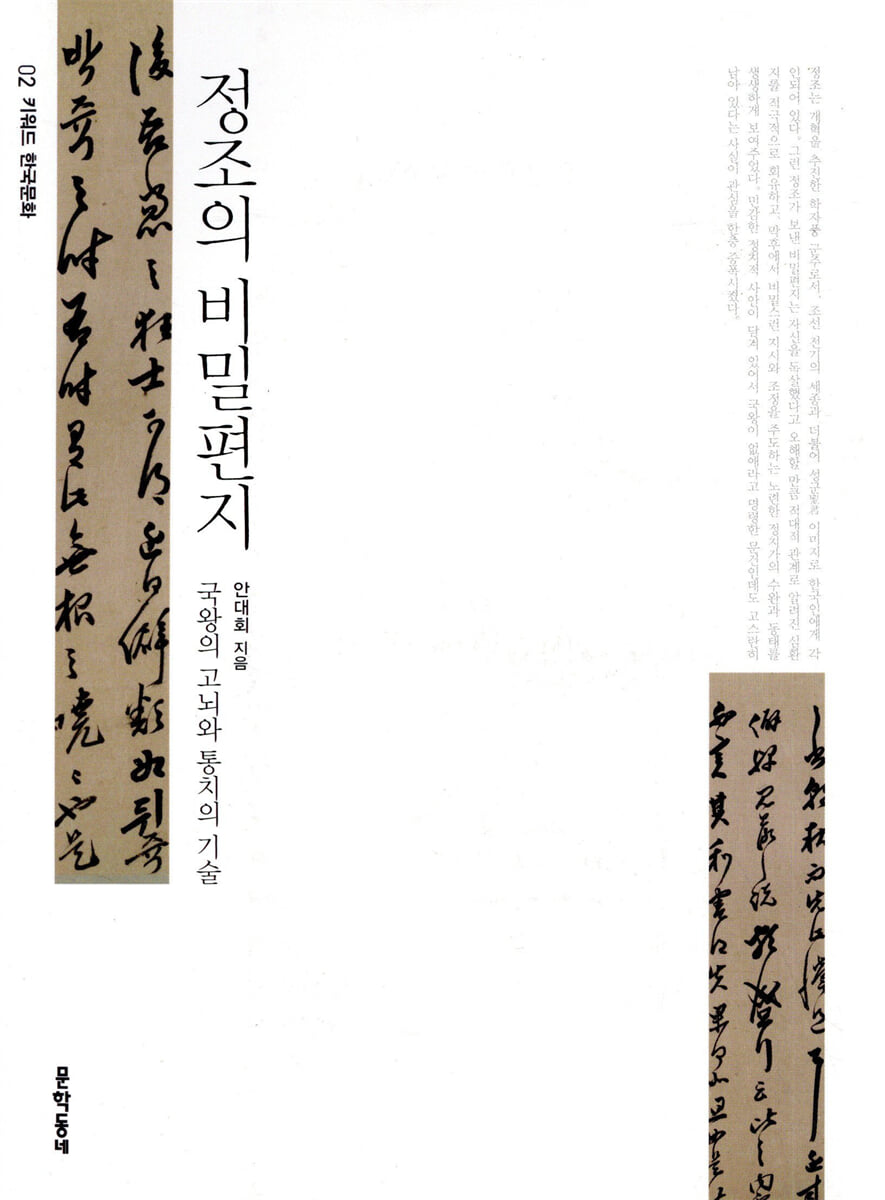
Jeongjo's secret letter
 |
Description
Book Introduction
A book that explores the human and political aspects of Jeongjo.
The 'Keyword Korean Culture' series is a project to rediscover Korean history and culture.
In other words, it is a task of finding the essence of Korean culture and organizing its meaning and value.
This series analyzes and introduces Korean culture using a single picture or a single historical scene as a keyword.
This book is the second volume in the series, titled “Jeongjo’s Secret Letter.”
In 2009, a controversial historical document called “Jeongjo Eochalcheop” was discovered.
The content of 『Jeongjo Eochal』, a letter sent by King Jeongjo to Sim Hwan-ji, completely changed the existing image of King Jeongjo as a virtuous king.
『Jeongjo's Secret Letter』 reveals the inner side of Jeongjo, who was known only as a virtuous king, through his secret letters included in the Jeongjo Eochalcheop.
The readers are shown the image of King Jeongjo as a seasoned, practical politician who knows how to move the hearts of his officials.
At the same time, Jeongjo's human side is also well revealed.
The book introduces the two-faced side of King Jeongjo, who was quick to anger and also received respect from his subjects.
This book can be said to be a guide that explains the Jeongjo Eochal, which was perceived as specialized, in a way that is accessible to the general public and explains its context in detail.
The 'Keyword Korean Culture' series is a project to rediscover Korean history and culture.
In other words, it is a task of finding the essence of Korean culture and organizing its meaning and value.
This series analyzes and introduces Korean culture using a single picture or a single historical scene as a keyword.
This book is the second volume in the series, titled “Jeongjo’s Secret Letter.”
In 2009, a controversial historical document called “Jeongjo Eochalcheop” was discovered.
The content of 『Jeongjo Eochal』, a letter sent by King Jeongjo to Sim Hwan-ji, completely changed the existing image of King Jeongjo as a virtuous king.
『Jeongjo's Secret Letter』 reveals the inner side of Jeongjo, who was known only as a virtuous king, through his secret letters included in the Jeongjo Eochalcheop.
The readers are shown the image of King Jeongjo as a seasoned, practical politician who knows how to move the hearts of his officials.
At the same time, Jeongjo's human side is also well revealed.
The book introduces the two-faced side of King Jeongjo, who was quick to anger and also received respect from his subjects.
This book can be said to be a guide that explains the Jeongjo Eochal, which was perceived as specialized, in a way that is accessible to the general public and explains its context in detail.
- You can preview some of the book's contents.
Preview
index
preface
1. The emergence of the 『Jeongjo Eochalcheop』
2.
The King's Secret Letter
3.
The process of exchanging secret letters with the recipient, a patient
4.
The royal court and politics
5.
The human side of King Jeongjo revealed in the 『Eochalcheop』
6.
The sentences and language of the letter
7.
Perennial illness and poisoning theory
8.
The secret left behind by the secret letter
main
References
Keywords within keywords
1. The emergence of the 『Jeongjo Eochalcheop』
2.
The King's Secret Letter
3.
The process of exchanging secret letters with the recipient, a patient
4.
The royal court and politics
5.
The human side of King Jeongjo revealed in the 『Eochalcheop』
6.
The sentences and language of the letter
7.
Perennial illness and poisoning theory
8.
The secret left behind by the secret letter
main
References
Keywords within keywords
Detailed image
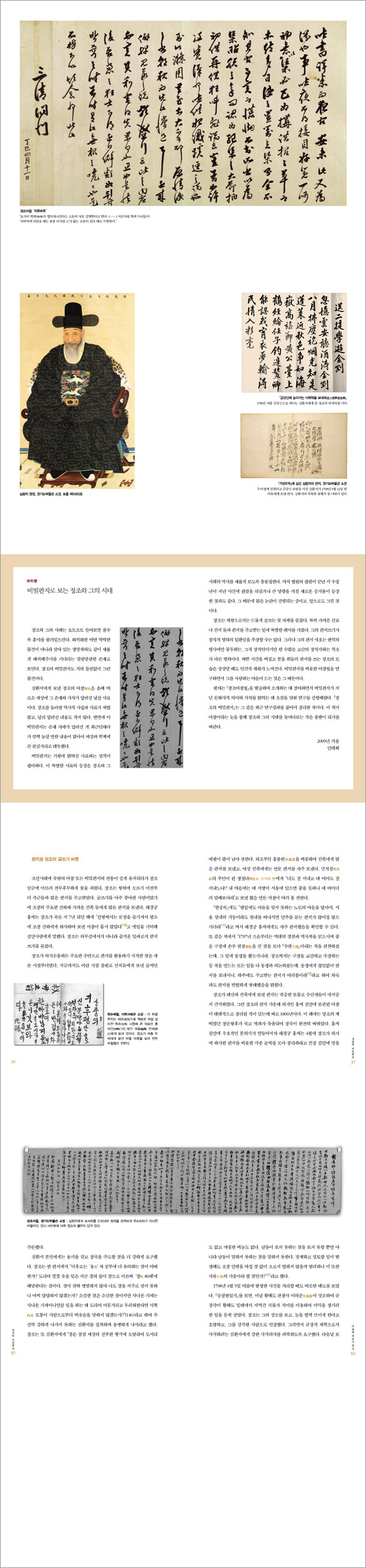
Into the book
Secrets of others that people do not want to reveal stimulate a strange curiosity in people.
Moreover, when it comes to the secrets of a monarch who displayed seasoned political prowess at the pinnacle of power, it goes beyond curiosity and provides an opportunity to relax and look behind the solemn and serious history.
For that alone, Jeongjo's secret letter is valuable.
Moreover, this text sometimes conflicts with and sometimes supplements official historical materials, including the Annals of the Joseon Dynasty and the Diaries of the Royal Secretariat.
It exposes what happened behind the scenes of the King's political actions and how those involved felt about them.
It reveals facts that official sources can never reveal, but are very important.
The occurrence, course, and handling of major events that occurred in the court during the four years of exchange of letters are largely contained in the conversations exchanged through letters, and secret information that cannot be found even in official historical records is hidden.
Therefore, the emergence of this temple demands a new perspective and way of thinking about the history of this era.
It has become possible to read interesting historical texts that fill in the gaps between the lines of political activities and historical texts from the Jeongjo era and further from the Joseon era.
--- In the text
Jeongjo was a scholar-like monarch who promoted reform, and along with Sejong of the early Joseon Dynasty, he is imprinted in the Korean people's image as a virtuous monarch.
The secret letters sent by Jeongjo vividly showed the skills and dynamics of a seasoned politician who actively persuaded Shim Hwan-ji, who was known to be so hostile that he was mistaken for poisoning him, and led secret instructions and coordination behind the scenes.
--- In the text
Jeongjo was known as a scholar-style monarch with a meticulous and gentle personality, and it cannot be denied that he actually had such aspects.
On the other hand, contrary to such an image, 『Eochalcheop』 reveals that Jeongjo was a monarch with many faces.
--- In the text
『Eochalcheop』 is composed of information and opinions with political weight, but it does not only show such content.
Just as political actions are not always serious and solemn, the letters of the king and his ministers are often light and trivial, and sometimes contain wit and humor.
--- In the text
Jeongjo, who had long been solidified as a dignified and reformist emperor, re-emerged as a practical politician and a human being after the appearance of the royal secretariat.
On the one hand, the series of letters sent to Sim Hwan-ji, who is known to have poisoned King Jeongjo, heated up the debate surrounding the theory of King Jeongjo's poisoning.
Moreover, when it comes to the secrets of a monarch who displayed seasoned political prowess at the pinnacle of power, it goes beyond curiosity and provides an opportunity to relax and look behind the solemn and serious history.
For that alone, Jeongjo's secret letter is valuable.
Moreover, this text sometimes conflicts with and sometimes supplements official historical materials, including the Annals of the Joseon Dynasty and the Diaries of the Royal Secretariat.
It exposes what happened behind the scenes of the King's political actions and how those involved felt about them.
It reveals facts that official sources can never reveal, but are very important.
The occurrence, course, and handling of major events that occurred in the court during the four years of exchange of letters are largely contained in the conversations exchanged through letters, and secret information that cannot be found even in official historical records is hidden.
Therefore, the emergence of this temple demands a new perspective and way of thinking about the history of this era.
It has become possible to read interesting historical texts that fill in the gaps between the lines of political activities and historical texts from the Jeongjo era and further from the Joseon era.
--- In the text
Jeongjo was a scholar-like monarch who promoted reform, and along with Sejong of the early Joseon Dynasty, he is imprinted in the Korean people's image as a virtuous monarch.
The secret letters sent by Jeongjo vividly showed the skills and dynamics of a seasoned politician who actively persuaded Shim Hwan-ji, who was known to be so hostile that he was mistaken for poisoning him, and led secret instructions and coordination behind the scenes.
--- In the text
Jeongjo was known as a scholar-style monarch with a meticulous and gentle personality, and it cannot be denied that he actually had such aspects.
On the other hand, contrary to such an image, 『Eochalcheop』 reveals that Jeongjo was a monarch with many faces.
--- In the text
『Eochalcheop』 is composed of information and opinions with political weight, but it does not only show such content.
Just as political actions are not always serious and solemn, the letters of the king and his ministers are often light and trivial, and sometimes contain wit and humor.
--- In the text
Jeongjo, who had long been solidified as a dignified and reformist emperor, re-emerged as a practical politician and a human being after the appearance of the royal secretariat.
On the one hand, the series of letters sent to Sim Hwan-ji, who is known to have poisoned King Jeongjo, heated up the debate surrounding the theory of King Jeongjo's poisoning.
--- In the text
Publisher's Review
Uncovering the secrets of over 300 royal seals!
The true nature of King Jeongjo's ruling techniques and backstage politics, a "human" who moved the hearts of his officials.
Through the secret letters of King Jeongjo included in the Jeongjo Eochalcheop, the inner side of King Jeongjo, who was known only as a virtuous king, was revealed.
His character as a seasoned, practical politician who knows how to move the hearts of his officials is fully revealed.
This book is the first guidebook to explain the Jeongjo Eochal, which was perceived as specialized, in a way that is accessible to the general public and to explain its context in detail.
"You stinking filthy bastard!" Is this really what a king would say? What was Jeongjo so desperately trying to say, writing over 300 secret letters? The king's backroom politics, manipulating his subjects behind the scenes, Jeongjo's Machiavellianism.
He would have certainly been a capable politician if he had been born in the 21st century.
However, even while working hard late into the night, his thoughts about the people were not just political gestures.
The reason he continued to write letters, even though his body felt like a fire, his eyes became dim, and he could no longer read the letters, was because he cared about the people.
Why 『Jeongjo Eochalcheop』?
2009 was the year of 『Jeongjo Eochalcheop』.
The 297 royal edicts of King Jeongjo, released on February 9, 2009, were enough to shake up the academic world.
Jeongjo sent a secret letter to Sim Hwan-ji, with whom he was known to have a hostile relationship to the point that people mistakenly thought he had poisoned him.
This not only overturned his image as a 'sage king', but also caused repercussions in the political world regarding Jeongjo's political style.
The author, Dae-hoe Ahn, who participated in the entire process from the excavation of Jeongjo's royal secret letter, presented the new achievements of 『Jeongjo's Secret Letter』 as follows.
1) The discussion was conducted based on the entire Jeongjo Eochal known so far.
This study analyzed the 350 letters, including 297 secret letters sent to Sim Hwan-ji and 50 or so discovered later, as well as royal letters sent to other officials and relatives, and conducted the most comprehensive analysis of royal letters to date, based on which the characteristics of the secret letters were analyzed.
2) Although a book translating the Jeongjo Eochal has been published, and a paper analyzing the Eochal has been published in an academic journal, the content was not easily accessible to the general educated public.
This book is significant as the first to be written to enable the general public to broadly understand Jeongjo Eochal.
3) For example, based on Sim Hwan-ji's collected works, the analysis of the recipient Sim Hwan-ji, the fact that Lady Hong of Hyegyeonggung collected and organized a large number of King Jeongjo's royal letters in 1806, the view of King Jeongjo's death from Sim No-sung, who was Sim Hwan-ji's enemy, the explanation of King Jeongjo's writing habits, and the letter-writing culture of Joseon Dynasty kings, etc., various facts surrounding King Jeongjo's royal letters were highlighted by utilizing new materials.
Politician Jeongjo - Master of Backstage Politics
『Jeongjo Eochalcheop』 is essentially a political document that is intended to be kept confidential.
This is a historical document containing King Jeongjo's political actions against Sim Hwan-ji.
So, in 『Jeongjo Eochalcheop』, the behind-the-scenes politics of Jeongjo, who led the political situation from behind, are revealed in detail.
Jeongjo would send secret letters to his subjects to instruct them to submit petitions and also inquire about their movements.
In particular, Jeongjo demanded that his subjects have a “strong sense of duty and a sharp attitude,” and ordered them to “be fierce and vicious in everything they do.”
In short, he urged his subjects not to follow the trends of the times but to clearly state their own opinions.
Human Chastity - Humans before the King
Meanwhile, Jeongjo was a human being before he was a king.
He was quick to anger, but he also impressed his subjects by giving them gifts.
That's why he was able to win the hearts of his subjects.
King Jeongjo was so choleric, easily excitable, and impatient about everything that he called his own temperament 'sun syndrome.'
“What kind of people are Hwang In-gi and Kim Yi-su that they dare to talk nonsense!” “What a shame, they are such bastards,” he said, expressing his discontent using harsh expressions.
But when he asked Shim Hwan-ji about his wife's well-being and sent her some roots as medicine for his wife who was suffering from a chronic illness, he was also a human being like us.
Even in his appearance, where he reads books all night and worries about the people's well-being, we can see his utmost love for the people as if they were his family, rather than as a politician.
The interpretation of Jeongjo's secret letter remains open.
The author, Daehoe Ahn, said this about the current meaning of Jeongjo Eochal.
“The secret letters sent by King Jeongjo, especially to Sim Hwan-ji, are of great significance in understanding the history of the Joseon Dynasty.
Perhaps it could become one of the main codes for modern people to understand the Joseon royal family and the culture of the noble class.
In particular, the significance of the emperor's almost real-time communication with his subjects and relatives through letters is similar to the behavior of modern people, for whom email has become an integral part of their daily lives.
Its meaning can continually come to us with new meanings.”
While Jeongjo's style of backroom politics remains problematic, what we must not overlook is the ultimate goal he sought to achieve through such politics.
According to Professor Ahn Dae-hoe, the Jeongjo Eochal is currently being de-translated and translated by each institution, mainly at university museums and libraries.
And the private collection of royal seals is also going through the same process.
All of this is an extension of the reaction that the release of King Jeongjo's royal decree last year brought about.
There will be more results this year as well.
However, it is difficult to have meaningful content like the secret letter sent to Sim Hwan-ji.
However, as it has a certain significance, continuous disclosure and research are necessary.
Professor Ahn Dae-hoe plans to publish a revised edition when new and important facts related to Jeongjo's Secret Letter are added.
The true nature of King Jeongjo's ruling techniques and backstage politics, a "human" who moved the hearts of his officials.
Through the secret letters of King Jeongjo included in the Jeongjo Eochalcheop, the inner side of King Jeongjo, who was known only as a virtuous king, was revealed.
His character as a seasoned, practical politician who knows how to move the hearts of his officials is fully revealed.
This book is the first guidebook to explain the Jeongjo Eochal, which was perceived as specialized, in a way that is accessible to the general public and to explain its context in detail.
"You stinking filthy bastard!" Is this really what a king would say? What was Jeongjo so desperately trying to say, writing over 300 secret letters? The king's backroom politics, manipulating his subjects behind the scenes, Jeongjo's Machiavellianism.
He would have certainly been a capable politician if he had been born in the 21st century.
However, even while working hard late into the night, his thoughts about the people were not just political gestures.
The reason he continued to write letters, even though his body felt like a fire, his eyes became dim, and he could no longer read the letters, was because he cared about the people.
Why 『Jeongjo Eochalcheop』?
2009 was the year of 『Jeongjo Eochalcheop』.
The 297 royal edicts of King Jeongjo, released on February 9, 2009, were enough to shake up the academic world.
Jeongjo sent a secret letter to Sim Hwan-ji, with whom he was known to have a hostile relationship to the point that people mistakenly thought he had poisoned him.
This not only overturned his image as a 'sage king', but also caused repercussions in the political world regarding Jeongjo's political style.
The author, Dae-hoe Ahn, who participated in the entire process from the excavation of Jeongjo's royal secret letter, presented the new achievements of 『Jeongjo's Secret Letter』 as follows.
1) The discussion was conducted based on the entire Jeongjo Eochal known so far.
This study analyzed the 350 letters, including 297 secret letters sent to Sim Hwan-ji and 50 or so discovered later, as well as royal letters sent to other officials and relatives, and conducted the most comprehensive analysis of royal letters to date, based on which the characteristics of the secret letters were analyzed.
2) Although a book translating the Jeongjo Eochal has been published, and a paper analyzing the Eochal has been published in an academic journal, the content was not easily accessible to the general educated public.
This book is significant as the first to be written to enable the general public to broadly understand Jeongjo Eochal.
3) For example, based on Sim Hwan-ji's collected works, the analysis of the recipient Sim Hwan-ji, the fact that Lady Hong of Hyegyeonggung collected and organized a large number of King Jeongjo's royal letters in 1806, the view of King Jeongjo's death from Sim No-sung, who was Sim Hwan-ji's enemy, the explanation of King Jeongjo's writing habits, and the letter-writing culture of Joseon Dynasty kings, etc., various facts surrounding King Jeongjo's royal letters were highlighted by utilizing new materials.
Politician Jeongjo - Master of Backstage Politics
『Jeongjo Eochalcheop』 is essentially a political document that is intended to be kept confidential.
This is a historical document containing King Jeongjo's political actions against Sim Hwan-ji.
So, in 『Jeongjo Eochalcheop』, the behind-the-scenes politics of Jeongjo, who led the political situation from behind, are revealed in detail.
Jeongjo would send secret letters to his subjects to instruct them to submit petitions and also inquire about their movements.
In particular, Jeongjo demanded that his subjects have a “strong sense of duty and a sharp attitude,” and ordered them to “be fierce and vicious in everything they do.”
In short, he urged his subjects not to follow the trends of the times but to clearly state their own opinions.
Human Chastity - Humans before the King
Meanwhile, Jeongjo was a human being before he was a king.
He was quick to anger, but he also impressed his subjects by giving them gifts.
That's why he was able to win the hearts of his subjects.
King Jeongjo was so choleric, easily excitable, and impatient about everything that he called his own temperament 'sun syndrome.'
“What kind of people are Hwang In-gi and Kim Yi-su that they dare to talk nonsense!” “What a shame, they are such bastards,” he said, expressing his discontent using harsh expressions.
But when he asked Shim Hwan-ji about his wife's well-being and sent her some roots as medicine for his wife who was suffering from a chronic illness, he was also a human being like us.
Even in his appearance, where he reads books all night and worries about the people's well-being, we can see his utmost love for the people as if they were his family, rather than as a politician.
The interpretation of Jeongjo's secret letter remains open.
The author, Daehoe Ahn, said this about the current meaning of Jeongjo Eochal.
“The secret letters sent by King Jeongjo, especially to Sim Hwan-ji, are of great significance in understanding the history of the Joseon Dynasty.
Perhaps it could become one of the main codes for modern people to understand the Joseon royal family and the culture of the noble class.
In particular, the significance of the emperor's almost real-time communication with his subjects and relatives through letters is similar to the behavior of modern people, for whom email has become an integral part of their daily lives.
Its meaning can continually come to us with new meanings.”
While Jeongjo's style of backroom politics remains problematic, what we must not overlook is the ultimate goal he sought to achieve through such politics.
According to Professor Ahn Dae-hoe, the Jeongjo Eochal is currently being de-translated and translated by each institution, mainly at university museums and libraries.
And the private collection of royal seals is also going through the same process.
All of this is an extension of the reaction that the release of King Jeongjo's royal decree last year brought about.
There will be more results this year as well.
However, it is difficult to have meaningful content like the secret letter sent to Sim Hwan-ji.
However, as it has a certain significance, continuous disclosure and research are necessary.
Professor Ahn Dae-hoe plans to publish a revised edition when new and important facts related to Jeongjo's Secret Letter are added.
GOODS SPECIFICS
- Date of issue: January 8, 2010
- Page count, weight, size: 164 pages | 230g | 140*190*20mm
- ISBN13: 9788954609920
- ISBN10: 8954609929
You may also like
카테고리
korean


korean

![GQ KOREA Mark (Monthly): December [2025]](http://librairie.coreenne.fr/cdn/shop/files/8ef265dbbfbf186523ed75ba7319009d.jpg?v=1765340328&width=3840)


