

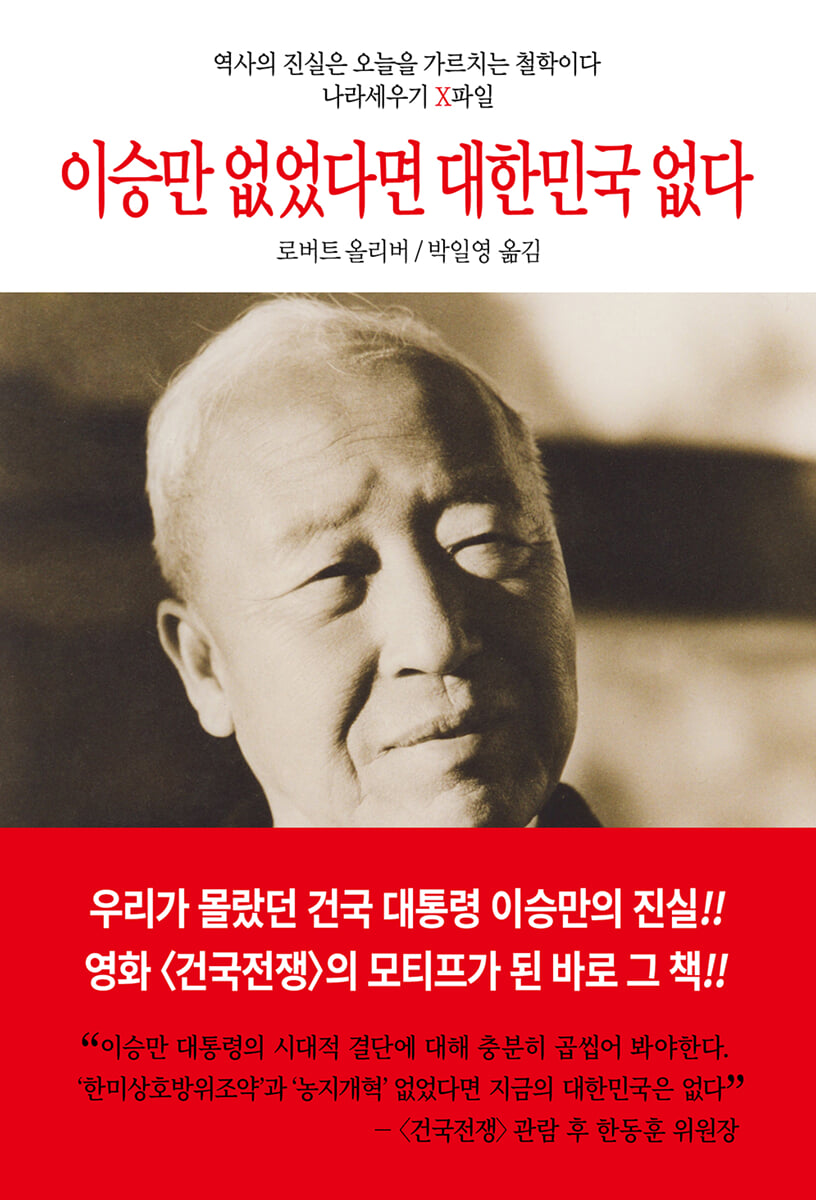
Without Syngman Rhee, there would be no Republic of Korea.
 |
Description
Book Introduction
The records in this book are deeply personal accounts of the ROK-US relationship that occurred during the founding of the Republic of Korea. They are detailed accounts of events, people, and situations from the perspectives of Syngman Rhee and his associates, and tell stories that have never been revealed before.
It tells the story of the problems Syngman Rhee had to face, based on very thorough and detailed documentation of his progress day by day and month by month.
Through this book, you will be able to approach the situation at the time: why did the United States try to eliminate him, why did Japan fear him, why did Kim Gu oppose his founding of the nation, and why did Kim Il-sung try to wipe him out?
It tells the story of the problems Syngman Rhee had to face, based on very thorough and detailed documentation of his progress day by day and month by month.
Through this book, you will be able to approach the situation at the time: why did the United States try to eliminate him, why did Japan fear him, why did Kim Gu oppose his founding of the nation, and why did Kim Il-sung try to wipe him out?
- You can preview some of the book's contents.
Preview
index
Foreword by Robert Oliver
Robert Oliver for Korean readers
1 The Dark Years in Washington (1942–1946)
2 Summer in Seoul (1946)
3. A Confrontation of Disappointment and Discord (Winter 1946–1947)
4. The Critical Point of the Trusteeship (Autumn 1947)
5. Korea Lobby in Washington (1946–1950)
6 Suspicious Movements of the United Nations (Winter 1947–1948)
7 From Darkness to Light (Spring 1948)
Establishment of the 8th government (summer 1948)
9 Administration in Chaos (August–December 1948)
10 South Korea's Trials (Spring 1949)
11 The Iron Curtain Moves South (July–December 1949)
12 Communist invasion (June 1950)
13 South of the 38th parallel (summer 1950)
14 To the Yalu River (Winter 1950)
15 The Price of Mistakes (1951)
16 Division within the Citadel (1950-1952)
17 Constitutional Crisis (1951-1952)
18 Anti-Communist Prisoners Released (1952-1953)
19 Panmunjom Armistice (July 1953)
20 Dizzying Diplomatic Stage (1954)
21 From ruins to economic revival (1950-1960)
22 Beyond the turbulent founding period (1959-1960)
Translator's Note: Park Il-young
Robert Oliver for Korean readers
1 The Dark Years in Washington (1942–1946)
2 Summer in Seoul (1946)
3. A Confrontation of Disappointment and Discord (Winter 1946–1947)
4. The Critical Point of the Trusteeship (Autumn 1947)
5. Korea Lobby in Washington (1946–1950)
6 Suspicious Movements of the United Nations (Winter 1947–1948)
7 From Darkness to Light (Spring 1948)
Establishment of the 8th government (summer 1948)
9 Administration in Chaos (August–December 1948)
10 South Korea's Trials (Spring 1949)
11 The Iron Curtain Moves South (July–December 1949)
12 Communist invasion (June 1950)
13 South of the 38th parallel (summer 1950)
14 To the Yalu River (Winter 1950)
15 The Price of Mistakes (1951)
16 Division within the Citadel (1950-1952)
17 Constitutional Crisis (1951-1952)
18 Anti-Communist Prisoners Released (1952-1953)
19 Panmunjom Armistice (July 1953)
20 Dizzying Diplomatic Stage (1954)
21 From ruins to economic revival (1950-1960)
22 Beyond the turbulent founding period (1959-1960)
Translator's Note: Park Il-young
Publisher's Review
Commemorating the 60th anniversary of the founding of the Republic of Korea! Exclusive contract! Urgent publication!
Why did the United States try to eliminate him? Why did Japan fear him?
Why did Kim Gu oppose his founding of the nation? Why did Kim Il-sung try to eradicate him?
Why are you releasing this top secret document?
Some of the letters that became the basis of the Syngman Rhee X-Files were made public by communists in a form that had been arbitrarily altered and appropriately quoted during a propaganda campaign conducted by a broadcasting station in Paris, France from 1950 to 1953 in an attempt to portray President Syngman Rhee as a “war merchant.”
When Seoul was occupied by communist forces in June 1950, President Rhee's files stored at the Gyeongmudae (Gyeongmudae) fell into enemy hands and were soon used by Soviet officials in Moscow.
This confidential document, which contains copies of letters from Syngman Rhee to me and letters I sent to him, is now being kept in safe custody and will one day be placed in a suitable library for use by researchers in modern Korean history and international relations.
If you look at his letters to me, you will see that Dr. Syngman Rhee sometimes referred to himself in the third person.
The reason is that he wrote the letter primarily for the purpose of giving me instructions to explain his motives and policies to the State Department and newspaper reporters.
He wrote the letter hoping that my remarks would be in line with his intentions.
Readers will note that I have included in this book even the letters he sent me that were marked "To be destroyed, not quoted," "To be kept," or "Not for public viewing."
I kept these letters because I believed they were essential for a well-founded account of the history of Korea-US relations.
At this point, some 40 to 50 years after these letters were written, I think it is the right time to publish a collection of letters, considering the significant impact of clarifying the vague and incomplete records.
I have never arbitrarily edited a letter.
Since all the letters were written hastily and under psychological pressure, any spelling errors or major grammatical errors were corrected.
Some omitted passages or brief mentions have been carefully explained.
I have conscientiously preserved the exact contents of the letters and other records, even if they may be gossiped about by Dr. Lee, myself, or others over time.
This is because I believe that the true value of a record lies in its accuracy.
Traces of blood, sweat, and tears
The accounts in this book are deeply personal accounts of Korea-US relations that occurred during a crucial period in the founding of the Republic of Korea.
It is a detailed account of events, people, and situations from the perspectives of Syngman Rhee and his associates, revealing a previously undiscovered story.
I would not claim that this is a 'completely accurate' account of the complexities that have highlighted the diplomatic and political situation that has left even the key figures involved in the inevitable decisions and necessary actions in a difficult position.
Historical truth is never simple.
It has many aspects that allow it to be viewed or interpreted from many different angles.
What President Syngman Rhee felt was "right" or necessary sometimes seemed "wrong" and sometimes just "random" to his political allies in Korea, the United States, and their UN allies.
However, I maintain that this story is well-founded and accurate as an unpublished record of various situations unfolding around us, in which we attempted to represent Korea's legitimate position even in the midst of very complex and troubled relationships.
I have been involved in the problems that Syngman Rhee had to face, and I know firsthand his fundamental motives and intentions, and I have a very honest and full understanding of them.
Therefore, this book is based on a very complete and detailed record of the progress from day to day and from month to month.
As I understand it, this book is fundamentally his story.
This book, along with the previously published stories of Harry Truman, Secretary of State Dean Acheson and John Foster Dulles, General Douglas MacArthur, General Mark Clark, and others, is a story that historians should give due weight to.
The ultimate truth of history must be a composite of many different perspectives, one that must be ultimately evaluated in light of events and their final consequences.
Korea, a hostage of one of the great powers
Gossips have repeatedly pointed out that even if Syngman Rhee's goals were right, his methods for achieving them were sometimes flawed.
It is also true that his methods were sometimes inappropriate or simply ill-timed and improvised.
As is often the case with political leaders, the reason was beyond his control.
In the difficult years following World War II, the readjustment of relations between nations unfolded at a dizzying pace.
The United States and the Soviet Union went from being wartime allies to being Cold War adversaries.
The relationship between the US and Japan has rapidly shifted from hatred to cooperation.
Sovereignty over mainland China shifted from the Kuomintang to the Communist Party.
The newly formed United Nations was vaguely united by communism, anti-communism, and the Third World.
In the midst of the whirlwind of change, Korea has been reduced from a nation to a collateral or a hostage.
What was rational and just for Korea often ran counter to global trends.
The tasks that needed to be accomplished were severely constrained by the fate that had to be accepted.
The world's great powers, including not only South Korea's open enemies but also its true friends and allies, supported and opposed the tasks Syngman Rhee sought to accomplish.
North Korea, the Soviet Union, and China actively fought against the Syngman Rhee government.
The United States, Britain, and India blocked, suppressed, and rejected many of Syngman Rhee's basic plans and key policies.
Syngman Rhee was attacked by both enemies and comrades.
He used all the means and strategies he had at his disposal.
How did Syngman Rhee establish and protect the Republic of Korea?
It was a special treatment to me to be his personal friend and advisor on international affairs during the four and a half centuries he held and exercised his power.
Throughout the period, we exchanged our thoughts and feelings freely, frequently and without formality, about the problems and people he had to face.
The letters exchanged, ranging from a few long letters written each year for several months, never exceeding a week, are contained in a thick, detailed collection of letters.
There were many close conversations we had while I was working with him in Korea for several months each year.
The book quotes letters extensively.
The personal memoirs are based on diaries and letters sent home as events occurred.
So these stories are records of everyday life at that time.
Looking back on these experiences now is more than just a curiosity about history.
It is truly worthwhile to enrich the record on one of the most important foreign policy challenges since World War II.
Why did the United States inadvertently establish itself on the Asian mainland? Why did the United Nations intervene directly in war for the first time in history, and only once to date?
It is enlightening to examine the causes of policy decisions, to observe what led to them, and to describe the often problematic methods, both then and now, that were often concealed from the public and often deviant, to find solutions.
Now, with enough time having passed since President Syngman Rhee was forced to resign from the presidency of the Republic of Korea in 1960, the time has come to speak openly about his story, which is intertwined with Korea-US relations.
Even today, I still don't know if the story I'm about to tell here will leave some sensitive emotional scars.
Even if that happens, I think it is right for me to report what I saw as the incident unfolded without any bias.
As an American who has served as an aide to a foreign head of state, I report on my own role as objectively as possible.
As the record shows, I was sometimes right and sometimes wrong.
Syngman Rhee also made mistakes, some of which turned out to be very serious.
It is true that the policymakers of the United States and the member states of the United Nations at the time had their own shortcomings and made mistakes, but they also had extraordinary strengths and achieved achievements that we can all be proud of.
Americans, Koreans, and citizens of other countries involved in the diplomatic and war issues examined in this book will also find this record relevant to many situations facing the world today.
What are the relationships between great powers and weaker ones? How do these relationships develop and are managed? What pressures are at play, and how are they addressed? These questions are crucial today, given the complexities of the Middle East, Africa, Southeast Asia, and the world.
The events that occurred in the early days of the Republic of Korea will help us all to more wisely address the decisions that must be made on the ground as international conflicts continue to unfold.
What is a true patriot?
Through this record, Syngman Rhee will be highlighted more clearly and directly in his true form, as I felt.
My eyes looking at him were extremely friendly.
It is also based on a much more intimate relationship than what is permitted to external third parties.
Moreover, as one of his subordinates who had participated in several of the projects he directed, I was acutely aware of the importance of the solitary position he sometimes occupied.
His difficulties and mistakes were disadvantages that I personally had to endure.
It is my hope that future records will show a truly pure and vivid Syngman Rhee.
When this record is evaluated, one outcome I hope is a reevaluation of President Syngman Rhee's role in Korean political history and Korea-US diplomatic history.
Syngman Rhee was not without major flaws.
But this was true for his political enemies and allies in Korea, for the key American officials, both military and civilian, with whom he dealt, and for the leaders of Britain, the Soviet Union, India, and both China, who exerted a significant influence on the unfolding of the events depicted in this book.
Like many leaders, he possessed great abilities and outstanding strengths.
Only by considering the overall complexity of the situation, which has been woven together by the events commonly referred to as the Korean problem, with an honest and informed eye, can a balanced view emerge.
I believe this view will be aided by the detailed records that comprise each chapter of this book.
Only by correctly understanding the past can we effectively cope with the present and successfully face the challenges of the future.
(From the preface, “If There Were No Syngman Rhee, There Would Be No Republic of Korea”)
Now the historical truth must be revealed.
'History is created by humans.'
There have been many writings about Syngman Rhee during this time.
However, most of them were incorrect or distorted historical facts.
Now here is a credible document that will set the record straight about all the rumors, misreports, and exaggerated slanders about a man who did his utmost to prevent the Marxist conquest of East Asia.
Syngman Rhee regarded anyone who forced or pressured collaboration with communists in any way as not only a public enemy of the free world but also an enemy of himself.
By stubbornly refusing to compromise with the Western powers, even if they insisted on it, he earned the reputation of being a stubborn, old tyrant who could not compromise with anyone.
He once said, “You can’t compromise with a cobra, can you?”
But Syngman Rhee was a gentleman of the century, possessing a sense of fair play, honor, self-denial, and moral duty.
Later, all history proved that most of what he predicted was correct and justified.
Syngman Rhee appealed to the crowd under the blazing sun that they must reclaim their country with sincerity, authority, courage, and unwavering conviction.
Facing the fierce political turmoil brought about by the Korean War, Syngman Rhee, with his conviction and pride, obtained material aid for the reconstruction of the destroyed South Korea in 1954, while simultaneously pushing the United States to pledge defense and economic aid to Korea.
This book contains vivid stories woven from events spanning over 20 years.
As an advisor to Syngman Rhee, Dr. Oliver edited his correspondence with him—through Dr. Rhee's many letters, he painted a portrait of an honest, capable, dedicated, and tireless patriot and politician.
He performed the monumental task of selecting materials, organizing events and decisions in order, and correcting the erroneous judgments of third parties, thereby bearing witness to the modern history of the Republic of Korea.
He did not try to justify it unconditionally, nor did he serve as an apologist for Syngman Rhee other than to set the record straight.
(George Foxmott, in a review for the Journal of the American Academy of Social Sciences)
Why did the United States try to eliminate him? Why did Japan fear him?
Why did Kim Gu oppose his founding of the nation? Why did Kim Il-sung try to eradicate him?
Why are you releasing this top secret document?
Some of the letters that became the basis of the Syngman Rhee X-Files were made public by communists in a form that had been arbitrarily altered and appropriately quoted during a propaganda campaign conducted by a broadcasting station in Paris, France from 1950 to 1953 in an attempt to portray President Syngman Rhee as a “war merchant.”
When Seoul was occupied by communist forces in June 1950, President Rhee's files stored at the Gyeongmudae (Gyeongmudae) fell into enemy hands and were soon used by Soviet officials in Moscow.
This confidential document, which contains copies of letters from Syngman Rhee to me and letters I sent to him, is now being kept in safe custody and will one day be placed in a suitable library for use by researchers in modern Korean history and international relations.
If you look at his letters to me, you will see that Dr. Syngman Rhee sometimes referred to himself in the third person.
The reason is that he wrote the letter primarily for the purpose of giving me instructions to explain his motives and policies to the State Department and newspaper reporters.
He wrote the letter hoping that my remarks would be in line with his intentions.
Readers will note that I have included in this book even the letters he sent me that were marked "To be destroyed, not quoted," "To be kept," or "Not for public viewing."
I kept these letters because I believed they were essential for a well-founded account of the history of Korea-US relations.
At this point, some 40 to 50 years after these letters were written, I think it is the right time to publish a collection of letters, considering the significant impact of clarifying the vague and incomplete records.
I have never arbitrarily edited a letter.
Since all the letters were written hastily and under psychological pressure, any spelling errors or major grammatical errors were corrected.
Some omitted passages or brief mentions have been carefully explained.
I have conscientiously preserved the exact contents of the letters and other records, even if they may be gossiped about by Dr. Lee, myself, or others over time.
This is because I believe that the true value of a record lies in its accuracy.
Traces of blood, sweat, and tears
The accounts in this book are deeply personal accounts of Korea-US relations that occurred during a crucial period in the founding of the Republic of Korea.
It is a detailed account of events, people, and situations from the perspectives of Syngman Rhee and his associates, revealing a previously undiscovered story.
I would not claim that this is a 'completely accurate' account of the complexities that have highlighted the diplomatic and political situation that has left even the key figures involved in the inevitable decisions and necessary actions in a difficult position.
Historical truth is never simple.
It has many aspects that allow it to be viewed or interpreted from many different angles.
What President Syngman Rhee felt was "right" or necessary sometimes seemed "wrong" and sometimes just "random" to his political allies in Korea, the United States, and their UN allies.
However, I maintain that this story is well-founded and accurate as an unpublished record of various situations unfolding around us, in which we attempted to represent Korea's legitimate position even in the midst of very complex and troubled relationships.
I have been involved in the problems that Syngman Rhee had to face, and I know firsthand his fundamental motives and intentions, and I have a very honest and full understanding of them.
Therefore, this book is based on a very complete and detailed record of the progress from day to day and from month to month.
As I understand it, this book is fundamentally his story.
This book, along with the previously published stories of Harry Truman, Secretary of State Dean Acheson and John Foster Dulles, General Douglas MacArthur, General Mark Clark, and others, is a story that historians should give due weight to.
The ultimate truth of history must be a composite of many different perspectives, one that must be ultimately evaluated in light of events and their final consequences.
Korea, a hostage of one of the great powers
Gossips have repeatedly pointed out that even if Syngman Rhee's goals were right, his methods for achieving them were sometimes flawed.
It is also true that his methods were sometimes inappropriate or simply ill-timed and improvised.
As is often the case with political leaders, the reason was beyond his control.
In the difficult years following World War II, the readjustment of relations between nations unfolded at a dizzying pace.
The United States and the Soviet Union went from being wartime allies to being Cold War adversaries.
The relationship between the US and Japan has rapidly shifted from hatred to cooperation.
Sovereignty over mainland China shifted from the Kuomintang to the Communist Party.
The newly formed United Nations was vaguely united by communism, anti-communism, and the Third World.
In the midst of the whirlwind of change, Korea has been reduced from a nation to a collateral or a hostage.
What was rational and just for Korea often ran counter to global trends.
The tasks that needed to be accomplished were severely constrained by the fate that had to be accepted.
The world's great powers, including not only South Korea's open enemies but also its true friends and allies, supported and opposed the tasks Syngman Rhee sought to accomplish.
North Korea, the Soviet Union, and China actively fought against the Syngman Rhee government.
The United States, Britain, and India blocked, suppressed, and rejected many of Syngman Rhee's basic plans and key policies.
Syngman Rhee was attacked by both enemies and comrades.
He used all the means and strategies he had at his disposal.
How did Syngman Rhee establish and protect the Republic of Korea?
It was a special treatment to me to be his personal friend and advisor on international affairs during the four and a half centuries he held and exercised his power.
Throughout the period, we exchanged our thoughts and feelings freely, frequently and without formality, about the problems and people he had to face.
The letters exchanged, ranging from a few long letters written each year for several months, never exceeding a week, are contained in a thick, detailed collection of letters.
There were many close conversations we had while I was working with him in Korea for several months each year.
The book quotes letters extensively.
The personal memoirs are based on diaries and letters sent home as events occurred.
So these stories are records of everyday life at that time.
Looking back on these experiences now is more than just a curiosity about history.
It is truly worthwhile to enrich the record on one of the most important foreign policy challenges since World War II.
Why did the United States inadvertently establish itself on the Asian mainland? Why did the United Nations intervene directly in war for the first time in history, and only once to date?
It is enlightening to examine the causes of policy decisions, to observe what led to them, and to describe the often problematic methods, both then and now, that were often concealed from the public and often deviant, to find solutions.
Now, with enough time having passed since President Syngman Rhee was forced to resign from the presidency of the Republic of Korea in 1960, the time has come to speak openly about his story, which is intertwined with Korea-US relations.
Even today, I still don't know if the story I'm about to tell here will leave some sensitive emotional scars.
Even if that happens, I think it is right for me to report what I saw as the incident unfolded without any bias.
As an American who has served as an aide to a foreign head of state, I report on my own role as objectively as possible.
As the record shows, I was sometimes right and sometimes wrong.
Syngman Rhee also made mistakes, some of which turned out to be very serious.
It is true that the policymakers of the United States and the member states of the United Nations at the time had their own shortcomings and made mistakes, but they also had extraordinary strengths and achieved achievements that we can all be proud of.
Americans, Koreans, and citizens of other countries involved in the diplomatic and war issues examined in this book will also find this record relevant to many situations facing the world today.
What are the relationships between great powers and weaker ones? How do these relationships develop and are managed? What pressures are at play, and how are they addressed? These questions are crucial today, given the complexities of the Middle East, Africa, Southeast Asia, and the world.
The events that occurred in the early days of the Republic of Korea will help us all to more wisely address the decisions that must be made on the ground as international conflicts continue to unfold.
What is a true patriot?
Through this record, Syngman Rhee will be highlighted more clearly and directly in his true form, as I felt.
My eyes looking at him were extremely friendly.
It is also based on a much more intimate relationship than what is permitted to external third parties.
Moreover, as one of his subordinates who had participated in several of the projects he directed, I was acutely aware of the importance of the solitary position he sometimes occupied.
His difficulties and mistakes were disadvantages that I personally had to endure.
It is my hope that future records will show a truly pure and vivid Syngman Rhee.
When this record is evaluated, one outcome I hope is a reevaluation of President Syngman Rhee's role in Korean political history and Korea-US diplomatic history.
Syngman Rhee was not without major flaws.
But this was true for his political enemies and allies in Korea, for the key American officials, both military and civilian, with whom he dealt, and for the leaders of Britain, the Soviet Union, India, and both China, who exerted a significant influence on the unfolding of the events depicted in this book.
Like many leaders, he possessed great abilities and outstanding strengths.
Only by considering the overall complexity of the situation, which has been woven together by the events commonly referred to as the Korean problem, with an honest and informed eye, can a balanced view emerge.
I believe this view will be aided by the detailed records that comprise each chapter of this book.
Only by correctly understanding the past can we effectively cope with the present and successfully face the challenges of the future.
(From the preface, “If There Were No Syngman Rhee, There Would Be No Republic of Korea”)
Now the historical truth must be revealed.
'History is created by humans.'
There have been many writings about Syngman Rhee during this time.
However, most of them were incorrect or distorted historical facts.
Now here is a credible document that will set the record straight about all the rumors, misreports, and exaggerated slanders about a man who did his utmost to prevent the Marxist conquest of East Asia.
Syngman Rhee regarded anyone who forced or pressured collaboration with communists in any way as not only a public enemy of the free world but also an enemy of himself.
By stubbornly refusing to compromise with the Western powers, even if they insisted on it, he earned the reputation of being a stubborn, old tyrant who could not compromise with anyone.
He once said, “You can’t compromise with a cobra, can you?”
But Syngman Rhee was a gentleman of the century, possessing a sense of fair play, honor, self-denial, and moral duty.
Later, all history proved that most of what he predicted was correct and justified.
Syngman Rhee appealed to the crowd under the blazing sun that they must reclaim their country with sincerity, authority, courage, and unwavering conviction.
Facing the fierce political turmoil brought about by the Korean War, Syngman Rhee, with his conviction and pride, obtained material aid for the reconstruction of the destroyed South Korea in 1954, while simultaneously pushing the United States to pledge defense and economic aid to Korea.
This book contains vivid stories woven from events spanning over 20 years.
As an advisor to Syngman Rhee, Dr. Oliver edited his correspondence with him—through Dr. Rhee's many letters, he painted a portrait of an honest, capable, dedicated, and tireless patriot and politician.
He performed the monumental task of selecting materials, organizing events and decisions in order, and correcting the erroneous judgments of third parties, thereby bearing witness to the modern history of the Republic of Korea.
He did not try to justify it unconditionally, nor did he serve as an apologist for Syngman Rhee other than to set the record straight.
(George Foxmott, in a review for the Journal of the American Academy of Social Sciences)
GOODS SPECIFICS
- Date of issue: August 15, 2008
- Page count, weight, size: 578 pages | 148*210*35mm
- ISBN13: 9788949704944
- ISBN10: 8949704943
You may also like
카테고리
korean


korean

![GQ KOREA Mark (Monthly): December [2025]](http://librairie.coreenne.fr/cdn/shop/files/8ef265dbbfbf186523ed75ba7319009d.jpg?v=1765340328&width=3840)


