

Tree Wars
 |
Description
Book Introduction
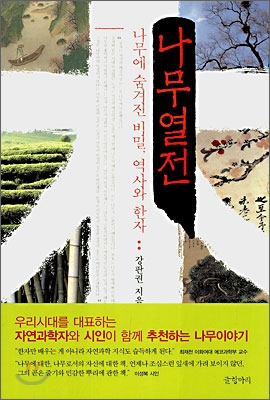
An educational book that explains the hidden historical stories of each tree in an easy and interesting way, along with the Chinese character names of the trees.
The Chinese character name concisely expresses the individual characteristics of the tree, and the name evokes a specific scene from history.
We can get a glimpse into the various uses of trees throughout history that we were unaware of, and the various aspects of the culture that ancient people created in relation to trees.
The Chinese character name concisely expresses the individual characteristics of the tree, and the name evokes a specific scene from history.
We can get a glimpse into the various uses of trees throughout history that we were unaware of, and the various aspects of the culture that ancient people created in relation to trees.
- You can preview some of the book's contents.
Preview
index
Recommendation by Choi Jae-cheon
preface
Part 1: Looking at the Forest
What is a tree?
A forest with many trees (林·森)
small tree (灌木)
Tall tree
Root
stem and branches
bark
leaves
flower
fruit
Part 2: Chinese characters found in the forest
Pine tree that obtained the title of Duke
Plum with sour fruit
Thuja (cypress) leaning toward the west
Apricot tree whose seeds kill dogs
The bark of the ghost-like tree
fragrant incense tree
thorny jujube tree
A juniper tree sprouting in the sunlight in spring
Pear trees growing in the mountains
Peach tree with fortune telling fruit
The red bean tree (棠·杜) that exudes a divine energy
Willow tree boasting strong vitality
Birch tree with bark lit
Mulberry tree with soft branches
Wisteria reaching for the sky
Cypress (檜) with paired leaves
A chestnut tree with lots of chestnuts hanging from it
The leader among trees, the ash tree
thorny thorn tree
Elm tree used as material for 'Masangi'
Tea tree (茶) from which tea is made
Hollow paulownia
Kudzu, a lifelong companion
Paper mulberry tree (楮) for making paper
The cinnamon tree that made the hole
Cherry, which bears fruit like beads on a necklace
A mountain cherry tree with flowers lined up(?)
Plum tree (Lee) with many fruits hanging in clusters
A buckwheat chestnut tree (柯) that was used to make a hook-shaped axe handle
Pomegranate (榴), a fruit full of seeds
A maple tree whose fruit flies in the wind
Pepper tree with fruit hanging like beans on its branches
The raft-maker, Pulmyeongja (査·)
A lush, bushy hazel tree
Liquid lacquer
Tangerines protesting with thorns
A sandalwood tree with a lot of something
The zelkova tree whose fruit brings joy to people
Bamboo that looks like rice
The tangled flowers of the rhododendron (欒)
Part 3: Leaving the Forest
Death of a tree
The Principle of Wood
A tree that builds a house after dying
cornerstone and pillar
Ridge and beam
rafters
Room and hall
Jidori (樞)
door
Conclusion
References
preface
Part 1: Looking at the Forest
What is a tree?
A forest with many trees (林·森)
small tree (灌木)
Tall tree
Root
stem and branches
bark
leaves
flower
fruit
Part 2: Chinese characters found in the forest
Pine tree that obtained the title of Duke
Plum with sour fruit
Thuja (cypress) leaning toward the west
Apricot tree whose seeds kill dogs
The bark of the ghost-like tree
fragrant incense tree
thorny jujube tree
A juniper tree sprouting in the sunlight in spring
Pear trees growing in the mountains
Peach tree with fortune telling fruit
The red bean tree (棠·杜) that exudes a divine energy
Willow tree boasting strong vitality
Birch tree with bark lit
Mulberry tree with soft branches
Wisteria reaching for the sky
Cypress (檜) with paired leaves
A chestnut tree with lots of chestnuts hanging from it
The leader among trees, the ash tree
thorny thorn tree
Elm tree used as material for 'Masangi'
Tea tree (茶) from which tea is made
Hollow paulownia
Kudzu, a lifelong companion
Paper mulberry tree (楮) for making paper
The cinnamon tree that made the hole
Cherry, which bears fruit like beads on a necklace
A mountain cherry tree with flowers lined up(?)
Plum tree (Lee) with many fruits hanging in clusters
A buckwheat chestnut tree (柯) that was used to make a hook-shaped axe handle
Pomegranate (榴), a fruit full of seeds
A maple tree whose fruit flies in the wind
Pepper tree with fruit hanging like beans on its branches
The raft-maker, Pulmyeongja (査·)
A lush, bushy hazel tree
Liquid lacquer
Tangerines protesting with thorns
A sandalwood tree with a lot of something
The zelkova tree whose fruit brings joy to people
Bamboo that looks like rice
The tangled flowers of the rhododendron (欒)
Part 3: Leaving the Forest
Death of a tree
The Principle of Wood
A tree that builds a house after dying
cornerstone and pillar
Ridge and beam
rafters
Room and hall
Jidori (樞)
door
Conclusion
References
Publisher's Review
Part 1 tells a story using Chinese characters related to the general properties of trees, such as trees, forests, trees, shrubs, leaves, roots, trunks, branches, flowers, and fruits.
The root (本) is the tree rooted in the ground, and the evening (杳) is the sun setting under the tree.
If so, the morning dan would be the sun rising over the trees.
Sam (森) is a forest where trees are lined up endlessly.
Samramansang (森羅萬象), which means all phenomena in the universe, also originated from sam.
If you go to a place with thick trees, no one can easily approach you.
This is exactly what strictness in the forest is.
The trunk is the stem of a tree.
The trunk is the force that supports the tree.
This is why we call the central roads that pass through the city center trunk roads.
The person who oversees all editing at a newspaper company is called the editor-in-chief.
In this way, the author invites readers to a journey into the forest by providing them with a basic understanding of Chinese characters.
In Part 2, we will choose 40 trees that we are familiar with, such as pine, cypress, apricot, chestnut, and plum trees, as well as lesser-known trees, such as chestnut, Japanese chestnut, and Chinese juniper, and tell the Chinese character stories associated with them.
One way to read this book is to notice how trees are close to some aspect of humanity.
First, among the Chinese characters related to the four seasons of spring, summer, fall, and winter, there are many words related to trees.
The second month of the lunar calendar is the month of seeing plum blossoms.
Because you can see plum blossoms.
The third month of the lunar calendar is called the cherry blossom month because cherry blossoms bloom there.
The time around May is called Hyangun (香雲).
When flowers bloom, their fragrance fills the air like a cloud.
The Chinese parasol flower blooms in the summer, and the seventh month of the lunar calendar is called the fifth month.
Nowadays, it would be very romantic to lie in your room and listen to the sound of rain falling on the parasol tree.
This rain is Odongwoo (梧桐雨).
Second, trees do not fall even where humans reside.
The Chinese juniper tree was planted in large numbers in the Chinese imperial court.
So the court was called Goejeong, and especially in the Zhou Dynasty of China, three locust trees were planted in the outer court, and the three dukes (Taesa, Taebu, and Taebo) sat facing them, so it was also called 'Samgoe' (Three Locusts).
The place where the Chinese emperor resides is Guichen.
Why? Because I like the conversation tree, so I planted it by my bedroom door.
Trees are home to not only humans but also animals.
In particular, many ants live in the rotten bark of the birch tree.
So in the old days, ants were called Goean-guk (槐安國).
Meanwhile, when Xiao Bo, the younger brother of King Wu of the Zhou Dynasty of China, was touring the southern countries, he stayed under a sweet tangerine tree and dealt with a lawsuit.
For this reason, the place under the red bean tree, or Dang-eum (棠陰), signifies a government office.
People who did not want to be interested in old politics would let their cattle graze in the area where the forsythia trees grew thickly.
That is why the cow is called Dorim Cheosa (桃林處士).
Third, trees were a means of disseminating knowledge.
It was widely used as a publishing material.
Because the pear tree is very hard, it was often used as a wood block for making books, along with the jujube tree.
So, Ijo (梨棗), which means pear tree and jujube tree, means publishing.
The maple tree is the king of trees.
Because it was such a high-quality wood, the carpenter was called a master carpenter.
The oak tree was only used to weave the king's coffin or to make important books for the country.
When we say “a book was placed on a coffin,” the coffin is a pine tree.
Fourth, trees live a long time.
That's why there are many Chinese characters related to life that contain the word tree.
Among them, the juniper tree lives particularly long.
So, in the words chunnyeon (椿年), chunsu (椿壽), chunryeong (椿齡), and daechun (大椿), which all mean longevity, the bamboo tree is seen.
Fifth, is there any material that is used as much in everyday life as wood?
A sacred vessel was made from the oak tree.
That is why the new stock is called Yulju (栗主).
The dark brown brush made from chestnut wood is called a yulmi brush.
Su Dongpo wrote his poems using this yulmi brush.
Paulownia trees were mainly used to make musical instruments.
The geomungo made of paulownia was called donggun.
It's a charming idea to add 'you' to the name of the instrument.
A cart was made from the cinnamon tree.
It is said that this cinnamon cart was very beautiful.
The best axe is one made from the chestnut tree.
The handle of an axe is called a buga.
There is no end to the number of wooden objects and their fancy names, many of which are still in use today.
Sixth, the author continues to point out prejudices related to trees.
『Yanghwasorok』, written by Kang Hee-an, a nobleman of the Joseon Dynasty, is cited as a representative example.
The term ‘yanghwa’ (養花), which means to grow flowers, is incorrect.
The author argues that this is a flaw that permeates the perception of trees as only flowers.
The Chinese characters for willow are 柳 and 楊.
There is a common claim that yang means willow tree and ryu means willow tree other than willow tree, but the author claims that this is not necessarily true and that the etymology is actually the opposite.
This is because the word Ryu, which is a combination of the character for tree (목) and the character for rabbit (묘), has the meaning of ‘flowing’ and is a weeping willow tree with long branches that look like they are flowing.
Part 3 deals with the philosophy of trees.
The author tells the story of a flower blooming on a dead tree, saying that the death of a tree is life itself.
It also refers to the principle of wood, the principle of trees.
In Part 3, unlike the first half, the author's personal experiences are incorporated into the narrative.
An introduction to one section is as follows:
“Until high school, I used to pull a cart to cut wood to boil porridge and heat my room.
Even now, I can't forget the experience I had while cutting down the tree I had brought.
When cutting a tree, sometimes it is very easy to cut, and sometimes it is very difficult.
When I didn't know the principles of wood, I just sharpened the saw and cut it with all my might.
But after doing that for a while, you get tired and can't continue.
The more you cut down trees, the more you learn about the principles of trees.
When cutting wood, it is much easier if you cut it along the grain.
Sometimes, it is difficult to pass a saw through a wounded area.
Trees build a very strong barrier to prevent disease from entering the wounded area again.
(…) You can tell about the life of a tree by looking at the grain pattern of the tree.
Looking at the resulting pattern of the cut tree is so beautiful that it brings tears to my eyes.
The grain pattern of a tree is a trace of the tree's life.
The reason the traces of the tree are beautiful is because it has lived.
People have flaws too.
People are beautiful when they live as they should.
“The principle of trees, Mokri (木理), is the principle of humans, Inri (人理), and the principle of education, Dokri (敎理).” (pp. 336-338)
Citing examples from the rich classics
Most of the Chinese character names of trees in this book are taken from classics.
The charm of this book lies in encountering interesting anecdotes from classics.
These are some interesting stories.
- A man living in Pagong, China, split open a tangerine tree in his yard and found two old men playing Go happily inside.
Since then, the joy of playing Baduk has been called the joy of playing tangerine.
(mandarin)
-Choe Shin-ming of the Tang Dynasty in China left behind a poem titled “Maple leaves fall into the cold Wujiang River.”
However, Jeong Se-ik (鄭世翼) was disappointed in Choi Shin-myeong, who had a high reputation, after seeing this poem.
This phrase is used to mean, “what you see is not what you hear.”
(Maple tree)
- Doseon (道詵) of the late Silla Dynasty prophesied in his “Doseon Bigi (道詵秘記)” that “500 years later, a dynasty with the surname Oyat, or Lee (李), will be established.”
So, after the mid-Goryeo Dynasty, plum trees (李) were planted and then cut down in Hanyang.
It was to prevent the prophecy from coming true.
(copy tree)
-Mulberry branches were the raw material for making windows.
The poor man made windows out of branches from a mulberry tree he planted near his house.
So, a window made of mulberry, or Sangho (桑戶), means a poor house.
The mulberry windows of the poor house could only open on one side, not on both sides.
The letters in oracle bone script can only be opened on one side.
(mulberry tree)
-Flying squirrels have five talents: flying, climbing trees, swimming, running, and digging.
However, because there is no expertise in any of them, they often end up in a difficult situation.
This case is called “Oseogigung” (梧鼠技窮).
It contains the meaning that you should do one thing well rather than just do a lot of things superficially like a flying squirrel.
(Paulownia)
-The fruit of the paulownia tree looks like a goblin's club from a distance.
If you look closely, its shape resembles human milk.
That is why the fruit of the paulownia tree is called dongyu (桐乳).
Milk (乳) is a composite character made up of the characters for claw (爪), child (子), and 乙.
Joe represents the shape of holding the hand with the palm facing down, and Eul represents the breast.
This letter is the letter that makes the baby go to the breast.
(Paulownia)
-Other names for the elm tree are chunyu (春楡) or yuyu (柳楡).
Chunyu means that the elm is the tree of spring, and yuyu is because this tree, along with the willow, was used to make fire in the spring.
Fire made from elm trees in spring is called Yuhwa.
In the old days, the tree that could obtain fire for each season was designated by law.
In summer, fire was made from jujube and apricot trees, in late summer from mulberry and wild mulberry trees, in autumn from oak trees, and in winter from maple and birch trees.
These regulations appear in the Joseon Dynasty law code, Gyeongguk Daejeon.
(elm tree)
-Gu Kaizhi, a famous painter from China's Eastern Jin Dynasty, fell in love with a girl from next door.
Unable to convey his feelings, he drew a picture of her and stabbed her in the chest with a thorn.
Strangely enough, a thorn got stuck in the chest of the girl whom Gogaeji had fallen in love with and she became ill.
He took advantage of that moment to go to the girl's house and get her better.
This is called a stabbing heart with a sticky needle.
(thorn tree)
Until this book came out
The author, who has published humanistic books on trees, believes that to understand trees, one must delve into their roots.
The author, who majored in Chinese history, has studied the etymology of Chinese characters extensively, and says that the more he learns about the origins of Chinese characters, the more he discovers that there are many things related to trees.
There are many dictionaries that the author referenced while writing this book.
The Erya (爾雅), a dictionary-style book that summarizes the interpretation of the Five Classics from the Former Han Dynasty in the 2nd century BC.
『Seok-Myeong (釋名, 8 volumes)』, developed from 『I-A』 and compiled by Liu Xi (劉熙) of the Later Han Dynasty.
『Shuowen Jiezi (說文解字, 15 volumes)』 written by Xu Shen (許愼) of the Later Han Dynasty, which the author especially frequently uses when studying the origin of Chinese characters.
『Okpyeon (30 volumes, 543)』, based on 『Seolmunhaeja』.
It is extensive, including the 『Kangxi Dictionary (康熙字典, 42 volumes)』, a large-scale dictionary with 47,000 title characters compiled by Zhang Yushu (張玉書) and others in the early Qing Dynasty.
Besides these Chinese dictionaries, the book that the author particularly enjoys reading is the Korean encyclopedia, 『Daedongunbogunok (大東韻譜群玉)』.
This book, the first half of which has now been translated into 10 volumes, was compiled by Chogan Kwon Mun-hae (1534-1591) based on the 『Unbugunok』 by Yinshibu (陰時夫) of the Yuan Dynasty, and is a cultural heritage that fully compiles the extensive knowledge of Toegye's school.
This massive book, consisting of 20 volumes and 20 books, organizes and includes 11 items, including geography, national names, suryeong (family names), personal names, filial sons, governors (suryeong), names of immortals (seonmyeong), names of trees (mokmyeong), and animals (geumsu), by Chinese character rhyme, from the Dangun era to that time.
The author says that finding Chinese characters related to trees through these books was a very happy experience.
Finally, there is a book you cannot miss on this trip.
This is the 『Daehanhwasa-den (大漢和辭典)』 compiled by Morohashi Tetsuji (諸橋轍次), a monumental Japanese oriental scholar and Confucian scholar.
In this dictionary by Morohashi, who devoted his life to dictionary compilation, the author was curious about how many Chinese characters there were for the character for tree (木).
A total of 1,610 characters were included.
We can see most of them in the recently published 『Tree Wars』.
The root (本) is the tree rooted in the ground, and the evening (杳) is the sun setting under the tree.
If so, the morning dan would be the sun rising over the trees.
Sam (森) is a forest where trees are lined up endlessly.
Samramansang (森羅萬象), which means all phenomena in the universe, also originated from sam.
If you go to a place with thick trees, no one can easily approach you.
This is exactly what strictness in the forest is.
The trunk is the stem of a tree.
The trunk is the force that supports the tree.
This is why we call the central roads that pass through the city center trunk roads.
The person who oversees all editing at a newspaper company is called the editor-in-chief.
In this way, the author invites readers to a journey into the forest by providing them with a basic understanding of Chinese characters.
In Part 2, we will choose 40 trees that we are familiar with, such as pine, cypress, apricot, chestnut, and plum trees, as well as lesser-known trees, such as chestnut, Japanese chestnut, and Chinese juniper, and tell the Chinese character stories associated with them.
One way to read this book is to notice how trees are close to some aspect of humanity.
First, among the Chinese characters related to the four seasons of spring, summer, fall, and winter, there are many words related to trees.
The second month of the lunar calendar is the month of seeing plum blossoms.
Because you can see plum blossoms.
The third month of the lunar calendar is called the cherry blossom month because cherry blossoms bloom there.
The time around May is called Hyangun (香雲).
When flowers bloom, their fragrance fills the air like a cloud.
The Chinese parasol flower blooms in the summer, and the seventh month of the lunar calendar is called the fifth month.
Nowadays, it would be very romantic to lie in your room and listen to the sound of rain falling on the parasol tree.
This rain is Odongwoo (梧桐雨).
Second, trees do not fall even where humans reside.
The Chinese juniper tree was planted in large numbers in the Chinese imperial court.
So the court was called Goejeong, and especially in the Zhou Dynasty of China, three locust trees were planted in the outer court, and the three dukes (Taesa, Taebu, and Taebo) sat facing them, so it was also called 'Samgoe' (Three Locusts).
The place where the Chinese emperor resides is Guichen.
Why? Because I like the conversation tree, so I planted it by my bedroom door.
Trees are home to not only humans but also animals.
In particular, many ants live in the rotten bark of the birch tree.
So in the old days, ants were called Goean-guk (槐安國).
Meanwhile, when Xiao Bo, the younger brother of King Wu of the Zhou Dynasty of China, was touring the southern countries, he stayed under a sweet tangerine tree and dealt with a lawsuit.
For this reason, the place under the red bean tree, or Dang-eum (棠陰), signifies a government office.
People who did not want to be interested in old politics would let their cattle graze in the area where the forsythia trees grew thickly.
That is why the cow is called Dorim Cheosa (桃林處士).
Third, trees were a means of disseminating knowledge.
It was widely used as a publishing material.
Because the pear tree is very hard, it was often used as a wood block for making books, along with the jujube tree.
So, Ijo (梨棗), which means pear tree and jujube tree, means publishing.
The maple tree is the king of trees.
Because it was such a high-quality wood, the carpenter was called a master carpenter.
The oak tree was only used to weave the king's coffin or to make important books for the country.
When we say “a book was placed on a coffin,” the coffin is a pine tree.
Fourth, trees live a long time.
That's why there are many Chinese characters related to life that contain the word tree.
Among them, the juniper tree lives particularly long.
So, in the words chunnyeon (椿年), chunsu (椿壽), chunryeong (椿齡), and daechun (大椿), which all mean longevity, the bamboo tree is seen.
Fifth, is there any material that is used as much in everyday life as wood?
A sacred vessel was made from the oak tree.
That is why the new stock is called Yulju (栗主).
The dark brown brush made from chestnut wood is called a yulmi brush.
Su Dongpo wrote his poems using this yulmi brush.
Paulownia trees were mainly used to make musical instruments.
The geomungo made of paulownia was called donggun.
It's a charming idea to add 'you' to the name of the instrument.
A cart was made from the cinnamon tree.
It is said that this cinnamon cart was very beautiful.
The best axe is one made from the chestnut tree.
The handle of an axe is called a buga.
There is no end to the number of wooden objects and their fancy names, many of which are still in use today.
Sixth, the author continues to point out prejudices related to trees.
『Yanghwasorok』, written by Kang Hee-an, a nobleman of the Joseon Dynasty, is cited as a representative example.
The term ‘yanghwa’ (養花), which means to grow flowers, is incorrect.
The author argues that this is a flaw that permeates the perception of trees as only flowers.
The Chinese characters for willow are 柳 and 楊.
There is a common claim that yang means willow tree and ryu means willow tree other than willow tree, but the author claims that this is not necessarily true and that the etymology is actually the opposite.
This is because the word Ryu, which is a combination of the character for tree (목) and the character for rabbit (묘), has the meaning of ‘flowing’ and is a weeping willow tree with long branches that look like they are flowing.
Part 3 deals with the philosophy of trees.
The author tells the story of a flower blooming on a dead tree, saying that the death of a tree is life itself.
It also refers to the principle of wood, the principle of trees.
In Part 3, unlike the first half, the author's personal experiences are incorporated into the narrative.
An introduction to one section is as follows:
“Until high school, I used to pull a cart to cut wood to boil porridge and heat my room.
Even now, I can't forget the experience I had while cutting down the tree I had brought.
When cutting a tree, sometimes it is very easy to cut, and sometimes it is very difficult.
When I didn't know the principles of wood, I just sharpened the saw and cut it with all my might.
But after doing that for a while, you get tired and can't continue.
The more you cut down trees, the more you learn about the principles of trees.
When cutting wood, it is much easier if you cut it along the grain.
Sometimes, it is difficult to pass a saw through a wounded area.
Trees build a very strong barrier to prevent disease from entering the wounded area again.
(…) You can tell about the life of a tree by looking at the grain pattern of the tree.
Looking at the resulting pattern of the cut tree is so beautiful that it brings tears to my eyes.
The grain pattern of a tree is a trace of the tree's life.
The reason the traces of the tree are beautiful is because it has lived.
People have flaws too.
People are beautiful when they live as they should.
“The principle of trees, Mokri (木理), is the principle of humans, Inri (人理), and the principle of education, Dokri (敎理).” (pp. 336-338)
Citing examples from the rich classics
Most of the Chinese character names of trees in this book are taken from classics.
The charm of this book lies in encountering interesting anecdotes from classics.
These are some interesting stories.
- A man living in Pagong, China, split open a tangerine tree in his yard and found two old men playing Go happily inside.
Since then, the joy of playing Baduk has been called the joy of playing tangerine.
(mandarin)
-Choe Shin-ming of the Tang Dynasty in China left behind a poem titled “Maple leaves fall into the cold Wujiang River.”
However, Jeong Se-ik (鄭世翼) was disappointed in Choi Shin-myeong, who had a high reputation, after seeing this poem.
This phrase is used to mean, “what you see is not what you hear.”
(Maple tree)
- Doseon (道詵) of the late Silla Dynasty prophesied in his “Doseon Bigi (道詵秘記)” that “500 years later, a dynasty with the surname Oyat, or Lee (李), will be established.”
So, after the mid-Goryeo Dynasty, plum trees (李) were planted and then cut down in Hanyang.
It was to prevent the prophecy from coming true.
(copy tree)
-Mulberry branches were the raw material for making windows.
The poor man made windows out of branches from a mulberry tree he planted near his house.
So, a window made of mulberry, or Sangho (桑戶), means a poor house.
The mulberry windows of the poor house could only open on one side, not on both sides.
The letters in oracle bone script can only be opened on one side.
(mulberry tree)
-Flying squirrels have five talents: flying, climbing trees, swimming, running, and digging.
However, because there is no expertise in any of them, they often end up in a difficult situation.
This case is called “Oseogigung” (梧鼠技窮).
It contains the meaning that you should do one thing well rather than just do a lot of things superficially like a flying squirrel.
(Paulownia)
-The fruit of the paulownia tree looks like a goblin's club from a distance.
If you look closely, its shape resembles human milk.
That is why the fruit of the paulownia tree is called dongyu (桐乳).
Milk (乳) is a composite character made up of the characters for claw (爪), child (子), and 乙.
Joe represents the shape of holding the hand with the palm facing down, and Eul represents the breast.
This letter is the letter that makes the baby go to the breast.
(Paulownia)
-Other names for the elm tree are chunyu (春楡) or yuyu (柳楡).
Chunyu means that the elm is the tree of spring, and yuyu is because this tree, along with the willow, was used to make fire in the spring.
Fire made from elm trees in spring is called Yuhwa.
In the old days, the tree that could obtain fire for each season was designated by law.
In summer, fire was made from jujube and apricot trees, in late summer from mulberry and wild mulberry trees, in autumn from oak trees, and in winter from maple and birch trees.
These regulations appear in the Joseon Dynasty law code, Gyeongguk Daejeon.
(elm tree)
-Gu Kaizhi, a famous painter from China's Eastern Jin Dynasty, fell in love with a girl from next door.
Unable to convey his feelings, he drew a picture of her and stabbed her in the chest with a thorn.
Strangely enough, a thorn got stuck in the chest of the girl whom Gogaeji had fallen in love with and she became ill.
He took advantage of that moment to go to the girl's house and get her better.
This is called a stabbing heart with a sticky needle.
(thorn tree)
Until this book came out
The author, who has published humanistic books on trees, believes that to understand trees, one must delve into their roots.
The author, who majored in Chinese history, has studied the etymology of Chinese characters extensively, and says that the more he learns about the origins of Chinese characters, the more he discovers that there are many things related to trees.
There are many dictionaries that the author referenced while writing this book.
The Erya (爾雅), a dictionary-style book that summarizes the interpretation of the Five Classics from the Former Han Dynasty in the 2nd century BC.
『Seok-Myeong (釋名, 8 volumes)』, developed from 『I-A』 and compiled by Liu Xi (劉熙) of the Later Han Dynasty.
『Shuowen Jiezi (說文解字, 15 volumes)』 written by Xu Shen (許愼) of the Later Han Dynasty, which the author especially frequently uses when studying the origin of Chinese characters.
『Okpyeon (30 volumes, 543)』, based on 『Seolmunhaeja』.
It is extensive, including the 『Kangxi Dictionary (康熙字典, 42 volumes)』, a large-scale dictionary with 47,000 title characters compiled by Zhang Yushu (張玉書) and others in the early Qing Dynasty.
Besides these Chinese dictionaries, the book that the author particularly enjoys reading is the Korean encyclopedia, 『Daedongunbogunok (大東韻譜群玉)』.
This book, the first half of which has now been translated into 10 volumes, was compiled by Chogan Kwon Mun-hae (1534-1591) based on the 『Unbugunok』 by Yinshibu (陰時夫) of the Yuan Dynasty, and is a cultural heritage that fully compiles the extensive knowledge of Toegye's school.
This massive book, consisting of 20 volumes and 20 books, organizes and includes 11 items, including geography, national names, suryeong (family names), personal names, filial sons, governors (suryeong), names of immortals (seonmyeong), names of trees (mokmyeong), and animals (geumsu), by Chinese character rhyme, from the Dangun era to that time.
The author says that finding Chinese characters related to trees through these books was a very happy experience.
Finally, there is a book you cannot miss on this trip.
This is the 『Daehanhwasa-den (大漢和辭典)』 compiled by Morohashi Tetsuji (諸橋轍次), a monumental Japanese oriental scholar and Confucian scholar.
In this dictionary by Morohashi, who devoted his life to dictionary compilation, the author was curious about how many Chinese characters there were for the character for tree (木).
A total of 1,610 characters were included.
We can see most of them in the recently published 『Tree Wars』.
GOODS SPECIFICS
- Date of issue: June 29, 2007
- Page count, weight, size: 375 pages | 696g | 153*224*30mm
- ISBN13: 9788954603393
- ISBN10: 8954603394
You may also like
카테고리
korean


korean

![GQ KOREA Mark (Monthly): December [2025]](http://librairie.coreenne.fr/cdn/shop/files/8ef265dbbfbf186523ed75ba7319009d.jpg?v=1765340328&width=3840)


