

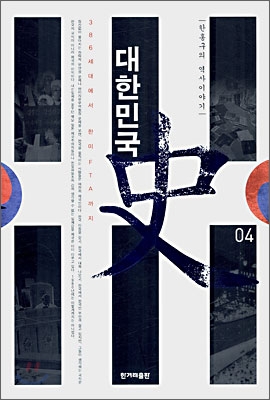
History of the Republic of Korea 4
 |
Description
Book Introduction
The definitive edition of 『History of the Republic of Korea』, Volume 4, has been published, following Volumes 1, 2, and 3.
Although the history of the Republic of Korea seems to be filled with the pain of Japanese colonial rule, division, war, and dictatorship, the author, who says that it is “a history of hope, not a history of despair,” covers a wide range of topics in 『History of the Republic of Korea 04』, from the story of the 386 generation to the Korea-US FTA, which is still a hotly debated issue today.
Part 1 discusses Korea's independent and equal relationship with the United States, comparing the Nogunri Massacre, the anti-American movement, which is an important issue facing Korean democracy, the Joseon Dynasty's aristocrats, and the Korea-US FTA, and asks whether we truly have sovereignty.
Part 2 deals with the National Security Act, which was born in December 1948 and has not yet disappeared.
It tells the story of the evolution of the National Security Act, including its background and essence, and the constant debate over its revision and abolition.
It depicts the suppression of the press based on the National Security Act, persistent controversy, hundreds of banned books, and the difficulties in researching Korean history.
Part 3 examines the past and present through the past of those who do not wish to remember and the pain of those who confess.
It shows our society living in the age of testimony, from the relationship between Park Chung-hee and Kim Hyung-wook, to Park Chung-hee's process of robbing the Buil Scholarship Association and the Kyunghyang Shinmun, the history and discrimination of Koreans in Japan, the confession of Kim Geun-tae, who became a laughing stock, to the issue of Japanese military comfort women, and the truth about the Gwangju Massacre.
Part 4 provides an opportunity to look back on the present by covering the prison life and college days of Professor Shin Young-bok, who has reached retirement age, the late Kim Hyung-ryul, a second-generation atomic bomb victim, and the stories of the 386 lawmakers who do not grow up.
Part 5 contains stories of distorted history that are still ongoing, such as the wiretapping incident, the Liberal Party during the Syngman Rhee era, the growth of private schools and family-run private schools, and the issue of military service as seen through gun incidents and military reductions.
Although the history of the Republic of Korea seems to be filled with the pain of Japanese colonial rule, division, war, and dictatorship, the author, who says that it is “a history of hope, not a history of despair,” covers a wide range of topics in 『History of the Republic of Korea 04』, from the story of the 386 generation to the Korea-US FTA, which is still a hotly debated issue today.
Part 1 discusses Korea's independent and equal relationship with the United States, comparing the Nogunri Massacre, the anti-American movement, which is an important issue facing Korean democracy, the Joseon Dynasty's aristocrats, and the Korea-US FTA, and asks whether we truly have sovereignty.
Part 2 deals with the National Security Act, which was born in December 1948 and has not yet disappeared.
It tells the story of the evolution of the National Security Act, including its background and essence, and the constant debate over its revision and abolition.
It depicts the suppression of the press based on the National Security Act, persistent controversy, hundreds of banned books, and the difficulties in researching Korean history.
Part 3 examines the past and present through the past of those who do not wish to remember and the pain of those who confess.
It shows our society living in the age of testimony, from the relationship between Park Chung-hee and Kim Hyung-wook, to Park Chung-hee's process of robbing the Buil Scholarship Association and the Kyunghyang Shinmun, the history and discrimination of Koreans in Japan, the confession of Kim Geun-tae, who became a laughing stock, to the issue of Japanese military comfort women, and the truth about the Gwangju Massacre.
Part 4 provides an opportunity to look back on the present by covering the prison life and college days of Professor Shin Young-bok, who has reached retirement age, the late Kim Hyung-ryul, a second-generation atomic bomb victim, and the stories of the 386 lawmakers who do not grow up.
Part 5 contains stories of distorted history that are still ongoing, such as the wiretapping incident, the Liberal Party during the Syngman Rhee era, the growth of private schools and family-run private schools, and the issue of military service as seen through gun incidents and military reductions.
- You can preview some of the book's contents.
Preview
index
Part 1: Is Sovereignty Still a Dangerous Dream? - From the Nogunri Bombing to the FTA Offensive
The horrific massacre of that day, which was ignored even by the US ambassador, was made known to the world through the Associated Press's coverage of No Gun Ri.
Gwangju gave birth to Kim Se-jin and Lee Jae-ho. The dramatic turnaround that led to the burning of the American Cultural Center and the anti-American movement.
Why Daewongun was better than Roh Moo-hyun: Answering the "Isolationist" argument of those promoting the Korea-US FTA.
Those who killed Gwanghaegun are back. The Joseon Confucian scholars who trampled on his outstanding diplomatic insight and pragmatic diplomacy with servility.
Part 2: A Country Without a National Security Law: Our Country is a Good Country
The National Security Act, which swallowed 120,000 people immediately after its creation: The story of how a cat transformed into a tiger.
My student was arrested for homework. A country without a national security law, our country is a good country.
A fired journalist, professor, and activists jump into publishing after cutting and burning a poetry collection with a chisel.
Don't study modern history, you'll get hurt! Memories of "Korean history research" in the 1970s and 1980s
Hwang Woo-suk and the People's Revolutionary Party: The Reproduction of Manipulation, Violence That Blocks Reasonable Doubt, and the Essence of the National Security Law
Part 3: Those Who Do Not Remember and Those Who Confess
Kim Hyung-wook, the dictator's simple, ignorant, and radical alter ego, who attacked Park Chung-hee with his "stone head."
He was so greedy for the press that he squirmed, robbing the Buil Scholarship Association and the Kyunghyang Shinmun.
The history of Koreans in Japan who were thoroughly exploited by the 38th parallel left by their homeland to Japan.
I am now waiting for a 'confession'. It is the only way to avoid passing on state violence as a legacy.
Looking at the national cemetery, it's breathtaking. People are buried there discriminated against by class.
Part 4: Those People Back Then - Shin Young-bok, Kim Hyung-ryul, Yoo Si-min, and the 386 Generation
Reflecting on Shin Young-bok's 60 years, we delve into modern Korean history and the inner workings of the Tonghyeokdang incident.
Professor Shin Young-bok's 20 Years in Prison and His College Days: Self-Reform from Prison
Kim Hyung-ryul's life must go on: Why the death of a second-generation atomic bomb victim strikes our hearts.
The joy of living without growing up. To the 386 generation of the Open Uri Party who became adults too quickly.
A generation that withered prematurely, living in the era of the "warriors" who left behind nothing, including love, honor, and name.
Part 5: Breaking the chain of distorted history
Are you happy with democratization? The tense "power struggle" between citizens and vested interests as seen in the wiretapping incident.
Will the curse of the Liberal Party be lifted? On the birthday of the Open Uri Party, which was supposed to break the distorted history.
Park Chung-hee's private school, which was ravaged by Park Chung-hee, is appeased by his daughter. The deformed growth of private schools and the nepotism of private schools.
Private Choi, Private Kim, and what's next? It's time to fundamentally reexamine the military service system.
180,000 troops cut, it's awkward. Passive troops cuts and budget increases are the problem.
The horrific massacre of that day, which was ignored even by the US ambassador, was made known to the world through the Associated Press's coverage of No Gun Ri.
Gwangju gave birth to Kim Se-jin and Lee Jae-ho. The dramatic turnaround that led to the burning of the American Cultural Center and the anti-American movement.
Why Daewongun was better than Roh Moo-hyun: Answering the "Isolationist" argument of those promoting the Korea-US FTA.
Those who killed Gwanghaegun are back. The Joseon Confucian scholars who trampled on his outstanding diplomatic insight and pragmatic diplomacy with servility.
Part 2: A Country Without a National Security Law: Our Country is a Good Country
The National Security Act, which swallowed 120,000 people immediately after its creation: The story of how a cat transformed into a tiger.
My student was arrested for homework. A country without a national security law, our country is a good country.
A fired journalist, professor, and activists jump into publishing after cutting and burning a poetry collection with a chisel.
Don't study modern history, you'll get hurt! Memories of "Korean history research" in the 1970s and 1980s
Hwang Woo-suk and the People's Revolutionary Party: The Reproduction of Manipulation, Violence That Blocks Reasonable Doubt, and the Essence of the National Security Law
Part 3: Those Who Do Not Remember and Those Who Confess
Kim Hyung-wook, the dictator's simple, ignorant, and radical alter ego, who attacked Park Chung-hee with his "stone head."
He was so greedy for the press that he squirmed, robbing the Buil Scholarship Association and the Kyunghyang Shinmun.
The history of Koreans in Japan who were thoroughly exploited by the 38th parallel left by their homeland to Japan.
I am now waiting for a 'confession'. It is the only way to avoid passing on state violence as a legacy.
Looking at the national cemetery, it's breathtaking. People are buried there discriminated against by class.
Part 4: Those People Back Then - Shin Young-bok, Kim Hyung-ryul, Yoo Si-min, and the 386 Generation
Reflecting on Shin Young-bok's 60 years, we delve into modern Korean history and the inner workings of the Tonghyeokdang incident.
Professor Shin Young-bok's 20 Years in Prison and His College Days: Self-Reform from Prison
Kim Hyung-ryul's life must go on: Why the death of a second-generation atomic bomb victim strikes our hearts.
The joy of living without growing up. To the 386 generation of the Open Uri Party who became adults too quickly.
A generation that withered prematurely, living in the era of the "warriors" who left behind nothing, including love, honor, and name.
Part 5: Breaking the chain of distorted history
Are you happy with democratization? The tense "power struggle" between citizens and vested interests as seen in the wiretapping incident.
Will the curse of the Liberal Party be lifted? On the birthday of the Open Uri Party, which was supposed to break the distorted history.
Park Chung-hee's private school, which was ravaged by Park Chung-hee, is appeased by his daughter. The deformed growth of private schools and the nepotism of private schools.
Private Choi, Private Kim, and what's next? It's time to fundamentally reexamine the military service system.
180,000 troops cut, it's awkward. Passive troops cuts and budget increases are the problem.
Into the book
When we look at the issues of strategic flexibility and the Korea-US Free Trade Agreement that are being pushed around recklessly, the people who run Korea are still imperialists.
They have Korean names, graduated from Korean universities, and live in Korea with Korean wives, but the national interest they think of is not the national interest of Korea, but the interest of the empire.
The empire has already achieved a sense of unity that even the old Japanese imperialists and pro-Japanese collaborators who dreamed of Japan-Korea unity could not dare to imagine.
It wasn't like this in 1980.
At that time, they used the term 'pro-American sycophant', they also called them pro-American, and because just saying pro-American was boring, they also called them 'crazy', but pro-Japanese and pro-American are terms that can only be used to describe Koreans.
Those dark-haired Americans who are fluent in Korean, those who clamor in the Blue House, the National Assembly, government ministries, media outlets, and universities, shouting that the ROK-US alliance is the only way to survive, have no Korea in their heads.
They have Korean names, graduated from Korean universities, and live in Korea with Korean wives, but the national interest they think of is not the national interest of Korea, but the interest of the empire.
The empire has already achieved a sense of unity that even the old Japanese imperialists and pro-Japanese collaborators who dreamed of Japan-Korea unity could not dare to imagine.
It wasn't like this in 1980.
At that time, they used the term 'pro-American sycophant', they also called them pro-American, and because just saying pro-American was boring, they also called them 'crazy', but pro-Japanese and pro-American are terms that can only be used to describe Koreans.
Those dark-haired Americans who are fluent in Korean, those who clamor in the Blue House, the National Assembly, government ministries, media outlets, and universities, shouting that the ROK-US alliance is the only way to survive, have no Korea in their heads.
--- p.36
The National Security Act was born in December 1948, when the Republic of Korea was established but had not yet established its own criminal code and was still using the old criminal code used by the Japanese.
As it is Law No. 10, the National Security Act was created before the various basic laws that are essential for running the country.
At that time, Article 6 of the Special Act stipulated the maximum penalty as life imprisonment, but now it has become a terrifying law with Article 25 mentioning the death penalty eight times.
After going through five revisions since the June 1987 Democracy Movement, it has been trimmed a bit, although it has not been able to pull out the fingernails and toenails, and is now in this shape.
The National Security Act was born in December 1948, when the Republic of Korea was established but had not yet established its own criminal code and was still using the old criminal code used by the Japanese.
As it is Law No. 10, the National Security Act was created before the various basic laws that are essential for running the country.
At that time, Article 6 of the Special Act stipulated the maximum penalty as life imprisonment, but now it has become a terrifying law with Article 25 mentioning the death penalty eight times.
After going through five revisions since the June 1987 Democracy Movement, it has been trimmed a bit, although it has not been able to pull out the fingernails and toenails, and is now in this shape.
As it is Law No. 10, the National Security Act was created before the various basic laws that are essential for running the country.
At that time, Article 6 of the Special Act stipulated the maximum penalty as life imprisonment, but now it has become a terrifying law with Article 25 mentioning the death penalty eight times.
After going through five revisions since the June 1987 Democracy Movement, it has been trimmed a bit, although it has not been able to pull out the fingernails and toenails, and is now in this shape.
The National Security Act was born in December 1948, when the Republic of Korea was established but had not yet established its own criminal code and was still using the old criminal code used by the Japanese.
As it is Law No. 10, the National Security Act was created before the various basic laws that are essential for running the country.
At that time, Article 6 of the Special Act stipulated the maximum penalty as life imprisonment, but now it has become a terrifying law with Article 25 mentioning the death penalty eight times.
After going through five revisions since the June 1987 Democracy Movement, it has been trimmed a bit, although it has not been able to pull out the fingernails and toenails, and is now in this shape.
--- pp.63~64
Everyone has a past they would like to forget.
It is actually incredibly painful to face the past honestly and forget it.
However, the pain of the perpetrator is not greater than the pain suffered by the victim.
The reason why confession is so important now is because confession is the cure.
For the victims who are still suffering and living in pain, your confession is the only medicine that can heal their wounded hearts.
Even if a billion won is paid in compensation, the emotional wounds that cannot be healed can be healed through the confession of the perpetrator.
Everyone has a past they would like to forget.
It is actually incredibly painful to face the past honestly and forget it.
However, the pain of the perpetrator is not greater than the pain suffered by the victim.
The reason why confession is so important now is because confession is the cure.
For the victims who are still suffering and living in pain, your confession is the only medicine that can heal their wounded hearts.
Even if a billion won is paid in compensation, the emotional wounds that cannot be healed can be healed through the confession of the perpetrator.
It is actually incredibly painful to face the past honestly and forget it.
However, the pain of the perpetrator is not greater than the pain suffered by the victim.
The reason why confession is so important now is because confession is the cure.
For the victims who are still suffering and living in pain, your confession is the only medicine that can heal their wounded hearts.
Even if a billion won is paid in compensation, the emotional wounds that cannot be healed can be healed through the confession of the perpetrator.
Everyone has a past they would like to forget.
It is actually incredibly painful to face the past honestly and forget it.
However, the pain of the perpetrator is not greater than the pain suffered by the victim.
The reason why confession is so important now is because confession is the cure.
For the victims who are still suffering and living in pain, your confession is the only medicine that can heal their wounded hearts.
Even if a billion won is paid in compensation, the emotional wounds that cannot be healed can be healed through the confession of the perpetrator.
--- p.172
GOODS SPECIFICS
- Date of issue: December 4, 2006
- Page count, weight, size: 303 pages | 454g | 153*224*30mm
- ISBN13: 9788984312050
- ISBN10: 8984312053
You may also like
카테고리
korean


korean

![GQ KOREA Mark (Monthly): December [2025]](http://librairie.coreenne.fr/cdn/shop/files/8ef265dbbfbf186523ed75ba7319009d.jpg?v=1765340328&width=3840)


