

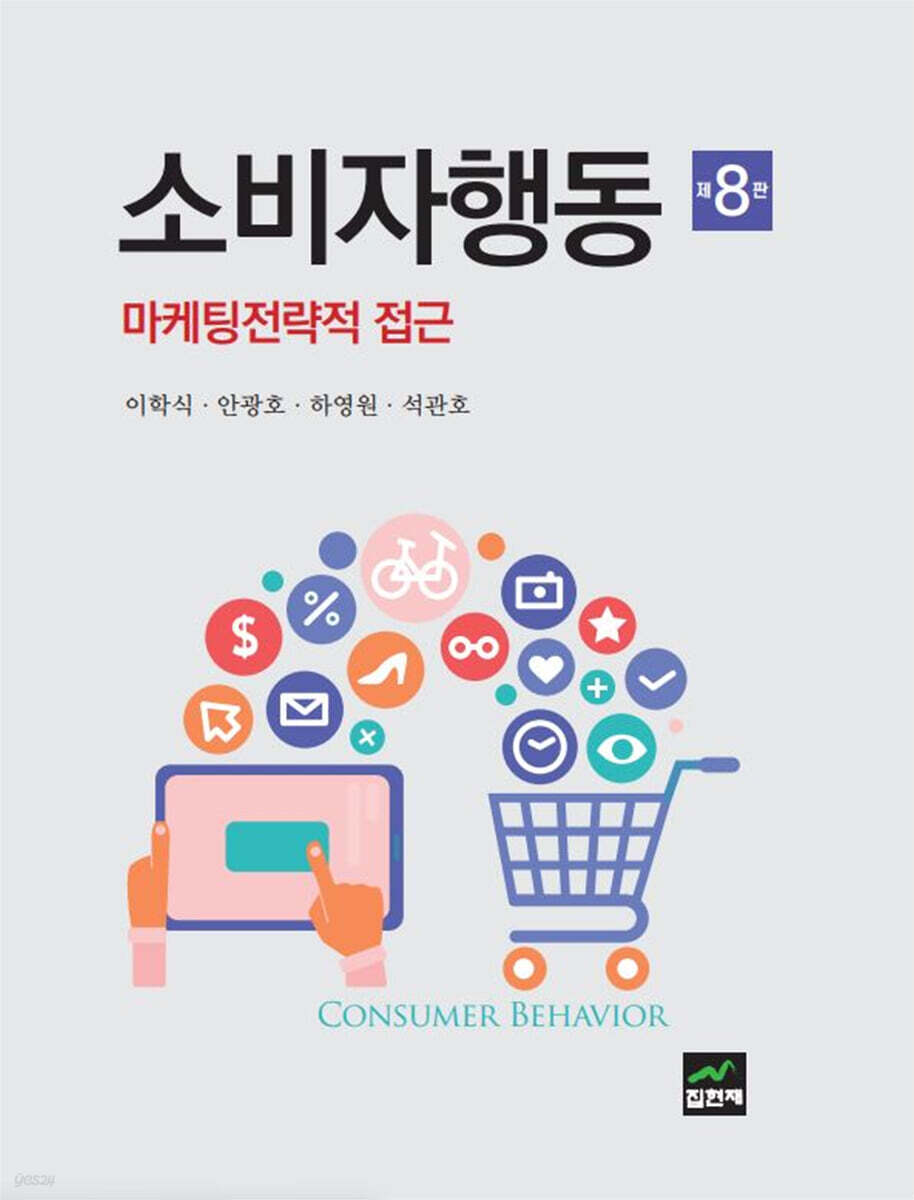
consumer behavior
 |
Description
Book Introduction
The development of this book and the authors' intentions
The first edition of this book was published in 1992, and has since gone through the 2nd edition (1997), the 3rd edition (2001), the 4th edition (2006), the 5th edition (2010), the 6th edition (2015), the 7th edition (2020), and now the 8th edition.
As with all other academic fields, research on consumer behavior is constantly evolving.
The authors have attempted to continuously reflect the research achievements up to that point in each of the seven revision processes.
Furthermore, from the time of writing the first edition until now, the authors have been writing and revising the manuscript with the sole purpose of producing a book that can convey knowledge about consumer behavior to readers as effectively and efficiently as possible.
Effective and efficient here means including essential information within a limited space while making it easy for readers to understand and find it interesting.
The essence of the marketing concept, which is the most important basic concept in executing marketing, is customer orientation.
As professors in the field of marketing, the authors have done their best to ensure that our product, this book, is customer-oriented, that is, reader-oriented.
The first edition of this book was published in 1992, and has since gone through the 2nd edition (1997), the 3rd edition (2001), the 4th edition (2006), the 5th edition (2010), the 6th edition (2015), the 7th edition (2020), and now the 8th edition.
As with all other academic fields, research on consumer behavior is constantly evolving.
The authors have attempted to continuously reflect the research achievements up to that point in each of the seven revision processes.
Furthermore, from the time of writing the first edition until now, the authors have been writing and revising the manuscript with the sole purpose of producing a book that can convey knowledge about consumer behavior to readers as effectively and efficiently as possible.
Effective and efficient here means including essential information within a limited space while making it easy for readers to understand and find it interesting.
The essence of the marketing concept, which is the most important basic concept in executing marketing, is customer orientation.
As professors in the field of marketing, the authors have done their best to ensure that our product, this book, is customer-oriented, that is, reader-oriented.
index
Part 1: Overview of Consumer Behavior
Chapter 1 Marketing and Consumer Behavior Research 2
Chapter 2: Overview of Consumer Behavior 26
Part 2: Consumer Decision-Making Process
Chapter 3: Problem Recognition, Information Search 56
Chapter 4: Pre-Purchase Alternative Evaluation 78
Chapter 5: Purchasing and Post-Purchase Behavior 103
Part 3 Consumer Information Processing and Memory
Chapter 6 Information Processing: Exposure, Attention, and Understanding 136
Chapter 7 Memory 178 Part 4 Attitude
Chapter 8 Attitudes I: Concepts and Attitude-Behavior Relationships 214
Chapter 9 Attitudes II: Attitude Formation and Change 241
Part 5 Personal Influences
Chapter 10 Learning 278
Chapter 11: Personality, Values, and Lifestyle 299
Part 6 Environmental Influence Factors
Chapter 12: Culture and Social Class 336
Chapter 13 Reference Groups and the Family 357
Part 7: Consumer Behavior and Marketing Strategy
Chapter 14 Consumer Behavior and Product, Price, and Distribution Strategies 400
Chapter 15 Consumer Behavior and Marketing Communications 438
** Notes 460
** Korean Index 480
** English index 482
** Corporate and Trademark Index 492
** About the Author 494
Chapter 1 Marketing and Consumer Behavior Research 2
Chapter 2: Overview of Consumer Behavior 26
Part 2: Consumer Decision-Making Process
Chapter 3: Problem Recognition, Information Search 56
Chapter 4: Pre-Purchase Alternative Evaluation 78
Chapter 5: Purchasing and Post-Purchase Behavior 103
Part 3 Consumer Information Processing and Memory
Chapter 6 Information Processing: Exposure, Attention, and Understanding 136
Chapter 7 Memory 178 Part 4 Attitude
Chapter 8 Attitudes I: Concepts and Attitude-Behavior Relationships 214
Chapter 9 Attitudes II: Attitude Formation and Change 241
Part 5 Personal Influences
Chapter 10 Learning 278
Chapter 11: Personality, Values, and Lifestyle 299
Part 6 Environmental Influence Factors
Chapter 12: Culture and Social Class 336
Chapter 13 Reference Groups and the Family 357
Part 7: Consumer Behavior and Marketing Strategy
Chapter 14 Consumer Behavior and Product, Price, and Distribution Strategies 400
Chapter 15 Consumer Behavior and Marketing Communications 438
** Notes 460
** Korean Index 480
** English index 482
** Corporate and Trademark Index 492
** About the Author 494
Publisher's Review
Consumer Behavior Research as an Interdisciplinary Field
Academic research on marketing has been conducted since the early 20th century.
Among the various branches of marketing, research on consumer behavior can be said to have begun in the late 1960s, and thus its academic history can be said to be relatively short.
However, the knowledge accumulated so far regarding consumer behavior is so vast that it can be said to be more extensive than that of other branches of marketing.
This is because much of the research on consumer behavior is based on knowledge accumulated in various social science fields such as social psychology, cognitive psychology, personality psychology, emotional psychology, sociology, and cultural anthropology.
In fact, without the accumulated knowledge in these social science fields, our knowledge of consumer behavior today would be much smaller.
Research on consumer behavior is primarily based on logical empiricism, which establishes hypotheses based on logic and statistically analyzes collected data to verify those hypotheses. This requires measurement methods for measuring consumer psychology and behavior and analytical methods for analyzing the collected data.
In this respect, it can be said that knowledge about research methods that have been developed and advanced in various social science fields has also greatly contributed to the advancement of consumer behavior research.
Research on consumer behavior is a typical example of interdisciplinary research because it is based on research results from various academic fields.
The development of this book and the authors' intentions
The first edition of this book was published in 1992, and has since gone through the 2nd edition (1997), the 3rd edition (2001), the 4th edition (2006), the 5th edition (2010), the 6th edition (2015), the 7th edition (2020), and now the 8th edition.
As with all other academic fields, research on consumer behavior is constantly evolving.
The authors have attempted to continuously reflect the research achievements up to that point in each of the seven revision processes.
Furthermore, from the time of writing the first edition until now, the authors have been writing and revising the manuscript with the sole purpose of producing a book that can convey knowledge about consumer behavior to readers as effectively and efficiently as possible.
Effective and efficient here means including essential information within a limited space while making it easy for readers to understand and find it interesting.
The essence of the marketing concept, which is the most important basic concept in executing marketing, lies in customer orientation.
As professors in the field of marketing, the authors have done their best to ensure that our product, this book, is customer-oriented, that is, reader-oriented.
Distinctive features of this book
This book has the following distinctive features compared to other books in the field of consumer behavior.
First, this book provides an overview of the contents of Parts 2 to 6 in Chapter 2, Overview of Consumer Behavior.
By reading the overview of consumer behavior, readers will be able to draw a foundation for a deeper understanding of the detailed contents of this book, and thus understand the contents of this book more easily.
It is recommended that you read Overview of Consumer Behavior not only before reading Part 2, but also after reading Part 6, as this will help you consolidate the knowledge gained in each chapter.
Some readers may want to read each chapter and then read the sections of the overview that relate to that chapter.
Second, Chapter 2 presents a consumer behavior model before providing a general explanation of consumer behavior.
A model is a concise representation of a phenomenon, and a consumer behavior model is a concise representation of various aspects of consumer behavior.
In this respect, the model presented in this book can be said to compress much of the book's content into a single figure.
The consumer behavior model can be of great help to readers in understanding the contents of each chapter presented independently.
Third, almost all aspects of consumer behavior, including consumer decision-making processes, information processing, and attitude formation and change, depend on the degree to which consumers are involved with a given product at each point in time.
Therefore, in order to understand consumer behavior, a conceptual understanding of involvement must come first.
This book provides readers with the basic knowledge to understand the subsequent content by explaining the level of involvement following the overview in Chapter 2.
Fourth, the primary readers of this book are business students at universities and marketing practitioners at companies, who need to understand not only consumer behavior itself but also how to apply that knowledge to marketing.
Accordingly, this book goes beyond simply describing the results of consumer behavior research and describes the marketing implications of such research results.
Fifth, as mentioned earlier, the authors have made it as easy and interesting for readers to understand the content as possible.
To this end, I have attempted to describe the contents of this book in a style that is as simple, concise, and accurate as possible.
Key terms are bolded to help readers understand the contents of this book more efficiently.
Additionally, we used as many examples as possible that readers commonly encounter in real life.
At the end of each chapter, 'Questions to Think About' are provided so that you can review and apply the contents of each chapter on your own.
Finally, many advertisements were inserted close to the relevant content.
This not only helps readers understand, but it can also provide a break from reading high-quality content.
Structure of this book
This book is divided into seven parts.
Part 1 describes consumer behavior research in relation to marketing and provides an overview of the book, including its implications for engagement, product knowledge, and cognitive systems.
Part 2 covers the consumer decision-making process, including problem recognition, information search, alternative evaluation, purchasing, and post-purchase behavior.
Part 3 describes the connection between consumer information processing and memory based on research results in cognitive psychology.
Part 4 is divided into two chapters to explain the attitude-behavior relationship and the formation and change of attitudes.
The contents of Parts 2, 3, and 4 are particularly important for understanding consumer behavior.
Parts 5 and 6 cover factors influencing consumer behavior, including personal and environmental factors, respectively.
Finally, each chapter presents a description of consumer behavior along with related marketing implications. Part 7 further describes marketing implications based on an understanding of consumer behavior.
Changes in the 8th edition
In this 8th edition, the location and format of the notes have been changed from the 7th edition. The footnotes at the bottom of each page have been changed to endnotes at the end of each chapter, and all references in the notes have been changed to Journal of Consumer Research Style.
As with every revision, we replaced many of the introductory examples, consumer behavior highlights, and advertising examples, and updated the brand name to reflect market conditions.
The main changes in each chapter are as follows:
Chapter 2: In order of involvement, cognitive system, and product knowledge in accordance with the flow of the book,
Change to the geosystem.
Chapter 3: Adding technology to consumers' information search process in online environments; Virtual Reality (VR) and
Added technology on the impact of augmented reality (AR) technology on consumer behavior.
Chapter 4: Introduction to the up-scaling effect, a newly reported selection context effect.
Chapter 5: Net Promoter Score (NPS), a Marketing Performance Indicator Related to Customer Satisfaction
addition.
Chapter 6 Add sensory marketing, which was previously in Chapter 14, to Chapter 6.
Chapter 8: Added examples of cognitive dissonance theory.
Chapter 9 Simplified content on cognitive and emotional responses.
Chapter 10: Confirmation Bias Occurring at the Collective Level as Social Media Usage Rapidly Increases
Introducing the 'echo-chamber effect'.
Chapter 11: Adding political orientation as a personality variable; presenting the means-end chain as a simplified concept.
Chapter 14: A Systematic Model of the Impact of Price on Purchasing Behavior; Sense in Distribution
Moving Marketing to Chapter 6.
Acknowledgements
While studying, researching, and teaching consumer behavior, the authors felt a strong need for a consumer behavior book for Korean readers, and so they wrote and revised this book to further develop it.
If this book helps readers understand consumer behavior, it should be attributed not to our own contribution, but to the contributions of the countless researchers who have studied consumer behavior to date.
Their research results have been published in numerous academic journals, including the Journal of Consumer Research, Journal of Marketing, Journal of Marketing Research, Advances in Consumer Research, Journal of Personality and Social Psychology, Marketing Research, Consumer Studies Research, and Management Research.
The following authors' work on consumer behavior also contributed significantly to the structure and content of this book: Assael; Bettman; Engel, Blackwell, and Miniard; Harrell; Hawkins and Mothersbaugh, Hoyer, and MacInnis; Kardes; Louden and Della Bitta; Mowen and Minor; Peter and Olson; and Schiffman and Kanuk.
The authors would like to express their deepest gratitude to the authors of the papers and books cited in this book, as researchers in the same field.
Additionally, this book uses advertisements for various corporate products to help readers understand.
We would like to express our gratitude to the company, the advertising agency, and the advertising models through this publication.
From the first to the eighth edition of this book, the authors have received direct or indirect assistance from many people.
First, I would like to express my gratitude to the professors who highly evaluated this book and adopted it as a textbook in their universities.
Several of them have given me positive feedback and constructive advice on this book whenever they have the opportunity.
In fact, it was thanks to their positive evaluations and adoption that this book was able to reach its current 8th edition.
I would also like to express my gratitude to the many university students who assisted me with typing, manuscript proofreading, and advertising research during the writing of this book.
During the process of publishing the 8th edition, Korea University students Kim Ga-eun, Jo Su-yeon, and Lee Jeong-hyeon, as well as Dongguk University graduate student Jo Eun-bi, skillfully performed various tasks related to advertising material research and manuscript preparation.
Finally, I would like to express my gratitude to President Wi Ho-jun of Jibhyunjae, who published this 8th edition, and Managing Director Jeon Chung-young, who edited the manuscript with his outstanding editing skills. I would also like to thank CEO Choi Yun-seok of C&I EDITION for his sophisticated cover design, and Deputy Manager Kim Gyeong-ah of Hongik m&b for her skillful typesetting.
Academic research on marketing has been conducted since the early 20th century.
Among the various branches of marketing, research on consumer behavior can be said to have begun in the late 1960s, and thus its academic history can be said to be relatively short.
However, the knowledge accumulated so far regarding consumer behavior is so vast that it can be said to be more extensive than that of other branches of marketing.
This is because much of the research on consumer behavior is based on knowledge accumulated in various social science fields such as social psychology, cognitive psychology, personality psychology, emotional psychology, sociology, and cultural anthropology.
In fact, without the accumulated knowledge in these social science fields, our knowledge of consumer behavior today would be much smaller.
Research on consumer behavior is primarily based on logical empiricism, which establishes hypotheses based on logic and statistically analyzes collected data to verify those hypotheses. This requires measurement methods for measuring consumer psychology and behavior and analytical methods for analyzing the collected data.
In this respect, it can be said that knowledge about research methods that have been developed and advanced in various social science fields has also greatly contributed to the advancement of consumer behavior research.
Research on consumer behavior is a typical example of interdisciplinary research because it is based on research results from various academic fields.
The development of this book and the authors' intentions
The first edition of this book was published in 1992, and has since gone through the 2nd edition (1997), the 3rd edition (2001), the 4th edition (2006), the 5th edition (2010), the 6th edition (2015), the 7th edition (2020), and now the 8th edition.
As with all other academic fields, research on consumer behavior is constantly evolving.
The authors have attempted to continuously reflect the research achievements up to that point in each of the seven revision processes.
Furthermore, from the time of writing the first edition until now, the authors have been writing and revising the manuscript with the sole purpose of producing a book that can convey knowledge about consumer behavior to readers as effectively and efficiently as possible.
Effective and efficient here means including essential information within a limited space while making it easy for readers to understand and find it interesting.
The essence of the marketing concept, which is the most important basic concept in executing marketing, lies in customer orientation.
As professors in the field of marketing, the authors have done their best to ensure that our product, this book, is customer-oriented, that is, reader-oriented.
Distinctive features of this book
This book has the following distinctive features compared to other books in the field of consumer behavior.
First, this book provides an overview of the contents of Parts 2 to 6 in Chapter 2, Overview of Consumer Behavior.
By reading the overview of consumer behavior, readers will be able to draw a foundation for a deeper understanding of the detailed contents of this book, and thus understand the contents of this book more easily.
It is recommended that you read Overview of Consumer Behavior not only before reading Part 2, but also after reading Part 6, as this will help you consolidate the knowledge gained in each chapter.
Some readers may want to read each chapter and then read the sections of the overview that relate to that chapter.
Second, Chapter 2 presents a consumer behavior model before providing a general explanation of consumer behavior.
A model is a concise representation of a phenomenon, and a consumer behavior model is a concise representation of various aspects of consumer behavior.
In this respect, the model presented in this book can be said to compress much of the book's content into a single figure.
The consumer behavior model can be of great help to readers in understanding the contents of each chapter presented independently.
Third, almost all aspects of consumer behavior, including consumer decision-making processes, information processing, and attitude formation and change, depend on the degree to which consumers are involved with a given product at each point in time.
Therefore, in order to understand consumer behavior, a conceptual understanding of involvement must come first.
This book provides readers with the basic knowledge to understand the subsequent content by explaining the level of involvement following the overview in Chapter 2.
Fourth, the primary readers of this book are business students at universities and marketing practitioners at companies, who need to understand not only consumer behavior itself but also how to apply that knowledge to marketing.
Accordingly, this book goes beyond simply describing the results of consumer behavior research and describes the marketing implications of such research results.
Fifth, as mentioned earlier, the authors have made it as easy and interesting for readers to understand the content as possible.
To this end, I have attempted to describe the contents of this book in a style that is as simple, concise, and accurate as possible.
Key terms are bolded to help readers understand the contents of this book more efficiently.
Additionally, we used as many examples as possible that readers commonly encounter in real life.
At the end of each chapter, 'Questions to Think About' are provided so that you can review and apply the contents of each chapter on your own.
Finally, many advertisements were inserted close to the relevant content.
This not only helps readers understand, but it can also provide a break from reading high-quality content.
Structure of this book
This book is divided into seven parts.
Part 1 describes consumer behavior research in relation to marketing and provides an overview of the book, including its implications for engagement, product knowledge, and cognitive systems.
Part 2 covers the consumer decision-making process, including problem recognition, information search, alternative evaluation, purchasing, and post-purchase behavior.
Part 3 describes the connection between consumer information processing and memory based on research results in cognitive psychology.
Part 4 is divided into two chapters to explain the attitude-behavior relationship and the formation and change of attitudes.
The contents of Parts 2, 3, and 4 are particularly important for understanding consumer behavior.
Parts 5 and 6 cover factors influencing consumer behavior, including personal and environmental factors, respectively.
Finally, each chapter presents a description of consumer behavior along with related marketing implications. Part 7 further describes marketing implications based on an understanding of consumer behavior.
Changes in the 8th edition
In this 8th edition, the location and format of the notes have been changed from the 7th edition. The footnotes at the bottom of each page have been changed to endnotes at the end of each chapter, and all references in the notes have been changed to Journal of Consumer Research Style.
As with every revision, we replaced many of the introductory examples, consumer behavior highlights, and advertising examples, and updated the brand name to reflect market conditions.
The main changes in each chapter are as follows:
Chapter 2: In order of involvement, cognitive system, and product knowledge in accordance with the flow of the book,
Change to the geosystem.
Chapter 3: Adding technology to consumers' information search process in online environments; Virtual Reality (VR) and
Added technology on the impact of augmented reality (AR) technology on consumer behavior.
Chapter 4: Introduction to the up-scaling effect, a newly reported selection context effect.
Chapter 5: Net Promoter Score (NPS), a Marketing Performance Indicator Related to Customer Satisfaction
addition.
Chapter 6 Add sensory marketing, which was previously in Chapter 14, to Chapter 6.
Chapter 8: Added examples of cognitive dissonance theory.
Chapter 9 Simplified content on cognitive and emotional responses.
Chapter 10: Confirmation Bias Occurring at the Collective Level as Social Media Usage Rapidly Increases
Introducing the 'echo-chamber effect'.
Chapter 11: Adding political orientation as a personality variable; presenting the means-end chain as a simplified concept.
Chapter 14: A Systematic Model of the Impact of Price on Purchasing Behavior; Sense in Distribution
Moving Marketing to Chapter 6.
Acknowledgements
While studying, researching, and teaching consumer behavior, the authors felt a strong need for a consumer behavior book for Korean readers, and so they wrote and revised this book to further develop it.
If this book helps readers understand consumer behavior, it should be attributed not to our own contribution, but to the contributions of the countless researchers who have studied consumer behavior to date.
Their research results have been published in numerous academic journals, including the Journal of Consumer Research, Journal of Marketing, Journal of Marketing Research, Advances in Consumer Research, Journal of Personality and Social Psychology, Marketing Research, Consumer Studies Research, and Management Research.
The following authors' work on consumer behavior also contributed significantly to the structure and content of this book: Assael; Bettman; Engel, Blackwell, and Miniard; Harrell; Hawkins and Mothersbaugh, Hoyer, and MacInnis; Kardes; Louden and Della Bitta; Mowen and Minor; Peter and Olson; and Schiffman and Kanuk.
The authors would like to express their deepest gratitude to the authors of the papers and books cited in this book, as researchers in the same field.
Additionally, this book uses advertisements for various corporate products to help readers understand.
We would like to express our gratitude to the company, the advertising agency, and the advertising models through this publication.
From the first to the eighth edition of this book, the authors have received direct or indirect assistance from many people.
First, I would like to express my gratitude to the professors who highly evaluated this book and adopted it as a textbook in their universities.
Several of them have given me positive feedback and constructive advice on this book whenever they have the opportunity.
In fact, it was thanks to their positive evaluations and adoption that this book was able to reach its current 8th edition.
I would also like to express my gratitude to the many university students who assisted me with typing, manuscript proofreading, and advertising research during the writing of this book.
During the process of publishing the 8th edition, Korea University students Kim Ga-eun, Jo Su-yeon, and Lee Jeong-hyeon, as well as Dongguk University graduate student Jo Eun-bi, skillfully performed various tasks related to advertising material research and manuscript preparation.
Finally, I would like to express my gratitude to President Wi Ho-jun of Jibhyunjae, who published this 8th edition, and Managing Director Jeon Chung-young, who edited the manuscript with his outstanding editing skills. I would also like to thank CEO Choi Yun-seok of C&I EDITION for his sophisticated cover design, and Deputy Manager Kim Gyeong-ah of Hongik m&b for her skillful typesetting.
GOODS SPECIFICS
- Date of issue: January 8, 2024
- Format: Paperback book binding method guide
- Page count, weight, size: 520 pages | 210*291*35mm
- ISBN13: 9791192436272
- ISBN10: 119243627X
You may also like
카테고리
korean


korean

![GQ KOREA Mark (Monthly): December [2025]](http://librairie.coreenne.fr/cdn/shop/files/8ef265dbbfbf186523ed75ba7319009d.jpg?v=1765340328&width=3840)


