

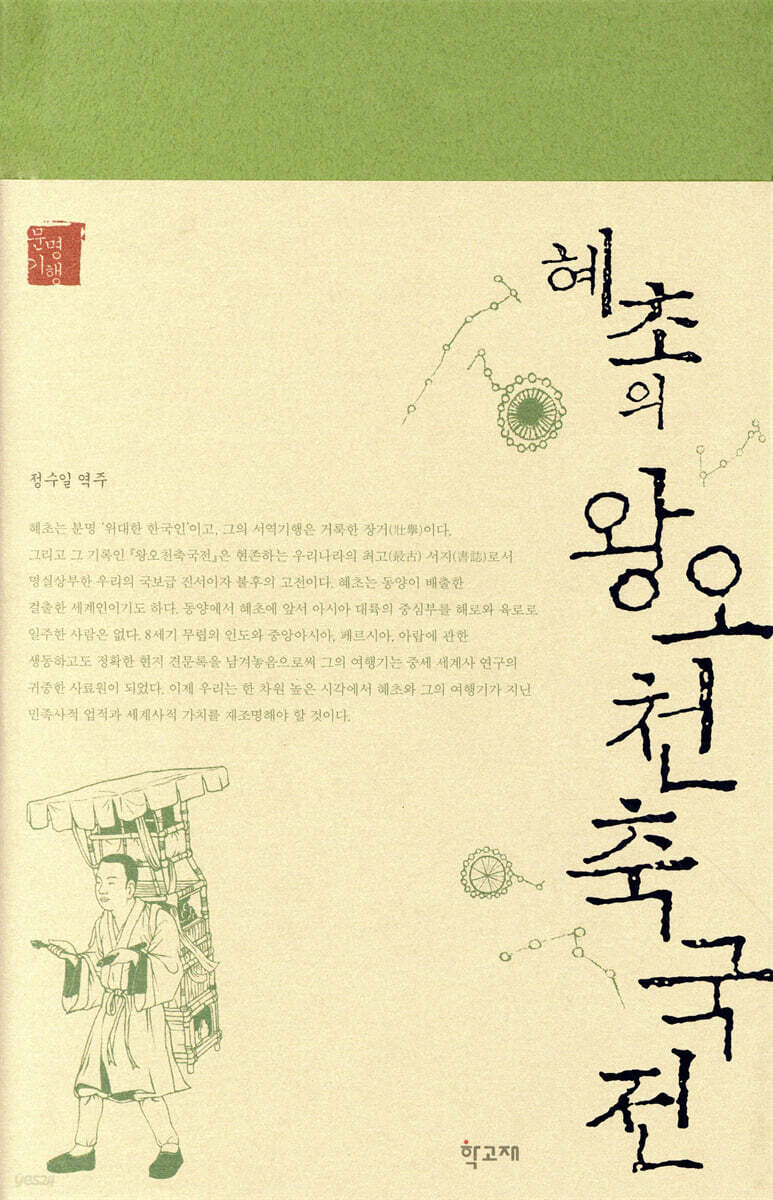
Hyecho's Wang Ocheonchukguk Jeon
 |
Description
Book Introduction
『Wang Ocheonchukgukjeon』 is the oldest extant Korean book and the only record of India and Central Asia in the 8th century.
Here, 'Tianchuk' is an old Chinese name for India.
Therefore, this can be seen as a 'record of a trip to the Five Heavenly Kingdoms', and it contains stories that the Silla monk Hyecho saw and heard while traveling through various countries in Central Asia, including India.
The original was a simple 10-page document with 6,000 Chinese characters.
However, thanks to the efforts of Jeong Su-il, an authority in this field, the book includes 400 pages of detailed annotations and commentary, making it easy for the general public to read.
In particular, the author has achieved the feat of confirming the dynasties and civilizations of the countries mentioned by Hyecho, as well as their current location.
It contains various aspects of medieval India and Central Asia, such as the story that in India, even if you committed a crime, you could solve it by simply paying a fine.
In addition, a poem written by Hyecho is included, allowing us to understand Hyecho's feelings as he spends a lonely night in a foreign land.
It is an interesting book comparable to 『The Western Regions of the Great Tang Dynasty』 and 『The Travels of Ibn Battuta』.
Here, 'Tianchuk' is an old Chinese name for India.
Therefore, this can be seen as a 'record of a trip to the Five Heavenly Kingdoms', and it contains stories that the Silla monk Hyecho saw and heard while traveling through various countries in Central Asia, including India.
The original was a simple 10-page document with 6,000 Chinese characters.
However, thanks to the efforts of Jeong Su-il, an authority in this field, the book includes 400 pages of detailed annotations and commentary, making it easy for the general public to read.
In particular, the author has achieved the feat of confirming the dynasties and civilizations of the countries mentioned by Hyecho, as well as their current location.
It contains various aspects of medieval India and Central Asia, such as the story that in India, even if you committed a crime, you could solve it by simply paying a fine.
In addition, a poem written by Hyecho is included, allowing us to understand Hyecho's feelings as he spends a lonely night in a foreign land.
It is an interesting book comparable to 『The Western Regions of the Great Tang Dynasty』 and 『The Travels of Ibn Battuta』.
Into the book
2.
In the comments
The translator compares existing domestic and foreign translations and research papers of 『Wang Ocheonchukgukjeon』 and points out parts where the interpretations are significantly different.
And we try to translate as accurately as possible by restoring the original text based on related books and the situation in that region at that time.
There is controversy over the character preceding the character '석(石)' in this sentence and the interpretation of the same character '오일(五一)'.
There are opinions that the character before the character '석' is the character '오(五)' (藤, 12a; F, 459; 羽, 613; 李, 96) and the character '오일(五一)' (Y, 41, 83; 鄭, 105), but there is also a scholar (張, 28) who uniquely sees it only as the character '일(一)'.
Scholars who see it as the letter 'o' without exception translated it as 'offering five islands to the king.'
When viewed as the character 'oil', it is sometimes translated as 'offering one of the five islands to the king' (Sang, 31).
What is unique is that it is written as ‘oil’ but translated as ‘five islands’ (Jeong, 105, 116).
However, considering that the Indian tax at the time was a tax system that required tribute of one-sixth of the harvest, it is reasonable to recognize it as 'oil' and translate it as 'gather five islands of grain from the land and give one island to the king.'
--- (from pages 171-172)
The translator provides further explanations in the footnotes regarding the parts where Hyecho describes the customs of the Western Regions, such as eating habits using chopsticks, incest, and polyandry.
Due to the tradition of nomadic life, Arabs have long had the custom of eating food with their bare hands (right hand).
Although spoons are sometimes used to eat things like soup, chopsticks are rarely used like those of the Han civilization.
I guess Hyecho mistook the skewers used by Arabs who enjoy grilling skewers for chopsticks.
So, it seemed 'quite ugly' to him that cannibals used spoons.
---(from page 366)
Hyecho criticizes the practice of marrying one's mother or sister as a 'very evil custom.'
Reciprocal marriage is a type of marriage that was popular among some peoples, including the Zoroastrians of Persia.
It is said that incestuous marriages, including recent marriages, have existed among various ethnic groups since ancient times for several reasons, such as maintaining the purity of bloodlines and religions, preventing the outflow of wealth due to marriage expenses, and appeasing women's desire for sex.
The first person to introduce this marriage system, which originated from the Persian Zoroastrianism, was Herodotus, who, in Book IX of his masterpiece Historia, tells the following anecdote about Cambyses, son of Cyrus, king of the Achaemenid Persian Empire.
Before Cambyses, the custom of taking a sister as a wife did not exist in Persia at all.
Now Cambyses was in love with one of his sisters and wanted to court her, but he knew that this was against custom.
So one day he called in the palace magistrate and asked if there was any law that could recognize his sister-in-law's marriage.
The judge, who had noticed the prince's intentions, had to find a clever way to do so that it would not violate the law, but would also not incur the prince's hatred.
After much thought, the judge replied that while there was no law legally recognizing marriage between brothers, there was also the law of the other side, which allowed the king to do whatever he wanted.
So the prince took that sister as his wife, and soon after, he took another sister as his wife.
---(from page 389)
'Polyandry', which is the practice of having multiple wives, is also a type of marriage system that has been found in many places since ancient times.
It was especially prevalent in Central Asia.
According to the "Biography of the Western Regions" in the "Book of Sui", in the Tohwa Kingdom, brothers take one wife, and when there is a household affair, they hang clothes outside the room to mark it, and the children belong to the older brother.
On the other hand, the Yanda people, who belong to the Dai Yuezhi tribe, have customs similar to those of the Turkic people, in which brothers take only one wife.
If there are no brothers, the wife wears a hat with one corner, and if there are several brothers, she wears a hat with as many corners as there are brothers (『Book of Wei』 「Biographies of the Western Regions」).
---(from pages 389-390)
In the comments
The translator compares existing domestic and foreign translations and research papers of 『Wang Ocheonchukgukjeon』 and points out parts where the interpretations are significantly different.
And we try to translate as accurately as possible by restoring the original text based on related books and the situation in that region at that time.
There is controversy over the character preceding the character '석(石)' in this sentence and the interpretation of the same character '오일(五一)'.
There are opinions that the character before the character '석' is the character '오(五)' (藤, 12a; F, 459; 羽, 613; 李, 96) and the character '오일(五一)' (Y, 41, 83; 鄭, 105), but there is also a scholar (張, 28) who uniquely sees it only as the character '일(一)'.
Scholars who see it as the letter 'o' without exception translated it as 'offering five islands to the king.'
When viewed as the character 'oil', it is sometimes translated as 'offering one of the five islands to the king' (Sang, 31).
What is unique is that it is written as ‘oil’ but translated as ‘five islands’ (Jeong, 105, 116).
However, considering that the Indian tax at the time was a tax system that required tribute of one-sixth of the harvest, it is reasonable to recognize it as 'oil' and translate it as 'gather five islands of grain from the land and give one island to the king.'
--- (from pages 171-172)
The translator provides further explanations in the footnotes regarding the parts where Hyecho describes the customs of the Western Regions, such as eating habits using chopsticks, incest, and polyandry.
Due to the tradition of nomadic life, Arabs have long had the custom of eating food with their bare hands (right hand).
Although spoons are sometimes used to eat things like soup, chopsticks are rarely used like those of the Han civilization.
I guess Hyecho mistook the skewers used by Arabs who enjoy grilling skewers for chopsticks.
So, it seemed 'quite ugly' to him that cannibals used spoons.
---(from page 366)
Hyecho criticizes the practice of marrying one's mother or sister as a 'very evil custom.'
Reciprocal marriage is a type of marriage that was popular among some peoples, including the Zoroastrians of Persia.
It is said that incestuous marriages, including recent marriages, have existed among various ethnic groups since ancient times for several reasons, such as maintaining the purity of bloodlines and religions, preventing the outflow of wealth due to marriage expenses, and appeasing women's desire for sex.
The first person to introduce this marriage system, which originated from the Persian Zoroastrianism, was Herodotus, who, in Book IX of his masterpiece Historia, tells the following anecdote about Cambyses, son of Cyrus, king of the Achaemenid Persian Empire.
Before Cambyses, the custom of taking a sister as a wife did not exist in Persia at all.
Now Cambyses was in love with one of his sisters and wanted to court her, but he knew that this was against custom.
So one day he called in the palace magistrate and asked if there was any law that could recognize his sister-in-law's marriage.
The judge, who had noticed the prince's intentions, had to find a clever way to do so that it would not violate the law, but would also not incur the prince's hatred.
After much thought, the judge replied that while there was no law legally recognizing marriage between brothers, there was also the law of the other side, which allowed the king to do whatever he wanted.
So the prince took that sister as his wife, and soon after, he took another sister as his wife.
---(from page 389)
'Polyandry', which is the practice of having multiple wives, is also a type of marriage system that has been found in many places since ancient times.
It was especially prevalent in Central Asia.
According to the "Biography of the Western Regions" in the "Book of Sui", in the Tohwa Kingdom, brothers take one wife, and when there is a household affair, they hang clothes outside the room to mark it, and the children belong to the older brother.
On the other hand, the Yanda people, who belong to the Dai Yuezhi tribe, have customs similar to those of the Turkic people, in which brothers take only one wife.
If there are no brothers, the wife wears a hat with one corner, and if there are several brothers, she wears a hat with as many corners as there are brothers (『Book of Wei』 「Biographies of the Western Regions」).
---(from pages 389-390)
.
1.
In the translation
One of the joys of traveling or reading travel stories is experiencing, directly or indirectly, customs and traditions that are different from our own.
Hyecho also vividly describes the unfamiliar customs of a foreign land that were different from the customs of the place where he lived.
People in this country and other countries do not drink much alcohol.
Even though I traveled all over the country of Ocheonchuk, I rarely saw people getting drunk and fighting each other.
Even if they did drink, they would only feel a little bit better and gain some energy, but I didn't see anyone singing, dancing, or having a noisy drinking party.
--- (From the section 'Shindu Gora Kingdom' on page 229)
Because they wear fur and linen clothes, they have a lot of lice and nits, and when they catch a lice, they put it in their mouths and never throw it away.
--- (From the section 'Toban Country' on page 263)
Meals are shared by everyone, regardless of social status, from one bowl.
He also had a spoon and chopsticks in his hand, but they looked very ugly.
--- (From the section 'Large Food' on page 360)
The customs are so bad that they mix up marriages, even taking their mothers or sisters as wives.
Even in the kingdom of Parsa, one takes one's mother as a wife.
And in countries such as Tohwara, Gyebin, Beomin, and Sarul, whether there are ten, five, three, or two brothers, they take one wife jointly, and each brother is not permitted to take a wife.
It's because they're afraid of their household going bankrupt.
---(From the section 'Protecting the Country' on page 373)
Hyecho recorded the number of Buddhist temples and monks, the degree of dominance of Mahayana and Theravada Buddhism, and the extent of the spread of pagan religions such as Hinduism and Islam wherever he went, which clearly shows the situation of the spread of Buddhism in 8th century India and Central Asia.
(The third tower) is in the country of Kavyala, which is the city where the Buddha was born.
I saw the tree of no worries there, but the castle was already in ruins.
There is a tower, but no monks or people.
--- (From the section 'The Four Great Pagodas of the Central Heavenly Kingdom' on page 181)
The king, the governor, and the people highly respect the Three Jewels, so there are many temples and monks, and Mahayana and Hinayana are practiced together.
--- (From the section 'Southern India' on page 197)
『Wang Ocheonchukgukjeon』 is called a lyrical travelogue because it contains five five-character poems that describe the joy Hyecho felt upon arriving at the holy land and the hardships of his arduous journey.
The following poem, recited while on his way to Namcheonchuk, well expresses Hyecho's feelings of homesickness in a foreign land far away.
Looking at the road home on a moonlit night
The floating clouds are swirling around.
I dare to send a letter to that side.
The wind is so strong that I can't hear the reply.
My country is in the north of the sky
The other country is at the westernmost end of the earth.
There are not even any geese in Ilnam
Who will fly to Gyerim to deliver the news?
--- (From Namcheonchukgukjeol on page 198) 1.
In the translation
One of the joys of traveling or reading travel stories is experiencing, directly or indirectly, customs and traditions that are different from our own.
Hyecho also vividly describes the unfamiliar customs of a foreign land that were different from the customs of the place where he lived.
People in this country and other countries do not drink much alcohol.
Even though I traveled all over the country of Ocheonchuk, I rarely saw people getting drunk and fighting each other.
Even if they did drink, they only felt a little bit better and gained some energy. I didn't see anyone singing, dancing, or having a noisy drinking party.
--- (From the section 'Shindu Gora Kingdom' on page 229)
Because they wear fur and linen clothes, they have a lot of lice and nits, and when they catch a lice, they put it in their mouths and never throw it away.
--- (From the section 'Toban Country' on page 263)
Meals are shared by everyone, regardless of social status, from one bowl.
He also had a spoon and chopsticks in his hand, but they looked very ugly.
--- (From the section 'Large Food' on page 360)
The customs are so bad that they mix up marriages, even taking their mothers or sisters as wives.
Even in the kingdom of Parsa, one takes one's mother as a wife.
And in countries such as Tohwara, Gyebin, Beomin, and Sarul, whether there are ten, five, three, or two brothers, they take one wife jointly, and each brother is not permitted to take a wife.
It's because they're afraid of their household going bankrupt.
---(From the section 'Protecting the Country' on page 373)
Hyecho recorded the number of Buddhist temples and monks, the degree of dominance of Mahayana and Theravada Buddhism, and the extent of the spread of pagan religions such as Hinduism and Islam wherever he went, which clearly shows the situation of the spread of Buddhism in 8th century India and Central Asia.
(The third tower) is in the country of Kavyala, which is the city where the Buddha was born.
I saw the tree of no worries there, but the castle was already in ruins.
There is a tower, but no monks or people.
--- (From the section 'The Four Great Pagodas of the Central Heavenly Kingdom' on page 181)
The king, the governor, and the people highly respect the Three Jewels, so there are many temples and monks, and Mahayana and Hinayana are practiced together.
--- (From the section 'Southern India' on page 197)
『Wang Ocheonchukgukjeon』 is called a lyrical travelogue because it contains five five-character poems that describe the joy Hyecho felt upon arriving at the holy land and the hardships of his arduous journey.
The following poem, recited while on his way to Namcheonchuk, well expresses Hyecho's feelings of homesickness in a foreign land far away.
Looking at the road home on a moonlit night
The floating clouds are swirling around.
I dare to send a letter to that side
The wind is so strong that I can't hear the reply.
My country is in the north of the sky
The other country is at the westernmost end of the earth.
There are not even any geese in Ilnam
Who will fly to Gyerim to deliver the news?
--- (From Namcheonchukgukjeol, page 198)
In the translation
One of the joys of traveling or reading travel stories is experiencing, directly or indirectly, customs and traditions that are different from our own.
Hyecho also vividly describes the unfamiliar customs of a foreign land that were different from the customs of the place where he lived.
People in this country and other countries do not drink much alcohol.
Even though I traveled all over the country of Ocheonchuk, I rarely saw people getting drunk and fighting each other.
Even if they did drink, they would only feel a little bit better and gain some energy, but I didn't see anyone singing, dancing, or having a noisy drinking party.
--- (From the section 'Shindu Gora Kingdom' on page 229)
Because they wear fur and linen clothes, they have a lot of lice and nits, and when they catch a lice, they put it in their mouths and never throw it away.
--- (From the section 'Toban Country' on page 263)
Meals are shared by everyone, regardless of social status, from one bowl.
He also had a spoon and chopsticks in his hand, but they looked very ugly.
--- (From the section 'Large Food' on page 360)
The customs are so bad that they mix up marriages, even taking their mothers or sisters as wives.
Even in the kingdom of Parsa, one takes one's mother as a wife.
And in countries such as Tohwara, Gyebin, Beomin, and Sarul, whether there are ten, five, three, or two brothers, they take one wife jointly, and each brother is not permitted to take a wife.
It's because they're afraid of their household going bankrupt.
---(From the section 'Protecting the Country' on page 373)
Hyecho recorded the number of Buddhist temples and monks, the degree of dominance of Mahayana and Theravada Buddhism, and the extent of the spread of pagan religions such as Hinduism and Islam wherever he went, which clearly shows the situation of the spread of Buddhism in 8th century India and Central Asia.
(The third tower) is in the country of Kavyala, which is the city where the Buddha was born.
I saw the tree of no worries there, but the castle was already in ruins.
There is a tower, but no monks or people.
--- (From the section 'The Four Great Pagodas of the Central Heavenly Kingdom' on page 181)
The king, the governor, and the people highly respect the Three Jewels, so there are many temples and monks, and Mahayana and Hinayana are practiced together.
--- (From the section 'Southern India' on page 197)
『Wang Ocheonchukgukjeon』 is called a lyrical travelogue because it contains five five-character poems that describe the joy Hyecho felt upon arriving at the holy land and the hardships of his arduous journey.
The following poem, recited while on his way to Namcheonchuk, well expresses Hyecho's feelings of homesickness in a foreign land far away.
Looking at the road home on a moonlit night
The floating clouds are swirling around.
I dare to send a letter to that side.
The wind is so strong that I can't hear the reply.
My country is in the north of the sky
The other country is at the westernmost end of the earth.
There are not even any geese in Ilnam
Who will fly to Gyerim to deliver the news?
--- (From Namcheonchukgukjeol on page 198) 1.
In the translation
One of the joys of traveling or reading travel stories is experiencing, directly or indirectly, customs and traditions that are different from our own.
Hyecho also vividly describes the unfamiliar customs of a foreign land that were different from the customs of the place where he lived.
People in this country and other countries do not drink much alcohol.
Even though I traveled all over the country of Ocheonchuk, I rarely saw people getting drunk and fighting each other.
Even if they did drink, they only felt a little bit better and gained some energy. I didn't see anyone singing, dancing, or having a noisy drinking party.
--- (From the section 'Shindu Gora Kingdom' on page 229)
Because they wear fur and linen clothes, they have a lot of lice and nits, and when they catch a lice, they put it in their mouths and never throw it away.
--- (From the section 'Toban Country' on page 263)
Meals are shared by everyone, regardless of social status, from one bowl.
He also had a spoon and chopsticks in his hand, but they looked very ugly.
--- (From the section 'Large Food' on page 360)
The customs are so bad that they mix up marriages, even taking their mothers or sisters as wives.
Even in the kingdom of Parsa, one takes one's mother as a wife.
And in countries such as Tohwara, Gyebin, Beomin, and Sarul, whether there are ten, five, three, or two brothers, they take one wife jointly, and each brother is not permitted to take a wife.
It's because they're afraid of their household going bankrupt.
---(From the section 'Protecting the Country' on page 373)
Hyecho recorded the number of Buddhist temples and monks, the degree of dominance of Mahayana and Theravada Buddhism, and the extent of the spread of pagan religions such as Hinduism and Islam wherever he went, which clearly shows the situation of the spread of Buddhism in 8th century India and Central Asia.
(The third tower) is in the country of Kavyala, which is the city where the Buddha was born.
I saw the tree of no worries there, but the castle was already in ruins.
There is a tower, but no monks or people.
--- (From the section 'The Four Great Pagodas of the Central Heavenly Kingdom' on page 181)
The king, the governor, and the people highly respect the Three Jewels, so there are many temples and monks, and Mahayana and Hinayana are practiced together.
--- (From the section 'Southern India' on page 197)
『Wang Ocheonchukgukjeon』 is called a lyrical travelogue because it contains five five-character poems that describe the joy Hyecho felt upon arriving at the holy land and the hardships of his arduous journey.
The following poem, recited while on his way to Namcheonchuk, well expresses Hyecho's feelings of homesickness in a foreign land far away.
Looking at the road home on a moonlit night
The floating clouds are swirling around.
I dare to send a letter to that side
The wind is so strong that I can't hear the reply.
My country is in the north of the sky
The other country is at the westernmost end of the earth.
There are not even any geese in Ilnam
Who will fly to Gyerim to deliver the news?
--- (From Namcheonchukgukjeol, page 198)
.
Publisher's Review
5.
The journey of translator Jeong Su-il
When Hyecho was young, he risked his life on foot to travel to the Western Regions.
The arduousness of the journey can be guessed from the passage in the poem where, on the way back, with the Pamir Plateau in front of him, he writes, “The road is rough and the snow-covered mountain peaks are hazy… I have never shed a tear in my life, / but today, I shed endless tears (p. 406).”
After returning to Chang'an, he devoted the rest of his life to the study of esoteric Buddhism.
The history of Jeong Su-il is somewhat similar to that of Hyecho.
Born in China, Mr. Jeong Su-il studied in Cairo and traveled to dozens of countries around the world, including Morocco, Tunisia, and Malaysia.
His somewhat hoarse voice is said to have changed after suffering from an endemic disease during his travels in Africa.
His career as an Islamic scholar put him at the center of a national tragedy.
But now, here in Seoul, he is focusing on establishing the unfamiliar discipline of civilization exchange studies based on the knowledge he has accumulated from various places around the world.
Translating a book in three languages, a feat rarely seen even abroad.
Although there have been instances of a single translator translating classics in one or two languages, both in the East and the West, it is difficult to find a case of a translator translating classics in three languages, especially languages that encompass both the East and the West, as well as languages in between.
The translator of this book, Jeong Su-il, has translated the classic 『A Road to China』 (Sageseol) in English and the classic 『The Travels of Ibn Battuta』 (Changbi) in Arabic, and has now translated the classic 『Wang Ocheonchukguk Jeon』 in Chinese for the third time, becoming a translator of books in three languages.
6.
etc
This book contains the first ever 3D digital reconstruction of Hyecho.
It recreates the scene of Hyecho, around the age of 23, passing by the Great Stupa of the Mahabodhi Temple in the center of India.
It was produced through the research of costumes by Director Yoo Hee-kyung of the Costume Culture Center (former professor at Ewha Womans University) and Professor Kim Mi-ja of Seoul Women's University, and with the participation of translator Jeong Su-il, digital restoration expert Park Jin-ho, and Dream Hans Co., Ltd., a digital restoration company for cultural prototypes.
Appendix: Original text (reprint) of 『Wang Ocheonchukgukjeon』 provided
The original text (reprint) of 『Wang Ocheonchukgukjeon』 is provided as a separate appendix.
This is a re-photograph of the original that the Ministry of Culture and Public Information had stored in the National Library of Paris in 1987. The original, which was 28.5 cm long, was reduced to 20 cm in length.
The scrolls were joined by hand and placed in specially made envelopes for them.
Considering that 『Wang Ocheonchukgukjeon』 is a classic Korean work, we put a lot of effort into the design of the book to give it a sense of both antiquity and sophistication.
It was bound in high-quality cloth and the cover with the restored image of Hyecho was put back on.
Considering that the annotations to the original text are no different in importance from the original text or the translation in terms of length and content, they are presented in footnote format in somewhat larger font.
The search is detailed by place name, person name, and details, and of course includes vocabulary from the footnotes.
Travelogues, characterized by the vivid transmission of facts, enable us to establish a correct view of civilization, including the view of others, and as an interesting literary genre, they evoke a unique aesthetic feeling in readers.
The Hakgojae "Civilization Journey" series was designed to reflect on the spirit of our ancestors who embarked on uncharted paths and to illuminate the wisdom of civilization they discovered.
There are many travel stories around us that transcend time and space and have a deep globality.
Among them, we will prioritize selecting works that have not been properly introduced in Korea, and we will focus on rigorous translations based on the original text as much as possible to avoid the pitfalls of translation, while also adding detailed annotations.
This will be a work that brings together the best travelogues of the East and the West, exploring different civilizations from ancient times to the modern era, through the perspective of those of us living in this land today.
The journey of translator Jeong Su-il
When Hyecho was young, he risked his life on foot to travel to the Western Regions.
The arduousness of the journey can be guessed from the passage in the poem where, on the way back, with the Pamir Plateau in front of him, he writes, “The road is rough and the snow-covered mountain peaks are hazy… I have never shed a tear in my life, / but today, I shed endless tears (p. 406).”
After returning to Chang'an, he devoted the rest of his life to the study of esoteric Buddhism.
The history of Jeong Su-il is somewhat similar to that of Hyecho.
Born in China, Mr. Jeong Su-il studied in Cairo and traveled to dozens of countries around the world, including Morocco, Tunisia, and Malaysia.
His somewhat hoarse voice is said to have changed after suffering from an endemic disease during his travels in Africa.
His career as an Islamic scholar put him at the center of a national tragedy.
But now, here in Seoul, he is focusing on establishing the unfamiliar discipline of civilization exchange studies based on the knowledge he has accumulated from various places around the world.
Translating a book in three languages, a feat rarely seen even abroad.
Although there have been instances of a single translator translating classics in one or two languages, both in the East and the West, it is difficult to find a case of a translator translating classics in three languages, especially languages that encompass both the East and the West, as well as languages in between.
The translator of this book, Jeong Su-il, has translated the classic 『A Road to China』 (Sageseol) in English and the classic 『The Travels of Ibn Battuta』 (Changbi) in Arabic, and has now translated the classic 『Wang Ocheonchukguk Jeon』 in Chinese for the third time, becoming a translator of books in three languages.
6.
etc
This book contains the first ever 3D digital reconstruction of Hyecho.
It recreates the scene of Hyecho, around the age of 23, passing by the Great Stupa of the Mahabodhi Temple in the center of India.
It was produced through the research of costumes by Director Yoo Hee-kyung of the Costume Culture Center (former professor at Ewha Womans University) and Professor Kim Mi-ja of Seoul Women's University, and with the participation of translator Jeong Su-il, digital restoration expert Park Jin-ho, and Dream Hans Co., Ltd., a digital restoration company for cultural prototypes.
Appendix: Original text (reprint) of 『Wang Ocheonchukgukjeon』 provided
The original text (reprint) of 『Wang Ocheonchukgukjeon』 is provided as a separate appendix.
This is a re-photograph of the original that the Ministry of Culture and Public Information had stored in the National Library of Paris in 1987. The original, which was 28.5 cm long, was reduced to 20 cm in length.
The scrolls were joined by hand and placed in specially made envelopes for them.
Considering that 『Wang Ocheonchukgukjeon』 is a classic Korean work, we put a lot of effort into the design of the book to give it a sense of both antiquity and sophistication.
It was bound in high-quality cloth and the cover with the restored image of Hyecho was put back on.
Considering that the annotations to the original text are no different in importance from the original text or the translation in terms of length and content, they are presented in footnote format in somewhat larger font.
The search is detailed by place name, person name, and details, and of course includes vocabulary from the footnotes.
Travelogues, characterized by the vivid transmission of facts, enable us to establish a correct view of civilization, including the view of others, and as an interesting literary genre, they evoke a unique aesthetic feeling in readers.
The Hakgojae "Civilization Journey" series was designed to reflect on the spirit of our ancestors who embarked on uncharted paths and to illuminate the wisdom of civilization they discovered.
There are many travel stories around us that transcend time and space and have a deep globality.
Among them, we will prioritize selecting works that have not been properly introduced in Korea, and we will focus on rigorous translations based on the original text as much as possible to avoid the pitfalls of translation, while also adding detailed annotations.
This will be a work that brings together the best travelogues of the East and the West, exploring different civilizations from ancient times to the modern era, through the perspective of those of us living in this land today.
What kind of book is Hyecho's "Wang Ocheonchukguk Jeon"?
1.
outline
This book is a travelogue of India and Central Asia from 1,200 years ago, revived in the 21st century.
This is a translated version of 『Wang Ocheonchukgukjeon』, published after painstaking research by Professor Jeong Su-il, a world-renowned scholar in the fields of civilization exchange and Islamic studies.
As one of the new volumes in the "Civilization Travels" series published by Hakgojae, we wanted to publish the first volume of a global travelogue written by a Korean.
『Wang Ocheonchukguk Jeon』 has been studied in many countries for nearly a hundred years since it was discovered by French explorer Pelliot in the Dunhuang Grottoes in 1908.
However, in Korea, the hometown of the author who wrote this book, research is far behind, and apart from the six or seven translated works published so far, there has not been a single decent translated work.
This is precisely what caused the translator of this book (Jeong Su-il) to feel a sense of guilt for not being able to properly honor our great ancestors, and what finally led him to begin the translation work.
『Wang Ocheonchukgukjeon』 is a record left by Hyecho, a great monk of Silla, after traveling around India, Arabia, Persia, and Central Asia around 720.
To understand a text written in Chinese characters about 1,200 years ago, and especially one about a distant country that is not our own, a translated text, not a simple translation, is absolutely necessary.
Accordingly, the translator compared and analyzed existing research papers and compared them with related books such as 『Records of the Western Regions of the Great Tang Dynasty』 and 『Records of the Buddhist Kingdoms』.
He also used his knowledge of Chinese language and cultural exchanges, Islam, Central Asian history, culture, and geography to publish Hyecho's "Wang Ocheonchukguk Jeon", a translated and annotated version of the original text with detailed and rich annotations.
One of the purposes of reading travelogues is to look at myself through the eyes of others.
This translation by Jeong Su-il breathes new life into an ancient document that had been dormant for 1,200 years, and brings a story from a distant place back to life in the present, here and now.
2.
composition
At the very beginning of the book, there is a map showing Hyecho's travel route, the first attempted restoration of Hyecho, and color plates related to the 『Wang Ocheonchukguk Jeon』, including the Dunhuang Grottoes, India, and Xi'an, China.
The commentary on the 『Wang Ocheonchukgukjeon』 that follows includes information on Hyecho's life, the process and content of his travelogue's discovery, his personality, Hyecho's journey to the West and its significance in the history of civilization, existing research results, and future research tasks.
Next comes the original text of the 『Wang Ocheonchukgukjeon』, divided into 227 lines as it was transcribed on a scroll.
The text is divided into 40 sections by region based on the original text of 『Wang Ocheonchukgukjeon』 and arranged in the order of translation, original text, and annotations.
It starts from Vaishali in central India and ends in Karashahr in Central Asia.
The back contains a chronology and index of Hyecho's reign, and a reprint of the "Hyecho Wang Ocheonchukgukjeon" section from Hyelin's "Ilchegyeong-eumui," which served as a basis for understanding the true nature of "Wang Ocheonchukgukjeon."
The search is detailed and categorized by place name, person name, and details.
In addition, the original text of 『Wang Ocheonchukgukjeon』, stored in the National Library of Paris, is being produced as a reprint and provided as a special appendix.
3.
Meaning
So far, domestic research on the Wang Ocheonchukgukjeon has consisted of only a few papers and translations.
So, it is difficult to understand the content of this travelogue just by looking at the translated version that explains the sentences.
First of all, it is a story from a long time ago in a far away place.
Because it is a short book of about 6,000 characters and summarizes what was seen and heard in about 40 regions, the content is brief, and when it was discovered, the beginning and end were cut off, and there are many letters that have been erased and are faint or no longer in use.
In order to properly understand, a translation that provides accurate explanations of the history, geography, and culture of the region at that time and that includes thorough annotations for Chinese characters with ambiguous meanings or forms is essential.
Translator Jeong Su-il has long lamented the reality that there is not a single decent translation.
Thus, based on an accurate translation, we finally published the first translated book in Korea with 503 detailed annotations, which is approximately ten times the length of the original text.
4.
Research Results: Providing Answers to Controversial Issues in Previous Research
The current 『Wang Ocheonchukgukjeon』 was discovered as a single scroll, and its contents are continuous without any paragraph breaks.
However, in Hyelin's 『Ilchegyeong-eum-ui』, which served as the basis for defining this scroll as 『Wangocheonchukgukjeon』, the annotations of the vocabulary appearing in 『Wangocheonchukgukjeon』 are classified into upper, middle, and lower volumes.
This is the reason why there is controversy over whether the existing 『Wang Ocheonchukgukjeon』 is a draft, an abridged version of the original, or a copy of the original.
The translator meticulously compared the number of words and the order of appearance among the words annotated in 『Ilchegyeongeumui』 and the words included in the existing 『Wang Ocheonchukgukjeon』.
And it is concluded that the existing 『Wang Ocheonchukgukjeon』 is an abridged version of the original three volumes.
In addition, based on the frequency of annotated vocabulary selected from 『Ilchegyeongumui』, the amount of text cut out from the existing 『Wang Ocheonchukgukjeon』 was also estimated for the first time.
There are many different opinions about the route Hyecho traveled.
This is because the travelogue contains a mix of places I visited personally and places I heard about.
The translator distinguished between travelogues and specialized journals by considering the accuracy and specificity of the description, geographical location, purpose of travel, and the fact that Hyecho wrote the opening sentences for the places he visited in a certain format.
And, breaking the prevailing academic opinion that Hyecho did not go as far as Persia and Arabia and wrote about these places based on what he heard, he presented valid evidence that he was the first Asian to travel to the Arab Empire.
However, this is based on the premise that the Arab Empire (Greater Food Nation) of that time had a different regional scope and concept from the Arab world of today.
According to the translator, Hyecho went to Nishapur (NDshApEr, present-day Mashhad in northeastern Iran), which was the Central Asian jurisdiction of the Arab Empire at the time and a passage to the East.
Hyecho's travel route, newly estimated by the translator, is as follows.
Departing from Guangzhou, China ⇒ South China Sea ⇒ Sumatra ⇒ Lion Country (Ceylon, Sri Lanka) ⇒ Eastern India ⇒ Vaishali ⇒ Kusinagara ⇒ Varanasi ⇒ Mageeta Country (4 major holy places including Rajasthan, Mahabodhi, etc.) ⇒ Kanyakubja, the capital of Central India ⇒ Nasik ⇒ Alor ⇒ Sarandala (Jalandhara) ⇒ Taksa Country (Takshar) ⇒ Sindhugura Country (Sindhugurjara) ⇒ Sarandala ⇒ Kasyapamira Country (Kashmir) ⇒ Gantara Country (Gandhara) ⇒ Udhyana ⇒ Chitral ⇒ Gantara Country ⇒ Lampa Country (Rampaka) ⇒ Kepong Country (Kapish) ⇒ Sayul country (Zabulistan) ⇒ Beomin country (Bamiyan) ⇒ Tohwara (Tokharistan) ⇒ Pasa (Persia) ⇒ Daishi (Nishapur) ⇒ Tohwara (Tokharistan) ⇒ Rye country (Wakhan) ⇒ Pamir Plateau (Chongryeongjin) ⇒ Soreuk country (Kashgar) ⇒ Kucha country (Kucha) ⇒ Ongi country (Karashahr) ⇒ Dunhuang ⇒ Lanzhou ⇒ Arrival at Chang'an
Previous researchers believed that Hyecho went to India via the Nicobar Islands and stopped by Yangdongguk (northern Bhutan) and Ugi (Khotan) on his way back.
The translator pointed out that the 'naked' in the first part of the travelogue does not refer to primitive humans being naked, but to the appearance of religious practitioners, and he believed that this part was likely written about Vaishali, not the Nicobar Islands in the Indian Ocean or the northern west coast of the Malay Peninsula, and that he wrote about Yangdong, which is located across the Himalayas, or the rainy season beyond the Taklamakan Desert, based on what he heard and heard, rather than directly visiting.
1.
outline
This book is a travelogue of India and Central Asia from 1,200 years ago, revived in the 21st century.
This is a translated version of 『Wang Ocheonchukgukjeon』, published after painstaking research by Professor Jeong Su-il, a world-renowned scholar of civilization exchange and Islamic studies.
As one of the new volumes in the "Civilization Travels" series published by Hakgojae, we wanted to publish the first volume of a global travelogue written by a Korean.
『Wang Ocheonchukguk Jeon』 has been studied in many countries for nearly a hundred years since it was discovered by French explorer Pelliot in the Dunhuang Grottoes in 1908.
However, in Korea, the hometown of the author who wrote this book, research is far behind, and apart from the six or seven translated works published so far, there has not been a single decent translation.
This is precisely what caused the translator of this book (Jeong Su-il) to feel a sense of guilt for not being able to properly honor our great ancestors, and what finally led him to begin the translation work.
『Wang Ocheonchukgukjeon』 is a record left by Hyecho, a great monk of Silla, after traveling around India, Arabia, Persia, and Central Asia around 720.
To understand a text written in Chinese characters about 1,200 years ago, and especially one about a distant country that is not our own, a translated text, not a simple translation, is absolutely necessary.
Accordingly, the translator compared and analyzed existing research papers and compared them with related books such as 『Records of the Western Regions of the Great Tang Dynasty』 and 『Records of the Buddhist Kingdoms』.
He also used his knowledge of Chinese language and cultural exchanges, Islam, Central Asian history, culture, and geography to publish Hyecho's "Wang Ocheonchukguk Jeon", a translated and annotated version of the original text with detailed and rich annotations.
One of the purposes of reading travelogues is to look at myself through the eyes of others.
This translation by Jeong Su-il breathes new life into an ancient document that had been dormant for 1,200 years, and brings a story from a distant place back to life in the present, here and now.
2.
composition
At the very beginning of the book, there is a map showing Hyecho's travel route, the first attempted restoration of Hyecho, and color plates related to the 『Wang Ocheonchukguk Jeon』, including the Dunhuang Grottoes, India, and Xi'an, China.
The commentary on the 『Wang Ocheonchukgukjeon』 that follows includes information on Hyecho's life, the process and content of his travelogue's discovery, his personality, Hyecho's journey to the West and its significance in the history of civilization, existing research results, and future research tasks.
Next comes the original text of the 『Wang Ocheonchukgukjeon』, divided into 227 lines as it was transcribed on a scroll.
The text is divided into 40 sections by region based on the original text of 『Wang Ocheonchukgukjeon』 and arranged in the order of translation, original text, and annotations.
It starts from Vaishali in central India and ends in Karashahr in Central Asia.
The back contains a chronology and index of Hyecho's reign, and a reprint of the "Hyecho Wang Ocheonchukgukjeon" section from Hyelin's "Ilchegyeong-eumui," which served as a basis for understanding the true nature of "Wang Ocheonchukgukjeon."
The search is detailed and categorized by place name, person name, and details.
In addition, the original text of 『Wang Ocheonchukgukjeon』, stored in the National Library of Paris, is being produced as a reprint and provided as a special appendix.
3.
Meaning
So far, domestic research on the Wang Ocheonchukgukjeon has consisted of only a few papers and translations.
So, it is difficult to understand the content of this travelogue just by looking at the translated version that explains the sentences.
First of all, it is a story from a long time ago in a far away place.
Because it is a short book of about 6,000 characters and summarizes what was seen and heard in about 40 regions, the content is brief, and when it was discovered, the beginning and end were cut off, and there are many letters that have been erased and are faint or no longer in use.
In order to properly understand, a translation that provides accurate explanations of the history, geography, and culture of the region at that time and that includes thorough annotations for Chinese characters with ambiguous meanings or forms is essential.
Translator Jeong Su-il has long lamented the reality that there is not a single decent translation.
Thus, based on an accurate translation, we finally published the first translated book in Korea with 503 detailed annotations, which is approximately ten times the length of the original text.
4.
Research Results: Providing Answers to Controversial Issues in Previous Research
The current 『Wang Ocheonchukgukjeon』 was discovered as a single scroll, and its contents are continuous without any paragraph breaks.
However, in Hyelin's 『Ilchegyeong-eum-ui』, which served as the basis for defining this scroll as 『Wangocheonchukgukjeon』, the annotations of the vocabulary appearing in 『Wangocheonchukgukjeon』 are classified into upper, middle, and lower volumes.
This is the reason why there is controversy over whether the existing 『Wang Ocheonchukgukjeon』 is a draft, an abridged version of the original, or a copy of the original.
The translator meticulously compared the number of words and the order of appearance among the words annotated in 『Ilchegyeongeumui』 and the words included in the existing 『Wang Ocheonchukgukjeon』.
And it is concluded that the existing 『Wang Ocheonchukgukjeon』 is an abridged version of the original three volumes.
In addition, based on the frequency of annotated vocabulary selected from 『Ilchegyeongumui』, the amount of text cut out from the existing 『Wang Ocheonchukgukjeon』 was also estimated for the first time.
There are many different opinions about the route Hyecho traveled.
This is because the travelogue contains a mix of places I visited personally and places I heard about.
The translator distinguished between travelogues and specialized journals by considering the accuracy and specificity of the description, geographical location, purpose of travel, and the fact that Hyecho wrote the opening sentences for the places he visited in a certain format.
And, breaking the prevailing academic opinion that Hyecho did not go as far as Persia and Arabia and wrote about these places based on what he heard, he presented valid evidence that he was the first Asian to travel to the Arab Empire.
However, this is based on the premise that the Arab Empire (Greater Food Nation) of that time had a different regional scope and concept from the Arab world of today.
According to the translator, Hyecho went to Nishapur (NDshApEr, present-day Mashhad in northeastern Iran), which was the Central Asian jurisdiction of the Arab Empire at the time and a passage to the East.
Hyecho's travel route, newly estimated by the translator, is as follows.
Departing from Guangzhou, China ⇒ South China Sea ⇒ Sumatra ⇒ Lion Country (Ceylon, Sri Lanka) ⇒ Eastern India ⇒ Vaishali ⇒ Kusinagara ⇒ Varanasi ⇒ Mageeta Country (4 major holy places including Rajasthan, Mahabodhi, etc.) ⇒ Kanyakubja, the capital of Central India ⇒ Nasik ⇒ Alor ⇒ Sarandala (Jalandhara) ⇒ Taksa Country (Takshar) ⇒ Sindhugura Country (Sindhugurjara) ⇒ Sarandala ⇒ Kasyapamira Country (Kashmir) ⇒ Gantara Country (Gandhara) ⇒ Udhyana ⇒ Chitral ⇒ Gantara Country ⇒ Lampa Country (Rampaka) ⇒ Kepong Country (Kapish) ⇒ Sayul country (Zabulistan) ⇒ Beomin country (Bamiyan) ⇒ Tohwara (Tokharistan) ⇒ Pasa (Persia) ⇒ Daishi (Nishapur) ⇒ Tohwara (Tokharistan) ⇒ Rye country (Wakhan) ⇒ Pamir Plateau (Chongryeongjin) ⇒ Soreuk country (Kashgar) ⇒ Kucha country (Kucha) ⇒ Ongi country (Karashahr) ⇒ Dunhuang ⇒ Lanzhou ⇒ Arrival at Chang'an
Previous researchers believed that Hyecho went to India via the Nicobar Islands and stopped by Yangdongguk (northern Bhutan) and Ugi (Khotan) on his way back.
The translator pointed out that the 'naked' in the first part of the travelogue does not refer to primitive humans being naked, but to the appearance of religious practitioners, and he believed that this part was likely written about Vaishali, not the Nicobar Islands in the Indian Ocean or the northern west coast of the Malay Peninsula, and that he wrote about Yangdong, which is located across the Himalayas, or the rainy season beyond the Taklamakan Desert, based on what he heard and heard, rather than directly visiting.
outline
This book is a travelogue of India and Central Asia from 1,200 years ago, revived in the 21st century.
This is a translated version of 『Wang Ocheonchukgukjeon』, published after painstaking research by Professor Jeong Su-il, a world-renowned scholar in the fields of civilization exchange and Islamic studies.
As one of the new volumes in the "Civilization Travels" series published by Hakgojae, we wanted to publish the first volume of a global travelogue written by a Korean.
『Wang Ocheonchukguk Jeon』 has been studied in many countries for nearly a hundred years since it was discovered by French explorer Pelliot in the Dunhuang Grottoes in 1908.
However, in Korea, the hometown of the author who wrote this book, research is far behind, and apart from the six or seven translated works published so far, there has not been a single decent translated work.
This is precisely what caused the translator of this book (Jeong Su-il) to feel a sense of guilt for not being able to properly honor our great ancestors, and what finally led him to begin the translation work.
『Wang Ocheonchukgukjeon』 is a record left by Hyecho, a great monk of Silla, after traveling around India, Arabia, Persia, and Central Asia around 720.
To understand a text written in Chinese characters about 1,200 years ago, and especially one about a distant country that is not our own, a translated text, not a simple translation, is absolutely necessary.
Accordingly, the translator compared and analyzed existing research papers and compared them with related books such as 『Records of the Western Regions of the Great Tang Dynasty』 and 『Records of the Buddhist Kingdoms』.
He also used his knowledge of Chinese language and cultural exchanges, Islam, Central Asian history, culture, and geography to publish Hyecho's "Wang Ocheonchukguk Jeon", a translated and annotated version of the original text with detailed and rich annotations.
One of the purposes of reading travelogues is to look at myself through the eyes of others.
This translation by Jeong Su-il breathes new life into an ancient document that had been dormant for 1,200 years, and brings a story from a distant place back to life in the present, here and now.
2.
composition
At the very beginning of the book, there is a map showing Hyecho's travel route, the first attempted restoration of Hyecho, and color plates related to the 『Wang Ocheonchukguk Jeon』, including the Dunhuang Grottoes, India, and Xi'an, China.
The commentary on the 『Wang Ocheonchukgukjeon』 that follows includes information on Hyecho's life, the process and content of his travelogue's discovery, his personality, Hyecho's journey to the West and its significance in the history of civilization, existing research results, and future research tasks.
Next comes the original text of the 『Wang Ocheonchukgukjeon』, divided into 227 lines as it was transcribed on a scroll.
The text is divided into 40 sections by region based on the original text of 『Wang Ocheonchukgukjeon』 and arranged in the order of translation, original text, and annotations.
It starts from Vaishali in central India and ends in Karashahr in Central Asia.
The back contains a chronology and index of Hyecho's reign, and a reprint of the "Hyecho Wang Ocheonchukgukjeon" section from Hyelin's "Ilchegyeong-eumui," which served as a basis for understanding the true nature of "Wang Ocheonchukgukjeon."
The search is detailed and categorized by place name, person name, and details.
In addition, the original text of 『Wang Ocheonchukgukjeon』, stored in the National Library of Paris, is being produced as a reprint and provided as a special appendix.
3.
Meaning
So far, domestic research on the Wang Ocheonchukgukjeon has consisted of only a few papers and translations.
So, it is difficult to understand the content of this travelogue just by looking at the translated version that explains the sentences.
First of all, it is a story from a long time ago in a far away place.
Because it is a short book of about 6,000 characters and summarizes what was seen and heard in about 40 regions, the content is brief, and when it was discovered, the beginning and end were cut off, and there are many letters that have been erased and are faint or no longer in use.
In order to properly understand, a translation that provides accurate explanations of the history, geography, and culture of the region at that time and that includes thorough annotations for Chinese characters with ambiguous meanings or forms is essential.
Translator Jeong Su-il has long lamented the reality that there is not a single decent translation.
Thus, based on an accurate translation, we finally published the first translated book in Korea with 503 detailed annotations, which is approximately ten times the length of the original text.
4.
Research Results: Providing Answers to Controversial Issues in Previous Research
The current 『Wang Ocheonchukgukjeon』 was discovered as a single scroll, and its contents are continuous without any paragraph breaks.
However, in Hyelin's 『Ilchegyeong-eum-ui』, which served as the basis for defining this scroll as 『Wangocheonchukgukjeon』, the annotations of the vocabulary appearing in 『Wangocheonchukgukjeon』 are classified into upper, middle, and lower volumes.
This is the reason why there is controversy over whether the existing 『Wang Ocheonchukgukjeon』 is a draft, an abridged version of the original, or a copy of the original.
The translator meticulously compared the number of words and the order of appearance among the words annotated in 『Ilchegyeongeumui』 and the words included in the existing 『Wang Ocheonchukgukjeon』.
And it is concluded that the existing 『Wang Ocheonchukgukjeon』 is an abridged version of the original three volumes.
In addition, based on the frequency of annotated vocabulary selected from 『Ilchegyeongumui』, the amount of text cut out from the existing 『Wang Ocheonchukgukjeon』 was also estimated for the first time.
There are many different opinions about the route Hyecho traveled.
This is because the travelogue contains a mix of places I visited personally and places I heard about.
The translator distinguished between travelogues and specialized journals by considering the accuracy and specificity of the description, geographical location, purpose of travel, and the fact that Hyecho wrote the opening sentences for the places he visited in a certain format.
And, breaking the prevailing academic opinion that Hyecho did not go as far as Persia and Arabia and wrote about these places based on what he heard, he presented valid evidence that he was the first Asian to travel to the Arab Empire.
However, this is based on the premise that the Arab Empire (Greater Food Nation) of that time had a different regional scope and concept from the Arab world of today.
According to the translator, Hyecho went to Nishapur (NDshApEr, present-day Mashhad in northeastern Iran), which was the Central Asian jurisdiction of the Arab Empire at the time and a passage to the East.
Hyecho's travel route, newly estimated by the translator, is as follows.
Departing from Guangzhou, China ⇒ South China Sea ⇒ Sumatra ⇒ Lion Country (Ceylon, Sri Lanka) ⇒ Eastern India ⇒ Vaishali ⇒ Kusinagara ⇒ Varanasi ⇒ Mageeta Country (4 major holy places including Rajasthan, Mahabodhi, etc.) ⇒ Kanyakubja, the capital of Central India ⇒ Nasik ⇒ Alor ⇒ Sarandala (Jalandhara) ⇒ Taksa Country (Takshar) ⇒ Sindhugura Country (Sindhugurjara) ⇒ Sarandala ⇒ Kasyapamira Country (Kashmir) ⇒ Gantara Country (Gandhara) ⇒ Udhyana ⇒ Chitral ⇒ Gantara Country ⇒ Lampa Country (Rampaka) ⇒ Kepong Country (Kapish) ⇒ Sayul country (Zabulistan) ⇒ Beomin country (Bamiyan) ⇒ Tohwara (Tokharistan) ⇒ Pasa (Persia) ⇒ Daishi (Nishapur) ⇒ Tohwara (Tokharistan) ⇒ Rye country (Wakhan) ⇒ Pamir Plateau (Chongryeongjin) ⇒ Soreuk country (Kashgar) ⇒ Kucha country (Kucha) ⇒ Ongi country (Karashahr) ⇒ Dunhuang ⇒ Lanzhou ⇒ Arrival at Chang'an
Previous researchers believed that Hyecho went to India via the Nicobar Islands and stopped by Yangdongguk (northern Bhutan) and Ugi (Khotan) on his way back.
The translator pointed out that the 'naked' in the first part of the travelogue does not refer to primitive humans being naked, but to the appearance of religious practitioners, and he believed that this part was likely written about Vaishali, not the Nicobar Islands in the Indian Ocean or the northern west coast of the Malay Peninsula, and that he wrote about Yangdong, which is located across the Himalayas, or the rainy season beyond the Taklamakan Desert, based on what he heard and heard, rather than directly visiting.
1.
outline
This book is a travelogue of India and Central Asia from 1,200 years ago, revived in the 21st century.
This is a translated version of 『Wang Ocheonchukgukjeon』, published after painstaking research by Professor Jeong Su-il, a world-renowned scholar of civilization exchange and Islamic studies.
As one of the new volumes in the "Civilization Travels" series published by Hakgojae, we wanted to publish the first volume of a global travelogue written by a Korean.
『Wang Ocheonchukguk Jeon』 has been studied in many countries for nearly a hundred years since it was discovered by French explorer Pelliot in the Dunhuang Grottoes in 1908.
However, in Korea, the hometown of the author who wrote this book, research is far behind, and apart from the six or seven translated works published so far, there has not been a single decent translation.
This is precisely what caused the translator of this book (Jeong Su-il) to feel a sense of guilt for not being able to properly honor our great ancestors, and what finally led him to begin the translation work.
『Wang Ocheonchukgukjeon』 is a record left by Hyecho, a great monk of Silla, after traveling around India, Arabia, Persia, and Central Asia around 720.
To understand a text written in Chinese characters about 1,200 years ago, and especially one about a distant country that is not our own, a translated text, not a simple translation, is absolutely necessary.
Accordingly, the translator compared and analyzed existing research papers and compared them with related books such as 『Records of the Western Regions of the Great Tang Dynasty』 and 『Records of the Buddhist Kingdoms』.
He also used his knowledge of Chinese language and cultural exchanges, Islam, Central Asian history, culture, and geography to publish Hyecho's "Wang Ocheonchukguk Jeon", a translated and annotated version of the original text with detailed and rich annotations.
One of the purposes of reading travelogues is to look at myself through the eyes of others.
This translation by Jeong Su-il breathes new life into an ancient document that had been dormant for 1,200 years, and brings a story from a distant place back to life in the present, here and now.
2.
composition
At the very beginning of the book, there is a map showing Hyecho's travel route, the first attempted restoration of Hyecho, and color plates related to the 『Wang Ocheonchukguk Jeon』, including the Dunhuang Grottoes, India, and Xi'an, China.
The commentary on the 『Wang Ocheonchukgukjeon』 that follows includes information on Hyecho's life, the process and content of his travelogue's discovery, his personality, Hyecho's journey to the West and its significance in the history of civilization, existing research results, and future research tasks.
Next comes the original text of the 『Wang Ocheonchukgukjeon』, divided into 227 lines as it was transcribed on a scroll.
The text is divided into 40 sections by region based on the original text of 『Wang Ocheonchukgukjeon』 and arranged in the order of translation, original text, and annotations.
It starts from Vaishali in central India and ends in Karashahr in Central Asia.
The back contains a chronology and index of Hyecho's reign, and a reprint of the "Hyecho Wang Ocheonchukgukjeon" section from Hyelin's "Ilchegyeong-eumui," which served as a basis for understanding the true nature of "Wang Ocheonchukgukjeon."
The search is detailed and categorized by place name, person name, and details.
In addition, the original text of 『Wang Ocheonchukgukjeon』, stored in the National Library of Paris, is being produced as a reprint and provided as a special appendix.
3.
Meaning
So far, domestic research on the Wang Ocheonchukgukjeon has consisted of only a few papers and translations.
So, it is difficult to understand the content of this travelogue just by looking at the translated version that explains the sentences.
First of all, it is a story from a long time ago in a far away place.
Because it is a short book of about 6,000 characters and summarizes what was seen and heard in about 40 regions, the content is brief, and when it was discovered, the beginning and end were cut off, and there are many letters that have been erased and are faint or no longer in use.
In order to properly understand, a translation that provides accurate explanations of the history, geography, and culture of the region at that time and that includes thorough annotations for Chinese characters with ambiguous meanings or forms is essential.
Translator Jeong Su-il has long lamented the reality that there is not a single decent translation.
Thus, based on an accurate translation, we finally published the first translated book in Korea with 503 detailed annotations, which is approximately ten times the length of the original text.
4.
Research Results: Providing Answers to Controversial Issues in Previous Research
The current 『Wang Ocheonchukgukjeon』 was discovered as a single scroll, and its contents are continuous without any paragraph breaks.
However, in Hyelin's 『Ilchegyeong-eum-ui』, which served as the basis for defining this scroll as 『Wangocheonchukgukjeon』, the annotations of the vocabulary appearing in 『Wangocheonchukgukjeon』 are classified into upper, middle, and lower volumes.
This is the reason why there is controversy over whether the existing 『Wang Ocheonchukgukjeon』 is a draft, an abridged version of the original, or a copy of the original.
The translator meticulously compared the number of words and the order of appearance among the words annotated in 『Ilchegyeongeumui』 and the words included in the existing 『Wang Ocheonchukgukjeon』.
And it is concluded that the existing 『Wang Ocheonchukgukjeon』 is an abridged version of the original three volumes.
In addition, based on the frequency of annotated vocabulary selected from 『Ilchegyeongumui』, the amount of text cut out from the existing 『Wang Ocheonchukgukjeon』 was also estimated for the first time.
There are many different opinions about the route Hyecho traveled.
This is because the travelogue contains a mix of places I visited personally and places I heard about.
The translator distinguished between travelogues and specialized journals by considering the accuracy and specificity of the description, geographical location, purpose of travel, and the fact that Hyecho wrote the opening sentences for the places he visited in a certain format.
And, breaking the prevailing academic opinion that Hyecho did not go as far as Persia and Arabia and wrote about these places based on what he heard, he presented valid evidence that he was the first Asian to travel to the Arab Empire.
However, this is based on the premise that the Arab Empire (Greater Food Nation) of that time had a different regional scope and concept from the Arab world of today.
According to the translator, Hyecho went to Nishapur (NDshApEr, present-day Mashhad in northeastern Iran), which was the Central Asian jurisdiction of the Arab Empire at the time and a passage to the East.
Hyecho's travel route, newly estimated by the translator, is as follows.
Departing from Guangzhou, China ⇒ South China Sea ⇒ Sumatra ⇒ Lion Country (Ceylon, Sri Lanka) ⇒ Eastern India ⇒ Vaishali ⇒ Kusinagara ⇒ Varanasi ⇒ Mageeta Country (4 major holy places including Rajasthan, Mahabodhi, etc.) ⇒ Kanyakubja, the capital of Central India ⇒ Nasik ⇒ Alor ⇒ Sarandala (Jalandhara) ⇒ Taksa Country (Takshar) ⇒ Sindhugura Country (Sindhugurjara) ⇒ Sarandala ⇒ Kasyapamira Country (Kashmir) ⇒ Gantara Country (Gandhara) ⇒ Udhyana ⇒ Chitral ⇒ Gantara Country ⇒ Lampa Country (Rampaka) ⇒ Kepong Country (Kapish) ⇒ Sayul country (Zabulistan) ⇒ Beomin country (Bamiyan) ⇒ Tohwara (Tokharistan) ⇒ Pasa (Persia) ⇒ Daishi (Nishapur) ⇒ Tohwara (Tokharistan) ⇒ Rye country (Wakhan) ⇒ Pamir Plateau (Chongryeongjin) ⇒ Soreuk country (Kashgar) ⇒ Kucha country (Kucha) ⇒ Ongi country (Karashahr) ⇒ Dunhuang ⇒ Lanzhou ⇒ Arrival at Chang'an
Previous researchers believed that Hyecho went to India via the Nicobar Islands and stopped by Yangdongguk (northern Bhutan) and Ugi (Khotan) on his way back.
The translator pointed out that the 'naked' in the first part of the travelogue does not refer to primitive humans being naked, but to the appearance of religious practitioners, and he believed that this part was likely written about Vaishali, not the Nicobar Islands in the Indian Ocean or the northern west coast of the Malay Peninsula, and that he wrote about Yangdong, which is located across the Himalayas, or the rainy season beyond the Taklamakan Desert, based on what he heard and heard, rather than directly visiting.
GOODS SPECIFICS
- Date of issue: April 20, 2004
- Page count, weight, size: 514 pages | 872g | 152*223*35mm
- ISBN13: 9788956250250
- ISBN10: 8956250251
You may also like
카테고리
korean


korean

![GQ KOREA Mark (Monthly): December [2025]](http://librairie.coreenne.fr/cdn/shop/files/8ef265dbbfbf186523ed75ba7319009d.jpg?v=1765340328&width=3840)


