

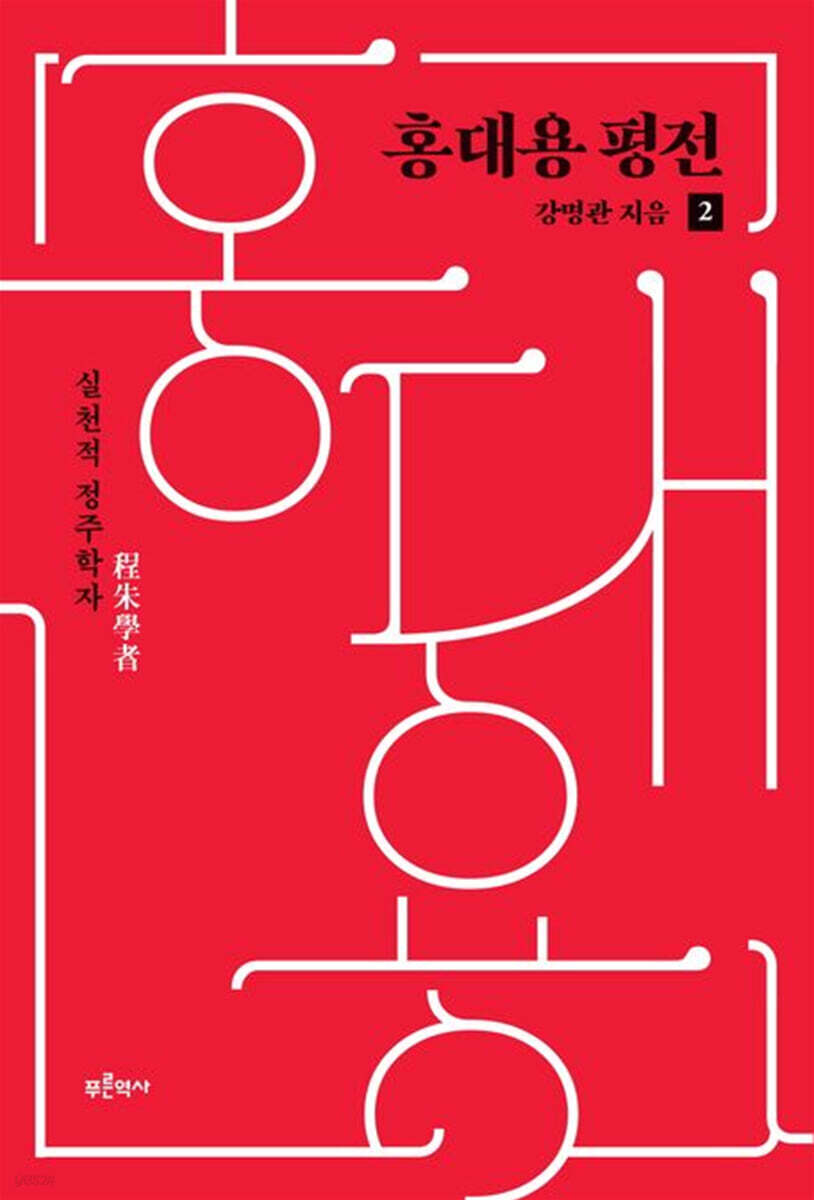
Hong Dae-yong Biography 2
 |
Description
Book Introduction
A social thinker who advocated the abolition of the caste system.
An internal nationalist who denies the theory of fire
Forget the myth surrounding Silhak scholar Damheon.
The definitive critical reading of the Damheon myth
Hong Dae-yong, who was active in the late Joseon Dynasty, is a representative Silhak scholar who is also counted as one of the six scholars who ‘shine in thought for 4,000 years.’
The author meticulously reads a vast body of relevant texts and presents a compelling challenge to this prevailing view.
By studying Hong Dae-yong's representative works, such as 『Uisanmundap』 and 『Imhagyeongryun』, as well as the letters he exchanged with Qing intellectuals in Beijing and contemporary Western mathematical and scientific works such as 『Surijeongon』, he succeeded in revealing Hong Dae-yong's true nature.
This book, which began writing the manuscript 16 years ago and took three years to edit, is approximately 5,500 pages long—in the meantime, new sources have come to light, adding approximately 1,000 pages—and is a masterpiece biography rarely seen in our publishing house just by its volume alone.
An internal nationalist who denies the theory of fire
Forget the myth surrounding Silhak scholar Damheon.
The definitive critical reading of the Damheon myth
Hong Dae-yong, who was active in the late Joseon Dynasty, is a representative Silhak scholar who is also counted as one of the six scholars who ‘shine in thought for 4,000 years.’
The author meticulously reads a vast body of relevant texts and presents a compelling challenge to this prevailing view.
By studying Hong Dae-yong's representative works, such as 『Uisanmundap』 and 『Imhagyeongryun』, as well as the letters he exchanged with Qing intellectuals in Beijing and contemporary Western mathematical and scientific works such as 『Surijeongon』, he succeeded in revealing Hong Dae-yong's true nature.
This book, which began writing the manuscript 16 years ago and took three years to edit, is approximately 5,500 pages long—in the meantime, new sources have come to light, adding approximately 1,000 pages—and is a masterpiece biography rarely seen in our publishing house just by its volume alone.
index
ㆍAt the beginning of the book
[01] Yeonam Group and first official position
Associating with the Yeonam Group | Letters from April 1770 to February 1774 |
February 1774: Started his official career | Damheon, a royal secretary | Questions and answers with Son Yu-ui and Deungsa Min |
Son Yu-ui's Answer | The Changes of the Two-Headed View
[02] A letter arrives from Hangzhou
Yu Geum's Journey to Beijing | News from Eomseong, which had been cut off for 10 years, arrives | Letter from Joo Moon-jo |
Letters with Eom | Letters exchanged with Deungsamin | Letters sent to Eom, Jumunjo, and others in 1779 |
A Letter from Yeonam | Becoming the Governor of Yeongcheon | The Last Letter to Son Yu-ui
[03] Astronomy and Mathematics
Western Astronomy, Mathematics, and the Gyeonghwa Family | Damheon's Study of Mathematics and Astronomy | Damheon's Mathematics - 《Annotated Commentary》 |
Accepting Trigonometry | Astronomical Calculations | Astronomical Observation Instruments | Music Theory | The Significance of Damheon's Mathematics and Astronomy
[04] The destination of Damheon’s thoughts, “Uisanmundap” and “Imhagyeongryun”
The final destination of Damheon's thought | The period and format of writing "Uisan Question and Answer" | The reason for writing "Uisan Question and Answer" |
Astronomy and Earth Science in Korean and Western Books: The "Uisan Question and Answer" | A Shift in Perspective, Theory of the Equalities of People |
Tiles, Celestial Bodies, and Matter | The Earth is Round, and It Rotates | A World Without a Center | The Coordination of Physics |
Humanity and History: The Denial of Fire Theory | A Controlled Utopia - "Imha Gyeongryun"
[05] Damheon's death and the uproar he caused
Damheon's Death | The Path Damheon Opened Is Now Blocked
Epilogue: Rethinking the "Damheon Myth"
ㆍNote
ㆍSearch
[01] Yeonam Group and first official position
Associating with the Yeonam Group | Letters from April 1770 to February 1774 |
February 1774: Started his official career | Damheon, a royal secretary | Questions and answers with Son Yu-ui and Deungsa Min |
Son Yu-ui's Answer | The Changes of the Two-Headed View
[02] A letter arrives from Hangzhou
Yu Geum's Journey to Beijing | News from Eomseong, which had been cut off for 10 years, arrives | Letter from Joo Moon-jo |
Letters with Eom | Letters exchanged with Deungsamin | Letters sent to Eom, Jumunjo, and others in 1779 |
A Letter from Yeonam | Becoming the Governor of Yeongcheon | The Last Letter to Son Yu-ui
[03] Astronomy and Mathematics
Western Astronomy, Mathematics, and the Gyeonghwa Family | Damheon's Study of Mathematics and Astronomy | Damheon's Mathematics - 《Annotated Commentary》 |
Accepting Trigonometry | Astronomical Calculations | Astronomical Observation Instruments | Music Theory | The Significance of Damheon's Mathematics and Astronomy
[04] The destination of Damheon’s thoughts, “Uisanmundap” and “Imhagyeongryun”
The final destination of Damheon's thought | The period and format of writing "Uisan Question and Answer" | The reason for writing "Uisan Question and Answer" |
Astronomy and Earth Science in Korean and Western Books: The "Uisan Question and Answer" | A Shift in Perspective, Theory of the Equalities of People |
Tiles, Celestial Bodies, and Matter | The Earth is Round, and It Rotates | A World Without a Center | The Coordination of Physics |
Humanity and History: The Denial of Fire Theory | A Controlled Utopia - "Imha Gyeongryun"
[05] Damheon's death and the uproar he caused
Damheon's Death | The Path Damheon Opened Is Now Blocked
Epilogue: Rethinking the "Damheon Myth"
ㆍNote
ㆍSearch
Into the book
From 1770 to 1774, for four years, Damheon began to associate in earnest with the so-called ‘Yeonam Group’, including Park Ji-won, Lee Deok-mu, Park Je-ga, Seo Sang-su, and Yu Deuk-gong, who lived near Baektap.
--- p.15
Park Jong-chae says that Yeonam's academic orientation was on practical studies such as welfare and economic specialties, and that Damheon's theories were the same.
The orientation toward practical learning can be understood in relation to the Gyeonghwa Sejok.… They attempted to correct the numerous problems of the Confucian aristocracy, and their will to correct them was expressed in the form of institutional reform programs.… Since Jeongjuhak also included practical issues, there is no conflict between ‘the study of utility and economic merit’ and Jeongjuhak.
However, apart from focusing on ethical issues, it only attempted to correct the problems that the four-legged system had exposed in the areas of ‘user benefits’ and ‘economic attractions.’
--- p.26
His astronomy was not based on observational figures and mathematics, but rather on the expansion of his imagination.
There is little evidence that he discussed astronomy, physics, or mathematics with anyone else.
--- p.27
It can be said that the views on economics between the Damheon and Yeonam groups were almost polar opposites.
Yeonam wrote “Hanminmyeongjeonui” (限民名田議) and argued that land ownership should be restricted by state power in order to resolve the land annexation by the wealthy. However, Damheon said that he knew nothing about reforming the land system other than the implementation of the Jeongjeon system and hoped that someone with specialized knowledge would study it.
--- p.30
Damheon was the one who criticized its unreality more than anyone else. … If Confucian morality is practiced in everyday life, it is the path that can lead to the way to heaven and the way of the world. Discussing only the concepts of Neo-Confucianism without grounding them in reality and life is unnecessary for beginners and can even be harmful. These were the frequent criticisms of Damheon, who pursued practical Confucianism.
--- p.110
Damheon said, “If Qin Shi Huang had not burned the miscellaneous books, the words of the Hundred Schools of Thought, which were of no use to the world, would have only served to distract people. What harm would have come from burning them?”
This is a scene that clearly reveals Damheon's straightforward and fundamentalist personality.
This statement is repeated later in the "Uisan Question and Answer".
It will also be possible to confirm that Damheon, who fiercely criticized the teachings, held the position that knowledge other than the truth of Jeongjuhak was unnecessary.
--- p.122
To overcome the criticism of the negative attributes of heresy, Damheon says that all thoughts are corrupt.
Just as there is a curse in heresy, there is also a curse in the actions that come from the public's designated thoughts of adults.
In other words, suspension also has its drawbacks.
--- p.151
The rigid, unpracticed, and orthodox Confucianism that I saw in Kim Jong-hu also became an opportunity to deeply contemplate the truth of heresy.
Another factor that can be considered is that the theory that the Earth is round, as argued in the "Questions and Answers of Uisan," gave rise to relativism.
In addition, the Yeonam he was connected with accepted relativism in the literary theory of the Gong'an faction.
Damheon was indifferent to literature, but his conversation with Yeonam probably led him to acknowledge a kind of value relativism.
--- p.155
In the concluding part of the "Uisan Question and Answer," Damheon denies the theory of fire.
He himself denied the differential theory of China and the West, which was one of the reasons that led him to go to Beijing.
The denial of the theory of fire in the "Uisan Question and Answer" was evaluated as a denial of Sinocentrism in the history of Korean thought and, furthermore, as the subjective establishment of nationalism.
In addition, some of the claims in “Imha Gyeongryun,” which contained national management theory or social thought, were interpreted as denying the caste system.
The main theme of evaluating Damheon's thought, which can be summarized as the denial of the theory of land and fire and the abolition of the class system, clearly converges into one.
It is ‘spontaneous modernity’.
In Damheon's life and thoughts, people in the 20th century read the developmental dynamics of Korean history as it progressed toward modernity.
However, it is questionable whether this reading is the result of a strict reading of Damheon's life and the texts he left behind.
--- p.229
“Hongjun’s mind is the most precise when it comes to studying constellations by hanging them on the ceiling of his study.” In other words, Damheon was absorbed in studying astronomy by hanging pictures of constellations on the ceiling of his study.
--- p.243
Mathematics in Joseon was practical mathematics, and the Confucian system left it to the group of accountants, who were technically skilled.
Damheon had to make an excuse for his study of mathematics, even though he was a commoner.
He cites as justification the fact that Confucius said, “Accounting must be handled properly” when he became a ‘commissioner’ and that mathematics was included as one of the six arts under Confucius.
Damheon took it as evidence that “the ancients put effort into practicality.”
--- p.249
《Annotated Commentary》 was a book intended to serve the practical purposes of the times and society in which Damheon lived.
For this reason, 《Annotated Commentary on Suyong》 cannot be a great mathematical book containing any new discoveries in the history of mathematics.… Most of the mathematics in 《Annotated Commentary on Suyong》 is merely the result of editing by citing traditional Chinese mathematics and some Korean mathematics.
--- p.251
The armillary sphere he created was not designed for the precise purpose of observing celestial bodies.
Since the astronomical observatory had already been established, using it to observe the sky was no different from observing with the naked eye.
The fact that no new celestial bodies or astronomical phenomena were discovered through his observations is proof of this… Damheon’s astronomy… The greatest significance is that Damheon considered the celestial bodies as three-dimensional, physical, and geometrical spaces that could be calculated.
Traditional Chinese and Korean astronomy did not consider the Earth, the Sun, the Moon, the planets, and other celestial bodies as physical entities in measurable space.
--- p.312
《Uisan Q&A》 is widely known for its statements denying the theory of the rotation of the Earth, the theory of the infinity of the universe, and even the Huai view that “there is no China or barbarians.” It is evaluated as the ‘Copernicus of Joseon’ that ended the pre-modern view of the universe.
Moreover, the denial of the theory of fire was read as a signal of inherent nationalism that denied the Sino-centric international order of East Asia.
On the other hand, certain parts of the “Imha Gyeongryun” were also understood as advocating for the dismantling of the pre-modern class system.
In short, Damheon's theory of the earth's source, his theory of the infinity of the universe, his denial of the Hwaigwan, and his mention of the caste system were all interpreted as significant signs of 'internal modernity' in the history of Joseon's thought.
--- p.316
The theory of the round Earth: In response to the argument that if the Earth were round, people could not live in the antipodes, the theory is that the Earth floats in infinite space, so there can be no up and down or four directions, and therefore, there can be no falling from above (the theory of the infinite universe).
It is claimed that any place on Earth can be the center.
--- p.325
Another argument to refute the antipodal theory is that when the Earth rotates, 'energy' is drawn toward the surface of the Earth, causing humans and objects to move toward the center of the Earth (the theory of rotation of the Earth).
--- p.326
《Uisanmundap》 is the first comprehensive book on earth science in Joseon.
Although the geophysics of the 《Uisan Question and Answer》 is not unaware of the 《Juja Eoryu》 and the 《Neo-ni Daejeon》, it is not thought that the existence of these two texts drove the geophysics of the 《Uisan Question and Answer》.
--- p.331
Damheon's geocentric theory did not have the same great impact on the Joseon intellectual community as Copernicus' heliocentric theory.
Although 《Uisanmundap》 was never published and few manuscripts remain, the legend of Jijeon became widely known through Yeonam.
--- p.369
If the Qing Dynasty embodies the universality of Chinese civilization, then the Qing Dynasty will soon become China, and if Joseon embodies it, then Joseon will soon become China.
In the past, Joseon's 'small-scale transformation' was possible through this logic.
If Joseon could be Chinese, then Qing could also be Chinese.
Because both Joseon and Qing were originally traitors.
Damheon's denial of the theory of fire is a denial in this sense.
--- p.404
Denying the theory of fire... meant denying the very establishment of the relationship between center and periphery, not re-establishing Joseon as the center.
Therefore, Damheon's statement that there is no center should be understood in a limited way.
It is by no means appropriate to derive ‘national subjectivity’ from this.
--- p.405
As he moved around a lot as a local official, it is understandable that he would have shown a serious awareness of the contradictions in the land system, but nowhere in the Damheonseo does he write about his experiences as a local official.
This is in stark contrast to Yeonam's detailed argument for the theory of land limitation in his "Hanmin Myeongjeonui" based on his experience as a local official.
--- p.410
Damheon argues that all of the land and palace buildings of the Naesusa, which were the king's private property, should be abolished and transferred to the jurisdiction of the Ministry of Taxation. He also criticizes the two offices for monopolizing the power of impeachment, arguing that it is unreasonable for a small number of officials, only about ten, to monopolize the power of impeachment when they cannot fully understand the specialized fields of each government department.
--- p.414
Damheon argues that people should be given appropriate jobs according to their talents and abilities.
We demand that everyone, including people with disabilities, have jobs.
Those who are obsessed with knowledge should be punished by the state and expelled from their hometown.
Giving jobs to disabled people is not because we care about them, but because there should be no one who is not educated.
The distribution of jobs according to talent and ability has often been interpreted as the abolition of the caste system.
--- p.417
Damheon left no thoughts at all about the slave system.
Not only in “Imha Gyeongryun,” but also throughout “Damheonseo,” there is almost no mention of slaves in Joseon, and the slave system is never raised as an issue.
--- p.421
In principle, the people of the ideal society envisioned by Damheon do not have the freedom to move their residence.
In unavoidable cases, relocation of residence is permitted, but this too is done under strict government control, that is, state control.
Farmers can only move their residence and receive farmland distribution with the permission of the state.
Anyone who arbitrarily moves their residence will be punished, and those responsible will also be punished.
--- p.432
《Lee Jae-nan-go》 states that Damheon used 500 seok of the 1,000 seok of Jinhyulgok for the original purpose of Jinhyulgok, and lent the remaining 500 seok to the private sector, counting them as 1,000 seok.
Instead of using all 1,000 seok, he embezzled 500 seok for personal use and lent it out to the poor at 100 percent interest.
--- p.442
After Damheon died, the astronomy and mathematics he had studied were quickly forgotten, and the astronomical instruments of Nongsugak began to be scattered.
According to Hwang Yun-seok's records, Hong Dae-yong's nephew Hong Seo said that Hong Won sold the second volume of "Yulryeokyeonwon" and the second volume of "Yeoksanggoseong" that Hong Dae-yong had owned to a powerful person for 50 nyang between the spring and summer of 1786, and that all the books in the family were taken by his eldest nephew in Seoul.
--- p.15
Park Jong-chae says that Yeonam's academic orientation was on practical studies such as welfare and economic specialties, and that Damheon's theories were the same.
The orientation toward practical learning can be understood in relation to the Gyeonghwa Sejok.… They attempted to correct the numerous problems of the Confucian aristocracy, and their will to correct them was expressed in the form of institutional reform programs.… Since Jeongjuhak also included practical issues, there is no conflict between ‘the study of utility and economic merit’ and Jeongjuhak.
However, apart from focusing on ethical issues, it only attempted to correct the problems that the four-legged system had exposed in the areas of ‘user benefits’ and ‘economic attractions.’
--- p.26
His astronomy was not based on observational figures and mathematics, but rather on the expansion of his imagination.
There is little evidence that he discussed astronomy, physics, or mathematics with anyone else.
--- p.27
It can be said that the views on economics between the Damheon and Yeonam groups were almost polar opposites.
Yeonam wrote “Hanminmyeongjeonui” (限民名田議) and argued that land ownership should be restricted by state power in order to resolve the land annexation by the wealthy. However, Damheon said that he knew nothing about reforming the land system other than the implementation of the Jeongjeon system and hoped that someone with specialized knowledge would study it.
--- p.30
Damheon was the one who criticized its unreality more than anyone else. … If Confucian morality is practiced in everyday life, it is the path that can lead to the way to heaven and the way of the world. Discussing only the concepts of Neo-Confucianism without grounding them in reality and life is unnecessary for beginners and can even be harmful. These were the frequent criticisms of Damheon, who pursued practical Confucianism.
--- p.110
Damheon said, “If Qin Shi Huang had not burned the miscellaneous books, the words of the Hundred Schools of Thought, which were of no use to the world, would have only served to distract people. What harm would have come from burning them?”
This is a scene that clearly reveals Damheon's straightforward and fundamentalist personality.
This statement is repeated later in the "Uisan Question and Answer".
It will also be possible to confirm that Damheon, who fiercely criticized the teachings, held the position that knowledge other than the truth of Jeongjuhak was unnecessary.
--- p.122
To overcome the criticism of the negative attributes of heresy, Damheon says that all thoughts are corrupt.
Just as there is a curse in heresy, there is also a curse in the actions that come from the public's designated thoughts of adults.
In other words, suspension also has its drawbacks.
--- p.151
The rigid, unpracticed, and orthodox Confucianism that I saw in Kim Jong-hu also became an opportunity to deeply contemplate the truth of heresy.
Another factor that can be considered is that the theory that the Earth is round, as argued in the "Questions and Answers of Uisan," gave rise to relativism.
In addition, the Yeonam he was connected with accepted relativism in the literary theory of the Gong'an faction.
Damheon was indifferent to literature, but his conversation with Yeonam probably led him to acknowledge a kind of value relativism.
--- p.155
In the concluding part of the "Uisan Question and Answer," Damheon denies the theory of fire.
He himself denied the differential theory of China and the West, which was one of the reasons that led him to go to Beijing.
The denial of the theory of fire in the "Uisan Question and Answer" was evaluated as a denial of Sinocentrism in the history of Korean thought and, furthermore, as the subjective establishment of nationalism.
In addition, some of the claims in “Imha Gyeongryun,” which contained national management theory or social thought, were interpreted as denying the caste system.
The main theme of evaluating Damheon's thought, which can be summarized as the denial of the theory of land and fire and the abolition of the class system, clearly converges into one.
It is ‘spontaneous modernity’.
In Damheon's life and thoughts, people in the 20th century read the developmental dynamics of Korean history as it progressed toward modernity.
However, it is questionable whether this reading is the result of a strict reading of Damheon's life and the texts he left behind.
--- p.229
“Hongjun’s mind is the most precise when it comes to studying constellations by hanging them on the ceiling of his study.” In other words, Damheon was absorbed in studying astronomy by hanging pictures of constellations on the ceiling of his study.
--- p.243
Mathematics in Joseon was practical mathematics, and the Confucian system left it to the group of accountants, who were technically skilled.
Damheon had to make an excuse for his study of mathematics, even though he was a commoner.
He cites as justification the fact that Confucius said, “Accounting must be handled properly” when he became a ‘commissioner’ and that mathematics was included as one of the six arts under Confucius.
Damheon took it as evidence that “the ancients put effort into practicality.”
--- p.249
《Annotated Commentary》 was a book intended to serve the practical purposes of the times and society in which Damheon lived.
For this reason, 《Annotated Commentary on Suyong》 cannot be a great mathematical book containing any new discoveries in the history of mathematics.… Most of the mathematics in 《Annotated Commentary on Suyong》 is merely the result of editing by citing traditional Chinese mathematics and some Korean mathematics.
--- p.251
The armillary sphere he created was not designed for the precise purpose of observing celestial bodies.
Since the astronomical observatory had already been established, using it to observe the sky was no different from observing with the naked eye.
The fact that no new celestial bodies or astronomical phenomena were discovered through his observations is proof of this… Damheon’s astronomy… The greatest significance is that Damheon considered the celestial bodies as three-dimensional, physical, and geometrical spaces that could be calculated.
Traditional Chinese and Korean astronomy did not consider the Earth, the Sun, the Moon, the planets, and other celestial bodies as physical entities in measurable space.
--- p.312
《Uisan Q&A》 is widely known for its statements denying the theory of the rotation of the Earth, the theory of the infinity of the universe, and even the Huai view that “there is no China or barbarians.” It is evaluated as the ‘Copernicus of Joseon’ that ended the pre-modern view of the universe.
Moreover, the denial of the theory of fire was read as a signal of inherent nationalism that denied the Sino-centric international order of East Asia.
On the other hand, certain parts of the “Imha Gyeongryun” were also understood as advocating for the dismantling of the pre-modern class system.
In short, Damheon's theory of the earth's source, his theory of the infinity of the universe, his denial of the Hwaigwan, and his mention of the caste system were all interpreted as significant signs of 'internal modernity' in the history of Joseon's thought.
--- p.316
The theory of the round Earth: In response to the argument that if the Earth were round, people could not live in the antipodes, the theory is that the Earth floats in infinite space, so there can be no up and down or four directions, and therefore, there can be no falling from above (the theory of the infinite universe).
It is claimed that any place on Earth can be the center.
--- p.325
Another argument to refute the antipodal theory is that when the Earth rotates, 'energy' is drawn toward the surface of the Earth, causing humans and objects to move toward the center of the Earth (the theory of rotation of the Earth).
--- p.326
《Uisanmundap》 is the first comprehensive book on earth science in Joseon.
Although the geophysics of the 《Uisan Question and Answer》 is not unaware of the 《Juja Eoryu》 and the 《Neo-ni Daejeon》, it is not thought that the existence of these two texts drove the geophysics of the 《Uisan Question and Answer》.
--- p.331
Damheon's geocentric theory did not have the same great impact on the Joseon intellectual community as Copernicus' heliocentric theory.
Although 《Uisanmundap》 was never published and few manuscripts remain, the legend of Jijeon became widely known through Yeonam.
--- p.369
If the Qing Dynasty embodies the universality of Chinese civilization, then the Qing Dynasty will soon become China, and if Joseon embodies it, then Joseon will soon become China.
In the past, Joseon's 'small-scale transformation' was possible through this logic.
If Joseon could be Chinese, then Qing could also be Chinese.
Because both Joseon and Qing were originally traitors.
Damheon's denial of the theory of fire is a denial in this sense.
--- p.404
Denying the theory of fire... meant denying the very establishment of the relationship between center and periphery, not re-establishing Joseon as the center.
Therefore, Damheon's statement that there is no center should be understood in a limited way.
It is by no means appropriate to derive ‘national subjectivity’ from this.
--- p.405
As he moved around a lot as a local official, it is understandable that he would have shown a serious awareness of the contradictions in the land system, but nowhere in the Damheonseo does he write about his experiences as a local official.
This is in stark contrast to Yeonam's detailed argument for the theory of land limitation in his "Hanmin Myeongjeonui" based on his experience as a local official.
--- p.410
Damheon argues that all of the land and palace buildings of the Naesusa, which were the king's private property, should be abolished and transferred to the jurisdiction of the Ministry of Taxation. He also criticizes the two offices for monopolizing the power of impeachment, arguing that it is unreasonable for a small number of officials, only about ten, to monopolize the power of impeachment when they cannot fully understand the specialized fields of each government department.
--- p.414
Damheon argues that people should be given appropriate jobs according to their talents and abilities.
We demand that everyone, including people with disabilities, have jobs.
Those who are obsessed with knowledge should be punished by the state and expelled from their hometown.
Giving jobs to disabled people is not because we care about them, but because there should be no one who is not educated.
The distribution of jobs according to talent and ability has often been interpreted as the abolition of the caste system.
--- p.417
Damheon left no thoughts at all about the slave system.
Not only in “Imha Gyeongryun,” but also throughout “Damheonseo,” there is almost no mention of slaves in Joseon, and the slave system is never raised as an issue.
--- p.421
In principle, the people of the ideal society envisioned by Damheon do not have the freedom to move their residence.
In unavoidable cases, relocation of residence is permitted, but this too is done under strict government control, that is, state control.
Farmers can only move their residence and receive farmland distribution with the permission of the state.
Anyone who arbitrarily moves their residence will be punished, and those responsible will also be punished.
--- p.432
《Lee Jae-nan-go》 states that Damheon used 500 seok of the 1,000 seok of Jinhyulgok for the original purpose of Jinhyulgok, and lent the remaining 500 seok to the private sector, counting them as 1,000 seok.
Instead of using all 1,000 seok, he embezzled 500 seok for personal use and lent it out to the poor at 100 percent interest.
--- p.442
After Damheon died, the astronomy and mathematics he had studied were quickly forgotten, and the astronomical instruments of Nongsugak began to be scattered.
According to Hwang Yun-seok's records, Hong Dae-yong's nephew Hong Seo said that Hong Won sold the second volume of "Yulryeokyeonwon" and the second volume of "Yeoksanggoseong" that Hong Dae-yong had owned to a powerful person for 50 nyang between the spring and summer of 1786, and that all the books in the family were taken by his eldest nephew in Seoul.
--- p.445
Publisher's Review
A Model of Biography: Restoring a Comprehensive and Three-Dimensional Portrait
Being a 'masterpiece' is not the only virtue of this book.
By comprehensively examining the achievements of Hong Dae-yong, who had been understood in segments such as classics, historical criticism, astronomy and natural science, mathematics, musicology, and Silhak, it was revealed that he was not a ‘Silhak scholar’ as previously known, but a thorough Zhu Xi scholar who even evaluated the ‘Burning of Books’ of Qin Shi Huang as legitimate.
In addition, the book adds depth to the understanding of Hong Dae-yong by portraying his life in a three-dimensional way, such as his family being a wealthy, powerful family, his wanderings during his teenage years, his critical questions raised about his teacher Kim Won-hang, the corruption scandal involving his father, Hong Yeok, and his level of mathematics before going to Beijing.
There is no need to say more about the fact that I even looked through middle and high school math books to understand Hong Dae-yong's math book, "Annotated Commentary."
The author's writing style, which delves deeply and examines broadly, is so profound that even fellow researchers would find it difficult to find fault with it.
In this way, Hong Dae-yong succeeded in proving that he never denied the truth of Zhu Xi's teachings, but was a 'practical Zhu Xi scholar' who criticized Zhu Xi's blind faith in Zhu Xi, which neglected practice.
'Joseon's Copernicus' with clear limitations
Hong Dae-yong is often evaluated as the ‘Copernicus of Joseon’ who destroyed the pre-modern view of the universe.
This is because he proposed the theory of Earth's rotation and the theory of the infinity of the universe, which states that the Earth rotates on its own.
However, the author points out the limitations of Hong Dae-yong's natural science, as it is not a 'science' based on observation and mathematics, but is composed of declarative imagination based on the theory of Gi of Jeongjuhak.
He even brought up the traditional theory of synchronous communication, such as the theory of logistics and insignificance, and even brazenly made the absurd claim that one could travel between celestial bodies through Taoist training.
The armillary sphere that Damheon made was not an observation instrument but a model of celestial bodies, and there are also cases where he devoted himself to the study of astronomy by hanging pictures of constellations on the ceiling of his study.
Additionally, the theory of rotation only talked about the Earth's rotation and was silent about its revolution, so it is said to be different from Copernicus' heliocentric theory, which broke the geocentric theory that the Earth is the center of the universe.
Above all, because Hong Dae-yong's 『Uisan Question and Answer』, which contained the theory of the Earth's rotation, was not printed and read, its social influence was minimal.
The theory of dismantling the caste system that is separate from the people
The author also argues that the claim that Hong Dae-yong was a social thinker who emphasized equality, including the abolition of the caste system, is a 'myth.'
First of all, it is difficult to find any mention of Min in all the writings he left behind.
The assessment that he “opposed social class and status discrimination” (Encyclopedia of Korean Culture) originated from the passage in “Imha Gyeongryun” where he criticized the “leisurely eating” literati, but this is a misreading.
Damheon himself was a landowner who owned slaves and worked as a government official.
Therefore, the statement that the children of talented and learned farmers or merchants could rise to high positions in the government and that it was okay for the children of noble families to become servants in government offices was seen as rhetoric lacking in truth or practicality.
Rather than talking about the social contradictions in which the people are exploited, he points out that when he was the governor of Yeongcheon, he embezzled the relief grain and lent it to the people in an attempt to double the amount.
Moreover, the ideal society he envisioned was a controlled society in which farmers could only move their residence and receive farmland distribution with the permission of the state.
The author claims that, unlike Dasan Jeong Yak-yong or Yeonam Park Ji-won, his 'reform measures' contained in 'Imha Gyeongryun', such as the land ownership system, are not specific and fragmentary.
The real reason and reality of the denial of the fire theory
In Joseon, the 'Hwa-iron' was a concept that contained a sense of loyalty to the Ming Dynasty, which sent reinforcements during the Imjin War.
However, Hong Dae-yong's Chinese friends, such as Eom Seong and Ban Jeong-gyun, whom he had cherished throughout his life after going to Beijing, had already recognized the Qing regime.
On his way back home, Damheon met Huiwonoe and criticized Damheon's attitude of trying to distinguish between fire and evil by bringing up clothing with the simple logic that everything changes.
Therefore, the author interprets that Damheon had a personal motive for asserting in his later work, 『Uisanmundap』, that the distinction between fire and water was merely a fiction.
It is explained that in the debate that took place after returning to the country, when Kim Jong-hu branded Eom Seong and others as base people who wanted to serve in a barbarian court without any sense of loyalty to the Ming Dynasty, Damheon, who valued his relationship with them, argued that there was no distinction between peace and harmony in order to refute this.
This is based on the theory of the roundness of the Earth, which states that the Earth is round and therefore China is not the center, but the author argues that it is unreasonable to interpret this simply as ‘national subjectivity.’
The Hong Dae-yong portrayed by the author is quite different from the Hong Dae-yong we have learned from ‘textbooks.’
However, the mainstream interpretation of Hong Dae-yong's achievements and significance is that he is a projection of the "sprout of indigenous modernization" that Koreans have longed for since the 20th century.
It is not easy to read this book, which is over 1,400 pages long, but it is not an exaggeration to say that it is the beginning and end of 'Damheonhak' - if there is one.
Additionally, if you want to see history straight, it will not be a meaningless journey.
Being a 'masterpiece' is not the only virtue of this book.
By comprehensively examining the achievements of Hong Dae-yong, who had been understood in segments such as classics, historical criticism, astronomy and natural science, mathematics, musicology, and Silhak, it was revealed that he was not a ‘Silhak scholar’ as previously known, but a thorough Zhu Xi scholar who even evaluated the ‘Burning of Books’ of Qin Shi Huang as legitimate.
In addition, the book adds depth to the understanding of Hong Dae-yong by portraying his life in a three-dimensional way, such as his family being a wealthy, powerful family, his wanderings during his teenage years, his critical questions raised about his teacher Kim Won-hang, the corruption scandal involving his father, Hong Yeok, and his level of mathematics before going to Beijing.
There is no need to say more about the fact that I even looked through middle and high school math books to understand Hong Dae-yong's math book, "Annotated Commentary."
The author's writing style, which delves deeply and examines broadly, is so profound that even fellow researchers would find it difficult to find fault with it.
In this way, Hong Dae-yong succeeded in proving that he never denied the truth of Zhu Xi's teachings, but was a 'practical Zhu Xi scholar' who criticized Zhu Xi's blind faith in Zhu Xi, which neglected practice.
'Joseon's Copernicus' with clear limitations
Hong Dae-yong is often evaluated as the ‘Copernicus of Joseon’ who destroyed the pre-modern view of the universe.
This is because he proposed the theory of Earth's rotation and the theory of the infinity of the universe, which states that the Earth rotates on its own.
However, the author points out the limitations of Hong Dae-yong's natural science, as it is not a 'science' based on observation and mathematics, but is composed of declarative imagination based on the theory of Gi of Jeongjuhak.
He even brought up the traditional theory of synchronous communication, such as the theory of logistics and insignificance, and even brazenly made the absurd claim that one could travel between celestial bodies through Taoist training.
The armillary sphere that Damheon made was not an observation instrument but a model of celestial bodies, and there are also cases where he devoted himself to the study of astronomy by hanging pictures of constellations on the ceiling of his study.
Additionally, the theory of rotation only talked about the Earth's rotation and was silent about its revolution, so it is said to be different from Copernicus' heliocentric theory, which broke the geocentric theory that the Earth is the center of the universe.
Above all, because Hong Dae-yong's 『Uisan Question and Answer』, which contained the theory of the Earth's rotation, was not printed and read, its social influence was minimal.
The theory of dismantling the caste system that is separate from the people
The author also argues that the claim that Hong Dae-yong was a social thinker who emphasized equality, including the abolition of the caste system, is a 'myth.'
First of all, it is difficult to find any mention of Min in all the writings he left behind.
The assessment that he “opposed social class and status discrimination” (Encyclopedia of Korean Culture) originated from the passage in “Imha Gyeongryun” where he criticized the “leisurely eating” literati, but this is a misreading.
Damheon himself was a landowner who owned slaves and worked as a government official.
Therefore, the statement that the children of talented and learned farmers or merchants could rise to high positions in the government and that it was okay for the children of noble families to become servants in government offices was seen as rhetoric lacking in truth or practicality.
Rather than talking about the social contradictions in which the people are exploited, he points out that when he was the governor of Yeongcheon, he embezzled the relief grain and lent it to the people in an attempt to double the amount.
Moreover, the ideal society he envisioned was a controlled society in which farmers could only move their residence and receive farmland distribution with the permission of the state.
The author claims that, unlike Dasan Jeong Yak-yong or Yeonam Park Ji-won, his 'reform measures' contained in 'Imha Gyeongryun', such as the land ownership system, are not specific and fragmentary.
The real reason and reality of the denial of the fire theory
In Joseon, the 'Hwa-iron' was a concept that contained a sense of loyalty to the Ming Dynasty, which sent reinforcements during the Imjin War.
However, Hong Dae-yong's Chinese friends, such as Eom Seong and Ban Jeong-gyun, whom he had cherished throughout his life after going to Beijing, had already recognized the Qing regime.
On his way back home, Damheon met Huiwonoe and criticized Damheon's attitude of trying to distinguish between fire and evil by bringing up clothing with the simple logic that everything changes.
Therefore, the author interprets that Damheon had a personal motive for asserting in his later work, 『Uisanmundap』, that the distinction between fire and water was merely a fiction.
It is explained that in the debate that took place after returning to the country, when Kim Jong-hu branded Eom Seong and others as base people who wanted to serve in a barbarian court without any sense of loyalty to the Ming Dynasty, Damheon, who valued his relationship with them, argued that there was no distinction between peace and harmony in order to refute this.
This is based on the theory of the roundness of the Earth, which states that the Earth is round and therefore China is not the center, but the author argues that it is unreasonable to interpret this simply as ‘national subjectivity.’
The Hong Dae-yong portrayed by the author is quite different from the Hong Dae-yong we have learned from ‘textbooks.’
However, the mainstream interpretation of Hong Dae-yong's achievements and significance is that he is a projection of the "sprout of indigenous modernization" that Koreans have longed for since the 20th century.
It is not easy to read this book, which is over 1,400 pages long, but it is not an exaggeration to say that it is the beginning and end of 'Damheonhak' - if there is one.
Additionally, if you want to see history straight, it will not be a meaningless journey.
GOODS SPECIFICS
- Date of issue: October 29, 2025
- Page count, weight, size: 584 pages | 152*224*35mm
- ISBN13: 9791156123071
- ISBN10: 1156123070
You may also like
카테고리
korean


korean

![GQ KOREA Mark (Monthly): December [2025]](http://librairie.coreenne.fr/cdn/shop/files/8ef265dbbfbf186523ed75ba7319009d.jpg?v=1765340328&width=3840)


