

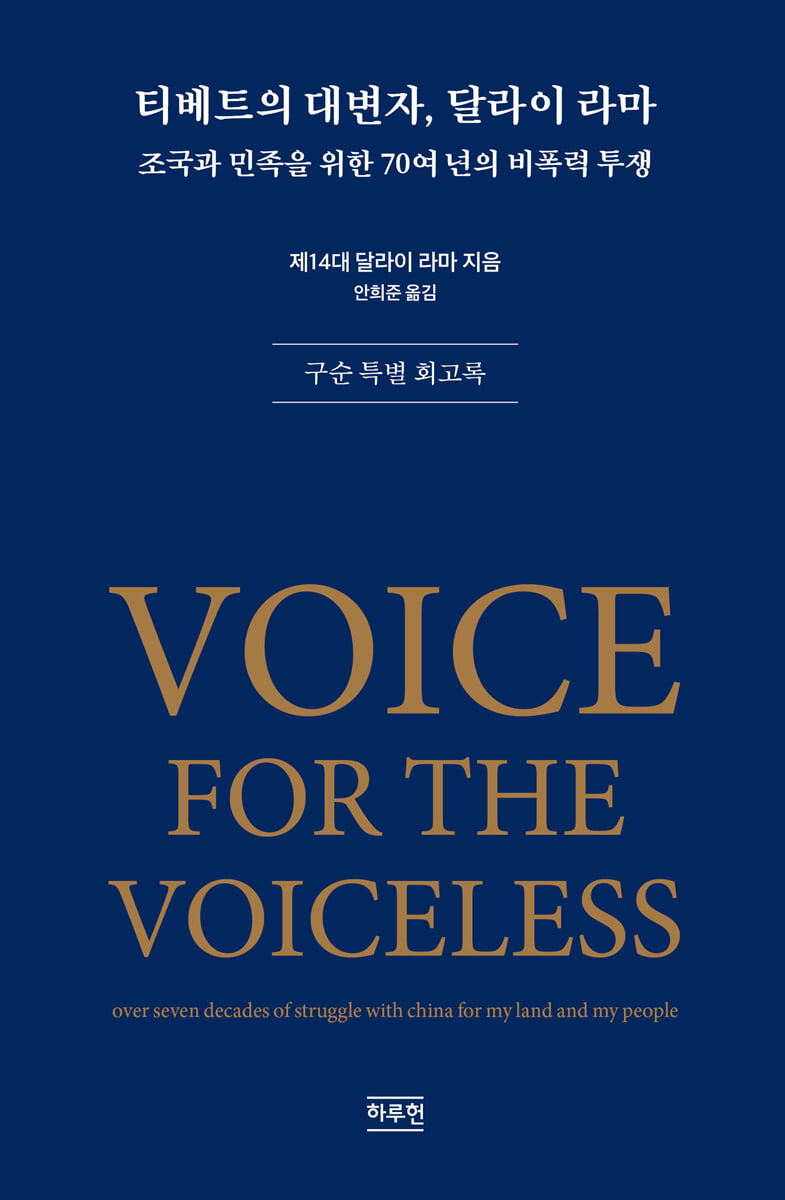
The Dalai Lama, the spokesman for Tibet
 |
Description
Book Introduction
A journey of human dignity and peace preserved amid despair and suffering
A voice for those forced into silence, from a leader who has lived his entire life with nonviolence and compassion.
He was invaded by China at the age of sixteen and fled to India at the age of twenty-five. He maintained his human dignity even in suffering for 75 years.
This book is the story of one man who responded with peace in a time of despair, and a record of a soul searching for a lost homeland and hope.
A voice for those forced into silence, from a leader who has lived his entire life with nonviolence and compassion.
He was invaded by China at the age of sixteen and fled to India at the age of twenty-five. He maintained his human dignity even in suffering for 75 years.
This book is the story of one man who responded with peace in a time of despair, and a record of a soul searching for a lost homeland and hope.
index
Korean edition preface
West Gate
Introduction
Chapter 1: The Chinese Invasion and Our New Ruler
Chapter 2: Meeting with Chairman Mao Zedong
Chapter 3: Visit to India
Chapter 4 Exile
Chapter 5: Geopolitical Dynamics
Chapter 6: The Ruins of the Fatherland and the Construction of a Land of Exile
Chapter 7: Prelude to Dialogue
Chapter 8: Help from the International Community
Chapter 9: The Aftermath of the Tiananmen Incident
Chapter 10: Useful Practices for Coping with Pain
Chapter 11: Closing the 20th Century
Chapter 12: Final Dialogue
Chapter 13: Evaluation of the Last Conversation
Chapter 14: A String of Hope
Chapter 15: Tibet's Present and Future
Chapter 16 Appeal
Acknowledgements
Appendix 1 Tibetan Pharmacist
Appendix 2: Treaty of Chiang-Qing between Tibet and China (821-822)
Appendix 3: Letters to Chinese Leaders Deng Xiaoping and Jiang Zemin
Appendix 4: Memorandum on Genuine Autonomy for the Tibetan People
Appendix 5: Appendix to the "Memorandum on Genuine Autonomy for the Tibetan People"
main
References
index
West Gate
Introduction
Chapter 1: The Chinese Invasion and Our New Ruler
Chapter 2: Meeting with Chairman Mao Zedong
Chapter 3: Visit to India
Chapter 4 Exile
Chapter 5: Geopolitical Dynamics
Chapter 6: The Ruins of the Fatherland and the Construction of a Land of Exile
Chapter 7: Prelude to Dialogue
Chapter 8: Help from the International Community
Chapter 9: The Aftermath of the Tiananmen Incident
Chapter 10: Useful Practices for Coping with Pain
Chapter 11: Closing the 20th Century
Chapter 12: Final Dialogue
Chapter 13: Evaluation of the Last Conversation
Chapter 14: A String of Hope
Chapter 15: Tibet's Present and Future
Chapter 16 Appeal
Acknowledgements
Appendix 1 Tibetan Pharmacist
Appendix 2: Treaty of Chiang-Qing between Tibet and China (821-822)
Appendix 3: Letters to Chinese Leaders Deng Xiaoping and Jiang Zemin
Appendix 4: Memorandum on Genuine Autonomy for the Tibetan People
Appendix 5: Appendix to the "Memorandum on Genuine Autonomy for the Tibetan People"
main
References
index
Into the book
On the night of March 17, 1959, I took off my monk's robes, put on a chuba, and passed through the main gate of Norbulingka Palace, cutting through the heavy darkness and freezing night air.
The time of exile that began at that moment has now passed over 60 years.
--- p.8
The Tibet issue was the most difficult of all, as it was the first task of my life and the one for which I had the deepest responsibility.
I constantly tried my best to find a breakthrough in negotiations with the Chinese Communist Party, which invaded Tibet in 1950.
--- p.13
“The world’s attention is focused on the Korean Peninsula, where the international coalition is fighting against North Korean aggression.
But something similar is happening in faraway Tibet, yet it goes completely unnoticed.”
--- p.22
I sent three letters to Chairman Mao, and I made sure that the third letter reached his hands.
But in the end, no answer came back.
Even the last hopes I had for Chairman Mao and the Communist Party leadership were shattered.
All the promises they made in the agreements they forced upon us turned out to be of no real significance.
--- p.42
The military fortification of the Tibetan Plateau, the ongoing security standoff between India and China over 3,000 kilometers of border disputed by sovereignty over some sections, the ecological destruction of the plateau due to deforestation and extensive mining, and the irresponsible management of the water sources of Asia's major rivers, upon which the livelihoods of hundreds of millions depend – all these factors make China's invasion of Tibet not just a tragedy for the Tibetan people, but a catastrophic disaster for all of humanity.
This is a tragedy of unprecedented historical proportions, and its devastating effects will last for centuries.
--- p.79
In the early 1970s, after much reflection on the nature of our struggle and the best way forward, I came to some important realizations.
One of them was that if we persisted in our goal of complete independence for Tibet, we might have to consider a long-term armed struggle against communist China, a choice that was not only unrealistic but also utterly self-destructive.
(Martial law was declared in Beijing and about 300,000 troops were deployed in the city center.
As tensions rose and this dramatic event was broadcast live around the world, I felt compelled to express my solidarity with the students and their aspirations.
People around me advised that we should refrain from expressing solidarity so as not to provoke Beijing, as the very entity with which we are attempting to negotiate is Beijing.
… … but if I remain silent now, I will lose the moral legitimacy to speak out about freedom and democracy in the future,” he said.
--- p.126~127
I remain convinced that actions rooted in hatred, no matter how noble the cause, destroy the foundation for sustainable solutions.
Buddhism has a special teaching that we should regard those who torment us as our teachers of practice.
Whatever their intentions, they offer us opportunities to practice patience and compassion.
Our enemies are our most precious teachers.
--- p.144
As citizens of an occupied country, we Tibetans have the right to demand independence, but for the reasons explained above, I believe that we Tibetans can also find a way to live within the family of the People's Republic of China, provided our rights and dignity as a people with a unique language, culture, religion, and historical heritage are truly guaranteed.
--- p.198
People often ask me if there will be a 15th Dalai Lama to succeed me.
Since the early 1960s, I have stated that the survival of the Dalai Lama institution is a matter for the Tibetan people to decide for themselves.
… … In 2011, I convened a conference with leaders from all the major sects in Tibet.
After that meeting, I issued a formal statement in which I stated that in the year I turned 90, I would consult with the great monks of each sect as well as the Tibetan people.
--- p.213
Our struggle for freedom will continue.
Totalitarianism is an inherently unstable system and therefore never lasts long.
Time is on the side of both Tibetans and Chinese who long for freedom.
What we need is perseverance, unwavering determination and unity, and courage born of a clear purpose.
The time of exile that began at that moment has now passed over 60 years.
--- p.8
The Tibet issue was the most difficult of all, as it was the first task of my life and the one for which I had the deepest responsibility.
I constantly tried my best to find a breakthrough in negotiations with the Chinese Communist Party, which invaded Tibet in 1950.
--- p.13
“The world’s attention is focused on the Korean Peninsula, where the international coalition is fighting against North Korean aggression.
But something similar is happening in faraway Tibet, yet it goes completely unnoticed.”
--- p.22
I sent three letters to Chairman Mao, and I made sure that the third letter reached his hands.
But in the end, no answer came back.
Even the last hopes I had for Chairman Mao and the Communist Party leadership were shattered.
All the promises they made in the agreements they forced upon us turned out to be of no real significance.
--- p.42
The military fortification of the Tibetan Plateau, the ongoing security standoff between India and China over 3,000 kilometers of border disputed by sovereignty over some sections, the ecological destruction of the plateau due to deforestation and extensive mining, and the irresponsible management of the water sources of Asia's major rivers, upon which the livelihoods of hundreds of millions depend – all these factors make China's invasion of Tibet not just a tragedy for the Tibetan people, but a catastrophic disaster for all of humanity.
This is a tragedy of unprecedented historical proportions, and its devastating effects will last for centuries.
--- p.79
In the early 1970s, after much reflection on the nature of our struggle and the best way forward, I came to some important realizations.
One of them was that if we persisted in our goal of complete independence for Tibet, we might have to consider a long-term armed struggle against communist China, a choice that was not only unrealistic but also utterly self-destructive.
(Martial law was declared in Beijing and about 300,000 troops were deployed in the city center.
As tensions rose and this dramatic event was broadcast live around the world, I felt compelled to express my solidarity with the students and their aspirations.
People around me advised that we should refrain from expressing solidarity so as not to provoke Beijing, as the very entity with which we are attempting to negotiate is Beijing.
… … but if I remain silent now, I will lose the moral legitimacy to speak out about freedom and democracy in the future,” he said.
--- p.126~127
I remain convinced that actions rooted in hatred, no matter how noble the cause, destroy the foundation for sustainable solutions.
Buddhism has a special teaching that we should regard those who torment us as our teachers of practice.
Whatever their intentions, they offer us opportunities to practice patience and compassion.
Our enemies are our most precious teachers.
--- p.144
As citizens of an occupied country, we Tibetans have the right to demand independence, but for the reasons explained above, I believe that we Tibetans can also find a way to live within the family of the People's Republic of China, provided our rights and dignity as a people with a unique language, culture, religion, and historical heritage are truly guaranteed.
--- p.198
People often ask me if there will be a 15th Dalai Lama to succeed me.
Since the early 1960s, I have stated that the survival of the Dalai Lama institution is a matter for the Tibetan people to decide for themselves.
… … In 2011, I convened a conference with leaders from all the major sects in Tibet.
After that meeting, I issued a formal statement in which I stated that in the year I turned 90, I would consult with the great monks of each sect as well as the Tibetan people.
--- p.213
Our struggle for freedom will continue.
Totalitarianism is an inherently unstable system and therefore never lasts long.
Time is on the side of both Tibetans and Chinese who long for freedom.
What we need is perseverance, unwavering determination and unity, and courage born of a clear purpose.
--- p.217
Publisher's Review
The World's Conscience: Official Memoirs of 75 Years of Nonviolence
The Dalai Lama's 75-year record, hailed by the world's media as the "voice of conscience."
- An official memoir highly praised by world-renowned media outlets such as The Guardian, The New York Times, and The Washington Post.
- A message of freedom and dignity from the Dalai Lama, who did not succumb to violence.
This book, which became a New York Times bestseller immediately after its publication, is the Dalai Lama's special memoir for his 90th birthday, which major media outlets around the world have praised as "the most personal record left by the world's conscience."
Having faced the Chinese invasion in 1950 at the age of sixteen, he left his homeland at the age of twenty-five and went into exile in India. For the next 75 years, he led his community based on the principles of compassion and dialogue rather than violence.
This book reveals for the first time the choices and conflicts he faced during that long period, and what he sought to protect.
This memoir contains numerous previously unpublished records.
The intimate account of the secret negotiations with the Chinese leadership, the behind-the-scenes account of the coercive treaties, the political and cultural struggles faced by the formation of the government-in-exile, and the diplomatic engagements with the world are unprecedented in any previous Dalai Lama work.
It also provides crucial clues to understanding today's Tibet by covering the issues of language and identity faced by the second and third generations of the diaspora, the reality of oppression created by China's recent policies toward Tibet, and the Dalai Lama's clear views on the future of Tibet and the 'Dalai Lama system'.
But this book is not just a list of historical events.
The story continues in a calm tone, discussing the decisions they had to make to preserve their national identity, language, culture, and religion even in the midst of long exile and loss, why they chose mercy even in times of violence, and how they never gave up hope even in moments of despair.
The Dalai Lama says, “Freedom from fear is true freedom,” and poses a question that must be asked again in today’s world, where conflict and division are intensifying.
Tibetan history also has a special resonance for Korean readers.
Our history of colonization, division, and language erasure naturally overlaps with the journey of the Tibetan people, who preserved their identity and dignity even under oppression.
This book goes beyond simply introducing the history of a distant land; it prompts us to reconsider the values we must uphold as human beings and the memories our community must never forget.
“We cannot create peace through violence.
But with mercy the world can be rebuilt.”
This sentence is a belief that runs through the Dalai Lama's life, and it makes clear why this record is so necessary for us now.
This book contains a history of suffering, but it does not speak of despair.
Finally, he speaks of hope.
The Dalai Lama's 75-year record, hailed by the world's media as the "voice of conscience."
- An official memoir highly praised by world-renowned media outlets such as The Guardian, The New York Times, and The Washington Post.
- A message of freedom and dignity from the Dalai Lama, who did not succumb to violence.
This book, which became a New York Times bestseller immediately after its publication, is the Dalai Lama's special memoir for his 90th birthday, which major media outlets around the world have praised as "the most personal record left by the world's conscience."
Having faced the Chinese invasion in 1950 at the age of sixteen, he left his homeland at the age of twenty-five and went into exile in India. For the next 75 years, he led his community based on the principles of compassion and dialogue rather than violence.
This book reveals for the first time the choices and conflicts he faced during that long period, and what he sought to protect.
This memoir contains numerous previously unpublished records.
The intimate account of the secret negotiations with the Chinese leadership, the behind-the-scenes account of the coercive treaties, the political and cultural struggles faced by the formation of the government-in-exile, and the diplomatic engagements with the world are unprecedented in any previous Dalai Lama work.
It also provides crucial clues to understanding today's Tibet by covering the issues of language and identity faced by the second and third generations of the diaspora, the reality of oppression created by China's recent policies toward Tibet, and the Dalai Lama's clear views on the future of Tibet and the 'Dalai Lama system'.
But this book is not just a list of historical events.
The story continues in a calm tone, discussing the decisions they had to make to preserve their national identity, language, culture, and religion even in the midst of long exile and loss, why they chose mercy even in times of violence, and how they never gave up hope even in moments of despair.
The Dalai Lama says, “Freedom from fear is true freedom,” and poses a question that must be asked again in today’s world, where conflict and division are intensifying.
Tibetan history also has a special resonance for Korean readers.
Our history of colonization, division, and language erasure naturally overlaps with the journey of the Tibetan people, who preserved their identity and dignity even under oppression.
This book goes beyond simply introducing the history of a distant land; it prompts us to reconsider the values we must uphold as human beings and the memories our community must never forget.
“We cannot create peace through violence.
But with mercy the world can be rebuilt.”
This sentence is a belief that runs through the Dalai Lama's life, and it makes clear why this record is so necessary for us now.
This book contains a history of suffering, but it does not speak of despair.
Finally, he speaks of hope.
GOODS SPECIFICS
- Date of issue: November 23, 2025
- Format: Hardcover book binding method guide
- Page count, weight, size: 336 pages | 620g | 145*225*24mm
- ISBN13: 9791199517202
- ISBN10: 1199517208
You may also like
카테고리
korean


korean

![GQ KOREA Mark (Monthly): December [2025]](http://librairie.coreenne.fr/cdn/shop/files/8ef265dbbfbf186523ed75ba7319009d.jpg?v=1765340328&width=3840)


